2017 NISSAN JUKE coolant temperature
[x] Cancel search: coolant temperaturePage 301 of 416
5-40Starting and driving
.Allow more stopping distance under
these conditions. Braking should be
started sooner than on dry pave-
ment.
. Allow greater following distances
on slippery roads.
. Watch for slippery spots (glare ice) .
These may appear on an otherwise
clear road in shaded areas. If a
patch of ice is seen ahead, brake
before reaching it. Try not to brake
while on the ice, and avoid any
sudden steering maneuvers.
. Do not use cruise control on slip-
pery roads.
. Snow can trap dangerous exhaust
gases under your vehicle. Keep
snow clear of the exhaust pipe and
from around your vehicle.
ENGINE BLOCK HEATER (if so
equipped)
Engine block heaters are used to assist in cold
temperature starting.
The engine block heater should be used when
the outside temperature is 208F( í78C) or lower.
To use the engine block heater
1. Turn the engine off.
2. Open the hood and unwrap the engine
block heater cord.
3. Plug the engine block heater cord into a grounded 3-wire, 3-pronged extension cord.
4. Plug the extension cord into a Ground Fault Interrupt (GFI) protected, grounded 110-
volt AC (VAC) outlet.
5. The engine block heater must be plugged in for at least 2 - 4 hours, depending on
outside temperatures, to properly warm the
engine coolant. Use an appropriate timer to
turn the engine block heater on.
6. Before starting the engine, unplug and properly store the cord to keep it away from
moving parts.
WARNING
.Do not use your engine block heater
with an ungrounded electrical sys-
tem or a 2-pronged adapter. You can
be seriously injured by an electrical
shock if you use an ungrounded
connection. .
Disconnect and properly store the
engine block heater cord before
starting the engine. Damage to the
cord could result in an electrical
shock and can cause serious injury.
. Use a heavy-duty 3-wire, 3-pronged
extension cord rated for at least
10A. Plug the extension cord into a
Ground Fault Interrupt (GFI) pro-
tected, grounded 110-VAC outlet.
Failure to use the proper extension
cord or a grounded outlet can result
in a fire or electrical shock and
cause serious personal injury.
Page 313 of 416
6-12In case of emergency
Manual Transmission (MT) models:
Move the shift lever to the N (Neutral)
position.
Do not stop the engine.
3. Turn off the air conditioner (if so equipped) . Open all the windows, move the heater or air
conditioner temperature control to maximum
hot and fan control to high speed.
4. Get out of the vehicle. Look and listen for steam or coolant escaping from the radiator
before opening the hood. (If steam or
coolant is escaping, turn off the engine.)
Do not open the hood further until no steam
or coolant can be seen.
5. Open the engine hood.
WARNING
If steam or water is coming from the
engine, stand clear to prevent getting
burned.
6. Visually check the drive belt for damage or looseness. Also check if the cooling fan is
running. The radiator hoses and radiator
should not leak water. If coolant is leaking or
the cooling fan does not run, stop the
engine.
WARNING
Be careful not to allow your hands, hair,
jewelry or clothing to come into contact
with, or get caught in, engine belts or
the engine cooling fan. The engine
cooling fan can start at any time.
7. After the engine cools down, check the coolant level in the reservoir with the engine
running. Add coolant to the reservoir if
necessary. Have your vehicle repaired. It is
recommended you visit a NISSAN dealer for
this service.
Page 330 of 416
SDI2641
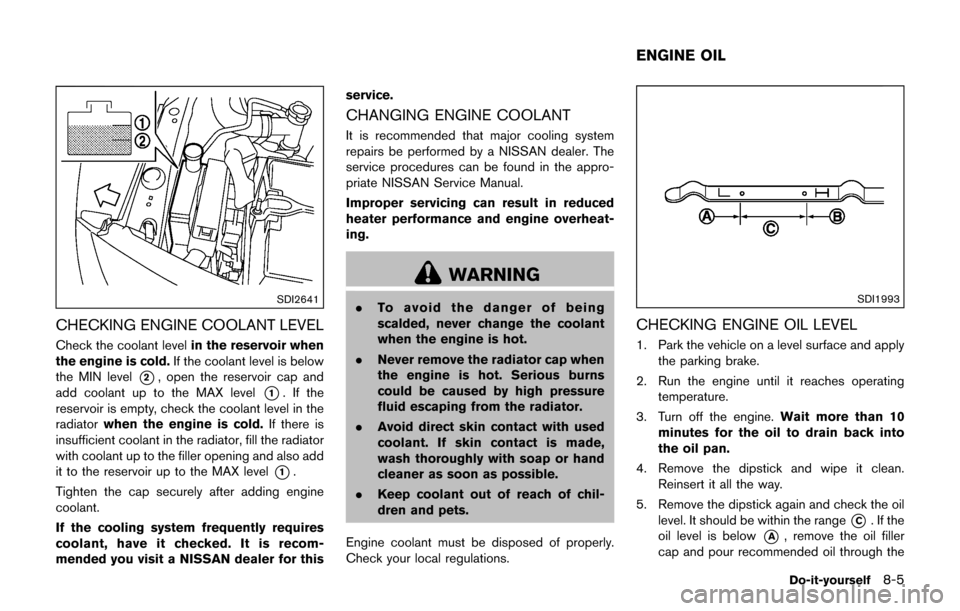
CHECKING ENGINE COOLANT LEVEL
Check the coolant levelin the reservoir when
the engine is cold. If the coolant level is below
the MIN level
*2, open the reservoir cap and
add coolant up to the MAX level
*1. If the
reservoir is empty, check the coolant level in the
radiator when the engine is cold. If there is
insufficient coolant in the radiator, fill the radiator
with coolant up to the filler opening and also add
it to the reservoir up to the MAX level
*1.
Tighten the cap securely after adding engine
coolant.
If the cooling system frequently requires
coolant, have it checked. It is recom-
mended you visit a NISSAN dealer for this service.
CHANGING ENGINE COOLANT
It is recommended that major cooling system
repairs be performed by a NISSAN dealer. The
service procedures can be found in the appro-
priate NISSAN Service Manual.
Improper servicing can result in reduced
heater performance and engine overheat-
ing.
WARNING
.
To avoid the danger of being
scalded, never change the coolant
when the engine is hot.
. Never remove the radiator cap when
the engine is hot. Serious burns
could be caused by high pressure
fluid escaping from the radiator.
. Avoid direct skin contact with used
coolant. If skin contact is made,
wash thoroughly with soap or hand
cleaner as soon as possible.
. Keep coolant out of reach of chil-
dren and pets.
Engine coolant must be disposed of properly.
Check your local regulations.SDI1993
CHECKING ENGINE OIL LEVEL
1. Park the vehicle on a level surface and apply the parking brake.
2. Run the engine until it reaches operating temperature.
3. Turn off the engine. Wait more than 10
minutes for the oil to drain back into
the oil pan.
4. Remove the dipstick and wipe it clean. Reinsert it all the way.
5. Remove the dipstick again and check the oil level. It should be within the range
*C. If the
oil level is below
*A, remove the oil filler
cap and pour recommended oil through the
Do-it-yourself8-5
ENGINE OIL
Page 371 of 416

9-4Maintenance and schedules
hard steering or strange noises.
Warning lights and chimes:Make sure that
all warning lights and chimes are operating
properly.
Windshield defroster: Check that the air
comes out of the defroster outlets properly and
in sufficient quantity when operating the heater
or air conditioner.
Windshield wiper and washer*: Check that
the wipers and washers operate properly and
that the wipers do not streak.
Under the hood and vehicle
The maintenance items listed here should be
checked periodically (for example, each time you
check the engine oil or refuel) .
Battery*: Check the fluid level in each cell.
It should be between the MAX and MIN lines.
Vehicles operated in high temperatures or under
severe condition require frequent checks of the
battery fluid level.
NOTE:
Care should be taken to avoid situations
that can lead to potential battery discharge
and potential no-start conditions such as:
1. Installation or extended use of electro-
nic accessories that consume battery
power when the engine is not running (Phone chargers, GPS, DVD players,
etc.)
2. Vehicle is not driven regularly and/or
only driven short distances.
In these cases, the battery may need to be
charged to maintain battery health.
Brake and clutch fluid level*: Make sure that
the brake and clutch fluid level is between the
MAX and MIN lines on the reservoir.
Engine coolant level*: Check the coolant level
when the engine is cold.
Engine drive belt*: Make sure that the drive
belt is not frayed, worn, cracked or oily.
Engine oil level*: Check the level after parking
the vehicle on a level surface and turning off the
engine. Wait more than 10 minutes for the oil to
drain back into the oil pan.
Exhaust system: Make sure there are no loose
supports, cracks or holes. If the sound of the
exhaust seems unusual or there is a smell of
exhaust fumes, immediately have the exhaust
system inspected. It is recommended you visit a
NISSAN dealer for this service. (See “Precau-
tions when starting and driving” (P.5-2) for
exhaust gas (carbon monoxide) .)
Fluid leaks: Check under the vehicle for fuel,
oil, water or other fluid leaks after the vehicle has
been parked for a while. Water dripping from the air conditioner after use is normal. If you should
notice any leaks or if gasoline fumes are evident,
check for the cause and have it corrected
immediately.
Radiator and hoses:
Check the front of the
radiator and clean off any dirt, insects, leaves,
etc., that may have accumulated. Make sure the
hoses have no cracks, deformation, rot or loose
connections.
Underbody: The underbody is frequently ex-
posed to corrosive substances such as those
used on icy roads or to control dust. It is very
important to remove these substances, other-
wise rust will form on the floor pan, frame, fuel
lines and around the exhaust system. At the end
of winter, the underbody should be thoroughly
flushed with plain water, being careful to clean
those areas where mud and dirt may accumu-
late. For additional information, see “Cleaning
exterior” (P.7-2).
Windshield washer fluid*: Check that there is
adequate fluid in the reservoir.
Page 408 of 416

11 Index
A
ABS (Anti-lock Braking System) ............................ 5-36
Adjusting the screen .................................................. 4-11
Advanced air bag system ......................................... 1-44
Air bag systemAdvanced air bag system .................................. 1-44
Front passenger air bag and status light ...... 1-46
Front-seat mounted side-impact
supplemental air bag system ............................ 1-51
Roof-mounted curtain side-impact
supplemental air bag system ............................ 1-51
Air bag warning labels .............................................. 1-54
Air bag warning light ..................................... 1-54, 2-20
Air cleaner housing filter ........................................... 8-14
Air conditioner Air conditioner operation ................................... 4-28
Air conditioner service ....................................... 4-35
Air conditioner specification label ................. 10-13
Air conditioning system refrigerant and
lubricant recommendations .................... 4-35, 10-8
In-cabin microfilter ............................................... 4-35
Air conditioner operation .......................................... 4-31
Alarm, How to stop alarm (see vehicle
security system) .......................................................... 2-34
Alcohol, drugs and driving ......................................... 5-7
All-wheel drive (AWD) .............................................. 5-29
Antenna ......................................................................... 4-75
Anti-lock Braking System (ABS) ............................ 5-36
Anti-lock braking system (ABS) warning light .... 2-16
Appearance care Exterior appearance care ..................................... 7-2
Interior appearance care ....................................... 7-5
Application download ................................................ 4-76
Around View
ŠMonitor .............................................. 4-13 Audible reminders ...................................................... 2-23
Audio operation precautions ................................... 4-35
Audio system ............................................................... 4-35
Steering wheel audio controls ......................... 4-73
Autolight system ......................................................... 2-40
Automatic Air conditioner ...................................................... 4-32
Door locks ................................................................ 3-5
Average fuel consumption ........................................ 2-13
Avoiding collision and rollover .................................. 5-6
B
Back door (See liftgate) ........................................... 3-16
Battery ........................................................................... 8-10 Battery replacement, Intelligent Key ............... 8-20
Battery saver system .......................................... 2-41
Variable voltage control system ....................... 8-12
Before starting the engine ....................................... 5-12
Bluetooth
ŠHands-Free Phone System .... 4-80, 4-89
BluetoothŠsettings ........................................ 4-88, 4-94
BluetoothŠstreaming audio ......................... 4-60, 4-71
Booster seats .............................................................. 1-34
Brake Anti-lock Braking System (ABS) ..................... 5-36
Brake and clutch fluid ........................................... 8-9
Brake system ........................................................ 5-35
Parking brake operation ..................................... 5-25
Warning light ........................................................ 2-16
Break-in schedule ....................................................... 5-27
Brightness control Instrument panel .................................................. 2-43
Bulb check/instrument panel ................................... 2-16
Bulb replacement ....................................................... 8-23
C
Cabin air filter .............................................................. 4-35
Capacities and
recommended fluids/lubricants ............................... 10-2
Car phone or CB radio ............................................. 4-80
Cargo cover ................................................................. 2-49
Cargo floor box ........................................................... 2-48
Catalytic converter, Three way catalyst .................. 5-3
CD/USB memory care and cleaning ..................... 4-73
Chassis and body maintenance ............................. 9-11
Check tire pressure warning ..................................... 2-9
Child restraints ............................................................ 1-18
Booster seats ....................................................... 1-34
LATCH system ..................................................... 1-20
Precautions on child restraints ........................ 1-19
Child safety .................................................................. 1-16
Child safety rear door lock ........................................ 3-6
Chimes, Audible reminders ...................................... 2-23
Circuit breaker, Fusible link ..................................... 8-18
Cleaning exterior and interior ........................... 7-2, 7-5
Clutch fluid ..................................................................... 8-9
Coat hook ..................................................................... 2-48
Cockpit ............................................................................ 2-3
Cold weather driving ................................................. 5-39
Compact Disc (CD) player (See
audio system) .............................................................. 4-65
Continuously Variable Transmission (CVT) fluid ... 8-8
Control buttons and function .................................... 4-3
Controls, Steering wheel audio controls .............. 4-73
Coolant Capacities and
recommended fluids/lubricants ........................ 10-2
Changing engine coolant ..................................... 8-5
Checking engine coolant level ............................ 8-5
High temperature warning light ....................... 2-18
Page 409 of 416

11-2
Corrosion protection .................................................... 7-7
Cover, Cargo cover ................................................... 2-49
Cruise control .............................................................. 5-26
Cup holders ................................................................. 2-47
CVT, Driving with CVT (Continuously
Variable Transmission) .............................................. 5-14
D
Daytime running light system .................................. 2-42
Defroster switch, Rear window and outside
mirror defroster switch .............................................. 2-38
Dimensions and weights ....................................... 10-10
Displaying Climate control ....................................... 4-34
Door open warning light ........................................... 2-17
Drive belt ...................................................................... 8-12
DrivingAll-wheel drive (AWD) ....................................... 5-29
Cold weather driving .......................................... 5-39
Driving with CVT (Continuously
Variable Transmission) ....................................... 5-14
Driving with manual transmission .................... 5-19
Precautions when starting and driving ............. 5-2
Safety precautions ................................................. 5-7
E
Economy, Fuel ............................................................. 5-29
Elapsed time .................................................... 2-13, 2-30
Electric power steering ............................................. 5-34
Electric power steering warning light .................... 2-17
Emission control information label ...................... 10-12
Emission control system maintenance .................... 9-8
Emission control system warranty ....................... 10-20
EngineBefore starting the engine ................................ 5-12
Break-in schedule ................................................ 5-27 Capacities and
recommended fluids/lubricants ........................ 10-2
Changing engine coolant ..................................... 8-5
Changing engine oil and filter ............................. 8-6
Checking engine coolant level ............................ 8-5
Checking engine oil level ..................................... 8-5
Coolant temperature gauge .............................. 2-10
Emergency engine shut off ...................... 5-11, 6-3
Engine block heater ............................................ 5-40
Engine compartment check locations ............... 8-3
Engine cooling system .......................................... 8-4
Engine oil .................................................................. 8-5
Engine oil and oil filter recommendation ....... 10-7
Engine oil viscosity .............................................. 10-8
Engine serial number ........................................ 10-11
Engine specifications .......................................... 10-9
High temperature warning light ....................... 2-18
If your vehicle overheats .................................... 6-11
Starting the engine ............................................. 5-13
Event Data Recorders (EDR) ............................... 10-22
Exhaust gas (carbon monoxide) ............................... 5-2
Explanation of scheduled maintenance items ....... 9-5
Extended storage fuse warning ................................ 2-9
F
F.M.V.S.S./C.M.V.S.S. certification label ............ 10-12
Filter Air cleaner housing filter .................................... 8-14
Changing engine oil and filter ............................. 8-6
Flashers (See hazard warning flasher switch) ...... 6-2
Flat tire ............................................................................ 6-3
Flat towing ................................................................. 10-18
Floor mat cleaning ........................................................ 7-5
Fluid Brake and clutch fluid ........................................... 8-9 Capacities and
recommended fluids/lubricants ........................ 10-2
Continuously Variable Transmission
(CVT) fluid ................................................................ 8-8
Engine coolant ........................................................ 8-4
Engine oil .................................................................. 8-5
Window washer fluid ............................................. 8-9
FM-AM radio with Compact Disc (CD) player .... 4-45
FM-AM-SAT radio with Compact Disc (CD)
player (Type A) ............................................................ 4-53
FM-AM-SAT radio with Compact Disc (CD)
player (Type B) ............................................................ 4-62
Fog light switch .......................................................... 2-44
Front manual seat adjustment ................................... 1-3
Front passenger air bag and status light ............. 1-46
Front seat, Front seat adjustment ............................ 1-3
Front-seat active head restraints .............................. 1-9
Fuel Capacities and
recommended fluids/lubricants ........................ 10-2
Distance to empty ............................................... 2-13
Fuel economy ....................................................... 5-29
Fuel information .................................................... 10-4
Fuel octane rating ............................................... 10-4
Fuel-filler cap ........................................................ 3-18
Fuel-filler door ...................................................... 3-18
Gauge ..................................................................... 2-11
Fuel Efficient Driving Tips ........................................ 5-28
Fuses ............................................................................. 8-17
Fusible links ................................................................. 8-18
G
Gas cap ........................................................................ 3-18
Gauge .............................................................................. 2-5 Engine coolant temperature gauge ................ 2-10
Fuel gauge ............................................................ 2-11
Page 412 of 416

S
SafetyChild seat belts .................................................... 1-16
Reporting safety defects ................................. 10-20
Seat adjustment Front manual seat adjustment ............................. 1-3
Front seats ............................................................... 1-3
Seat belt(s) Child safety ........................................................... 1-16
Infants ..................................................................... 1-17
Injured persons .................................................... 1-12
Larger children ..................................................... 1-17
Precautions on seat belt usage ....................... 1-10
Pregnant women .................................................. 1-12
Seat belt cleaning .................................................. 7-7
Seat belt extenders ............................................. 1-15
Seat belt hooks .................................................... 1-15
Seat belt maintenance ....................................... 1-15
Seat belt warning light ....................................... 2-20
Seat belts .............................................................. 1-10
Seat belts with pretensioners .......................... 1-52
Shoulder belt height adjustment ..................... 1-14
Small children ....................................................... 1-17
Three-point type .................................................. 1-12
Seat(s) Heated seats ........................................................ 2-45
Seats .......................................................................... 1-2
Security system (NISSAN Vehicle Immobilizer
System) , Engine start ................................................ 2-34
Security system, Vehicle security system ............. 2-33
Servicing air conditioner ........................................... 4-35
Setting climate eco .................................................... 4-34
Shift lever Shift lock release ................................................. 5-18
Shift lock release Transmission ......................................................... 5-18 Shifting
CVT (Continuously Variable Transmission) .... 5-14
Manual transmission ........................................... 5-19
Shoulder belt height adjustment, For
front seats .................................................................... 1-14
Siri
ŠEyes Free ............................................................ 4-76
SOURCE select switch ............................................ 4-73
Spare tire .......................................................... 8-41, 10-9
Spark plugs .................................................................. 8-13
Speedometer ................................................................. 2-7
Standard maintenance ................................................ 9-7
Starting Before starting the engine ................................ 5-12
Jump starting ........................................................... 6-9
Precautions when starting and driving ............. 5-2
Push starting ......................................................... 6-11
Starting the engine ............................................. 5-13
Status light, Front passenger air bag .................... 1-46
Steering Electric power steering ...................................... 5-34
Steering wheel switch for audio controls ..... 4-73
Tilting steering column ....................................... 3-20
Storage ......................................................................... 2-47
Sun visors ..................................................................... 3-21
Supplemental air bag warning labels .................... 1-54
Supplemental air bag warning light ........... 1-54, 2-20
Supplemental restraint system ................................ 1-38 Precautions on supplemental
restraint system .................................................... 1-38
Switch Audio control steering wheel switch .............. 4-73
Autolight switch ................................................... 2-40
Fog light switch ................................................... 2-44
Hazard warning flasher switch ............................ 6-2
Headlight switch .................................................. 2-40
Power door lock switch ........................................ 3-5 Rear window and outside mirror
defroster switch ................................................... 2-38
Turn signal switch ................................................ 2-43
Vehicle dynamic control (VDC) off switch .... 2-44T
Tachometer ..................................................................... 2-9
Temperature display ................................................... 2-12
Temperature gauge, Engine coolant
temperature gauge ..................................................... 2-10
Text messaging ........................................................... 4-93
Theft (NISSAN Vehicle Immobilizer System) ,
Engine start .................................................................. 2-34
Three-way catalyst ....................................................... 5-3
Tilt steering column .................................................... 3-20
Tire pressure, Low tire pressure warning light .... 2-18
Tires
Flat tire ...................................................................... 6-3
Low tire pressure warning system ..................... 5-3
Tire and Loading information label .... 8-30, 10-12
Tire chains ............................................................. 8-37
Tire dressing ............................................................ 7-4
Tire pressure ......................................................... 8-28
Tire pressure monitoring
system (TPMS) .............................................. 5-3, 6-3
Tire rotation ........................................................... 8-38
Types of tires ........................................................ 8-36
Uniform tire quality grading ............................. 10-19
Wheel/tire size ..................................................... 10-9
Wheels and tires ................................................. 8-28
Tonneau cover (see cargo cover) .......................... 2-49
Touch screen ................................................................. 4-4
Towing Flat towing ........................................................... 10-18
Tow truck towing ................................................. 6-13
Towing a trailer ................................................... 10-18
11-5