2017 MITSUBISHI MIRAGE speci
[x] Cancel search: speciPage 50 of 307

Supplemental Restraint System (SRS) - airbag
Seat and restraint systems 4-25
4
The main purpose of an EDR is to record, in certain crash or near
crash-like situations,
such as an airbag deployment or hitting a road obstacle, data that
will assist in under-
standing how a vehicl
e’s systems performed.
The EDR is designed to record data related to vehicle dynamics and safety systems for a short period of time,
typically 30 seconds or
less. The EDR in this vehicle is designed to record such data as: How various systems
in your vehicle were
operating; Whether or not the driver and front pas- senger safety belts we
re buckled/fastened;
How far (if at all) the driver was depress- ing the accelerator and/or brake pedal; and, How fast the vehicle was traveling.
These data can help provide a better under- standing of the circumstances in which crashes and injuries occur.
To read data recorded by an EDR, special equipment is required, and access to the vehi-cle or the EDR is needed. In addition to the vehicle manufacturer, ot
her parties, such as
law enforcement, that have the special equip-ment, can read the information if they have access to the vehicle or the EDR.
N00417900223
The driver’s seat position sensor is attachedto the seat rail and provides the airbag control unit with information on the seat’s fore-aftposition. The airbag control unit controls deployment of the driver’s front airbag in accordance with the information it receivesfrom this sensor. If there is a problem involving the driver’s seat position sensor, the SRS warning light inthe instrument panel will come on. Refer to
“SRS warning light” on page 4-27.
N00418000364
The passenger’s seat oc
cupant classification
sensor system is attach
ed to the front passen-
ger seat cushion and provides the airbag con- trol unit with information regarding theoccupant on the front passenger seat. The air- bag control unit controls deployment of the
NOTE
EDR data are recorded by your vehicle only if a non-trivial crash si
tuation occurs; no data
are recorded by the EDR under normal driv-ing conditions and no personal data (e.g., name, gender, age, a
nd crash location) are
recorded. However, ot
her parties, such as
law enforcement, could combine the EDR data with the type of
personally identifying
data routinely acquire
d during a crash inves-
tigation.
Driver’s seat position sensor
WA R N I N G If the SRS warning
light comes on, have
the vehicle inspected by an authorized Mitsubishi Motors dealer as soon as possi-ble. Please observe the following instructions to ensure that the driver’s seat position sensor can operate correctly.• Adjust the seat to the correct position,and sit well back
against the seatback.
Refer to “Front seats” on page 4-2.• Do not recline the seatback more thannecessary when driving.• Do not place metallic objects or luggageunder the front seat.
If the vehicle is involved in a severe impact, have the SRS sensor inspected byan authorized
Mitsubishi Motors dealer as
soon as possible.
Passenger’s seat occupant clas- sification sensor system
BK0236100US.book 25 ページ 2016年2月1日 月曜日 午前10時15分
Page 58 of 307

Supplemental Restraint System (SRS) - airbag
Seat and restraint systems 4-33
4
WA R N I N G In order to reduce the risk of injury from a deploying side airb
ag, do not allow any
rear seat passengers to hold onto the back of either front seat.
Special care should be
taken with children. Do not place any objects around the area where the side airbags deploy. Such objects can interfere with proper side air- bag deployment, and
cause injury during
deployment of the side airbag. Do not place stickers, labels or additional trim on the back of either front seat. They can interfere with proper side airbag deployment.
WA R N I N G Do not attach a microphone (A) or any other object around the part where thecurtain airbag deploys
, such as on the
windshield, side door
glass or front and
rear pillars and roof
side rail. When the
curtain airbag inflates, the microphone orother object may be
hurled with great
force or the curtain airbag may not inflate correctly, resulting
in death or serious
injury.WA R N I N G Do not install seat c
overs or re-cover seats
that have side airbag
s. Covers can inter-
fere with proper si
de airbag deployment
and adversely affect
side airbag perfor-
mance.
Never install a rear-facing child restraint system in the front passenger seat. Rear-facing child restraint systems MUSTONLY be used in the rear seat. Front-facing child restraint systems should also be used ON
LY in the rear seat.
If a front-facing child restraint system must be used in the front passenger seat,move the seat as far
back as possible, and
make sure that the child stays in the child restraint system, properly restrained andaway from the door. Do not allow a child to lean against or sit close to the passenger door, even if the child is seated in a child restraint system. The child’s head sh
ould also not lean
against or be close to the section of the seatback where the side airbag and cur- tain airbag are located. It is dangerous ifthe side airbag or cu
rtain airbag deploys.
Failure to follow all of these instructions could lead to serious in
jury or death to the
child. Work done on or in th
e vicinity of the side
airbag or curtain
airbag components
should be done only
by an authorized
Mitsubishi Motors dealer. There is a riskof a serious injury
or death. Improper
work methods can cause accidental side airbag or curtain ai
rbag deployment, or
render a side airb
ag or curtain airbag
inoperable. Either of these situations could result in seri
ous injury or death.
WA R N I N G
BK0236100US.book 33 ページ 2016年2月1日 月曜日 午前10時15分
Page 66 of 307

Electronic immobilizer (Ant
i-theft starting system)
Features and controls 5-5
5
To add a key, you must already have 2 regis- tered keys. You need to register the ID code to the vehicle.Registering the ID code can be done by your- self (except for vehicles
sold in Canada), or
by your authorized Mits
ubishi Motors dealer.
For you to register the ID code yourself, fol- low the “Customer key programming” proce- dure below. If you choose to have your authorized Mitsubishi Motors dealer register the IDcode, take your vehicle and all remaining keys to your authorized Mitsubishi Motors dealer.
N00562201178
You can program new keys to the system if you have two valid (already registered) keys and blank immobilizer ke
y (specially cut for
your vehicle at your Mitsubishi Motors dealer) by doing the following: 1. Insert the first valid key into the ignition switch and turn the key to the “ON” posi- tion for 5 seconds. 2. Turn the key to the “OFF” position andremove the first key. 3. Within 30 seconds of removing the first key, insert the second valid key into theignition and turn it
to the “ON” position.
About 10 seconds late
r, the immobilizer
indicator will start to blink. 4. When the immobilizer indicator starts blinking, turn the second valid key to the“OFF” position and remove it. Within 30 seconds after doing so, insert a blank immobilizer key into the ignition switchand turn it to the “ON” position. Perform this operation no more than 30 seconds after the immobilizer indicator startsblinking. When registration of the ID code is complete, the immobilizer indica- tor will come on for 3 seconds then go off.If an error occurs, the immobilizer indica- tor will go off during the procedure.
5. If you wish to register another key, per- form the process again from step 1.
Additional keys
NOTE
You are provided with 2 keys, but you may register up to 8 keys.
Customer key programming (Except for vehicles sold in Canada)
NOTE
When the key registration is completed, the immobilizer indicator wi
ll come on within 3
seconds of turning the ignition switch to the“ON” position with th
e blank immobilizer
key (specially cut for your vehicle at your Mitsubishi Motors dealer). NOTE
It is not possible to register a key if: • the immobilizer indicator goes off during the procedure • the immobilizer indi
cator does not come on
within 30 seconds after step 4.
The procedure will be
terminated automati-
cally if: • a period of 30 seconds
or longer elapses
from the moment when the first key isturned to the “OFF” position to the moment when the second key is turned to the “ON” • a period of 30 seconds
or longer elapses
from the moment when the second key isturned to the “OFF” position to the momentwhen the blank immobilizer key is turned to the “ON” position • more than 20 seconds elapses after the immobilizer indicato
r starts blinking
BK0236100US.book 5 ページ 2016年2月1日 月曜日 午前10時15分
Page 85 of 307
Door locks 5-24 Features and controls
5
5. Close the case firmly. 6. Check the keyless entry system to see thatit works.
N00509201573
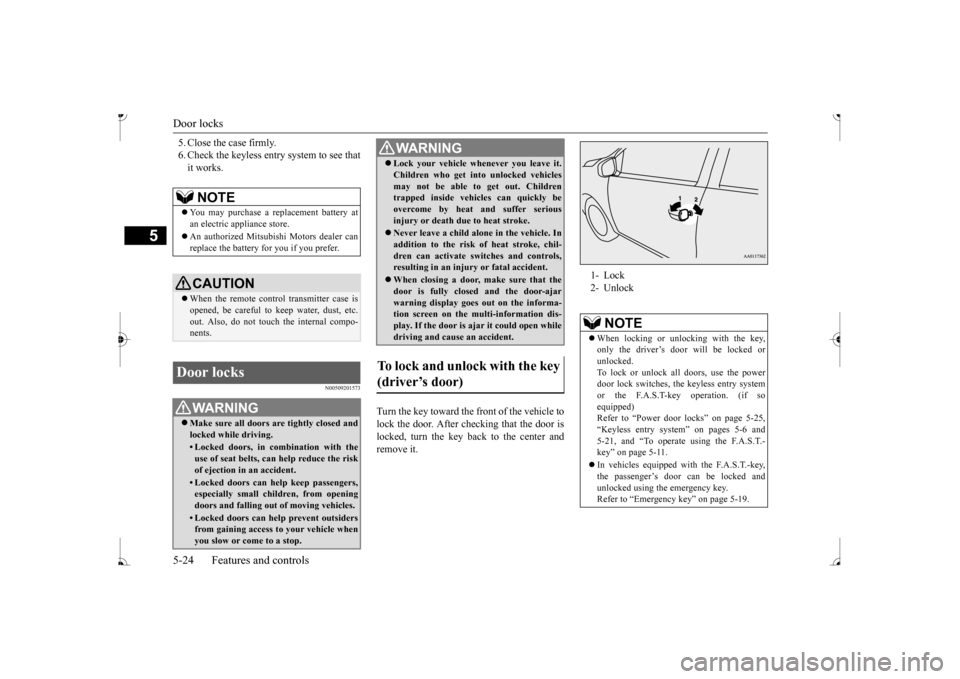
Turn the key toward the front of the vehicle to lock the door. After checking that the door is locked, turn the key back to the center andremove it.
NOTE
You may purchase a re
placement battery at
an electric appliance store. An authorized Mitsubishi Motors dealer can replace the battery for you if you prefer.CAUTION When the remote control transmitter case is opened, be careful to
keep water, dust, etc.
out. Also, do not touch the internal compo- nents.
Door locks
WA R N I N G Make sure all doors are tightly closed and locked while driving.• Locked doors, in co
mbination with the
use of seat belts, can help reduce the riskof ejection in an accident.• Locked doors can help keep passengers,especially small children, from opening doors and falling out
of moving vehicles.
• Locked doors can help prevent outsiders from gaining access
to your vehicle when
you slow or come to a stop.
Lock your vehicle when
ever you leave it.
Children who get into
unlocked vehicles
may not be able to get out. Childrentrapped inside vehicles can quickly be overcome by heat
and suffer serious
injury or death due to heat stroke. Never leave a ch
ild alone in the vehicle. In
addition to the risk
of heat stroke, chil-
dren can activate switches and controls, resulting in an injury
or fatal accident.
When closing a door,
make sure that the
door is fully closed and the door-ajar warning display goes
out on the informa-
tion screen on the multi-information dis- play. If the door is aj
ar it could open while
driving and cause an accident.
To lock and unlock with the key (driver’s door)
WA R N I N G
1- Lock 2- Unlock
NOTE
When locking or unlocking with the key, only the driver’s door will be locked orunlocked. To lock or unlock all doors, use the power door lock switches, th
e keyless entry system
or the F.A.S.T-key operation. (if so equipped) Refer to “Power door locks” on page 5-25,“Keyless entry system” on pages 5-6 and 5-21, and “To operate using the F.A.S.T.- key” on page 5-11. In vehicles equipped wi
th the F.A.S.T.-key,
the passenger’s door can be locked andunlocked using the emergency key. Refer to “Emergency key” on page 5-19.
BK0236100US.book 24 ページ 2016年2月1日 月曜日 午前10時15分
Page 88 of 307

Trunk lid
Features and controls 5-27
5
Child safety locks help prevent rear passen- gers, especially children, from opening therear door using the inside door handle. A lock lever for the child safety lock is pro- vided on each rear door.When the lever is in the lock position (1), the rear door cannot be opened using the inside door handle.To open the rear door when the child safety lock lever is in the lock position, pull the out- side door handle. When the lever is in the release position (2), the child safety lock is released and the reardoor can be opened using the inside door han- dle.
N00509501215
Insert the key and turn it clockwise. The trunk lid will pop up
slightly. Lift it to
open the trunk. Press the trunk button (Vehicles with F.A.S.T.-key). (See “Free-hand Advanced Security Transmitter
(F.A.S.T.-key)” on page
5-9.)
WA R N I N G Always keep the door
s tightly closed and
locked when driving. An unlocked doormay be accidentally
opened by a passen-
ger, especially by
a child who could fall
out. Also, if the doors are not locked, thereis a greater risk of
someone being thrown
from the vehicle
in an accident.
Trunk lid
WA R N I N GIt is dangerous to drive with the trunk lid open since carbon mo
noxide (CO) gas can
enter the cabin. CO is an invisible, odor- less gas that can cause unconsciousness and even death. Do not allow children to have access to the trunk by climbing into the trunk fromoutside of the vehicl
e. Always close the
trunk lid when your vehicle is unattended. If trapped in the trunk, it is possible toescape from the trunk by using the inside emergency trunk re
lease lever. (See
“Inside emergency trunk lid release” onpage 5-28.)CAUTION Do not stand behind the exhaust pipe when loading and unloading
luggage. Heat from
the exhaust could lead to burns.
To open Operation from outside the vehicle Using the key (Vehicles with key cylin- der)
ntrol transmitter
(Vehicles with F.A.S.T.-key)
BK0236100US.book 27 ページ 2016年2月1日 月曜日 午前10時15分
Page 90 of 307

Manual window control (if so equipped)
Features and controls 5-29
5
To open the trunk from the inside, move the lever (A) in the direction of the arrow on thelever. Push up on the trunk lid to open the trunk and climb out.
N00510700021
N00510800370
WA R N I N G Children should never be left unsuper- vised in or ar
ound vehicles.
Unsupervised children could lock them- selves in an open vehicle or trunk. People trapped inside
a vehicle or trunk,
even if only for a shor
t period of time, can
quickly die from su
ffocation or heat
stroke, especially on hot days. Interior temperatures in vehicles can rise in min- utes. Keep your vehicle d
oors locked and the
trunk lid closed when not in use. Keepyour vehicle keys aw
ay from children.
CAUTIONWhen loading the trunk, place your things so that they will not touch the emergency trunklid release lever when you close the trunk.Otherwise you could damage the lever and make it unusable.
Manual window control
(if so
equipped) 2- To close
Power window control 1- Open (down)2- Close (up)
NOTE
Never try to operate the main switch and sub-switch in different directions at the same time. This will freeze the window in posi- tion. Operating the power
windows repeatedly
with the engine st
opped will run down the
battery. Use the window
switches only while
the engine is running.WA R N I N G Before operating the power windows, make sure that nothing can be trapped (head, hands, fingers, etc.) in the window.
BK0236100US.book 29 ページ 2016年2月1日 月曜日 午前10時15分
Page 92 of 307

Power window control
Features and controls 5-31
5
stopped. However, once the driver’s door or the front passenger’s
door is opened, the
power windows cannot be operated.
N00549000169
When this switch is in the lock mode, the pas-senger door switches cannot be used to open or close the door windows, and the main switch will open or close only the driver’s door window. To unlock the switch, press it again.
N00528801161
If a hand or head is trapped, for safety thedoor window is automatically lowered a little. After the door window is lowered, clear the obstruction, then pull up the switch again toclose the door window.
Lock switch 1- Lock2- Unlock
Ty p e 1 Ty p e 2
WA R N I N G Before driving with a child in the vehicle, be sure to lock the window switch to makeit inoperative. Children tampering withthe switch could easily trap their hands or heads in the window.
Safety mechanism (Driver’s door window of Type 1 only)
WA R N I N G If the battery terminals are disconnected or the fuse for electric window is replaced, the safety mechanism will be cancelled. If a hand or head got
trapped, a serious
injury could result.CAUTION The safety mechanism is deactivated just before the door window closes. This allows the door window to close completely. There- fore be especially careful that fingers are nottrapped in the door window opening.
The safety mechanism is deactivated while the switch is pulled up.
Therefore be espe-
cially careful that fi
ngers are not trapped in
the door window opening. Do not deliberately tr
ap your hands or head
in order to activate the safety mechanism. Your hand or head coul
d be trapped and per-
sonal injury could result.NOTE
The safety mechanism can be activated if the driving conditions or
other circumstances
cause the door window to be subjected to a physical shock similar
to that caused by
trapped hand or head. If the safety mechanism is activated 5 or more times in a row, the safety mechanismwill be cancelled a
nd the door window will
not close correctly. In such a case, the following procedureshould be implemented to rectify this situa- tion. If the window is open, repeatedly raise thedriver’s door window sw
itch until that win-
dow has been fully closed. Following this, release the switch, raise the switch once again and hold it in this condition for atleast1 second, then release it. You should now be able to operate in the normal fashion.CAUTION
BK0236100US.book 31 ページ 2016年2月1日 月曜日 午前10時15分
Page 106 of 307

Continuously variable transmission (CVT) (if so equipped)
Features and controls 5-45
5
N00549500018 N00574601036
When the selector le
ver position indicator
blinks while you are driv
ing, there could be a
malfunction in the automatic transaxle system or CVT fluid temperature becomes abnor- mally high.
N00560801079
When a malfunction occurs in the automatic transaxle
When the selector lever position indicator blinks
NOTE
The “A” indicator blinks only if the CVT selector lever sw
itch is broken.
It is not seen during normal driving.
CAUTION If a malfunction occurs in the CVT while driving, the indicator will blink.In this case, immediat
ely park your vehicle
in a safe place and fo
llow these procedures:
[If the indicator blinks
rapidly (once per sec-
ond), the CVT fluid is overheating.]Park your vehicle in a safe place but do not turn off the engine. M
ove the selector lever
to the “P” (PARK) position and open theengine hood. Keep th
e engine, idling.
After a while, move the selector lever into any position other than “P” (PARK) positionand confirm that the i
ndicator stops blinking.
It is safe to continue driving if the indicator no longer blinks.If the indicator conti
nues blinking or blinks
intermittently, have your
vehicle inspected at
an authorized Mitsubishi Motors dealer orrepair facility
of your choice.
[If the indicator blinks slowly (once per 2 seconds), the CVT may
be operating in fail-
safe mode due to a malfunction.] Have the vehicle inspected at an authorized Mitsubishi Motors dealer
or repair facility of
your choice as soon as possible.
Operation of the CVT
CAUTION Before selecting a pos
ition with the engine
running and the vehicl
e stationary, firmly
depress the brake pedal to prevent the vehi- cle from creeping. The vehicle will begin to move as soon as theCVT is engaged, especi
ally when the engine
speed or idle speed is
high, or with the air
conditioning (cooling or
heating) operating.
Do not release the brak
e pedal until you are
ready to drive away. Depress the brake pedal
with the right foot at
all times. Using the left foot could cause driver move-ment delay in case of an emergency. To prevent sudden acce
leration, never run
the engine at high rpms when shifting from the