2017 MITSUBISHI L200 differential
[x] Cancel search: differentialPage 162 of 426

NOTElWhen the rear differential is locked with the
drive mode-selector in “4L” or “4H” posi-
tion (Easy select 4WD), “4LLc” or “4HLc”
position (Super select 4WD II) changing the drive mode-selector to “2H” position (Easyselect 4WD), “2H” or “4H” position (Super
select 4WD II) makes the rear differential unlock automatically.The rear differential lock indi-
cation lamp
E00606301429
When the ignition switch is turned to the
“ON” position or the operation mode is put in ON, the rear differential lock indication lamp
(A) in the meter cluster illuminates for a few
seconds then indicates the rear differential lock’s operating status (activated or deactiva-
ted).
NOTEl The 2WD/4WD operation indication lamp
also illuminates for a few seconds when the
ignition switch is turned to the “ON” posi- tion or the operation mode is put in ON.
Refer to “2WD/4WD operation indication
lamp” on pages 6-38, 6-42.
The status of the rear differential lock (re- sulting from depression of the rear differen-
tial lock switch) is shown by blinking or steady illumination of the rear differential
lock indication lamp.The opera-
tion state of rear differ- ential lockRear differential lock indi- cation lampEasy select4WDSuper select4WD IIRear differ-ential lock
deactivatedThe opera-
tion state of rear differ- ential lockRear differential lock indi- cation lampEasy select4WDSuper select4WD IISwitching inprogress
Rear differ-ential lock activated
: Blink
: Illuminate (steady)
: Remain off
Rear differential lock*
6-46OKTE17E1Starting and driving6 Easy select 4WD Super select 4WD II
Page 163 of 426

NOTElThe indication lamp blinks while the rear
differential lock is being switched between
its activated and deactivated conditions. When the switching operation is complete,
the indication lamp is either illuminated steadily or not illuminated.
l The ASTC and ABS functions are suspen-
ded while the rear differential lock is activa-
ted.
ASTC indication lamp, ASTC OFF indica- tion lamp and ABS warning lamp are illumi- nated while these functions are suspended.
It does not indicate a problem. When the
rear differential lock is disengaged, these lamps go out and function again.
Refer to “ABS warning lamp” on page
6-57, “ASTC indication lamp, ASTC OFF in-
dication lamp” on page 6-62.
l If the indication lamp continues blinking af-
ter the switch has been pressed to deactivate
the rear differential lock, hold the steering
wheel in the straight ahead position then slowly depress and release the accelerator
pedal several times.
l If the indication lamp continues blinking af-
ter the switch has been pressed to activate the rear differential lock, bear in mind thefollowing instructions:
• If the vehicle speed is 12 km/h or higher,
decelerate to a speed of 2.5 km/h or low-er. The indication lamp will illuminate
steadily and the rear differential lock will be activated.NOTE• If the vehicle speed is 12 km/h or lower,
turn the steering wheel from side to side
until the indication lamp illuminates steadily. If the vehicle is stuck in softground, make sure the area around the ve-
hicle is clear then repeatedly attempt to
drive forward and backward. The indica- tion lamp will illuminate steadily and the
rear differential lock will be activated.CAUTIONl If a problem is detected in the rear differen-
tial lock system, a safety device will acti- vate. The rear differential lock indication lamp will blink rapidly (twice per second),
and the rear differential lock will deactivate. Park your vehicle in a safe place, turn off the
engine for a few moments. Restart the en- gine. It is safe to continue driving if the lamps resume normal operation. If the rear differential lock indication lamp blinks whenthe rear differential lock is reactivated, have
the vehicle checked by a MITSUBISHI
MOTORS Authorized Service Point as soon
as possible.Examples of effective use of the
rear differential lock
E00606401127
CAUTIONl Use the rear differential lock only as an
emergency measure when the vehicle is stuck and cannot be freed with the drivemode-selector in “4L” or “4H” position (Easy select 4WD) or in “4LLc” or “4HLc” position (Super select 4WD II). Deactivate
the rear differential lock immediately after
using it.
When one of the wheels has fall-
en in a ditch
Rear differential lock*
6-47OKTE17E1Starting and driving6
Page 164 of 426
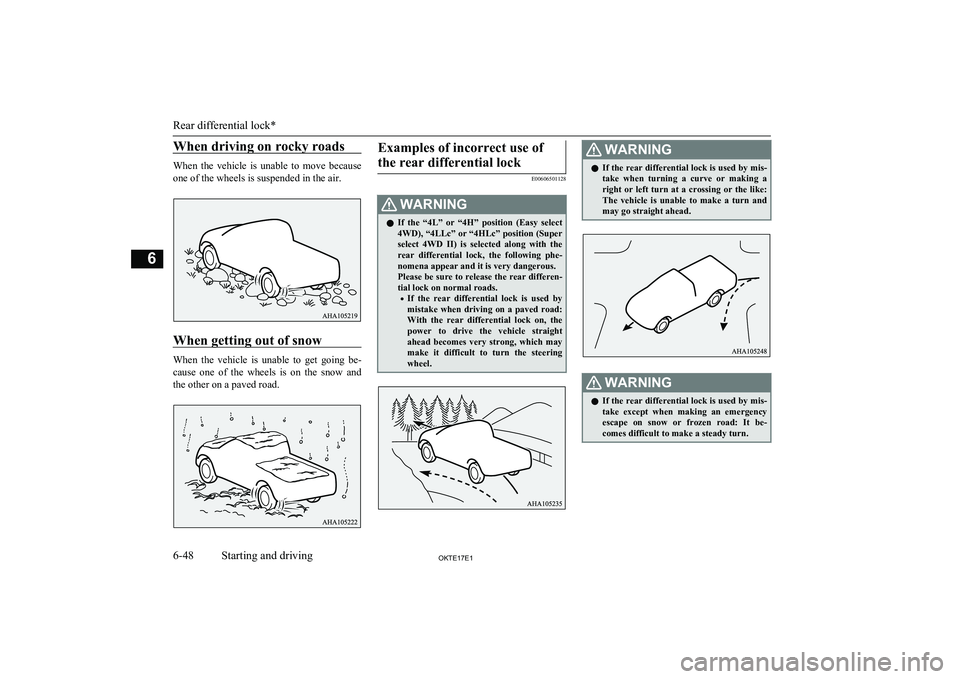
When driving on rocky roads
When the vehicle is unable to move becauseone of the wheels is suspended in the air.
When getting out of snow
When the vehicle is unable to get going be-cause one of the wheels is on the snow and
the other on a paved road.
Examples of incorrect use of
the rear differential lock
E00606501128
WARNINGl If the “4L” or “4H” position (Easy select
4WD), “4LLc” or “4HLc” position (Super
select 4WD II) is selected along with the rear differential lock, the following phe-nomena appear and it is very dangerous.
Please be sure to release the rear differen-
tial lock on normal roads.
• If the rear differential lock is used by
mistake when driving on a paved road:
With the rear differential lock on, the power to drive the vehicle straight
ahead becomes very strong, which may make it difficult to turn the steering
wheel.WARNINGl If the rear differential lock is used by mis-
take when turning a curve or making a
right or left turn at a crossing or the like:
The vehicle is unable to make a turn and may go straight ahead.WARNINGl If the rear differential lock is used by mis-
take except when making an emergencyescape on snow or frozen road: It be-
comes difficult to make a steady turn.
Rear differential lock*
6-48OKTE17E1Starting and driving6
Page 165 of 426

WARNINGlIn the case where the condition of the
road is different for the right tyre to drive
from the left tyre (such as one tyre on a paved road and the other on ice), direc- tion of the vehicle may change abruptly
when engine braking or accelerating.
Do not use the rear differential lock ex-
cept when making an emergency escape on a snow or frozen road, but drive with
4WD.4-wheel drive operation*
E00606602171
By selecting 4-wheel drive, both axles of the
vehicle are rigidly connected with each other. This improves the traction characteristics. When turning sharp corners or moving for-
ward and backward repeatedly, however, the drive line is stressed, which is felt as a brak-
ing effect. A 4-wheel drive vehicle can accel-
erate more quickly and smoothly.
However, note that the braking distance is not shorter than that of a rear-wheel drive ve-hicle.
When using 4-wheel drive on rough roads
(snow, mud, sand, etc.), it is important to op- erate the vehicle correctly.NOTEl The driving posture should be more upright
and closer to the wheel than usual; adjust the
seat to a good position for easy steering and pedal operation. Be sure to wear the seatbelt.
l After driving on rough roads, check each
part of the vehicle and wash it thoroughlywith water. Refer to the “Vehicle care” sec-
tion and “Inspection and maintenance fol-
lowing rough road operation” on page 6-52.Driving on dry paved road and
highway
Select “2H” position (Easy select 4WD),
“2H” or “4H” position (Super select 4WD II) to drive on the dry paved road. Especially on
dry highway, never select the “4H” or “4L”
position (Easy select 4WD), “4HLc” or “4LLc” position (Super select 4WD II).
CAUTIONl Selecting “4H” or “4L” position (Easy select
4WD), “4HLc” or “4LLc” position (Super
select 4WD II) to drive on dry paved road will increase the fuel consumption with pos-sible noise generation and early tyre wear.It may also increase the differential oil tem-
perature, resulting in possible damage to the driving system.
Further, the drive train will be subjected to
excessive loading, possibly leading to oil leakage, component seizure, or other serious faults.
Driving on snowy or icy roads
Set the drive mode-selector to “4H” position
(Easy select 4WD), “4H” or “4HLc” position in accordance with the road conditions (Su-
per select 4WD II) and then gradually de-
press the accelerator pedal for a smooth start. Keep the pressure on the accelerator pedal asconstant as possible, and drive at low speed.
4-wheel drive operation*
6-49OKTE17E1Starting and driving6
Page 168 of 426

CAUTIONlAfter crossing a stream, apply the brakes to
be sure they are functioning properly. If the
brakes are wet and not functioning properly,
dry them out by driving slowly while lightly
depressing the brake pedal.
Inspect each part of the vehicle carefully.Inspection and maintenance
following rough roadoperation E00606701566
After operating the vehicle in rough road
conditions, be sure to perform the following inspection and maintenance procedures:
l Check that the vehicle has not been dam-
aged by rocks, gravel, etc.
l Carefully wash the vehicle with water.
Drive the vehicle slowly while lightly
depressing the brake pedal in order to dry out the brakes. If the brakes still do
not function properly, we recommend you to have the brakes checked as soon
as possible.
l Remove the insects, dried grass, etc.
clogging the radiator core and A/T oil
cooler.
l After crossing a stream, be sure to have
the following items inspected at aMITSUBISHI MOTORS Authorized
Service Point and take the necessary
measures. • Check the brake system and, if neces-
sary, have it serviced.
• Check the engine, transmission, trans-
fer, and differential oil or grease level
and turbidity. If the oil or grease is milky, it indicates water contamina-
tion. Replace it with new oil or grease.
• Grease the propeller shaft.
• Check the inside of the vehicle. If in-
gress of water is found, dry the carpet etc.
• Inspect the headlamps. If the head-
lamp bulb is flooded with water, have the headlamp drained off.Cautions on handling of 4-
wheel drive vehicles E00606802102
Tyres and wheels
Since the driving torque can be applied to the
4 wheels, the performance of the vehicle when operating in 4-wheel drive is greatly af- fected by the condition of the tyres.
Pay close attention to the tyres.
l Install specified tyres on all wheels. Re-
fer to “Tyres and wheels” on page
11-16.
l Be sure to the appropriate tyre inflation
pressure according to no cargo or cargo.
Refer to “Tyre inflation pressures” on
page 10-12.
l Be sure to fit all 4 tyres and wheels of
the same size and type.
When replacement of any of the tyres or wheels is necessary, replace all of them.
l All tyres should be rotated whenever the
wear difference between the front and
rear tyres is recognizable.
Good vehicle performance cannot be expec- ted if there is a difference in wear between tyres. Refer to “Tyre rotation” on page 10-13.
l Check the tyre inflation pressure regular-
ly.CAUTIONl Always use tyres of the same size, same
type, and same brand, and which have no wear differences. Using the tyres which dif-fer in size, type, brands or the degree of
wear or the inappropriate tyre inflation pres-
sure, will increase the differential oil tem- perature and may be impossible to shift the transfer, resulting in possible damage to thedriving system. Further, the drive train willbe subjected to excessive loading, possibly
leading to oil leakage, component seizure, or
other serious faults.
Inspection and maintenance following rough road operation
6-52OKTE17E1Starting and driving6
Page 173 of 426

NOTE•The brake pedal has been depressed, and
the system judges that it was sudden brak-
ing from the vehicle deceleration and the operating condition of the anti-lock brake
system (ABS).
[Deactivating condition for the emergency stop signal system]
It deactivates when one of the following conditions is met.
• The brake pedal is released.
• The hazard warning flasher switch is
pressed.
• The system judges that it was not sudden
braking from the vehicle deceleration and
the operating condition of the anti-lock brake system (ABS).Anti-lock brake system
(ABS) E00607102577
The anti-lock brake system (ABS) helps pre-vent the wheels from locking during braking.
This helps maintain vehicle drivability and
steering wheel handling.
Driving hints
l Always keep a safe distance from the ve-
hicle in front of you. Even if your vehi- cle is equipped with ABS, leave a great-
er braking distance when:
• Driving on gravel or snow-covered
roads.
• Driving with tyre chains installed.
• Driving on roads where the road sur-
face is pitted or has other differences in surface height.
• Driving on uneven road surfaces.
l Operation of ABS is not restricted to sit-
uations where brakes are applied sud-denly. This system may also prevent the
wheels from locking when you drive over manholes, steel roadwork plates,
road markings, or any uneven road sur-
face.
l When the ABS is activated, you may
feel the brake pedal pulsation and the vi-
brations of the vehicle body and steering
wheel. It may also feel as if the pedal re- sists being pressed.
In this situation, simply hold the brake
pedal down firmly. Do not pump the
brake, which will result in reduced brak- ing performance.
l An operation noise is emitted from the
engine compartment or you can feel a shock from the brake pedal when start-
ing to drive immediately after starting
the engine. These are normal sounds or operations that the ABS makes whenperforming a self-check. It does not indi-
cate a malfunction.l The ABS can be used after the vehicle
has reached a speed over approximately 10 km/h (6 mph). It stops working when the vehicle slows below 7 km/h.CAUTIONl The ABS cannot prevent accidents. It is your
responsibility to take safety precautions and to drive carefully.
l To prevent failure of the ABS, be sure all 4
wheels and tyres are the same size and the same type.
l Do not install any aftermarket limited-slip
differential (LSD) on your vehicle. The ABS may stop functioning properly.ABS warning lamp
E00607202477
If there is a malfunction in the system, the
ABS warning lamp will come on.
Anti-lock brake system (ABS)
6-57OKTE17E1Starting and driving6
Page 174 of 426

Under normal conditions, the ABS warning
lamp comes on when the ignition switch is turned to the “ON” position or the operation
mode is put in ON and goes off a few sec-
onds later.CAUTIONl Any of the following indicates that the ABS
is not functioning and only the standard
brake system is working. (The standard brake system is functioning normally.) If this happens, take your vehicle to a
MITSUBISHI MOTORS Authorized Serv-
ice Point.
• When the ignition switch is turned to the
“ON” position or the operation mode is put in ON, the warning lamp does notcome on or it remains on and does not go
off.
• The warning lamp comes on while drivingNOTEl On vehicles with the rear differential lock
and the active stability & traction control
(ASTC), the ASTC and ABS functions are suspended while the rear differential lock isactivated.
ASTC indication lamp, ASTC OFF indica-
tion lamp and ABS warning lamp are illumi- nated while these functions are suspended.
It does not indicate a problem. When the
rear differential lock is disengaged, these lamps go out and function again.
Refer to “ASTC indication lamp, ASTC
OFF indication lamp” on page 6-62.
If only the ABS warning lamp
illuminates
Avoid hard braking and high-speed driving.
Stop the vehicle in a safe place.
Restart the engine and check to see whether the lamp goes out after a few minutes driv-
ing; if it then remains off during driving,
there is no problem.
However, if the warning lamp do not disap- pear, or if they come on again when the vehi-cle is driven, we recommend you to have the vehicle checked as soon as possible.
If the ABS warning lamp and
brake warning lamp illuminate at the same time
The ABS and brake force distribution func-tion may not work, so hard braking could
make the vehicle unstable.
Avoid hard braking and high-speed driving.
Stop the vehicle in a safe place and we rec- ommend you to have it checked.
Anti-lock brake system (ABS)
6-58OKTE17E1Starting and driving6
Page 176 of 426

CAUTIONlDo not install any aftermarket limited-slip
differential (LSD) on your vehicle. The Ac-
tive Stability Control function may stop functioning properly.NOTEl An operation noise may be emitted from the
engine compartment in the following situa-
tions. The sound is associated with checking the operations of the ASTC. At this time,
you may feel a shock from the brake pedal if
you depress it. These do not indicate a mal- function.
• When the ignition switch is set to the
“ON” position or the operation mode is put in ON.
• When the vehicle is driven for a while af-
ter the engine is turned on.
l When the ASTC is activated, you may feel a
vibration in the vehicle body or hear a whin-
ing sound from the engine compartment.
This indicates that the system is operating normally. It does not indicate a malfunction.
l When the anti-lock brake system warning
lamp is illuminated, the ASTC is not active.NOTEl On vehicles with the rear differential lock,
the ASTC and ABS functions are suspended
while the rear differential lock is activated. ASTC indication lamp, ASTC OFF indica-
tion lamp and ABS warning lamp are illumi- nated while these functions are suspended. It
does not indicate a problem. When the rear differential lock is disengaged, these lamps
go out and function again.
Refer to “ABS warning lamp” on page 6-57,
“ASTC indication lamp, ASTC OFF indica-
tion lamp” on page 6-62.Active Stability Control func-
tion
E00616901200
The Active Stability Control function is de- signed to help the driver maintain control of the vehicle on slippery roads or during rapid
steering manoeuvres. It works by controlling the engine output and brake on each wheel.
NOTEl The Active Stability Control function does
not operate when the drive mode-selector isin the “4L” position (Easy select 4WD),“4LLc” position (Super select 4WD II).
When the Active Stability Control function
is operating with the drive mode-selector in the “2H” or “4H” position (Easy select
4WD), “2H”, “4H” or “4HLc” position (Su-
per select 4WD II), setting the drive mode- selector to the “4L” (Easy select 4WD), “4LLc” position (Super select 4WD II) posi-
tion makes the Active Stability Control func-
tion deactivate automatically.
l The Active Stability Control function oper-
ates at speeds of about 15 km/h (9 mph) or
higher.
l On vehicles with rear differential locks, the
Active Stability Control function does notoperate when the rear differential lock is ac-
tivated.“ASC OFF” switch
E00639800036
The Active Stability Control function is auto-
matically activated when the ignition switchis turned to the “ON” position or the opera-
tion mode is put in ON. You can deactivate
the system by pressing down the “ASC OFF”
switch for 3 seconds or longer.
Active Stability & Traction Control (ASTC)*
6-60OKTE17E1Starting and driving6