2017 MITSUBISHI L200 Check ool level
[x] Cancel search: Check ool levelPage 115 of 426

Precautions to observe whenusing wipers and washers
E00507601473
l If the moving wipers become blocked
partway through a sweep by ice or other deposits on the glass, the wipers maytemporarily stop operating to prevent the
motor from overheating. In this case,
park the vehicle in a safe place, turn the ignition switch to the “LOCK” position
or put the operation mode in OFF, and
then remove the ice or other deposits.
The wipers will start operating again af- ter the wiper motor cools down, so
check that the wipers operate before us-
ing them.
l Do not use the wipers when the glass is
dry.
They may scratch the glass surface and the blades wear out prematurely.
l Before using the wipers in cold weather,
check that the wiper blades are not fro-zen onto the glass. The motor may burn
out if the wipers are used with the blades
frozen onto the glass.
l Avoid using the washer continuously for
more than 20 seconds. Do not operate the washer when the fluid reservoir isempty.
Otherwise, the motor may burn out.
l Periodically check the level of washer
fluid in the reservoir and refill if re-
quired.
During cold weather, add a recommen- ded washer solution that will not freeze
in the washer reservoir. Failure to do so
could result in loss of washer function and frost damage to the system compo- nents.Rear window demister
switch E00507902604
The rear window demister switch can be op-erated when the engine is running.
Push the switch to turn on the rear window
demister. It will be turned off automatically
in about 20 minutes. To turn off the demister
within about 20 minutes, push the switch again.
The indication lamp (A) will illuminate while
the demister is on.
Rear window demister switch
5-27OKTE17E1Instruments and controls5Type 1 Type 2
Page 168 of 426

CAUTIONlAfter crossing a stream, apply the brakes to
be sure they are functioning properly. If the
brakes are wet and not functioning properly,
dry them out by driving slowly while lightly
depressing the brake pedal.
Inspect each part of the vehicle carefully.Inspection and maintenance
following rough roadoperation E00606701566
After operating the vehicle in rough road
conditions, be sure to perform the following inspection and maintenance procedures:
l Check that the vehicle has not been dam-
aged by rocks, gravel, etc.
l Carefully wash the vehicle with water.
Drive the vehicle slowly while lightly
depressing the brake pedal in order to dry out the brakes. If the brakes still do
not function properly, we recommend you to have the brakes checked as soon
as possible.
l Remove the insects, dried grass, etc.
clogging the radiator core and A/T oil
cooler.
l After crossing a stream, be sure to have
the following items inspected at aMITSUBISHI MOTORS Authorized
Service Point and take the necessary
measures. • Check the brake system and, if neces-
sary, have it serviced.
• Check the engine, transmission, trans-
fer, and differential oil or grease level
and turbidity. If the oil or grease is milky, it indicates water contamina-
tion. Replace it with new oil or grease.
• Grease the propeller shaft.
• Check the inside of the vehicle. If in-
gress of water is found, dry the carpet etc.
• Inspect the headlamps. If the head-
lamp bulb is flooded with water, have the headlamp drained off.Cautions on handling of 4-
wheel drive vehicles E00606802102
Tyres and wheels
Since the driving torque can be applied to the
4 wheels, the performance of the vehicle when operating in 4-wheel drive is greatly af- fected by the condition of the tyres.
Pay close attention to the tyres.
l Install specified tyres on all wheels. Re-
fer to “Tyres and wheels” on page
11-16.
l Be sure to the appropriate tyre inflation
pressure according to no cargo or cargo.
Refer to “Tyre inflation pressures” on
page 10-12.
l Be sure to fit all 4 tyres and wheels of
the same size and type.
When replacement of any of the tyres or wheels is necessary, replace all of them.
l All tyres should be rotated whenever the
wear difference between the front and
rear tyres is recognizable.
Good vehicle performance cannot be expec- ted if there is a difference in wear between tyres. Refer to “Tyre rotation” on page 10-13.
l Check the tyre inflation pressure regular-
ly.CAUTIONl Always use tyres of the same size, same
type, and same brand, and which have no wear differences. Using the tyres which dif-fer in size, type, brands or the degree of
wear or the inappropriate tyre inflation pres-
sure, will increase the differential oil tem- perature and may be impossible to shift the transfer, resulting in possible damage to thedriving system. Further, the drive train willbe subjected to excessive loading, possibly
leading to oil leakage, component seizure, or
other serious faults.
Inspection and maintenance following rough road operation
6-52OKTE17E1Starting and driving6
Page 200 of 426

Check that your towing bar coupling ball
does not obscure your vehicle’s licence plate when the trailer or caravan is disconnected. Ifit obscures the licence plate, please remove
the towing bar coupling ball. And if the tow-
ing bar coupling ball is lockable by using a
key or any kind of tools, please remove the coupling ball and use a towing bar coupling
ball which can be removed or repositioned
without the use of a key or any kind of tools instead.
The regulations concerning the towing of a
trailer may differ from country to country.
You are advised to obey the regulations in
each area.CAUTIONl Danger of Accident!
A towing bar should be fitted according to
MITSUBISHI MOTORS guidelines.NOTEl If you are going to tow a trailer, pay careful
attention to the following points.Maximum towable weight with
brake and maximum trailer- nose weight
Never exceed the maximum towable weight
with brake and the maximum trailer-nose weight as listed in the specifications. (Referto “Vehicle weight” on page 11-11.)
If you tow a trailer at an altitude of more than
1,000 m above sea-level, reduce your weight
by 10 % of the gross combination weight for
every increase of 1,000 m above sea-level, as the engine output is lowered owing to de-
crease in atmospheric pressure.
Towing bar mounting specifi-cations
See the following table for fixing points (A) for the towing bar.
Single cabClub cabDouble
cab130 mm30 mm30 mm255 mm55 mm55 mm360 mm60 mm60 mm4810 mm925 mm925 mm519.5 mm19.5 mm19.5 mm647.5 mm47.5 mm47.5 mm788 mm88 mm88 mm*1: Vehicles without heavy duty suspension
*2 : Vehicles with heavy duty suspension
*3 : Vehicles equipped with 17 inch tyres
*4 : 2WD vehicles equipped with 245/70R16
tyres, 4WD vehicles equipped with 17 inch tyres
Trailer towing
6-84OKTE17E1Starting and driving6
Page 323 of 426

4.Check the coolant level in the reserve
tank (B).
5. Add coolant to the radiator and/or re-
serve tank if necessary (refer to the
“Maintenance” section).
WARNINGl Make sure that the engine has cooled
down before removing the radiator cap (C), because hot steam or boiling water
otherwise will gush from the filler port and may scald you.CAUTIONl Do not add coolant while the engine is hot.
Suddenly adding cold coolant could damage the engine. Wait for the engine to cool
down, then add coolant a little at a time.6. Examine the radiator hoses for coolant
leakage and the drive belt for looseness
or damage.
If there is anything wrong with the cool-
ing system or drive belt, we recommend
you to have it checked and repaired.Bleeding the fuel system
E00800701423
The fuel system should be bled to remove air
as described below if the fuel supply is ex- hausted during travel.
Pump the hand pump (A) at the top of the fuel filter until the hand pump becomes stiff.Then try again to start the engine.
If the engine does not start, repeat the process
above.
CAUTIONl Do not smoke or have any other open flame
near the vehicle while bleeding the fuel sys-
tem.
l Be sure to carefully clean away any spilt fuel
which could ignite and cause a fire.Removal of water from the
fuel filter E00800801525
If the fuel filter indication lamp in the instru-ment panel illuminates during driving, it indi-
cates that water has accumulated in the fuel filter. If this occurs, remove the water as de-
scribed below. 1. Loosen the drain plug (A) of the fuel fil-
ter.
Bleeding the fuel system
8-11OKTE17E1For emergencies8FULLLOW
Page 354 of 426

NOTE•On vehicles with DPF, the engine oil will
increase due to a little fuel getting mixed
in the engine oil when the DPF regener- ates to burn away the PM (particulate
matter). However, it does not indicate a
malfunction.
• The engine oil level will be increased due
to an amount of the fuel being mixed in
the engine oil when the DPF regenerates
to burn away the PM (particulate matter). It does not indicate a malfunction.
In the following conditions, the engine oil level may increase easily. We recommendyou to have it checked frequently.
•frequent driving at uphill and down-
hill
• frequent driving at high altitudes
• frequent and extended idling
• frequent driving through a traffic
jam
l The engine oil will deteriorate rapidly if the
vehicle is subjected to severe conditions, re- quiring earlier oil replacement. Please refer
to the maintenance schedule.
l For handling of used engine oils, refer to
page 2-06.Selection of engine oil
l Select engine oil of the proper SAE vis-
cosity number according to the atmos-pheric temperature.
l Use engine oil conforming to the follow-
ing classification: • ACEA classification: “For service C1, C2, C3 or C4”
• JASO classification: “For service DL-1”
If those classifications are not available, con- tact a MITSUBISHI MOTORS Authorized
Service Point.
NOTEl Use of additives is not recommended since
they may reduce the effectiveness of addi-
tives already included in the engine oil. It may result in failure of the mechanical as-
sembly.Engine coolant
E01000503509
To check the coolant level
A transparent coolant reserve tank (A) is lo-cated in the engine compartment.
Engine coolant
10-06OKTE17E1Maintenance10
Page 355 of 426

The coolant level in this tank should be keptbetween the “L” (LOW) and “F” (FULL)
marks when measured while the engine is cold.
To add coolant
The cooling system is a closed system and normally the loss of coolant should be very
slight. A noticeable drop in the coolant level
could indicate leakage. If this occurs, we rec- ommend you to have the system checked as
soon as possible.
If the level should drop below the “L”
(LOW) level on the reserve tank, open the lid
and add coolant.
Also, if the reserve tank is completely empty, remove the radiator cap (B) and add coolant until the level reaches the filler neck.WARNINGl Do not open the radiator cap (B) while the
engine is hot. The coolant system is under
pressure and any hot coolant escaping
could cause severe burns.
Anti-freeze
The engine coolant contains an ethylene gly-
col anti-corrosion agent. Some parts of the engine are cast aluminium alloy, and periodic
changing of the engine coolant is necessary to prevent corrosion of these parts.
Use “ MITSUBISHI MOTORS GENUINE
SUPER LONG LIFE COOLANT PREMI- UM” or equivalent*.
*: similar high quality ethylene glycol based
non-silicate, non-amine, nonnitrate and non- borate coolant with long life hybrid organic
acid technology
MITSUBISHI MOTORS GENUINE Coolant
has excellent protection against corrosion and
rust formation of all metals including alumi- nium and can avoid blockages in the radiator,
heater, cylinder head, engine block, etc.
Because of the necessity of this anti-corro-
sion agent, the coolant must not be replaced with plain water even in summer. The re-
quired concentration of anti-freeze differs de- pending on the expected ambient tempera-
ture.
Above -35 °C: 50 % concentration of anti-
freeze
Below -35 °C: 60 % concentration of anti- freezeCAUTIONl Do not use alcohol or methanol anti-freeze
or any engine coolants mixed with alcoholor methanol anti-freeze. The use of an im-
proper anti-freeze can cause corrosion of the aluminium components.
l Do not use water to adjust the concentration
of coolant.
l Concentrations exceeding 60 % will result in
a reduction of both the anti-freeze and cool-
ing performance thus adversely affecting the
engine.
l Do not top up with water only.
Engine coolant
10-07OKTE17E1Maintenance10
Page 356 of 426
During cold weather
If the temperatures in your area drop belowfreezing, there is the danger that the coolant
in the engine or radiator could freeze and
cause severe damage to the engine and/or ra- diator. Add a sufficient amount of anti-freeze to the coolant to prevent it from freezing.The concentration should be checked before the start of cold weather and anti-freeze add-
ed to the system if necessary.
Washer fluid
E01000702113
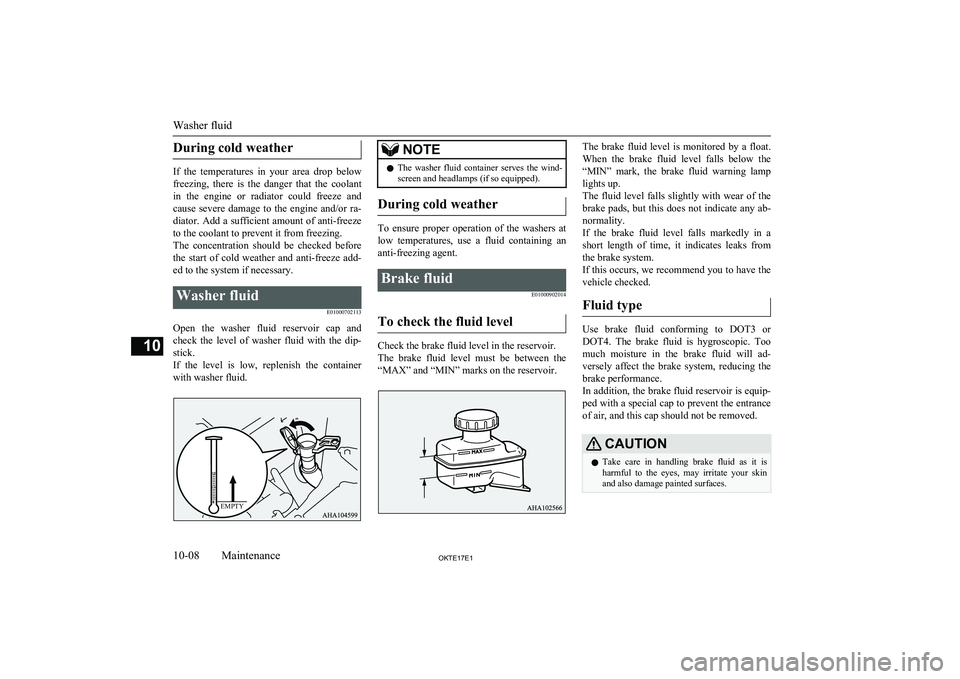
Open the washer fluid reservoir cap andcheck the level of washer fluid with the dip- stick.
If the level is low, replenish the container with washer fluid.
NOTEl The washer fluid container serves the wind-
screen and headlamps (if so equipped).
During cold weather
To ensure proper operation of the washers at
low temperatures, use a fluid containing ananti-freezing agent.
Brake fluid
E01000902014
To check the fluid level
Check the brake fluid level in the reservoir.
The brake fluid level must be between the “MAX” and “MIN” marks on the reservoir.
The brake fluid level is monitored by a float.
When the brake fluid level falls below the “MIN” mark, the brake fluid warning lamp
lights up.
The fluid level falls slightly with wear of the brake pads, but this does not indicate any ab-
normality.
If the brake fluid level falls markedly in a short length of time, it indicates leaks from
the brake system.
If this occurs, we recommend you to have the vehicle checked.
Fluid type
Use brake fluid conforming to DOT3 or
DOT4. The brake fluid is hygroscopic. Too
much moisture in the brake fluid will ad- versely affect the brake system, reducing the brake performance.
In addition, the brake fluid reservoir is equip-
ped with a special cap to prevent the entrance
of air, and this cap should not be removed.
CAUTIONl Take care in handling brake fluid as it is
harmful to the eyes, may irritate your skin
and also damage painted surfaces.
Washer fluid
10-08OKTE17E1Maintenance10EMPTY