2017 MERCEDES-BENZ G-Class warning light
[x] Cancel search: warning lightPage 103 of 286
Switching air-recirculation mode
on/off
General notes
If you switch on air-recirculation mode, the win-
dows can fog up more quickly, in particular at
low temperatures. Only use air-recirculation
mode briefly to prevent the windows from fog-
ging up.
Activating/deactivating
XTurn the SmartKey to position 2in the igni-
tion lock (Ypage 104).
XTo activate: press thedbutton.
The indicator lamp in the dbutton lights
up.
iAir-recirculation mode is automatically acti-
vated at high levels of pollution or at high out-
side temperatures. When air-recirculation
mode is activated automatically, the indicator
lamp in the dbutton is not lit.
Outside air is added after about 30 minutes.
XTo deactivate: press thedbutton.
The indicator lamp in the dbutton goes
out.
iAir-recirculation mode switches off auto-
matically:
Rafter approximately five minutes at outside
temperatures below approximately 41 ‡
Rafter approximately five minutes if cooling
with air dehumidification is deactivated
Rafter approximately 30 minutes at outside
temperatures above approximately 41 ‡
(5 †)
Switching the residual heat on or off
General notes
The residual heat function is only available on
vehicles for Canada.
It is possible to make use of the residual heat of
the engine to continue heating the stationary
vehicle for up to 30 minutes after the engine has
been switched off. The heating time depends on the set interior temperature.
Activating/deactivating
XTurn the SmartKey to position gin the igni-
tion lock (Ypage 104) or remove it.
XTo activate: press theÁbutton.
The indicator lamp in the Ábutton lights
up.
iThe blower will run at alow speed regardless
of the airflow setting.
iIf you activate the residual heat function at
high temperatures, only the ventilation will be
activated.
XTo deactivate: press theÁbutton.
The indicator lamp in the Ábutton goes
out.
Residual heat is deactivated automatically:
Rafter approximately 30 minutes
Rwhen the ignition is switched on
Rif the battery voltage drops
Rif the coolant temperature is too low
Air vents
Important safety notes
GWARNING
Very hot or very cold air can flow from the air
vents. This could result in burns or frostbitei n
the immediate vicinity of the air vents. There
is ar isk of injury.
Make sure that all vehicle occupants always
maintain asufficient distance to the air out-
lets. If necessary, redirect the airflow to
another area of the vehicle interior.
In order to ensure the direct flow of fresh air
through the air ventsi nto the vehicle interior,
please observe the following notes:
Rkeep the air inlet between the windshield and
the hood free of blockages, such as ice, snow or leaves.
Rnever cover the air ventsora ir intake grilles in
the vehicle interior.
iFor virtually draft-free ventilation, adjust the
sliders of the air ventstot he center position.
iIf the automatic climate control constantly
differs from the set temperature or if unde-
Air vents101
Climatec ontrol
Z
Page 106 of 286

Do not switch off the ignition whiledriving.
GWARNING
If the parkin gbrake hasn ot been fully
released when driving, the parkin gbrake can:
Roverheat and cause afire
Rlose its hol dfunction.
There is ariskoff irea nd an accident. Release
the parkin gbrake full ybefor ed rivin goff.
!Warm up the engine quickly. Do not us ethe
engine's full performance unti lithasreached
operating temperature.
Onlys hift the automatic transmission to the
desired drive positio nwhent he vehicl eissta-
tionary.
Where possible, avoi dspinning the drive
wheels when pulling away on slippery roads.
Yo uc ould otherwis edamag ethe drive train.
!Avoi dhighe ngine speeds when the engine
is cold. The engine's servic elifec ould other-
wise be significantl yshortened. Do not use
the engine's full performance unti lithas
reachedo perating temperature.
!Mercedes-AMG vehicles: at lowengine oil
temperatures belo w68‡ (+20† ),the max-
imu me ngine spee disrestricted in order to
protect the engine .Toprotect the engine and
maintain smooth engine operation, avoi ddriv-
ing at full throttle when the engine is cold.
SmartKey positions
gTo remove the SmartKey
1Powe rsuppl yfor som econsumers ,suc ha s
the windshiel dwiper s
2Ignitio n(powe rsuppl yfor al lconsumers)
and drive position
3To start the engine
As soo nasthe ignition is switched on, al lthe
indicator lamps in the instrument cluster light
up .Ifani ndicator lamp does not go ou tafter
startin gthe engine or lights up whil edriving, see
(
Ypage 189).
If the SmartKeyisinp osition gin the ignition
lock for alon gerp eriod, it can no longe rbe
turned in the ignition lock. The steerin gisthen
locked .Tounlock, remove the SmartKeya nd
reinsert it into the ignition lock.
The steerin gislocked when yo uremove the
SmartKeyf romthe ignition lock.
XRemov ethe SmartKeyw hent he engine is
switched off.
The starter battery could otherwis ebedis-
charged.
If yo ucanno tturnt he SmartKeyint he ignition
lock, the starter battery mayn ot be charged
sufficiently.
XCheck the starter battery and charge it if nec-
essar y(Ypage 243).
or
XJump-star tthe vehicl e(Ypage 243).
Yo uc an onl yremove the SmartKeyi f:
Rthe SmartKeyisinpositiongin the ignition
lock
Rthe automatic transmission selecto rlev er is
in j
Starting the engine
Important safety notes
GWARNING
If children ar eleftu nsupervised in the vehicle,
theyc ould:
Ropen the doors ,thuse ndangering other
people or roa dusers.
Rgeto utand disrupt traffic.
Roperate the vehicle's equipment.
104Driving
Driving an dparking
Page 110 of 286
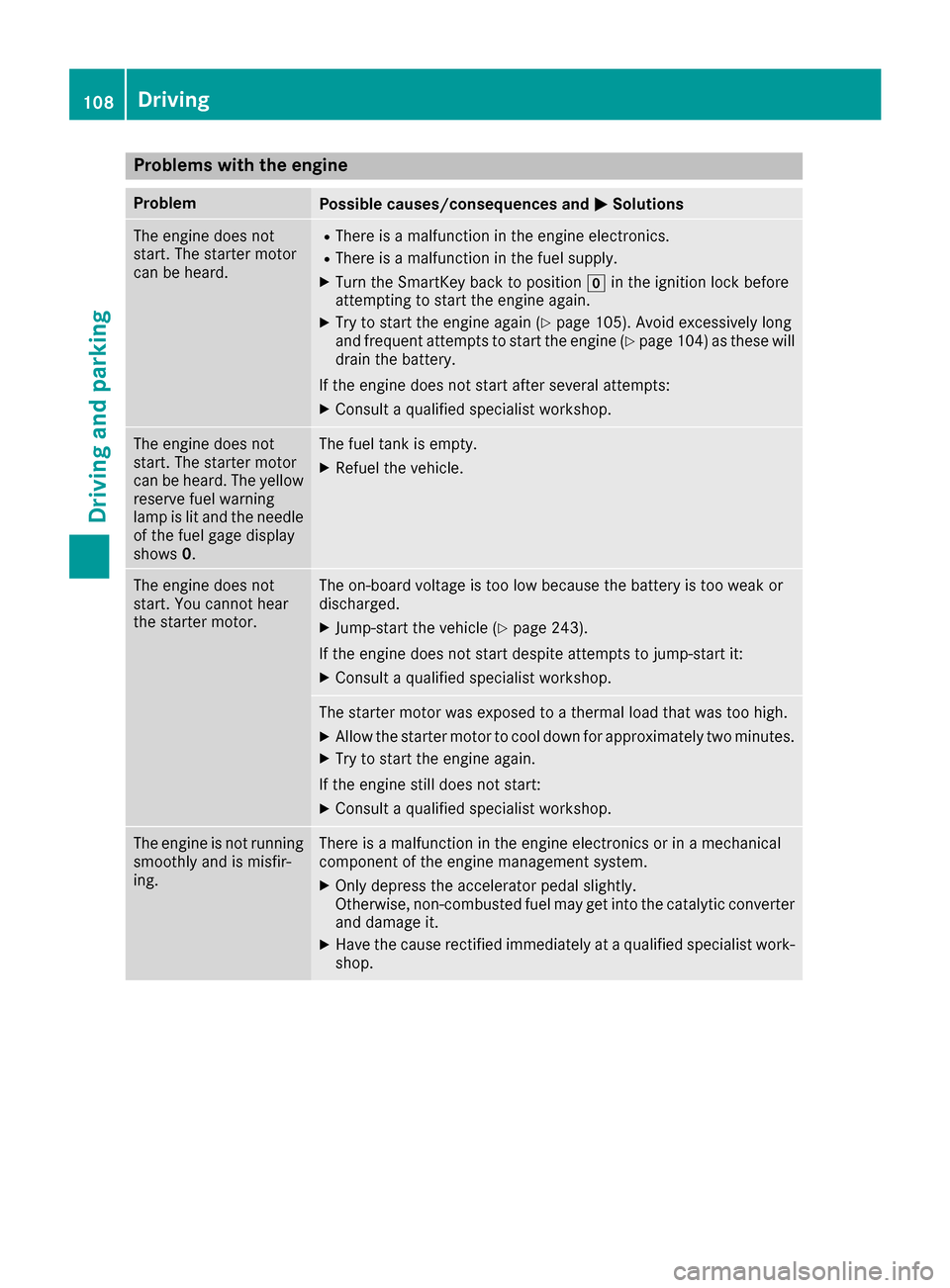
Problems with the engine
ProblemPossible causes/consequences andMSolutions
The engine does not
start. The starter motor
can be heard.RThere isamalfunction in the engine electronics.
RThere is amalfunction in the fuel supply.
XTurn the SmartKey back to position gin the ignition lock before
attempting to start the engine again.
XTry to start the engine again (Ypage 105). Avoid excessively long
and frequent attemptstos tart the engine (Ypage 104) as these will
drain the battery.
If the engine does not start after several attempts:
XConsult aqualified specialist workshop.
The engine does not
start. The starter motor
can be heard. The yellow
reserve fuel warning
lamp is lit and the needle
of the fuel gage display
shows 0.The fuel tank is empty.
XRefuel the vehicle.
The engine does not
start. You cannot hear
the starter motor.The on-board voltage is too low because the battery is too weak or
discharged.
XJump-start the vehicle (Ypage 243).
If the engine does not start despite attempt stojump-start it:
XConsult aqualified specialist workshop.
The starter motor was exposed to athermal load that was too high.
XAllow the starter motor to cool down for approximately two minutes.
XTry to start the engine again.
If the engine still does not start:
XConsult aqualified specialist workshop.
The engine is not running
smoothly and is misfir-
ing.There is amalfunction in the engine electronics or in amechanical
componentoft he engine management system.
XOnly depress the accelerator pedal slightly.
Otherwise, non-combusted fuel may get into the catalytic converter
and damage it.
XHave the cause rectified immediately at aqualified specialist work-
shop.
108Driving
Driving and parking
Page 111 of 286
ProblemPossible causes/consequences andMSolutions
The coolant temperature
gage showsavalue
above A
display message may
also appear in the multi-
function display and a
warning tone may sound.The coolant level is too low. The coolant is too hot and the engine is no
longer being cooled sufficiently.
XStop as soon as possible and allow the engine and the coolant to
cool down.
XCheck the coolant level (Ypage 229). Observe the warning notes
as you do so and add coolant if necessary.
If the coolant level is correct,t he radiator fan may be faulty. The cool-
ant is too hot and the engine is no longer being cooled sufficiently.
XAt coolant temperatures below drive to the nearest
qualified specialist workshop.
XAvoid heavy loads on the engin easyou do so, e.g. driving in moun-
tainou sterrai nand stop-and-go traffic.
Adjustabl edamping
General notes
With adjustabl edamping you can choose
between two different suspensions ettings.
Suspensions ettings
COMFcomfortable suspensions etting
Sportsports suspensionsetting
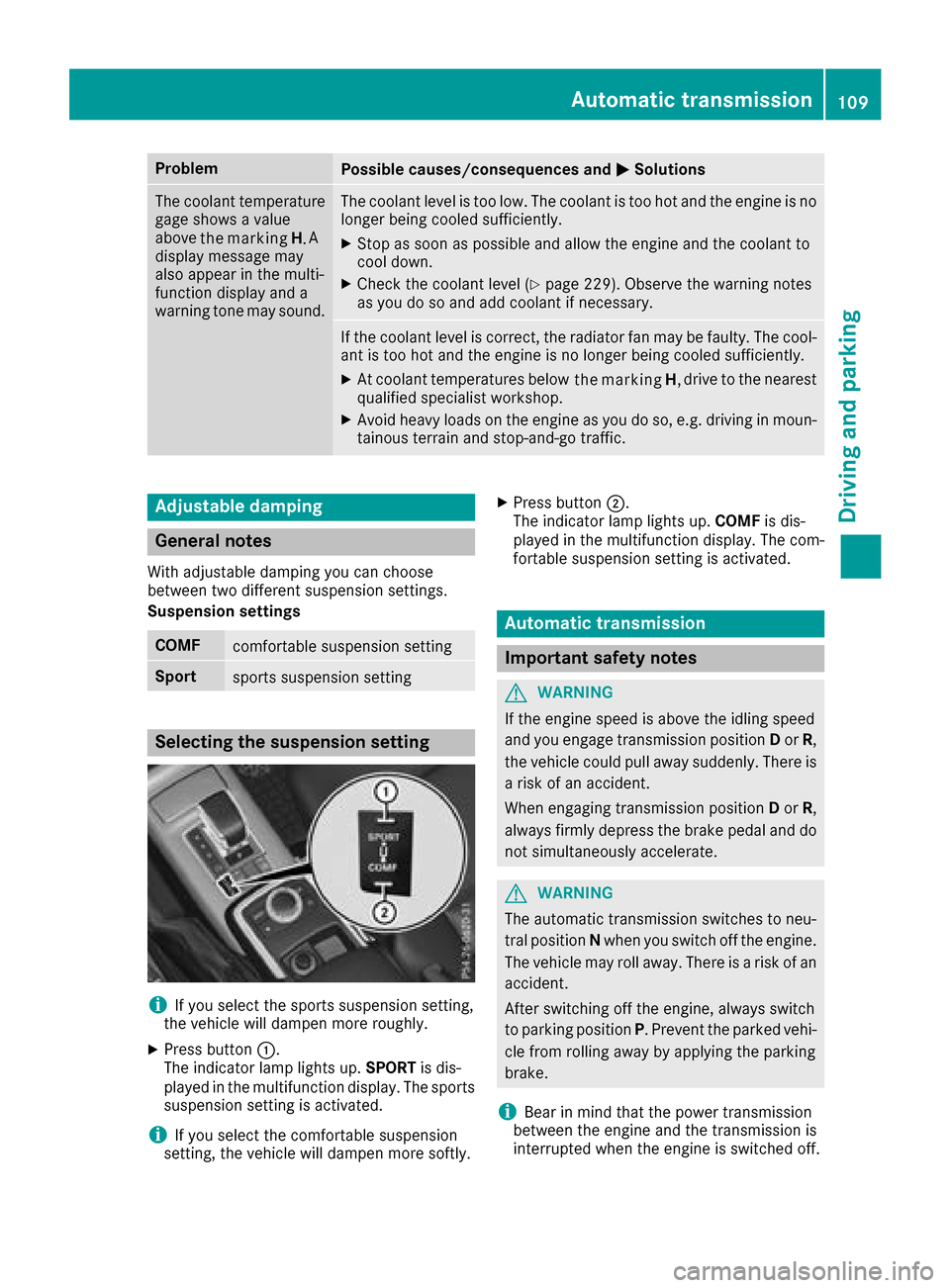
Selecting the suspension setting
iIf you select the sports suspensions etting,
the vehicle wil ldampen more roughly.
XPress button :.
The indicator lamp lights up. SPORTis dis-
played in the multifunction display. The sports
suspensions etting is activated.
iIf you select the comfortable suspension
setting, the vehicle wil ldampen more softly.
XPress button ;.
The indicator lamp lights up. COMFis dis-
played in the multifunction display. The com-
fortabl esuspensions etting is activated.
Automatic transmission
Important safety notes
GWARNING
If the engine speedisa bove the idling speed
and you engag etransmission position Dor R,
the vehicle coul dpulla wa ysuddenly.T here is
ar isk of an accident.
When engaging transmission position Dor R,
always firmlyd epress the brake pedal and do
not simultaneousl yaccelerate.
GWARNING
The automatic transmission switches to neu-
tral position Nwhe nyou switch off the engine.
The vehicle may roll away .There is arisk of an
accident.
After switching off the engine, always switch
to parking position P.Prevent the parke dvehi-
cle from rolling away by applying the parking
brake.
iBear in mind that the power transmission
between the engine and the transmission is
interrupted whe nthe engine is switched off.
Automatic transmission109
Driving and parking
Z
the marking
H
.
the markingH,
Page 121 of 286

Opening the fuel filler flap
:To open the fuel filler flap
;Tire pressure table
=Instruction label for fuel type to be refueled
?To insert the fuel filler cap
XSwitchthe engine off.
iWhen the engine is running and the fuel filler
flap is open, the yellow reserve fuel warning
lamp and the =(USA only) or ;(Can-
ada only) Check Engine warning lamp may
light up.
Further information about warning and indi-
cator lamps in the instrument cluster can be
found in the Digital Operator's Manual.
XRemove the SmartKey from the ignition lock.
XTurn the fuel filler cap counterclockwise and
remove it.
XInser tthe fuel filler cap into the holder
bracket on the inside of filler flap ?.
XCompletely insert the filler neck of the fuel
pump nozzle into the tank and refuel.
XOnly fill the tank until the pump nozzle
switches off.
Do not add any more fuel after the pump stops
filling for the first time. Otherwise, fuel may leak
out.
Closing the fuel filler flap
XReplace the cap on the filler neck and turn
clockwise until it engages audibly.
XClose the fuel filler flap.
Close the fuel filler flap before lockin gthe vehi-
cle. If you are driving with the fuel filler cap open, the
8
reservef uel warning lamp flashes. Ames-
sage appears in the multifunction display
(
Ypage 179).
Fuel filler flap emergency release
The emergency release is located in the cargo
compartment ,onthe right-hand side when
viewed in the direction of travel, behind the rear
panel trim.
The vehicle walls in the area around the emer-
genc yrelease have sharp edges. There is arisk
of injury. Avoid contact with the edges on the
inside of the vehicle body.
XOpen the rear door.
XPull off edge protection ;.
XRemove rear wall trim:.
XPull emergency release =in the direction of
the arrow.
The fuel filler flap is unlocked.
XOpen the fuel filler flap (Ypage 119).
Refueling119
Driving and parking
Z
Page 123 of 286
To ensure that the vehicle is safeguarded
against rolling away unintentionally:
Rthe parking brake must be applied.
Rthe transmission must be in positionPand the
SmartKey must be removed from the ignition
lock
Rthe transfer case must not be in the neutral
position
Rthe front wheels must be turned towards the
curb on steep uphill or downhill gradients
Rthe empty vehicle must be secured at the
front axle with awheel chock or similar
object ,for example, on uphill or downhill gra-
dients
Ral aden vehicle must also be secured at the
rear axle with awheel chock or similar object,
for example, on uphill or downhill gradients
Switching off the engine
GWARNING
The automatic transmission switches to neu-
tral position Nwhen you switch off the engine.
The vehicle may roll away.T here isarisk of an
accident.
After switching off the engine, alwayss witch
to parking position P.Prevent the parked vehi-
cle from rolling away by applying the parking
brake.
XShift the automatic transmission to position
P.
XTurn the SmartKey to position 0in the ignition
lock and remove it.
The immobilizer is activated.
XApply the parking brake firmly.
XTurn the steerin gwheel until the steering
wheel lock engages.
If you switch the engine off with the transmis-
sion in position Ror D,t he automatic transmis-
sion shifts to Nautomatically.
If you then open the driver's door or the front-
passenger door or remove the SmartKey from
the ignition ,the automatic transmission shifts
to Pautomatically.
If you switch off the engine while the transmis-
sion is in position N,t he automatic transmission
remains in Neven if adoor is opened. The auto-
matic transmission only automatically shifts into neutral
Nwhen you switch off the engine
using the SmartKey.
Parking brake
GWARNING
If you must brake the vehicle with the parking brake, the braking distance is considerably
longer and the wheels could lock. There is an
increased danger of skidding and accidents.
Only use the parking brake to brake the vehi-
cle when the service brake is faulty. Do not
apply the parking brake too firmly. If the
wheels lock, release the parking brake until
the wheels begin turnin gagain.
GWARNING
If you leave children unsupervised in the vehi-
cle, they could set it in motion by, for example:
Rrelease the parking brake.
Rshift the automatic transmission out of the
parking position P.
Rstart the engine.
In addition, they may operate vehicle equip-
ment and become trapped. There is arisk of
an accident and injury.
When leaving the vehicle, alwayst ake the
SmartKey with you and lock the vehicle. Never
leave children unsupervised in the vehicle.
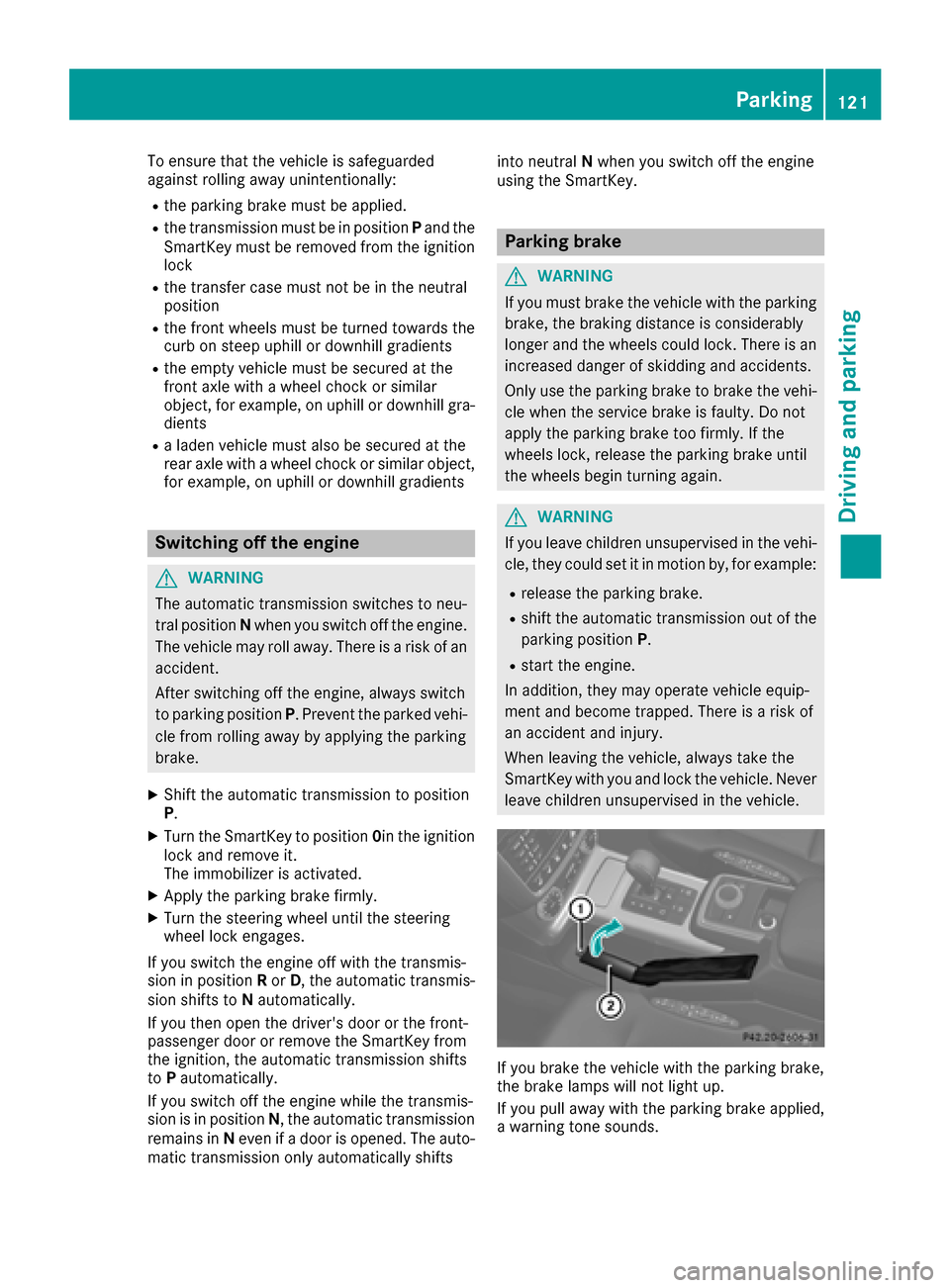
If you brake the vehicle with the parking brake,
the brake lamps will not light up.
If you pull away with the parking brake applied,
aw arning ton esounds.
Parking121
Driving and parking
Z
Page 124 of 286

XTo apply:pull parking brake lever ;up
firmly.
Whe nthe ignition is switched on, the F
(US Aonly) or J(Canada only) indicator
lamp in the instrument cluster lights up.
XTo release: pull parking brake lever ;
slightly.
XPress release button :and guid eparking
brake ;down to the stop.
The F (USAonly) or !(Canada only)
indicator lamp in the instrument cluster goes
out.
The vehicl ecan also be braked during an emer-
genc ybyu sing the parking brake.
XTo brake in an emergency: press and hold
release button :and carefull ypullp arking
brake lever ;upwards.
If yo udrive on we troads or dirt-covered surfa-
ces, roads alta nd/or dirt could get into the
parking brake.
In order to prevent corrosion and areduction in
the braking powe rofthe parking brake, observe
the following:
Rpull the parking brake up with release but-
ton :depressedf rom time to time before
beginning ajourney.
Rdrive for approximately1 10 yds(100 m) at a
maximu mspeed of 12 mph (20 km/h)
Parking the vehicle for alon gp eriod
If yo uleave the vehicl eparked for longer than
fourw eeks, the battery maybed amaged by
exhaustive discharging.
If yo ulea ve the vehicl eparked for longer thans ix
weeks, the vehicl emaysuffer damage as a
resul toflackofu se.
XVisit aquali fied specialist workshop and seek
advice.
iYo uc an obtai ninformatio nabout trickle
chargers from aquali fied specialist work-
shop.
Driving tips
General driving tips
Important safety notes
GWARNING
If yo uswitch off the ignition whil edriving,
safety-relevant functions are onlya vailable
with limitations, or not at all. Thi scould affect,
for example, the powe rsteering and the brake
boosting effect. Yo uwillr equire considerably
more effort to steera nd brake. There isarisk
of an accident.
Do not switch off the ignition whil edriving.
GWARNING
If yo uoperate mobil ecommunication equip-
ment whil edriving ,you will be distracted from
traffic conditions. Yo ucould also lose control
of the vehicle. There is ariskofana ccident.
Onlyo perate thise quipment when the vehicle
is stationary.
Observe the legalr equirements for the country
in which yo uare driving .Some jurisdictions pro-
hibi tthe driver from using amobilephone while
driving avehicle.
If yo umakeac allw hile driving ,alway suse
hands-free mode. Onlyo perate the telephone
when the traffic situatio npermits. If yo uare
unsure, pull overtoas afel oc ation and stop
before operating the telephone.
Bea rinm ind thatata speed of only30m ph
(approximately50k m/h), the vehiclecovers a
distance of 44 ft (approximately1 4m)per sec-
ond.
Drive sensibly –save fuel
Observe the following tips to save fuel:
XThe tires should always be inflated to the rec-
ommended tire pressure.
XRemove unnecessary loads.
XRemove roof carriersw hen they are not nee-
ded.
XWarm up the engin eatlow engin espeeds.
XAvoid frequenta cceleration or braking.
XHave all servicea nd maintenancework car-
ried out at the specified intervals.
122Driving tips
Driving and parking
Page 126 of 286

Heavy and light loads
GWARNING
If you rest you rfoot on the brake pedalw hile
driving, the braking system can overheat. This increases the stopping distance and can even
caus ethe braking system to fail .There is a
risk of an accident.
Never use the brake pedalasaf ootrest. Never
depress the brake pedala nd the accelerator
pedalatt he same time.
!Depressing the brake pedalc onstantly
results in excessive and premature weart o
the brake pads.
If the brakes have been subjected to aheavy
load, do not stop the vehiclei mmediately. Drive
on for ashort while. This allows the airflow to
cool the brakes more quickly.
Wet roads
If driving in heavy rain for aprolonged period of
time without braking, there may be adelayed
reactio nfrom the brakes when braking for the
first time. This may als ooccur after the vehicle
has been washed.
You have to depress the brake pedalm ore
firmly.M aintainagreater distance from the
vehicleinf ront.
After driving on awet road or having the vehicle
washed, brake firmly while paying attention to
the traffic conditions. This wil lwarmupt he
brake discs, thereby drying them more quickly
and protecting them against corrosion.
Limited braking performance on salt-
treated roads
If you drive on salted roads, alayer of sal tresi-
due may form on the brake discs and brake
pads. This can result in asignificantly longer
braking distance.
RIn order to prevent any sal tbuild-up, apply the
brakes occasionall ywhile paying attention to
the traffic conditions.
RCarefully depress the brake pedala nd the
beginning and end of ajourney.
RMaintain agreater distance to the vehicle
ahead.
Servicing the brakes
!The brake flui dlevelm ay be too low,i f:
Rif the red brake warning lamp lights up in
the instrument cluste rand
Ryou hearaw arning tone while the engine is
running
Observe additiona lwarning messages in the
multifunction display.
The brake flui dlevelm ay be too low due to
brake pad wearorl eaking brake lines.
Have the brake system checked immediately. Consult aqualified specialist workshopt o
arrange this.
!If the brake warning lamp lights up in the
instrument cluste rand you hearaw arning
tone even though the parking brake has been
released ,the brake flui dlevelm ay be too low.
Observe additionalw arning messages in the
multifunction display.
The brake flui dlevelm ay be too low due to
brake pad wearorl eaking brake lines.
Have the brake system checked immediately.
This work should be carrie dout at aqualified
specialist workshop.
!Af unction or performance test should only
be carrie dout on a2-axle dynamometer. If
you wis htooperate the vehicleons uch a
dynamometer, please consul taqualified spe-
cialist workshopina dvance. You couldoth-
erwise damage the drive train or the brake
system.
!The ESP®system operates automatically.I f
the parking brake is tested on abrake dyna-
mometer (for amaximu moften seconds),t he
engine and the ignitio nmust be switched off.
Braking triggereda utomatically by ESP
®may
otherwise caus esevere damage to the brake
system.
All checks and maintenance work on the brake
system must be carrie dout at aqualified spe-
cialist workshop.
Have brake pad sinstalled and brake fluid
replaced at aqualified specialist workshop.
If the brake system has only been subject to
moderate loads, you shoul
d test the functional-
ity of you rbrakes at regular intervals.
Informatio nonBAS (Brake Assist) (
Ypage5 8).
124Driving tips
Driving and parking