2017 MERCEDES-BENZ G-Class wheel
[x] Cancel search: wheelPage 40 of 286
Occupant safety
Introduction to the restraint system
The restraint system can reduce the risk of vehi-cle occupant scomin ginto contact with parts of
the vehicle's interior in the event of an accident.
The restraint system can also reduce the forces to which vehicle occupant sare subjected during
an accident.
The restraint system comprises:
RSeat belt system
RAir bags
RChild restraint system
RChild seat securings ystems
The component softhe restraint system work in
conjunction with each other .They can only
deploy their protective function if, at all times, all
vehicle occupants:
Rhave fastened their seat belts correctly
(Ypage 41)
Rhave the seat and head restraint adjusted
properly (Ypage 74)
As the driver, you also have to make sure that
the steering wheel is adjusted correctly.
Observe the information relating to the correct
driver's seat position (
Ypage 74).
You also have to make sure that an air bag can
inflate properly if deployed (
Ypage 43).
An air bag supplement sacorrectly worn seat
belt. As an additional safety device, the air bag
increases the level of protection for vehicle
occupant sinthe event of an accident. For exam-
ple, if, in the event of an accident, the protection
offered by the seat belt is sufficient, the air bags
are not deployed. When an accidento ccurs,only
the air bags that increase protection in that par- ticular accidents ituation are deployed. How-
ever, seat belts and air bags generally do not
protec tagainst objects penetratin gthe vehicle
from the outside.
Information on restraint system operation can
be found under "Triggering of the Emergency
Tensioning Devices and air bags" (
Ypage 46).
See "Children in the vehicle" for information on
children travelin gwith you in the vehicle as well
as on child restraint systems (
Ypage 49).
Important safetyn otes
GWARNING
Modifications to the restraint system may
cause it to no longer work as intended. The
restraint system may then not perform its
intended protective function and may fail in an
accidentort rigger unexpectedly, for example.
This poses an increased risk of injur yoreven
fatal injury.
Never modify parts of the restraint system.
Never tamper with the wiring, the electronic
component sortheir software.
If it is necessary to modify component softhe
restraint system to accommodate aperson
with disabilities, contact an authorized
Mercedes-Benz Center for details. USA only:
for further information contact our Customer
Assistance Center at 1-800-FOR-MERCedes
(1‑ 800‑367‑ 6372).
Mercedes-Benz recommends that you only use
driving aids which have been approved specifi-
cally for your vehicle by Mercedes-Benz.
Restraint system warning lamp
The function softhe restraint system are
checked after the ignition is switched on and at
regular intervals while the engin eisrunning.
Therefore, malfunctions can be detected in
good time.
The 6 restraint system warning lamp on the
instrument cluster lights up when the ignition is
switched on. It goes out no later than afew sec-
onds after the vehicle is started. The compo-
nents of the restraint system are in operational
readiness.
Am alfunction has occurred if the 6restraint
system warning lamp:
Rdoes not light up after the ignition is switched
on
Rdoes not go out after afew seconds with the
engin erunning
Rlights up again while the engin eisrunning
GWARNING
If the restraint system is malfunctioning,
restraint system component smay be trig-
38Occupant safety
Safety
Page 46 of 286

To avoid hazardous situations, alwaysmake
sure that all of the vehicle's occupants:
Rhave fastened their seat belts correctly,
including pregnant women
Rare sittin gcorrectly and maintain the great-
est possible distance to the air bags
Rfollow the following instructions
Always make sure that there are no objects
between the air bag and the vehicle's occu-
pants.
RAdjust the seats properly before beginning
your journey. Always make sure that the seat
is in an almost upright position. The center of
the head restraint must support the head at
about eye level.
RMove the driver's and front-passenger seats
as far back as possible. The driver's seat posi-
tion must allow the vehicle to be driven safely.
ROnly hold the steerin gwheel on the outside.
This allows the air bag to be fully deployed.
RAlways lean against the backrest while driv-
ing. Do not lean forwards or lean against the
door or side window. You may otherwise be in
the deployment area of the air bags.
RAlways keep your feet in the footwell in front
of the seat. Do not put your feet on the dash-
board, for example. Your feet may otherwise
be in the deployment area of the air bag.
RFor this reason, alwayss ecure persons less
than 5ft(1.50 m) tall in suitable restraint sys-
tems. Up to this height, the seat belt cannot
be worn correctly.
If ac hild is traveling in your vehicle, also
observe the followingn otes:
RAlways secure children under twelve years of
age and less than5ft(1.50 m)tallins uitable
child restraint systems.
RChil drestraint systems shoul dbeinstalle don
the rea rseats.
ROnlys ecureac hild in arearward-facing child
restraint systemont he front-passengerseat
when the front-passengerf ront airbag is
deactivated .Ifthe PASSENGER AIR BAG OFF
indicator lamp is permanentl ylit,t he front-
pa sseng
e
rfront ai rbag is deactivated
(Ypage 39).
RAlway sobser ve the instructions and safety
note son" Childr en in the vehicle"
(
Ypage 49 )and on the "Child restraint sys- tem on the front-passenge
rseat"
(
Ypage 54 )inadditiontot he child restraint
systemm anufacturer's installatio nand oper-
ating instructions.
Objects in the vehicle interior may prevent
an air bag fromf unctioningcorrectly. Before
startin gyourjourney and to avoi drisks resulting
fromt he spee dofthe airbag as it deploys, make
sure that:
Rthere ar enopeople, animals or objects
between the vehicl eoccupants and an ai rbag
Rthere ar enoobjects between the seat, door
and B-pillar
Rthere ar enohardo bjects ,e.g.c oa th angers,
hanging on the gra bhandles or coa thooks
Rno accessories, such as cup holders, are
attache dtothe vehicl ewithint he deployment
area of an ai rbag,e.g.tod oors,s idew indows,
rea rsidet rim or side walls
Rno heavy, sharp-edged or fragile objects ar ein
the pockets of your clothing. Store such
objects in asuitabl eplace
GWARNING
If yo umodify the ai rbag cove rora ffix objects
such as sticker stoit, the ai rbag can no longer
functio ncorrectly. There is an increasedr isk
of injury.
Never modify an ai rbag cove rora ffix objects
to it.
GWARNING
Sensors to control the ai rbagsa relocate din
the doors .Modifications or work not per-
formed correctl ytothe doors or door panel-
ing ,asw ellasd amaged doors,can lead to the
functio nofthe sensors being impaired. Th eair
bags might therefore not functio nproperly
anymore. Consequently, the ai rbagsc annot
protect vehicl eoccupants as theya re
designe dtodo.There is an increasedr isko f
injury.
Never modify the doors or parts of the doors.
Alway shavew orkont he doors or door pan-
eling carrie doutataq uali fied specialis twork-
shop.
44Occupant safety
Safety
Page 47 of 286

Frontair bags
!Do no tplac eh eav yobject sont hefront-
passenger seat .This could caus ethe system
to identify th eseat as bein goccupied. In th e
event of an accident, th erestrain tsystems on
th ef ront-pa ssenger side may be triggered
and have to be replaced.
Driver's air bag :deploys in fron tofthesteer -
ing wheel. Front-passenger fron tair bag ;
deploys in fron tofand abov ethe glov ebox.
When deployed, th efront air bags offer addi-
tional head and thorax protection for th eoccu-
pants in th efront seats.
Ap ermanentl ylit PASSENGER AI RBAG OFF
indicator lamp inform syou that th efront -
passenger fron tair bag is deactivated
(
Ypage 39).
The front-passenger fron tair bag will only
deplo yif:
Ran occupant is detected on th efront -
passenger seat
Rth eP ASSENG ER AIRBAG OFFindicator lamp
does no tligh tup(Ypage 53 )
Rther estrain tsystem control unit predicts a
high acciden tseverit y
Sidei mpact air bags
GWARNIN G
Unsuitable seat cover scan obstruc torpre-
ven tdeploymen toftheair bags integrate d
int ot he seats. Consequently, th eair bags
canno tprotect vehicl eoccupant sastheya re
designed to do. In addition ,the function sof
BabySmart ™may be impaired .This pose san
increased ris kofinjury or eve nfatal injury.
You should only use seat cover sthath ave
been approve dfor th erespective seat by
Mercedes-Benz.
Sid eimpac tair bags :deplo ynexttot heouter
bolste roftheseat backrest .
When deployed, th eside impac tair bag offers
additional thorax protection .How ever, it does
no tp rotect the:
Rhead
Rneck
Rarm s
In th eevent of aside impact ,the side impac tair
bag is deployed on th eside on whic hthe impac t
occurs.
Pelvisa ir bags
GWARNIN G
Unsuitable seat cover scan obstruc torpre-
ven tdeploymen toftheair bags integrate d
int ot he seats. Consequently, th eair bags
canno tprotect vehicl eoccupant sastheya re
designed to do. In addition ,the function sof
BabySmart ™may be impaired .This pose san
increased ris kofinjury or eve nfatal injury.
You should only use seat cover sthath ave
been approve dfor th erespective seat by
Mercedes-Benz.
Occupant safety45
Safety
Z
Page 51 of 286
XWith your hand flat, firmly push the NECK-
PRO head restraint cushion back in the direc-tion of arrow =until it engages.
XRepeat this procedure for the secondN ECK-
PRO head restraint.
iResettin gthe NECK-PRO head restraints
requires alot of strength. If you have difficulty
resetting the NECK-PRO head restraints, have
this work carried out at aqualified specialist
workshop.
NECK-PRO luxuryh ead restraints
Do not insert your finger between the cushion of
the head restraint and the cover. Pay particular
attention while resetting the NECK-PRO luxury
head restraints.
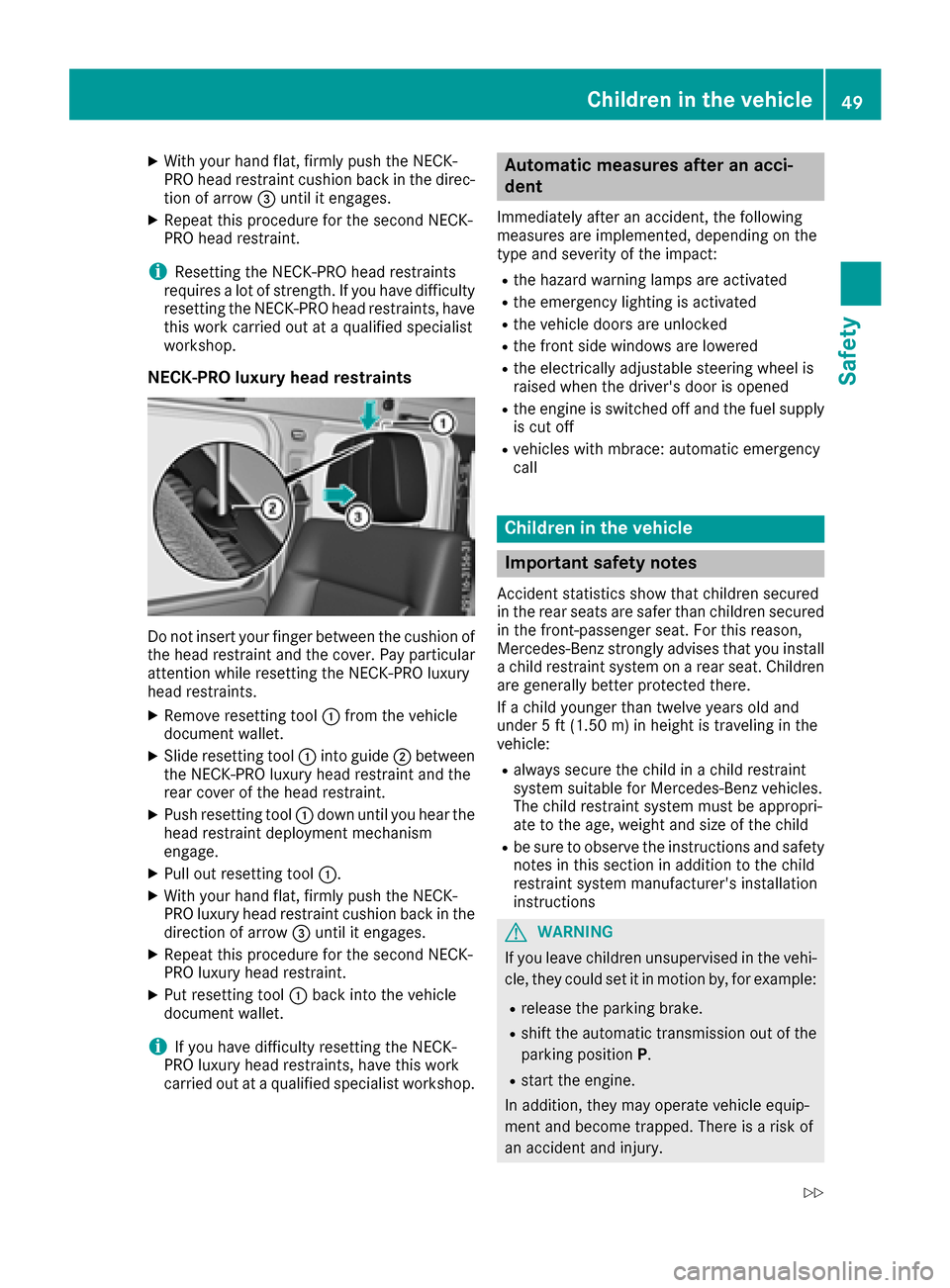
XRemove resetting tool :from the vehicle
document wallet.
XSlide resetting tool :into guide ;between
the NECK-PRO luxury head restraint and the
rear cover of the head restraint.
XPush resetting tool :down until you hear the
head restraint deployment mechanism
engage.
XPull out resetting tool :.
XWith your hand flat, firmly push the NECK-
PRO luxury head restraint cushion back in the
direction of arrow=until it engages.
XRepeat this procedure for the secondN ECK-
PRO luxury head restraint.
XPut resetting tool :back into the vehicle
document wallet.
iIf you have difficulty resetting the NECK-
PRO luxury head restraints, have this work
carried out at aqualified specialist workshop.
Automatic measures after an acci-
dent
Immediately after an accident ,the following
measures are implemented, depending on the
type and severityoft he impact:
Rthe hazard warning lamps are activated
Rthe emergency lighting is activated
Rthe vehicle doors are unlocked
Rthe frontside windows are lowered
Rthe electrically adjustable steerin gwheel is
raised when the driver's door is opened
Rthe engine is switched off and the fuel supply
is cut off
Rvehicles with mbrace: automatic emergency
call
Children in the vehicle
Important safety notes
Accident statistics show that children secured
in the rear seats are safer than children secured
in the front-passenger seat. For this reason,
Mercedes-Benz strongly advises that you install
ac hild restraint system on arear seat. Children
are generally better protected there.
If ac hild younger than twelve years old and
under 5ft(1.50m )inh eight is travelin ginthe
vehicle:
Ralwayss ecure the child in achild restraint
system suitable for Mercedes-Benz vehicles.
The child restraint system must be appropri-
ate to the age, weight and size of the child
Rbe sure to observe the instruction sand safety
notes in this section in addition to the child
restraint system manufacturer's installation
instructions
GWARNING
If you leave children unsupervised in the vehi-
cle, they could set it in motion by, for example:
Rrelease the parking brake.
Rshift the automatic transmission out of the
parking position P.
Rstart the engine.
In addition, they may operate vehicle equip-
ment and become trapped. There is arisk of
an accident and injury.
Children in the vehicle49
Safety
Z
Page 59 of 286
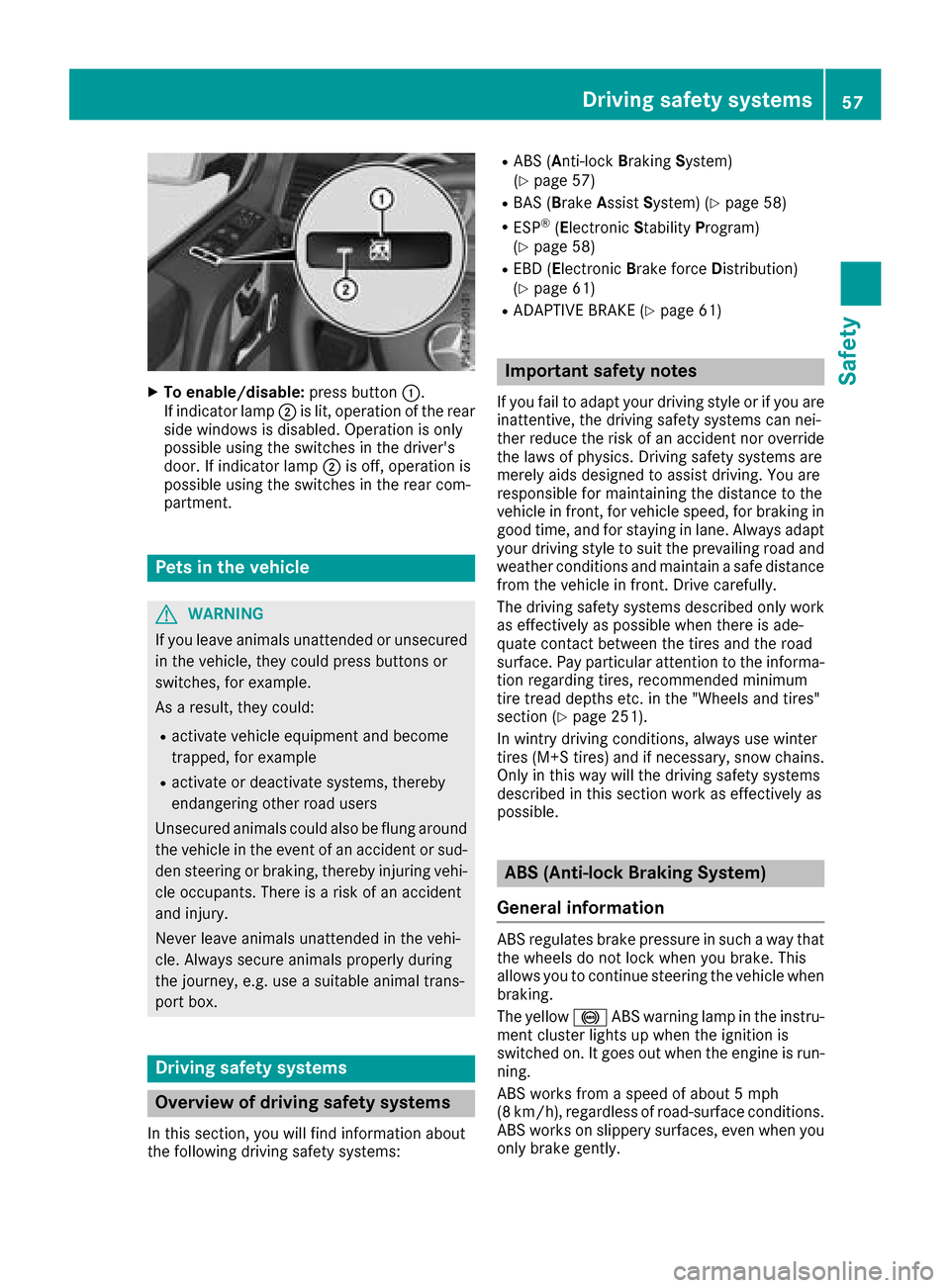
XTo enable/disable:press button:.
If indicator lamp ;is lit, operatio nofthe rear
side windows is disabled .Operation is only
possibl eusing the switches in the driver's
door. If indicator lamp ;is off, operatio nis
possibl eusing the switches in the rearc om-
partment.
Pets in the vehicle
GWARNING
If yo ulea ve animals unattende dorunsecured
in the vehicle, they could press buttons or
switches, for example.
As aresult, they could:
Ractivate vehicl eequipment and become
trapped, for example
Ractivate or deactivate systems, thereby
endangering othe rroadu sers
Unsecured animals could also be flung around
the vehicl einthe event of an accident or sud-
de ns teering or braking ,thereb yinjuring vehi-
cle occupants. There is ariskofana ccident
and injury.
Never leave animals unattende dinthe vehi-
cle .Alway ssecure animals properly during
the journey ,e.g.u se asuitabl eanimal trans-
port box.
Driving safety systems
Overvie wofdriving safety systems
In thiss ection, yo uwillf ind informatio nabout
the following driving safety systems:
RABS ( Anti-lock Braking System)
(Ypage 57)
RBAS ( Brake Assis tSys tem )(Ypage 58)
RESP®(E le ctronic Stability Program)
(Ypage 58)
REBD ( Ele ctronic Brake force Dis tribution)
(Ypage 61)
RADAPTIVE BRAK E(Ypage 61)
Important safety notes
If youfailtoa dapt your driving style or if yo uare
inattentive, the driving safety systemsc an nei-
ther reduce the ris kofanaccident nor override
the laws of physics. Driving safety systemsa re
merel yaidsd esig ned to assist driving .You are
responsibl efor maintaining the distance to the
vehicl einfront, for vehicl espeed ,for braking in
goo dtime ,and for staying in lane. Alway sadapt
your driving style to suit the prevailing roada nd
weather conditions and maintain asafed istance
from the vehicl einfront. Driv ecarefully.
The driving safety systemsd escribe donlyw ork
as effectively as possibl ewhent her eisa de-
quate contact between the tire sand the road
surface. Payp articula rattentio ntothe informa-
tio nr egarding tires, recommende dminimum
tire trea ddepths etc. in the "Wheels and tires"
section (
Ypage 251).
In wintry driving conditions, always us ewinter
tire s(M+ Stires) and if necessary,s now chains.
Onlyint hiswaywill the driving safety systems
describe dinthissection work as effectively as
possible.
ABS (Anti-lock Brakin gSystem)
General information
ABS regulate sbrake pressure in such awaythat
the wheels do not lock when yo ubrake. This
allows yo utocontinue steering the vehicl ewhen
braking.
The yellow !ABS warning lamp in the instru-
ment cluster lights up when the ignition is
switched on. It goe soutwhen the engine is run-
ning.
ABS works from aspeed of about5m ph
(8 km/h), regardless of road-surface conditions.
ABS works on slippery surfaces, eve nwheny ou
onlyb rake gently.
Driving safety systems57
Safety
Z
Page 60 of 286

Important safety notes
iObservethe "Importan tsafet ynotes "sec-
tion (Ypage 57).
GWARNIN G
If AB Sisf aulty, th ewheels could loc kwhen
braking .The steerabilit yand braking charac -
teristics may be severely impaired .Addition -
ally, further driving safet ysystems are deac -
tivated. Ther eisanincreased danger of skid-
din gand accidents .
Drive on carefully. Hav eABS checke dimme-
diately at aqualified specialist workshop.
When AB Sismalfunctioning ,other systems ,
includin gdriving safet ysystems ,will also
become inoperative. Observ ethe information
on th eABS warning lamp (
Ypage 190) and dis-
play message swhichm ay be shown in th e
instrumen tcluste r(
Ypage 171).
Braking
XIf ABS intervenes: continue to depress th e
brak epedal vigorously until th ebraking sit -
uation is over.
XTo make afullb rake application: depress
th eb rak epedal wit hfull force .
If AB Sintervenes when braking ,you will fee la
pulsing in th ebrak epedal .
The pulsating brak epedal can be an indication
of hazardous road conditions, and function sasa
reminder to tak eextra carew hile driving .
Off-road ABS
An ESP®system specifically suited to off-road
terrain is activated automatically once th eoff-
road program is activated.
At speeds belo w37mph (60 km/h), th efront
wheels loc kcyclically during braking .The dig-
ging-in effec tachieved in th eprocess reduce s
th es topping distanc eonoff-road terrain .This
limits steering capability.
BAS (Brak eAssistS ystem)
General information
BA So perate sinemergenc ybraking situations.
If you depress th ebrak epedal quickly, BA S
automatically boosts th ebraking force ,thu s
shortening th estopping distance.
Important safety notes
iObserv ethe "Importan tsafet ynotes "sec-
tion (Ypage 57) .
GWARNIN G
If BA Sism alfunctioning ,the braking distanc e
in an emergenc ybraking situation is
increased. Ther eisariskofana ccident.
In an emergenc ybraking situation ,depress
th eb rak epedal wit hfull force .ABS prevents
th ew heels from locking.
Braking
XKee pthe brak epedal firmly depressed until
th ee mergenc ybraking situation is over.
AB Sp revents th ewheels from locking.
The brakes will function as usual once you
release th ebrak epedal .BAS is deactivated.
ESP®(Electronic StabilityP rogram)
General notes
iObserv ethe "Importan tsafet ynotes "sec-
tion (Ypage 57).
ES P
®monitors driving stabilit yand traction ,i.e .
power transmission between th etires and th e
road surface.
If ES P
®detects that th evehicl eisd eviating from
th ed irection desired by th edriver, on eormore
wheels are braked to stabiliz ethe vehicle. The
engin eoutput is also modifie dtokeept he vehi-
cle on th edesired cours ewithin physical limits .
ES P
®assist sthe driver when pullin gaway on
wet or slippery roads. ES P®can also stabilize
th ev ehicl eduring braking .
58Driving safety systems
Safety
Page 61 of 286
4ETS (Electronic Traction System)
iObserve the "Important safety notes" sec-
tion (Ypage 57).
4ET Straction contro lispart of ESP
®.
4ET Straction contro lisnolonger activ eabove a
speed of approximately 37 mph (60 km/h).
Traction contro lbrakes the drive wheels indi-
vidually if they spin. This enables you to pull
away and accelerate on slippery surfaces,f or
example if the road surface is slippery on one
side. In addition, more drive torque is transfer-
red to the wheel or wheels with traction.
Traction contro lremains active, even if you
deactivate ESP
®.
Importan tsafetyn otes
iObserve the "Important safety notes" sec-
tion (Ypage 57).
GWARNING
If ESP
®is malfunctioning, ESP®is unable to
stabilize the vehicle. Additionally, further driv-
ing safety systems are deactivated. This
increases the risk of skiddin gand an accident.
Driv eonc arefully. Have ESP
®checked at a
qualified specialist workshop.
!Only operate the vehicle for amaximum of
ten seconds on abrake test dynamometer.
Switc hoff the ignition.
Application of the brakes by ESP
®may oth-
erwise destroy the brake system.
!Af unction or performanc etest should only
be carried out on atwo-axle dynamometer.
Beforey ou operate the vehicle on such a
dynamometer, please consult aqualified
workshop. You could otherwise damage the
drive train or the brake system.
If the å ESP
®OFF warning lamp lights up
continuously, ESP®is deactivated.
If the ÷ ESP®warning lamp lights up contin-
uously, ESP®is not available due to amalfunc-
tion.
Observe the information on warning lamps
(
Ypage 191) and display messages which may
be displayed in the instrument cluster
(
Ypage 171). Only use wheels with the recommended tire
sizes. Only then will ESP
®function properly.
If differential locksa re switched on, ABS, BAS
and ESP
®switc hoff automatically.
Characteristics of ESP®
Genera linformation
If the ÷ ESP®warning lamp goes out before
beginning the journey, ESP®is automatically
active.
If ESP
®intervenes, the ÷ESP®warning lamp
flashes in the instrument cluster.
If ESP
®intervenes:
XDo not deactivate ESP®under any circum-
stances.
XOnly depress the accelerator pedal as far as
necessary when pulling away.
XAdapt your drivings tyle to suit the prevailing
road and weather conditions.
ECO start/stop function
The ECO start/stop function switches the
engin eoff automatically when the vehicle stops
moving. The engin estart sautomatically when
the driver wants to pull away again. ESP
®
remains in its previously selected status, e.g. if
ESP®was deactivated before the engin ewas
automatically switched off.
Deactivating/activating ESP®
Important safetyn otes
iObservethe "Important safety notes" sec-
tion (Ypage 57).
You can select between the following states of
ESP
®:
RESP®is activated.
RESP®is deactivated.
GWARNING
If you deactivate ESP
®,E SP®no longer sta-
bilizes the vehicle. There is an increased risk
of skiddin gand an accident.
Only deactivate ESP
®in the situation sdescri-
bed in the following.
Driving safetys ystems59
Safety
Z
Page 62 of 286
It may be best to deactivate ESP®in the follow-
ing situations:
Rwhen using snow chains
Rin deep snow
Ron sand or gravel
Roff-road
Spinning the wheelsr esults inacutting action
which providesb etter grip.
Activate ESP
®as soon as the situations descri-
bed above no longer apply. ESP®willo therwise
not be abletos tabilize the vehicle if the vehicle
starts to skid or awheel starts to spin.
!Avoid spinning the driven wheelsf or an
extended period with ESP®deactivated. You
could otherwise damage the drivetrain.
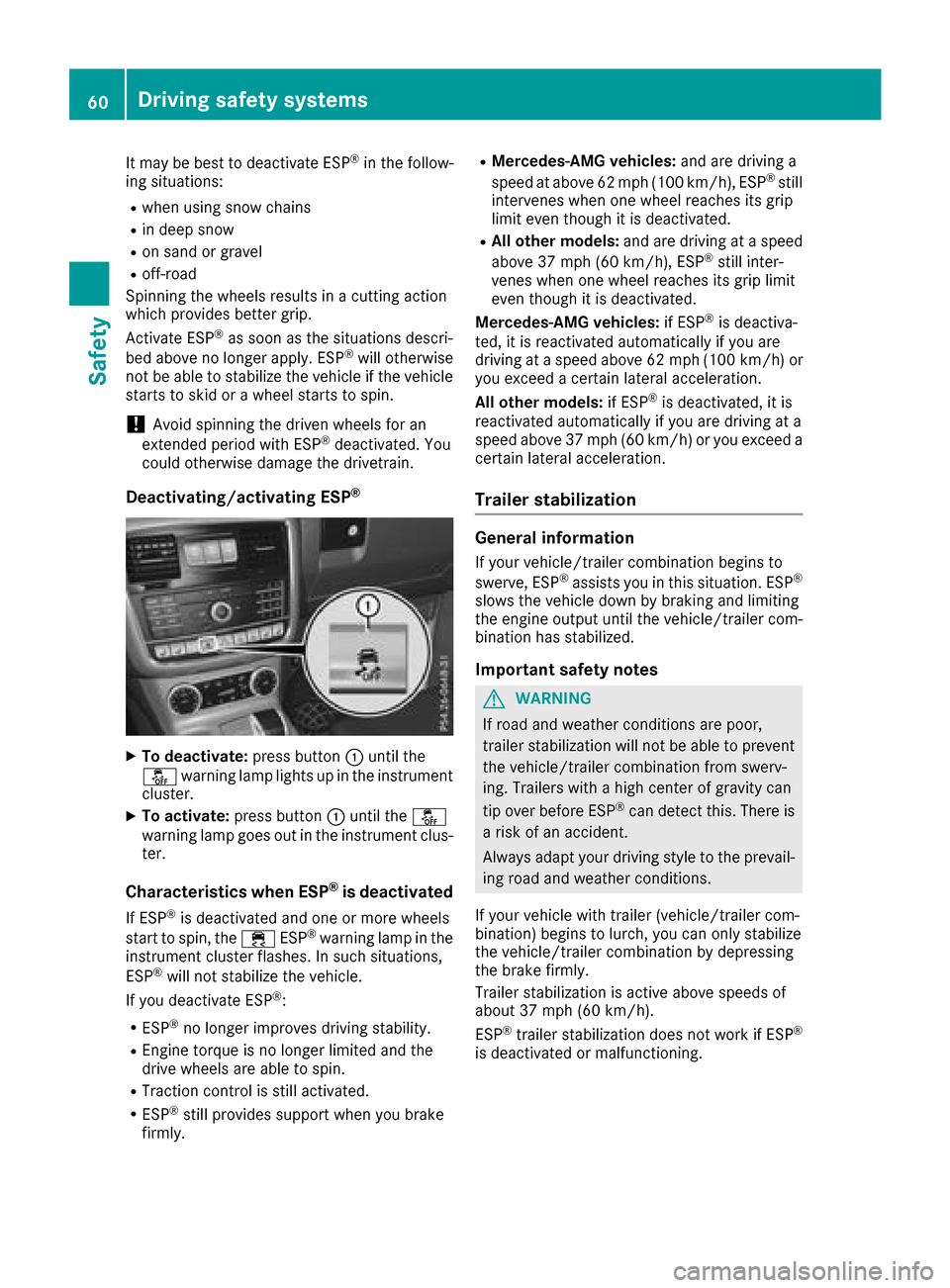
Deactivating/activating ESP®
XTo deactivate: press button:until the
å warning lamp lights up in the instrument
cluster.
XTo activate: press button :until the å
warning lamp goes out in the instrument clus-
ter.
Characteristic swhen ESP®is deactivated
If ESP®is deactivated and one or more wheels
start to spin, the ÷ESP®warning lamp in the
instrument cluster flashes. In such situations,
ESP
®willn ot stabilize the vehicle.
If you deactivate ESP®:
RESP®no longer improves driving stability.
REngine torque is no longer limited and the
drive wheelsa re abletospin.
RTraction control is still activated.
RESP®still providess upport when you brake
firmly.
RMercedes-AMG vehicles: and are driving a
speed at above 62 mph (100 km/h), ESP®still
intervenes when one wheel reaches its grip
limite ven though it is deactivated.
RAll other models: and are driving ataspeed
above 37 mph (60 km/h), ESP®still inter-
venes when one wheel reaches its grip limit
even though it is deactivated.
Mercedes-AMG vehicles: if ESP
®is deactiva-
ted, it is reactivated automatically if you are
driving at aspeed above 62 mph (100 km/h )or
you exceed acertain laterala cceleration.
All other models: if ESP
®is deactivated, it is
reactivated automatically if you are driving at a
speed above 37 mph (60 km/h) or you exceed a certain laterala cceleration.
Trailer stabilization
General information
If yourvehicle/trailer combination begins to
swerve, ESP®assists you in this situation. ESP®
slowst he vehicle down by braking and limiting
the engine outputu ntil the vehicle/trailer com-
bination has stabilized.
Important safety notes
GWARNING
If road and weather conditions are poor,
trailers tabilization willn ot be abletoprevent
the vehicle/trailer combination from swerv-
ing. Trailers with ahigh center of gravity can
tip over before ESP
®can detect this. There is
ar isk of an accident.
Alway sadapt you rdriving style to the prevail-
ing road and weather conditions.
If you rvehicle with trailer( vehicle/trailercom-
bination) begins to lurch, you can only stabilize
the vehicle/trailer combination by depressing
the brake firmly.
Trailer stabilization is active above speedso f
about3 7mph (60 km/h).
ESP
®trailer stabilization does not work if ESP®
is deactivated or malfunctioning.
60Driving safety systems
Safety