2017 MERCEDES-BENZ G-Class load capacity
[x] Cancel search: load capacityPage 21 of 286

Summer tiresinwinter .................. 253
Temperature .................................. 263
TIN (Tire Identification Number)
(definition) ..................................... 269
Tire bead (definition) ...................... 269
Tire pressure (definition) ................ 269
Tire pressures (recommended )...... 268
Tire size (data )............................... 273
Tire size designation, load-bearing
capacity, speed rating .................... 264
Tire tread. ...................................... 252
Tire tread( definition) ..................... 269
Totall oadlim it (definition) ............. 269
Tractio n......................................... 263
Tractio n(definition) ....................... 269
Tread wear ..................................... 263
TWR (permissibl etraile rdrawbar
noseweight) (definition) ................. 269
Uniform Tire Quality Grading
Standard s...................................... 263
Uniform Tire Quality Grading
Standard s(de finition) .................... 267
Wea rindicator (definition) ............. 269
Wheel and tire combination ........... 273
Wheel rim (definition) .................... 268
see Fla ttire
Top Tether ............................................ 52
Tow-starting
Emergency engine starting ............ 248
Important safety notes .................. 246
Towin gatrailer
Axle load ,permissibl e.................... 284
Cleaning the traile rtow hitch ......... 235
Coupling up atraile r...................... 154
Decoupling atraile r....................... 155
Driving tip s.................................... 151
Important safety notes .................. 149
Installing the ball coupling ............. 152
Lights display message .................. 176
Pulling away with atraile r.............. 105
Shift rang e..................................... 113
Trailer load s................................... 284
Trailer tow hitch ............................. 284
Towin gaway
Important safety guideline s........... 246
In the event of malfunctions .......... 248
With both axle
s on the ground ....... 247 Towin
geye
Front .............................................. 247
Rear ............................................... 247
Trafficr eports
see also Digital Operator's Man-
ua l.................................................. 198
Trailer
7-pi nconnecto r............................. 156
Power supply ................................. 156
Trailer coupling
see Towing atrailer
Trailer loads
Technical data ............................... 284
Trailer loads and drawbar nose-
weights ............................................... 155
Trailer tow hitch
Ballposition ................................... 284
Trailer towing
ESP
®................................................ 60
PARKTRONIC ................................. 142
Permissibl etraile rloads and
drawbar noseweights ..................... 155
Transfer case
Generaln otes ................................ 145
Shift rang e..................................... 145
Shifting .......................................... 146
Shifting (general notes). ................. 146
Shifting (important safety notes). .. 146
Shifting to neutral .......................... 147
Switching off the off-road gear
rati o............................................... 146
Switching on the off-road gear
rati o............................................... 146
Transmission
see Automati ctransmission
Transmissio npositions .................... 112
Transporting the vehicle .................. 247
Traveling uphill
Brow of hill ..................................... 130
Trim piece s(clea ning instruc-
tions) .................................................. 236
Trip computer (on-board com-
puter) .................................................. 160
Trip odometer
Calling up ....................................... 160
Resetting (on-board computer) ...... 160
Index19
Page 209 of 286
level of protection and could even cause
injuries.
RObjectsorloads in the trunk/cargo com-
partmentc annot be restraine dbythe seat
backrest.
There is an increased risk of injury.
Before everyt rip, make sure that the seat
backrestsa nd the rear benc hseat/rear seat
are engaged.
GWARNING
Combustion engines emit poisonous exhaust
gases such as carbo nmonoxide .Ifthe rear
door is open when the engin eisrunning, par-
ticularly if the vehicle is moving, exhaust
fumes could enter the passenger compart-
ment. There is arisk of poisoning.
Turn off the engin ebeforeo pening the rear
door. Never drive with the rear door open.
!Ensure that you remove all containers from
the cup holder in the rear beforef oldingthe
seat backrest and the seat cushio nofthe rear
benc hseat forwards.
Observe the loading guideline s(
Ypage 204).
The rear benc hseat is split symmetrically.
The left-han dand right-han drear benc hseats
can be folded forward to increase the capacity
of the rear compartment. You can:
Rfold the seat backrestsf orward
Rfold the rear benchseat back fully
Folding th eseat backrest forward
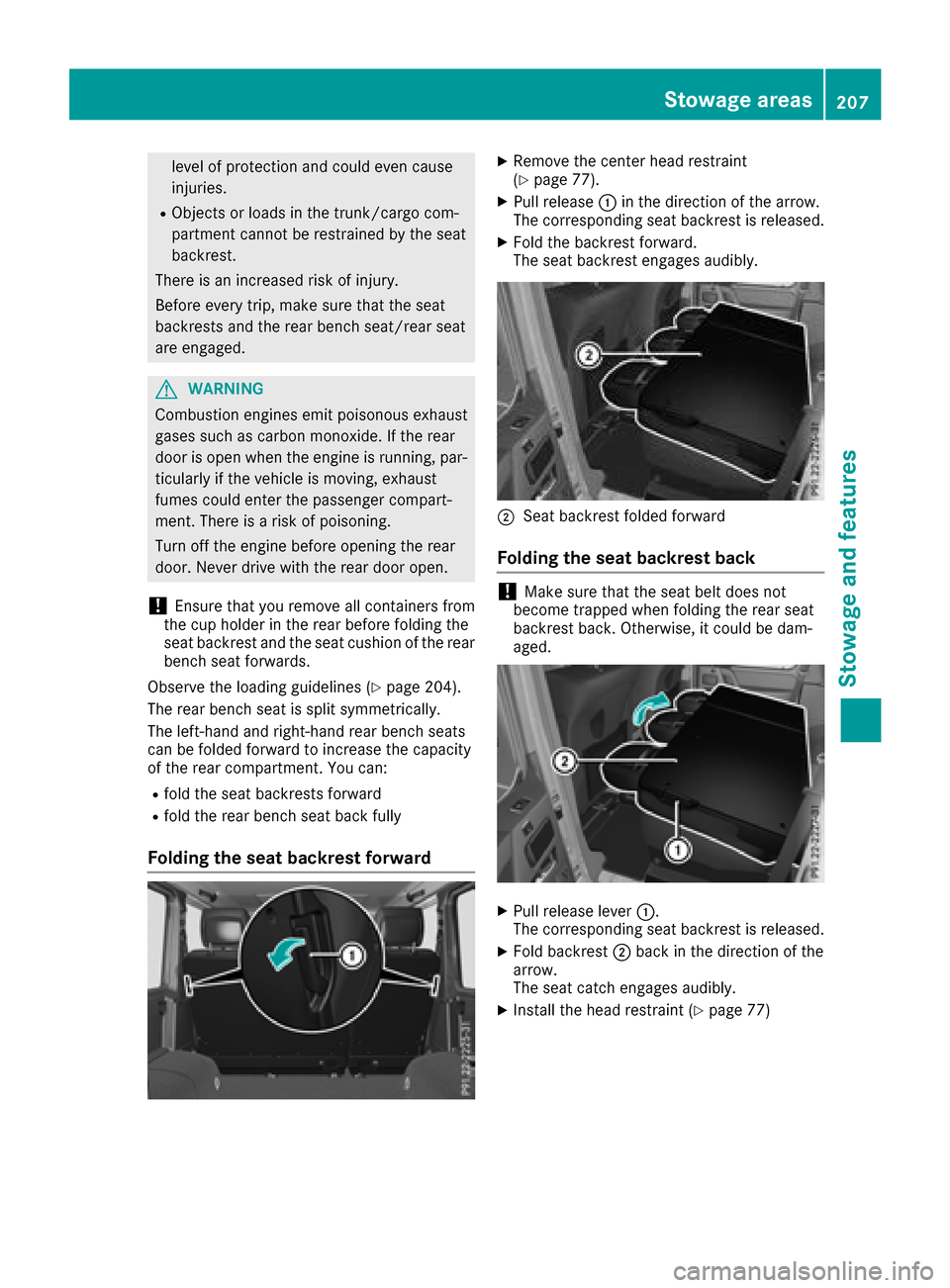
XRemove the center head restraint
(Ypage 77).
XPull release :in the direction of the arrow.
The correspondin gseat backrest is released.
XFold the backrest forward.
The seat backrest engages audibly.
;Seat backrest folded forward
Folding th eseat backrest back
!Make sure that the seat belt does not
becom etrapped when foldingt he rear seat
backrest back .Otherwise, it could be dam-
aged.
XPull release lever :.
The correspondin gseat backrest is released.
XFold backrest ;back in the direction of the
arrow.
The seat catch engages audibly.
XInstall the head restraint (Ypage 77)
Stowage areas207
Stowage and features
Z
Page 266 of 286
in combination, can cause excessiveheat
build-up and possible tir efailure.
The temperature grades are A(the highest), B,
and C, representin gthe tire's resistance to the
generatio nofheat and its ability to dissipate
heat when tested under controlled conditions
on aspecified indoo rlaboratory tes twheel. Sus-
tained high temperature can cause the material
of the tir etodegeneratea nd reducetirel ife, and
excessivet emperature can lead to sudden tire
failure. The grade Ccorresponds to alevel of
performance which all passenger car tires must
meet under the Federal Motor Vehicle Safety
Standard No. 109.G radesBandArepresent
higher levels of performance on the laboratory
tes twheel than the minimum requiredbyl aw.
Tirelabeling
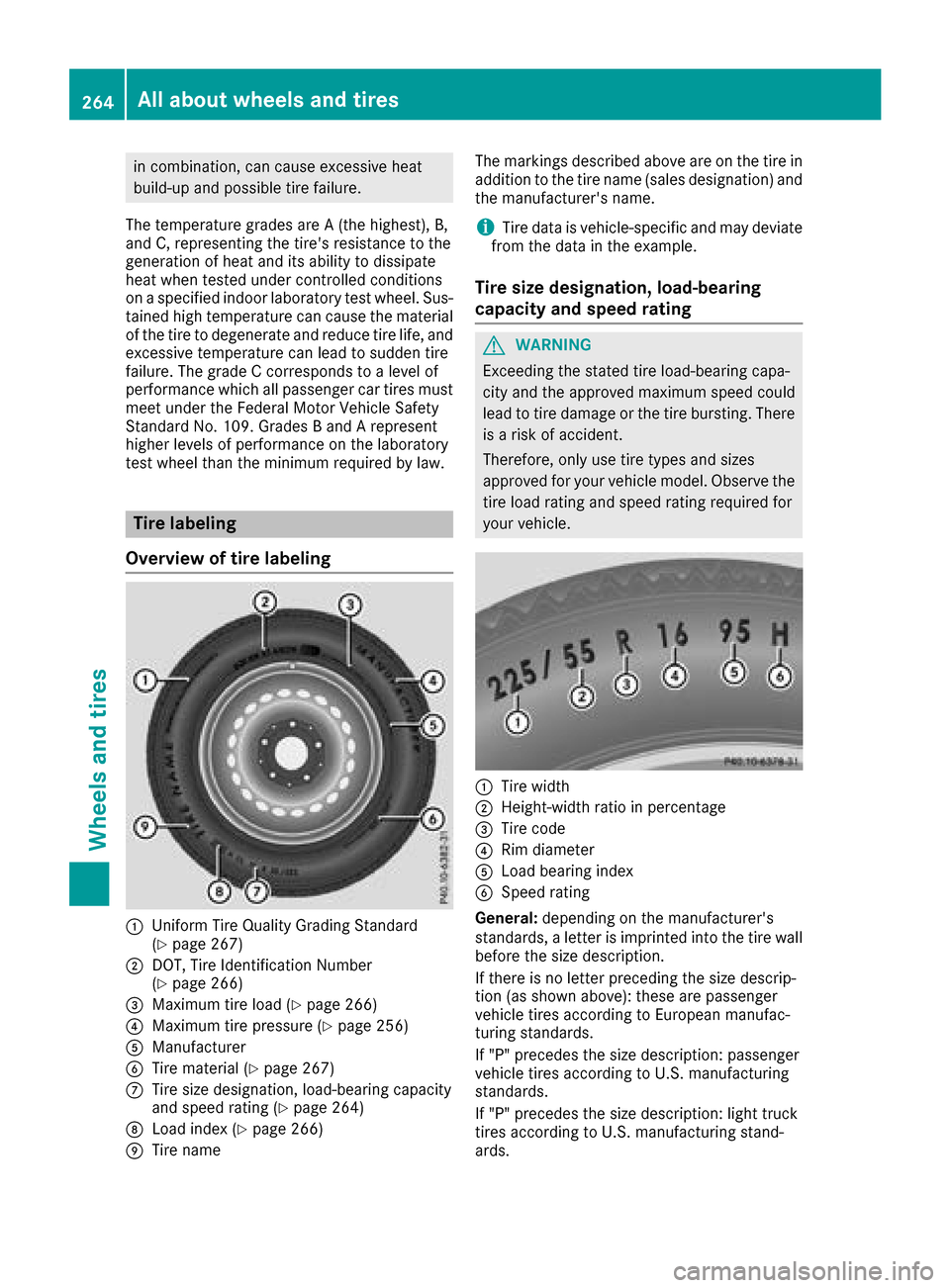
Overview of tir elabeling
:Uniform Tire Quality Grading Standard
(Ypage 267)
;DOT ,Tire Identification Number
(Ypage 266)
=Maximum tir eload (Ypage 266)
?Maximum tir epressure (Ypage 256)
AManufacturer
BTire material (Ypage 267)
CTire size designation ,load-bearing capacity
and speed ratin g(Ypage 264)
DLoad index (Ypage 266)
ETire name The markings described above are on the tir
ein
addition to the tir ename (sales designation )and
the manufacturer'sn ame.
iTire data is vehicle-specific and may deviate
fromt he data in the example.
Tires ize designation, load-bearing
capacity and speed rating
GWARNING
Exceedin gthe stated tir eload-bearing capa-
cit ya nd the approved maximum speed could
lead to tir edamage or the tir ebursting. There
is ar isk of accident.
Therefore, only use tir etypes and sizes
approved for your vehicle model. Observe the
tir el oad ratin gand speed ratin grequiredf or
your vehicle.
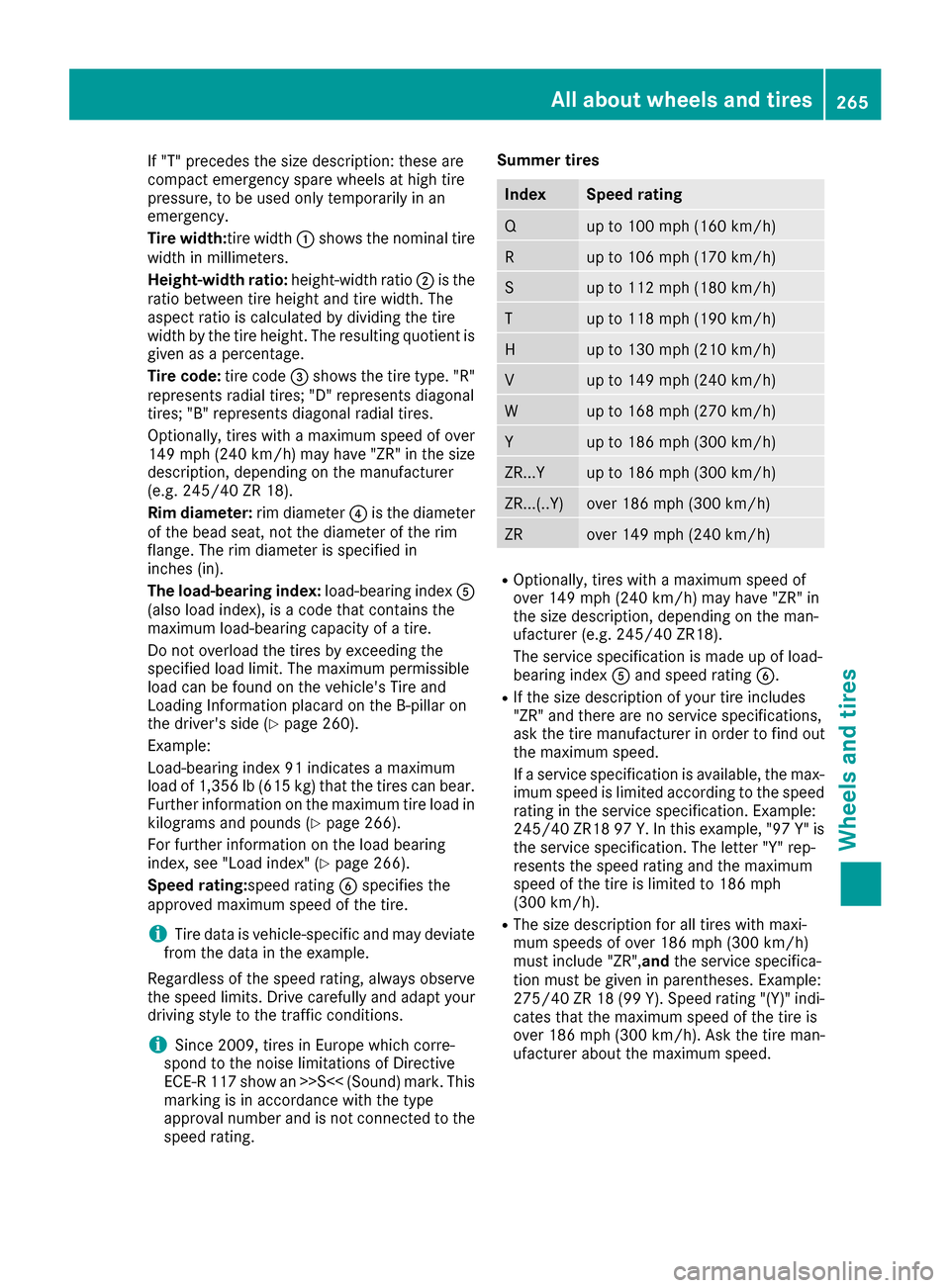
:Tire width
;Height-width ratio in percentage
=Tire code
?Rim diameter
ALoad bearingi ndex
BSpeed rating
General: depending on the manufacturer's
standards, aletter is imprinted int othe tir ewall
beforet he size description.
If there is no letter preceding the size descrip-
tion (as shown above): these are passenger
vehicle tires accordingtoE uropean manufac-
turin gstandards.
If "P" precedes the size description: passenger
vehicle tires accordingtoU .S.m anufacturing
standards.
If "P" precedes the size description: light truck
tires accordingtoU .S.m anufacturing stand-
ards.
264All about wheels and tires
Wheels and tires
Page 267 of 286
If "T" precedes the size description: these are
compact emergency spare wheelsathigh tire
pressure, to be used only temporarilyina n
emergency.
Tire width:tire width :shows the nominal tire
width in millimeters.
Height-width ratio: height-width ratio;is the
ratio between tire height and tire width. The
aspect ratio is calculated by dividing the tire
width by the tire height. The resulting quotient is
given as apercentage.
Tire code: tire code=shows the tire type. "R"
represents radial tires; "D" represents diagonal
tires; "B" represents diagonal radial tires.
Optionally, tires with amaximum speed of over
149 mph (240 km/h )may have "ZR "inthe size
description, depending on the manufacturer
(e.g. 245/40 ZR 18).
Rim diameter: rim diameter?is the diameter
of the bead seat, not the diameter of the rim
flange. The rim diameter is specifiedi n
inches (in).
The load-bearingi ndex:load-bearing index A
(also load index), is acode that contains the
maximum load-bearing capacity of atire.
Do not overloadt he tires by exceeding the
specifiedl oad limit. The maximum permissible
load can be found on the vehicle's Tire and
Loading Information placard on the B-pillaro n
the driver's side (
Ypage 260).
Example:
Load-bearing index 91 indicates amaximum
load of 1,356 lb (615 kg) that the tires can bear.
Further information on the maximum tire load in
kilograms and pounds (
Ypage 266).
For further information on the load bearing
index, see "Loadi ndex" (
Ypage 266).
Speed rating:speed rating Bspecifiest he
approved maximum speed of the tire.
iTire data is vehicle-specific and may deviate
from the data in the example.
Regardless of the speed rating, always observe
the speed limits. Drive carefully and adapt your driving style to the traffic conditions.
iSince 2009, tires in Europe which corre-
spond to the noise limitations of Directive
ECE-R 117 show an >>S<< (Sound) mark. This
marking is in accordance with the type
approval number and is not connected to the
speed ra
ting. Summer tires
IndexSpeed rating
Qup to 100 mph (160 km/h)
Rup to 106 mph (170 km/h)
Sup to 112 mph (180 km/h)
Tup to 118 mph (190 km/h)
Hup to 130 mph (210 km/h)
Vup to 149 mph (240 km/h)
Wup to 168 mph (270 km/h)
Yup to 186 mph (300 km/h)
ZR...Yup to 186 mph (300 km/h)
ZR...(..Y)over 186 mph (300 km/h)
ZRover 149 mph (240 km/h)
ROptionally, tires with
amaximum speed of
over 149 mph (240 km/h) may have "ZR "in
the size description, depending on the man-
ufacturer (e.g. 245/40 ZR18).
The service specification is made up of load-
bearing index Aand speed rating B.
RIf the size descriptionofy ourtire includes
"ZR"a nd there are no service specifications,
ask the tire manufacture rinorder to find out
the maximum speed.
If as ervice specification is available, the max-
imum speed is limited according to the speed rating in the service specification. Example:
245/40 ZR18 97 Y.In this example," 97 Y" is
the service specification. The letter "Y" rep-
resents the speed rating and the maximum
speed of the tire is limited to 186 mph
(300 km/h).
RThe size descriptionf or all tires with maxi-
mum speedsofo ver 186 mph (300 km/h)
must include "ZR", andthe service specifica-
tion must be given in parentheses.E xample:
275/40 ZR 18 (99 Y) .Speed rating "(Y)" indi-
cates that the maximum speed of the tire is
over 186 mph (300 km/h). Ask the tire man-
ufacturer aboutt he maximum speed.
Allabout wheels and tires265
Wheelsa nd tires
Z
Page 270 of 286
Recommendedtire pressures
The recommended tire pressure applie stothe
tire sm ounted at the factory.
The Tir eand Loading Information placard con-
tains the recommended tire pressures for cold
tire sonaf ully loaded vehicle and for the maxi-
mum permissible vehicle speed.
The tire pressure table contains the recommen- ded pressures for coldt iresfor variou soperat-
ing conditions ,i.e .d iffering loa dand speed con-
ditions.
Increasedv ehicle weight due to optional
equipment
The combined weigh tofallstandard and
optionale quipment available for the vehicle,
regardless of whether it is actually installed on
the vehicle or not.
Rim
Thisist he part of the wheel on which the tire is
mounted.
GAW R(Gross Axle Weight Rating)
The GAW Risthe maximum grossa xlew eight
rating. The actual loa donanaxlem ustn ever
excee dthe grossa xlew eigh trating. The gross
axl ew eigh trating can be found on the vehicle
identification plate on the B-pillar on the driver's
side.
Speed rating
The speed rating is part of the tire identification. It specifies the speed rang efor which the tire is
approved.
GTW (Gross Trailer Weight)
The GT Wisthe weigh tofatraile rincluding the
weigh tofthe load, luggage, accessorie setc. on
the trailer.
GVW (Gross Vehicl eWeight)
The grossv ehicle weigh tincludes the weigh tof
the vehicle including fuel, tools, the spare wheel,
accessorie sinstalled, occupants, luggage and
the drawbar noseweight, if applicable. The gross
vehicle weigh tmustn ot excee dthe grossv ehi-
cle weigh trating GVW Rasspecified on the vehi-
cle identification plate on the B-pillar on the
driver'ss ide.
GVWR (Gross Vehicl eWeight Rating)
The GVW Risthe maximum permissible gross
weigh tofafully loaded vehicle (the weigh tofthe
vehicle including al laccessories, occupants,
fuel, luggage and the drawbar noseweight, if
applicable). The grossv ehicle weightrating is
specified on the vehicle identification plate on
the B-pillar on the driver'ss ide.
Maximum loaded vehicle weight
The maximum weightist he sumo f:
Rthe curb weigh tofthe vehicle
Rthe weigh tofthe accessories
Rthe loa dlim it
Rthe weigh tofthe factory installed optional
equipment
Kilopascal (kPa)
Metricu nitf or tire pressure. 6.9 kPa corre-
sponds to 1psi.A nother uni tfor tire pressure is
bar. 100 kilopascals (kPa )are the equivalent of
1b ar.
Load index
In addition to the load-bearing index, the load
index may also be imprinte donthe sidewal lof
the tire .Thiss pecifies the load-bearing capacity
of the tire more precisely.
Curb weight
The weigh tofavehicle with standard equipment
incl uding the maximum capacity of fuel, oil and
coolant. It also includes the air-conditioning sys-
tem and optionale quipment if thesea re instal-
le dint he vehicle ,but doe snot includ epassen-
ger sorl uggage.
Maximum load rating
The maximum tire loa disthe maximum permis-
sible weigh tinkilograms or lb sfor which atire is
approved.
Maximum permissiblet ire pressure
Maximumpermissible tire pressure for one tire.
Maximum load on on etire
Maximu mloadono ne tire .Thisisc alculate dby
dividing the maximum axl eloa dofo ne axl eby
two.
268Al la bout wheels and tires
Wheels and tires
Page 273 of 286
Observe the following when raising the vehi-
cle:
RTo raise the vehicle, only use the vehicle-spe-
cific jack that has been tested and approved
by Mercedes-Benz.Ifused incorrectly, the
jack could tip over with the vehicle raised.
RThe jack is designed only to raise and hold the
vehicle for ashort time while awheel is being
changed. It must not be used for performing
maintenance work under the vehicle.
RAvoid changin gthe wheel on uphill and down-
hill slopes.
RBeforer aising the vehicle, secure it from roll-
ing away by applying the parking brake and
inserting wheel chocks. Do not disengage the
parking brake while the vehicle is raised.
RThe jack must be placed on afirm, flat and
non-slip surface. On aloose surface, alarge,
flat, load-bearing underlay must be used. On a
slippery surface, anon-slip underlay must be
used, e.g. rubber mats.
RDo not use wooden blocks or similar objects
as ajack underlay. Otherwise, the jack will not
be able to achieve its load-bearing capacity
due to the restricted height.
RMake sure that the distanc ebetween the
underside of the tires and the ground does not
exceed 1.2 in (3 cm).
RDo not place your hands or feet under the
raised vehicle.
RDo not lie under the vehicle.
RDo not start the engine when the vehicle is
raised.
RDo not open or close adoor when the vehicle
is raised.
RMake sure that no persons are present in the
vehicle when the vehicle is raised.
XUsing lug wrench :,loosen the bolts on the
wheel you wish to change by about one full
turn .Don ot unscrew the bolts completely.
XAssemble the pump lever for the jack from the
vehicle tool kit.
XTurn lowering screw =on the jack clockwise
as far as it will go using notch ;on the pump
lever.
Pressure release screw =is closed.
iDo not turn pressure release screw =by
more than one to two revolutions. Otherwise,
hydraulic fluid could escape.
XPosition jack Avertically under the jacking
point of axle carrier tube ?.
Changingawheel271
Wheels and tires
Z
Page 283 of 286

Refrigerant instructionlabel
Example:refrigerant instruction label
:Warning symbol
;Refrigerant filling capacity
=Applicabl estandards
?PAG oilp artn umber
AType of refrigerant
Warning symbol :advises yo uabout :
RPossible dangers
RHaving service work carrie doutataq uali fied
specialist workshop
Fillin gcapacities
Missing value sweren ot available at time of
going to print.
ModelRefrigerant
Mercedes-AMG vehicles
Al lo the rm odels
ModelPAGo il
Mercedes-AMG vehicles
Allm odels
Vehicl edata
General notes
Please note that for the specified vehicl edata:
Rthe heights specified may var yasaresultof:
-tires
-load
-condition of the suspension
-optionale quipment
Rthe vehiclelen gth specified includes the front
license plate adapter.
Dimension sand weights
Missing value sweren ot available at time of
going to print.
G5 50
:Distance to top
edge75 in -78.9 in
(1905 mm - 2005 mm)
; Distance to lower
edge26.8 in -30.7 in
(680 mm - 780 mm)
= Rangeofm ovement36.7 in (931 mm)
Vehicledata281
Technical data
Z