2017 MERCEDES-BENZ G-Class lock
[x] Cancel search: lockPage 54 of 286
childrestraint system with the Top Tether
belt, if available.
Alway scomply with the manufacturer'si nstal-
lation and operating instructions for the child
restraint system used.
Beforee very trip,make sure that the LATCH-
typ e(ISOFIX) chil drestraint system is engaged
correctly in both LATCH-typ e(ISOFIX) securing
rings
!Wheni nstalling the chil drestraint system,
make sure that the seatb eltf or the middle
seatd oesn ot get trapped .The seatb eltc ould
otherwise be damaged.
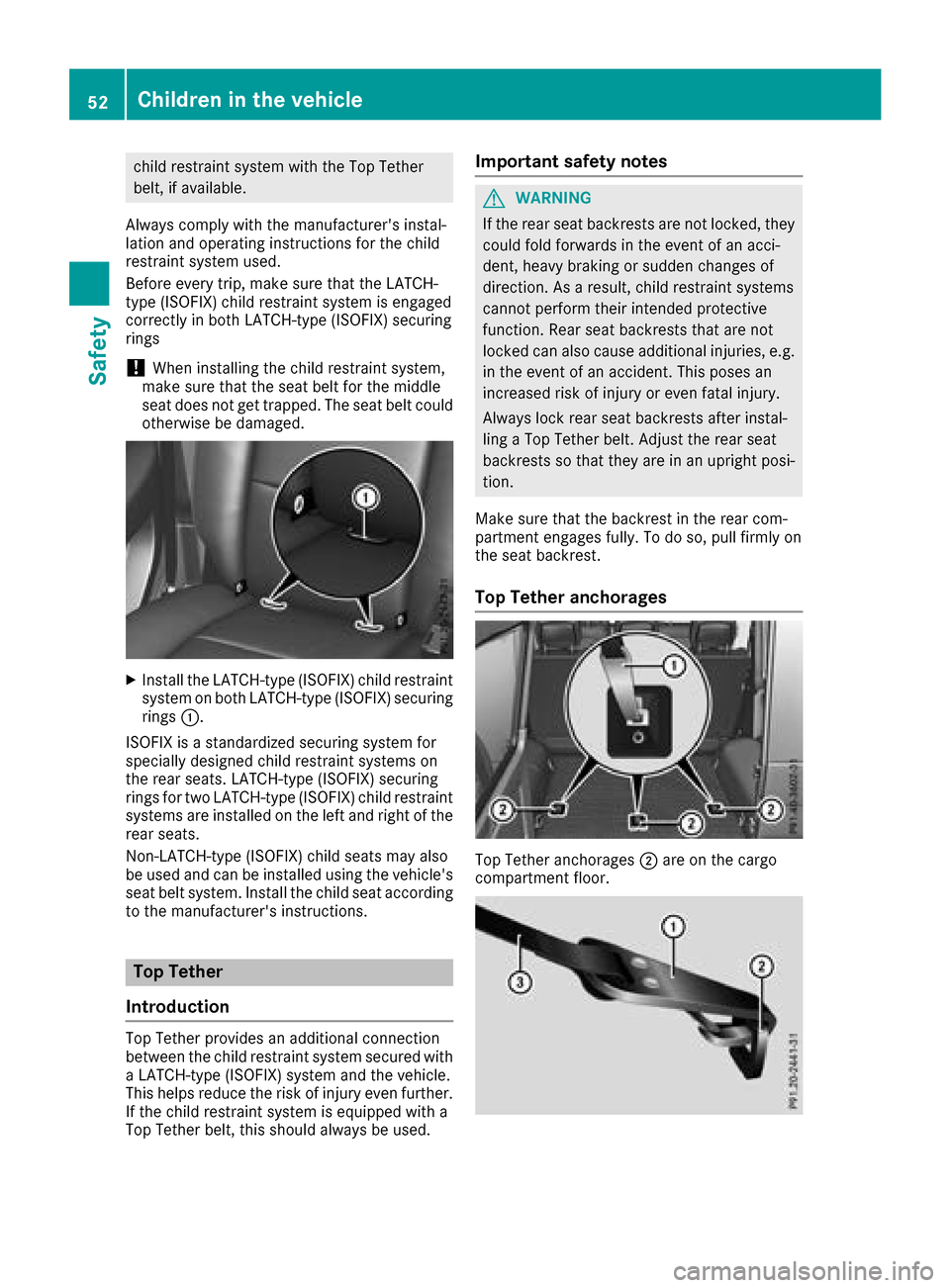
XInstal lthe LATCH-typ e(ISOFIX) chil drestraint
system on both LATCH-typ e(ISOFIX) securing
rings :.
ISOFIX is astandardized securing system for
speciall ydesigne dchildr estraint systems on
the rears eats. LATCH-typ e(ISOFIX) securing
ring sfor two LATCH-typ e(ISOFIX) chil drestraint
systems are installed on the left and right of the
rears eats.
Non-LATCH-typ e(ISOFIX) chil dseats may also
be used and can be installed using the vehicle's
seatb elts ystem. Instal lthe chil dseata ccording
to the manufacturer'si nstructions.
Top Tether
Introduction
Top Tether provides an additiona lconnection
between the chil drestraint system secured with
aL ATCH-typ e(ISOFIX) system and the vehicle.
Thish elps reduce the ris kofinjury evenf urther.
If the chil drestraint system is equipped with a
Top Tether belt, this shoul dalway sbeu sed.
Important safety notes
GWARNING
If the rears eatbackrests are not locked, they
could foldf orwardsinthe event of an acci-
dent, heavy braking or sudde nchanges of
direction. As aresult, chil drestraint systems
cannot perform theiri ntended protective
function. Rear seatb ackrests that are not
locke dcan also cause additiona linjuries, e.g.
in the event of an accident. Thisp oses an
increase driskofi njury or evenf atalinjury.
Alway slock rears eatbackrests afte rinstal-
ling aTop Tether belt. Adjus tthe rears eat
backrests so that they are in an upright posi-
tion.
Make sure that the backrest in the rearc om-
partment engages fully .Todoso, pull firmly on
the seatb ackrest.
Top Tethe ranchorages
Top Tether anchorages ;are on the cargo
compartment floor.
52Children in the vehicle
Safety
Page 56 of 286

GWARNING
If you secure achild in aforward-facing child
restraint system on the front-passenge rseat
and you position the front-passenge rseat too
close to the dashboard, in the event of an
accident, the child could:
Rcome into contact with the vehicle's inte-
rior if the PASSENGER AIR BAG OFF indi-
cator lamp is lit, for example
Rbe struck by the air bag if the PASSENGER
AIR BAG OFF indicator lamp is off
This poses an increased risk of injury or even fatal injury.
Move the front-passenge rseat as far back as
possible.A lways make sure that the shoulder
belts trap is correctly routed from the vehicle
belts ash guide to the shoulderb eltguide on
the child restraint system. The shoulderb elt
strap must be routed forwards and down-
wards from the belts ash guide. If necessary,
adjust the belts ash guide and the front-
passenger seat accordingly.A lways observe
the information about suitable positioning of
the child restraint system in this Operator's
Manual as wellast he child restraint system
manufacturer's installation instructions.
PASSENGER AIR BAG OFF indicator lamp :
showsy ou whethert he front-passenge rfront air
bag is deactivated.
XTurn the SmartKey to position 1or 2in the
ignitio nlock.
The system carrie sout self-diagnostics.
The PASSENGER AIR BAG OFF indicator lamp
must light up for approximately six seconds. If, after the system self-test, the
PASSENGER AI
RBAG OFF indicator lamp:
Ris lit:t he front-passenge rfront air bag is
deactivated. It wil lthen not be deploye dinthe
event of an accident.
Ris not lit :the sensor system did not detect a
child restraint system with transponde rfor
the BabySmart™ air bag deactivation system.
If, in the event of an accident, all deployment criteria are met, the front-passenge rfront air
bag is deployed.
Childr estraint system on the front-
passenger seat
General notes
Accident statistics show that children secured
in the rear seats are safer than children secured
in the front-passenge rseat. For this reason,
Mercedes-Benz strongly advises that you install
the child restraint system on arear seat.
If it is absolutel ynecessary to install achild
restraint system on the front-passenge rseat,
alway sobserve the information on the "Baby-
Smart™ air bag deactivation system"
(
Ypage5 3).
You can thus avoi dthe risks that coul darisea s
ar esult of:
Rac hild restraint system that is not detected
by the BabySmart™ air bag deactivation sys-
tem sensor system
Rthe unintentional deactivation of the front-
passenger front air bag
Rthe unsuitabl epositioning of the child
restraint system, e.g. too close to the dash-
board
Rearward-facin gchildr estraint system
If it is absolutel ynecessary to install arearward-
facing child restraint system on the front-
passenger seat, alway smake sure that the
front-passenge rfront air bag is deactivated.
Only if the PASSENGER AIR BAG OFF indicator
lamp is permanently lit (
Ypag e39) is the front-
passenger front air bag deactivated.
Always observe the child restraint system man-
ufacturer's installation and operating instruc-
tions.
54Children in the vehicle
Safety
Page 58 of 286
Child-proof locks
Important safety notes
GWARNING
If childre nare traveling in th evehicle ,the y
could:
Ropen doors, thus endangering other people
or road users
Rexit th evehicle and be caught by oncoming
traffic
Roperate vehicle equipmenta nd become
trapped
Thereisar iskofana ccidenta nd injury.
Always activat ethe child-proof locks and
override feature if childre nare traveling in the
vehicle .When leaving th evehicle ,always take
th ek eywithy ou and lockt hevehicle .Never
leave childre nunattende dinthevehicle.
Override feature for:
Rth er ear doors(Ypage 56)
Rther ear side windows (Ypage 56)
GWARNING
If you leave childre nunsupervised in th evehi-
cle ,the yc oul dset it in motion by, for example:
Rrelease th eparking brake.
Rshiftt heautomatic transmission out of the
parking position P.
Rstart theengine.
In addition,t heym ay operate vehicle equip-
men tand become trapped. Thereisar isko f
an accidenta nd injury.
When leaving th evehicle ,always tak ethe
SmartKey withy ou and lockthevehicle .Never
leave childre nunsupervised in th evehicle.
GWARNING
If persons, particularly childre nare subjected
to prolonged exposuretoe xtremeheat or
cold, there is ariskofi njury, possibly even
fatal. Never leave childre nunattende dinthe
vehicle.
GWARNING
If th echild restraint system is subjected to
direct sunlight,p artsm ay get ver yhot.C hil-
dren may burn themselve sonthese parts,
particularly on th emetal partsoft hechild
restraint system. Thereisar iskofi njury.
If you leave th evehicle ,taking th echild with
you, always ensure that th echild restraint
system is no texposedtod irect sunlight.P ro-
tect it withab lanket, for example .Ifthechild
restraint system has been exposedtod irect
sunlight,l et it cooldown before securin gthe
child in it. Never leave childre nunattende din
th ev ehicle.
Child-proof locks for th ereard oors
You secure each door individually witht hechild-
proof locks on th erear doors. Adoor secured
withac hild-proof lockc annotbeo pened from
inside th evehicle .When th evehicle is unlocked,
th ed oor can be opened from th eoutside.
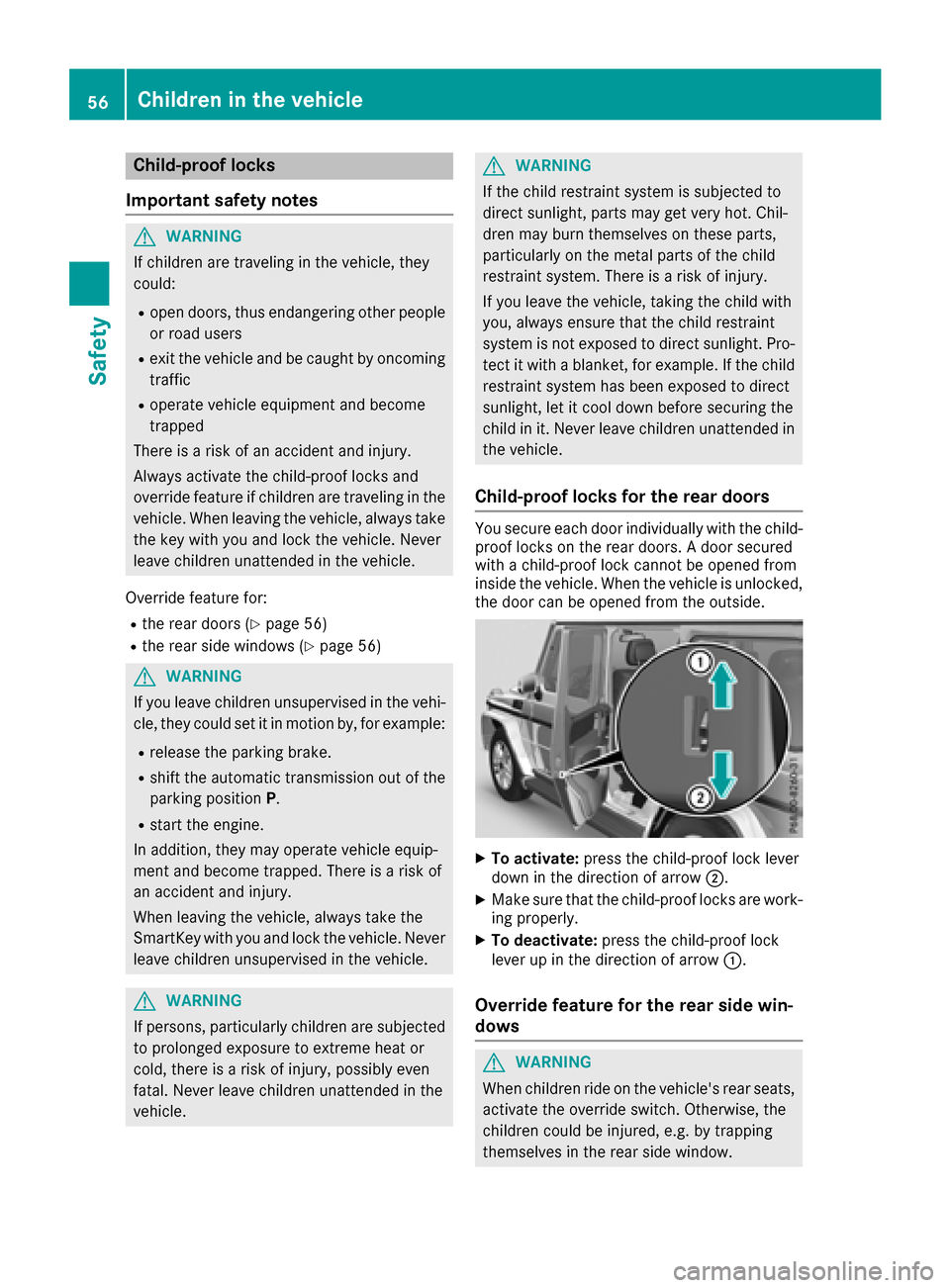
XTo activate: pressthe child-proof lockl ever
down in th edirection of arrow ;.
XMakesure that th echild-proof locks are work-
ing properly.
XTo deactivate: pressthe child-proof lock
leve rupint hedirection of arrow :.
Overridefeature for th erears idew in-
dows
GWARNING
When childre nride on th evehicle's rear seats,
activat ethe override switch .Otherwise, the
childre ncoul dbei njured, e.g .bytrapping
themselve sintherear side window.
56Children in th evehicle
Safety
Page 59 of 286
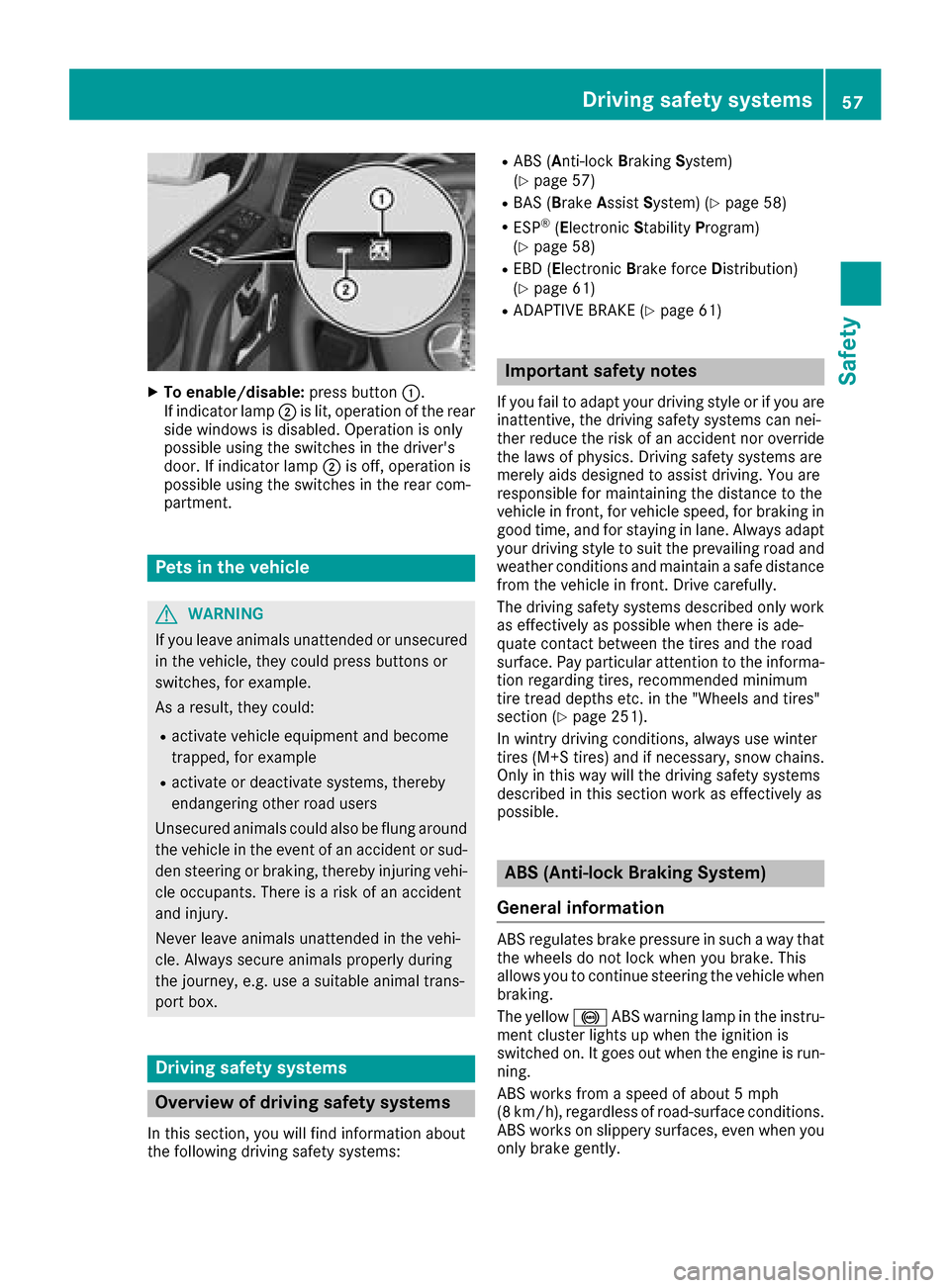
XTo enable/disable:press button:.
If indicator lamp ;is lit, operatio nofthe rear
side windows is disabled .Operation is only
possibl eusing the switches in the driver's
door. If indicator lamp ;is off, operatio nis
possibl eusing the switches in the rearc om-
partment.
Pets in the vehicle
GWARNING
If yo ulea ve animals unattende dorunsecured
in the vehicle, they could press buttons or
switches, for example.
As aresult, they could:
Ractivate vehicl eequipment and become
trapped, for example
Ractivate or deactivate systems, thereby
endangering othe rroadu sers
Unsecured animals could also be flung around
the vehicl einthe event of an accident or sud-
de ns teering or braking ,thereb yinjuring vehi-
cle occupants. There is ariskofana ccident
and injury.
Never leave animals unattende dinthe vehi-
cle .Alway ssecure animals properly during
the journey ,e.g.u se asuitabl eanimal trans-
port box.
Driving safety systems
Overvie wofdriving safety systems
In thiss ection, yo uwillf ind informatio nabout
the following driving safety systems:
RABS ( Anti-lock Braking System)
(Ypage 57)
RBAS ( Brake Assis tSys tem )(Ypage 58)
RESP®(E le ctronic Stability Program)
(Ypage 58)
REBD ( Ele ctronic Brake force Dis tribution)
(Ypage 61)
RADAPTIVE BRAK E(Ypage 61)
Important safety notes
If youfailtoa dapt your driving style or if yo uare
inattentive, the driving safety systemsc an nei-
ther reduce the ris kofanaccident nor override
the laws of physics. Driving safety systemsa re
merel yaidsd esig ned to assist driving .You are
responsibl efor maintaining the distance to the
vehicl einfront, for vehicl espeed ,for braking in
goo dtime ,and for staying in lane. Alway sadapt
your driving style to suit the prevailing roada nd
weather conditions and maintain asafed istance
from the vehicl einfront. Driv ecarefully.
The driving safety systemsd escribe donlyw ork
as effectively as possibl ewhent her eisa de-
quate contact between the tire sand the road
surface. Payp articula rattentio ntothe informa-
tio nr egarding tires, recommende dminimum
tire trea ddepths etc. in the "Wheels and tires"
section (
Ypage 251).
In wintry driving conditions, always us ewinter
tire s(M+ Stires) and if necessary,s now chains.
Onlyint hiswaywill the driving safety systems
describe dinthissection work as effectively as
possible.
ABS (Anti-lock Brakin gSystem)
General information
ABS regulate sbrake pressure in such awaythat
the wheels do not lock when yo ubrake. This
allows yo utocontinue steering the vehicl ewhen
braking.
The yellow !ABS warning lamp in the instru-
ment cluster lights up when the ignition is
switched on. It goe soutwhen the engine is run-
ning.
ABS works from aspeed of about5m ph
(8 km/h), regardless of road-surface conditions.
ABS works on slippery surfaces, eve nwheny ou
onlyb rake gently.
Driving safety systems57
Safety
Z
Page 60 of 286

Important safety notes
iObservethe "Importan tsafet ynotes "sec-
tion (Ypage 57).
GWARNIN G
If AB Sisf aulty, th ewheels could loc kwhen
braking .The steerabilit yand braking charac -
teristics may be severely impaired .Addition -
ally, further driving safet ysystems are deac -
tivated. Ther eisanincreased danger of skid-
din gand accidents .
Drive on carefully. Hav eABS checke dimme-
diately at aqualified specialist workshop.
When AB Sismalfunctioning ,other systems ,
includin gdriving safet ysystems ,will also
become inoperative. Observ ethe information
on th eABS warning lamp (
Ypage 190) and dis-
play message swhichm ay be shown in th e
instrumen tcluste r(
Ypage 171).
Braking
XIf ABS intervenes: continue to depress th e
brak epedal vigorously until th ebraking sit -
uation is over.
XTo make afullb rake application: depress
th eb rak epedal wit hfull force .
If AB Sintervenes when braking ,you will fee la
pulsing in th ebrak epedal .
The pulsating brak epedal can be an indication
of hazardous road conditions, and function sasa
reminder to tak eextra carew hile driving .
Off-road ABS
An ESP®system specifically suited to off-road
terrain is activated automatically once th eoff-
road program is activated.
At speeds belo w37mph (60 km/h), th efront
wheels loc kcyclically during braking .The dig-
ging-in effec tachieved in th eprocess reduce s
th es topping distanc eonoff-road terrain .This
limits steering capability.
BAS (Brak eAssistS ystem)
General information
BA So perate sinemergenc ybraking situations.
If you depress th ebrak epedal quickly, BA S
automatically boosts th ebraking force ,thu s
shortening th estopping distance.
Important safety notes
iObserv ethe "Importan tsafet ynotes "sec-
tion (Ypage 57) .
GWARNIN G
If BA Sism alfunctioning ,the braking distanc e
in an emergenc ybraking situation is
increased. Ther eisariskofana ccident.
In an emergenc ybraking situation ,depress
th eb rak epedal wit hfull force .ABS prevents
th ew heels from locking.
Braking
XKee pthe brak epedal firmly depressed until
th ee mergenc ybraking situation is over.
AB Sp revents th ewheels from locking.
The brakes will function as usual once you
release th ebrak epedal .BAS is deactivated.
ESP®(Electronic StabilityP rogram)
General notes
iObserv ethe "Importan tsafet ynotes "sec-
tion (Ypage 57).
ES P
®monitors driving stabilit yand traction ,i.e .
power transmission between th etires and th e
road surface.
If ES P
®detects that th evehicl eisd eviating from
th ed irection desired by th edriver, on eormore
wheels are braked to stabiliz ethe vehicle. The
engin eoutput is also modifie dtokeept he vehi-
cle on th edesired cours ewithin physical limits .
ES P
®assist sthe driver when pullin gaway on
wet or slippery roads. ES P®can also stabilize
th ev ehicl eduring braking .
58Driving safety systems
Safety
Page 61 of 286
4ETS (Electronic Traction System)
iObserve the "Important safety notes" sec-
tion (Ypage 57).
4ET Straction contro lispart of ESP
®.
4ET Straction contro lisnolonger activ eabove a
speed of approximately 37 mph (60 km/h).
Traction contro lbrakes the drive wheels indi-
vidually if they spin. This enables you to pull
away and accelerate on slippery surfaces,f or
example if the road surface is slippery on one
side. In addition, more drive torque is transfer-
red to the wheel or wheels with traction.
Traction contro lremains active, even if you
deactivate ESP
®.
Importan tsafetyn otes
iObserve the "Important safety notes" sec-
tion (Ypage 57).
GWARNING
If ESP
®is malfunctioning, ESP®is unable to
stabilize the vehicle. Additionally, further driv-
ing safety systems are deactivated. This
increases the risk of skiddin gand an accident.
Driv eonc arefully. Have ESP
®checked at a
qualified specialist workshop.
!Only operate the vehicle for amaximum of
ten seconds on abrake test dynamometer.
Switc hoff the ignition.
Application of the brakes by ESP
®may oth-
erwise destroy the brake system.
!Af unction or performanc etest should only
be carried out on atwo-axle dynamometer.
Beforey ou operate the vehicle on such a
dynamometer, please consult aqualified
workshop. You could otherwise damage the
drive train or the brake system.
If the å ESP
®OFF warning lamp lights up
continuously, ESP®is deactivated.
If the ÷ ESP®warning lamp lights up contin-
uously, ESP®is not available due to amalfunc-
tion.
Observe the information on warning lamps
(
Ypage 191) and display messages which may
be displayed in the instrument cluster
(
Ypage 171). Only use wheels with the recommended tire
sizes. Only then will ESP
®function properly.
If differential locksa re switched on, ABS, BAS
and ESP
®switc hoff automatically.
Characteristics of ESP®
Genera linformation
If the ÷ ESP®warning lamp goes out before
beginning the journey, ESP®is automatically
active.
If ESP
®intervenes, the ÷ESP®warning lamp
flashes in the instrument cluster.
If ESP
®intervenes:
XDo not deactivate ESP®under any circum-
stances.
XOnly depress the accelerator pedal as far as
necessary when pulling away.
XAdapt your drivings tyle to suit the prevailing
road and weather conditions.
ECO start/stop function
The ECO start/stop function switches the
engin eoff automatically when the vehicle stops
moving. The engin estart sautomatically when
the driver wants to pull away again. ESP
®
remains in its previously selected status, e.g. if
ESP®was deactivated before the engin ewas
automatically switched off.
Deactivating/activating ESP®
Important safetyn otes
iObservethe "Important safety notes" sec-
tion (Ypage 57).
You can select between the following states of
ESP
®:
RESP®is activated.
RESP®is deactivated.
GWARNING
If you deactivate ESP
®,E SP®no longer sta-
bilizes the vehicle. There is an increased risk
of skiddin gand an accident.
Only deactivate ESP
®in the situation sdescri-
bed in the following.
Driving safetys ystems59
Safety
Z
Page 63 of 286
EBD (electronic brakeforce distribu-
tion)
General information
EB Dm onitors and controls th ebrak epressure
on th erear wheels to improve driving stability
while braking.
Important safety notes
iObserv ethe "Important safety notes" sec-
tio n(Ypage 57).
GWARNING
If EB Dism alfunctioning, th erear wheels can
lock, e.g .unde rfull braking .This increases the
risk of skiddinga nd an accident.
You should therefore adapt your driving style
to th edifferenth andlingcharacteristics .Have
th eb rak esystem checked at aqualified spe-
cialist workshop.
Observ einformatio nregardin gindicator and
warning lamps (
Ypage 190) as well as display
messages (Ypage 172).
ADAPTIV EBRAKE
ADAPTIVEB RAKE provide sincreased braking
safety. In addition to th ebraking function,
ADAPTIVEB RAKE also has th eHOLDf unction
(
Ypage 139) and hill start assist(Ypage 127).
Protection against theft
Immobilizer
The immobilizer prevent syour vehicle from
beings tarted without th ecorrec tSma rtKey.
XTo activate: remove theSmartKey from the
ignition lock.
XTo deactivate: switch on theignition.
When leavin gthe vehicle ,always tak ethe
SmartKey with you and lockt hevehicle .The
engine can be started by anyon ewithavalid
SmartKey that is left inside th evehicle.
iThe immobilizer is always deactivate dwhen
you start th eengine. In th
eeven ttha tthe engine canno tbestarted
(yet th evehicle's battery is charged), th esys-
te misn otoperational. Contac tanauthorized
Mercedes-Ben zCenter or call
1-800-FOR-MERCedes (in th eUSA)or
1-800-387-0100 (in Canada).
ATA (anti-thef talarm system)
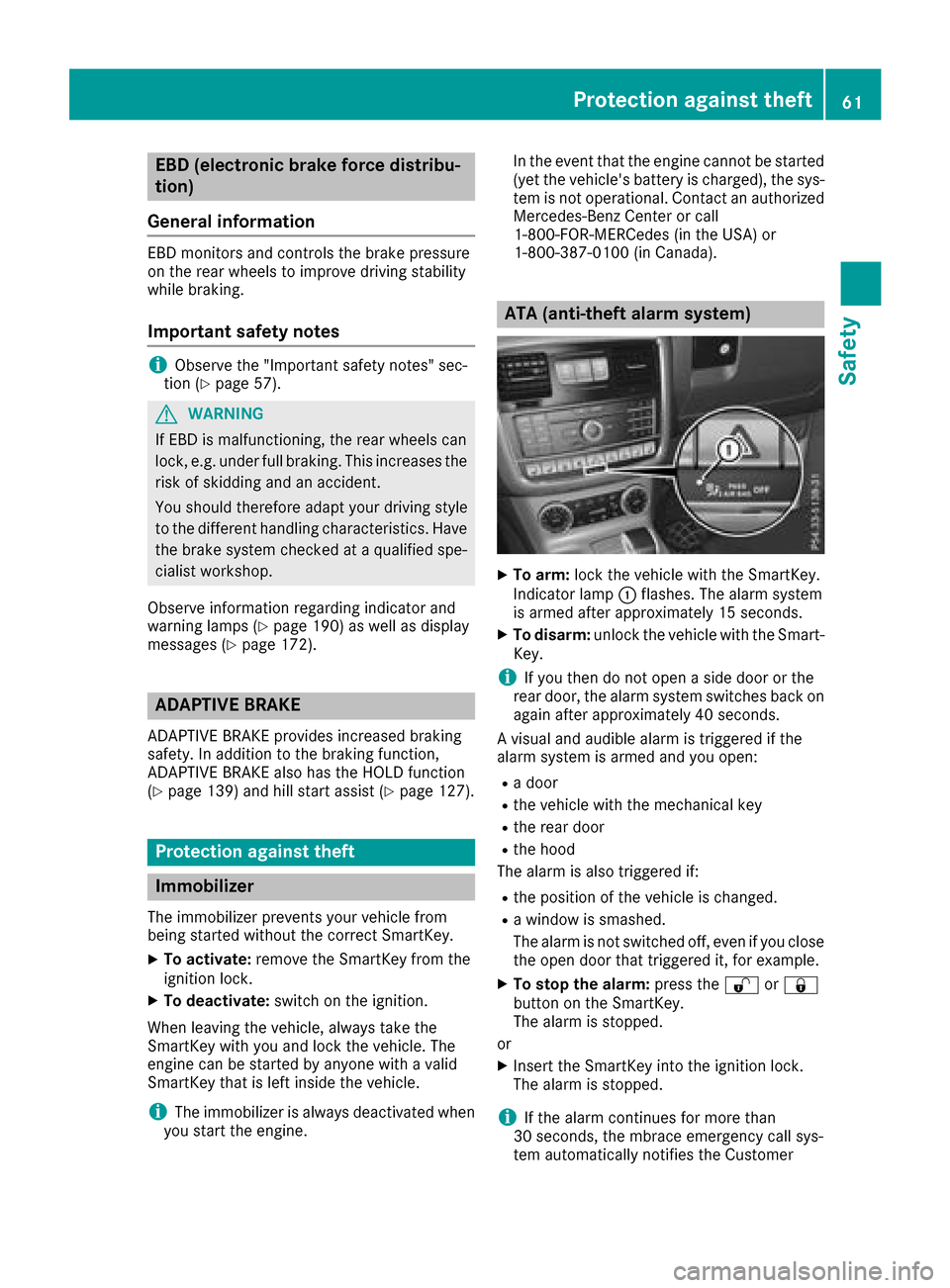
XTo arm: lockthevehicle with th eSmartKey.
Indicato rlamp :flashes. The alarm system
is armed after approximately 15 seconds.
XTo disarm: unlock thevehicle with th eSma rt-
Key.
iIf you then do no topen aside door or the
rear door,t healarm system switches back on
again after approximately 40 seconds.
Av isual and audible alarm is triggered if the
alarm system is armed and you open:
Rad oor
Rthev ehicle with th emechanical key
Rther ear door
Rtheh ood
The alarm is also triggered if:
Rth ep osition of th evehicle is changed.
Raw indow is smashed.
The alarm is no tswitched off ,even if you close
th eo pen door that triggered it, for example.
XTo stop th ealarm: pressthe % or&
butto nont heSmartKey.
The alarm is stopped.
or
XInsertt heSmartKey int othe ignition lock.
The alarm is stopped.
iIf th ealarm continues for mor ethan
30 seconds, th embrace emergency call sys-
te ma utomaticall ynotifies th eCustomer
Protection against theft61
Safety
Z
Page 65 of 286
SmartKey
Important safety notes
GWARNING
If children are left unsupervised in the vehicle,
they could:
Ropen the doors, thus endangering other
people or road users.
Rget out and disrupt traffic.
Roperate the vehicle's equipment.
Additionally, children could set the vehicle in
motion if, for example, they:
Rrelease the parking brake.
Rshifting the automatic transmission out of
park position P
RStart the engine.
There is arisk of an accident and injury.
When leaving the vehicle, always take the
SmartKey with you and lock the vehicle. Never
leave children or animals unattended in the
vehicle. Always keep the SmartKey out of
reach of children.
GWARNING
If you attach heavy or large object stothe
SmartKey, the SmartKey could be uninten-
tionally turned in the ignition lock. This could
cause the engine to be switched off. There is a risk of an accident.
Do not attach any heavy or large object stothe
SmartKey. Remove any bulky key rings before
insertingt he SmartKey into the ignition lock.
!Keep the SmartKey away from stron gmag-
netic fields. Otherwise, the remote control
function could be affected.
Strong magnetic fields can occur in the vicin-
ity of powerful electrical installations.
Do not keep the SmartKey:
Rwith electronic devices, e.g. amobile phone
or another SmartKey.
Rwith metallic objects, e.g. coins or metal foil.
Rinside metallic objects, e.g. ametal case.
This can affect the functionality of the Smart- Key. Ac
heck which periodically establishes aradio
connection between the vehicle and the Smart-
Key determines whether avalid SmartKey is in
the vehicle. This occurs, for example:
Rwhen startin gthe engine
Rwhile driving
SmartKey functions
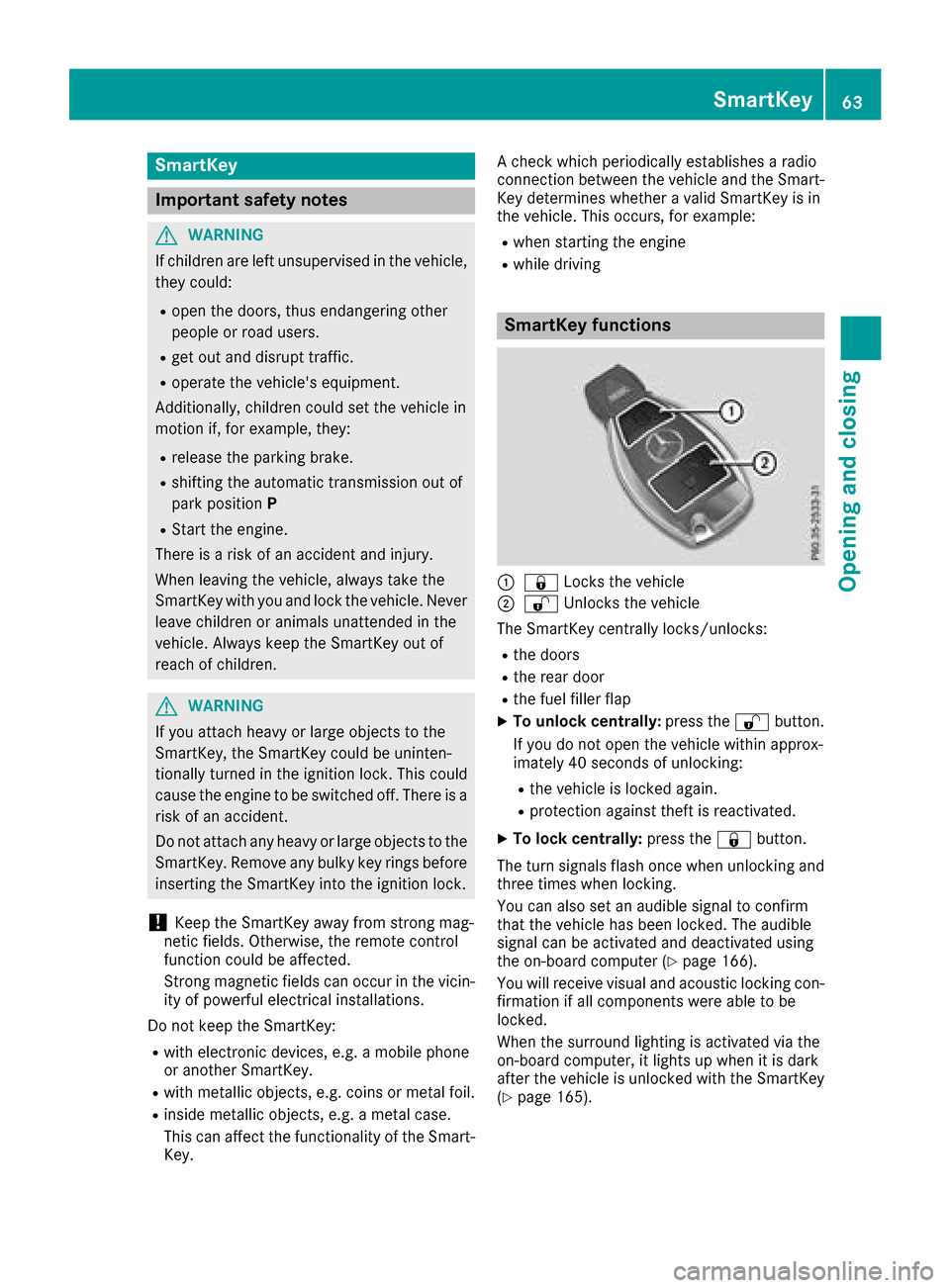
:& Locks the vehicle
;%Unlockst he vehicle
The SmartKey centrally locks/unlocks:
Rthe doors
Rthe rear door
Rthe fuel filler flap
XTo unlock centrally: press the%button.
If you do not open the vehicle within approx-
imately 40 seconds of unlocking:
Rthe vehicle is locked again.
Rprotection against theft is reactivated.
XTo lock centrally: press the&button.
The turn signals flash once when unlocking and
three times when locking.
You can also set an audible signal to confirm
that the vehicle has been locked. The audible
signal can be activated and deactivated using
the on-board computer (
Ypage 166).
You will receive visual and acoustic locking con-
firmation if all components were able to be
locked.
When the surround lighting is activated via the
on-board computer, it lights up when it is dark
after the vehicle is unlocked with the SmartKey (
Ypage 165).
SmartKey63
Opening and closing
Z