2017 MERCEDES-BENZ G-Class lock
[x] Cancel search: lockPage 19 of 286

Convenience opening feature .......... 70
Display message ............................ 187
Door central locking/unlocking ...... .63
Important safety notes .................... 63
Loss .................................................6 6
Mechanical key ................................ 64
Overview .......................................... 63
Positions (ignition lock) ................. 104
Problem (malfunction) ..................... 66
Starting the engine ........................ 105
SMS
see also Digital Operator's Man-
ual .................................................. 198
Snow chains ...................................... 253
Socket (12 V)
Cargo compartment. ...................... 213
Front-passenger footwell ............... 212
General notes ................................ 212
Rear compartment. ........................213
Sound
Switching on/off ........................... 199
Spare fuses ........................................ 249
Spare wheel
Spare wheel bracket at the rear .... 239
Stainless-steel spare hub cap ........2 39
Special seat beltr etractor.................. 50
Specialist workshop ............................ 27
Speedometer
Digita l............................................ 160
In the Instrument cluster ................. 32
Segments ...................................... 157
Selecting the displayu nit ...............165
Standingl amps
Display message ............................ 176
Switching on/off .............................. 86
Starting the engine
Important safety notes .................. 104
Steering (display message) .............. 187
Steering wheel
Adjusting (electrically). .................... 80
Buttons (on-board computer) ......... 158
Cleaning ..................... .................... 236
Important sa
fety notes .................... 79
Paddle shifters ............................... 114
Steering wheel heating .................... 80
Storing settings (memory func-
tion) ................................................. 83 Steering wheel heating
Indicator lamp (malfunction) ............ 80
Steering wheel paddle shifters ........114
Stopwatch (RACETIMER) ................... 168
Stowage areas ................................... 205
Stowage compartment
Door stowage compartment .......... 206
Stowage compartments
Armrest (under) .............................2 06
Cu ph olders ................................... 210
Glove box ....................................... 205
Important safety information ......... 205
Stowag enet ................................... 206
Stowag epockets ........................... 206
Stowage net ....................................... 206
Summer opening
see Convenience opening feature
Summer tires
In winter ........................................ 253
Sun visor ............................................ 210
Surround lighting (on-board com-
puter) ..................................................1 65
SUV
(Sport Utility Vehicle) ....................... 26
Switchin gair-recirculation mode
on/off ................................................. 101
Switchin gonmedia mode
Via the device lis t.......................... 203
T
Tachometer ........................................ 157
Tail lamp
Replacing bulb s............................... 91
Tail lamps
Displa ymessage ............................ 176
Tank content
Fuelgauge ....................................... 32
Technical data
Capacities ...................................... 276
Drawba rloa d( maximum) ............... 284
Information .................................... 274
Trailer load s................................... 284
Vehicl edata. .................................. 281
Telephone
Accepting acall. ............................ 163
Authorizing amobilephone (con-
necting) ......................................... 202
Index17
Page 22 of 286
Turn signalsDisplay message ............................ 176
Replacing bulb s(front) ..................... 90
Switching on/off .............................. 87
TV
Operating (on-boar dcomputer) ..... 163
see Separate operating instructions
Two-way radio
Frequencie s................................... 274
Installation ..................................... 274
Transmission output( maximum) .... 274
TWR (Tongue Weight Rating) (defi-
nition) ................................................. 269
Type identificatio nplate
see Vehicl eide ntificatio nplate
U
Unlocking
Emergency unlocking ....................... 68
From insid ethe vehicl e(central
unlocking button) ............................. 67
US Bd evices
Connecting to the Media Inter-
face ...............................................2 03
V
Vanity mirror
Sun visor. ....................................... 211
Vehicle
Correct use ...................................... 27
Data acquisition ............................... 28
Display message ............................ 186
Equipment ....................................... 24
Individua lsettings .......................... 164
Limited Warranty .............................2 8
Loading .......................................... 260
Locking (in an emergency) ............... 68
Locking (SmartKey) .......................... 63
Lowering ........................................ 272
Maintenance .................................... 25
Operation outsidet he USA/
Canada ............................................ 25
Parking .......................................... 120
Parking for along period. ............... 122
Pulling awa y................................... 105
Raising ........................................... 270
Securing from rolling away ............ 270 Tow-starting ................................... 248
Towing ........................................... 246
Transporting .................................. 247
Unlocking (i
nanemergency) ........... 68
Unlocking (SmartKey). ..................... 63
Vehicl edata. .................................. 281
Vehicl edata ....................................... 281
Vehicl edata (off-road driving)
Approach/departure angle ............ 283
Fording depth ................................ 283
Maximu mgradient climbing abil-
ity .................................................. 283
Vehicl edimensions ........................... 281
Vehicl eemergencyl ocking ................ 68
Vehicl eidentificatio nnumber
see VIN
Vehicl eidentificatio nplate .............. 275
Vehicl etoolkit.................................. 239
Ventilation
Setting the airflow ........................... 98
Video
Operating the DVD ......................... 162
see also Digital Operator's Man-
ual.................................................. 198
VIN
Type plate ...................................... 275W
Warning and indicator lampsABS ................................................ 190
Brakes ........................................... 189
Check Engine ................................. 194
Coolant .......................................... 194
Distance warning ........................... 196
DISTRONIC PLUS. .......................... 196
ESP
®.............................................. 191
ESP®OFF ....................................... 192
Fue ltank ........................................ 194
Generaln otes ................................ 187
Overview .......................................... 32
Parking brake ................................ 193
PASSENGER AIR BAG OFF ............... 39
Reserve fue l................................... 194
Restraint system ............................ 193
Seatb elt. ....................................... 188
Tire pressure monitor .................... 197
Warning triangle ................................ 238
20Index
Page 33 of 286
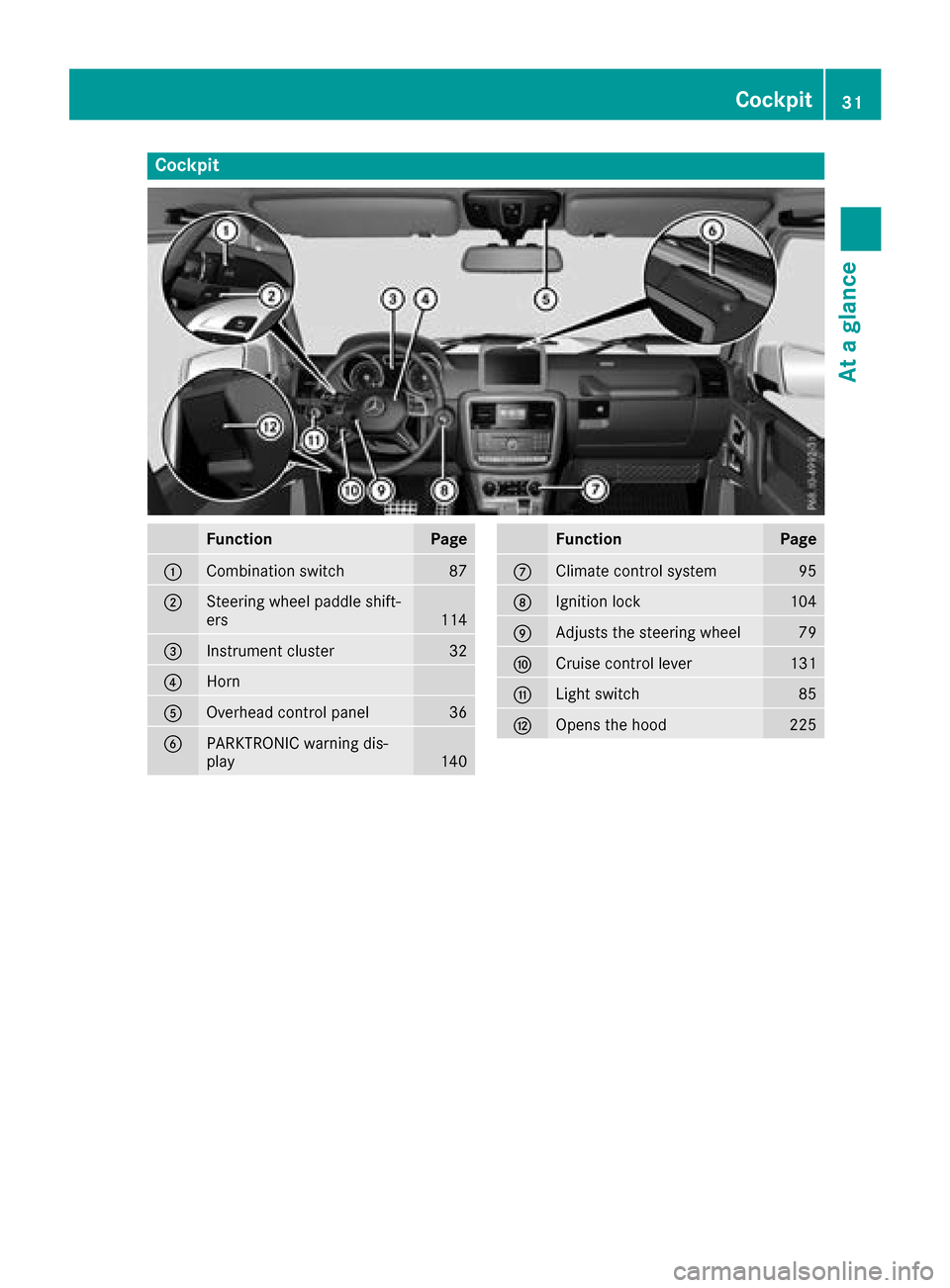
Cockpit
FunctionPage
:Combination switch87
;Steering wheel paddle shift-
ers114
=Instrumentcluster32
?Horn
AOverhead control panel36
BPARKTRONIC warning dis-
play140
FunctionPage
CClimatecontrol system95
DIgnition lock104
EAdjusts th esteering wheel79
FCruis econtrol lever131
GLights witch85
HOpenst hehood225
Cockpit31
Atag lance
Page 39 of 286

Door controlpanel
FunctionPage
:n Override feature fo rthe
rea rsidew indows56
;W Opens/closes th eside
windows69
=7Z ö\
Adjust sand folds th eexter ior
mirrors in/out electrically
81
?r 45=
Stores settings for the seat,
exterior mirrors and steering
column
83
FunctionPage
AAdjusts the seats electrically76
B%&Locks/unlocks
the vehicle67
COpens the door67
Door control panel37
At ag lance
Page 41 of 286
gered unintentionally or may not deploy as
intended during an accident.This can affect
for example the Emergency Tensioning
Device or the air bag. This poses an increased
risk of injury or even fatal injury.
Have the restraint system checked and
repaired in aqualified specialist workshop as
soon as possible.
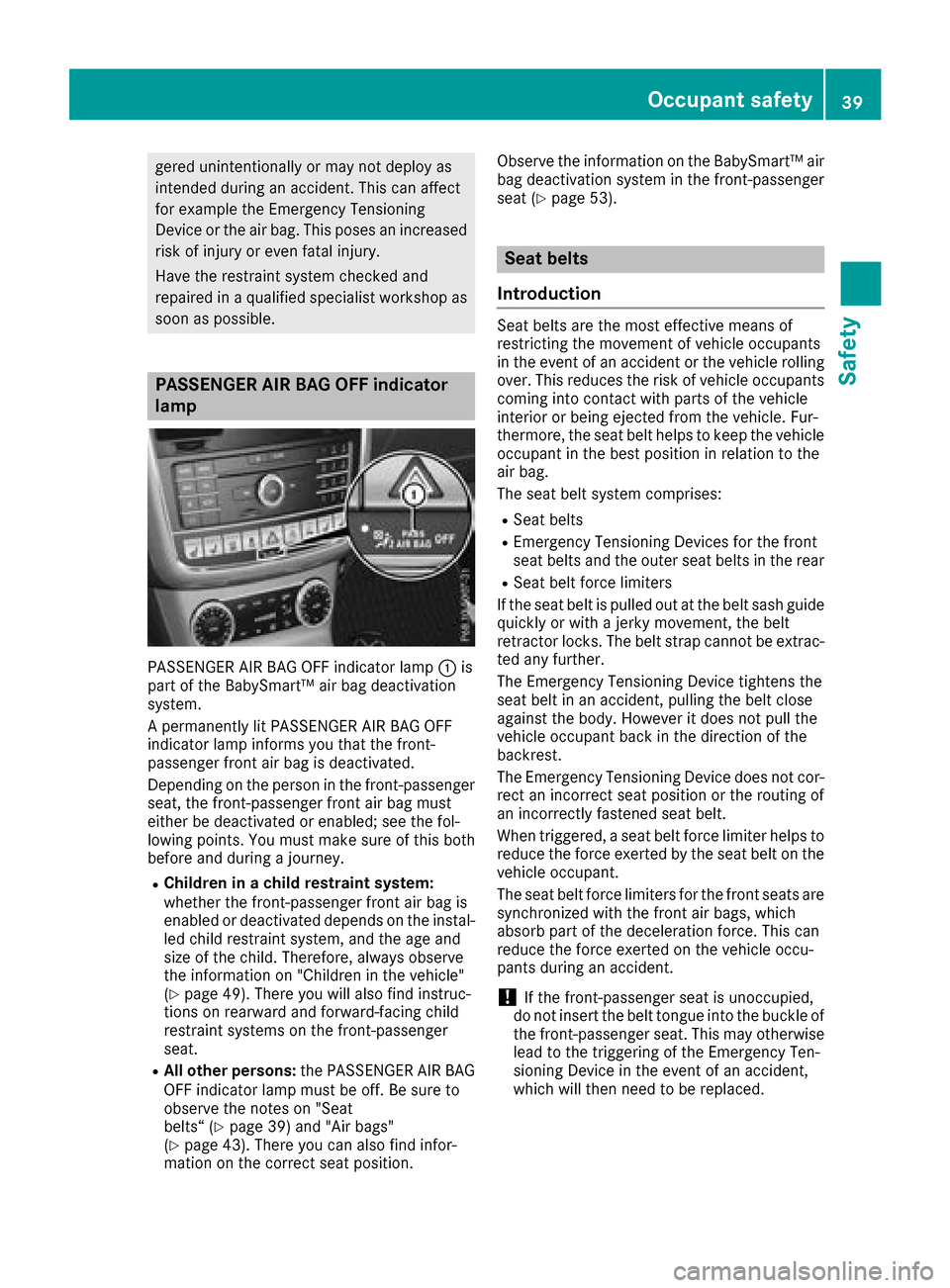
PASSENGER AIR BAG OFF indicator
lamp
PASSENGER AIR BAG OFF indicator lamp :is
part of the BabySmart™ air bag deactivation
system.
Ap ermanently lit PASSENGER AIR BAG OFF
indicator lamp informs you that the front-
passenger front air bag is deactivated.
Depending on the person in the front-passenger
seat, the front-passenger front air bag must
either be deactivated or enabled; see the fol-
lowing points. You must make sure of this both
before and during ajourney.
RChildren in achild restraint system:
whether the front-passenger front air bag is
enabled or deactivated depends on the instal- led child restraint system, and the age and
size of the child. Therefore, always observe
the information on "Children in the vehicle"
(
Ypage 49). There you will also find instruc-
tions on rearward and forward-facingc hild
restraint systems on the front-passenger
seat.
RAll other persons: the PASSENGER AIR BAG
OFF indicator lamp must be off. Be sure to
observe the notes on "Seat
belts“ (
Ypage 39) and "Air bags"
(Ypage 43). There you can also find infor-
mation on the corrects eat position. Observe the information on the BabySmart™ air
bag deactivation system in the front-passenger
seat (
Ypage 53).
Seat belts
Introduction
Seat belts are the most effective means of
restricting the movement of vehicle occupants
in the event of an accident or the vehicle rolling
over. This reduces the risk of vehicle occupants
coming into contact with parts of the vehicle
interior or being ejected from the vehicle. Fur-
thermore, the seat belt helps to keep the vehicle
occupant in the best position in relation to the
air bag.
The seat belt system comprises:
RSeat belts
REmergency Tensioning Devices for the front
seat belts and the outer seat belts in the rear
RSeat belt force limiters
If the seat belt is pulled out at the belt sash guide
quickly or with ajerk ym ovement ,the belt
retractor locks. The belt strap cannot be extrac-
ted any further.
The Emergency Tensioning Device tighten sthe
seat belt in an accident,p ulling the belt close
against the body. However it does not pull the
vehicle occupant back in the direction of the
backrest.
The Emergency Tensioning Device does not cor-
rect an incorrect seat position or the routing of
an incorrectly fastened seat belt.
When triggered, aseat belt force limiter helps to
reduce the force exerted by the seat belt on the
vehicle occupant.
The seat belt force limiters for the front seats are
synchronized with the front air bags, which
absorb part of the deceleration force. This can
reduce the force exerted on the vehicle occu-
pants during an accident.
!If the front-passenger seat is unoccupied,
do not insert the belt tongue into the buckle of
the front-passenger seat. This may otherwise
lead to the triggering of the Emergency Ten-
sioning Device in the event of an accident,
which will then need to be replaced.
Occupant safety39
Safety
Z
Page 49 of 286
immediately or open the window in order to pre-
ventbreathing difficulties.
Air bags and pyrotechnic Emergency Tensioning
Devices (ETDs) contain perchloratem aterial,
which may require special handlin gand regard
for the environment. National guideline smust
be observed duringd isposal. In California, see
www.dtsc.ca.gov/HazardousWaste/
Perchlorate/index.cfm .
Method of operation
Duringthe firsts tageofac ollision, the restraint
system control unit evaluate simportan tphysi-
cal data relating to vehicle deceleratio noraccel-
eration, such as:
Rduration
Rdirection
Rintensity
Based on the evaluatio nofthis data, the
restraint system control unit triggers the Emer-
genc yTensionin gDevices duringaf rontal or
rear collision.
An Emergency Tensionin gDevice can only be
triggered, if:
Rthe ignition is switched on
Rthe component softhe restraint system are
operational. You can findf urther information
under :"Restraint system warnin glamp"
(
Ypage 38)
Rthe seat belt buckle tongue has engaged in
the belt buckle of the respective front seat
The Emergency Tensionin gDevices in the rear
compartmenta re triggeredindependently of the
lock status of the seat belts.
If the restraint system control unit detect sa
more severea ccident,further component sof
the restraint system are activate dindepend-
ently of each other in certain frontal collision
situations:
RDriver'sa ir bag
RFront-passenge rfront air bag
The front-passenge rfront air bag is activate dor
deactivate ddepending on the personont he
front-passenge rseat. The front-passenge rfront
air bag can only deploy in an accident if the
PASSENGER AI RBAG OFF indicator lamp is off.
Observe the information on the PASSENGER AIR
BA GO FF indicator lamp (
Ypage 39).
Your vehicle has atwo-stag edriver's air bag.
Durin gthe firstd eployments tagethe driver's air
bag fills with sufficient propellantg as to reducet
he risk of injuries. The front air bag is fully
deployed with the maximum amount of propel-
lant gas if asecond deploymentt hreshold is
reached within afew milliseconds.
The activatio nthreshold of the Emergency Ten-
sioning Devices and the air bag are determined
by evaluatin gthe rate of vehicle deceleratio nor
acceleration which occurs at various point sin
the vehicle. This process is pre-emptive in
nature. Deployment should tak eplace in good
tim eatt he star tofthe collision.
The rate of vehicle deceleratio noracceleration
and the direction of the force are essentially
determined by:
Rthe distribution of forces duringt he collision
Rthe collision angle
Rthe deformationcharacteristics of the vehicle
Rthe characteristics of the object with which
the vehicle has collided
Factor swhich can only be seen and measured
after acollision has occurred do not play adeci-
sive role in the deploymentofana ir bag. Nor do
the yprovide an indication of air bag deploy-
ment.
The vehicle can be deformed considerably, with-
out an air bag being deployed. This is the case if
only partsw hich are relatively easily deformed
are affected and the rate of deceleratio nisnot
high. Conversely, air bags may be deployed even
though the vehicle suffers only minor deforma-
tion .This is the case if, for example, very rigid
vehicle partss uch as longitudinal body mem-
bers are hit, and sufficient deceleratio noccurs
as aresult.
If the restraint system control unit detect saside
impact or if the vehicle rolls over,t he applicable
component softhe restraint system are activa-
ted independently of each other depending on
the apparentt ype of accident .
RSide impact air bag and pelvis air bag on the
side on which an impact occurs, independent
fromt
he Emergency Tensionin gDevice and
seat belt usage
The side impact air bag on the front-
passenger side deploys under the following
conditions:
-BabySmart™ detect sthat the front-
passenger seat is occupied or
-the seat belt buckle tongue is engaged in
the belt buckle of the front-passenge rseat
RWindo wcurtain air bag on the side of impact,
independently of the use of the seat belt and
Occupant safety47
Safety
Z
Page 51 of 286
XWith your hand flat, firmly push the NECK-
PRO head restraint cushion back in the direc-tion of arrow =until it engages.
XRepeat this procedure for the secondN ECK-
PRO head restraint.
iResettin gthe NECK-PRO head restraints
requires alot of strength. If you have difficulty
resetting the NECK-PRO head restraints, have
this work carried out at aqualified specialist
workshop.
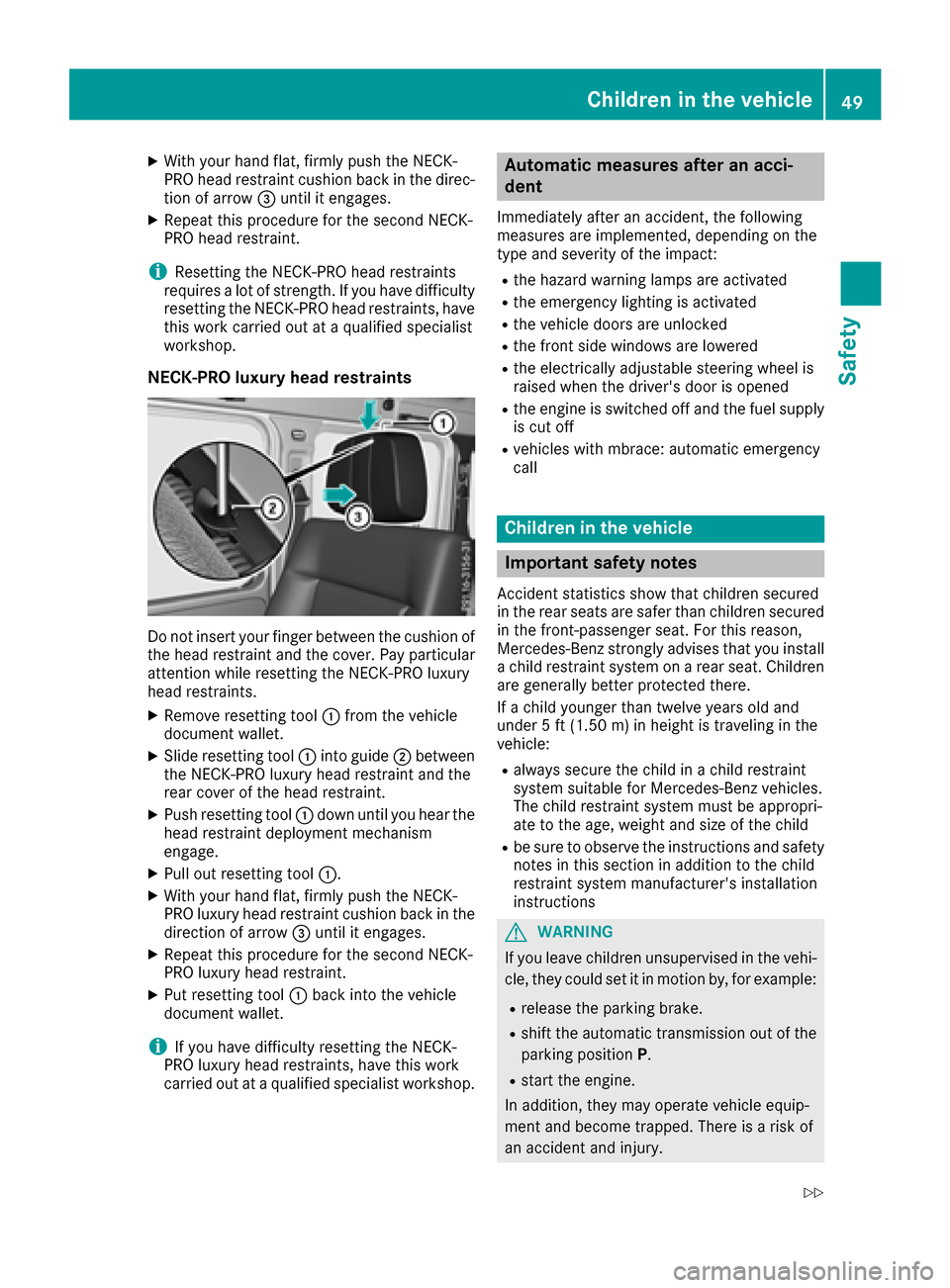
NECK-PRO luxuryh ead restraints
Do not insert your finger between the cushion of
the head restraint and the cover. Pay particular
attention while resetting the NECK-PRO luxury
head restraints.
XRemove resetting tool :from the vehicle
document wallet.
XSlide resetting tool :into guide ;between
the NECK-PRO luxury head restraint and the
rear cover of the head restraint.
XPush resetting tool :down until you hear the
head restraint deployment mechanism
engage.
XPull out resetting tool :.
XWith your hand flat, firmly push the NECK-
PRO luxury head restraint cushion back in the
direction of arrow=until it engages.
XRepeat this procedure for the secondN ECK-
PRO luxury head restraint.
XPut resetting tool :back into the vehicle
document wallet.
iIf you have difficulty resetting the NECK-
PRO luxury head restraints, have this work
carried out at aqualified specialist workshop.
Automatic measures after an acci-
dent
Immediately after an accident ,the following
measures are implemented, depending on the
type and severityoft he impact:
Rthe hazard warning lamps are activated
Rthe emergency lighting is activated
Rthe vehicle doors are unlocked
Rthe frontside windows are lowered
Rthe electrically adjustable steerin gwheel is
raised when the driver's door is opened
Rthe engine is switched off and the fuel supply
is cut off
Rvehicles with mbrace: automatic emergency
call
Children in the vehicle
Important safety notes
Accident statistics show that children secured
in the rear seats are safer than children secured
in the front-passenger seat. For this reason,
Mercedes-Benz strongly advises that you install
ac hild restraint system on arear seat. Children
are generally better protected there.
If ac hild younger than twelve years old and
under 5ft(1.50m )inh eight is travelin ginthe
vehicle:
Ralwayss ecure the child in achild restraint
system suitable for Mercedes-Benz vehicles.
The child restraint system must be appropri-
ate to the age, weight and size of the child
Rbe sure to observe the instruction sand safety
notes in this section in addition to the child
restraint system manufacturer's installation
instructions
GWARNING
If you leave children unsupervised in the vehi-
cle, they could set it in motion by, for example:
Rrelease the parking brake.
Rshift the automatic transmission out of the
parking position P.
Rstart the engine.
In addition, they may operate vehicle equip-
ment and become trapped. There is arisk of
an accident and injury.
Children in the vehicle49
Safety
Z
Page 52 of 286
When leaving the vehicle, alwaystake the
SmartKey with you and lock the vehicle. Never
leave children unsupervised in the vehicle.
GWARNING
If persons, particularly children are subjected to prolonged exposure to extreme heat or
cold, there is arisk of injury, possibly even
fatal. Never leave children unattended in the
vehicle.
GWARNING
If the child restraint system is subjected to
direct sunlight, parts may get very hot. Chil-
dren may burn themselves on these parts,
particularly on the metal parts of the child
restraint system. There is arisk of injury.
If you leave the vehicle, takin gthe child with
you, alwayse nsure that the child restraint
system is not exposed to direct sunlight. Pro- tect it with ablanket ,for example. If the child
restraint system has been exposed to direct
sunlight, let it cool down before securing the
child in it. Never leave children unattended in
the vehicle.
Always ensure that all vehicle occupantsh ave
their seat belts fastened correctly and are sitting
properly. Particular attention must be paid to
children.
Observe the safety notes on the seat belt
(
Ypage 40) and the notes on correct use of seat
belts (Ypage 41).
Ab ooster seat may be necessary to achieve
proper seat belt positionin gfor children over
41 lbs (1 8kg)until they reach aheight where a
three-point seat belt can be properly fastened
without abooster seat.
Special seat belt retractor
GWARNING
If the seat belt is released while driving, the
child restraint system will no longer be
secured properly. The special seat belt retrac- tor is disabled and the inertia real draws in a
portion of the seat belt. The seat belt cannot
be immediately refastened. There is an
increased risk of injury, possibly even fatal.
Stop the vehicle immediately, paying atten-
tion to road and traffic conditions. Reactivate
the special seat belt retractor and secure the
child restraint system properly.
All seat belts except the driver's seat belt are
equipped with aspecial seat belt retractor.
When activated, the special seat belt retractor
ensures that the seat belt will not slacken once
the child restraint system has been secured.
Installing achild restraint system:
XAlways comply with the child restraint system
manufacturer's installation instructions.
XPull the seat belt smoothly out of the belt sash
guide.
XEngage the seat belt tongue in the belt buckle.
Activating the special seat belt retractor:
XPull the seat belt out fully and let the inertia
reel retract it again.
While the seat belt is retracting, you should
hear aratchetin gsound. The special seat belt
retractor is activated.
XPush the child seat restraint system down so
that the seat belt is tight and does not loosen.
Removing achild restraint system and deacti-
vating the special seat belt retractor:
XAlways comply with the child restraint system
manufacturer's installation instructions.
XPress release button of belt buckle, hold the
belt tongue firmly and guide it back towards
the belt sash guide.
The special seat belt retractor is deactivated.
Child restraint system
The use of seat belts and child restraint systems
is required by law in:
Rall 50 states
Rthe U.S .territories
Rthe District of Columbia
Rall Canadian provinces
You can obtain further information about the
correct child restraint system from any author-
ized Mercedes-Benz Center.
50Children in the vehicle
Safety