2017 MERCEDES-BENZ G-Class ESP
[x] Cancel search: ESPPage 55 of 286

XRemove cargo compartmentcover
(Ypage 209).
XMov ethe head restrain tup.
XInstall th eLATCH-type (ISOFIX) child restrain t
system wit hTop Tether .Always comply wit h
th ec hild restrain tsystem manufacturer' s
installation instruction swhen doin gso.
XRout eTop Tether belt =under th ehead
restrain tbetween th etwo head restrain tbars .
XHook Top Tether hoo k: of Top Tether belt
= intoT op Tether anchorage ;.
Mak esuret hatT op Tether belt =is no ttwis-
ted.
XTension Top Tether belt =.Always comply
wit hthe child restrain tsystem manufactur -
er' sinstallation instruction swhen doin gso.
XMov ehead restrain tbackd own again slightly
if necessar y(Ypage 77). Mak esuret hat
you do no tinterfere wit hthe correc trouting of
Top Tether belt =.
BabySmart™air bag deactivation sys-
tem
GWARNIN G
Electronic device sonthefront-passenger
seat can affec tthe function of th eBaby-
Smart ™air bag deactivation system, for
example:
RLaptop
RMobile phon e
RTransponder cards suc hasskipasses or
access passes
The front-passenger air bag could deplo yacci-
dentally or no tfunction as intended during an
accident. This poses an increased ris kof
injury or eve nfatal injury.
Do no tplac ea ny of th edevice smentioned
abov eors imilar device sonthefront-
passenger seat .Beaware of th estatus of th e
front-passenger fron tair bag bot hbefore and
during th ejou rney.
The BabySmart ™air bag deactivation system' s
sensor system in th efront-pa ssenger seat
detects whether aspecial Mercedes-Ben zchild
restrain tsystem wit hatransponder for th e
BabySmart ™air bag deactivation system has been installed. In this case, th
ePASSENG ER AIR
BA GO FFindicator lamp lights up and remain s
lit .T he front-passenger fron tair bag is deacti -
vated.
When th eSma rtKey is remove dfromt heignition
loc korisinp osition0,thePASSENGER AI RBAG
OF Findicator lamp does no tligh tup.
iIf th efront-pa ssenger fron tair bag is deac -
tivated by th eBabySmart ™air bag deactiva-
tion system, th ef
o
llowin gremain enabled on
th ef ront-pa ssenger side :
Rthes ide impact air bag
Rthep elvis air bag
Rthew indow curtai nair bag
RtheE me rgency Tensioning Devic e
GWARNING
If you secure achild in achild restrain tsystem
on th efront-pa ssenger seat and th e
PASSENGER AI RBAG OFFindicator lamp is
off ,the front-passenger fron tair bag can
deplo yintheevent of an accident. The child
could be struc kbytheair bag. This poses an
increased ris kofinjury or eve nfatal injury.
Mak esuret hatthe front-passenger fron tair
bag has been disabled. The PASSENGER AI R
BA GO FFindicator lamp mus tbelit.
GWARNIN G
If th ePASSENG ER AIRBAG OFFindicator
lamp is lit ,the front-passenger fron tair bag is
deactivated. It will no tbedeployed in th e
event of an acciden tand canno tperfor mits
intended protective function .Aperson in th e
front-passenger seat could then ,for example,
come int ocontac twitht he vehicle's interior,
especially if th eperson is sitting to oclose to
th ed ashboard. This poses an increased ris kof
injury or eve nfatal injury.
In this cas ethe front-passenger seat may no t
be used .You may only transpor tachild on th e
front-passenger seat if they are seated in a
suitable rearward or forward-facing child
restrain tsystem. Always observ ethe child
restrain tsystem manufacturer' sinstallation
instructions.
Children in th evehicle53
Safety
Z
Page 59 of 286
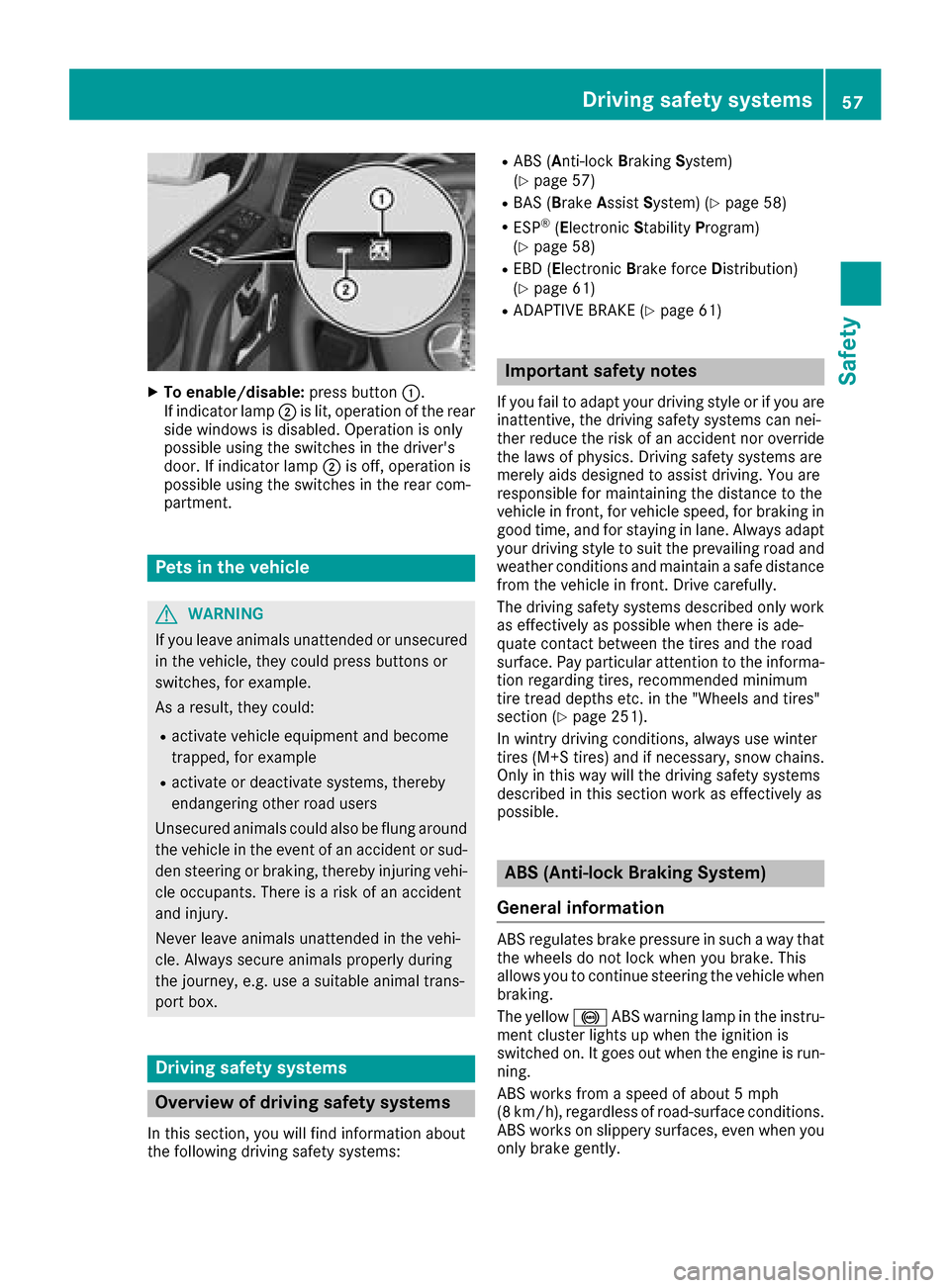
XTo enable/disable:press button:.
If indicator lamp ;is lit, operatio nofthe rear
side windows is disabled .Operation is only
possibl eusing the switches in the driver's
door. If indicator lamp ;is off, operatio nis
possibl eusing the switches in the rearc om-
partment.
Pets in the vehicle
GWARNING
If yo ulea ve animals unattende dorunsecured
in the vehicle, they could press buttons or
switches, for example.
As aresult, they could:
Ractivate vehicl eequipment and become
trapped, for example
Ractivate or deactivate systems, thereby
endangering othe rroadu sers
Unsecured animals could also be flung around
the vehicl einthe event of an accident or sud-
de ns teering or braking ,thereb yinjuring vehi-
cle occupants. There is ariskofana ccident
and injury.
Never leave animals unattende dinthe vehi-
cle .Alway ssecure animals properly during
the journey ,e.g.u se asuitabl eanimal trans-
port box.
Driving safety systems
Overvie wofdriving safety systems
In thiss ection, yo uwillf ind informatio nabout
the following driving safety systems:
RABS ( Anti-lock Braking System)
(Ypage 57)
RBAS ( Brake Assis tSys tem )(Ypage 58)
RESP®(E le ctronic Stability Program)
(Ypage 58)
REBD ( Ele ctronic Brake force Dis tribution)
(Ypage 61)
RADAPTIVE BRAK E(Ypage 61)
Important safety notes
If youfailtoa dapt your driving style or if yo uare
inattentive, the driving safety systemsc an nei-
ther reduce the ris kofanaccident nor override
the laws of physics. Driving safety systemsa re
merel yaidsd esig ned to assist driving .You are
responsibl efor maintaining the distance to the
vehicl einfront, for vehicl espeed ,for braking in
goo dtime ,and for staying in lane. Alway sadapt
your driving style to suit the prevailing roada nd
weather conditions and maintain asafed istance
from the vehicl einfront. Driv ecarefully.
The driving safety systemsd escribe donlyw ork
as effectively as possibl ewhent her eisa de-
quate contact between the tire sand the road
surface. Payp articula rattentio ntothe informa-
tio nr egarding tires, recommende dminimum
tire trea ddepths etc. in the "Wheels and tires"
section (
Ypage 251).
In wintry driving conditions, always us ewinter
tire s(M+ Stires) and if necessary,s now chains.
Onlyint hiswaywill the driving safety systems
describe dinthissection work as effectively as
possible.
ABS (Anti-lock Brakin gSystem)
General information
ABS regulate sbrake pressure in such awaythat
the wheels do not lock when yo ubrake. This
allows yo utocontinue steering the vehicl ewhen
braking.
The yellow !ABS warning lamp in the instru-
ment cluster lights up when the ignition is
switched on. It goe soutwhen the engine is run-
ning.
ABS works from aspeed of about5m ph
(8 km/h), regardless of road-surface conditions.
ABS works on slippery surfaces, eve nwheny ou
onlyb rake gently.
Driving safety systems57
Safety
Z
Page 60 of 286

Important safety notes
iObservethe "Importan tsafet ynotes "sec-
tion (Ypage 57).
GWARNIN G
If AB Sisf aulty, th ewheels could loc kwhen
braking .The steerabilit yand braking charac -
teristics may be severely impaired .Addition -
ally, further driving safet ysystems are deac -
tivated. Ther eisanincreased danger of skid-
din gand accidents .
Drive on carefully. Hav eABS checke dimme-
diately at aqualified specialist workshop.
When AB Sismalfunctioning ,other systems ,
includin gdriving safet ysystems ,will also
become inoperative. Observ ethe information
on th eABS warning lamp (
Ypage 190) and dis-
play message swhichm ay be shown in th e
instrumen tcluste r(
Ypage 171).
Braking
XIf ABS intervenes: continue to depress th e
brak epedal vigorously until th ebraking sit -
uation is over.
XTo make afullb rake application: depress
th eb rak epedal wit hfull force .
If AB Sintervenes when braking ,you will fee la
pulsing in th ebrak epedal .
The pulsating brak epedal can be an indication
of hazardous road conditions, and function sasa
reminder to tak eextra carew hile driving .
Off-road ABS
An ESP®system specifically suited to off-road
terrain is activated automatically once th eoff-
road program is activated.
At speeds belo w37mph (60 km/h), th efront
wheels loc kcyclically during braking .The dig-
ging-in effec tachieved in th eprocess reduce s
th es topping distanc eonoff-road terrain .This
limits steering capability.
BAS (Brak eAssistS ystem)
General information
BA So perate sinemergenc ybraking situations.
If you depress th ebrak epedal quickly, BA S
automatically boosts th ebraking force ,thu s
shortening th estopping distance.
Important safety notes
iObserv ethe "Importan tsafet ynotes "sec-
tion (Ypage 57) .
GWARNIN G
If BA Sism alfunctioning ,the braking distanc e
in an emergenc ybraking situation is
increased. Ther eisariskofana ccident.
In an emergenc ybraking situation ,depress
th eb rak epedal wit hfull force .ABS prevents
th ew heels from locking.
Braking
XKee pthe brak epedal firmly depressed until
th ee mergenc ybraking situation is over.
AB Sp revents th ewheels from locking.
The brakes will function as usual once you
release th ebrak epedal .BAS is deactivated.
ESP®(Electronic StabilityP rogram)
General notes
iObserv ethe "Importan tsafet ynotes "sec-
tion (Ypage 57).
ES P
®monitors driving stabilit yand traction ,i.e .
power transmission between th etires and th e
road surface.
If ES P
®detects that th evehicl eisd eviating from
th ed irection desired by th edriver, on eormore
wheels are braked to stabiliz ethe vehicle. The
engin eoutput is also modifie dtokeept he vehi-
cle on th edesired cours ewithin physical limits .
ES P
®assist sthe driver when pullin gaway on
wet or slippery roads. ES P®can also stabilize
th ev ehicl eduring braking .
58Driving safety systems
Safety
Page 61 of 286
4ETS (Electronic Traction System)
iObserve the "Important safety notes" sec-
tion (Ypage 57).
4ET Straction contro lispart of ESP
®.
4ET Straction contro lisnolonger activ eabove a
speed of approximately 37 mph (60 km/h).
Traction contro lbrakes the drive wheels indi-
vidually if they spin. This enables you to pull
away and accelerate on slippery surfaces,f or
example if the road surface is slippery on one
side. In addition, more drive torque is transfer-
red to the wheel or wheels with traction.
Traction contro lremains active, even if you
deactivate ESP
®.
Importan tsafetyn otes
iObserve the "Important safety notes" sec-
tion (Ypage 57).
GWARNING
If ESP
®is malfunctioning, ESP®is unable to
stabilize the vehicle. Additionally, further driv-
ing safety systems are deactivated. This
increases the risk of skiddin gand an accident.
Driv eonc arefully. Have ESP
®checked at a
qualified specialist workshop.
!Only operate the vehicle for amaximum of
ten seconds on abrake test dynamometer.
Switc hoff the ignition.
Application of the brakes by ESP
®may oth-
erwise destroy the brake system.
!Af unction or performanc etest should only
be carried out on atwo-axle dynamometer.
Beforey ou operate the vehicle on such a
dynamometer, please consult aqualified
workshop. You could otherwise damage the
drive train or the brake system.
If the å ESP
®OFF warning lamp lights up
continuously, ESP®is deactivated.
If the ÷ ESP®warning lamp lights up contin-
uously, ESP®is not available due to amalfunc-
tion.
Observe the information on warning lamps
(
Ypage 191) and display messages which may
be displayed in the instrument cluster
(
Ypage 171). Only use wheels with the recommended tire
sizes. Only then will ESP
®function properly.
If differential locksa re switched on, ABS, BAS
and ESP
®switc hoff automatically.
Characteristics of ESP®
Genera linformation
If the ÷ ESP®warning lamp goes out before
beginning the journey, ESP®is automatically
active.
If ESP
®intervenes, the ÷ESP®warning lamp
flashes in the instrument cluster.
If ESP
®intervenes:
XDo not deactivate ESP®under any circum-
stances.
XOnly depress the accelerator pedal as far as
necessary when pulling away.
XAdapt your drivings tyle to suit the prevailing
road and weather conditions.
ECO start/stop function
The ECO start/stop function switches the
engin eoff automatically when the vehicle stops
moving. The engin estart sautomatically when
the driver wants to pull away again. ESP
®
remains in its previously selected status, e.g. if
ESP®was deactivated before the engin ewas
automatically switched off.
Deactivating/activating ESP®
Important safetyn otes
iObservethe "Important safety notes" sec-
tion (Ypage 57).
You can select between the following states of
ESP
®:
RESP®is activated.
RESP®is deactivated.
GWARNING
If you deactivate ESP
®,E SP®no longer sta-
bilizes the vehicle. There is an increased risk
of skiddin gand an accident.
Only deactivate ESP
®in the situation sdescri-
bed in the following.
Driving safetys ystems59
Safety
Z
Page 62 of 286
It may be best to deactivate ESP®in the follow-
ing situations:
Rwhen using snow chains
Rin deep snow
Ron sand or gravel
Roff-road
Spinning the wheelsr esults inacutting action
which providesb etter grip.
Activate ESP
®as soon as the situations descri-
bed above no longer apply. ESP®willo therwise
not be abletos tabilize the vehicle if the vehicle
starts to skid or awheel starts to spin.
!Avoid spinning the driven wheelsf or an
extended period with ESP®deactivated. You
could otherwise damage the drivetrain.
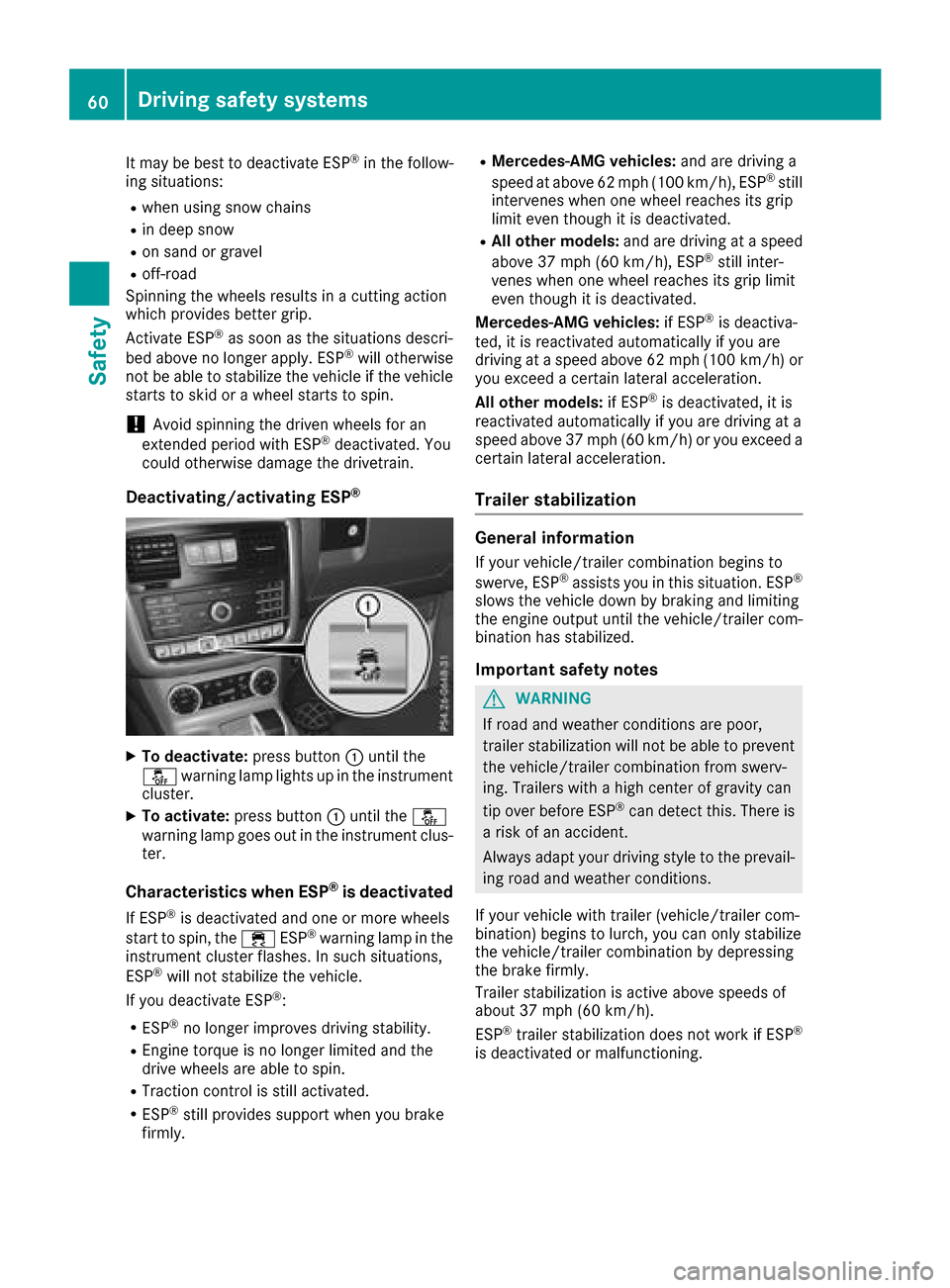
Deactivating/activating ESP®
XTo deactivate: press button:until the
å warning lamp lights up in the instrument
cluster.
XTo activate: press button :until the å
warning lamp goes out in the instrument clus-
ter.
Characteristic swhen ESP®is deactivated
If ESP®is deactivated and one or more wheels
start to spin, the ÷ESP®warning lamp in the
instrument cluster flashes. In such situations,
ESP
®willn ot stabilize the vehicle.
If you deactivate ESP®:
RESP®no longer improves driving stability.
REngine torque is no longer limited and the
drive wheelsa re abletospin.
RTraction control is still activated.
RESP®still providess upport when you brake
firmly.
RMercedes-AMG vehicles: and are driving a
speed at above 62 mph (100 km/h), ESP®still
intervenes when one wheel reaches its grip
limite ven though it is deactivated.
RAll other models: and are driving ataspeed
above 37 mph (60 km/h), ESP®still inter-
venes when one wheel reaches its grip limit
even though it is deactivated.
Mercedes-AMG vehicles: if ESP
®is deactiva-
ted, it is reactivated automatically if you are
driving at aspeed above 62 mph (100 km/h )or
you exceed acertain laterala cceleration.
All other models: if ESP
®is deactivated, it is
reactivated automatically if you are driving at a
speed above 37 mph (60 km/h) or you exceed a certain laterala cceleration.
Trailer stabilization
General information
If yourvehicle/trailer combination begins to
swerve, ESP®assists you in this situation. ESP®
slowst he vehicle down by braking and limiting
the engine outputu ntil the vehicle/trailer com-
bination has stabilized.
Important safety notes
GWARNING
If road and weather conditions are poor,
trailers tabilization willn ot be abletoprevent
the vehicle/trailer combination from swerv-
ing. Trailers with ahigh center of gravity can
tip over before ESP
®can detect this. There is
ar isk of an accident.
Alway sadapt you rdriving style to the prevail-
ing road and weather conditions.
If you rvehicle with trailer( vehicle/trailercom-
bination) begins to lurch, you can only stabilize
the vehicle/trailer combination by depressing
the brake firmly.
Trailer stabilization is active above speedso f
about3 7mph (60 km/h).
ESP
®trailer stabilization does not work if ESP®
is deactivated or malfunctioning.
60Driving safety systems
Safety
Page 71 of 286
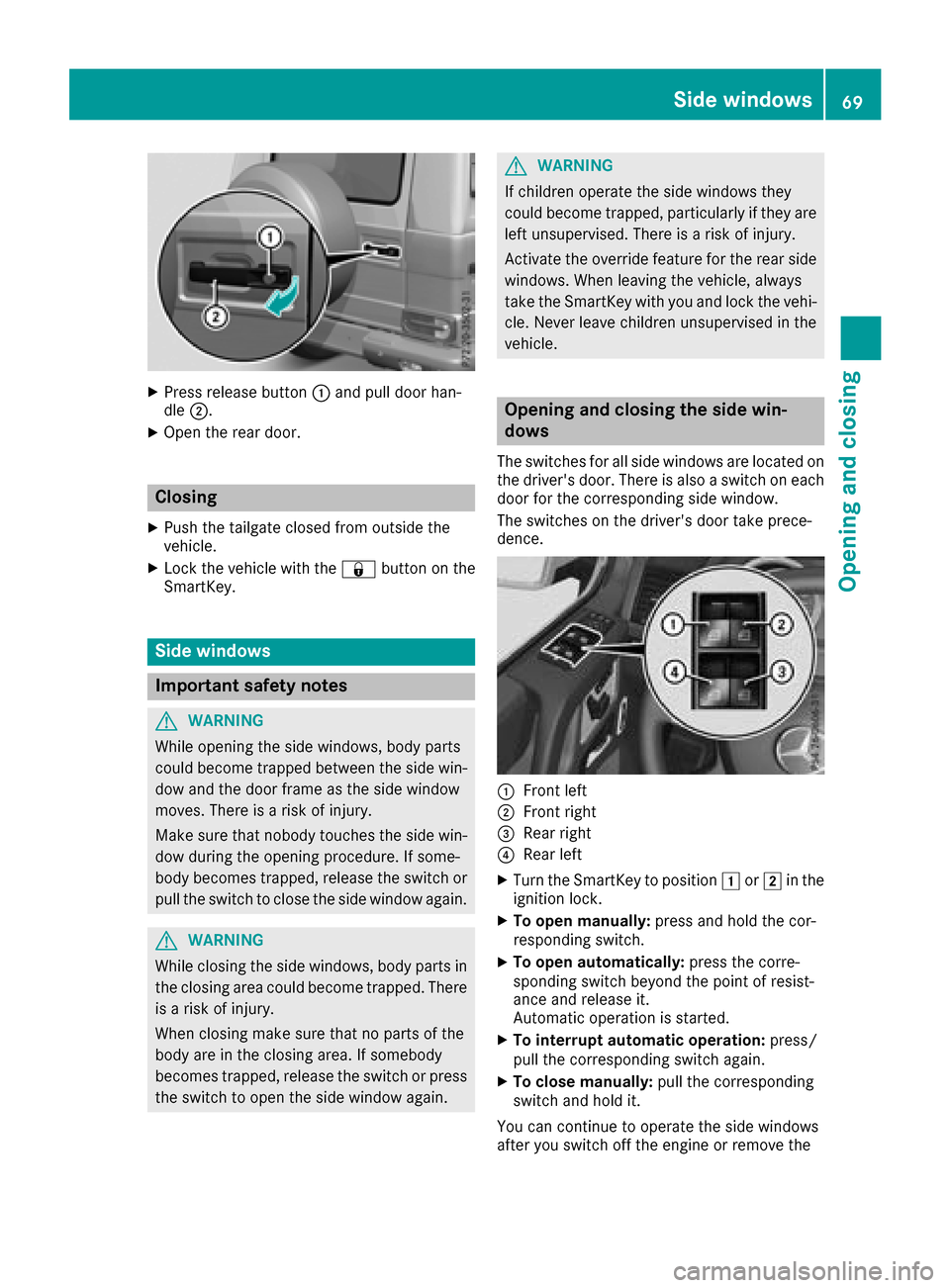
XPress release button:and pull door han-
dle ;.
XOpen the rear door.
Closing
XPush the tailgate closed from outside the
vehicle.
XLock the vehicle with the &button on the
SmartKey.
Side windows
Important safety notes
GWARNING
While opening the side windows, body parts
could become trapped between the side win-
dow and the door frame as the side window
moves. There is arisk of injury.
Make sure that nobody touches the side win-
dow during the opening procedure. If some-
body becomes trapped, release the switch or
pull the switch to close the side window again.
GWARNING
While closing the side windows, body parts in
the closing area could become trapped. There is ar isk of injury.
When closing make sure that no parts of the
body are in the closing area. If somebody
becomes trapped, release the switch or press
the switch to open the side window again.
GWARNING
If children operate the side windows they
could become trapped, particularly if they are left unsupervised. There is arisk of injury.
Activate the override feature for the rear side
windows. When leaving the vehicle, always
take the SmartKey with you and lock the vehi-
cle. Never leave children unsupervised in the
vehicle.
Opening and closing the side win-
dows
The switches for all side windows are located on
the driver's door. There is also aswitch on each
door for the corresponding side window.
The switches on the driver's door take prece-
dence.
:Frontl eft
;Frontr ight
=Rear right
?Rear left
XTurn the SmartKey to position 1or2 in the
ignition lock.
XTo open manually: press and hold the cor-
respondings witch.
XTo open automatically: press the corre-
sponding switch beyond the point of resist-
ance and release it.
Automatic operation is started.
XTo interrupt automatic operation: press/
pull the corresponding switch again.
XTo close manually: pull the corresponding
switch and hold it.
You can continue to operate the side windows
after you switch off the engine or remove the
Side windows69
Opening and closing
Z
Page 73 of 286
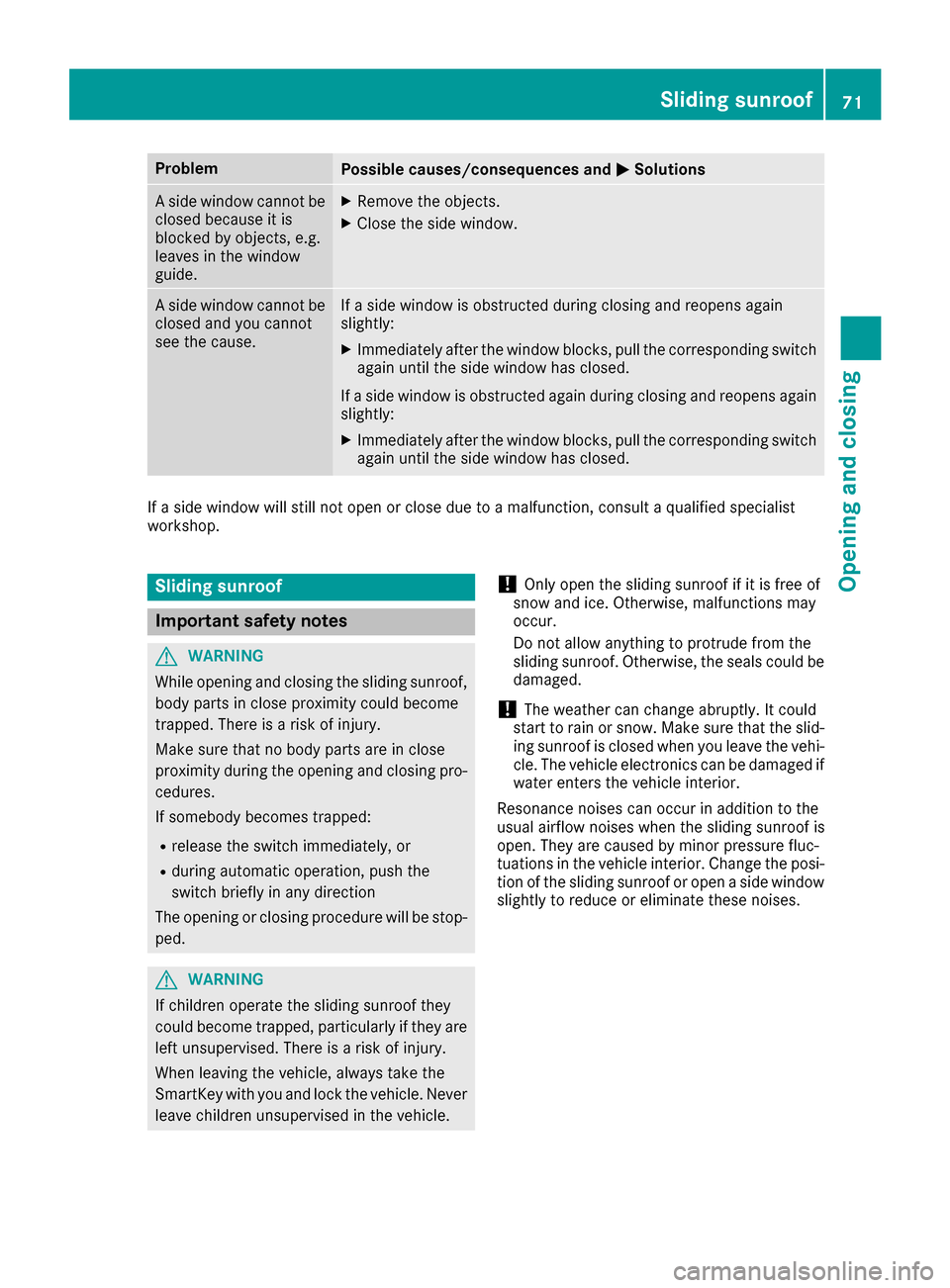
ProblemPossible causes/consequences andMSolutions
Aside window cannot be
closed because it is
blocked by objects, e.g.
leaves in the window
guide.XRemove the objects.
XClose the side window.
As ide window cannot be
closed and you cannot
see the cause.If as ide window is obstructed during closing and reopens again
slightly:
XImmediately after the window blocks, pull the correspondings witch
again until the side window has closed.
If as ide window is obstructed again during closing and reopens again
slightly:
XImmediately after the window blocks, pull the correspondings witch
again until the side window has closed.
If as ide window will still not open or close due to amalfunction, consult aqualified specialist
workshop.
Sliding sunroof
Important safety notes
GWARNING
While opening and closing the sliding sunroof, body parts in close proximity could become
trapped. There is arisk of injury.
Make sure that no body parts are in close
proximity during the opening and closing pro-
cedures.
If somebody becomes trapped:
Rrelease the switch immediately, or
Rduring automatic operation, push the
switch briefly in any direction
The opening or closing procedure will be stop- ped.
GWARNING
If children operate the sliding sunroof they
could become trapped, particularly if they are left unsupervised. There is arisk of injury.
When leaving the vehicle, always take the
SmartKey with you and lock the vehicle. Never
leave children unsupervised in the vehicle.
!Only open the sliding sunroof if it is free of
snow and ice. Otherwise, malfunctions may
occur.
Do not allow anything to protrude from the
sliding sunroof. Otherwise, the seals could be
damaged.
!The weather can change abruptly. It could
start to rain or snow. Make sure that the slid- ing sunroof is closed when you leave the vehi-
cle. The vehicle electronics can be damaged if
water enters the vehicle interior.
Resonance noises can occur in addition to the
usual airflow noises when the sliding sunroof is
open. They are caused by minor pressure fluc-
tuations in the vehicle interior. Change the posi-
tion of the sliding sunroof or open aside window
slightly to reduce or eliminate these noises.
Sliding sunroof71
Opening and closing
Z
Page 86 of 286
the vehicleasaresultoft he adjustments
being made .There is ariskofana ccident.
Onlyu sethe memory functio nonthe driver's
side when the vehicl eisstationary.
GWARNING
When the memory functio nadjusts the seat or
steering wheel, yo uand othe rvehicl eoccu-
pants –particularly children –could become
trapped .There is ariskofi njury.
Whil ethe memory functio nism aking adjust-
ments ,makes uret hatnoo ne hasa ny body
parts in the swee pofthe seat or steering
wheel. If somebod ybecome strapped ,imm e-
diately release the memory functio nposit ion
button. The adjustment proces sisstopped.
GWARNING
Childre ncould become trapped if theya cti-
vate the memory function, particularly when
unattended .There is ariskofi njury.
When leaving the vehicle, always take the
SmartKeyw ithy ou and lock the vehicle. Never
leav echildren unsupervised in the vehicle.
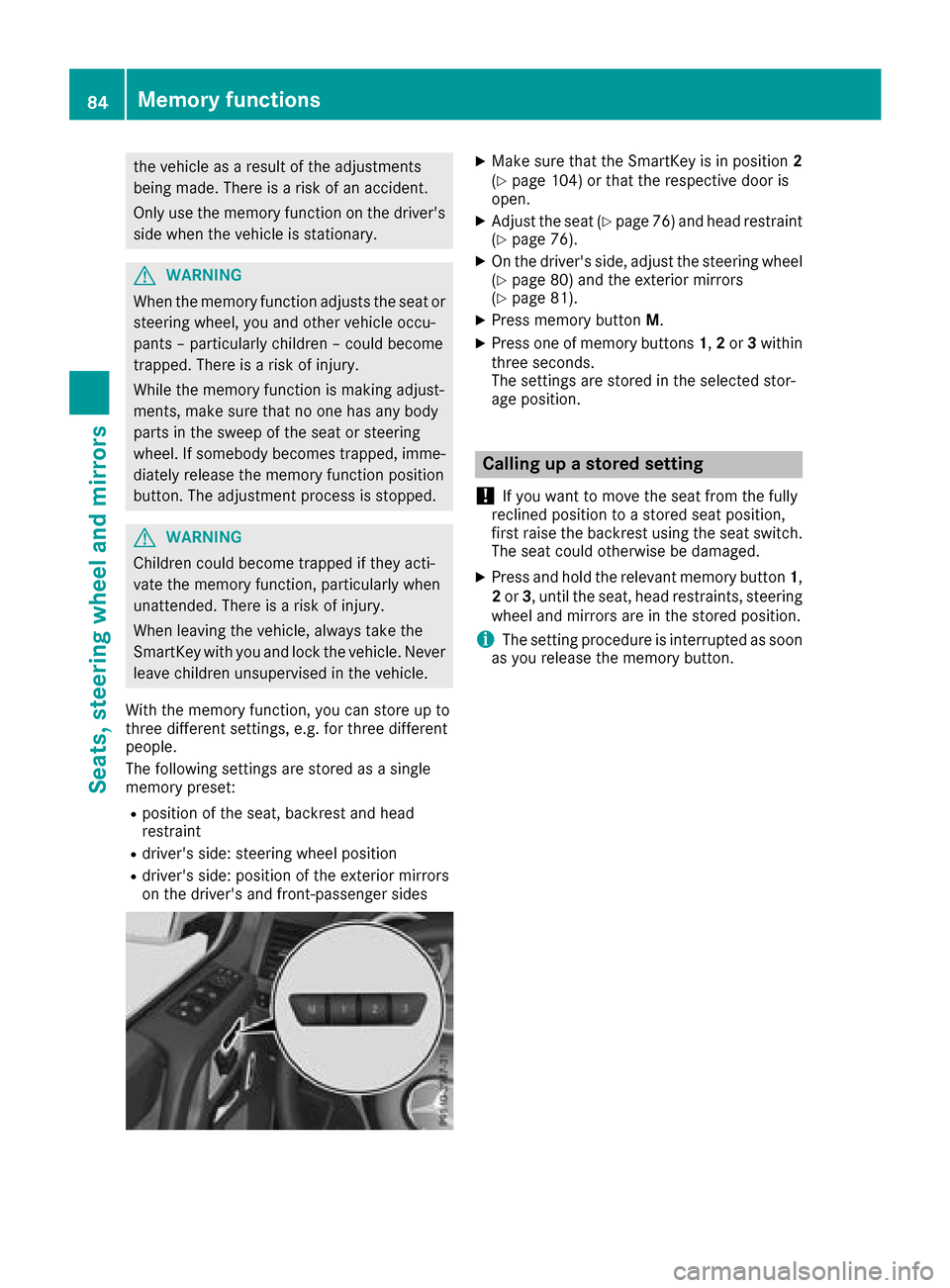
With the memory function, yo ucan stor eupto
threed ifferent settings, e.g .for threed ifferent
people.
The following setting sarestored as asingle
memory preset:
Rpositio nofthe seat, backrest and head
restraint
Rdriver's side :steering whee lposit ion
Rdriver's side :posit ionoft he exterio rmirrors
on the driver's and front-passenge rsides
XMake sure thatt he SmartKeyisinp osition 2
(Ypage 104 )orthatthe respectiv edooris
open.
XAdjust the seat (Ypage 76 )and hea drestraint
(Ypage 76).
XOn the driver'ss ide,adjus tthe steering wheel
(Ypage 80 )and the exterio rmirrors
(Ypage 81).
XPress memory button M.
XPress one of memory buttons 1,2 or 3within
threes econds.
The settings are stored in the selecte dstor-
ag ep osition.
Calling up astored setting
!
If yo uwanttom ove the sea tfrom the fully
recline dposition toas tored sea tposition,
first raise the backres tusing the sea tswitch.
The sea tcould otherwise be damaged.
XPress and hol dthe relevant memory button 1,
2 or 3,u nti lthe seat, hea drestraints, steering
whee land mirrors are in the stored position.
iThe setting procedur eisinterruptedass oon
as yo urelease the memory button.
84Memory functions
Seats, steering wheel andmirrors