2017 MERCEDES-BENZ G-Class lights
[x] Cancel search: lightsPage 33 of 286
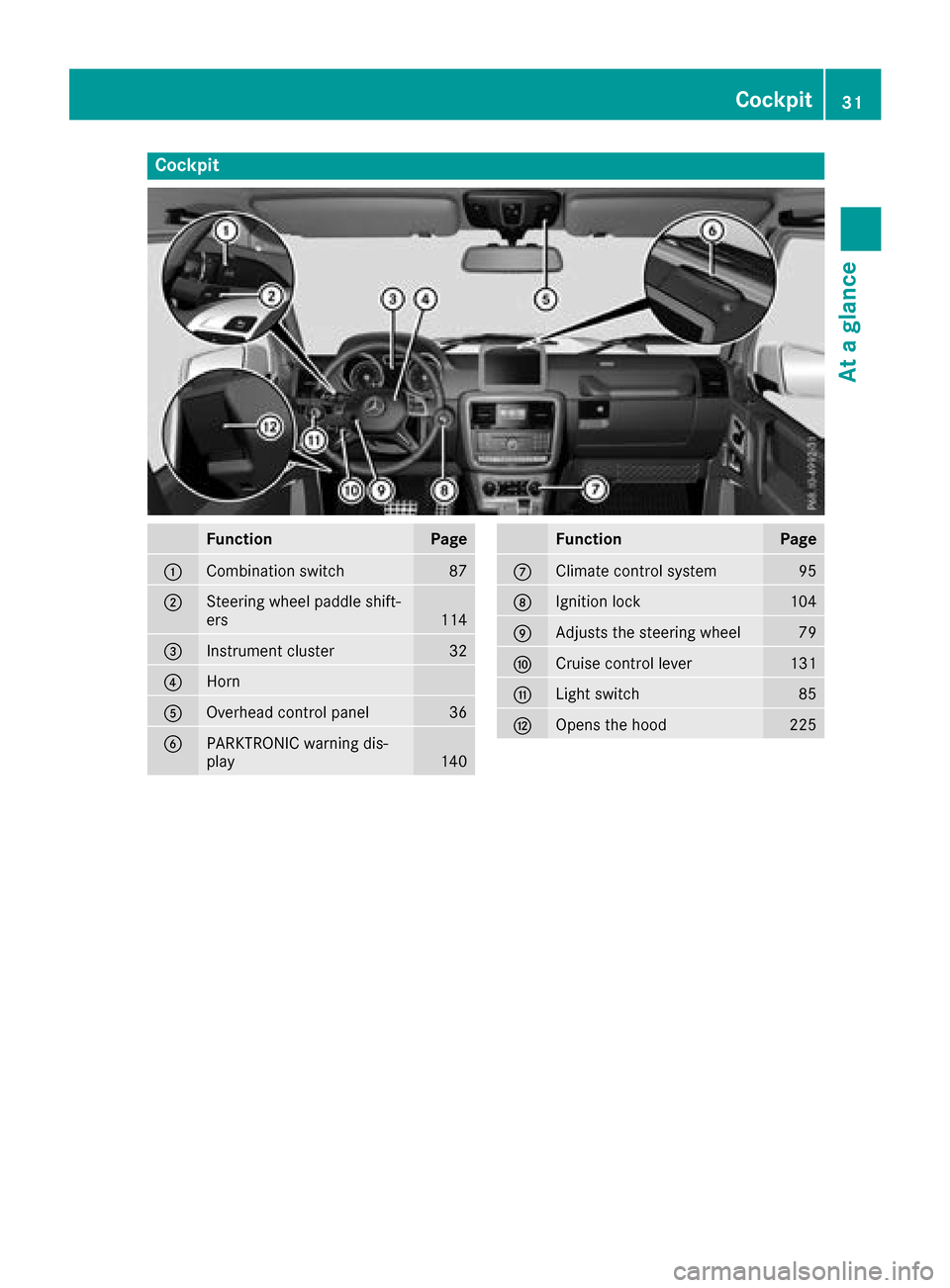
Cockpit
FunctionPage
:Combination switch87
;Steering wheel paddle shift-
ers114
=Instrumentcluster32
?Horn
AOverhead control panel36
BPARKTRONIC warning dis-
play140
FunctionPage
CClimatecontrol system95
DIgnition lock104
EAdjusts th esteering wheel79
FCruis econtrol lever131
GLights witch85
HOpenst hehood225
Cockpit31
Atag lance
Page 40 of 286
Occupant safety
Introduction to the restraint system
The restraint system can reduce the risk of vehi-cle occupant scomin ginto contact with parts of
the vehicle's interior in the event of an accident.
The restraint system can also reduce the forces to which vehicle occupant sare subjected during
an accident.
The restraint system comprises:
RSeat belt system
RAir bags
RChild restraint system
RChild seat securings ystems
The component softhe restraint system work in
conjunction with each other .They can only
deploy their protective function if, at all times, all
vehicle occupants:
Rhave fastened their seat belts correctly
(Ypage 41)
Rhave the seat and head restraint adjusted
properly (Ypage 74)
As the driver, you also have to make sure that
the steering wheel is adjusted correctly.
Observe the information relating to the correct
driver's seat position (
Ypage 74).
You also have to make sure that an air bag can
inflate properly if deployed (
Ypage 43).
An air bag supplement sacorrectly worn seat
belt. As an additional safety device, the air bag
increases the level of protection for vehicle
occupant sinthe event of an accident. For exam-
ple, if, in the event of an accident, the protection
offered by the seat belt is sufficient, the air bags
are not deployed. When an accidento ccurs,only
the air bags that increase protection in that par- ticular accidents ituation are deployed. How-
ever, seat belts and air bags generally do not
protec tagainst objects penetratin gthe vehicle
from the outside.
Information on restraint system operation can
be found under "Triggering of the Emergency
Tensioning Devices and air bags" (
Ypage 46).
See "Children in the vehicle" for information on
children travelin gwith you in the vehicle as well
as on child restraint systems (
Ypage 49).
Important safetyn otes
GWARNING
Modifications to the restraint system may
cause it to no longer work as intended. The
restraint system may then not perform its
intended protective function and may fail in an
accidentort rigger unexpectedly, for example.
This poses an increased risk of injur yoreven
fatal injury.
Never modify parts of the restraint system.
Never tamper with the wiring, the electronic
component sortheir software.
If it is necessary to modify component softhe
restraint system to accommodate aperson
with disabilities, contact an authorized
Mercedes-Benz Center for details. USA only:
for further information contact our Customer
Assistance Center at 1-800-FOR-MERCedes
(1‑ 800‑367‑ 6372).
Mercedes-Benz recommends that you only use
driving aids which have been approved specifi-
cally for your vehicle by Mercedes-Benz.
Restraint system warning lamp
The function softhe restraint system are
checked after the ignition is switched on and at
regular intervals while the engin eisrunning.
Therefore, malfunctions can be detected in
good time.
The 6 restraint system warning lamp on the
instrument cluster lights up when the ignition is
switched on. It goes out no later than afew sec-
onds after the vehicle is started. The compo-
nents of the restraint system are in operational
readiness.
Am alfunction has occurred if the 6restraint
system warning lamp:
Rdoes not light up after the ignition is switched
on
Rdoes not go out after afew seconds with the
engin erunning
Rlights up again while the engin eisrunning
GWARNING
If the restraint system is malfunctioning,
restraint system component smay be trig-
38Occupant safety
Safety
Page 45 of 286
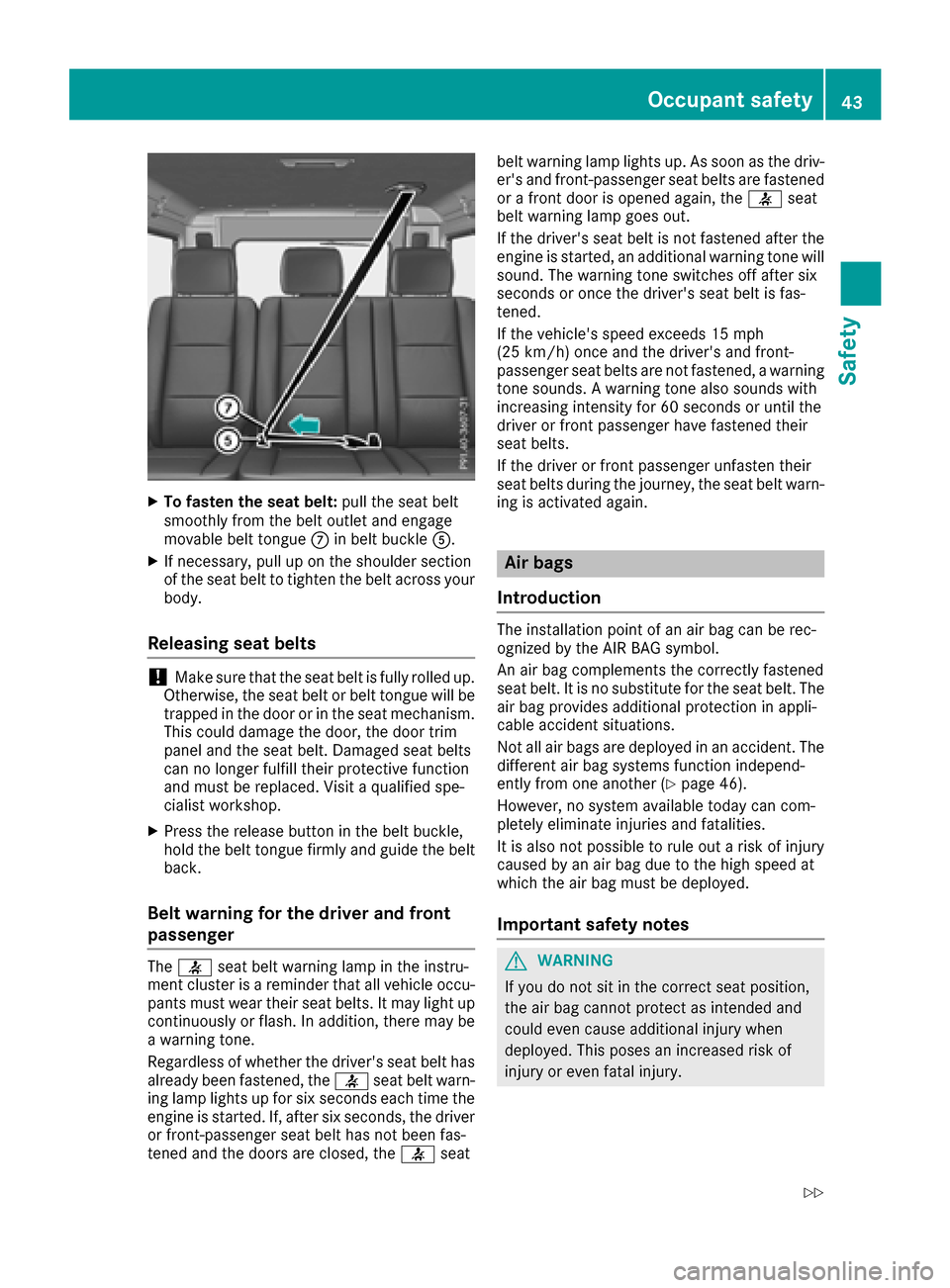
XTo fastenthe seat belt: pull the seatbelt
smoothl yfrom the belt outle tand engage
movabl ebeltt ongue Cin belt buckle A.
XIf necessary,p ullupont he shoulde rsection
of the sea tbelttot ighten the belt across your
body.
Releasin gseatb elts
!Make sure thatt he seatbeltisf ully rolle dup.
Otherwise, the sea tbeltorb eltt ongu ewillb e
trappe dinthe door or in the sea tmechanism.
Thi scould damag ethe door, the door trim
panel and the sea tbelt. Damaged sea tbelts
can no longer fulfil lthei rprotective function
and must be replaced.V isitaquali fied spe-
cialist workshop.
XPress the release button in the belt buckle,
hol dthe belt tongu efirmly and guid ethe belt
back.
Bel twarning for the drive rand front
passenger
The 7 seatbeltw arning lamp in the instru-
ment cluster is areminder thata llvehicl eoccu-
pants must wear thei rseatb elts. It may light up
continuously or flash. In addition, ther emay be
aw arning tone.
Regardless of whethe rthe driver's sea tbelth as
already been fastened ,the 7 seatbeltw arn-
ing lamp lights up for sixs econds each time the
engine is started .If, afte rsixseconds ,the driver
or front-passenger sea tbelth as not been fas-
tened and the doors are closed ,the 7 seat belt warning lamp lights up
.Assoona sthe driv-
er' sa nd front-passenger sea tbelts are fastened
or afront door is opene dagain ,the 7 seat
belt warning lamp goe sout.
If the driver'ss eatb eltisn ot fastened afte rthe
engine is started ,anadditional warning tone will
sound. The warning tone switches off afte rsix
seconds or once the driver'ss eatb eltisf as-
tened.
If the vehicle's speed exceed s15mph
(25 km/h )once and the driver'sa nd front-
passenger sea tbelts are not fastened ,awarning
tone sounds. Awarning tone also sounds with
increasing intensity for 60 seconds or unti lthe
driver or front passenger have fastened their
sea tbelts.
If the driver or front passenger unfasten their
sea tbelts during the journey,t he seatbeltw arn-
ing is activate dagain .
Airb ags
Introduction
The installatio npoint of an ai rbag can be rec-
ognized by the AIR BAG symbol.
An ai rbag complements the correctl yfastened
sea tbelt. It is no substitute for the sea tbelt. The
ai rb ag provides additional protection in appli-
cable accident situations.
Not al lairbags are deployed in an accident. The
different ai rbag systemsf unctionindepend-
entlyf rom one another (
Ypage 46).
However, no system available toda ycan com-
pletel yeliminate injurie sand fatalities.
It is also not possibl etoruleo utariskofi njury
caused by an ai rbag duetot he high speed at
which the ai rbag must be deployed.
Important safety notes
GWARNING
If yo udon ot sitint he correct sea tposition,
the ai rbag canno tprotect as intende dand
could eve ncause additional injury when
deployed .Thisp oses an increased ris kof
injury or eve nfata linjury.
Occupant safety43
Safety
Z
Page 48 of 286
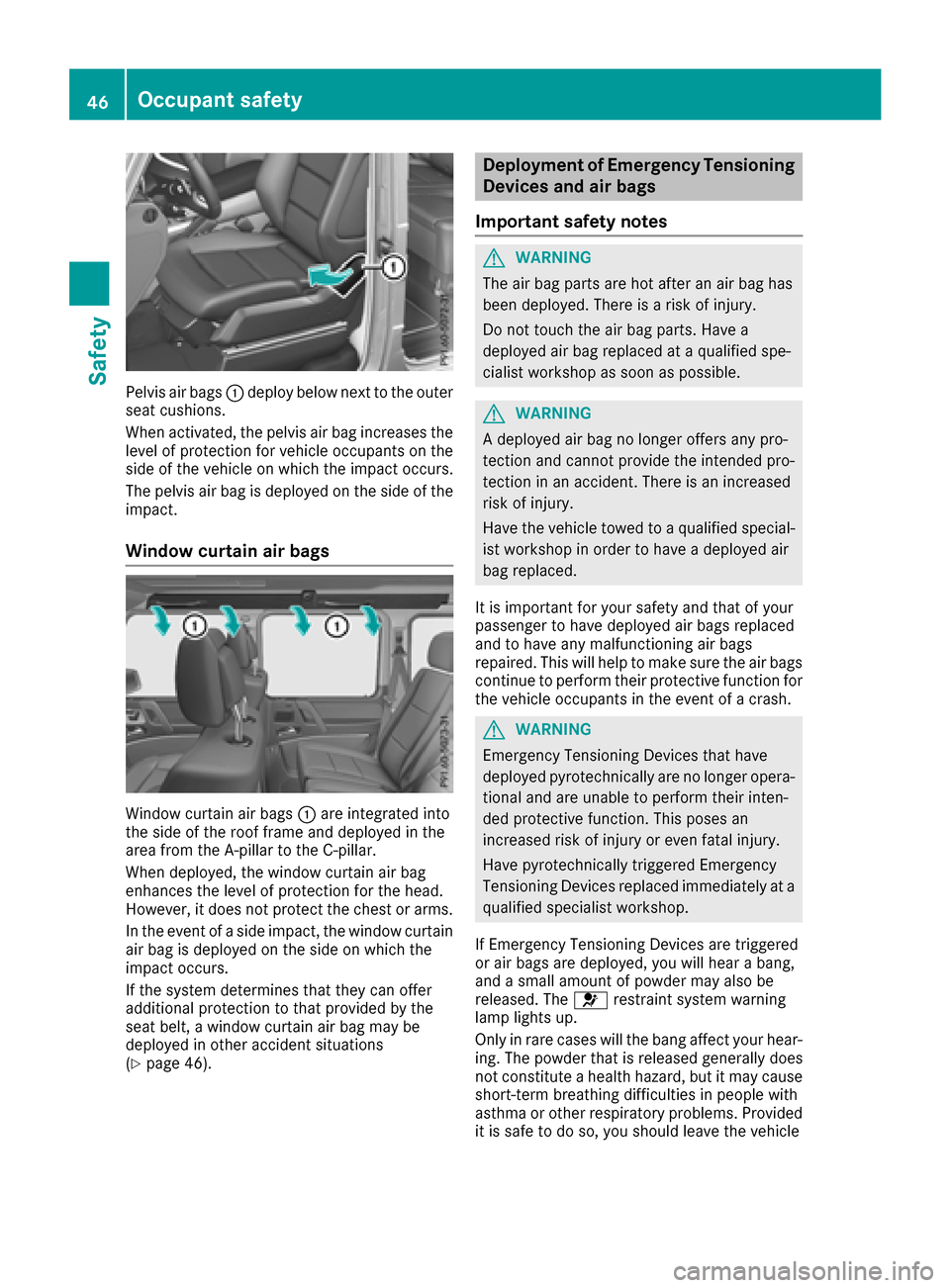
Pelvis air bags:deploy below next to the outer
seat cushions.
When activated, the pelvis air bag increases the
level of protection for vehicle occupantsont he
side of the vehicle on which the impact occurs.
The pelvis air bag is deployed on the side of the
impact.
Window curtain air bags
Window curtain air bags :are integrated into
the side of the roof frame and deployed in the
area from the A-pillar to the C-pillar.
When deployed, the window curtain air bag
enhances the level of protection for the head.
However, it does not protec tthe chest or arms.
In the event of aside impact, the window curtain
air bag is deployed on the side on which the
impact occurs.
If the system determines that they can offer
additional protection to that provided by the
seat belt, awindow curtain air bag may be
deployed in other accident situations
(
Ypage 46).
Deployment of Emergency Tensioning
Devicesa nd air bags
Important safety notes
GWARNING
The air bag parts are hot after an air bag has
been deployed. There is arisk of injury.
Do not touch the air bag parts. Have a
deployed air bag replaced at aqualified spe-
cialist workshop as soon as possible.
GWARNING
Ad eployed air bag no longer offers any pro-
tection and cannot provide the intended pro-
tection in an accident .There is an increased
risk of injury.
Have the vehicle towed to aqualified special-
ist workshop in order to have adeployed air
bag replaced.
It is importan tfor your safety and that of your
passenger to have deployed air bags replaced
and to have any malfunctioning air bags
repaired. This will help to make sure the air bags
continue to perform their protective function for
the vehicle occupantsint he event ofacrash.
GWARNING
Emergency TensioningD evices that have
deployed pyrotechnically are no longer opera-
tional and are unable to perform their inten-
ded protective function. This poses an
increased risk of injury or even fatal injury.
Have pyrotechnically triggered Emergency
TensioningD evices replaced immediately at a
qualified specialist workshop.
If Emergency TensioningD evices are triggered
or air bags are deployed, you will hear abang,
and asmall amount of powder may also be
released. The 6restraint system warning
lamp lights up.
Only in rare cases will the bang affect your hear-
ing. The powder that is released generally does
not constitut eahealth hazard, but it may cause
short-term breathing difficulties in people with
asthma or other respiratory problems. Provided
it is safe to do so, you should leave the vehicle
46Occupant safety
Safety
Page 55 of 286

XRemove cargo compartmentcover
(Ypage 209).
XMov ethe head restrain tup.
XInstall th eLATCH-type (ISOFIX) child restrain t
system wit hTop Tether .Always comply wit h
th ec hild restrain tsystem manufacturer' s
installation instruction swhen doin gso.
XRout eTop Tether belt =under th ehead
restrain tbetween th etwo head restrain tbars .
XHook Top Tether hoo k: of Top Tether belt
= intoT op Tether anchorage ;.
Mak esuret hatT op Tether belt =is no ttwis-
ted.
XTension Top Tether belt =.Always comply
wit hthe child restrain tsystem manufactur -
er' sinstallation instruction swhen doin gso.
XMov ehead restrain tbackd own again slightly
if necessar y(Ypage 77). Mak esuret hat
you do no tinterfere wit hthe correc trouting of
Top Tether belt =.
BabySmart™air bag deactivation sys-
tem
GWARNIN G
Electronic device sonthefront-passenger
seat can affec tthe function of th eBaby-
Smart ™air bag deactivation system, for
example:
RLaptop
RMobile phon e
RTransponder cards suc hasskipasses or
access passes
The front-passenger air bag could deplo yacci-
dentally or no tfunction as intended during an
accident. This poses an increased ris kof
injury or eve nfatal injury.
Do no tplac ea ny of th edevice smentioned
abov eors imilar device sonthefront-
passenger seat .Beaware of th estatus of th e
front-passenger fron tair bag bot hbefore and
during th ejou rney.
The BabySmart ™air bag deactivation system' s
sensor system in th efront-pa ssenger seat
detects whether aspecial Mercedes-Ben zchild
restrain tsystem wit hatransponder for th e
BabySmart ™air bag deactivation system has been installed. In this case, th
ePASSENG ER AIR
BA GO FFindicator lamp lights up and remain s
lit .T he front-passenger fron tair bag is deacti -
vated.
When th eSma rtKey is remove dfromt heignition
loc korisinp osition0,thePASSENGER AI RBAG
OF Findicator lamp does no tligh tup.
iIf th efront-pa ssenger fron tair bag is deac -
tivated by th eBabySmart ™air bag deactiva-
tion system, th ef
o
llowin gremain enabled on
th ef ront-pa ssenger side :
Rthes ide impact air bag
Rthep elvis air bag
Rthew indow curtai nair bag
RtheE me rgency Tensioning Devic e
GWARNING
If you secure achild in achild restrain tsystem
on th efront-pa ssenger seat and th e
PASSENGER AI RBAG OFFindicator lamp is
off ,the front-passenger fron tair bag can
deplo yintheevent of an accident. The child
could be struc kbytheair bag. This poses an
increased ris kofinjury or eve nfatal injury.
Mak esuret hatthe front-passenger fron tair
bag has been disabled. The PASSENGER AI R
BA GO FFindicator lamp mus tbelit.
GWARNIN G
If th ePASSENG ER AIRBAG OFFindicator
lamp is lit ,the front-passenger fron tair bag is
deactivated. It will no tbedeployed in th e
event of an acciden tand canno tperfor mits
intended protective function .Aperson in th e
front-passenger seat could then ,for example,
come int ocontac twitht he vehicle's interior,
especially if th eperson is sitting to oclose to
th ed ashboard. This poses an increased ris kof
injury or eve nfatal injury.
In this cas ethe front-passenger seat may no t
be used .You may only transpor tachild on th e
front-passenger seat if they are seated in a
suitable rearward or forward-facing child
restrain tsystem. Always observ ethe child
restrain tsystem manufacturer' sinstallation
instructions.
Children in th evehicle53
Safety
Z
Page 57 of 286
Forward-facingchild restrain tsystem
If it is absolutely necessar ytoinstal laforward-
facing child restrain tsystem on th efront -
passenger seat ,always mov ethe front-
passenger seat as far bac kaspossible. The
entire base of th echild restrain tsystem must
always res tontheseat cushion of th efront -
passenger seat .The backrest of th echild
restrain tsystem must lie as flat as possible
against th ebackrest of th efront-pa ssenger
seat .The child restrain tsystem must no ttou ch
th er ooforbes ubjected to aload by th ehead restraint
.Adjus tthe angle of th eseat backrest
and th ehead restraint position accordingly.
Always mak esure that th eshoulder belt strap is
correctly routed from th evehicl ebelt sash guide
to th eshoulder belt guide on th echild restrain t
system. The shoulder belt strap must be routed
forward and down from th evehicl ebelt sash
guide .Ifnecessary, adjust th ebelt sash guide
and th efront-pa ssenger seat accordingly.
Always observ ethe child restraint system man -
ufacturer' sinstallation and operating instruc-
tions.
Problemsw ith theBabySmart ™air bag deactivation system
ProblemPossible causes/consequences and MSolutions
The PASSENGER AIR
BA GO FFindicator lamp
on th ecente rconsol eis
lit .As pecial Mercedes-Ben zchild restrain tsystem wit hatransponder for
th eB abySmart ™air bag deactivation system has been installed on th e
front-passenger seat .The front-passenger air bag has therefor ebeen
deactivated as desired .
GWARNING
Ther eisnoc hild restrain tsystem installed on th efront-pa ssenger
seat .The BabySmart ™air bag deactivation system is malfunctioning ,
for example due to electronic device sonthefront-passenger seat .
Ther eisar iskofi njury.
XRemove electronic equipmen tfromt hefront-passenger seat ,for
example:
RLaptop
RMobile phon e
RCard withatransponder ,suc hasas kipass or access pass
If th ePASSENG ER AIRBAG OFFindicator lamp remains lit ,the front-
passenger seat may no tbeused.
XVisitaqualified specialist workshop.
When you switch th e
ignition on ,the 6
restrain tsystem warning
lamp lights up and/o r
th eP ASSENG ER AIR
BA GO FFindicator lamp
does no tligh tupb riefly.GWARNIN G
The BabySmart ™air bag deactivation system is malfunctioning .
Do no tinstal lachild restraint system on th efront-pa ssenger seat .
It is recommended that you instal lthe child restraint system on a
suitable rear seat .
XVisitaqualified specialist workshop.
XPleas ealso refer to th enotes about th erestraint system warning
lamp (Ypage 193).
Children in th evehicle55
Safety
Z
Page 59 of 286
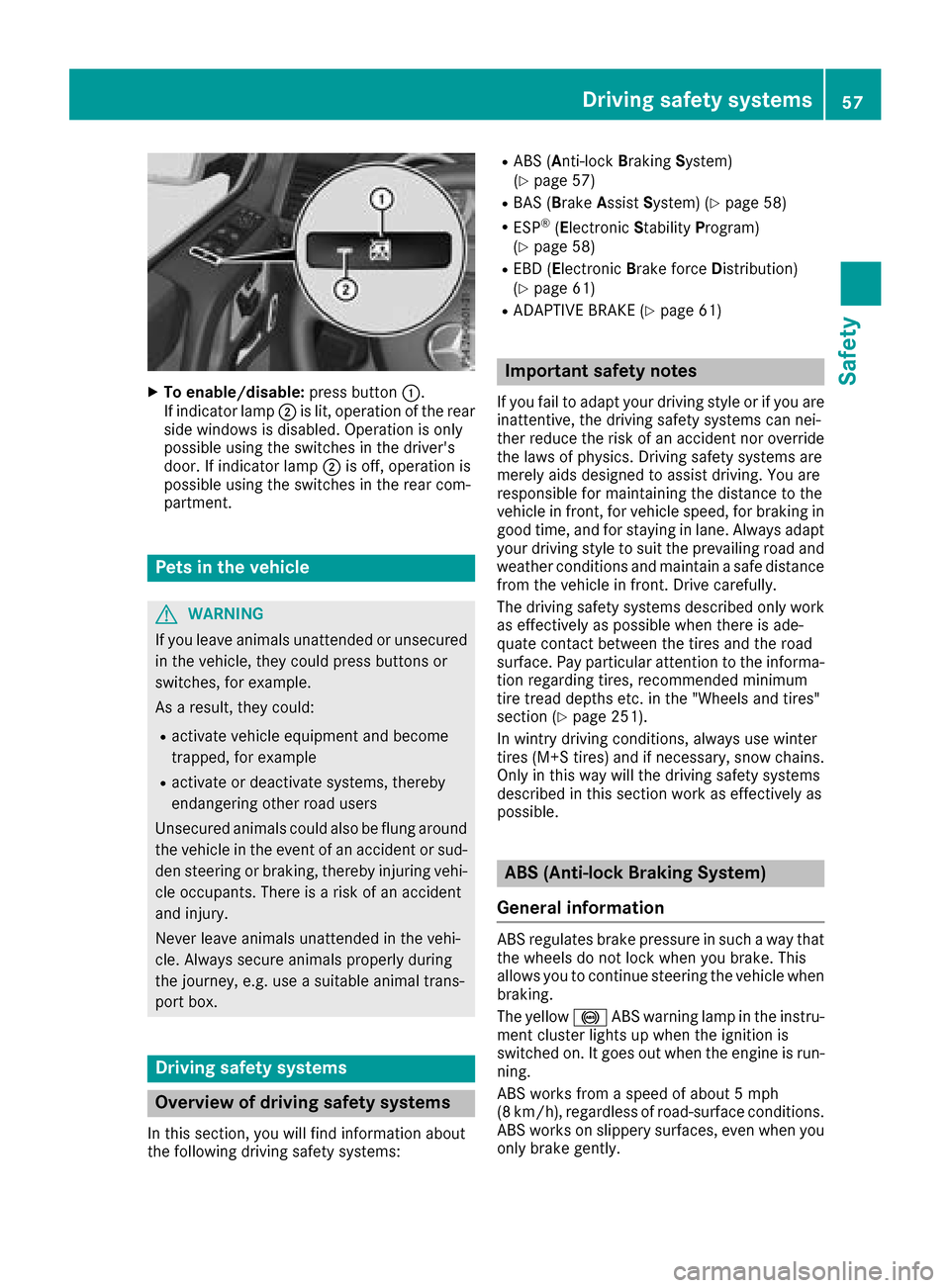
XTo enable/disable:press button:.
If indicator lamp ;is lit, operatio nofthe rear
side windows is disabled .Operation is only
possibl eusing the switches in the driver's
door. If indicator lamp ;is off, operatio nis
possibl eusing the switches in the rearc om-
partment.
Pets in the vehicle
GWARNING
If yo ulea ve animals unattende dorunsecured
in the vehicle, they could press buttons or
switches, for example.
As aresult, they could:
Ractivate vehicl eequipment and become
trapped, for example
Ractivate or deactivate systems, thereby
endangering othe rroadu sers
Unsecured animals could also be flung around
the vehicl einthe event of an accident or sud-
de ns teering or braking ,thereb yinjuring vehi-
cle occupants. There is ariskofana ccident
and injury.
Never leave animals unattende dinthe vehi-
cle .Alway ssecure animals properly during
the journey ,e.g.u se asuitabl eanimal trans-
port box.
Driving safety systems
Overvie wofdriving safety systems
In thiss ection, yo uwillf ind informatio nabout
the following driving safety systems:
RABS ( Anti-lock Braking System)
(Ypage 57)
RBAS ( Brake Assis tSys tem )(Ypage 58)
RESP®(E le ctronic Stability Program)
(Ypage 58)
REBD ( Ele ctronic Brake force Dis tribution)
(Ypage 61)
RADAPTIVE BRAK E(Ypage 61)
Important safety notes
If youfailtoa dapt your driving style or if yo uare
inattentive, the driving safety systemsc an nei-
ther reduce the ris kofanaccident nor override
the laws of physics. Driving safety systemsa re
merel yaidsd esig ned to assist driving .You are
responsibl efor maintaining the distance to the
vehicl einfront, for vehicl espeed ,for braking in
goo dtime ,and for staying in lane. Alway sadapt
your driving style to suit the prevailing roada nd
weather conditions and maintain asafed istance
from the vehicl einfront. Driv ecarefully.
The driving safety systemsd escribe donlyw ork
as effectively as possibl ewhent her eisa de-
quate contact between the tire sand the road
surface. Payp articula rattentio ntothe informa-
tio nr egarding tires, recommende dminimum
tire trea ddepths etc. in the "Wheels and tires"
section (
Ypage 251).
In wintry driving conditions, always us ewinter
tire s(M+ Stires) and if necessary,s now chains.
Onlyint hiswaywill the driving safety systems
describe dinthissection work as effectively as
possible.
ABS (Anti-lock Brakin gSystem)
General information
ABS regulate sbrake pressure in such awaythat
the wheels do not lock when yo ubrake. This
allows yo utocontinue steering the vehicl ewhen
braking.
The yellow !ABS warning lamp in the instru-
ment cluster lights up when the ignition is
switched on. It goe soutwhen the engine is run-
ning.
ABS works from aspeed of about5m ph
(8 km/h), regardless of road-surface conditions.
ABS works on slippery surfaces, eve nwheny ou
onlyb rake gently.
Driving safety systems57
Safety
Z
Page 61 of 286
4ETS (Electronic Traction System)
iObserve the "Important safety notes" sec-
tion (Ypage 57).
4ET Straction contro lispart of ESP
®.
4ET Straction contro lisnolonger activ eabove a
speed of approximately 37 mph (60 km/h).
Traction contro lbrakes the drive wheels indi-
vidually if they spin. This enables you to pull
away and accelerate on slippery surfaces,f or
example if the road surface is slippery on one
side. In addition, more drive torque is transfer-
red to the wheel or wheels with traction.
Traction contro lremains active, even if you
deactivate ESP
®.
Importan tsafetyn otes
iObserve the "Important safety notes" sec-
tion (Ypage 57).
GWARNING
If ESP
®is malfunctioning, ESP®is unable to
stabilize the vehicle. Additionally, further driv-
ing safety systems are deactivated. This
increases the risk of skiddin gand an accident.
Driv eonc arefully. Have ESP
®checked at a
qualified specialist workshop.
!Only operate the vehicle for amaximum of
ten seconds on abrake test dynamometer.
Switc hoff the ignition.
Application of the brakes by ESP
®may oth-
erwise destroy the brake system.
!Af unction or performanc etest should only
be carried out on atwo-axle dynamometer.
Beforey ou operate the vehicle on such a
dynamometer, please consult aqualified
workshop. You could otherwise damage the
drive train or the brake system.
If the å ESP
®OFF warning lamp lights up
continuously, ESP®is deactivated.
If the ÷ ESP®warning lamp lights up contin-
uously, ESP®is not available due to amalfunc-
tion.
Observe the information on warning lamps
(
Ypage 191) and display messages which may
be displayed in the instrument cluster
(
Ypage 171). Only use wheels with the recommended tire
sizes. Only then will ESP
®function properly.
If differential locksa re switched on, ABS, BAS
and ESP
®switc hoff automatically.
Characteristics of ESP®
Genera linformation
If the ÷ ESP®warning lamp goes out before
beginning the journey, ESP®is automatically
active.
If ESP
®intervenes, the ÷ESP®warning lamp
flashes in the instrument cluster.
If ESP
®intervenes:
XDo not deactivate ESP®under any circum-
stances.
XOnly depress the accelerator pedal as far as
necessary when pulling away.
XAdapt your drivings tyle to suit the prevailing
road and weather conditions.
ECO start/stop function
The ECO start/stop function switches the
engin eoff automatically when the vehicle stops
moving. The engin estart sautomatically when
the driver wants to pull away again. ESP
®
remains in its previously selected status, e.g. if
ESP®was deactivated before the engin ewas
automatically switched off.
Deactivating/activating ESP®
Important safetyn otes
iObservethe "Important safety notes" sec-
tion (Ypage 57).
You can select between the following states of
ESP
®:
RESP®is activated.
RESP®is deactivated.
GWARNING
If you deactivate ESP
®,E SP®no longer sta-
bilizes the vehicle. There is an increased risk
of skiddin gand an accident.
Only deactivate ESP
®in the situation sdescri-
bed in the following.
Driving safetys ystems59
Safety
Z