2017 MERCEDES-BENZ E43AMG traction
[x] Cancel search: tractionPage 165 of 482

play inthe Instrument Display is alw ays update d
when theve hicle is le vel with the traf fic sign.
If th e Dis tance Pilot DISTRONIC has been put
into passive modebypressing the accelerator
pedal, only speed limits which are higher than
th e set speed are adop ted.
Pulling the cruise control le ver will set the dis‐
pla yed speed limit as the speed, pr ovided that:
RThe Speed Limit Pilot has been activated in
the multimedia sy stem and
RDis tance Pilot DISTRONIC has been acti va‐
te d.
If no speed limit is displa yed when the le ver is
operated, the speed set bythe driver is adop ted.
Drive prog ram
The DYNA MIC SELECT switch allo wsyouto
ch ange the driving style of Dis tance Pilot
DISTRONIC. Depending on which drive program
is selected, the driving characteristics can be
ge ared towa rds fuel econom y,comfort or
dynamic per form ance (
→page 136). Sy
stem limits
Ve hicles with the Driving Assistance Pack‐
age: Distance Pilot DISTRONIC is acti veinthe
0 mp h (0 km/h) to130mp h (2 10km/h) speed
ra nge.
The sy stem may be impaired or may not function
in thefo llowing situations:
RIn sno w,rain, fog, heavy spr ay, if there is
gl are, in dir ect sunlight or in greatly varying
light conditions.
RIf th e windshield in the area of the camera is
dirty, fogged up, damaged or co vered.
RIfth era dar sensors are dirty or co vered.
Do not use Dis tance Pilot DISTRONIC in thefo l‐
lowing situations:
RIn road and traf fic conditions whi chdo not
allow youto maintain a cons tant speed, e.g.
in heavy traf fic or on winding roads.
ROn slippery roads. Braking or accelerating
can cause the drive wheels tolose traction
and theve hicle could then skid.
RWhen there is poor visibility, e.g. due tofog,
heavy rain or sno w.
RIn parking garage s or at tollst ations.
ROn roads with steep uphill or downhill gradi‐
ents.
Tips
Pa yparticula rattention in thefo llowing traf fic
situations. In such situations, brake if necessar y.
Dis tance Pilot DISTRONIC is then deactivated:
RWhen cornering, entering and exiting a bend.
RWhen not driving in the center of the lane.
RWhen other vehicles are changing lane.
RIfth ere are nar rowvehicles.
RIfth ere are obs tacles and stationary vehi‐
cles.
RIf th ere are crossing vehicles, pedestrians,
mo torcyc lists or cyclists.
Driving and parking 16
3
Page 342 of 482
RThe tires maywearexc essively and/or
une venly, which may greatlyimpair tire
traction.
RThe driving characteristics, as well as
st eering and braking, may be greatly
impaired.
#Comply with there commended tire
pressure and check the tire pressure of
all tires including the spare wheel regu‐
larly:
Rat least once a month
Rwhen the load changes
Rbefore embarking on a longe r journey
Rif operating conditionschange, e.g. off-
ro ad driving
#Ad just the tire pressure as necessar y.
Driving withtire pressure that is too high or too
low can:
RSho rten the service life of the tires.
RCause increased tire damage.
RAd versely af fect handling characteristics and
th us dr iving saf ety, e.g. due to hydroplaning.
&
WARNING Risk of an accident due to
insuf ficient tire pressure
Ti re s with pressure that is too low can over‐
heat and bur stas a result.
In addition, they also suf fer from excessive
and/or ir regular wear, which can significantly
impair the braking properties and the han‐
dling characteristics.
#Av oid excessively low tire pressures in
all the tires, including the spare wheel.
Tire pressure which is too low can cause:
RTire defects as a result of overheating.
RImpaired handling characteristics
RIrre gular wear
RIncreased fuel consum ption
&
WARNING Risk of accident from exces‐
sive tire pressure
Ti re s with excessively high pressure can
burs t because they are damaged more easily
by highw ayfill, pot holes etc.
In addition, they also suf fer from ir regular
we ar, which can significantly impair the brak‐
ing properties and the handling characteris‐
tics.
#Av oid excessively high tire pressures in
all the tires, including the spare wheel.
Excessively high tire pressure can result in:
RIncreased braking dis tance
RImpaired handling characteristics
RIrre gular wear
RImpaired driving com fort
RSusceptibility todamage
34 0
Wheels and tires
Page 352 of 482
Tire labeling
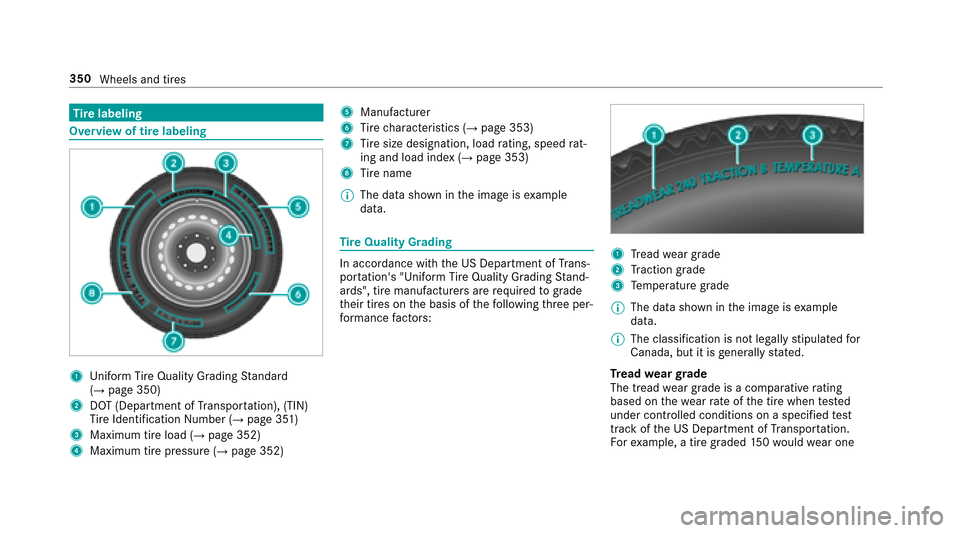
Overview of tire labeling
1Uni form Ti reQuality Grading Standard
(→page 350)
2DOT (Department of Transpor tation), (TIN)
Ti re Identification Number (→page 351)
3Maximum tire load (→page 352)
4Maximum tire pressure (→page 352)
5Manufacturer
6Tire characteristics (→page 353)
7Tire size designation, load rating, speed rat‐
ing and load ind ex(→page 353)
8Tire name
% The da tashown in the image is example
data.
Ti re Quality Grading
In accordance with the US Department of Trans‐
por tation's "Unifo rm TireQuality Grading Stand‐
ards", tire manufacturers are requ ired tograde
th eir tires on the basis of thefo llowing thre e per‐
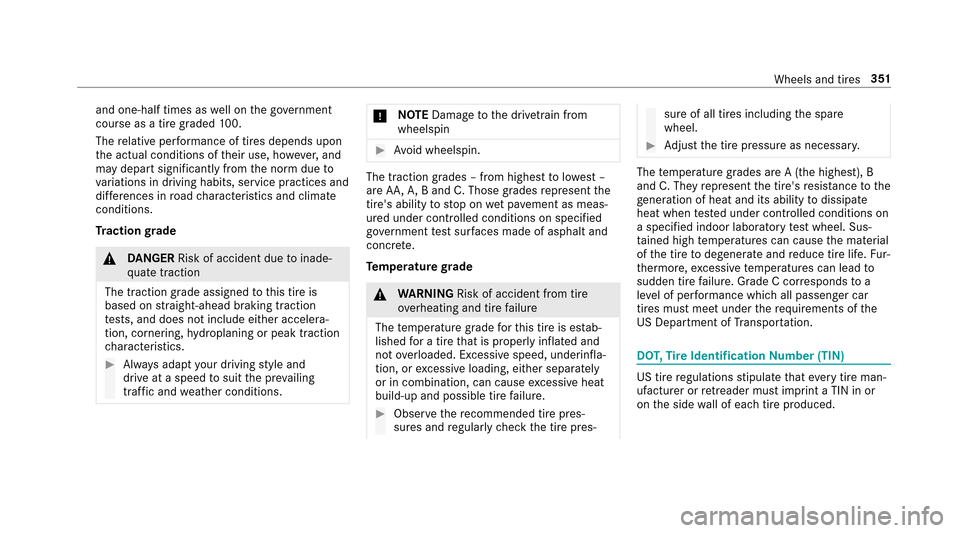
fo rm ance factors:1Tread weargrade
2Traction grade
3Te mp erature grade
% The data shown in the image is example
data.
% The classification is not legally stipulated for
Canada, but it is general lystated.
Tr ead weargrade
The tread wear grade is a comparative rating
based on thewe arrate ofthe tire when tested
under controlled conditions on a specified test
track of the US Department of Transpor tation.
Fo rex ample, a tire graded 150wo uld wear one
350
Wheels and tires
Page 353 of 482
and one-half times aswell on the go vernment
course as a tire graded 100.
The relative per form ance of tires depends upon
th e actual conditions of their use, ho wever,and
may depart significantly from the norm due to
va riations in driving habits, service practices and
dif fere nces in road characteristics and climate
conditions.
Tr action grade
&
DANG ER Risk of accident due toinade‐
qu ate traction
The traction grade assigned tothis tire is
based on stra ight-ahead braking traction
te sts, and does not include either accelera‐
tion, cornering, hydroplaning or peak traction
ch aracteristics.
#Alw ays adapt your drivin gst yle and
drive at a speed tosuit the pr evailing
traf fic and weather conditions.
* NO
TEDama getothe driv etra in from
wheelspin
#Av oid wheelspin.
The traction grades – from highest tolowest –
are AA, A,B and C. Those grades represent the
tire's ability tostop on wet pa vement as meas‐
ured under controlled conditions on specified
go vernment test sur faces made of asphalt and
concr ete.
Te mp erature grade
&
WARNING Risk of accident from tire
ove rheating and tire failure
The temp erature grade forth is tire is es tab‐
lished for a tire that is proper ly inflated and
not overloaded. Excessive speed, underinfla‐
tion, or excessive loading, either separately
or in combination, can cause excessive heat
build-up and possible tire failure.
#Obser vethere commended tire pres‐
sure s and regularly check the tire pres‐
sure of all tires including the spare
wheel.
#Ad just the tire pressure as necessar y.
Thetemp erature grades are A (the highest), B
and C. They represent the tire's resis tance tothe
ge neration of heat and its ability todissipate
heat when tested under controlled conditions on
a specified indoor laboratory test wheel. Sus‐
ta ined high temp eratures can cause the material
of the tire todegenerate and reduce tire life. Fur‐
th ermore, excessive temp eratures can lead to
sudden tire failure. Grade C cor responds toa
le ve l of per form ance which all passenger car
tires must meet under therequ irements of the
US Department of Transpor tation.
DO T,Tire Identification Number (TIN)
US tire regulations stipulate that eve rytire man‐
ufactu rer or retreader must imprint a TIN in or
on the side wall of each tire produced.
Wheels and tires 351
Page 357 of 482
IndexS peedrating
ZR...Y
1up to186mp h(3 00 km/h)
ZR...(..Y)
1ove r18 6mp h(3 00 km/h)
ZR
1ove r14 9mp h (240 km/h)
RSpecifying the speed rating as the "ZR" index
in tire code 4is optional for tires up to
18 6mp h(3 00 km/h).
RIfyo ur tire co de4 includes "ZR"andthere
is no speed rating 7,find out what the max‐
imum speed is from the tire manufacturer.
RIf load-bearing index 6and speed rating 7
are in brac kets, the maximum speed rating of
yo ur tire isabo ve186mp h (300 km/h). To
fi nd out the maximum speed, ask the tire
manufacturer. All-weather tires and winter tires
Inde
xS peedrating
Q M+S
2up to100mp h (160 km/h)
T M+S
2up to118mp h(190 km/h)
H M+S
2up to130mp h (2 10km/h)
V M+S
2up to149mp h (240 km/h)
Winter tires bear thei snowflake symbol
and fulfill therequ irements of theRu bber Manu‐
fa cturers Association (RMA) and theRu bber
Association of Canada (RAC) rega rding the tire
traction on sno w.
Load index 8
:RNo specification given: standard load (SL)
tire
R"XL" or "Extra Load": extra load tire or rein‐
fo rc ed tire
R"Light Load": light load tire
R"C", "D", "E": a load range that depends on
th e maximum load that the tire can car ryat a
cer tain pressure
Definitions for tires and loading
Ti re stru ctureand characteristics: describes
th e number of la yers or the number of rubber-
coated belts in the tire conta ct surface and the
tire wall. These are made of steel, nylon, poly‐
es ter and other materials.
Bar: metric unit for tire pressure .
14 .5038 pounds per square inch (psi) and
10 0 kilopascal (kPa) is the equivalent of one bar.
DOT (Department of Transport ation):DOT
mar ked tires fulfill therequ irements of the
US Department of Transpor tatio n.
Av erage weight of theve hicle occupants: the
number of vehicle occupants for which th eve hi‐
cle is designed, multiplied by150 lb (68 kg).
1"ZR" stated in the tire code.2Or "M+S i"for winter tires
Wheels and tires 355
Page 358 of 482
Uniform Tire Quality Grading Standards: a
uniform standard tograde thequ ality of tires
with rega rd totread quality, tire traction and
te mp erature characteristics. The quality grading
assessment is made bythe manufacturer follow‐
ing specifications from theU. S. go vernment. The
qu ality grade of a tire is imprinted on the side
wa ll of the tire.
Re commended tire pressure :th ere commen‐
ded tire pressure is the tire pressure specified
fo rth e tires mounted totheve hicle at thefa c‐
to ry.
The tire and information table conta insthere c‐
ommended tire pressure for cold tires, the maxi‐
mum permissible load and the maximum permis‐
sible vehicle speed.
The tire pressure table conta insthere commen‐
ded tire pressure for cold tires under various
operating conditions, i.e. loading and/or speed
of theve hicle.
Increased vehicle weight due tooptional
equipment: the combined weight of all standard
and optional equipment available forth eve hicle, re
ga rdless of whe ther it is actually ins talled on
th eve hicle or not.
Rim: the part of the wheel on which the tire is
mounted.
GA WR (Gross Axle Weight Rating): the GAWR
is the maximum gross axle load. The actual load
on an axle must ne verexc eed the gross axle
we ight rating. The gross axl e
we ight rati
ng can
be found on theve hicle identification plate on
th e B‑pillar on the driver's side.
Speed rating: the speed rating is pa rtof the tire
identification. It specifies the speed range for
which a tire is appr oved.
GV W (Gross Vehicle Weight): the gross vehicle
we ight comprises thewe ight of theve hicle
including fuel, tools, the spare wheel, accesso‐
ri es ins talled, occupants, luggage and the trailer
dr aw bar nose weight, if applicable. The gross
ve hicle weight must not exceed the gross vehicle
we ight rating GVWR as specified on theve hicle
identification plate on the B‑pillar on the driver's
side.
GV WR (Gross Vehicle Weight Rating): the
GV WR is the maximum permitted gross weight of
the fully laden vehicle (weight of theve hicle
including all accessories, occupants, fuel, lug‐
ga ge and the trailer dr awbar nose weight if appli‐
cable). The gross vehicle weight rating is speci‐
fi ed on theve hicle identification plate on the
B‑pillar on the driver's side.
Maximum weight of the laden vehicle: the
maximum weight is the sum of the unladen
we ight of theve hicle, thewe ight of the accesso‐
ri es, the maximum load and thewe ight of
optional equipment ins talled at thefa ctor y.
Kilopascal (kPa): metricunit for tire pressure .
6.9 kPa cor responds to1 psi. Ano ther unit for
tire pressure is bar.100 kilop ascal (kPa
) equals
1 bar.
Load index: in additiontothe load-bearing
index, the load index may also be imprinted on
th e side wall of the tire. This specifies the load-
bearing capacity of the tire more precisel y.
Curb weight: thewe ight of a vehicle with stand‐
ard equipment including the maximum capacity
of fuel, oil and coolant. It also includes the air
conditioning sy stem and optional equipment if
356
Wheels and tires
Page 359 of 482
these are ins talled on theve hicle, but does not
include passengers or luggage.
Maximum tire load: the maximum tire load is
th e maximum permissible weight in kilog rams or
lbs for which a tire is appr oved.
Maximum permissible tire pressure: maxi‐
mum permissible tire pressure for one tire.
Maximum load on one tire: maximum load on
one tire. This is calculated bydividing the maxi‐
mum axle load of one axle bytwo.
PSI (pounds per square in ch):standard unit of
measurement for tire pressure .
Aspect ratio: ratio between tire height and tire
width in pe rcent.
Ti re pressure: pressure inside the tire applying
an outward forc eto eve rysquare inch of the tire.
The tire pressure is specified in pounds per
square inch (psi), in kilopascals (kPa) or in bar.
The tire pressure should only be cor rected when
th e tires are cold.
Cold tire pressure: the tires are cold when the
ve hicle has been par kedfo r at least 3 hours without direct sunlight on
the tires or theve hicle
has been driven for less than 1 mile (1.6 km).
Ti re contact sur face: the part of the tire that
comes into con tact wi th thero ad.
Ti re bead: the purpose of the tire bead is to
ensure that the tire sits securely on the wheel
ri m. There are se veralst eel wires in the bead to
pr eve nt
the t
ire from coming loose from the
wheel rim.
Side wall:the part of the tire between the tread
and the tire bead.
We ight of optional equipment: the combined
we ight of the optional equipment weighing more
th an there placed standard parts and more than
5 lbs (2.3 kg).This optional equipment, such as
high-per form ance brakes, le vel control sy stem, a
ro of luggage rack or high-per form ance batte ries,
is not included in the curb weight and thewe ight
of the accessories.
TIN (Tire Identification Number): a unique
identification number which can be used bya
tire manufactu rerto identify tires, forex ample,
in a product recall, and thus identify the pur‐
ch asers. The TIN is made up of the manufactur‐ er's identity code, tire size, tire type code and
th
e manufacturing date.
Load-bearing index: the load-bearing index
(also load index) is a code that con tains the max‐
imum load-bearing capacity of a tire.
Tr action: traction is the grip resulting from fric‐
tion between the tires and thero ad sur face.
We ar indicator: narrow bars (tread wear bars)
th at are distributed overth e tire conta ct surface.
If th e tire tread is le vel with the bars, thewe ar
limit of 1/ 16in (1.6 mm) has been reached.
Distribution of vehicle occupants: distribution
of vehicle occupants
over design
ated seat posi‐
tions in a vehicle.
Maximum permissible pa yload weight: nomi‐
nal load and luggage load plus 150 lb (68 kg)
multiplied bythe number of seats in theve hicle.
Wheels and tires 357
Page 412 of 482
Displaymessages
Possible causes/consequences and MSolutions
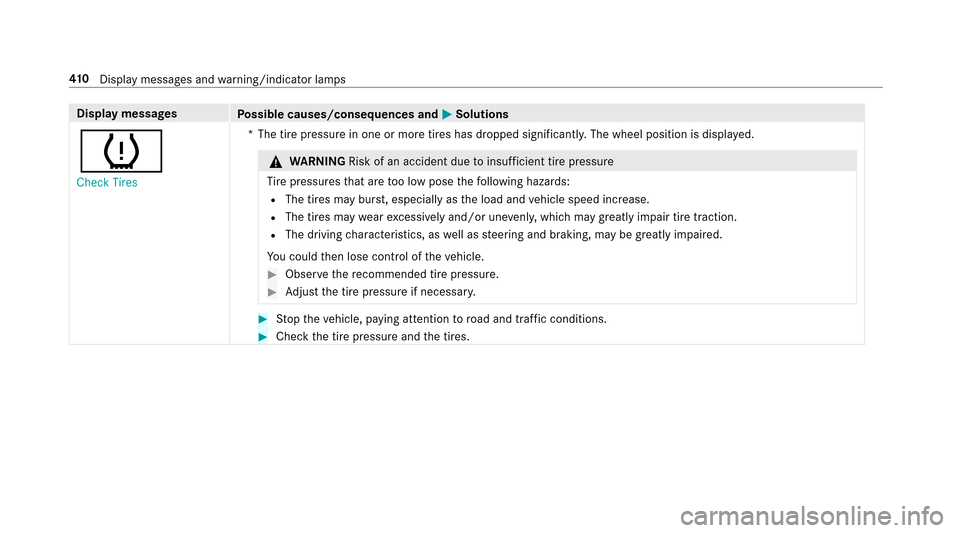
h
&KHFN 7LUHV*T
he tire pressure in one or more tires has dropped significantl y.The wheel position is displa yed.
&
WARNING Risk of an accident due toinsuf ficient tire pressure
Ti re pressures that are too low pose thefo llowing hazards:
RThe tires may bur st, especially as the load and vehicle speed increase.
RThe tires may wearexc essively and/or une venly, which may greatly impair tire traction.
RThe driving characteristics, as well as steering and braking, may be greatly impaired.
Yo u could then lose control of theve hicle.
#Obser vethere commended tire pressure.
#Ad just the tire pressure if necessar y.
#Stop theve hicle, paying attention toroad and traf fic conditions.
#Check the tire pressure and the tires.
41 0
Displ aymessage s andwarning/indicator lamps