2017 MERCEDES-BENZ E-CLASS ESTATE trailer
[x] Cancel search: trailerPage 257 of 585
Tr
aile rhitch Tr
aile roperation no tes Mercedes‑AMG
vehicles: alwayso bser vethe
no tesint he Supplement. Otherwise, youm ay
fa ilto recognise dangers.
Obser vethef ollowing no tesont hetongue
we ight:
R use atongue weight as clos easpossible to
th em aximum tongu eweight
R do no tuse atongue weight that exc eeds or
fa lls belo wthe permissible tongu eweight
Do no texceed thef ollowing values:
R thep ermissible towing capacity
R thep ermissible rear axle load of thet ow ing
ve hicle
R thep ermissible gross mass of thet ow ing
ve hicle
R thep ermissible gross mass of thet railer
R them aximum permissible speed of thet railer Mak
esureoft hefollowing befor estartin gaj our‐
ney:
R thet yrep ressur eont herear axle of thet ow‐
ing vehicle is se tfor am aximu mload
R thel ighting of thec onnected trailer is opera‐
tional
R Vehicles without LED headlamps or MUL‐
TIBEA MLED headlamps: The headlamps
ha ve been se tcorrectly.
In thee vent of increased rear axle load, thec ar/
trailer combination ma ynot exc eedamaximum
speed of 100k m/h forr easons concerning the
operating permit. This also applies in countri es
in whic hthe permissible maximum speed for
car/traile rcombinations is ab ove1 00 km/h. Extending/
retracting the bal lneckf ullye lec‐
trically &
WARNING Risk of accident du etothe
ball nec knotbeing engaged
If th eb all nec kisnotengaged, thet railer
ma ycome loose. #
Mak esuret hat theb all nec ksecurely
engages and loc ksintop lace. *
NO
TEDama getothef ully-electric trailer
hitch The fully-elect
rict railer hitchcould be
mechanically damaged byapplying additional
pressur ewhen theb all nec kisbeingexten‐
de dorr etra cted. #
Do no tmaket he ball nec kextend/
re tract faster by applying additional
pressure. Re
quirements:
Mak esureoft hefollowing befor eextending/
re tracting theb all nec kfullye lectrically:
R Shif tthe transmission toposition jori.
R The rang eofm ovement is clear.
R Onl yw hen retracting: remo vethet railer
cables or adap terp lugs. 254
Driving and parking
Page 258 of 585
Extending/r
etra ctin gthe bal lneckf ullye lec‐
trically #
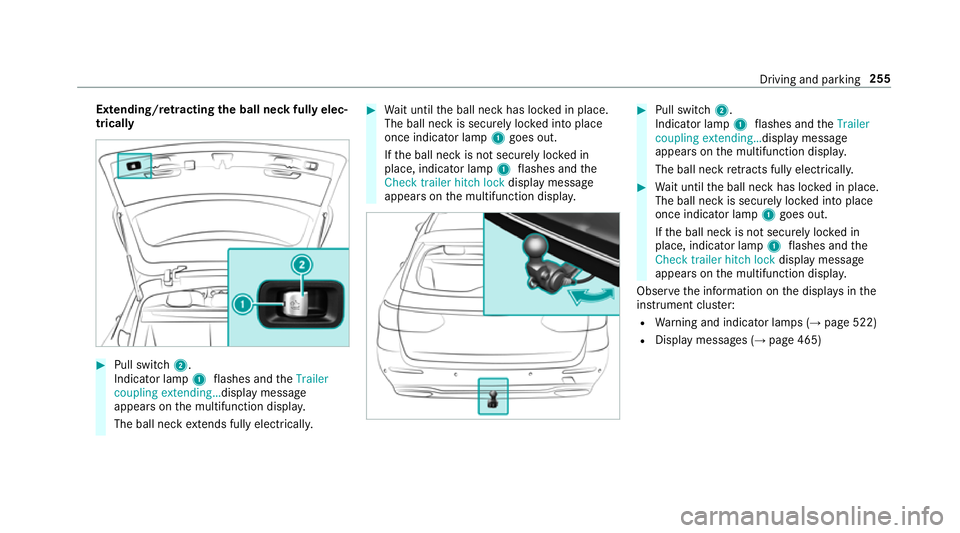
Pull swit ch2.
Indicator lamp 1flashes and theTrailer
coupling extending… displaymessage
appear sonthe multifunction displa y.
The ball nec kextends fully electrically. #
Wait until theb all nec khas loc kedinp lace.
The ball nec kissecurel yloc kedi ntop lace
onc eindicator lamp 1goes out.
If th eb all nec kisnotsecurel yloc kedin
place, indicator lamp 1flashes and the
Chec ktrailer hitch lock displaymessa ge
appear sonthe multifunction displa y. #
Pull switch 2.
Indicator lamp 1flashes and theTrailer
coupling extending… displaymessage
appear sonthe multifunction displa y.
The ball nec kretra cts fully electrically. #
Wait until theb all nec khas loc kedinp lace.
The ball nec kissecurel yloc kedi ntop lace
onc eindicator lamp 1goes out.
If th eb all nec kisnotsecurel yloc kedin
place, indicator lamp 1flashes and the
Chec ktrailer hitch lock displaymessa ge
appear sonthe multifunction displa y.
Obser vethei nformation on thed ispla ysinthe
instrumen tclus ter:
R Warning and indicator lamps (→ page522)
R Displa ymessages (→ page465) Drivin
gand parking 255
Page 259 of 585
Coupling up/uncouplin
gatrailer &
WARNING Risk of inju ryfrom thev ehicle
le ve lb eing changed
Ve hicles with le velc ontrol sy stem: the
ve hicle le velm aybe changed unin tentional ly,
e.g. by ot her persons. Youm aybecome trap‐
ped if youc ouple up or uncouple atrailer
while thev ehicle le velisc hanging. In addi‐
tion, other people could become trapped if
th eir limbs ar ebetwe en thev ehicle body and
th et yres or underneat hthe vehicle.
When coupling up or uncoupling atrailer,
mak esuret hat: #
The door sortailgat earenoto pened or
closed. #
Do no tinitiat ethe le velc ontrol sy stem
and do no toperat ethe DYNA MIC
SELECT switch. #
The vehicle is no tloc kedoru nlocked. Re
quirements:
R theb all nec kmustbee xtende dfully electri‐
cal lyand engaged in thes ecurel yloc ked
position.
R All-Terrain vehicles: couplethe trailer in the
Comfort driveprogram. (→ page175)
R All-Ter rain vehicles: ensurethe vehicle is at
normal le vel.
Tr ailer switha7 -pin plug can be connec tedto
th ev ehicle wit hthe following adap ters:
R adap terp lug
R adapte rcable
The trailer willo nly be correctly de tected bythe
ve hicle if thef ollowing condition sareme t:
R thet railer is connected cor rectly
R thet railer lighting sy stem is in working order
The operation of thef ollowing sy stems depends
on thet railer being connected cor rectly:
R ActiveL aneK eeping Assist
R ESP ®
R Parking Assis tPARKTRONIC R
ActiveP arking Assist
R Blin dSpotA ssis torA ctiveBlind Spo tAssist
Coupling up atrailer
* NO
TEDama getotheb atter ydue tofull
discharge Charging
thet railer batter yusing thep ower
supply of thet railer can damag ethe batter y. #
Do no tuse thep owe rsupp lyto charge
th et railer batter y. #
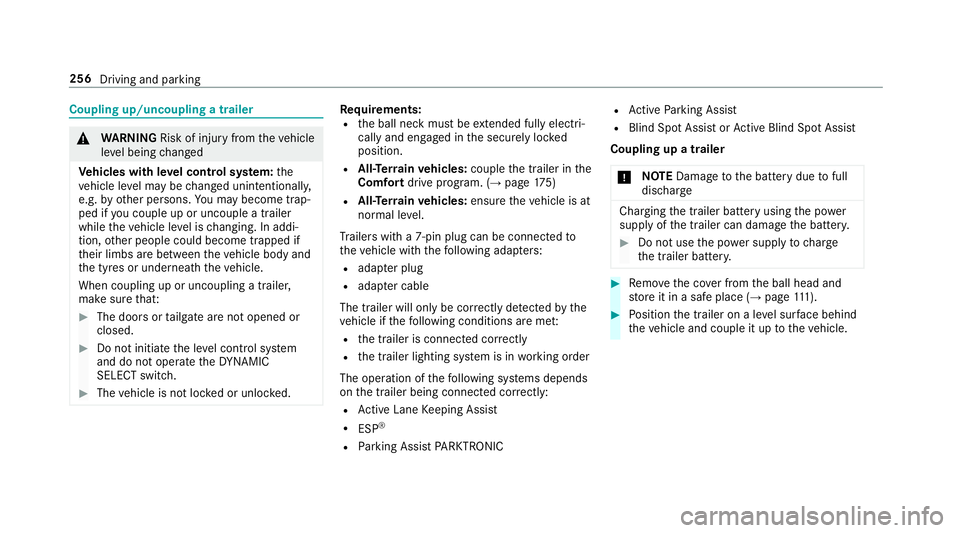
Remo vethec ove rfromt he ball head and
st or eitinas afep lace (→ page111). #
Position thet railer on alevel sur face behind
th ev ehicle and couple it up tothev ehicle. 256
Driving and parking
Page 260 of 585
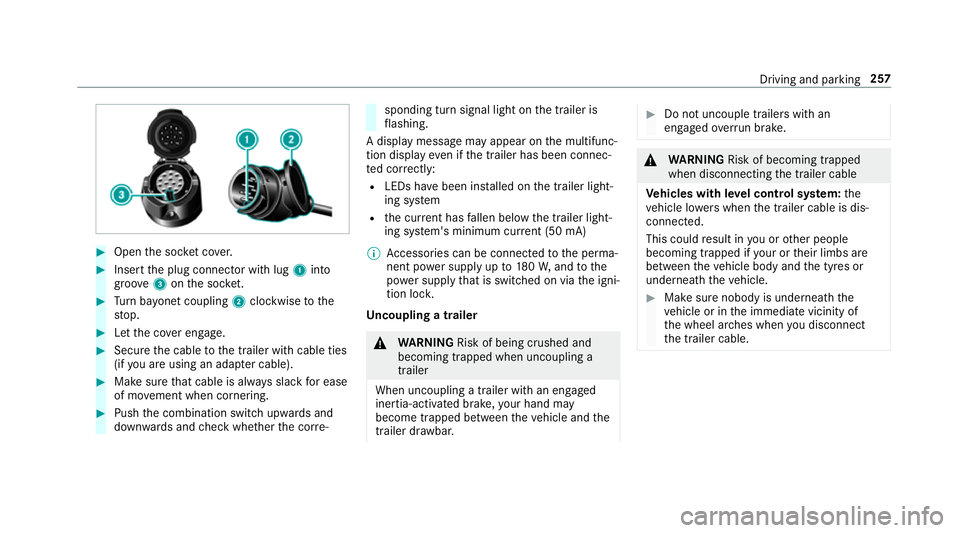
#
Open thes ocketc ove r. #
Inser tthe plug connector wit hlug 1 into
groo ve3 onthes ocket. #
Turn bayone tc oupling 2clockwise tothe
st op. #
Letthe co vere ngage. #
Secur ethe cable tothet railer wit hcable ties
(if youa reusin gana dapterc able). #
Mak esuret hat cabl eisalway ss lac kfor ease
of mo vement when cornering. #
Push thec ombination switc hupwards and
down wardsa nd checkw hether thec orre‐ sponding tur
nsignal light on thet railer is
fl ashing.
Ad ispla ymessag emayappear on them ultifunc‐
tion displa yevenift he trailer has been connec‐
te dc orrectly:
R LEDs ha vebeen ins talled on thet railer light‐
ing sy stem
R thec urrent ha sfallen belo wthe trailer light‐
ing sy stem's minimum cur rent (50 mA)
% Accessorie scan be connected tothep erma‐
nentp owersupp lyup to180W,a ndtothe
po we rsupp lythat is swit ched on via thei gni‐
tion loc k.
Un coupling atrailer &
WARNING Risk of being crushed and
becoming trapped whe nuncoupling a
trailer
Whe nuncoupling atrailer with an engaged
ine rtia-activated brake, your han dmay
become trapped between thev ehicle and the
traile rdrawbar. #
Do no tuncouple trailer swithan
engaged overrunb rake. &
WARNING Risk of becoming trapped
whe ndisconnecting thet railer cable
Ve hicles with le velc ontrol sy stem: the
ve hicle lo werswhen thet railer cable is dis‐
connected.
This could result in youoro ther people
becoming trapped if your or their limbs are
between thev ehicle body and thet yres or
underneat hthe vehicle. #
Mak esuren obody is underneat hthe
ve hicle or in thei mmediat evicinity of
th ew heel ar ches when youd isconnect
th et railer cable. Driving and parking
257
Page 261 of 585
*
NO
TEDama getother ear bumper from
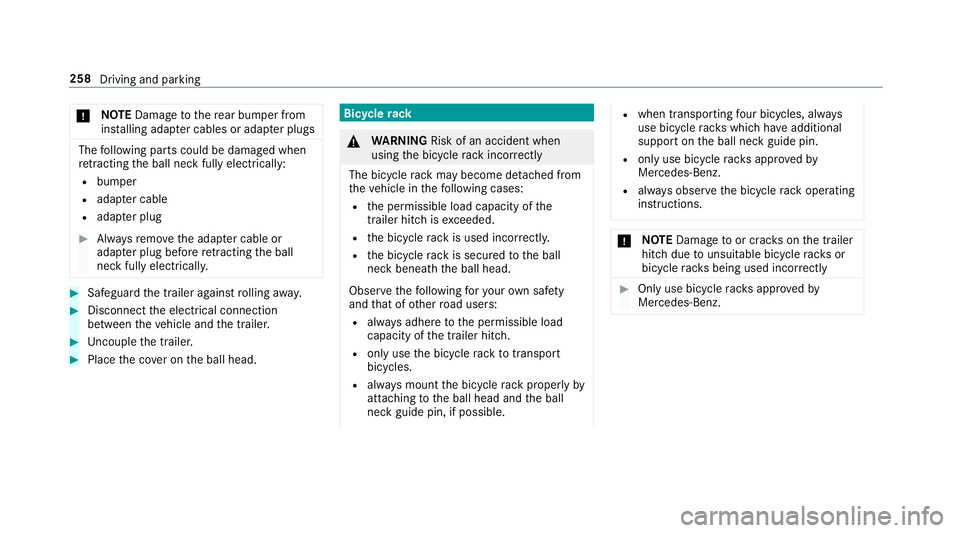
ins talling adap terc ables or adapte rplugs The
following parts could be damaged when
re tracting theb all nec kfullye lectrically:
R bumper
R adap terc able
R adapte rplug #
Alw aysr emo vethea dap terc ableor
adapte rplugb efor eretra cting theb all
nec kfullye lectrically. #
Safeguar dthe trailer agains trolling away. #
Disconnect thee lectrical connection
between thev ehicle and thet railer. #
Uncoupl ethe trailer. #
Place thec over on theb all head. Bicycle
rack &
WARNING Risk of an accident when
using theb icycle rack incor rectly
The bicycle rack ma ybecome de tach ed from
th ev ehicle in thef ollowing cases:
R thep ermissible load capacity of the
traile rhitch isexceeded.
R theb icycle rack is used incor rectl y.
R theb icycle rack is secured totheb all
nec kbeneat hthe ball head.
Obser vethef ollowing fory our owns afety
and that of other road users:
R alwaysa dher etot he permissible load
capacity of thet railer hitch.
R onlyusetheb icycle rack totranspo rt
bicycles.
R alwaysm ount theb icycle rack properly by
attachin gtothe ball head and theb all
nec kguide pin, if possible. R
when transporting four bic ycles, alw ays
use bic ycle rack sw hichh ave additional
suppo rton theb all nec kguide pin.
R onlyuse bicycle rack sa ppr ove dby
Mercedes-Benz.
R alwayso bser vetheb icycle rack operating
instructions. *
NO
TEDama getoor crac kson thet railer
hitc hduetounsuitable bic ycle rack sor
bicycle rack sb eing used incor rectly #
Onlyusebicycle rack sa ppr ove dby
Mercedes-Benz. 258
Driving and parking
Page 263 of 585
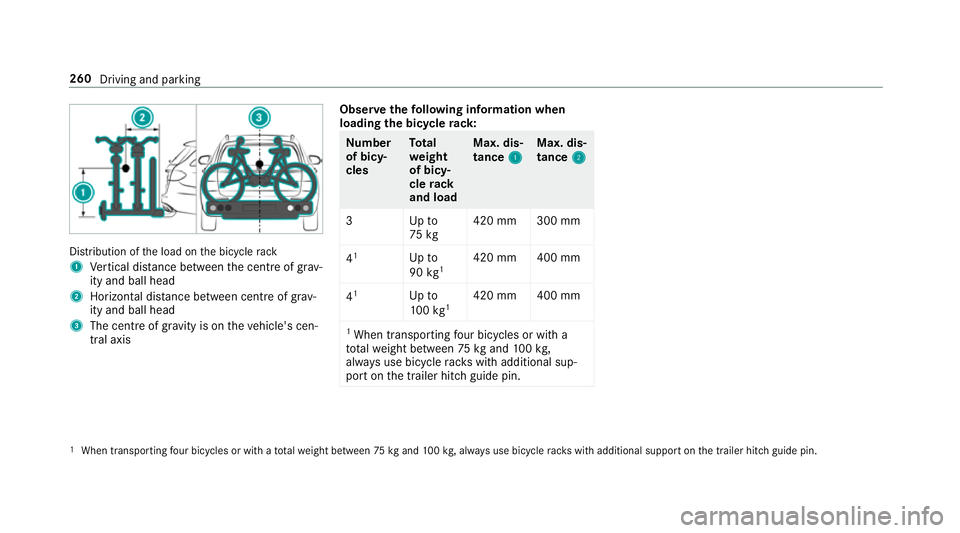
Distribution of
thel oad on theb icycle rack
1 Vertical dis tance betwee nthe centre of grav‐
ity and ball head
2 Horizon tald ista nce betwee ncentreofg rav‐
ity and ballh ead
3 The centr eofgravity is on thev ehicle's cen‐
tral axis Obser
vethef ollowing information when
loading theb icycle rack: Nu
mber
of bicy‐
cles To
tal
we ight
of bicy‐
cle rack
and load Max. dis‐
tance
1 1Max. dis‐
tance
2 2
3U pto
75 kg 420 mm 300 mm
4 1
Upto
90 kg1 420 mm 400 mm
4 1
Upto
10 0kg 1 420 mm 400 mm
1 When transpo rting four bic ycles or wit ha
tot alwe ight between 75kgand 100k g,
alw aysu se bicycle rack sw itha dditional sup‐
por tont he trailer hitc hguide pin. 1
When transporting four bicycles or wit hatotal we ight between 75kgand 100k g, al ways use bicycle rack sw itha dditional suppor tonthe trailer hitc hguide pin. 260
Driving and parking
Page 407 of 585
Note
sonc leaning and car eA voiding vehicl edamage
Exhaus tpipes
Clean withcleaning agents recommended byMercedes-Benz,
particular lyin thew inter and af terw ashing thev ehicle. Do no
tuse acidic cleaning agents.
Tr aile rtow hitch R
Remo vetrace sofrustont he ball, e.g. wit hawireb rush.
R Remo vedirtw ithal int-free clo th.
R Afterc leaning, oil or grease theb all coupling lightl y.
R Obser vethen otes on car einthe trailer towh itch manu‐
fa cturer's ope rating instructions. Do no
tclean theb all coupling wit hahigh-pressur ecleaner or
solvent. Note
sonc areoft he interior &
WARNING Risk of inju ryfrom pla stic
parts breakin goffafte rt he use of sol‐
ve nt-based car eprodu cts
Ca reand cleanin gproducts con tainin gsol‐
ve nts can cause su rfaces in thec ockpit to
become porous. When
thea irbags ar edeplo yed, plastic parts
ma ybreak away. #
Do no tuse anyc areorc leaning prod‐
ucts containing sol vents toclean the
cockpit. &
WARNING Risk of inju ryor deat hfrom
bleached seat belts
Bleaching or dyeing seat belts can se verely
we aken them.
This can, fore xamp le, caus eseat belt sto
te ar or fail in an accident. #
Neverb lea ch or dy eseat belts. 404
Maintenance and care
Page 426 of 585
Ve
hicles with ADSP LUS(Ad aptiv eDamping
Sy stem PLUS) &
WARNING Risk of an accident when
transporting vehicles wit hAdaptive
Damping Sy stem PLUS
The reduced damping forc es on thev ehicle
being transpor tedc an cause thev ehicle/
trailer combinatio ntostart to swing.
As aresult, when transporting vehicles with
th eA daptiv eDampin gSystemP LUS,the
ve hicle/trailer combination ma ystart to skid.
Consequentl y,yo uc ould lose cont rolofy our
ve hicle. #
When transporting, ensur ethat:
R thev ehicle has been loaded onto
th et ranspor terc orrectly
R thev ehicle is secured at all four
wheel swiths uitable tensioning
st ra ps
R them aximum permissible speed of
60 km/hisn otexc eeded when
transporting *
NO
TEDama getothev ehicle from secur‐
ing it incor rectly #
Afterl oading, thev ehicle mus tbe
secured on all four wheels. Otherwise,
th ev ehicle could be damaged. #
Am inimum dis tance of 20 cm up wards
and 10cm down wardsm ustbek eptto
th et ranspor tplatform. #
Secur ethe vehicle on all four wheel safter
loading.
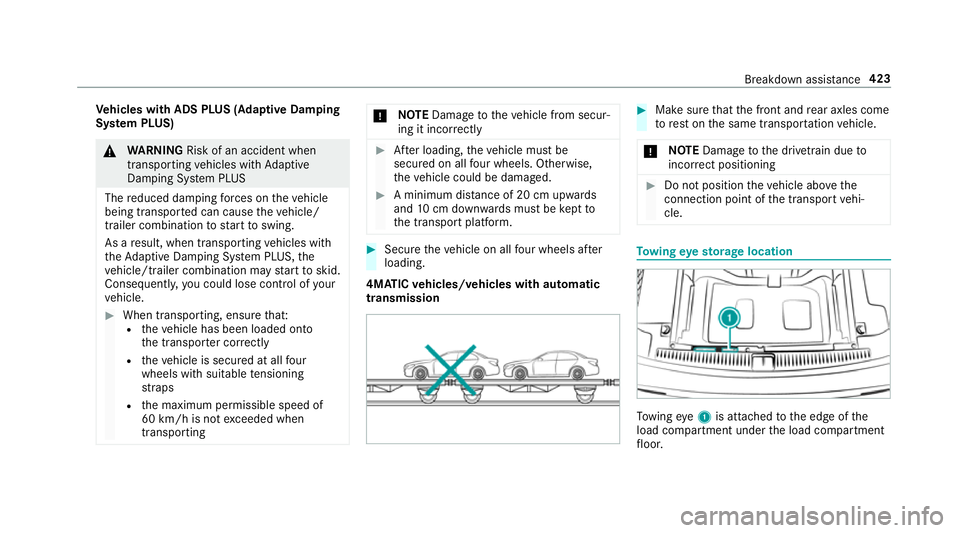
4MATIC vehicles/ vehicles with automatic
transmission #
Mak esuret hat thef ront and rear axle scome
to rest on thes ame transpor tatio nv ehicle.
* NO
TEDama getothed rive trai ndueto
incor rect positioning #
Do no tposition thev ehicle abo vethe
connection point of thet ranspor tvehi‐
cle. To
wing eyes torage location To
wing eye1is attached tothee dgeoft he
load compartment under thel oad compartment
fl oor. Breakdown assis
tance 423