2017 LINCOLN MKZ HYBRID fuel
[x] Cancel search: fuelPage 173 of 546

During certain events (such as vehicle
servicing) your low voltage 12-volt battery
may become disconnected or disabled. Once
the battery is reconnected and after driving
the vehicle, the engine may continue to
operate for three to five seconds after the
key is turned to off. This is a normal
condition.
Braking:
Your hybrid is equipped with standard
hydraulic braking and regenerative braking.
Regenerative braking is performed by your
transmission and it captures brake energy
and stores it in your high voltage battery.
Driving to Optimize Fuel Economy
Note:
Having your engine running is not
always an indication of inefficiency. In some
cases, it is actually more efficient than
driving in electric mode. Your fuel economy should improve
throughout your hybrid's break-in period. As
with any vehicle, your driving habits and
accessory usage can significantly impact
your fuel economy. For best results, keep in
mind these tips:
•
Keep the tires properly inflated and only
use the recommended size.
• Aggressive driving increases the amount
of energy required to move your vehicle.
In general, you can achieve better fuel
economy with mild to moderate
acceleration and deceleration. Moderate
braking is particularly important since it
allows you to maximize the energy
captured by the regenerative braking
system.
Additional Tips:
• Do not carry extra loads.
• Be mindful of adding external
accessories that may increase
aerodynamic drag.
• Observe posted speed limits. •
Perform all scheduled maintenance.
• There is no need to wait for your engine
to warm up. The vehicle is ready to drive
immediately after starting.
EV+ Mode
Your vehicle will recognize your frequent
destinations and allow for more EV driving
as you approach them. For example, when
nearing your home it should be easier to stay
in electric mode. The EV indicator will display
EV+ when this mode is active. You should
see this approximately 1/8 mile (200 meters)
from a frequent destination. See Information
Displays (page 108).
Note: Frequent destinations are learned by
your vehicle after two to four weeks of use.
To add a destination immediately, perform
the following process: cycle the ignition on
for 2 seconds, but do not start your vehicle,
then off for 2 seconds. Repeat the process
10 times. This location is now programmed
for EV+. You can clear these destinations
with a Driving History reset through the
Settings menu.
170
MKZ Hybrid (CC9) Hybrid Electric Vehicle (HEV), Canada/United States of America, enUSA, First Printing Unique Driving Characteristics
Page 174 of 546

Note:
You can switch the EV+ feature on or
off through the Driver Assist section of the
Settings menu.
ECOSELECT
EcoSelect is a drive mode for non plug-in
vehicles designed to offer the best possible
fuel economy with tradeoffs in vehicle
performance and comfort. To switch EcoSelect on, press the
ECO button.
A graphic displays on your information
display when EcoSelect is on.
Your vehicle will remember the last selected
mode whenever you start your vehicle. EcoSelect allows your vehicle to operate
more efficiently. You will notice:
•
Less aggressive cooling.
• Softer acceleration.
• Increased deceleration when coasting.
• Changes in engine behavior.
• ECO cruise control activation.
171
MKZ Hybrid (CC9) Hybrid Electric Vehicle (HEV), Canada/United States of America, enUSA, First Printing Unique Driving CharacteristicsE198654
Page 176 of 546
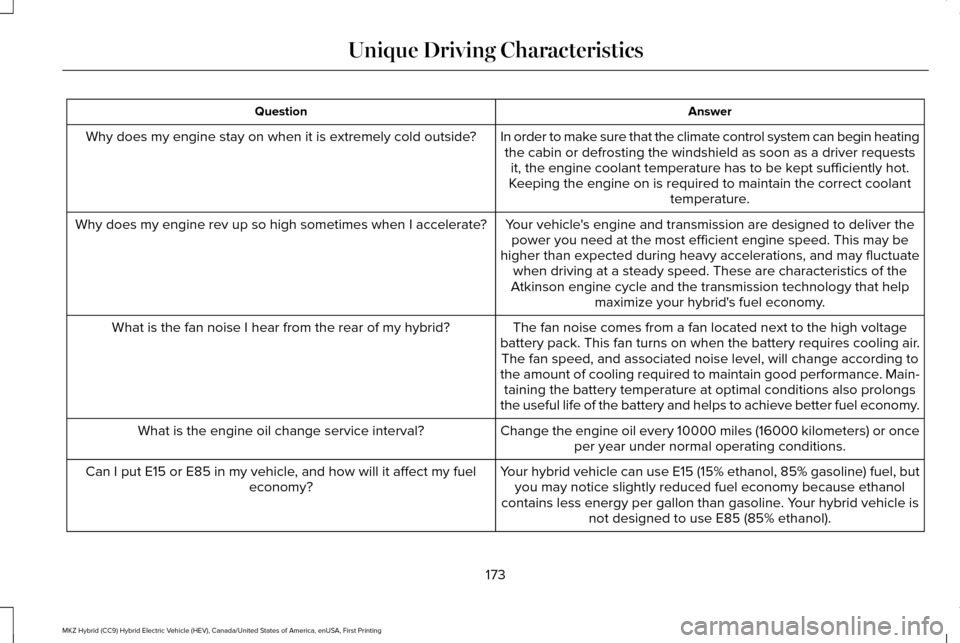
Answer
Question
In order to make sure that the climate control system can begin heatingthe cabin or defrosting the windshield as soon as a driver requests it, the engine coolant temperature has to be kept sufficiently hot.
Keeping the engine on is required to maintain the correct coolant temperature.
Why does my engine stay on when it is extremely cold outside?
Your vehicle's engine and transmission are designed to deliver thepower you need at the most efficient engine speed. This may be
higher than expected during heavy accelerations, and may fluctuate when driving at a steady speed. These are characteristics of the
Atkinson engine cycle and the transmission technology that help maximize your hybrid's fuel economy.
Why does my engine rev up so high sometimes when I accelerate?
The fan noise comes from a fan located next to the high voltage
battery pack. This fan turns on when the battery requires cooling air. The fan speed, and associated noise level, will change according to
the amount of cooling required to maintain good performance. Main- taining the battery temperature at optimal conditions also prolongs
the useful life of the battery and helps to achieve better fuel economy.
What is the fan noise I hear from the rear of my hybrid?
Change the engine oil every 10000 miles (16000 kilometers) or onceper year under normal operating conditions.
What is the engine oil change service interval?
Your hybrid vehicle can use E15 (15% ethanol, 85% gasoline) fuel, butyou may notice slightly reduced fuel economy because ethanol
contains less energy per gallon than gasoline. Your hybrid vehicle is not designed to use E85 (85% ethanol).
Can I put E15 or E85 in my vehicle, and how will it affect my fuel
economy?
173
MKZ Hybrid (CC9) Hybrid Electric Vehicle (HEV), Canada/United States of America, enUSA, First Printing Unique Driving Characteristics
Page 178 of 546

SAFETY PRECAUTIONS
WARNINGS
Do not overfill the fuel tank. The
pressure in an overfilled tank may
cause leakage and lead to fuel spray and
fire. The fuel system may be under
pressure. If you hear a hissing sound
near the fuel filler inlet, do not refuel until the
sound stops. Otherwise, fuel may spray out,
which could cause serious personal injury. Fuels can cause serious injury or death
if misused or mishandled.
Flow of fuel through a fuel pump nozzle
can produce static electricity. This can
cause a fire if you are filling an ungrounded
fuel container. Fuel may contain benzene, which is a
cancer-causing agent. WARNINGS
When refueling always shut the engine
off and never allow sparks or open
flames near the fuel tank filler valve. Never
smoke or use a cell phone while refueling.
Fuel vapor is extremely hazardous under
certain conditions. Avoid inhaling excess
fumes. Observe the following guidelines when
handling automotive fuel:
•
Extinguish all smoking materials and any
open flames before refueling your
vehicle.
• Always turn off the vehicle before
refueling.
• Automotive fuels can be harmful or fatal
if swallowed. Fuel such as gasoline is
highly toxic and if swallowed can cause
death or permanent injury. If fuel is
swallowed, call a physician immediately,
even if no symptoms are immediately
apparent. The toxic effects of fuel may
not be visible for hours. •
Avoid inhaling fuel vapors. Inhaling too
much fuel vapor of any kind can lead to
eye and respiratory tract irritation. In
severe cases, excessive or prolonged
breathing of fuel vapor can cause serious
illness and permanent injury.
• Avoid getting fuel liquid in your eyes. If
fuel is splashed in the eyes, remove
contact lenses (if worn), flush with water
for 15 minutes and seek medical
attention. Failure to seek proper medical
attention could lead to permanent injury.
175
MKZ Hybrid (CC9) Hybrid Electric Vehicle (HEV), Canada/United States of America, enUSA, First Printing Fuel and Refueling
Page 179 of 546

•
Fuels can also be harmful if absorbed
through the skin. If fuel is splashed on
the skin, clothing or both, promptly
remove contaminated clothing and wash
skin thoroughly with soap and water.
Repeated or prolonged skin contact with
fuel liquid or vapor causes skin irritation.
• Be particularly careful if you are taking
Antabuse or other forms of Disulfiram for
the treatment of alcoholism. Breathing
gasoline vapors could cause an adverse
reaction, serious personal injury or
sickness. If fuel is splashed on the skin,
wash the affected areas immediately with
plenty of soap and water. Consult a
physician immediately if you experience
any adverse reactions. FUEL QUALITY
Choosing the Right Fuel We recommend regular unleaded gasoline
with a minimum pump (R+M)/2 octane rating
of 87. Some fuel stations offer fuels posted
as regular unleaded gasoline with an octane
rating below 87, particularly in high altitude
areas. We do not recommend fuels with an
octane rating below 87.
Do not use any fuel other than those
recommended because they could lead to
engine damage that may not be covered by
the vehicle Warranty.Note:
Use of any fuel other than those
recommended can impair the emission
control system and cause a loss of vehicle
performance.
Do not use:
• Diesel fuel.
• Fuels containing kerosene or paraffin.
• Fuel containing more than 15% ethanol
or E85 fuel.
• Fuels containing methanol.
• Fuels containing metallic-based additives,
including manganese-based compounds.
• Fuels containing the octane booster
additive, methylcyclopentadienyl
manganese tricarbonyl (MMT).
• Leaded fuel (using leaded fuel is
prohibited by law).
The use of fuels with metallic compounds
such as methylcyclopentadienyl manganese
tricarbonyl (commonly known as MMT), which
is a manganese-based fuel additive, will
impair engine performance and affect the
emission control system.
176
MKZ Hybrid (CC9) Hybrid Electric Vehicle (HEV), Canada/United States of America, enUSA, First Printing Fuel and RefuelingE161513
Page 180 of 546

Do not be concerned if the engine
sometimes knocks lightly. However, if the
engine knocks heavily while using fuel with
the recommended octane rating, contact an
authorized dealer to prevent any engine
damage.
Fuel Freshness Mode (If Equipped)
This helps keep the fuel system functional
and the fuel fresh.
If you mainly use your vehicle in electric
power mode without refueling, the gasoline
in the fuel tank may become stale due to
aging. Stale gasoline can damage the
engine and fuel system.
Your vehicle automatically switches to fuel
freshness mode if you do not refuel your
vehicle with fresh fuel within an 18-month
period. Fuel freshness mode protects your
vehicle from potential engine and fuel system
damage caused by using stale fuel.
Note: If you do not add new fuel during an
18-month period, fuel freshness mode will
use fuel until approximately 1.2 gal (4.5 L) of
fuel remains in the fuel tank. During fuel freshness mode:
•
The information display will indicate fuel
freshness mode is active.
• The vehicle will only run in hybrid mode.
EV Now mode will not be available.
• Most of the plug-in power will be stored
until fuel freshness mode is completed.
Note: EV Now mode resumes when less than
1.2 gal (4.5 L) of fuel remains in the fuel tank.
Note: When the fuel level is less than
one-quarter full, refueling your vehicle will
end fuel freshness mode.
Note: We recommend you use a fuel
stabilizer if you use less than a full tank of
fuel during an 18-month period.
RUNNING OUT OF FUEL
Avoid running out of fuel because this
situation may have an adverse effect on
vehicle components.
If you have run out of fuel: •
To start the vehicle with a keyless
ignition, just start the engine. Crank time
will be longer than usual.
• Normally, adding 1 gallon (3.8 liters) of
fuel is enough to restart the vehicle. If the
vehicle is out of fuel and on a steep
grade, more than 1 gallon (3.8 liters) may
be required.
• The service engine soon indicator may
come on.
Refilling With a Portable Fuel Container WARNINGS
Do not insert the nozzle of portable
fuel containers or aftermarket funnels
into the capless fuel system. This could
damage the fuel system and its seal, and
may cause fuel to run onto the ground
instead of filling the tank, which could result
in serious personal injury. Do not try to pry open or push open
the capless fuel system with foreign
objects. This could damage the fuel system
and its seal and cause injury to you or others. 177
MKZ Hybrid (CC9) Hybrid Electric Vehicle (HEV), Canada/United States of America, enUSA, First Printing Fuel and Refueling
Page 181 of 546

Note:
Do not use aftermarket funnels; they
will not work with the capless fuel system
and can damage it. The included funnel has
been specially designed to work safely with
your vehicle. When filling the vehicle
’s fuel tank from a
portable fuel container, use the funnel
included with the vehicle.
178
MKZ Hybrid (CC9) Hybrid Electric Vehicle (HEV), Canada/United States of America, enUSA, First Printing Fuel and Refueling
Page 182 of 546

179
MKZ Hybrid (CC9) Hybrid Electric Vehicle (HEV), Canada/United States of America, enUSA, First Printing Fuel and RefuelingE163066