2017 KIA CARENS RHD belt
[x] Cancel search: beltPage 608 of 723
821
Maintenance
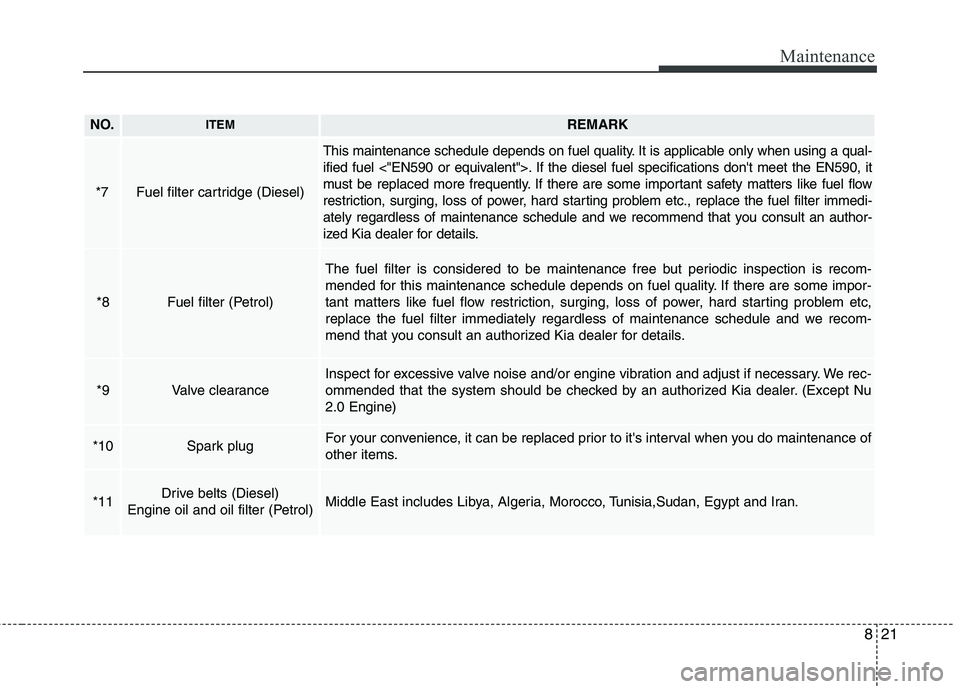
NO.ITEMREMARK
*7Fuel filter cartridge (Diesel)
This maintenance schedule depends on fuel quality. It is applicable only when using a qual-
ified fuel <"EN590 or equivalent">. If the diesel fuel specifications don't meet the EN590, it
must be replaced more frequently. If there are some important safety matters like fuel flow
restriction, surging, loss of power, hard starting problem etc., replace the fuel filter immedi-
ately regardless of maintenance schedule and we recommend that you consult an author-
ized Kia dealer for details.
*8Fuel filter (Petrol)
The fuel filter is considered to be maintenance free but periodic inspection is recom-
mended for this maintenance schedule depends on fuel quality. If there are some impor-
tant matters like fuel flow restriction, surging, loss of power, hard starting problem etc,
replace the fuel filter immediately regardless of maintenance schedule and we recom-
mend that you consult an authorized Kia dealer for details.
*9Valve clearance
Inspect for excessive valve noise and/or engine vibration and adjust if necessary. We rec-
ommended that the system should be checked by an authorized Kia dealer. (Except Nu2.0 Engine)
*10Spark plugFor your convenience, it can be replaced prior to it's interval when you do maintenance of
other items.
*11Drive belts (Diesel)
Engine oil and oil filter (Petrol)Middle East includes Libya, Algeria, Morocco, Tunisia,Sudan, Egypt and Iran.
Page 609 of 723
Maintenance
22
8
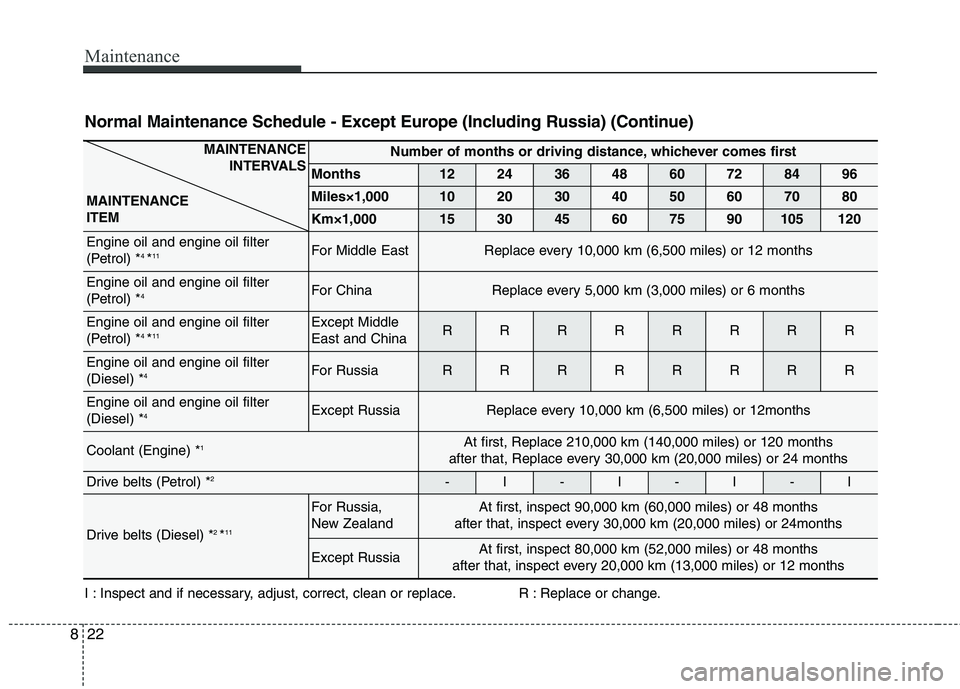
Normal Maintenance Schedule - Except Europe (Including Russia) (Continue)
I : Inspect and if necessary, adjust, correct, clean or replace. R : Replace or change.
MAINTENANCE
INTERVALS
MAINTENANCE ITEMNumber of months or driving distance, whichever comes first
Months1224364860728496
Miles×1,0001020304050607080
Km×1,000153045607590105120
Engine oil and engine oil filter
(Petrol) * 4
*11For Middle East Replace every 10,000 km (6,500 miles) or 12 months
Engine oil and engine oil filter
(Petrol) * 4For ChinaReplace every 5,000 km (3,000 miles) or 6 months
Engine oil and engine oil filter
(Petrol) *4
*11Except Middle East and ChinaRRRRRRRR
Engine oil and engine oil filter (Diesel) * 4For RussiaRRRRRRRR
Engine oil and engine oil filter (Diesel) *4Except RussiaReplace every 10,000 km (6,500 miles) or 12months
Coolant (Engine) * 1At first, Replace 210,000 km (140,000 miles) or 120 months
after that, Replace every 30,000 km (20,000 miles) or 24 months
Drive belts (Petrol) * 2-I-I-I-I
Drive belts (Diesel) * 2
*11
For Russia,
New ZealandAt first, inspect 90,000 km (60,000 miles) or 48 months
after that, inspect every 30,000 km (20,000 miles) or 24months
Except RussiaAt first, inspect 80,000 km (52,000 miles) or 48 months
after that, inspect every 20,000 km (13,000 miles) or 12 months
Page 615 of 723
Maintenance
28
8
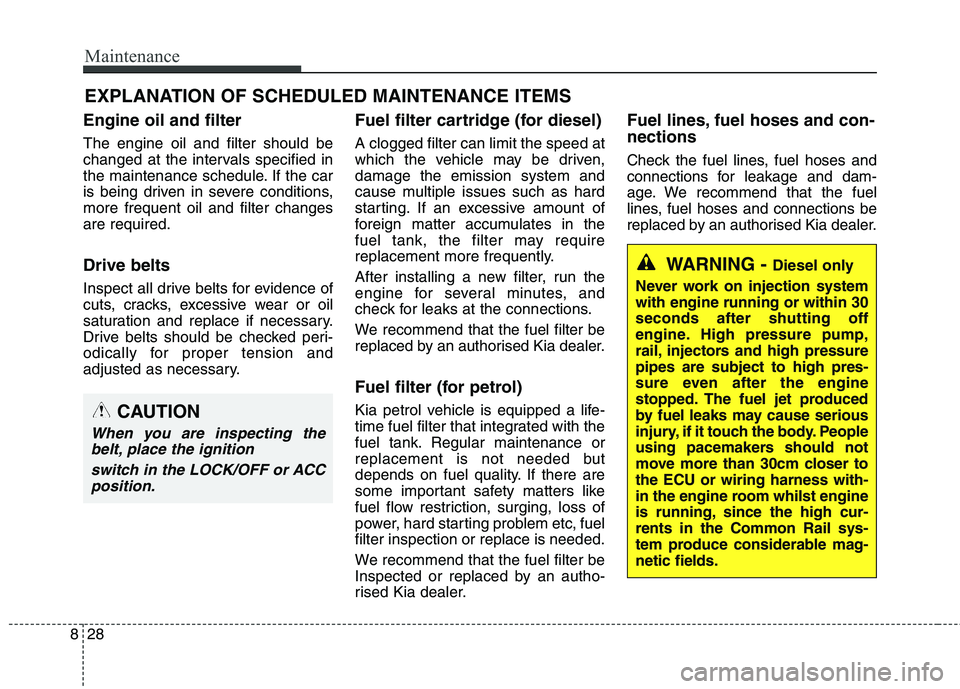
EXPLANATION OF SCHEDULED MAINTENANCE ITEMS
Engine oil and filter The engine oil and filter should be
changed at the intervals specified in
the maintenance schedule. If the car
is being driven in severe conditions,more frequent oil and filter changesare required. Drive belts
Inspect all drive belts for evidence of
cuts, cracks, excessive wear or oil
saturation and replace if necessary.
Drive belts should be checked peri-
odically for proper tension and
adjusted as necessary. Fuel filter cartridge (for diesel) A clogged filter can limit the speed at
which the vehicle may be driven,damage the emission system and
cause multiple issues such as hard
starting. If an excessive amount of
foreign matter accumulates in the
fuel tank, the filter may require
replacement more frequently.
After installing a new filter, run the
engine for several minutes, and
check for leaks at the connections.
We recommend that the fuel filter be
replaced by an authorised Kia dealer.
Fuel filter (for petrol)
Kia petrol vehicle is equipped a life-
time fuel filter that integrated with the
fuel tank. Regular maintenance or
replacement is not needed but
depends on fuel quality. If there are
some important safety matters like
fuel flow restriction, surging, loss of
power, hard starting problem etc, fuelfilter inspection or replace is needed.
We recommend that the fuel filter be
Inspected or replaced by an autho-
rised Kia dealer.Fuel lines, fuel hoses and con- nections
Check the fuel lines, fuel hoses and
connections for leakage and dam-
age. We recommend that the fuel
lines, fuel hoses and connections be
replaced by an authorised Kia dealer.
WARNING -
Diesel only
Never work on injection system with engine running or within 30seconds after shutting off
engine. High pressure pump,
rail, injectors and high pressurepipes are subject to high pres-
sure even after the engine
stopped. The fuel jet produced
by fuel leaks may cause serious
injury, if it touch the body. People
using pacemakers should not
move more than 30cm closer tothe ECU or wiring harness with-
in the engine room whilst engine
is running, since the high cur-rents in the Common Rail sys-
tem produce considerable mag-netic fields.
CAUTION
When you are inspecting the belt, place the ignition
switch in the LOCK/OFF or ACCposition.
Page 647 of 723
Maintenance
60
8
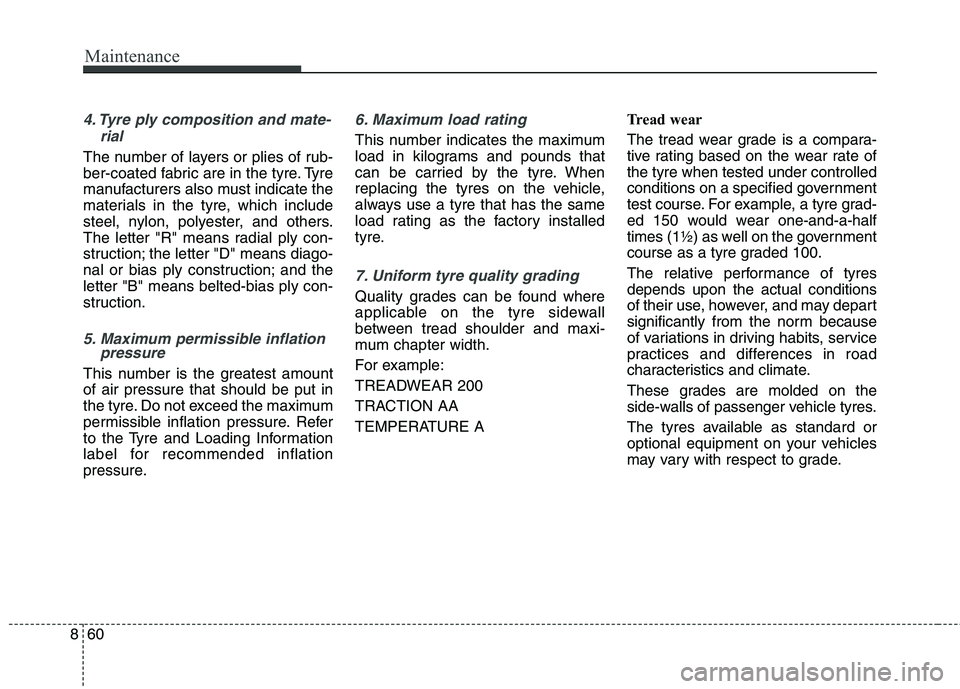
4. Tyre ply composition and mate-
rial
The number of layers or plies of rub-
ber-coated fabric are in the tyre. Tyre
manufacturers also must indicate the
materials in the tyre, which include
steel, nylon, polyester, and others.
The letter "R" means radial ply con-
struction; the letter "D" means diago-
nal or bias ply construction; and theletter "B" means belted-bias ply con-
struction.
5. Maximum permissible inflationpressure
This number is the greatest amount of air pressure that should be put in
the tyre. Do not exceed the maximum
permissible inflation pressure. Refer
to the Tyre and Loading Information
label for recommended inflation
pressure.
6. Maximum load rating
This number indicates the maximum
load in kilograms and pounds that
can be carried by the tyre. When
replacing the tyres on the vehicle,
always use a tyre that has the same
load rating as the factory installed
tyre.
7. Uniform tyre quality grading
Quality grades can be found where
applicable on the tyre sidewall
between tread shoulder and maxi-
mum chapter width.
For example:
TREADWEAR 200
TRACTION AA
TEMPERATURE A Tread wear
The tread wear grade is a compara-
tive rating based on the wear rate ofthe tyre when tested under controlled
conditions on a specified government
test course. For example, a tyre grad-
ed 150 would wear one-and-a-half
times (1½) as well on the government
course as a tyre graded 100.
The relative performance of tyres depends upon the actual conditions
of their use, however, and may depart
significantly from the norm because
of variations in driving habits, service
practices and differences in road
characteristics and climate.
These grades are molded on the
side-walls of passenger vehicle tyres.
The tyres available as standard or
optional equipment on your vehicles
may vary with respect to grade.
Page 695 of 723
Maintenance
108
8
Cleaning the upholstery and inte-
rior trim
Vinyl
Remove dust and loose dirt from
vinyl with a whisk broom or vacuum
cleaner. Clean vinyl surfaces with a
vinyl cleaner.
Fabric
Remove dust and loose dirt from fab-
ric with a whisk broom or vacuum
cleaner. Clean with a mild soap solu-
tion recommended for upholstery or
carpets. Remove fresh spots imme-
diately with a fabric spot cleaner. If
fresh spots do not receive immediate
attention, the fabric can be stained
and its colour can be affected. Also,
its fire-resistant properties can be
reduced if the material is not proper-ly maintained.
Cleaning the lap/shoulder beltwebbing
Clean the belt webbing with any mild
soap solution recommended for
cleaning upholstery or carpet. Follow
the instructions provided with the
soap. Do not bleach or re-dye the
webbing because this may weaken it.
Cleaning the interior window glass
If the interior glass surfaces of the
vehicle become fogged (that is, cov-
ered with an oily, greasy or waxy
film), they should be cleaned with
glass cleaner. Follow the directions
on the glass cleaner container.
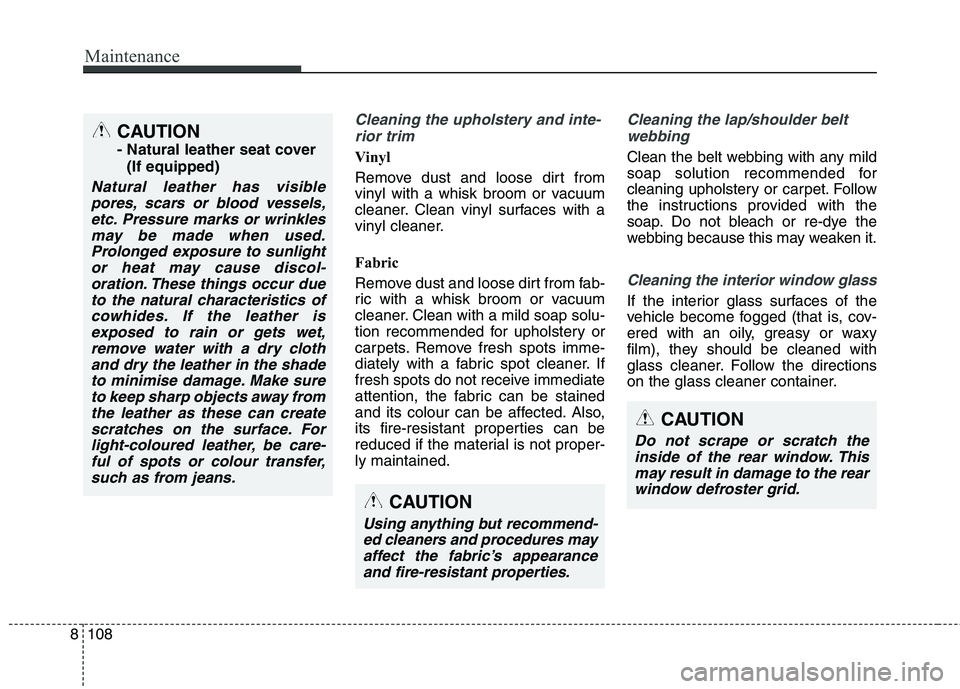
CAUTION
Do not scrape or scratch theinside of the rear window. Thismay result in damage to the rear window defroster grid.
CAUTION
Using anything but recommend-ed cleaners and procedures mayaffect the fabric’s appearance and fire-resistant properties.
CAUTION
- Natural leather seat cover
(If equipped)
Natural leather has visiblepores, scars or blood vessels,etc. Pressure marks or wrinkles may be made when used.Prolonged exposure to sunlightor heat may cause discol- oration. These things occur dueto the natural characteristics ofcowhides. If the leather is exposed to rain or gets wet,remove water with a dry clothand dry the leather in the shadeto minimise damage. Make sure to keep sharp objects away fromthe leather as these can createscratches on the surface. For light-coloured leather, be care-ful of spots or colour transfer,such as from jeans.
Page 715 of 723
I3
Index
Checking the amount of air conditioner refrigerant and
compressor lubricant ..............................................4-162
Climate control air filter ..........................................4-161
Manual heating and air conditioning ........................4-153
System operation ......................................................4-159
Automatic transaxle ......................................................6-26 Automatic transaxle operation ....................................6-26
Good driving practices ................................................6-32
Battery............................................................................8-48 Battery capacity label..................................................8-50
Battery recharging ....................................................8-50
For best battery service ..............................................8-48
Reset items ..................................................................8-51
Before driving ..................................................................6-4 Before entering vehicle ................................................6-4Before starting ..............................................................6-4
Necessary inspections ..................................................6-4
Blind spot detection system (BSD) ..............................6-82 BSD (Blind Spot Detection) / LCA (Lane Change Assist) ......................................6-83
Driver's Attention ........................................................6-88
RCTA (Rear cross traffic alert) ..................................6-86
Bonnet ............................................................................4-38 Closing the bonnet ......................................................4-39
Opening the bonnet ....................................................4-38 Brake system..................................................................6-44
Anti-lock brake system (ABS) ..................................6-53
Electronic parking brake (EPB) ..................................6-48
Electronic stability control (ESC) ..............................6-56
Emergency Stop Signal (ESS) ....................................6-62
Good braking practices ..............................................6-62
Hill-start assist control (HAC) ....................................6-61
Parking brake - Hand type ..........................................6-46
Power brakes ............................................................6-44
Vehicle stability management (VSM) ........................6-60
Brake/clutch fluid ..........................................................8-38 Checking the brake/clutch fluid level ........................8-38
Bulb wattage ....................................................................9-5
Child restraint system ....................................................3-39 Child restraint system ................................................3-41
Installing a child restraint system with a lap/shoulder belt........................................................3-42
ISOFIX and Top Tether Anchorage system ................3-48
Top Tether Anchor system ..........................................3-46
Clean air ......................................................................4-167
Climate control air filter ................................................8-42 Filter inspection ..........................................................8-42
Filter replacement ......................................................8-42
Cruise Control system ..................................................6-64 Cruise control switch ..................................................6-65
B
C
Page 720 of 723
Index
8
I
Parking brake - hand type ..............................................8-39
Checking the parking brake ......................................8-39
Rear parking assist system ............................................4-96 Non-operational conditions of rear parking assist system ........................................4-97
Operation of the rear parking assist system................4-96
Rear parking assist system precautions ......................4-98
Self-diagnosis..............................................................4-99
Rearview camera..........................................................4-116
Recommended lubricants and capacities ........................9-8 Recommended SAE viscosity number ......................9-10
Refrigerant label ............................................................9-13
Remote keyless entry ......................................................4-8 Battery replacement ....................................................4-11
Remote keyless entry system operations ......................4-8
Transmitter precautions ..............................................4-10
Road warning ..................................................................7-2 Hazard warning flasher ..............................................7-2
Scheduled maintenance service ..................................8-11
Seat ..................................................................................3-2 Armrest ......................................................................3-19
Front seat adjustment - Manual ....................................3-6 Front seat adjustment - Power ......................................3-7
Headrest (Front seat) ..................................................3-10
Headrest (Rear seat) ....................................................3-20
Rear seat adjustment ..................................................3-13
Seatback pocket ..........................................................3-13
Seat belt ........................................................................3-22 3 Point rear centre belt ................................................3-29
Care of seat belts ........................................................3-37
Lap belt ......................................................................3-28
Lap/shoulder belt ........................................................3-26
Pre-tensioner seat belt ................................................3-32
Seat belt precautions ..................................................3-35
Seat belt warning ........................................................3-24
Smart key ......................................................................4-13 Door lock/unlock in an emergency situation ..............4-15
Smart key function ......................................................4-13
Smart key precautions ................................................4-14
Smart parking assist system (SPAS)............................4-106 How the system works ..............................................4-110
Non-operating condition ..........................................4-107
Operating condition ..................................................4-107
System malfunction ..................................................4-115
Special driving conditions ............................................6-92 Driving at night ..........................................................6-93
Driving in flooded areas ............................................6-94
Driving in the rain ......................................................6-94
Driving off-road ..........................................................6-94
Hazardous driving conditions ..................................6-92
S
R