2017 KIA CARENS RHD automatic transmission
[x] Cancel search: automatic transmissionPage 474 of 723
639
Driving your vehicle
D (Drive)
This is the normal driving position.
The transmission will automatically
shift through a seven-gear
sequence, providing the best fuel
economy and power.
For extra power when passing anoth-
er vehicle or driving uphill depress
the accelerator pedal further until
you feel the transmission downshift
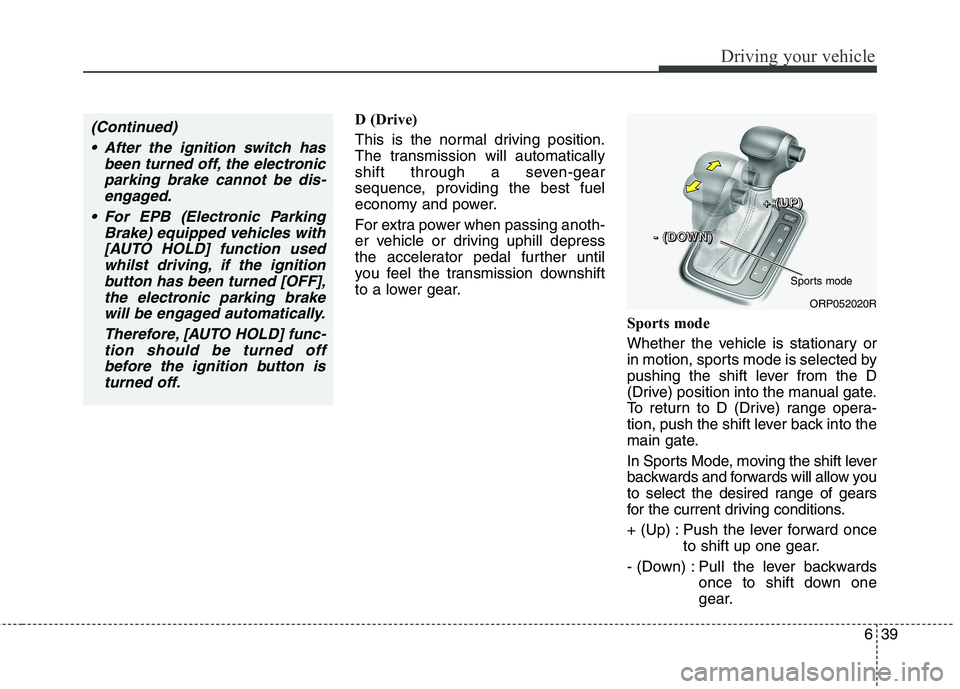
to a lower gear.Sports mode
Whether the vehicle is stationary or
in motion, sports mode is selected by
pushing the shift lever from the D
(Drive) position into the manual gate.
To return to D (Drive) range opera-
tion, push the shift lever back into the
main gate.
In Sports Mode, moving the shift lever
backwards and forwards will allow you
to select the desired range of gears
for the current driving conditions.
+ (Up) : Push the lever forward onceto shift up one gear.
- (Down) : Pull the lever backwards once to shift down one
gear.
ORP052020R
Sports mode
+
+++ ((((UUUUPPPP))))
---- ((((DDDDOOOOWWWWNNNN))))
(Continued)
After the ignition switch has been turned off, the electronicparking brake cannot be dis- engaged.
For EPB (Electronic Parking Brake) equipped vehicles with[AUTO HOLD] function usedwhilst driving, if the ignition button has been turned [OFF],the electronic parking brakewill be engaged automatically.
Therefore, [AUTO HOLD] func-tion should be turned off before the ignition button isturned off.
Page 475 of 723
Driving your vehicle
40
6
✽✽
NOTICE
Only the seven forward gears can be selected. To reverse or park the
vehicle, move the shift lever to the
R (Reverse) or P (Park) position as
required.
Downshifts are made automatical- ly when the vehicle slows down.
When the vehicle stops, 1st gear is
automatically selected.
When the engine rpm approaches the red zone the transmission will
upshift automatically.
If the driver presses the lever to + (Up) or - (Down) position, the
transmission may not make the
requested gear change if the next
gear is outside of the allowable
engine rpm range. The driver
must execute upshifts in accor-
dance with road conditions, taking
care to keep the engine rpms
below the red zone.Shift lock system (if equipped)
For your safety, the Dual clutch trans-
mission has a shift lock system which
prevents shifting the transaxle from P
(Park) or N (Neutral) into R (Reverse)
unless the brake pedal is depressed.
To shift the transaxle from P (Park) or
N (Neutral) into R (Reverse):
1. Depress and hold the brake pedal.
2. Start the engine or turn the ignition switch to the ON position.
3. Move the shift lever.
If the brake pedal is repeatedly depressed and released with the shift
lever in the P (Park) position, a chat-
tering noise near the shift lever may
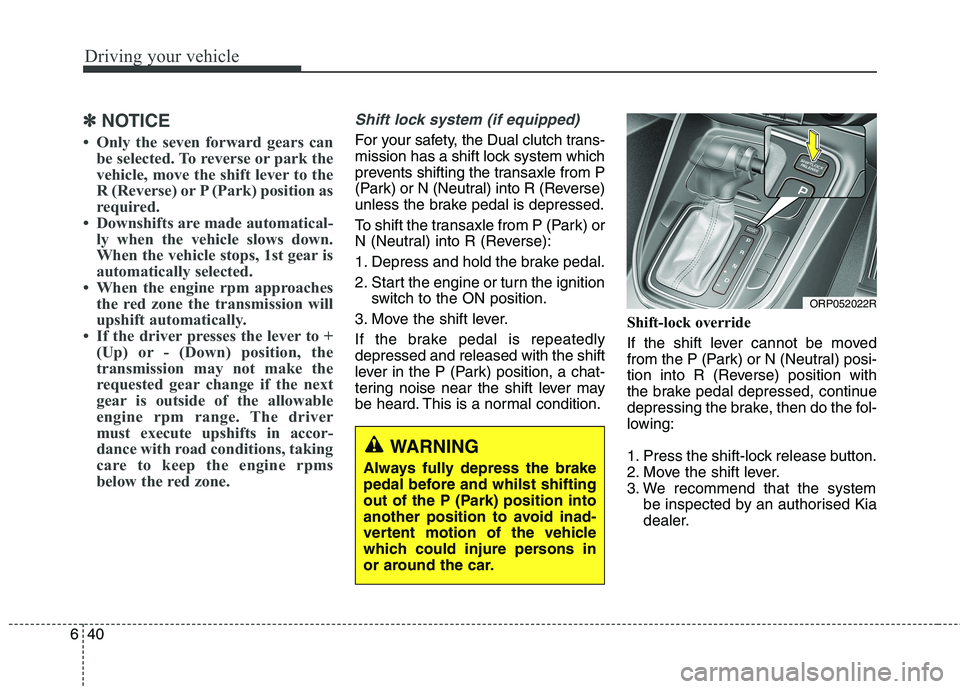
be heard. This is a normal condition. Shift-lock override
If the shift lever cannot be moved
from the P (Park) or N (Neutral) posi-
tion into R (Reverse) position with
the brake pedal depressed, continue
depressing the brake, then do the fol-
lowing:
1. Press the shift-lock release button.
2. Move the shift lever.
3. We recommend that the system
be inspected by an authorised Kia
dealer.
ORP052022R
WARNING
Always fully depress the brake
pedal before and whilst shifting
out of the P (Park) position into
another position to avoid inad-
vertent motion of the vehicle
which could injure persons in
or around the car.
Page 478 of 723

643
Driving your vehicle
Active ECO operation
Active ECO helps improve fuel effi-
ciency by controlling the engine and
transaxle. But fuel-efficiency can be
changed by the driver's driving habits
and road conditions.
When the Active ECO button ispressed the ECO indicator (green)
will illuminate to show that the
Active ECO is operating.
If Active ECO is turned off, it will return to the normal mode. When Active ECO is activated:
The acceleration may slightly be
reduced eventhough you depress
the accelerator fully.
The air conditioner performance may be limited.
The shift pattern of the automatic transaxle/dual clutch transmission
may change.
The above situations are normal
conditions when the active eco sys-
tem is activated to improve fuel effi-
ciency. Limitation of Active ECO oper- ation:
If the following conditions occur
whilst Active ECO is operating, the
system operation is limited eventhough there is no change in the
ECO indicator.
When the coolant temperature is
low: The system will be limited until
engine performance becomes nor-mal.
When driving up a hill: The system will be limited to gain power when
driving uphill because the engine
torque is restricted.
When using sports mode: The sys- tem will be limited according to theshift location.
When the accelerator pedal is deeply pressed for a few seconds:The system will be limited, judging
that the driver wants to speed up.
ACTIVE ECO SYSTEM (IF EQUIPPED)
ORP056023R
Page 481 of 723
Driving your vehicle
46
6
Parking brake - Hand type
Applying the parking brake
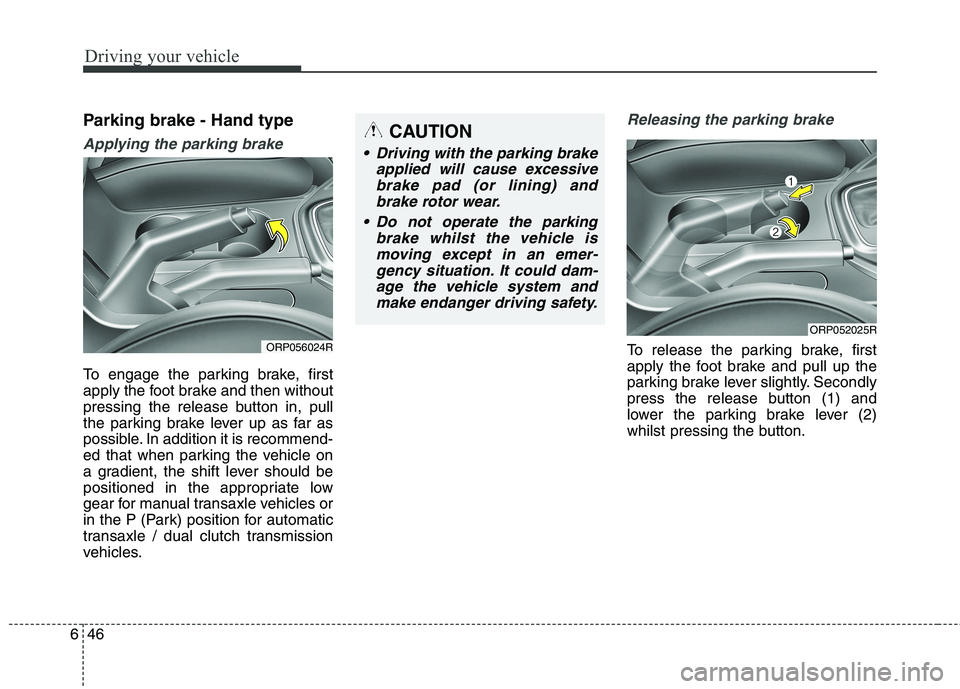
To engage the parking brake, first
apply the foot brake and then without
pressing the release button in, pull
the parking brake lever up as far as
possible. In addition it is recommend-
ed that when parking the vehicle on
a gradient, the shift lever should be
positioned in the appropriate low
gear for manual transaxle vehicles or
in the P (Park) position for automatic
transaxle / dual clutch transmission
vehicles.
Releasing the parking brake
To release the parking brake, first
apply the foot brake and pull up the
parking brake lever slightly. Secondly
press the release button (1) and
lower the parking brake lever (2)
whilst pressing the button.
ORP052025R
ORP056024R
CAUTION
Driving with the parking brake
applied will cause excessivebrake pad (or lining) and brake rotor wear.
Do not operate the parking brake whilst the vehicle ismoving except in an emer-gency situation. It could dam- age the vehicle system andmake endanger driving safety.
Page 482 of 723
647
Driving your vehicle
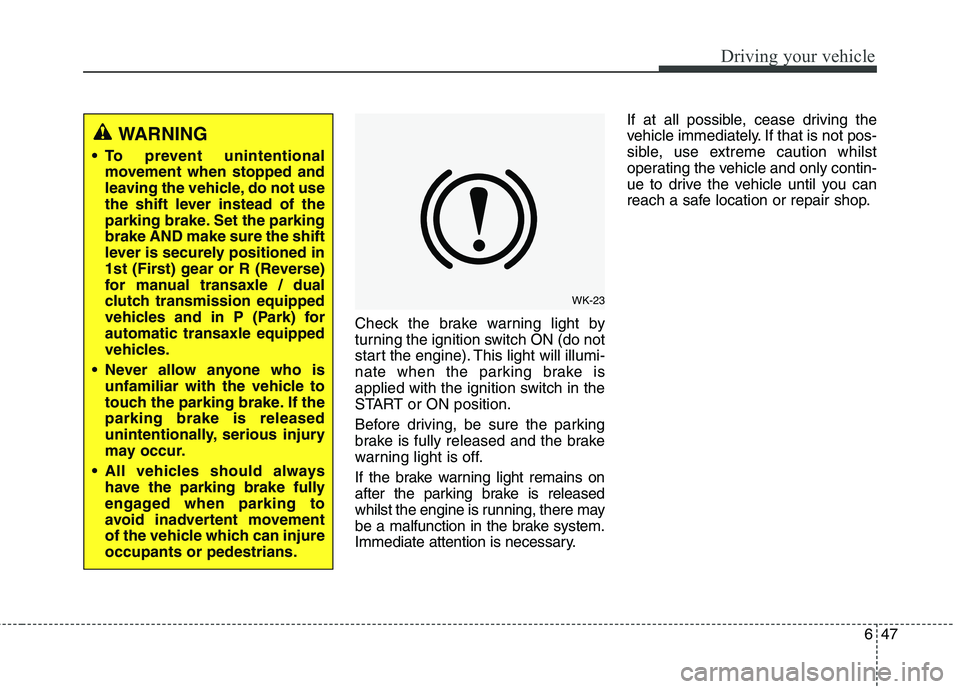
Check the brake warning light by
turning the ignition switch ON (do not
start the engine). This light will illumi-
nate when the parking brake is
applied with the ignition switch in the
START or ON position.
Before driving, be sure the parking
brake is fully released and the brake
warning light is off.
If the brake warning light remains on
after the parking brake is released
whilst the engine is running, there may
be a malfunction in the brake system.
Immediate attention is necessary.If at all possible, cease driving the
vehicle immediately. If that is not pos-
sible, use extreme caution whilst
operating the vehicle and only contin-
ue to drive the vehicle until you can
reach a safe location or repair shop.
WARNING
To prevent unintentional movement when stopped and
leaving the vehicle, do not use
the shift lever instead of the
parking brake. Set the parkingbrake AND make sure the shift
lever is securely positioned in
1st (First) gear or R (Reverse)
for manual transaxle / dual
clutch transmission equipped
vehicles and in P (Park) forautomatic transaxle equipped
vehicles.
Never allow anyone who is unfamiliar with the vehicle to
touch the parking brake. If theparking brake is released
unintentionally, serious injury
may occur.
All vehicles should always have the parking brake fully
engaged when parking to
avoid inadvertent movement
of the vehicle which can injureoccupants or pedestrians.
WK-23
Page 498 of 723
663
Driving your vehicle
Check to be sure the parking brakeis not engaged and that the park-
ing brake indicator light is out
before driving away.
Driving through water may get the brakes wet. They can also get wet
when the vehicle is washed. Wet
brakes can be dangerous! Your
vehicle will not stop as quickly if the
brakes are wet. Wet brakes may
cause the vehicle to pull to one
side.
To dry the brakes, apply the brakes
lightly until the braking action
returns to normal, taking care to
keep the vehicle under control at
all times. If the braking action does
not return to normal, stop as soon
as it is safe to do so and we rec-
ommend that you call an autho-
rised Kia dealer.
Do not coast down hills with the vehicle out of gear. This is extreme-
ly hazardous. Keep the vehicle in
gear at all times, use the brakes to
slow down, then shift to a lower
gear so that engine braking will
help you maintain a safe speed. Do not "ride" the brake pedal.
Resting your foot on the brake
pedal whilst driving can be danger-ous because it can result in the
brakes overheating and losing their
effectiveness. It also increases the
wear of the brake components.
If a tyre goes flat whilst you are driving, apply the brakes gently and
keep the vehicle pointed straight
ahead whilst you slow down. When
you are moving slowly enough for it
to be safe to do so, pull off the road
and stop in a safe place.
If your vehicle is equipped with an automatic transaxle / dual clutch
transmission, do not let your vehi-
cle creep forward. To avoid creep-
ing forward, keep your foot firmly
on the brake pedal when the vehi-cle is stopped.
Be cautious when parking on a hill. Firmly engage the parking brake
and place the shift lever in P (auto-
matic transaxle / dual clutch trans-
mission) or in first or reverse gear
(manual transaxle). If your vehicle
is facing downhill, turn the front
wheels into the kerb to help keep
the vehicle from rolling. If your vehicle is facing uphill, turn
the front wheels away from the
kerb to help keep the vehicle from
rolling. If there is no kerb or if it is
required by other conditions to
keep the vehicle from rolling, block
the wheels.
Under some conditions your park- ing brake can freeze in the
engaged position. This is most like-ly to happen when there is an accu-
mulation of snow or ice around or
near the rear brakes or if the brakes
are wet. If there is a risk that the
parking brake may freeze, apply it
only temporarily whilst you put the
shift lever in P (automatic transaxle
/ dual clutch transmission) or in first
or reverse gear (manual transaxle)
and block the rear wheels so the
vehicle cannot roll. Then release
the parking brake.
Do not hold the vehicle on the upgrade with the accelerator
pedal. This can cause the transaxle
to overheat. Always use the brake
pedal or parking brake.
Page 502 of 723
667
Driving your vehicle
To temporarily accelerate with
the cruise control on:
If you want to speed up temporarily
when the cruise control is on,
depress the accelerator pedal.
Increased speed will not interfere
with cruise control operation orchange the set speed.
To return to the set speed, take your
foot off the accelerator pedal.To cancel cruise control, do
one of the following:
Depress the brake pedal.
Depress the clutch pedal if
equipped with a manual transaxle.
Shift into N (Neutral) if equipped with an automatic transaxle / dual
clutch transmission.
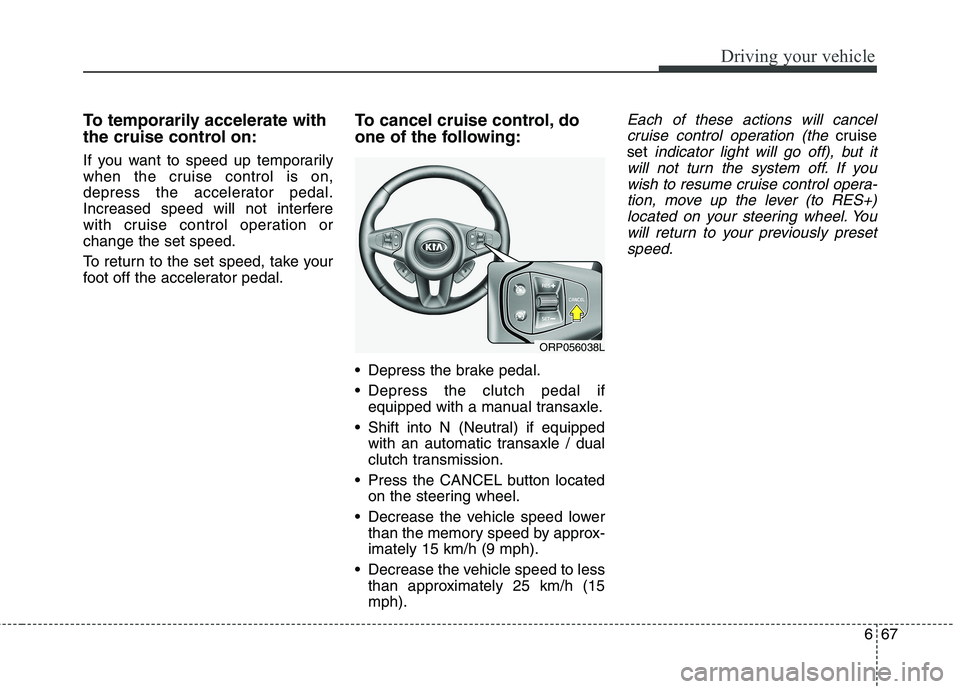
Press the CANCEL button located on the steering wheel.
Decrease the vehicle speed lower than the memory speed by approx-imately 15 km/h (9 mph).
Decrease the vehicle speed to less than approximately 25 km/h (15mph).Each of these actions will cancel
cruise control operation (the
cruise
set
indicator light will go off), but it
will not turn the system off. If you wish to resume cruise control opera-tion, move up the lever (to RES+)located on your steering wheel. You will return to your previously presetspeed.
ORP056038L
Page 527 of 723
Driving your vehicle
92
6
Hazardous driving conditions
When hazardous driving conditions
are encountered such as water,
snow, ice, mud, sand, or similar haz-
ards, follow these suggestions:
Drive cautiously and allow extra
distance for braking.
Avoid sudden braking or steering.
When braking with non-ABS brakes pump the brake pedal with
a light up-and-down motion until
the vehicle is stopped.
If stalled in snow, mud, or sand, use second gear. Accelerate slowly to
avoid spinning the drive wheels.
Use sand, rock salt, tyre chains, or other non-slip material under the
drive wheels to provide traction
when stalled in ice, snow, or mud. Rocking the vehicle
If it is necessary to rock the vehicle to
free it from snow, sand, or mud, first
turn the steering wheel right and left
to clear the area around your front
wheels. Then, shift back and forth
between 1 (First) and R (Reverse) in
vehicles equipped with a manual
transaxle or R (Reverse) and any for-
ward gear in vehicles equipped with
an automatic transaxle / dual clutch
transmission. Do not race the engine,and spin the wheels as little as possi-
ble. If you are still stuck after a few
tries, have the vehicle pulled out by a
tow vehicle to avoid engine overheat-
ing and possible damage to the
transaxle.
SPECIAL DRIVING CONDITIONS WARNING
- Downshifting
Downshifting with an automatic
transaxle / dual clutch transmis-
sion, whilst driving on slipperysurfaces can cause an accident.
The sudden change in tyrespeed could cause the tyres to
skid. Be careful when down-
shifting on slippery surfaces.
WARNING - ABS
Do not pump the brake pedal on
a vehicle equipped with ABS.
CAUTION
Prolonged rocking may cause engine over-heating, transaxledamage or failure, and tyre dam- age.