2017 HONDA RIDGELINE air condition
[x] Cancel search: air conditionPage 29 of 85

VEHICLE CONTROLS
50 || 51
V
EHICLE CONTROLS
Air Conditioning System*
Manually control the front and rear heating and cooling in your vehicle’\
s interior using
the buttons on the dashboard.
n
Front Operation
Fan control
switch
A/C
buttonMAX A/C
button Windshield
defroster button
Temperature control switch
Recirculation button:
Recirculation mode (indicator
on): Recirculates air from the
vehicle’s interior.
Fresh air mode (indicator off):
Maintains outside ventilation. Rear defogger/
heated door
mirrors button*
ON/OFF
button
MODE button:
Change airflow
location.
Climate Control System*
The automatic climate control system can maintain your preferred interio\
r temperature
by selecting the proper mix of heated or cooled air and fan speed. Use t\
he buttons on
the dashboard to control both front and rear operation.
n
Front Operation
AUTO button: Press, then
use the temperature
control switch to set your
preferred temperature. SYNC button: Set the passenger’s
side and rear temperature to the
same as the driver’s side.
Driver’s side
temperature
control switch
A/C
buttonPassenger’s side
temperature
control switch
Recirculation button:
Recirculation mode (indicator on):
Recirculates air from the vehicle’s interior.
Fresh Air mode (indicator off):
Maintains outside ventilation.
Rear defogger/
heated door
mirrors button*
Windshield
defroster button
Fan
control
buttons
ON/OFF
button
MODE button:
Change
airflow
location.
n Rear Operation
RR SETTINGS button:
Adjust rear temperature.
REAR ON/OFF button
*if equipped
*if equipped
REAR LOCK button*:
Disable rear controls*.
Page 39 of 85
AUDIO AND CONNECTIVITY
70 || 71
A
UDIO AND CONNECTIVITY
Models with touchcreen
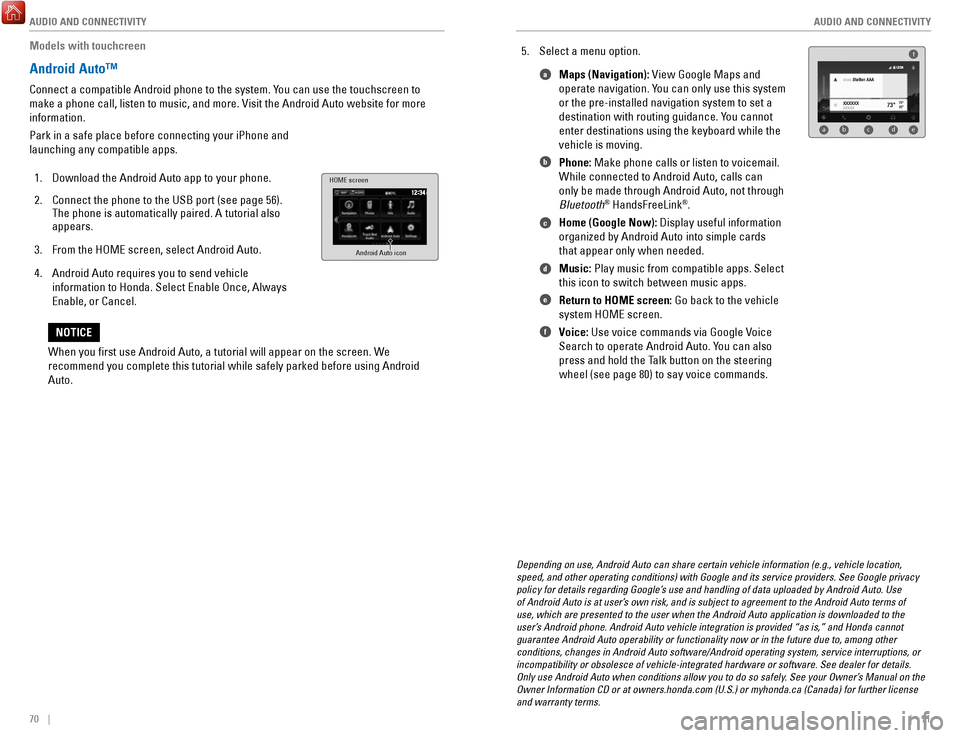
Android Auto™
Connect a compatible Android phone to the system. You can use the touchscreen to
make a phone call, listen to music, and more. Visit the Android Auto web\
site for more
information.
Park in a safe place before connecting your iPhone and
launching any compatible apps.
1.
Download the Android Auto app to your phone.
2.
Connect the phone to the USB port (see page 56).
The phone is automatically paired. A tutorial also
appears.
3.
From the HOME screen, select Android Auto.
4.
Android Auto requires you to send vehicle
information to Honda. Select Enable Once, Always
Enable, or Cancel.
HOME screen
Android Auto icon
5. Select a menu option. Maps (Navigation): View Google Maps and
operate navigation. You can only use this system
or the pre-installed navigation system to set a
destination with routing guidance. You cannot
enter destinations using the keyboard while the
vehicle is moving.
Phone: Make phone calls or listen to voicemail.
While connected to Android Auto, calls can
only be made through Android Auto, not through
Bluetooth
® HandsFreeLink®.
Home (Google Now): Display useful information
organized by Android Auto into simple cards
that appear only when needed.
Music: Play music from compatible apps. Select
this icon to switch between music apps.
Return to HOME screen: Go back to the vehicle
system HOME screen.
Voice: Use voice commands via Google Voice
Search to operate Android Auto. You can also
press and hold the Talk button on the steering
wheel (see page 80) to say voice commands.
f
ab cde
a
b
c
d
e
f
Depending on use, Android Auto can share certain vehicle information (e\
.g., vehicle location,
speed, and other operating conditions) with Google and its service prov\
iders. See Google privacy
policy for details regarding Google’s use and handling of data uploaded by Android Auto. Use
of Android Auto is at user’s own risk, and is subject to agreement to the Android Auto terms of
use, which are presented to the user when the Android Auto application i\
s downloaded to the
user’s Android phone. Android Auto vehicle integration is provided “as is,\
” and Honda cannot
guarantee Android Auto operability or functionality now or in the future\
due to, among other
conditions, changes in Android Auto software/Android operating system, s\
ervice interruptions, or
incompatibility or obsolesce of vehicle-integrated hardware or software.\
See dealer for details.
Only use Android Auto when conditions allow you to do so safely. See your Owner’s Manual on the
Owner Information CD or at owners.honda.com (U.S.) or myhonda.ca (Can\
ada) for further license
and warranty terms.
When you first use Android Auto, a tutorial will appear on the screen.\
We
recommend you complete this tutorial while safely parked before using An\
droid
Auto.
NOTICE
Page 73 of 85

MAINTENANCE
138 || 139
M
AINTENANCE
Maintenance Minder™
When maintenance is due, the system message indicator comes on and a mes\
sage
appears on the display every time you turn the vehicle on. See page 139 to check what
maintenance is due indicated by the codes that appear.
Press the Info (
/) button on the steering wheel to change displays.
System message
indicator
Maintenance Minder message
Main
items Sub items
• Independent of the Maintenance Minder information, replace the brake fl\
uid every
3 years.
•
Inspect idle speed every 160,000 miles (256,000 km).
•
Adjust the valves during services A, B, 1, 2, or 3 if they are noisy.
U.S. models
Maintenance, replacement, or repair of emissions control devices and sys\
tems may
be done by any automotive repair establishment or individuals using part\
s that are
certified to EPA standards.
According to state and federal regulations, failure to perform maintenan\
ce on the
maintenance main items marked with # will not void your emissions warranties.
However
, all maintenance services should be performed in accordance with the
intervals indicated by the multi-information display. n
Maintenance Minder Service Codes
These codes indicate what services are due on your vehicle.
*1: If the message Maintenance Due Now does not appear more than 12 months after the display
is reset, change the engine oil every year.
#: See information on maintenance and emissions warranty.
*2: If you drive in dusty conditions, replace the air cleaner element every \
15,000 miles (24,000 km).
*3: If you drive primarily in urban areas that have high concentrations of s\
oot in the air from industry and diesel-powered vehicles, replace every 15,000 miles (24,000 km).
CODEMaintenance Main Items
A
Replace engine oi l*1
BReplace engine oil*1 and oil lter
Inspect front and rear brakes
Check parking brake adjustment
Inspect tie rod ends, steering gearbox, and boots
Inspect suspension components
Inspect driveshaft boots
Inspect brake hoses and lines (Including ABS/VSA)
Inspect all uid levels and condition of uids
Inspect exhaust system#
Inspect fuel lines and connection s#
*4: If you drive regularly in very high temperatures (over 110°F, 43°\
C), in very low temperatures
(under -20°F, -29°C), or towing a trailer, replace every 60,000 \
miles/100,000 km.
*5: Driving in mountainous areas at very low vehicle speeds or trailer towin\
g results in higher level
of mechanical (Shear) stress to uid. This requires differential \
uid changes more frequently
than recommended by the Maintenance Minder. If you regularly drive your \
vehicle under these
conditions, have the differential uid changed at 7,500 miles (12,00\
0 km), then every 15,000 miles
(24,000 km).
CODEMaintenance Sub Item s
1
Rotate tires
2Replace air cleaner element*2
Replace dust and pollen lte r*3
Inspect drive belt
3
Replace transfer-case uid and transmission ui d
4Replace spark plugs
Replace timing belt and inspect water pump*4
Inspect valve clearance
5
Replace engine coolant
6Replace rear differential ui d*, *5
*
*if equipped
Page 77 of 85

MAINTENANCE
146 || 147
M
AINTENANCE
Changing Wiper Blades
If the wiper blades leave streaks across the windshield, try cleaning th\
em first with a
paper towel or soft cloth and wiper fluid. If the wiper blade rubber h\
as deteriorated, you
should change the wiper blades.
n
Changing the Front Wiper Blade Rubber
1.
Lift the driver side wiper arm first, then the
passenger side.
2. Place a cloth on the edge of the lock tab. Push the
lock tab up using a flat-tip screwdriver.Lock tab
3. Slide the blade from the wiper arm.
4.
Slide the wiper blade out from its holder by pulling
the tabbed end out.
Blade
5. Remove the retainers from the rubber blade that
has been removed, and mount to a new rubber
blade. Correctly align the rubber protrusion and the
retainer grooves.
Retainer
Blade
6. Slide the new wiper blade onto the holder from the
bottom end. The tab on the holder should fit in the
indent of the wiper blade. Slide the wiper blade
onto the wiper arm until it locks
7. Slide the wiper blade onto the wiper arm, then
push down the lock tab.
8.
Lower the passenger side wiper arm first, then the driver side.
Avoid dropping the wiper arm, as it may damage the windshield.
NOTICE
Tire Information
To safely operate your vehicle, your tires must be of the proper type and\
size, in good
condition with adequate tread, and properly inflated.
n
Inflation Guidelines •
Properly inflated tires provide the best combination of handling, trea\
d life, and
comfort. Refer to the driver’s doorjamb label or the specifications (see page 154)
for the specified pressure.
•
Underinflated tires wear unevenly, adversely affect handling and fuel economy,
and are more likely to fail from overheating.
•
Overinflated tires make your vehicle ride harshly, are more prone to road
hazards, and wear unevenly.
•
Every day before you drive, look at each of the tires. If one looks lowe\
r than the
others, check the pressure with a tire gauge.
•
Measure the air pressure when tires are cold. This means the vehicle has been
parked for at least 3 hours, or driven less than 1 mile (1.6 km). If n\
ecessary, add
or release air until the specified pressure is reached. If checked whe\
n hot, tire
pressure can be as much as 4-6 psi (30-40 kPa, 0.3-0.5 kgf/cm2) higher\
than
checked when cold.
•
At least once a month or before long trips, use a gauge to measure the p\
ressure
in all tires, including the spare. Even tires in good condition can lose\
1-2 psi
(10-20 kPa, 0.1-0.2 kgf/cm2) per month.
n
Inspection Guidelines
Every time you inflate the tires, check for the following: •
Any damage to tires, including bumps, bulges, cuts, splits, or cracks in\
the side
or tread. Remove any foreign objects and inspect for air leaks. Replace \
tires if
you see fabric or cord.
•
Uneven or excessive tread wear. Have a dealer check the wheel alignment.
•
Cracks or other damage around the valve stems.
n
Wear Indicators
The groove where the wear indicator is located is
1/16 inch (1.6 mm) shallower than elsewhere on the
tire. If the tread has worn so low that the indicator is
exposed, replace the tire. Worn out tires have poor
traction on wet roads.Example of a wear
indicator mark
Page 78 of 85

MAINTENANCE
148 || 149
M
AINTENANCE
Using tires that are excessively worn or improperly inflated can cause\
a
crash in which you can be seriously hurt or killed.
Follow all instructions in this owner’s manual regarding tire inflation and
maintenance
.
WARNING
n Tire and Loading Information Label
The label attached to the driver’s doorjamb provides necessary tire and
loading information.
Original
tire sizes
Number of people your
vehicle can carry
Proper cold tire pressure Total weight your
vehicle can carry
(do not exceed)
n Tire and Wheel Replacement
Replace your tires with radials of the same size, load range, speed rati\
ng, and
maximum cold tire pressure rating (as shown on the tire’s sidewall). Using tires of a
different size or construction can cause certain vehicle systems to work\
incorrectly
.
It is best to replace all four tires at the same time. If that isn’t possible, replace the
front or rear tires in pairs.
If you change or replace a wheel, make sure that the wheel’s specifications match
those of the original wheels. Only use TPMS-specified wheels approved \
for your
vehicle.
Installing improper tires on your vehicle can affect handling and stabil\
ity.
This can cause a crash in which you can be seriously hurt or killed.
Always use the size and type of tires recommended in the Owner’s
Manual.
WARNING
n Tire Service Life
The life of your tires is dependent on many factors, including driving h\
abits, road
conditions, vehicle loading, inflation pressure, maintenance history, speed, and
environmental conditions (even when the tires are not in use).
In addition to regular inspections and inflation pressure maintenance,\
it is
recommended that you have annual inspections performed once the tires re\
ach five
years old. All tires, including the spare, should be removed from servic\
e after
10 years from the date of manufacture, regardless of their condition or \
state of wear
.
n
Winter Tires
If driving on snowy or frozen roads, mount all season tires marked “M\
+S”, snow tires, or tire chains; reduce speed; and maintain sufficient distance \
between
vehicles when driving. For winter tires, select the size and load ranges\
that are the same as the original tires, and mount them to all four wheels.
n
Tire Chains
Install tire chains on the front tires only. Because your vehicle has limited tire
clearance, we strongly recommend using the following chains:
Cable type: SCC Super Z LT-ZT735
Mount chains as tightly as you can, and make sure that they do not touch\
the brake
lines or suspension.
Traction devices that are the wrong size or improperly installed can
damage your vehicle’s brake lines, suspension, body, and wheels. Stop
driving if they are hitting any part of the vehicle.
NOTICE
Using the wrong chains, or not properly installing chains, can damage th\
e
brake lines and cause a crash in which you can be seriously injured or
killed.
Follow all instructions in this guide regarding the selection and use of\
tire
chains.
WARNING
Page 79 of 85

MAINTENANCE
150 || 151
M
AINTENANCE
Tire Labeling
The tires that came on your vehicle have a number of markings. Those you\
should be aware of are described below.
Here is an example of what each marking means:
P235/60R18 102V
•
P: vehicle type (P indicates passenger vehicle)
•
235: tire width in millimeters
•
60: aspect ratio (tire section height as a
percentage of its width)
•
R: tire construction code (radial)
•
18: rim diameter in inches
•
102: load index (code indicating maximum load
tire can carry)
•
V: speed symbol (code indicating maximum
speed rating)
Tire size
Tire
identication
number (TIN)
Maximum
tire load
Maximum
tire pressure
Tire size
n Tire Identification Number (TIN)
The tire identification number
(TIN) is a group of numbers and
letters that look like the example
below. TIN is located on the
sidewall of the tire.DOT B97R FW6X 2209
DOT: This indicates that the tire meets all
requirements of the U.S. Department of
Transportation.
B97R: Manufacturer’s identication mark
FW6X: Tire type code
22 09: Date of Transportation
Year
Week
n Glossary of Tire Terminology
Cold Tire Pressure – The tire air pressure when the vehicle has been parked
for at least three hours or driven less than 1 mile (1.6 km).
Load Rating –
The maximum load that a tire is rated to carry for a given
inflation pressure.
Maximum Inflation Pressure – The maximum tire air pressure that the tire
can hold.
Maximum Load Rating – The load rating for a tire at the maximum
permissible inflation pressure for that tire.
Recommended Inflation Pressure – The cold tire inflation pressure
recommended by the manufacturer.
Treadwear Indicators (TWI) – The projections within the principal grooves
designed to give a visual indication of the degrees of wear of the tread\
.
DOT Tire Quality Grading
The tires on your vehicle meet all U.S. Federal Safety Requirements. All\
tires are also
graded for treadwear, traction, and temperature performance according to Department
of Transportation (DOT) standards. The following explains these gradings.
n
Uniform Tire Quality Grading
Quality grades can be found where applicable on the tire sidewall betwee\
n tread
shoulder and maximum section width.
For example:
Treadwear 200
Traction AA
Temperature A
All passenger car tires must conform to Federal Safety Requirements in a\
ddit
ion to
these grades.
n
Treadwear
The treadwear grade is a comparative rating based on the wear rate of th\
e tire
when tested under controlled conditions on a specified government test\
course. For
example, a tire graded 150 would wear one and one-half (1 1/2) times a\
s well on the
government course as a tire graded 100. The relative performance of tire\
s depends
upon the actual conditions of their use, however, and may depart significantly from
the norm due to variations in driving habits, service practices, and dif\
ferences
in
road characteristics and climate.
n
Traction
The traction grades, from highest to lowest, are AA, A, B, and C. Those \
grades represent the tire’s ability to stop on wet pavement as measured under controlled
conditions on specified government test surfaces of asphalt and concre\
te. A tire
marked C may have poor traction performance.
W
ARNING: The traction grade assigned to this tire is based on straight-ahead
braking traction tests, and does not include acceleration, cornering, hy\
droplaning,
or peak traction characteristics.
Page 81 of 85

SPECIFICATIONS
154 || 155
S
PECIFICATIONS
SPECIFICATIONS
*if equipped
* *
Vehicle
2: 2WD models
1: AWD models
ModelHonda Ridgeline
Front No. of Passengers: 2
Rear 3
6,019 lbs (2,730 kg)*25,710 lbs (2,590 kg)*1
3,131 lbs (1,420 kg)*13,042 lbs (1,380 kg)*2
3,219 lbs (1,460 kg)*13,042 lbs (1,380 kg)*2
9,987 lbs (4,530 kg)*18,201 lbs (3,720 kg)*2
Air Conditioning:
Weights:
Gross Vehicle
Weight Rating
Gross Axle Weight
Rating (Front)
Gross Axle Weight
Rating (Rear)
Gross Combined Weight
Rating
Refrigerant TypeCharge Quantit yLubricant TypeQuantity
HFO-1234yf (R-1234yf )
20.3 – 22.0 oz (575 – 625 g)
POE RL85HM
7.5 – 8.7 cu-in (123 – 143 cm
3)
Engine and Fuel
Fluids
Displacemen t211.8 cu-in (3,471 cm3)
Spark Plugs NGKDILZKR7B11GUnleaded gasoline, Pump octane
Fuel Type
Washer Tank Capacity
number of 87 or higher
Fuel Tank Capacity 19.5 US gal (73.8 )
U.S.: 1.0 US gal (3.8 )
Canada: 1.4 US gal (5.3 )
Light Bulbs
*
*1: Models with LED low beam headlights
* 2: Models without LED low beam headlights
* 3: Models with LED day time running lights
*
* 4: Models without LED day time running lights
5: Models with moonroof
6: Models without moonroof
Headlights (L
ow Beam) LE
D*155 W*2 (H11)
60W (HB3 )
35 W (H8)
28/8 W (Amber)
LE D
LE D
LE D
*3Daytime Running Lights
60 W (HB3)*4
Headlights (High Beam)
Fog Lights*
Front Turn Signal/Parking Light s*
Parking Lights*
Front Side Marker Lights
LED
LE D
LE D
21 W
21 W
LE D
5 W
Bed Lights LE
D
*13C P*2
Front Map Lights LE
D*55 W*6
In teri or Lights
5 W
1.4 W
LE D
Side Turn Signal Lights (on Door Mirrors)
*
Rear Side Marker Light
s
Brake/Taillights
Back-Up Lights
Rear Turn Signal Lights
High-M ount Brake Ligh t
Rear License Plate Ligh t
LED
3.8 W
LE D
1.4 W
1.4 W
Rear Map Lights
Vanity Mirror Lights
*
Door Pocket Lights*
Beverage Holder Light*
Door Courtesy Light
s*
Door Inner Handle Light s*
Console Compartment Light
Glove Box Light
Engine Oil
Recommende d·
Engine Coolan
t
·
Genuine Honda Motor Oil 0W-20
Change
Capacity API Premium-grade 0W-20 detergent oi
l
5.4 US qt (5.1 )
Change
lter including
5.7 US qt (5.4 )
Specie d
Ratio
Capacity
Honda Long Life Antifreeze/Coolant Type 2
50/50 with distilled wate r
1.88 US gal (7.13 )
(change including the remaining
0.19 US gal (0.72 ) in the reserve tank )
Brake Fluid
Automatic Transmission Fluid
Rear Differential Fluid*
Transfer Case Fluid*
SpeciedHonda Heavy Duty Brake Fluid DOT 3
Specied
CapacityHonda Automatic Transmission ATF DW- 1
Chang e3 .3 US qt (3.1 )
Specied Honda DPSF-II
Capacit yC hange
1.92 US qt (1.82 )
·
Specie d· Honda Hypoid Gear Oil HGO-1
SAE 90 (API grade GL4 or GL5)
Capacit y Hypoid gear oil SAE 75W-85 or
Change
0.45 US qt (0.43 )
Washer Flui d
Tires
RegularSize245/60R18 105 H
Pressure
35 (240 [2.4])
psi (kPa [kgf/cm2])
Spar e
Compact
Size
T165/90R17 105M
Pressure 60 (420 [4.2])
psi (kPa [kgf/cm2])
Wheel SizeRegular18 x 8J17 x 4TCompact Spare
Total5
LED
Footwell Lights*
*if equipped
* *
Vehicle
2: 2WD models
1: AWD models
Model Honda Ridgeline
Front No. of Passengers: 2
Rear 3
6,019 lbs (2,730 kg)
*25,710 lbs (2,590 kg)*1
3,131 lbs (1,420 kg)*1
3,042 lbs (1,380 kg)*2
3,219 lbs (1,460 kg)*1
3,042 lbs (1,380 kg)*2
9,987 lbs (4,530 kg)*1
8,201 lbs (3,720 kg)*2
Air Conditioning: Weights :
Gross Vehicle
Weight Rating
Gross Axle Weight
Rating (Front)
Gross Axle Weight
Rating (Rear)
Gross Combined Weight
Rating
Refrigerant Type
Charge Quantit y
Lubricant Type
Quantity
HFO-1234yf (R-1234yf )
20.3 – 22.0 oz (575 – 625 g)
POE RL85HM
7.5 – 8.7 cu-in (123 – 143 cm
3)
Engine and Fuel
Fluids
Displacemen t211.8 cu-in (3,471 cm3)
Spark Plugs NGK DILZKR7B11G
Unleaded gasoline, Pump octane
Fuel Type
Washer Tank Capacity number of 87
or higher
Fuel Tank Capacity 19.5 US gal (73.8 )
U.S.: 1.0 US gal (3.8 )
Canada: 1.4 US gal (5.3 )
Light Bulbs
*
*1: Models with LED low beam headlights
* 2: Models without LED low beam headlights
* 3: Models with LED day time running lights
*
*
4: Models without LED day time running lights
5: Models with moonroof
6: Models without moonroof
Headlights (L ow Beam) LE
D*1
55 W*2 (H11)60W (HB3 )35 W (H8)28/8 W (Amber)LEDLEDLE D*3Daytime Running Lights
60 W (HB3)*4
Headlights (High Beam)
Fog Lights*
Front Turn Signal/Parking Light s*
Parking Lights*
Front Side Marker Lights
LEDLED
LE D
21 W21 WLED5 W
Bed LightsLE D*1
3C P*2
Front Map Lights LE
D*5
5 W*6
In teri or Lights
5 W
1.4 W
LE D
Side Turn Signal Lights (on Door Mirrors)
*
Rear Side Marker Light
s
Brake/Taillights
Back-Up Lights
Rear Turn Signal Lights
High-M ount Brake Ligh t
Rear License Plate Ligh t
LED
3.8 W
LE D
1.4 W
1.4 W
Rear Map Lights
Vanity Mirror Lights*
Door Pocket Lights*
Beverage Holder Light*
Door Courtesy Light s*
Door Inner Handle Light s*
Console Compartment Light
Glove Box Light
Engine Oil
Recommende d·
Engine Coolan
t
·
Genuine Honda Motor Oil 0W-20
Change
Capacity API Premium-grade 0W-20 detergent oi
l
5.4 US qt (5.1 )
Change
lter including 5.7 US qt (5.4 )
Specie d
Ratio
Capacity Honda Long Life Antifreeze/Coolant Type
2
50/50 with distilled wate r
1.88 US gal (7.13 )
(change including the remaining
0.19 US gal (0.72 ) in the reserve tank )
Brake Fluid
Automatic Transmission Fluid
Rear Differential Fluid
*
Transfer Case Flui d*
SpeciedHonda Heavy Duty Brake Fluid DOT 3
Specied
Capacit yHonda Automatic Transmission ATF DW-
1
Chang e3 .3 US qt (3.1 )
Specied Honda DPSF-II
Capacit yC hange 1.92 US qt (1.82 )
·
Specie d· Honda Hypoid Gear Oil HGO-1
SAE 90 (API grade GL4 or GL5)
Capacit y Hypoid gear oil SAE 75W-85 or
Change 0.45 US qt (0.43 )
Washer Fluid
Tire s
Regular Size
245/60R18 105H
Pressure 35 (240 [2.4])
psi (kPa [kgf/cm2])
Spar e
Compact
Size
T165/90R17 105M
Pressure 60 (420 [4.2])
psi (kPa [kgf/cm
2])
Wheel Size Regular
18 x 8J
17 x 4T
Compact Spar e
Total5LED
Footwell Lights*
Page 83 of 85

CUSTOMER INFORMATION
158 || 159
V
OICE COMMAND INDEX
Honda Roadside Assistance
24-hour emergency road service is available to you in the United States \
and Canada
throughout your 3-year/36,000-mile warranty term. Services include jump starting, flat
tire and lockout assistance, towing, and more (limitations apply).
Call (866) 864-5211 (U.S.) or (800) 465-7587 (Canada).
Warranty Coverages
Below is a brief summary of the warranties covering your new vehicle.
New Vehicle Limited Warranty: Covers your new vehicle, except for the emissions
control system and accessories, against defects in materials and workman\
ship.
Emissions Control Systems Defects Warranty and Emissions Performance Warranty:
Covers your vehicle’s emissions control systems. Time, mileage, and coverage are
conditional.
Seat Belt Limited Warranty: Covers seat belts that fail to function properly.
Rust Perforation Limited Warranty: Covers all exterior body panels that rust through
from the inside.
Accessory Limited Warranty: Covers Honda accessories.
Replacement Parts Limited Warranty: Covers all Honda replacement parts against
defects in materials and workmanship.
Replacement Battery Limited Warranty: Provides prorated coverage for a replacement
battery purchased from a Honda dealer.
Replacement Muffler Lifetime Limited Warranty: Covers a replacement muffler for the
duration of the ownership.
Restrictions and exclusions apply to all these warranties. See the Warranty Manual
on the Owner Information CD or at owners.honda.com (U.S.) or www.myhonda.ca
(Canada) for complete descriptions of each warranty, including time, mileage, and other
conditional limitations.
Your vehicle’s original tires are covered by their manufacturer. Tire warranty information
can be found on the Owner Information CD or at owners.honda.com (U.S.) or
www.myhonda.ca (Canada).
VOICE COMMAND INDEX
Learn about all available voice commands to help you operate the vehicle\
. Available on
vehicles with touchscreen.
Press the Talk button before you say a command.
•
Phone call
•
Music search
•
Audio
•
Climate control
•
Navigation* •
Voice setting
•
Voice help
•
What is today’s date?
•
What time is it?
•
View map
•
Find place
•
Find category
•
Find intersection
•
Recently found •
Go home
•
Find address
•
Find city
•
Find saved places
*models with navigation
**These commands toggle the function on and off, so the command may not match your intended action.
• Climate control on**
•
Climate control off**
•
Air conditioner on**
•
Air conditioner off**
•
Defrost on**
•
Defrost off** •
Fan speed # (#: 1 to 7)
•
Temperature # degrees
(#: 57 to 87°F)
•
Temperature max heat
•
Temperature max cool
•
Call by number
•
Call by name •
Call (number)
•
Call (name)
n
Voice Portal Commands
When you press the Talk button, the Voice Portal screen appears. Say one of the
options, and follow the system prompts.
n
Navigation Commands*
The system accepts these commands on most screens. You only need to press the
Talk button once for navigation commands.
n
Climate Control Commands
The system accepts these commands on most screens.
n
Phone Commands
The system accepts these commands on most screens.
EPA Contact Information
An owner may obtain further information
concerning emission warranties or report
violations of the terms of the emission
warranties by contacting: U.S. Environmental Protection Agency
Office of Transportation and Air Quality
Compliance Division,
Light-Duty Vehicles Group
Attn: Warranty Complaints
2000 Traverwood Drive
Ann Arbor, MI 48105
Email: [email protected]