2017 HONDA CLARITY ELECTRIC towing
[x] Cancel search: towingPage 4 of 543
Contents
This owner’s manual should be considered a permanent part of the
vehicle and should remain with the vehicle when it is sold.
This owner’s manual covers all models of your vehicle. You may find
descriptions of equipment and features that are not on your
particular model.
Images throughout this owner’s manu al (including the front cover)
represent features and equipment that are available on some, but
not all, models. Your particular mo del may not have some of these
features.
The information and specifications in cluded in this publication were
in effect at the time of approval for printing. Honda Motor Co., Ltd.
reserves the right, however, to discontinue or change specifications
or design at any time without notice and without incurring any
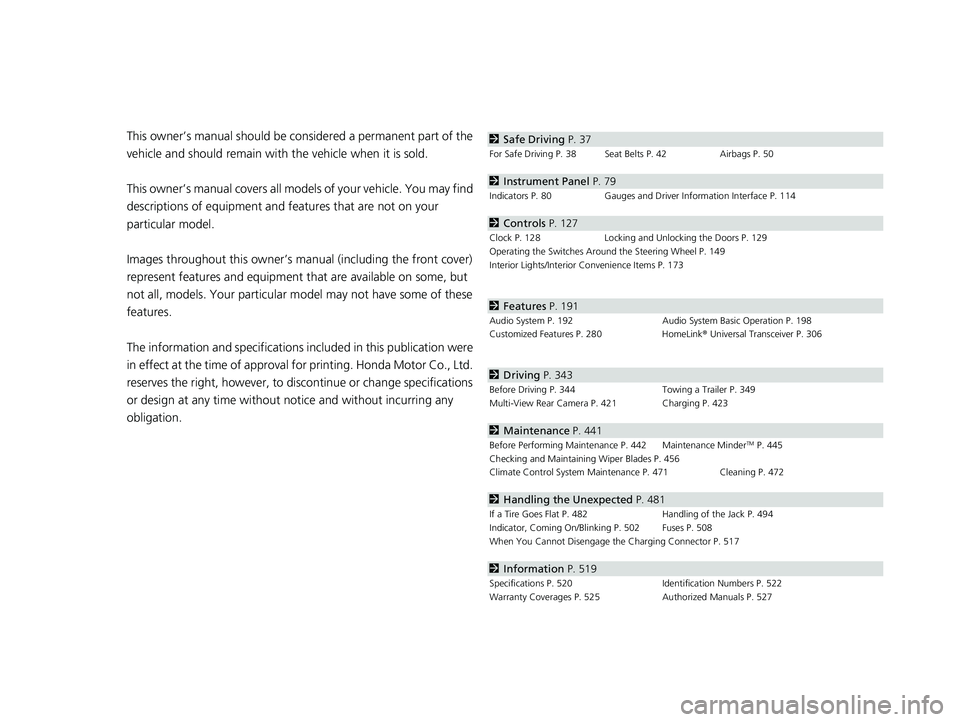
obligation.2 Safe Driving P. 37
For Safe Driving P. 38 Seat Belts P. 42 Airbags P. 50
2Instrument Panel P. 79
Indicators P. 80 Gauges and Driver Information Interface P. 114
2Controls P. 127
Clock P. 128 Locking and Unlocking the Doors P. 129
Operating the Switches Ar ound the Steering Wheel P. 149
Interior Lights/Interior Convenience Items P. 173
2 Features P. 191
Audio System P. 192 Audio System Basic Operation P. 198
Customized Features P. 280 HomeLink® Universal Transceiver P. 306
2 Driving P. 343
Before Driving P. 344 Towing a Trailer P. 349
Multi-View Rear Camera P. 421 Charging P. 423
2 Maintenance P. 441
Before Performing Maintenance P. 442 Maintenance MinderTM P. 445
Checking and Maintaining Wiper Blades P. 456
Climate Control System Main tenance P. 471 Cleaning P. 472
2Handling the Unexpected P. 481
If a Tire Goes Flat P. 482 Handling of the Jack P. 494
Indicator, Coming On/Blinking P. 502 Fuses P. 508
When You Cannot Disengage the Charging Connector P. 517
2Information P. 519
Specifications P. 520 Identification Numbers P. 522
Warranty Coverages P. 525 Authorized Manuals P. 527
17 CLARITY BEV CSS-31TRV6000.book 2 ページ 2017年4月14日 金曜日 午前11時8分
Page 5 of 543
Contents
Child Safety P. 65Safety Labels P. 78
Opening and Closing the Trunk P. 141 Security System P. 144 Opening and Closing the Windows P. 147
Adjusting the Mirrors P. 164 Adjusting the Seats P. 166
Climate Control System P. 183
Audio Error Messages P. 270 General Information on the Audio System P. 274
Bluetooth® HandsFreeLink ® P. 309
When Driving P. 350 Braking P. 404Parking Your Vehicle P. 419
Energy Economy P. 439
Maintenance Under the Hood P. 449 Replacing Light Bulbs P. 454
Checking and Maintaining Tires P. 459 12-Volt Battery P. 468 Remote Transmitter Care P. 470
Accessories and Modifications P. 478
Power System Won’t Start P. 495 Jump Starting P. 498 Overheating P. 501
Emergency Towing P. 515 When You Cannot Open the Charge Lid P. 516
When You Cannot Open the Trunk P. 518
Devices that Emit Radio Waves P. 523 Reporting Safety Defects P. 524
Customer Service Information P. 528
Quick Reference GuideP. 4
Safe DrivingP. 37
Instrument PanelP. 79
ControlsP. 127
FeaturesP. 191
DrivingP. 343
MaintenanceP. 441
Handling the UnexpectedP. 481
InformationP. 519
IndexP. 530
17 CLARITY BEV CSS-31TRV6000.book 3 ページ 2017年4月14日 金曜日 午前11時8分
Page 35 of 543
Quick Reference Guide
33
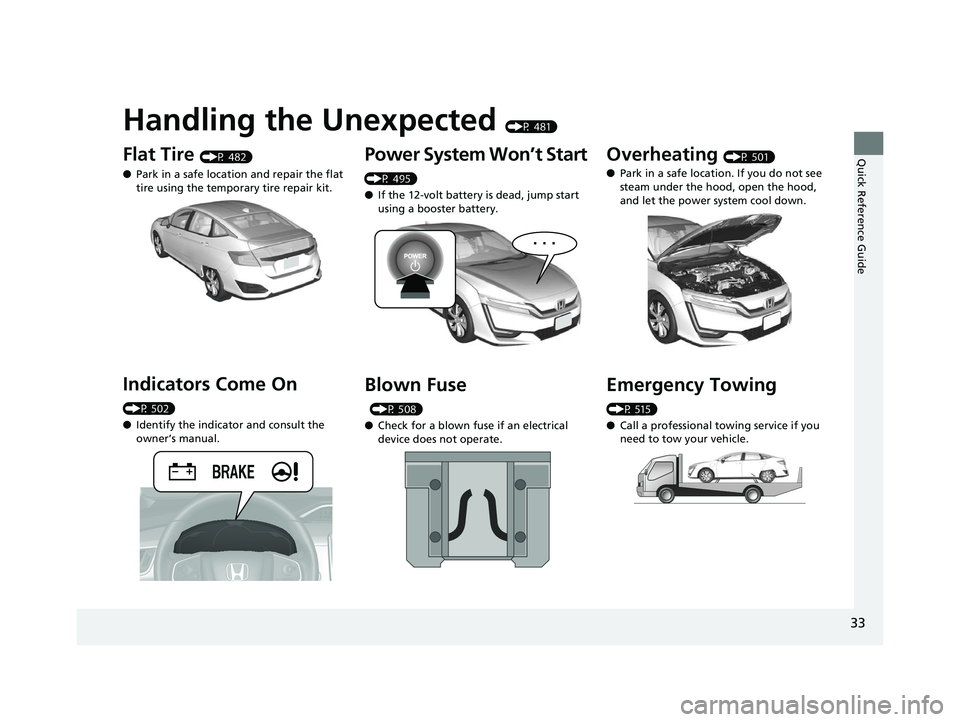
Handling the Unexpected (P 481)
Flat Tire (P 482)
● Park in a safe location and repair the flat
tire using the temporary tire repair kit.
Indicators Come On
(P 502)
●Identify the indica tor and consult the
owner’s manual.
Power System Won’t Start
(P 495)
● If the 12-volt battery is dead, jump start
using a booster battery.
Blown Fuse
(P 508)
● Check for a blown fuse if an electrical
device does not operate.
Overheating (P 501)
● Park in a safe location. If you do not see
steam under the hood, open the hood,
and let the power system cool down.
Emergency Towing
(P 515)
●Call a professional towing service if you
need to tow your vehicle.
17 CLARITY BEV CSS-31TRV6000.book 33 ページ 2017年4月14日 金曜日 午前11時 8分
Page 48 of 543
uuSeat Belts uFastening a Seat Belt
46
Safe Driving
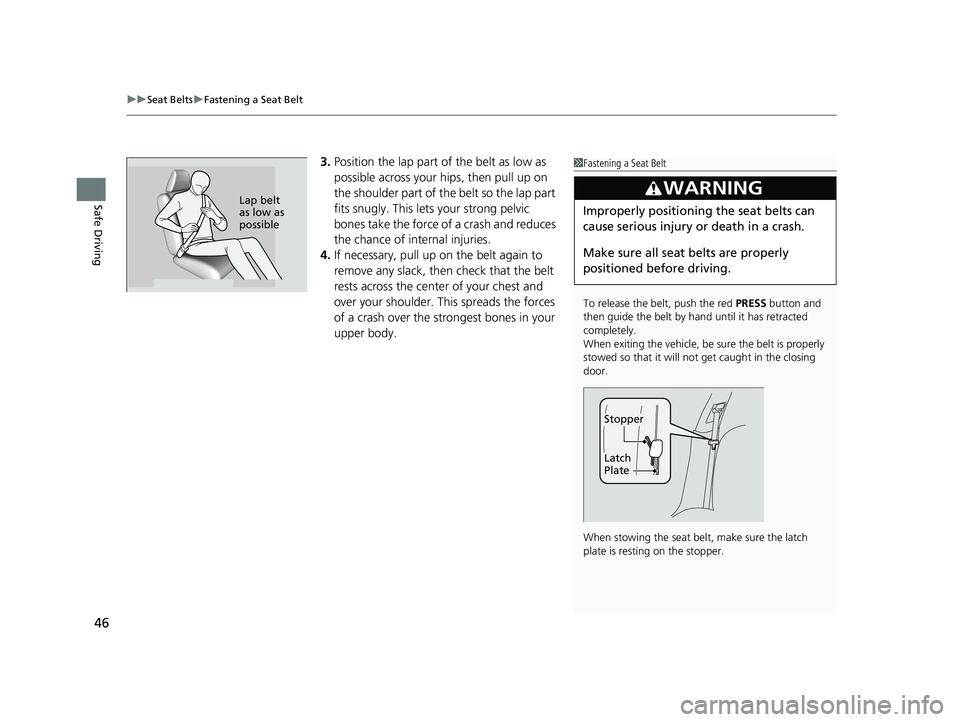
3. Position the lap part of the belt as low as
possible across your hips, then pull up on
the shoulder part of the belt so the lap part
fits snugly. This lets your strong pelvic
bones take the force of a crash and reduces
the chance of internal injuries.
4. If necessary, pull up on the belt again to
remove any slack, then check that the belt
rests across the center of your chest and
over your shoulder. Th is spreads the forces
of a crash over the strongest bones in your
upper body.1 Fastening a Seat Belt
To release the belt, push the red PRESS button and
then guide the belt by hand until it has retracted
completely.
When exiting the vehicle, be sure the belt is properly
stowed so that it will not get caught in the closing
door.
When stowing the seat belt, make sure the latch
plate is resting on the stopper.
3WARNING
Improperly positioning the seat belts can
cause serious injury or death in a crash.
Make sure all seat belts are properly
positioned before driving.
Latch
Plate
Stopper
Lap belt
as low as
possible
17 CLARITY BEV CSS-31TRV6000.book 46 ページ 2017年4月14日 金曜日 午前11時 8分
Page 345 of 543
343
Driving
This chapter discusses driving and charging.
Before Driving................................... 344
Towing a Trailer ................................ 349
When Driving Turning on the Power ...................... 350
Precautions While Driving................. 353
Transmission .................................... 354
Shifting ............................................ 355
SPORT Mode.................................... 361
Deceleration Paddle Selector ............ 362
ECON Button ................................... 365
Acoustic Vehicle Al erting System ...... 366
Front Sensor Camera ....................... 367
Road Departure Mi tigation (RDM)
System ........................................ 369
Adaptive Cruise Control (ACC) with Low
Speed Follow (LSF) ......................... 373
Lane Keeping Assist System (LKAS)...... 388Vehicle Stability Assist (VSA ®), aka Electronic
Stability Control (ESC), System ............. 395
Agile Handling Assist ....................... 397Tire Pressure Monitoring System (TPMS) .. 398Tire Pressure Monitoring System (TPMS) - Required Federal Explanation ......... 400
LaneWatchTM....................................... 402Braking Brake System ................................... 404
Anti-lock Brake System (ABS) ........... 409
Brake Assist System.......................... 410 Collision Mitigation Braking System
TM
(CMBSTM) ....................................... 411
Parking Your Vehicle When Stopped ................................ 419
Multi-View Rear Camera .................. 421
Charging ............................................ 423
Before Charging .............................. 423
Charge the High Voltage battery using a Level 1, 2 or SAE J1772 DC charger ...424
Control Box ..................................... 431
High Voltage Battery........................ 436
Using a Timer .................................. 437
Energy Economy ............................... 439
17 CLARITY BEV CSS-31TRV6000.book 343 ページ 2017年4月14日 金曜日 午前11 時8分
Page 349 of 543
347
uuBefore Driving uMaximum Load Limit
Continued
Driving
Maximum Load Limit
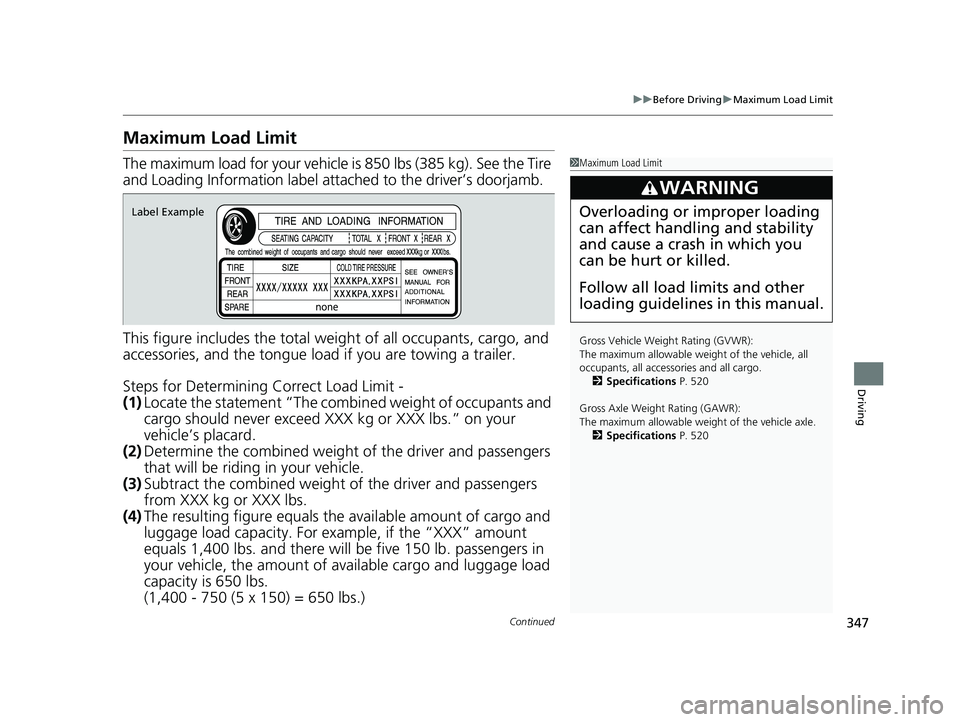
The maximum load for your vehicle is 850 lbs (385 kg). See the Tire
and Loading Information label atta ched to the driver’s doorjamb.
This figure includes the total weig ht of all occupants, cargo, and
accessories, and the tongue load if you are towing a trailer.
Steps for Determining Correct Load Limit -
(1) Locate the statement “The comb ined weight of occupants and
cargo should never exceed XXX kg or XXX lbs.” on your
vehicle’s placard.
(2) Determine the combined weight of the driver and passengers
that will be riding in your vehicle.
(3) Subtract the combined weight of the driver and passengers
from XXX kg or XXX lbs.
(4) The resulting figure equals the available amount of cargo and
luggage load capacity. For example, if the “XXX” amount
equals 1,400 lbs. and there will be five 150 lb. passengers in
your vehicle, the am ount of available cargo and luggage load
capacity is 650 lbs.
(1,400 - 750 (5 x 150) = 650 lbs.)1 Maximum Load Limit
Gross Vehicle Weight Rating (GVWR):
The maximum allowable weight of the vehicle, all
occupants, all accesso ries and all cargo.
2 Specifications P. 520
Gross Axle Weight Rating (GAWR):
The maximum allowable weight of the vehicle axle. 2 Specifications P. 520
3WARNING
Overloading or improper loading
can affect handling and stability
and cause a crash in which you
can be hurt or killed.
Follow all load limits and other
loading guidelines in this manual.Label Example
17 CLARITY BEV CSS-31TRV6000.book 347 ページ 2017年4月14日 金曜日 午前11 時8分
Page 350 of 543
348
uuBefore Driving uMaximum Load Limit
Driving
(5) Determine the combined weight of luggage and cargo being
loaded on the vehicle. That we ight may not safely exceed the
available cargo and luggage load capacity calculated in step 4.
(6) If your vehicle will be towing a tra iler, load from your trailer will
be transferred to your vehicl e. Consult this manual to
determine how this reduces the available cargo and luggage
load capacity of your vehicle.
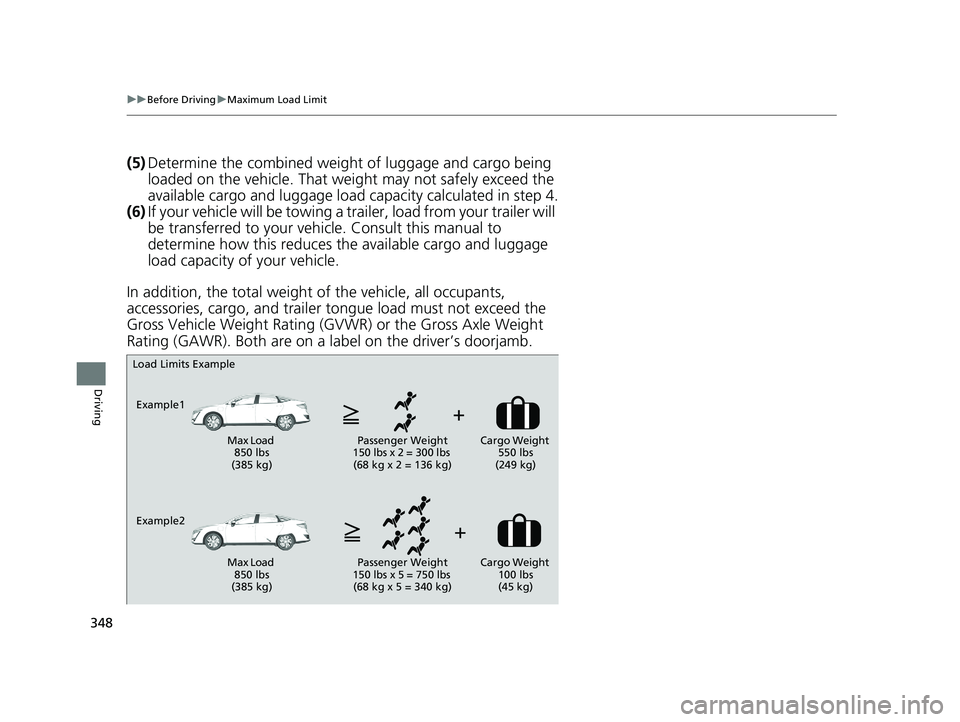
In addition, the total weight of the vehicle, all occupants,
accessories, cargo, and trailer tongue load must not exceed the
Gross Vehicle Weight Rating (GVW R) or the Gross Axle Weight
Rating (GAWR). Both are on a label on the driver’s doorjamb.
Load Limits Example
Example1 Max Load 850 lbs
(385 kg) Passenger Weight
150 lbs x 2 = 300 lbs (68 kg x 2 = 136 kg) Cargo Weight
550 lbs
(249 kg)
Example2 Max Load 850 lbs
(385 kg) Passenger Weight
150 lbs x 5 = 750 lbs (68 kg x 5 = 340 kg) Cargo Weight
100 lbs
(45 kg)
17 CLARITY BEV CSS-31TRV6000.book 348 ページ 2017年4月14日 金曜日 午前11 時8分
Page 351 of 543
349
Driving
Towing a Trailer
Your vehicle is not designed to tow a trailer. Attempting to do so can void your
warranties.
Towing Your Vehicle
Your vehicle is not designed to be towed behind a motor home. If your vehicle needs
to be towed in an emergency, refer to the emergency towing information.
2Emergency Towing P. 515
17 CLARITY BEV CSS-31TRV6000.book 349 ページ 2017年4月14日 金曜日 午前11 時8分