2017 FORD SUPER DUTY heating
[x] Cancel search: heatingPage 342 of 636
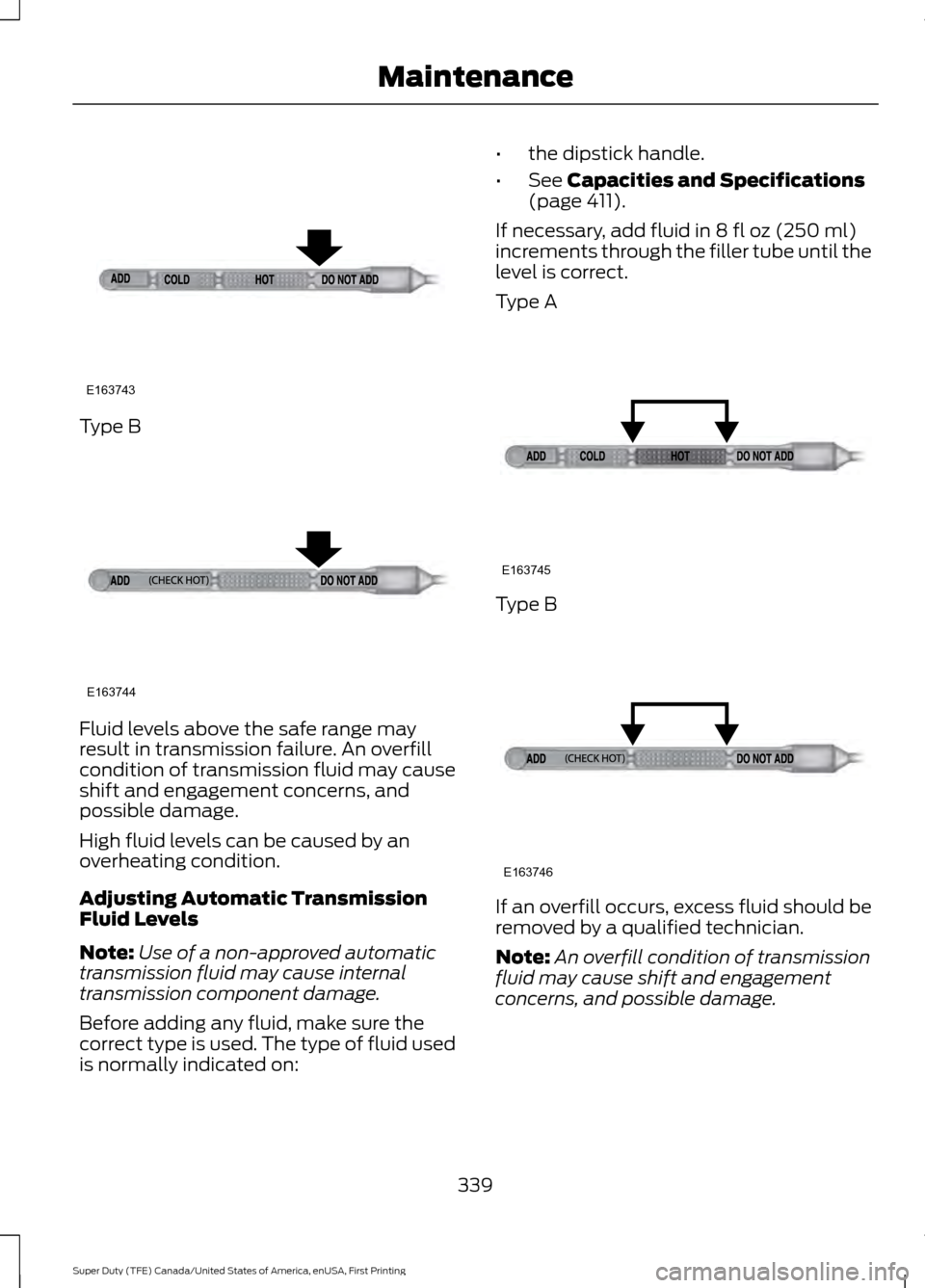
Type B
Fluid levels above the safe range may
result in transmission failure. An overfill
condition of transmission fluid may cause
shift and engagement concerns, and
possible damage.
High fluid levels can be caused by an
overheating condition.
Adjusting Automatic Transmission
Fluid Levels
Note:
Use of a non-approved automatic
transmission fluid may cause internal
transmission component damage.
Before adding any fluid, make sure the
correct type is used. The type of fluid used
is normally indicated on: •
the dipstick handle.
• See Capacities and Specifications
(page 411).
If necessary, add fluid in
8 fl oz (250 ml)
increments through the filler tube until the
level is correct.
Type A Type B
If an overfill occurs, excess fluid should be
removed by a qualified technician.
Note:
An overfill condition of transmission
fluid may cause shift and engagement
concerns, and possible damage.
339
Super Duty (TFE) Canada/United States of America, enUSA, First Printing MaintenanceE163743 E163744 E163745 E163746
Page 519 of 636
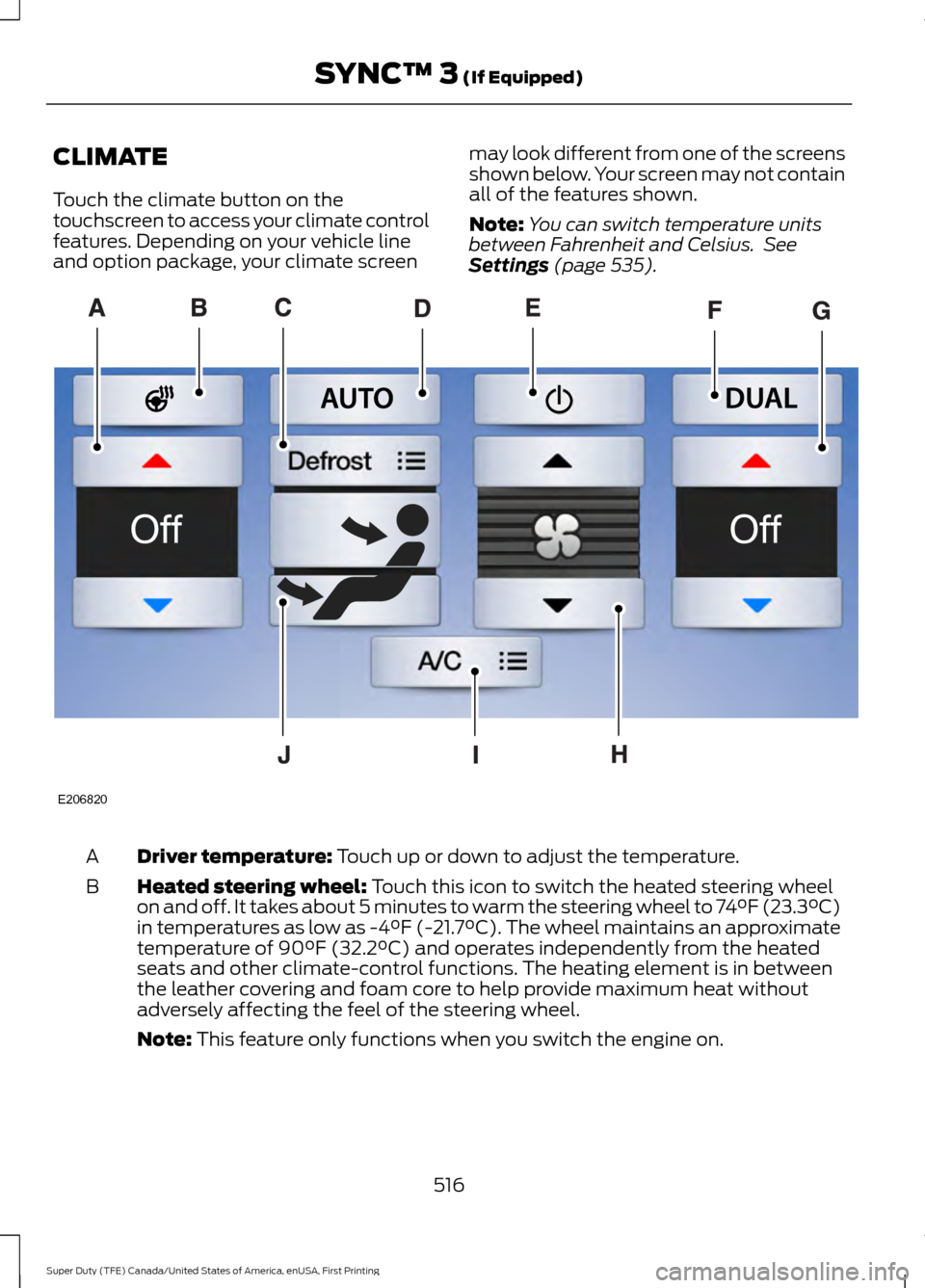
CLIMATE
Touch the climate button on the
touchscreen to access your climate control
features. Depending on your vehicle line
and option package, your climate screen
may look different from one of the screens
shown below. Your screen may not contain
all of the features shown.
Note:
You can switch temperature units
between Fahrenheit and Celsius. See
Settings (page 535). Driver temperature:
Touch up or down to adjust the temperature.
A
Heated steering wheel:
Touch this icon to switch the heated steering wheel
on and off. It takes about 5 minutes to warm the steering wheel to 74°F (23.3°C)
in temperatures as low as -4°F (-21.7°C). The wheel maintains an approximate
temperature of 90°F (32.2°C) and operates independently from the heated
seats and other climate-control functions. The heating element is in between
the leather covering and foam core to help provide maximum heat without
adversely affecting the feel of the steering wheel.
B
Note:
This feature only functions when you switch the engine on. 516
Super Duty (TFE) Canada/United States of America, enUSA, First Printing SYNC™ 3
(If Equipped)E206820
Page 520 of 636
Note: The heated steering wheel may remain on after remote starting the
vehicle, based on your remote start settings. The heated steering wheel may
also turn on when you start your vehicle, if it was on when you switched your
vehicle off.
Note:
For steering wheels with wood trim, the heating feature will not heat the
wheel between the 10 and 2 o'clock positions.
Defrost:
A pop up appears on the screen to display the defrost options.
C
MAX Defrost: Touch the button to maximize defrosting. Air flows through the
windshield vents, the fan automatically adjusts to the highest speed and the
driver and passenger temperatures are set to HI. You can use this setting to
defog or clear a thin covering of ice from the windshield. The heated rear window
also automatically turns on when you select MAX Defrost.
Defrost:
Distributes air through the windshield defroster vents and demister
vents.
AUTO:
Touch the button to switch on automatic operation. Select the desired
temperature using the temperature control. The system adjusts fan speed, air
distribution, air conditioning operation, and selects outside air or recirculated
air to heat or cool the vehicle in order to maintain the desired temperature.
D
Power:
Touch the button to switch the system on and off. Switching off the
climate control system prevents outside air from entering the vehicle.
E
DUAL:
This button lights up when the passenger controls are active. To switch
it off and link the passenger temperature to the driver temperature, touch the
DUAL button.
F
Note:
the passenger side temperature and the DUAL indication automatically
turn on when you or your passenger adjust the passenger temperature.
Passenger temperature:
Touch up or down to adjust the temperature.
G
Fan speed:
Touch up or down to increase or decrease the volume of air that
circulates in your vehicle.
H
Note:
You cannot adjust the fan speed when the system is set to AUTO or MAX
A/C.
A/C:
A pop-up appears on the screen to display the air conditioning options.
I
MAX A/C: Touch the button to activate and maximize cooling. The driver and
passenger temperatures are set to LO, recirculated air flows through the
instrument panel vents, air conditioning automatically turns on and the fan
automatically adjusts to the highest speed.
A/C:
Touch to switch the air conditioning on or off. Use A/C with recirculated
air to improve cooling performance and efficiency.
Note:
In certain conditions (for example, Max Defrost), the air conditioning
compressor may continue to operate even when you switch the air conditioning
A/C button off.
517
Super Duty (TFE) Canada/United States of America, enUSA, First Printing SYNC™ 3
(If Equipped)
Page 571 of 636
Ford Motor Company has recommended
maintenance intervals for various parts
and component systems based upon
engineering testing. Ford Motor Company
relies upon this testing to determine the
most appropriate mileage for replacement
of oils and fluids to protect your vehicle at
the lowest overall cost to you and
recommends against maintenance
schedules that deviate from the scheduled
maintenance information.
We strongly recommend the use of only
genuine Ford, Motorcraft or
Ford-authorized re-manufactured
replacement parts engineered for your
vehicle.
Additives and Chemicals
This owner's manual and the Ford
Workshop Manual list the recommended
additives and chemicals for your vehicle.
We do not recommend using chemicals or
additives not approved by us as part of
your vehicle
’s normal maintenance. Please
consult your warranty information. Oils, Fluids and Flushing
In many cases, fluid discoloration is a
normal operating characteristic and, by
itself, does not necessarily indicate a
concern or that the fluid needs to be
changed. However, a qualified expert, such
as the factory-trained technicians at your
dealership, should inspect discolored fluids
that also show signs of overheating or
foreign material contamination
immediately.
Make sure to change your vehicle
’s oils and
fluids at the specified intervals or in
conjunction with a repair. Flushing is a
viable way to change fluid for many vehicle
sub-systems during scheduled
maintenance. It is critical that systems are
flushed only with new fluid that is the same
as that required to fill and operate the
system or using a Ford-approved flushing
chemical.
Owner Checks and Services
Make sure you perform the following basic
maintenance checks and inspections every
month or at six-month intervals. Check every month
Air filter restriction gauge.
Fuel and water separator. Drain if necessary (or if indicated by the information display). Tires (including spare) for wear and proper pressure.
Holes and slots in the tail pipe to make sure they are functional and clear of debris.
568
Super Duty (TFE) Canada/United States of America, enUSA, First Printing Scheduled Maintenance
Page 577 of 636
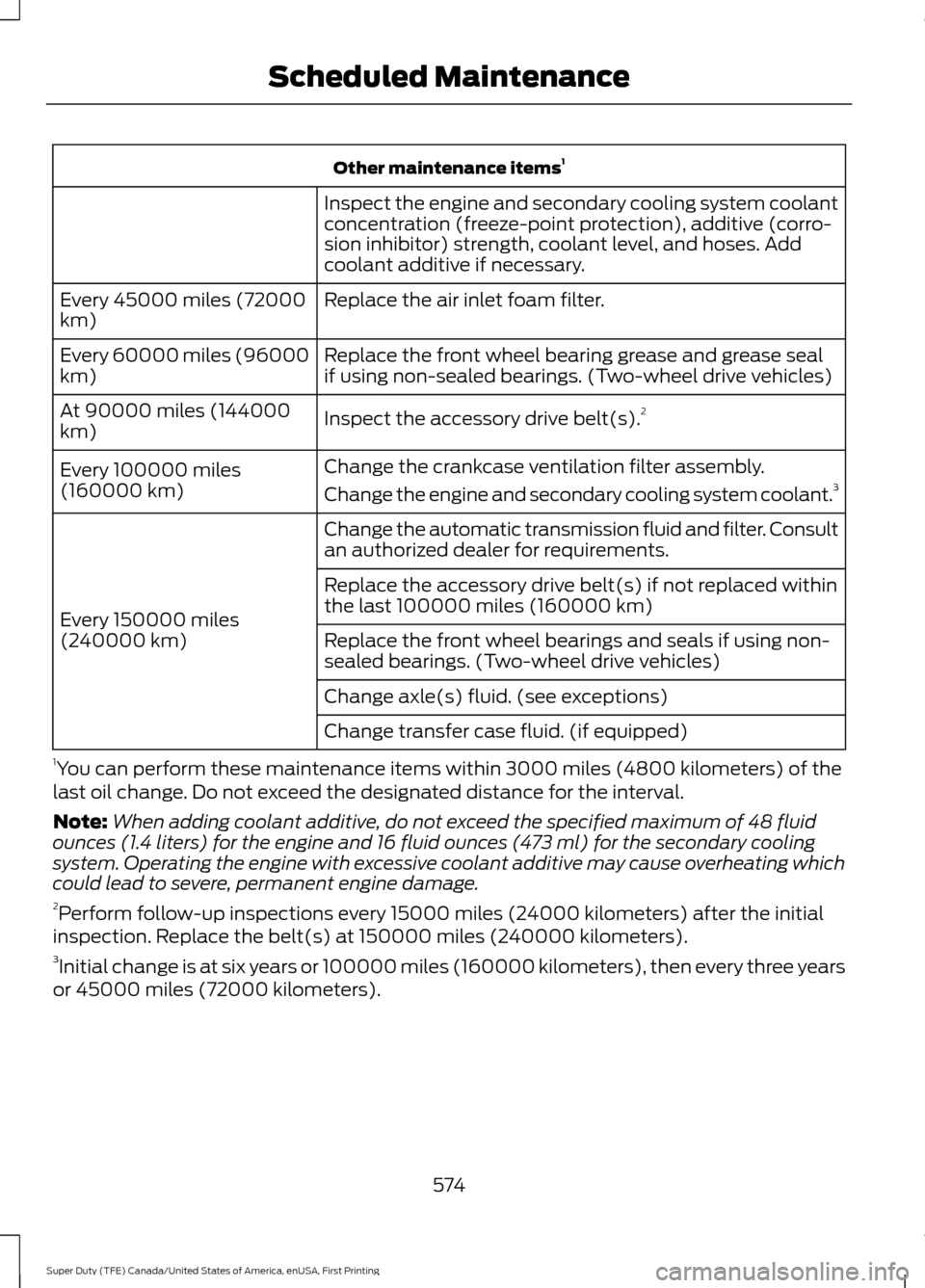
Other maintenance items
1
Inspect the engine and secondary cooling system coolant
concentration (freeze-point protection), additive (corro-
sion inhibitor) strength, coolant level, and hoses. Add
coolant additive if necessary.
Replace the air inlet foam filter.
Every 45000 miles (72000
km)
Replace the front wheel bearing grease and grease seal
if using non-sealed bearings. (Two-wheel drive vehicles)
Every 60000 miles (96000
km)
Inspect the accessory drive belt(s). 2
At 90000 miles (144000
km)
Change the crankcase ventilation filter assembly.
Every 100000 miles
(160000 km) Change the engine and secondary cooling system coolant. 3
Change the automatic transmission fluid and filter. Consult
an authorized dealer for requirements.
Every 150000 miles
(240000 km) Replace the accessory drive belt(s) if not replaced within
the last 100000 miles (160000 km)
Replace the front wheel bearings and seals if using non-
sealed bearings. (Two-wheel drive vehicles)
Change axle(s) fluid. (see exceptions)
Change transfer case fluid. (if equipped)
1 You can perform these maintenance items within 3000 miles (4800 kilometers) of the
last oil change. Do not exceed the designated distance for the interval.
Note: When adding coolant additive, do not exceed the specified maximum of 48 fluid
ounces (1.4 liters) for the engine and 16 fluid ounces (473 ml) for the secondary cooling
system. Operating the engine with excessive coolant additive may cause overheating which
could lead to severe, permanent engine damage.
2 Perform follow-up inspections every 15000 miles (24000 kilometers) after the initial
inspection. Replace the belt(s) at 150000 miles (240000 kilometers).
3 Initial change is at six years or 100000 miles (160000 kilometers), then every three years
or 45000 miles (72000 kilometers).
574
Super Duty (TFE) Canada/United States of America, enUSA, First Printing Scheduled Maintenance
Page 581 of 636
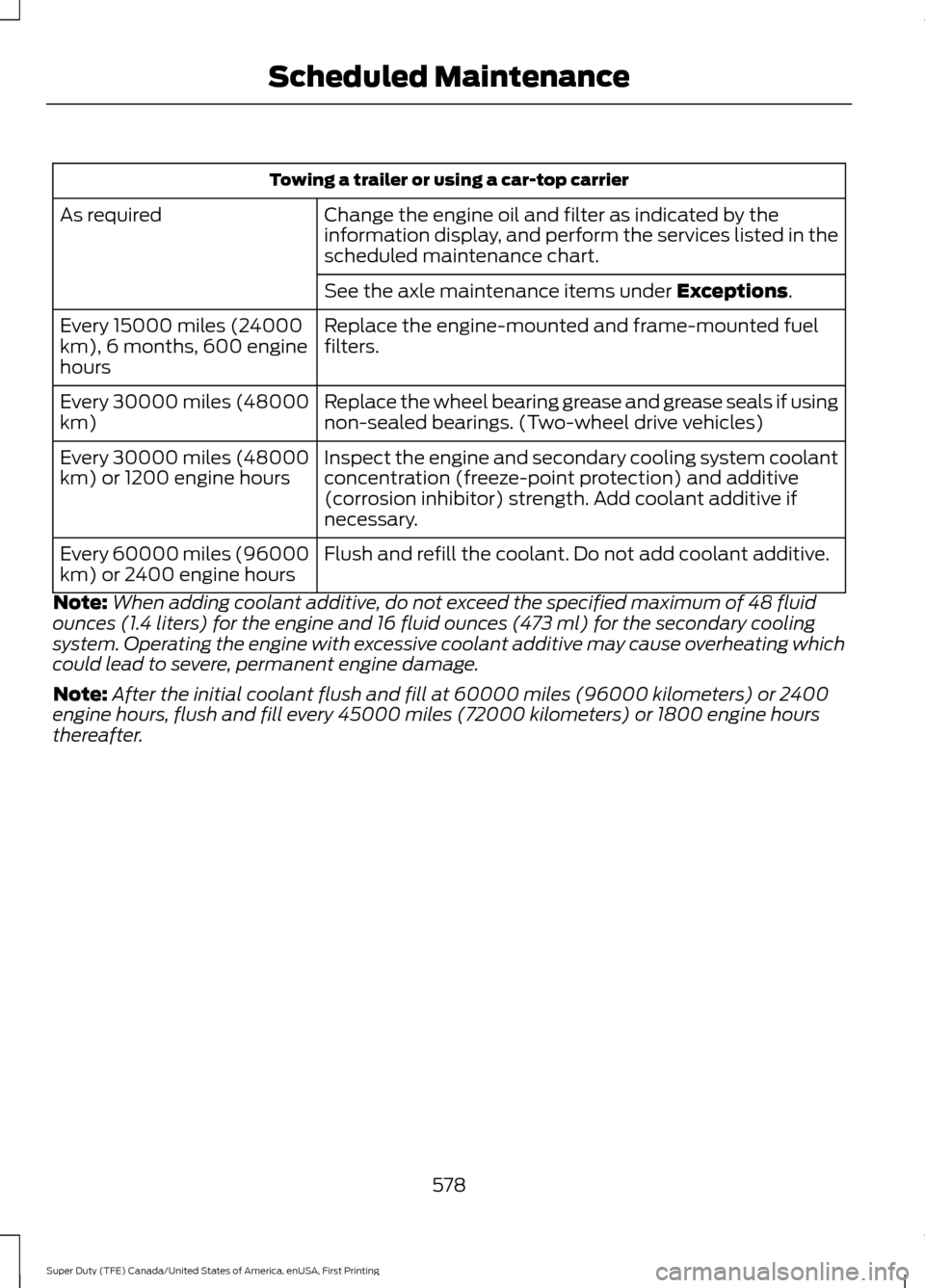
Towing a trailer or using a car-top carrier
Change the engine oil and filter as indicated by the
information display, and perform the services listed in the
scheduled maintenance chart.
As required
See the axle maintenance items under Exceptions.
Replace the engine-mounted and frame-mounted fuel
filters.
Every 15000 miles (24000
km), 6 months, 600 engine
hours
Replace the wheel bearing grease and grease seals if using
non-sealed bearings. (Two-wheel drive vehicles)
Every 30000 miles (48000
km)
Inspect the engine and secondary cooling system coolant
concentration (freeze-point protection) and additive
(corrosion inhibitor) strength. Add coolant additive if
necessary.
Every 30000 miles (48000
km) or 1200 engine hours
Flush and refill the coolant. Do not add coolant additive.
Every 60000 miles (96000
km) or 2400 engine hours
Note: When adding coolant additive, do not exceed the specified maximum of 48 fluid
ounces (1.4 liters) for the engine and 16 fluid ounces (473 ml) for the secondary cooling
system. Operating the engine with excessive coolant additive may cause overheating which
could lead to severe, permanent engine damage.
Note: After the initial coolant flush and fill at 60000 miles (96000 kilometers) or 2400
engine hours, flush and fill every 45000 miles (72000 kilometers) or 1800 engine hours
thereafter.
578
Super Duty (TFE) Canada/United States of America, enUSA, First Printing Scheduled Maintenance
Page 582 of 636
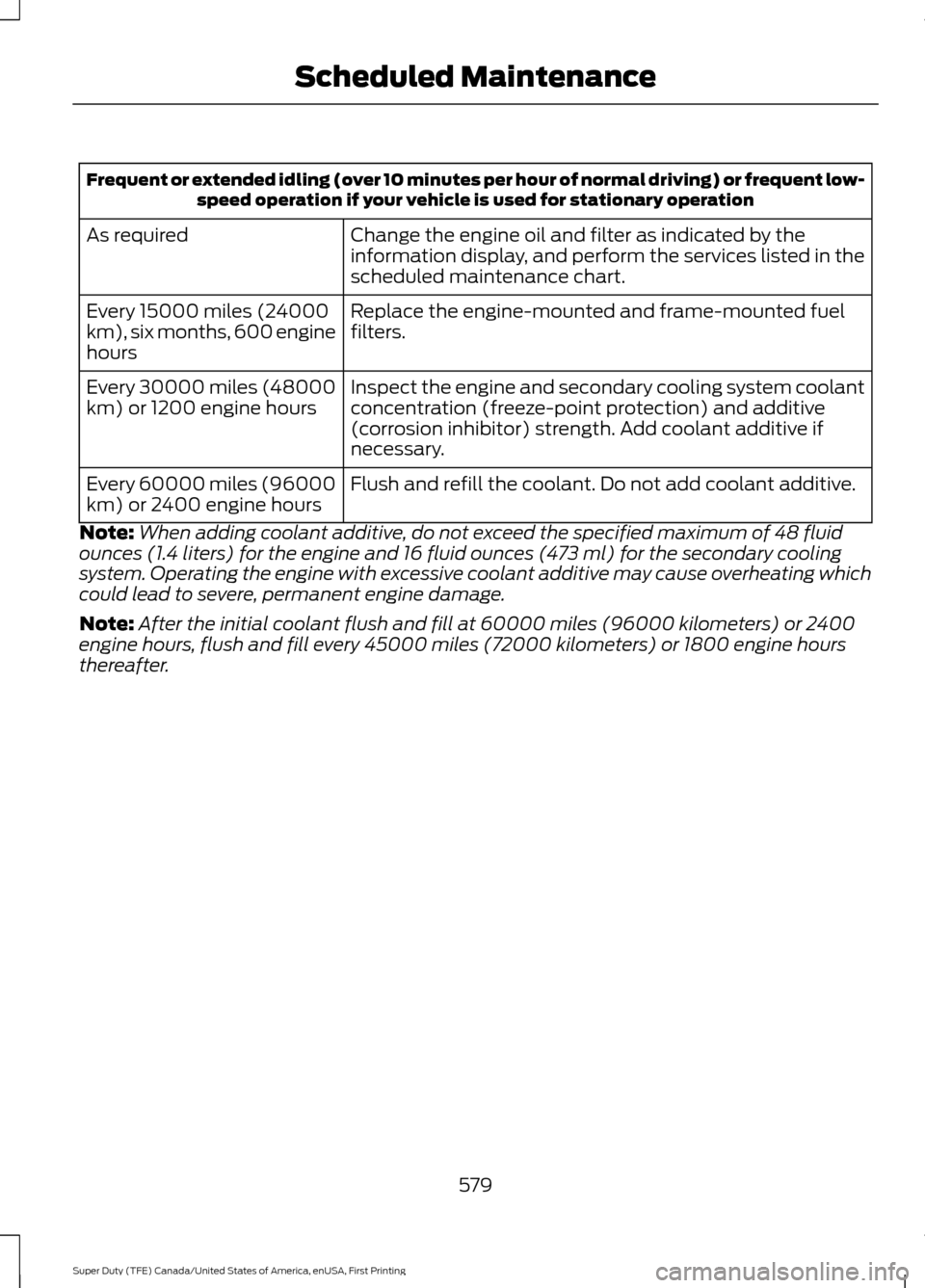
Frequent or extended idling (over 10 minutes per hour of normal driving) or frequent low-
speed operation if your vehicle is used for stationary operation
Change the engine oil and filter as indicated by the
information display, and perform the services listed in the
scheduled maintenance chart.
As required
Replace the engine-mounted and frame-mounted fuel
filters.
Every 15000 miles (24000
km), six months, 600 engine
hours
Inspect the engine and secondary cooling system coolant
concentration (freeze-point protection) and additive
(corrosion inhibitor) strength. Add coolant additive if
necessary.
Every 30000 miles (48000
km) or 1200 engine hours
Flush and refill the coolant. Do not add coolant additive.
Every 60000 miles (96000
km) or 2400 engine hours
Note: When adding coolant additive, do not exceed the specified maximum of 48 fluid
ounces (1.4 liters) for the engine and 16 fluid ounces (473 ml) for the secondary cooling
system. Operating the engine with excessive coolant additive may cause overheating which
could lead to severe, permanent engine damage.
Note: After the initial coolant flush and fill at 60000 miles (96000 kilometers) or 2400
engine hours, flush and fill every 45000 miles (72000 kilometers) or 1800 engine hours
thereafter.
579
Super Duty (TFE) Canada/United States of America, enUSA, First Printing Scheduled Maintenance
Page 583 of 636
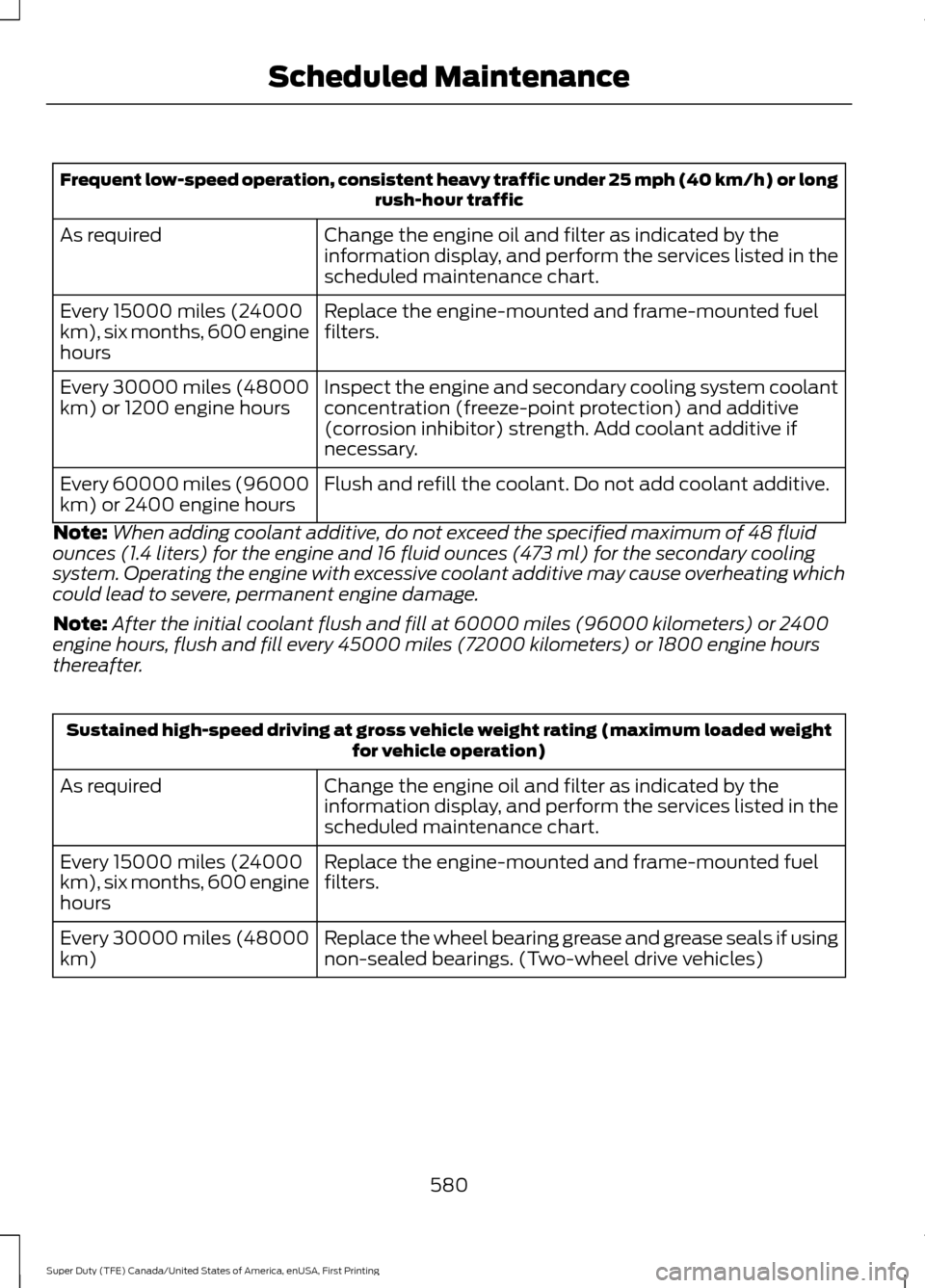
Frequent low-speed operation, consistent heavy traffic under 25 mph (40 km/h) or long
rush-hour traffic
Change the engine oil and filter as indicated by the
information display, and perform the services listed in the
scheduled maintenance chart.
As required
Replace the engine-mounted and frame-mounted fuel
filters.
Every 15000 miles (24000
km), six months, 600 engine
hours
Inspect the engine and secondary cooling system coolant
concentration (freeze-point protection) and additive
(corrosion inhibitor) strength. Add coolant additive if
necessary.
Every 30000 miles (48000
km) or 1200 engine hours
Flush and refill the coolant. Do not add coolant additive.
Every 60000 miles (96000
km) or 2400 engine hours
Note: When adding coolant additive, do not exceed the specified maximum of 48 fluid
ounces (1.4 liters) for the engine and 16 fluid ounces (473 ml) for the secondary cooling
system. Operating the engine with excessive coolant additive may cause overheating which
could lead to severe, permanent engine damage.
Note: After the initial coolant flush and fill at 60000 miles (96000 kilometers) or 2400
engine hours, flush and fill every 45000 miles (72000 kilometers) or 1800 engine hours
thereafter. Sustained high-speed driving at gross vehicle weight rating (maximum loaded weight
for vehicle operation)
Change the engine oil and filter as indicated by the
information display, and perform the services listed in the
scheduled maintenance chart.
As required
Replace the engine-mounted and frame-mounted fuel
filters.
Every 15000 miles (24000
km), six months, 600 engine
hours
Replace the wheel bearing grease and grease seals if using
non-sealed bearings. (Two-wheel drive vehicles)
Every 30000 miles (48000
km)
580
Super Duty (TFE) Canada/United States of America, enUSA, First Printing Scheduled Maintenance