2017 FIAT TIPO 5DOORS STATION WAGON Trailer
[x] Cancel search: TrailerPage 126 of 264

Detection distances
If several obstacles are detected by the
sensors, only the nearest one is
considered.
Indication on display
The indications regarding the Park
Assist system are shown only if the
"Acoustic signal and display" item in the
"Settings" menu of theUconnect™ 5"
or7" HDsystem (where provided) was
previously selected (for more
information, see the description in the
dedicated chapter).
The system indicates the presence of
an obstacle by displaying a single arc in
one of the possible areas, in
accordance with the distance of the
object and the position in relation to the
vehicle. If the obstacle is detected in the
rear central area, a single arc will be
displayed as the obstacle approaches,
first constant, then flashing, in addition
to an acoustic signal.
FAULT INDICATION
Parking sensor faults, if any, will be
indicated when reverse is engaged by
the switching on of the
symbol on
the instrument panel together with the
message on the display (see
description in the "Warning lights and
messages" paragraph, "Knowing the
instrument panel" chapter).
OPERATION WITH A
TRAILER
The operation of the sensors is
automatically deactivated when the
trailer's electrical connection is inserted
in the vehicle's tow hook socket.
Sensors are reactivated on removing
the trailer's electrical connection.
IMPORTANT NOTES
When parking, take the utmost care
over obstacles that may be above or
under the sensor. Objects close to the
vehicle are not detected under certain
circumstances and could therefore
cause damage to the vehicle or be
damaged.
Some conditions may influence the
performance of the parking system:
reduced sensor sensitivity and a
reduction in the parking assistance
system performance could be due to
the presence of: ice, snow, mud, paint,
etc. on the surface of the sensor;
the sensor may detect a
non-existent obstacle ("echo
interference") due to mechanical
interference, for example when washing
the vehicle, in rain (strong wind), hail;
the signals sent by the sensor can
also be altered by the presence of
ultrasonic systems (e.g. pneumatic
brake systems of trucks or pneumatic
drills) near the vehicle;
parking assistance system
performance can also be influenced by
the position of the sensors, for example
due to a change in the ride setting
(caused by wear to the shock
absorbers, suspension), or by changing
tyres, overloading the vehicle or fitting
specific trims that require the vehicle to
be lowered;
the presence of a tow hook without
trailer, which may interfere with the
correct operation of the parking
sensors;
the presence of adhesives on the
sensors. Therefore, take care not to
place adhesives on the sensors.
WARNING
123)Parking and other potentially
dangerous manoeuvres are, however,
always the driver’s responsibility. When
performing these operations, always make
sure that there are no other people
(especially children) or animals on the route
you want to take. The parking sensors are
an aid for the driver, but the driver must
never allow their attention to lapse during
potentially dangerous manoeuvres, even
those executed at low speeds.
124
STARTING AND DRIVING
Page 129 of 264

IMPORTANT NOTES
IMPORTANT In some circumstances,
such as with ice, snow or mud on the
surface of the camera, the camera
sensitivity may be reduced.
IMPORTANT When parking, take the
utmost care over obstacles that may be
above or under the camera range.
WARNING
124)Parking and other potentially
dangerous manoeuvres are, however,
always the driver’s responsibility. While
carrying out these manoeuvres, always
make sure that no people (especially
children) or animals are in the area
concerned. The camera is an aid for the
driver, but the driver must never allow
his/her attention to lapse during potentially
dangerous manoeuvres, even those
executed at low speeds. Always keep a
slow speed, so as to promptly brake in the
case of obstacles.
IMPORTANT
53)It is vital, for correct operation, that the
camera is always kept clean and free from
any mud, dirt, snow or ice. Be careful not
to scratch or damage the camera while
cleaning it. Avoid using dry, rough or hard
cloths. The camera must be washed using
clean water, with the addition of car
shampoo if necessary. In washing stations
which use steam or high-pressure jets,
clean the camera quickly, keeping the
nozzle more than 10 cm away from the
sensors. Also, do not apply stickers to the
camera.
TOWING TRAILERS
IMPORTANT NOTES
125) 126)
For towing caravans or trailers the
vehicle must be fitted with an approved
tow hook and an adequate electrical
system. Should aftermarket installation
be requested, this must be carried out
by specialists.
Install any specific and/or additional
door mirrors as specified by the
Highway Code.
Remember that, when towing a trailer,
steep hills are harder to climb, braking
distances increase and overtaking takes
longer depending on the overall weight
of the trailer.
Engage a low gear when driving
downhill, rather than constantly using
the brake.
The weight the trailer exerts on the
vehicle tow hook reduces the vehicle's
loading capacity by the same amount.
To make sure that the maximum
towable weight is not exceeded (given
in the vehicle registration document)
account should be taken of the fully
laden trailer, including accessories and
luggage.
127
Page 130 of 264

Do not exceed the speed limits specific
to each country you are driving in, in the
case of vehicles towing trailers. In any
case, the top speed must not exceed
100 km/h.
Any electric brake must be powered
directly by the battery through a cable
with a cross-section of no less than
2.5 mm
2.
In addition to the electrical branches,
the vehicle electrical system can only be
connected to the supply cable for an
electric brake and to the cable for an
internal light for the trailer, not
exceeding 15 W. For connections, use
the preset control unit with a battery
cable with section not less than 2.5 mm
2.
IMPORTANT The use of auxiliary loads
other than external lights (e.g. electric
brake) must take place with engine
running.
INSTALLING A TOW
HOOK
To install a tow hook contact a Fiat
Dealership.
WARNING
125)The ABS with which the car is
equipped will not control the braking
system of the trailer. Particular caution is
required on slippery roads.
126)Never modify the braking system of
the vehicle to control the trailer brake. The
trailer braking system must be fully
independent of the car’s hydraulic system.
REFUELLING THE
VEHICLE
127) 128) 129)
Before refuelling, make sure that the
fuel type is correct.
Also stop the engine before refuelling.
PETROL ENGINES
Only use 95 R.O.N. unleaded petrol (EN
228 specifications).
DIESEL ENGINES
54)
Only use Diesel for motor vehicles
(EN590 specification).
When using or parking the vehicle for a
long time in the mountains or cold
areas, it is advisable to refuel using
locally available Diesel. In this case, it is
also advisable to keep the tank over
50% full.
REFUELLING CAPACITY
To ensure that you fill the tank
completely, top up twice after the first
click of the fuel supply gun.
Further top-ups could cause faults in
the fuel feeding system.
128
STARTING AND DRIVING
Page 161 of 264
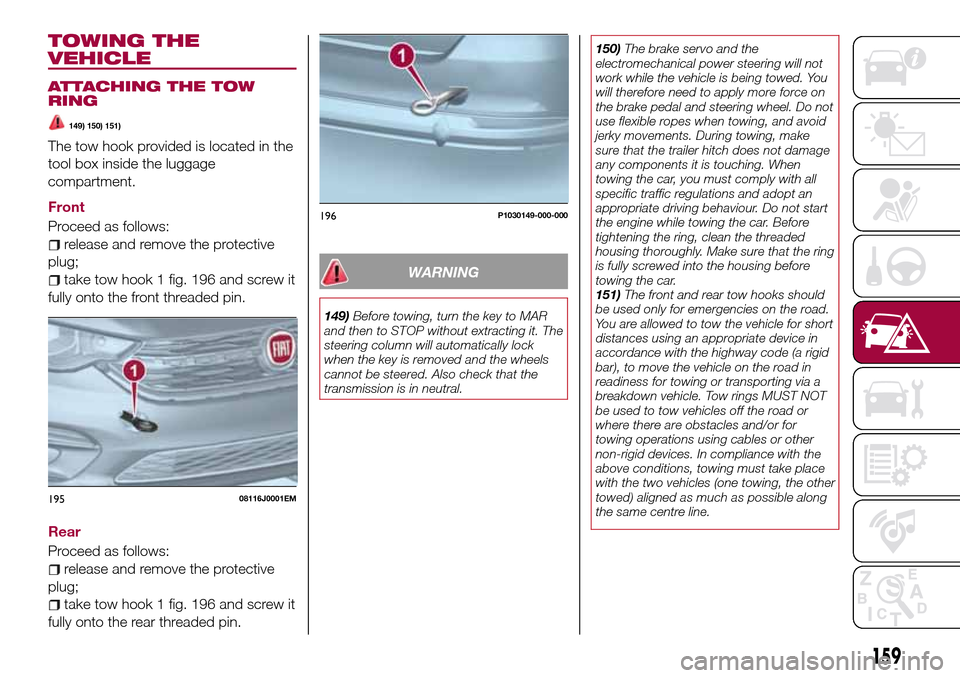
TOWING THE
VEHICLE
ATTACHING THE TOW
RING
149) 150) 151)
The tow hook provided is located in the
tool box inside the luggage
compartment.
Front
Proceed as follows:
release and remove the protective
plug;
take tow hook 1 fig. 196 and screw it
fully onto the front threaded pin.
Rear
Proceed as follows:
release and remove the protective
plug;
take tow hook 1 fig. 196 and screw it
fully onto the rear threaded pin.
WARNING
149)Before towing, turn the key to MAR
and then to STOP without extracting it. The
steering column will automatically lock
when the key is removed and the wheels
cannot be steered. Also check that the
transmission is in neutral.150)The brake servo and the
electromechanical power steering will not
work while the vehicle is being towed. You
will therefore need to apply more force on
the brake pedal and steering wheel. Do not
use flexible ropes when towing, and avoid
jerky movements. During towing, make
sure that the trailer hitch does not damage
any components it is touching. When
towing the car, you must comply with all
specific traffic regulations and adopt an
appropriate driving behaviour. Do not start
the engine while towing the car. Before
tightening the ring, clean the threaded
housing thoroughly. Make sure that the ring
is fully screwed into the housing before
towing the car.
151)The front and rear tow hooks should
be used only for emergencies on the road.
You are allowed to tow the vehicle for short
distances using an appropriate device in
accordance with the highway code (a rigid
bar), to move the vehicle on the road in
readiness for towing or transporting via a
breakdown vehicle. Tow rings MUST NOT
be used to tow vehicles off the road or
where there are obstacles and/or for
towing operations using cables or other
non-rigid devices. In compliance with the
above conditions, towing must take place
with the two vehicles (one towing, the other
towed) aligned as much as possible along
the same centre line.
19508116J0001EM
196P1030149-000-000
159
Page 199 of 264
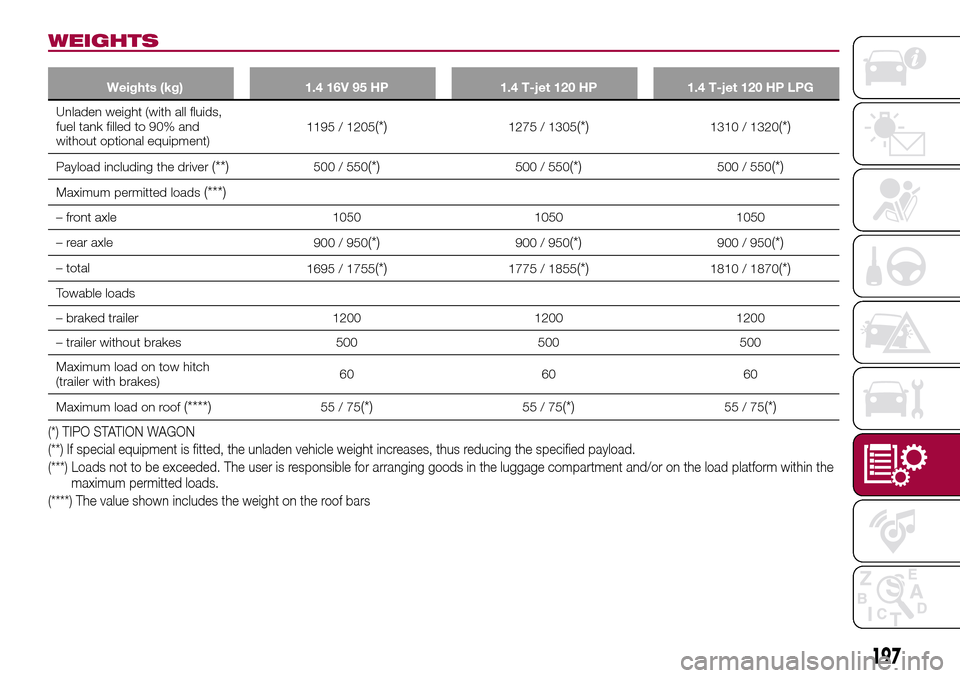
WEIGHTS
Weights (kg) 1.4 16V 95 HP 1.4 T-jet 120 HP 1.4 T-jet 120 HP LPG
Unladen weight (with all fluids,
fuel tank filled to 90% and
without optional equipment)1195 / 1205(*)1275 / 1305(*)1310 / 1320(*)
Payload including the driver(**)500 / 550(*)500 / 550(*)500 / 550(*)
Maximum permitted loads(***)
– front axle 1050 1050 1050
– rear axle
900 / 950
(*)900 / 950(*)900 / 950(*)
– total
1695 / 1755(*)1775 / 1855(*)1810 / 1870(*)
Towable loads
– braked trailer 1200 1200 1200
– trailer without brakes 500 500 500
Maximum load on tow hitch
(trailer with brakes)60 60 60
Maximum load on roof
(****)55/75(*)55/75(*)55/75(*)
(*) TIPO STATION WAGON
(**) If special equipment is fitted, the unladen vehicle weight increases, thus reducing the specified payload.
(***) Loads not to be exceeded. The user is responsible for arranging goods in the luggage compartment and/or on the load platform within the
maximum permitted loads.
(****) The value shown includes the weight on the roof bars
197
Page 200 of 264

Weights (kg) 1.3 MultiJet 95 HP 1.6 Multijet 120 HP
Unladen weight (with all fluids, fuel tank filled
to 90% and without optional equipment)1290 / 1300(*)1295 / 1320(*)
Payload including the driver(**)500 / 550(*)500 / 550(*)
Maximum permitted loads(***)
– front axle 1050 1050
– rear axle
900 / 950
(*)900 / 950(*)
– total
1790 / 1850(*)1795 / 1870(*)
Towable loads
– braked trailer 1200 1200
– trailer without brakes 500 500
Maximum load on tow hitch (trailer with
brakes)60 60
Maximum load on roof
(****)55/75(*)55/75(*)
(*) TIPO STATION WAGON
(**) If special equipment is fitted, the unladen vehicle weight increases, thus reducing the specified payload.
(***) Loads not to be exceeded. The user is responsible for arranging goods in the luggage compartment and/or on the load platform within the
maximum permitted loads.
(****) The value shown includes the weight on the roof bars
198
TECHNICAL DATA
Page 261 of 264
Steering wheel...............21
Steering wheel controls.........237
Stop/Start system............111
TC (system)................74
Technical data..............187
Third brake light (bulb
replacement)..............140
Toolbox...................36
Towing the vehicle............159
Towing trailers..............127
Trip Computer...............58TSC (system)................75
Tyres (inflation pressure)........192
Uconnect 3” Radio...........213
Uconnect 5” LIVE — Uconnect 5”
Nav LIVE................222
Uconnect 7" HD LIVE - Uconnect
7" HD Nav LIVE............234
Use of the Owner Handbook.......3
Using the transmission.........111
Vehicle changes/alterations.......4
Version with LPG system........41
Warning lights and messages.....59
Weights..................197
Wheels...................190
Wheels and tyres.............182
Window bag...............105
Windows (cleaning)...........184
Windscreen wiper
replacing wiper blades.......180
Windscreen/rear window wiper....26