2017 FIAT SPIDER ABARTH air condition
[x] Cancel search: air conditionPage 58 of 292

Sunlight/Temperature
Sensor
The air conditioning system measures
inside and outside temperatures, and
sunlight.
It then sets temperatures inside the
cabin accordingly.
Note: Do not obstruct either sensor.
Otherwise, the air-conditioning system
will not operate properly. POWER WINDOWS Power Window Controls
The ignition must be placed in the ON
position for the power windows to
operate.
A power window may no longer
open/close if you continue to push the
switch after opening/closing the power
window.
If the power window does not
open/close, wait a moment and then
operate the switch again.
Note: To prevent burning out the fuse
and damaging the power window
system, do not open or close both
windows at once.
The passenger window can be
operated with each door switch when
the power window lock switch on the
driver's door is in the unlocked position.
Passenger Control Switches
The passenger window can also be
operated using the master control
switches on the driver's door.06010904333003
Exterior Sensor
1 — Sunlight Sensor 06010904-121-002AB
Interior Sensor
2 — Interior Temperature Sensor
56
GETTING TO KNOW YOUR VEHICLE
Page 95 of 292

Amber Warning Lights Warning Light What It Means
TPMS (Tire Pressure Monitoring System) Warning Light — If Equipped
The warning light switches on and a message is displayed to indicate that the tire pressure is
lower than the recommended value and/or that slow pressure loss is occurring. In these cases,
optimal tire duration and fuel consumption may not be guaranteed.
Should one or more tires be in the condition mentioned above, the display will show the
indications corresponding to each tire in sequence.
Note: Do not continue driving with one or more flat tires as handling may be compromised. Stop the
vehicle, avoiding sharp braking and steering. Repair immediately using the dedicated tire repair
kit and contact your authorized dealer as soon as possible.
Each tire, including the spare (if provided), should be checked monthly when cold and inflated to
the inflation pressure recommended by the vehicle manufacturer on the vehicle placard or tire
inflation pressure label. (If your vehicle has tires of a different size than the size indicated on the
vehicle placard or tire inflation pressure label, you should determine the proper tire inflation
pressure for those tires.)
As an added safety feature, your vehicle has been equipped with a tire pressure monitoring
system (TPMS) that illuminates a low tire pressure telltale when one or more of your tires is
significantly under-inflated. Accordingly, when the low tire pressure telltale illuminates, you should
stop and check your tires as soon as possible, and inflate them to the proper pressure. Driving
on a significantly under-inflated tire causes the tire to overheat and can lead to tire failure.
Under-inflation also reduces fuel efficiency and tire tread life, and may affect the vehicle’s
handling and stopping ability.
Please note that the TPMS is not a substitute for proper tire maintenance, and it is the driver’s
responsibility to maintain correct tire pressure, even if under-inflation has not reached the level to
trigger illumination of the TPMS low tire pressure telltale.
The TPMS malfunction indicator is combined with the low tire pressure telltale. When the system
detects a malfunction, the telltale will flash for approximately one minute and then remain
continuously illuminated. This sequence will continue upon subsequent vehicle start-ups as long
as the malfunction exists. When the malfunction indicator is illuminated, the system may not be
able to detect or signal low tire pressure as intended. TPMS malfunctions may occur for a variety
of reasons, including the installation of replacement or alternate tires or wheels on the vehicle
that prevent the TPMS from functioning properly. Always check the TPMS malfunction telltale
after replacing one or more tires or wheels on your vehicle to ensure that the replacement or
alternate tires and wheels allow the TPMS to continue to function properly.
93
Page 124 of 292

The following regulatory statement
applies to all radio frequency (RF)
devices equipped in this vehicle:
This device complies with Part 15 of the
FCC Rules and with Industry Canada
license-exempt RSS standard(s).
Operation is subject to the following
two conditions:
(1) This device may not cause harmful
interference, and
(2) This device must accept any
interference received, including
interference that may cause undesired
operation.
Note: Changes or modifications not
expressly approved by the party
responsible for compliance could void
the user’s authority to operate the
equipment. OCCUPANT
RESTRAINT
SYSTEMS The most important safety equipment
of the vehicle comprise the following
protection systems:
Seat Belts
SBA (Seat Belt Alert) System
Head Restraints
Child Restraint Systems
Front Air Bags And Side Air Bags
Read the information given in the
following pages with the utmost care.
It is of fundamental importance that the
protection systems are used in the
correct way to guarantee the maximum
possible safety level for the driver and
the passengers. SEAT BELT
SYSTEMS Buckle up even though you are an
excellent driver, even on short trips.
Someone on the road may be a poor
driver and could cause a collision that
includes you. This can happen far away
from home or on your own street.
Research has shown that seat belts
save lives, and they can reduce the
seriousness of injuries in a collision.
Some of the worst injuries happen
when people are thrown from the
vehicle. Seat belts reduce the possibility
of ejection and the risk of injury caused
by striking the inside of the vehicle.
Everyone in a motor vehicle should be
belted at all times.
122
SAFETY
Page 129 of 292

seriously injured in an accident. Only use
the extender provided for you and for the
particular vehicle and seat.
NEVER use the extender in a different
vehicle or seat. If you sell your vehicle, do
not leave your seat belt extender in the
vehicle. It could be used accidentally by the
new owner of the vehicle. After removing
the seat belt extender, discard it. Never use
the seat belt extender in any other vehicle
you may own in the future.
Do not use an extender that is too long.
Using an extender that is too long is
dangerous. The seat belt will not fit
properly. In an accident, the seat belt will
not provide adequate protection and you
could be seriously injured. Do not use the
extender or choose one shorter in length if
the distance between the extender's
buckle and the center of the user's body is
less than 6 inches (15 cm).
Do not leave a seat belt extender
connected to the buckle. Leaving a seat
belt extender connected to the buckle
without using the seat belt is dangerous.
When the seat belt extender is connected
to the driver's seat belt buckle (or
passenger) seat, the SRS driver's (or
passenger's) air bag system will determine
that the driver (or passenger) is wearing the
seat belt even if the driver (or passenger) is
not wearing it. This condition could cause
the driver's (or passenger's) air bag to not
activate correctly and result in death or
serious injury in the event of collision.
Always wear the seat belt with the seat belt
extender.
Do not use the seat belt extender when
installing a child restraint system on the
passenger seat. Using a seat belt extender
to fasten a child restraint system on any
seat is dangerous. Always follow the child restraint system manufacturer's installation
instructions and never use a seat belt
extender.
Driver And Passenger
BeltAlert (If Equipped)
Seat Belt Warning Systems
The LED on dashboard trim turns on if
the driver or passenger's seat is
occupied and the seat belt is not
fastened with the ignition switched ON.
If the driver or passenger's seat belt is
unfastened (only when the passenger
seat is occupied) and the vehicle is
driven at a speed faster than about
12 MPH (20 km/h), the
LED flashes.
After a short time, the LED stops
flashing, but remains illuminated.
If a seat belt remains unfastened, the
LED flashes again for a given period of
time. In this case, fasten the seat belt.
Seat Belt Pretensioner
For optimum protection, the driver and
passenger seat belts are equipped with
pretensioner and load limiting systems.
For both these systems to work
properly you must wear the seat belt
properly.
The seat belt pretensioners are
designed to deploy in moderate or
severe frontal, near frontal collisions. In
addition, during a side collision, the
pretensioner operates on the side in
which the collision occurs. The pretensioners operate differently
depending on what types of air bags
are equipped. For details on the seat
belt pretensioner operation, refer to the
“SRS Air Bag Deployment Criteria”
paragraph in this chapter.
When a collision is detected, the
pretensioners deploy simultaneously with
the air bags. For deployment details, refer
to the “SRS Air Bag Deployment Criteria”
paragraph in this chapter.
The seat belt retractors remove slack
quickly as the air bags are expanding. Any
time the air bags and seat belt
pretensioners have fired they must be
replaced.
With Passenger Occupant
Classification System
In addition, the pretensioner system for
the passenger, like the front and side
passenger Air Bag, is designed to only
deploy when the passenger occupant
classification sensor detects a passenger
sitting on the passenger's seat.
Note:
These devices are not a substitute
for proper seat belt placement by the
occupant. The seat belt still must be
worn snugly and positioned properly.
The pretensioners are triggered by
the Occupant Restraint Controller
(ORC). Like the air bags, the
pretensioners are single use items. A
deployed pretensioner or a deployed
air bag must be replaced immediately.
127
Page 139 of 292

Warning Light/Beep
A system malfunction or operation
conditions are indicated by a warning.
Refer to the beginning paragraph of
“Warning Lights And Messages” in
“Getting To Know Your Instrument
Panel” for further information.
Warning!Ignoring the Air Bag Warning Light in your
instrument panel could mean you won’t
have the air bags to protect you in a
collision. If the light does not come on as a
bulb check when the ignition is first turned
on, stays on after you start the vehicle, or if
it comes on as you drive, have an
authorized dealer service the air bag
system immediately.
Passenger Side Front Air Bag And
Child Restraint Systems
Rearward-facing child restraint systems
must NEVER be fitted on the front seat
with an active passenger side air bag
since in the event of an impact the air
bag activation may cause fatal injuries
to the transported child.
ALWAYS comply with the instructions
on the label stuck on the passenger
side sun visor : A = Mexico market/ B =
U.S.A. and Canada market. Warning!Do not use accessory seat covers or place
objects between you and the Side Air
Bags; the performance could be adversely
affected and/or objects could be pushed
into you, causing serious injury. Warning! Side Air Bags need room to inflate. Do
not lean against the door or window. Sit
upright in the center of the seat.
Being too close to the Side Air Bags
during deployment could cause you to be
severely injured or killed.
Relying on the Side Air Bags alone could
lead to more severe injuries in a collision.
The Side Air Bags work with your seat belt
to restrain you properly. In some collisions,
Side Air Bags won’t deploy at all. Always
wear your seat belt even though you have
Side Air Bags. 03030101-121-001
Sun Visor Air Bag Labels
137
Page 143 of 292

Passenger Occupant
Classification Sensor
Your vehicle is equipped with a
passenger occupant classification
sensor as a part of the supplementary
restraint system. This sensor is
equipped in the passenger's seat
cushion. This sensor measures the
electrostatic capacity of the
passenger's seat.
The SRS unit is designed to prevent the
passenger front and side Air Bags and
seat belt pretensioner system from
deploying if the passenger Air Bag
deactivation indicator light turns on.
To reduce the chance of injuries caused
by deployment of the passenger Air
Bag, the system deactivates the
passenger front and side Air Bags and
also the seat belt pretensioner system
when the passenger Air Bag
deactivation indicator light turns on.
This system shuts off the passenger
front and side Air Bags and seat belt
pretensioner system, so make sure the
passenger Air Bag deactivation
indicator light turns on.
The air bag/seat belt pretensioner
system warning light flashes and the
passenger Air Bag deactivation
indicator light illuminates if the sensors
have a possible malfunction. If this
happens, the passenger front and side
Air Bags and seat belt pretensioner
system will not deploy. Note: If a passenger is seated as
shown in the following figure the
passenger occupant classification
sensor cannot detect a passenger
sitting on the passenger's seat correctly
and the deployment/non-deployment of
the Air Bags cannot be controlled as
indicated in the passenger Air Bag
deactivation indicator light on/off
condition chart.
Warning!If a child restraint system, child, small
teenager or adult in the front passenger
seat is seated improperly, the occupant
may provide an output signal to the
occupant classification sensor that is
different from the occupant’s properly
seated weight input. This may result in
serious injury or death in a collision.
Warning! Ignoring the Air Bag Warning Light in
your instrument panel could mean you
won’t have the air bags to protect you in a
collision. If the light does not come on as a
bulb check when the ignition is first turned
on, stays on after you start the vehicle, or if
it comes on as you drive, have an
authorized dealer service the air bag
system immediately.A
B 03040600-123-001
Side Collision 03040600-124-002
Roll-Over Collision
141
Page 146 of 292

Passenger Air Bag Deactivation Indicator Light On/Off Condition Chart
If the passenger occupant classification sensor is normal, the indicator light turns on when the ignition is switched ON. The light turns
off after a few seconds. Then, the indicator light turns on or is off under the following conditions: Condition Detected By The
Passenger Occupant
Classification System Passenger Air Bag
Deactivation Indicator Light Passenger Front And Side Air
Bags Passenger Seat Belt
Pretensioner System
Empty (Not occupied) On Deactivated Deactivated
A child
is seated in a child
restraint system (*) On Deactivated Deactivated
Adult (**) Off Ready Ready
(*) The occupant classification sensor may not detect a child seated on the seat, in a child restraint system, or a junior seat
depending on the child's physical size and seated posture.
(**) If a smaller adult sits on the passenger seat, the sensors might detect the person as being a child depending on the
person's physique.
If the passenger air bag deactivation indicator light does not turn on when the ignition is switched ON and does not turn on as
indicated in the passenger air bag deactivation indicator light on/off condition chart, do not allow an occupant to sit in the
passenger seat and contact an authorized dealer as soon as possible. The system may not work properly in an accident.
144
SAFETY
Page 164 of 292
RADAR SENSORS —
IF EQUIPPED Rear Radar Sensors
The following systems use the rear
radar sensors:
Blind Spot Monitoring System (BSM)
Rear Cross Traffic Alert (RCTA)
The radar sensors function by detecting
the radio waves reflected off of a vehicle
approaching from the rear, or an
obstruction, sent from the radar sensor.
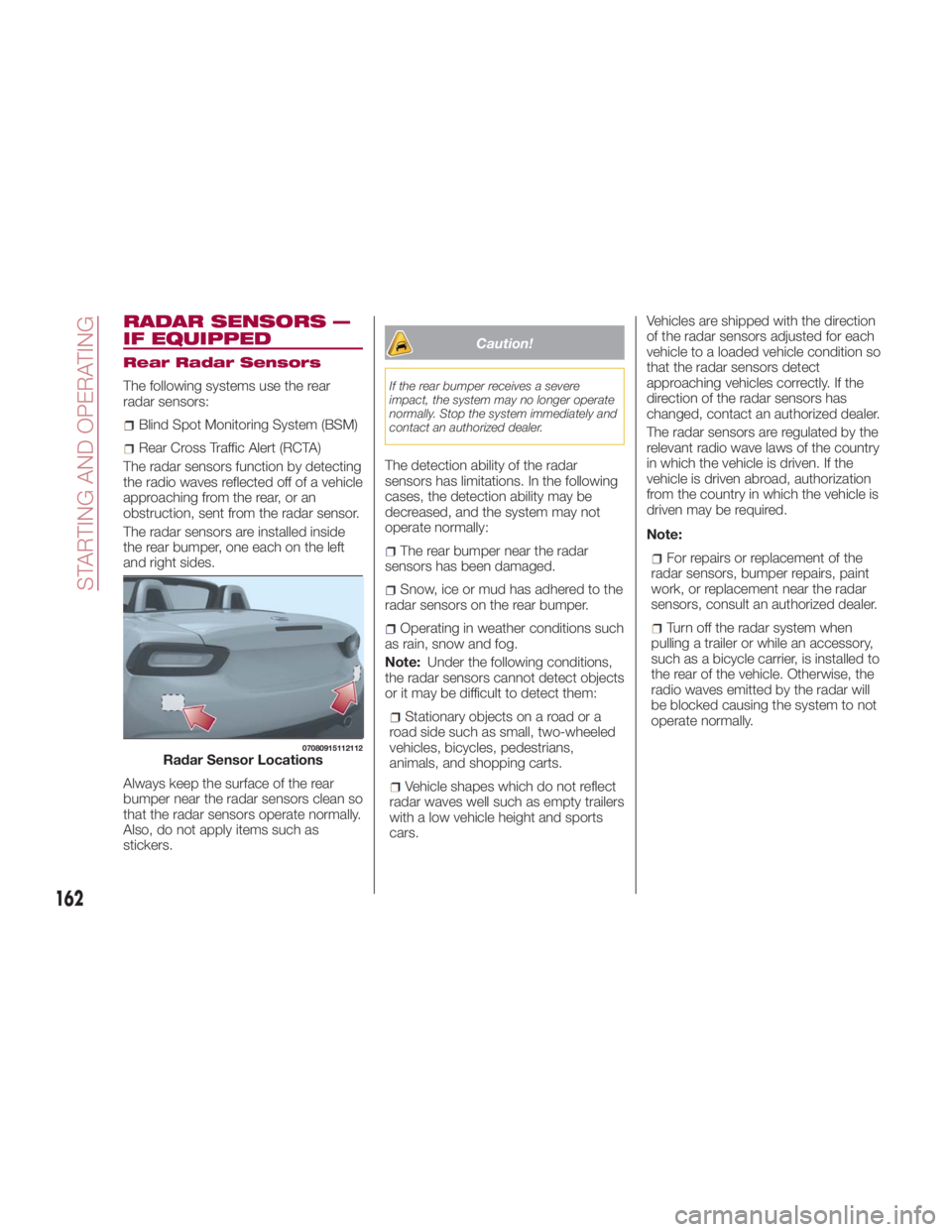
The radar sensors are installed inside
the rear bumper, one each on the left
and right sides.
Always keep the surface of the rear
bumper near the radar sensors clean so
that the radar sensors operate normally.
Also, do not apply items such as
stickers. Caution!If the rear bumper receives a severe
impact, the system may no longer operate
normally. Stop the system immediately and
contact an authorized dealer.
The detection ability of the radar
sensors has limitations. In the following
cases, the detection ability may be
decreased, and the system may not
operate normally:
The rear bumper near the radar
sensors has been damaged.
Snow, ice or mud has adhered to the
radar sensors on the rear bumper.
Operating in weather conditions such
as rain, snow and fog.
Note: Under the following conditions,
the radar sensors cannot detect objects
or it may be difficult to detect them:
Stationary objects on a road or a
road side such as small, two-wheeled
vehicles, bicycles, pedestrians,
animals, and shopping carts.
Vehicle shapes which do not reflect
radar waves well such as empty trailers
with a low vehicle height and sports
cars. Vehicles are shipped with the direction
of the radar sensors adjusted for each
vehicle to a loaded vehicle condition so
that the radar sensors detect
approaching vehicles correctly. If the
direction of the radar sensors has
changed, contact an authorized dealer.
The radar sensors are regulated by the
relevant radio wave laws of the country
in which the vehicle is driven. If the
vehicle is driven abroad, authorization
from the country in which the vehicle is
driven may be required.
Note:
For repairs or replacement of the
radar sensors, bumper repairs, paint
work, or replacement near the radar
sensors, consult an authorized dealer.
Turn off the radar system when
pulling a trailer or while an accessory,
such as a bicycle carrier, is installed to
the rear of the vehicle. Otherwise, the
radio waves emitted by the radar will
be blocked causing the system to not
operate normally.07080915112112
Radar Sensor Locations
162
STARTING AND OPERATING