2017 FIAT SPIDER ABARTH air condition
[x] Cancel search: air conditionPage 165 of 292
REAR PARK ASSIST
— IF EQUIPPED Rear Park Assist
Warning!Do not rely completely on the parking
sensor system and be sure to confirm the
safety around your vehicle visually when
driving. This system can assist the driver in
operating the vehicle in the forward and
backward directions while parking. The
detection ranges of the sensors are limited,
therefore, driving the vehicle while relying
only on the system may cause an accident.
Always confirm the safety around your
vehicle visually when driving.
Parking and other potentially dangerous
maneuvers are, however, always the
driver’s responsibility. When performing
these operations, always make sure that
there are no other people (especially
children) or animals on the route you want
to drive into. The parking sensors are an
aid for the driver, but the driver must never
allow their attention to lapse during
potentially dangerous maneuvers, even
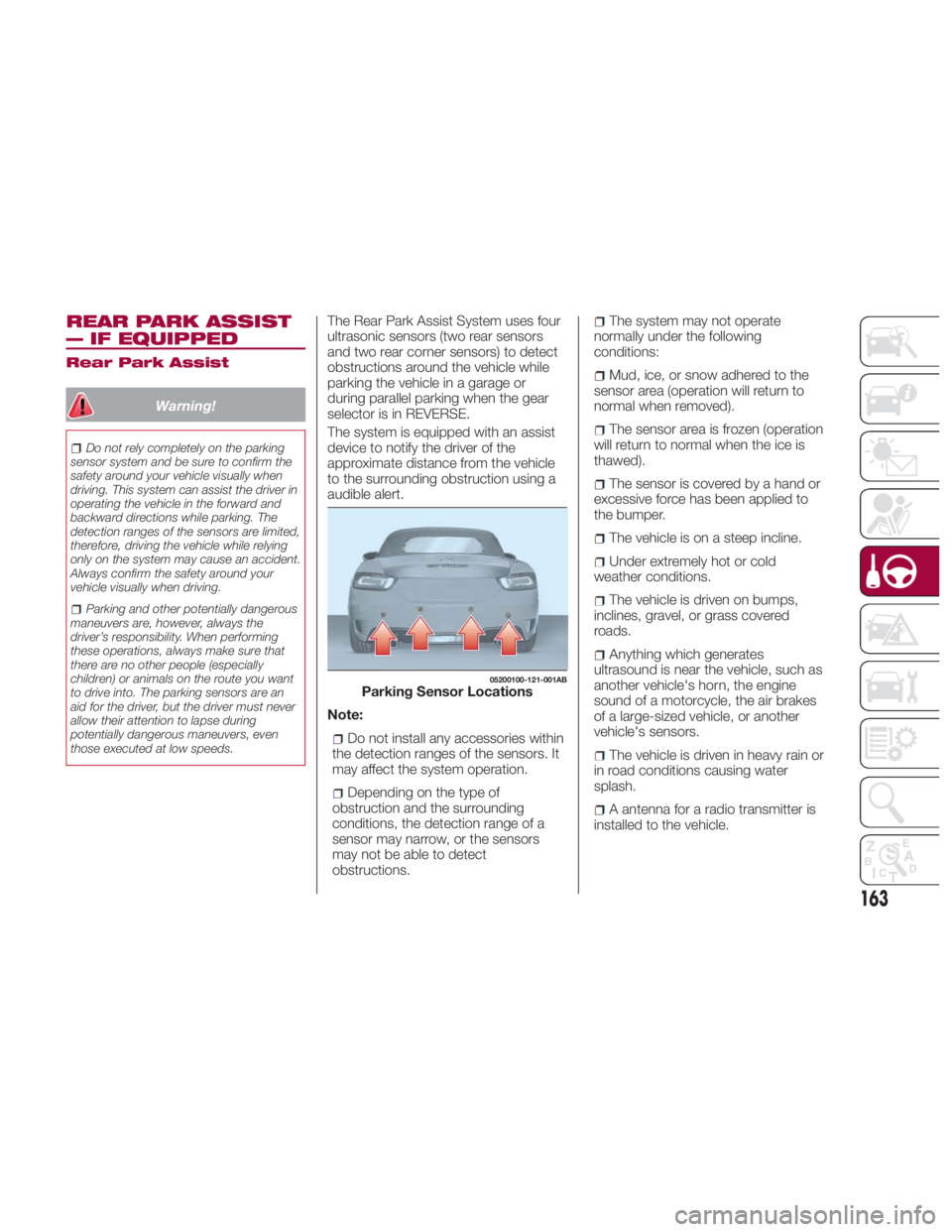
those executed at low speeds. The Rear Park Assist System uses four
ultrasonic sensors (two rear sensors
and two rear corner sensors) to detect
obstructions around the vehicle while
parking the vehicle in a garage or
during parallel parking when the gear
selector is in REVERSE.
The system is equipped with an assist
device to notify the driver of the
approximate distance from the vehicle
to the surrounding obstruction using a
audible alert.
Note:
Do not install any accessories within
the detection ranges of the sensors. It
may affect the system operation.
Depending on the type of
obstruction and the surrounding
conditions, the detection range of a
sensor may narrow, or the sensors
may not be able to detect
obstructions. The system may not operate
normally under the following
conditions:
Mud, ice, or snow adhered to the
sensor area (operation will return to
normal when removed).
The sensor area is frozen (operation
will return to normal when the ice is
thawed).
The sensor is covered by a hand or
excessive force has been applied to
the bumper.
The vehicle is on a steep incline.
Under extremely hot or cold
weather conditions.
The vehicle is driven on bumps,
inclines, gravel, or grass covered
roads.
Anything which generates
ultrasound is near the vehicle, such as
another vehicle's horn, the engine
sound of a motorcycle, the air brakes
of a large-sized vehicle, or another
vehicle's sensors.
The vehicle is driven in heavy rain or
in road conditions causing water
splash.
A antenna for a radio transmitter is
installed to the vehicle. 05200100-121-001AB
Parking Sensor Locations
163
Page 177 of 292

Carbon Monoxide
Warnings
Warning!Carbon monoxide (CO) in exhaust gases is
deadly. Follow the precautions below to
prevent carbon monoxide poisoning:
Do not inhale exhaust gases. They
contain carbon monoxide, a colorless and
odorless gas, which can kill. Never run the
engine in a closed area, such as a garage,
and never sit in a parked vehicle with the
engine running for an extended period. If
the vehicle is stopped in an open area with
the engine running for more than a short
period, adjust the ventilation system to
force fresh, outside air into the vehicle.
Guard against carbon monoxide with
proper maintenance. Have the exhaust
system inspected every time the vehicle is
raised. Have any abnormal conditions
repaired promptly. Until repaired, drive with
all side windows fully open.
Refueling Procedure
Fuel Filler Door
Note: Always use only a designated
FCA fuel filler cap or an approved
equivalent, available at your authorized
dealer. The wrong cap can result in a
serious malfunction of the fuel and
emission control systems. When the fuel filler door end is pressed
with the doors unlocked, the fuel filler
door rises.
The fuel filler door operates in
conjunction with the door
locking/unlocking mechanism.
To close, press the fuel filler door until a
click sound is heard.
Note:
Make sure to lock both the doors
when leaving the vehicle.
Lock the doors after closing the fuel
filler door. If the fuel filler door is closed
after locking the doors, the fuel filler
door cannot be locked.
Fuel Filler Cap
To remove the fuel filler cap, turn it
counterclockwise. Attach the removed
cap to the inner side of the fuel filler
door. To close the fuel filler cap, turn it
clockwise until a click is heard.
Warning! Never have any smoking materials lit in
or near the vehicle when the gas cap is
removed or the tank is being filled.
Never add fuel when the engine is
running. This is in violation of most state
and federal fire regulations and may cause
the MIL to turn on.
A fire may result if gasoline is pumped
into a portable container that is inside of a
vehicle. You could be burned. Always place
gas containers on the ground while filling. 04040201-12A-002AB
Fuel Filler Door 04040202-12A-001AB
Fuel Filler Cap
175
Page 180 of 292

TOWING TRAILERS Trailer Towing
Your car is not designed for towing.
Recreational Towing
An example of "recreational towing" is
towing your vehicle behind a
motorhome.
The transmission is not designed for
towing this vehicle on all four wheels.
Caution!DO NOT flat tow this vehicle. Damage to
the drivetrain will result. If this vehicle
requires towing, make sure the drive
wheels are OFF the ground.
Towing this vehicle in violation of the
above requirements can cause severe
transmission damage. Damage from
improper towing is not covered under the
New Vehicle Limited Warranty. DRIVING TIPS Engine Break-In
Recommendation
No special break-in is necessary, but a
few precautions in the first 620 miles
(1000 km) may add to the performance,
economy, and life of the vehicle:
Do not race the engine.
Do not maintain one constant speed,
either slow or fast, for a long period of
time.
Do not drive constantly at full-throttle
or high engine rpm for extended
periods of time.
Avoid unnecessary hard stops.
Avoid full-throttle starts.
Saving Fuel And
Protection Of The
Environment
How you operate your vehicle
determines how far it will travel on a
tank of fuel.
Use these suggestions to help save fuel
andreduceCO 2
:
Avoid long warm-ups. Once the
engine runs smoothly, begin driving.
Avoid fast starts.
Drive at lower speeds.
Anticipate when to apply the brakes
(avoid sudden braking). Follow the maintenance schedule
and contact your authorized dealer.
Use the air conditioner only when
necessary.
Slow down on rough roads.
Keep the tires properly inflated.
Do not carry unnecessary weight.
Do not rest your foot on the brake
pedal while driving.
Keep the wheels in correct
alignment.
Keep windows closed at high
speeds.
Slow down when driving in
crosswinds and headwinds.
Hazardous Driving
When driving on ice or in water, snow,
mud, sand, or similar hazards:
Be cautious and allow extra distance
for braking.
Avoid sudden braking and sudden
maneuvering.
Do not pump the brakes. Continue to
press down on the brake pedal.
If you get stuck, select a lower gear
and accelerate slowly. Do not spin the
rear wheels.
178
STARTING AND OPERATING
Page 200 of 292

DESCRIPTION FUSE RATING PROTECTED COMPONENT
F01 ENG IG3 5 A Engine Control Systems
F02 ENG
IG2 5 A Engine Control Systems
F03 HORN2 7.5 A Horn
F04 C/U IG1 15 A For Protection Of Various Circuits
F05 ENG IG1 7.5 A Engine Control System
F06 — — —
F07 INTERIOR 15 A Overhead Light
F08 — — —
F09 AUDIO2 15 A Audio System
F10 METER1 10 A Instrument Cluster
F11 SRS1 7.5 A Air Bag
F12 — — —
F13 RADIO 7.5 A Audio System
F14 ENGINE3 20 A Engine Control System
F15 ENGINE1 10 A Engine Control System
F16 ENGINE2 15 A Engine Control System
F17 AUDIO1 25 A Audio System
F18 A/C MAG 7.5 A Air Conditioner
F19 AT PUMP H/L HI 20 A Transmission Control System (If Equipped)
F20 AT 15 A Transmission Control System (If Equipped)
F21 D LOCK 25 A Power Door Locks
F22 H/L RH 20 A Headlight (RH)
F23 ENG + B2 7.5 A Engine Control System
198
IN CASE OF EMERGENCY
Page 202 of 292

DESCRIPTION FUSE RATING PROTECTED COMPONENT
F46 EPS 60 A Power Steering System
F47 DEFOG 30
A Rear Window Defogger
F48 IG2 30 A For Protection Of Various Circuits
F49 — — —
F50 HEATER 40 A Air Conditioner
F51 — — —
F52 — — —
200
IN CASE OF EMERGENCY
Page 206 of 292

To Secure The Jack
Proceed as follows:
1. Insert the wing bolt into the jack with
the jack screw pointing back, and turn
the wing bolt clockwise to temporarily
tighten it.
2. Turn the jack screw clockwise.
3. Turn the wing bolt completely to
secure the jack.
4. Insert the cover tabs and install the
cover.
Warning!A loose tire or jack thrown forward in a
collision or hard stop could endanger the
occupants of the vehicle. Always stow the
jack parts and the spare tire in the places
provided. Have the deflated (flat) tire
repaired or replaced immediately.
Maintenance
Always keep the jack clean.
Make sure the moving parts are kept
free from dirt or rust.
Make sure the screw thread is
adequately lubricated. Conditions Of Non-Use
Temperatures below -40°F (−40°C)
On sandy or muddy ground
On uneven ground
On steep roads
In extreme weather conditions
In direct contact with the engine or
for repairs under the vehicle
On boats
Jacking Instructions
Note: Make sure the jack is well
lubricated before using it.
Warning!Do not attempt to change a tire on the side
of the vehicle close to moving traffic, pull
far enough off the road to avoid being hit
when operating the jack or changing the
wheel.
Proceed as follows:
1. Stop the vehicle in a position that
does not cause any danger to traffic
and lets you change the tire in safety, as
far as possible from the edge of the
driving lane. The ground must be flat
and sufficiently compact. 2. Turn on the Hazard Warning Lights
and engage the parking brake.
3. For vehicles with automatic
transmission, place the gear selector in
PARK. For vehicles with manual
transmission, place gear selector in
REVERSE and turn the engine to OFF.
4. Stop the engine. The motor must be
kept off as long as the vehicle is lifted
off the ground.
5. Remove the jack and tools.
6. Block both the front and rear of the
wheel diagonally opposite of the jacking
position. For example, if changing the
right front tire, block the left rear wheel. 08020300-121-001
Blocking Right Front Tire And Left
Rear Tire
204
IN CASE OF EMERGENCY
Page 211 of 292

Tire Service Usage
Precautions
The tire sealant cannot be reused. If the
sealant has been used, or is expired,
purchase new tire sealant at an
authorized dealer.
Note: The Tire Service Kit cannot be
used in the following cases. Consult an
authorized dealer if any of these
conditions exist:
The period of effective use for the
tire sealant has expired (the period of
effectiveness is indicated on the bottle
label)
The tear or puncture in the tire
exceeds about 0.16 inches (4 mm)
The damage has occurred to an
area of the tire other than the tread
The vehicle has been driven with
nearly no air remaining in the tire
The tire has come off the wheel rim
Damage to the wheel rim has
occurred
The tire has two or more punctures Sealing A Tire With Tire
Service Kit
Warning!Do not attempt to seal a tire on the side
of the vehicle closest to traffic. Pull far
enough off the road to avoid the danger of
being hit when using the Tire Service Kit.
Do not use Tire Service Kit or drive the
vehicle under the following circumstances:
If the puncture in the tire tread is
approximately 1/4 inch (6 mm) or larger.
If the tire has any sidewall damage.
If the tire has any damage from driving
with extremely low tire pressure.
If the tire has any damage from driving
on a flat tire.
If the wheel has any damage.
If you are unsure of the condition of the
tire or the wheel.
Keep Tire Service Kit away from open
flames or heat sources.
A loose Tire Service Kit thrown forward
in a collision or hard stop could endanger
the occupants of the vehicle. Always stow
the Tire Service Kit in the place provided.
Failure to follow these warnings can result
in injuries that are serious or fatal to you,
your passengers, and others around you.
Take care not to allow the contents of
Tire Service Kit to come in contact with
hair, eyes, or clothing. Tire Service Kit
sealant is harmful if inhaled, swallowed, or absorbed through the skin. It causes skin,
eye, and respiratory irritation. Flush
immediately with plenty of water if there is
any contact with eyes or skin. Change
clothing as soon as possible, if there is any
contact with clothing.
Tire Service Kit Sealant solution contains
latex. In case of an allergic reaction or rash,
consult a physician immediately. Keep Tire
Service Kit out of reach of children. If
swallowed, rinse mouth immediately with
plenty of water and drink plenty of water.
Do not induce vomiting! Consult a
physician immediately.
U.S.A. And CANADA Markets:
Proceed as follows:
1. Pull over to a safe location and turn
on the vehicle’s Hazard Warning Lights.
2. Verify that the valve stem (on the
wheel with the deflated tire) is in a
position that is near to the ground. This
will allow the Tire Service Kit hoses to
reach the valve stem and keep the Tire
Service Kit flat on the ground. This will
provide the best positioning of the kit
when injecting the sealant into the
deflated tire and running the air pump.
Move the vehicle as necessary to place
the valve stem in this position before
proceeding.
3. Place the gear selector in REVERSE
for a manual transmission, and PARK
for automatic transmission.
209
Page 212 of 292

4. Apply the parking brake with the
brake pedal pressed and turn the
engine OFF.
5. Unload passengers and cargo, then
remove the Tire Service Kit.
6. Gently shake the sealant bottle to
mix the contents. Then extend the
injection hose. Note:
Do not shake the bottle
excessively. Otherwise, the sealant
could spray out of the injection hose. If
the sealant contacts clothing or other
objects, you may not be able to
remove it.
The sealant hardens easily, and
injecting it will be difficult under cold
weather conditions (32 °F (0 °C) or
below). Warm the sealant inside the
vehicle to facilitate injection.
7. Pull out the air compressor hose
and the air compressor plug from the
air compressor.
8. Install the air compressor hose,
which was pulled out of the air
compressor, into the injection valve of
the bottle. Note: Make sure that the air
compressor switch is off before
inserting the air compressor hose into
the injection valve of the bottle. If the air
compressor hose is not installed to the
injection valve of the bottle securely, the
sealant may leak.
9. Remove the valve cap from the valve
of the flat tire, install the injection hose
to the tire valve, and turn the sleeve to
the right to tighten.08020202-121-003
Tire Service Kit Location 08020202-03A-666
Sealant Bottle With Injection Hose
1 — Injection Hose 08020202-36A-004
Air Compressor With Hose And
Plug
2 — Air Compressor Hose 08020202-031-670
Install Air Compressor To Sealant
Bottle
3 — Air Compressor Hose
4 — Injection Valve
210
IN CASE OF EMERGENCY