2017 CHEVROLET EXPRESS CARGO VAN ECU
[x] Cancel search: ECUPage 124 of 346
Chevrolet Express Owner Manual (GMNA-Localizing-U.S./Canada/Mexico-9967827) - 2017 - crc - 5/2/16
Instruments and Controls 123
2MINUTES :The exterior lamps willstay on for two minutes.
NO CHANGE :No change will bemade to this feature. The currentsetting will remain.
To s e l e c t a s e t t i n g , p r e s sVwhile
the desired setting is displayed onthe DIC.
APPROACH LIGHTING
This feature allows you to selectwhether or not to have the exteriorlamps turn on briefly during low lightperiods after unlocking the vehicleusing the Remote KeylessEntry (RKE) transmitter.
PressUuntil APPROACH
LIGHTING appears on the DIC
display. PressVonce to access the
settings for this feature. Then
pressUto scroll through the
following settings:
OFF :The exterior lamps will notturn on when you unlock the vehiclewith the RKE transmitter.
ON (default) :If it is dark enoughoutside, the exterior lamps will turnon briefly when you unlock thevehicle with the RKE transmitter.The lamps will remain on for
20 seconds or untilQon the RKE
transmitter is pressed, or the vehicleis no longer off. SeeRemoteKeyless Entry (RKE) SystemOperation025.
NO CHANGE :No change will bemade to this feature. The currentsetting will remain.
To s e l e c t a s e t t i n g , p r e s sVwhile
the desired setting is displayed onthe DIC.
CHIME VOLUME
This feature allows you to select thevolume level of the chime.
PressUuntil CHIME VOLUME
appears on the DIC display.
PressVonce to access the settings
for this feature. Then pressUto
scroll through the following settings:
NORMAL :The chime volume willbe set to a normal level.
LOUD :The chime volume will beset to a loud level.
NO CHANGE :No change will bemade to this feature. The currentsetting will remain.
There is no default for chimevolume. The volume will stay at thelast known setting.
To s e l e c t a s e t t i n g , p r e s sVwhile
the desired setting is displayed onthe DIC.
FACTORY SETTINGS
This feature allows you to set all ofthe customization features back totheir factory default settings.
PressUuntil FACTORY SETTINGS
appears on the DIC display.
PressVonce to access the settings
for this feature. Then pressUto
scroll through the following settings:
RESTORE ALL (default) :Thecustomization features will be set totheir factory default settings.
DO NOT RESTORE :Thecustomization features will not beset to their factory default settings.
Page 159 of 346
Chevrolet Express Owner Manual (GMNA-Localizing-U.S./Canada/Mexico-9967827) - 2017 - crc - 5/2/16
158 Climate Controls
Climate Controls
Climate Control Systems
Climate Control Systems . . . . . 158Rear Heating System . . . . . . . . . 160Rear Climate ControlSystem . . . . . . . . . . . . . . . . . . . . . . 161
Air Vents
Air Vents . . . . . . . . . . . . . . . . . . . . . 163
Maintenance
Service . . . . . . . . . . . . . . . . . . . . . . . 163
Climate Control Systems
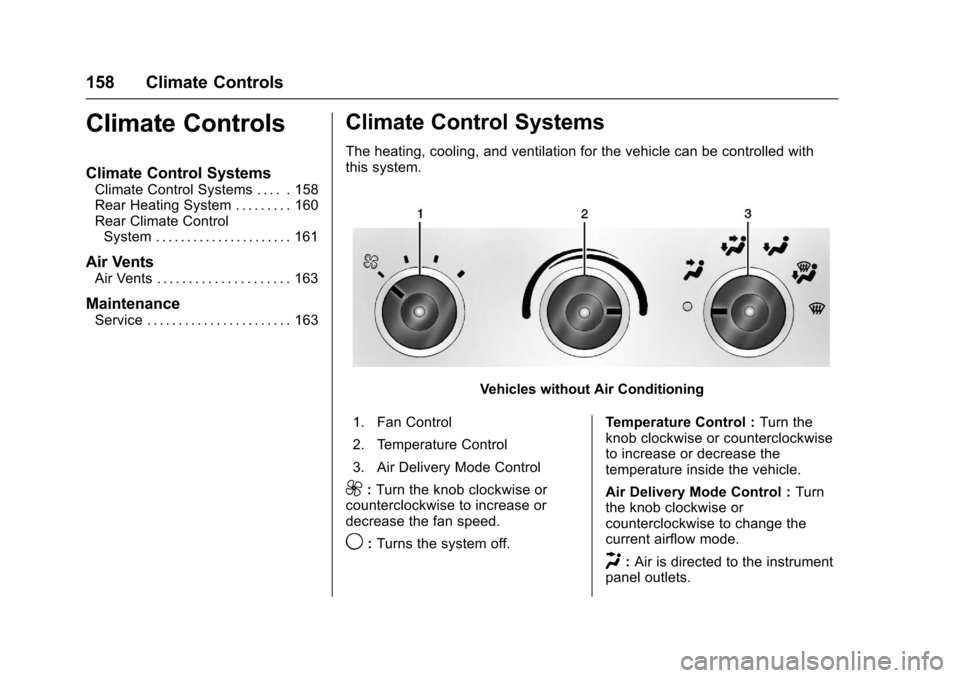
The heating, cooling, and ventilation for the vehicle can be controlled withthis system.
Vehicles without Air Conditioning
1. Fan Control
2. Temperature Control
3. Air Delivery Mode Control
9:Turn the knob clockwise orcounterclockwise to increase ordecrease the fan speed.
9:Turns the system off.
Te m p e r a t u r e C o n t r o l :Turn theknob clockwise or counterclockwiseto increase or decrease thetemperature inside the vehicle.
Air Delivery Mode Control :Turnthe knob clockwise orcounterclockwise to change thecurrent airflow mode.
H:Air is directed to the instrumentpanel outlets.
Page 176 of 346
Chevrolet Express Owner Manual (GMNA-Localizing-U.S./Canada/Mexico-9967827) - 2017 - crc - 5/6/16
Driving and Operating 175
Warning (Continued)
.Never stack heavier
things, like suitcases,
inside the vehicle so that
some of them are above
the tops of the seats.
.Do not leave an
unsecured child restraint
in the vehicle.
.When you carry
something inside the
vehicle, secure it
whenever you can.
.Do not leave a seat
folded down unless you
need to.
Add-On Equipment
When carrying removable items,
alimitonhowmanypeople
carried inside the vehicle may
be necessary. Be sure to weigh
the vehicle before buying and
installing the new equipment.
Starting and
Operating
New Vehicle Break-In
Caution
The vehicle does not need an
elaborate break-in. But it will
perform better in the long run if
you follow these guidelines:
.Keep the vehicle speed at88 km/h (55 mph) or less forthe first 805 km (500 mi).
.Do not drive at any oneconstant speed, fast or slow,for the first 805 km (500 mi).Do not make full-throttlestarts. Avoid downshifting tobrake or slow the vehicle.
.Avoid making hard stops forthe first 322 km (200 mi) orso. During this time the newbrake linings are not yetbroken in. Hard stops withnew linings can mean
(Continued)
Caution (Continued)
premature wear and earlierreplacement. Follow thisbreaking-in guideline everytime you get new brakelinings.
.Do not tow a trailer duringbreak-in. SeeTr a i l e r To w i n g0205for the trailer towingcapabilities of the vehicleand more information.
Following break-in, engine speed
and load can be gradually
increased.
Page 181 of 346
Chevrolet Express Owner Manual (GMNA-Localizing-U.S./Canada/Mexico-9967827) - 2017 - crc - 5/6/16
180 Driving and Operating
Warning (Continued)
condition, or using adamaged heater orextension cord, could makeit overheat and cause a fire,property damage, electricshock, and injury.
.Do not operate the vehiclewith the heater cordpermanently attached to thevehicle. Possible heatercord and thermostatdamage could occur.
.While in use, do not let theheater cord touch vehicleparts or sharp edges. Neverclose the hood on theheater cord.
.Before starting the vehicle,unplug the cord, reattachthe cover to the plug, andsecurely fasten the cord.Keep the cord away fromany moving parts.
4. Before starting the engine, besure to unplug and store thecord as it was before to keep itaway from moving engine partsand prevent damage.
The length of time the heater shouldremain plugged in depends onseveral factors. Ask a dealer in thearea where you will be parking thevehicle for the best advice on this.
Retained Accessory
Power (RAP)
These vehicle accessories can beused for up to 10 minutes after theengine is turned off:
.Audio System
.Power Windows (if equipped)
These features will work when theignition key is in ON/RUN or ACC/ACCESSORY. Once the key isturned from ON/RUN to LOCK/OFF,power to the radio and powerwindows will continue to work10 minutes or until the driver door isopened.
Shifting Into Park
1. Hold the brake pedal down,then set the parking brake.
2. Move the shift lever into theP(Park) position by pulling theshift lever toward you andmoving it up as far as it will go.
3. Turn the ignition key toLOCK/OFF.
4. Remove the key and take itwith you. If you can leave thevehicle with the ignition key inyour hand, the vehicle isin P (Park).
Leaving the Vehicle with the
Engine Running
{Warning
It can be dangerous to leave the
vehicle with the engine running.
It could overheat and catch fire.
(Continued)
Page 204 of 346
Chevrolet Express Owner Manual (GMNA-Localizing-U.S./Canada/Mexico-9967827) - 2017 - crc - 5/6/16
Driving and Operating 203
.The trailer must be equippedwith brakes adequate for theintended use. A loaded trailerweighing more than 680 kg(1,500 lb) must be equipped withits own brake system, withbrakes working on all axles.Trailer braking equipmentconforming to CanadianStandards Association (CSA)requirement CAN3-D313, or itsequivalent, is recommended.
.Do not tow a trailer during thefirst 800 km (500 mi) to preventdamage to the engine, axle,or other parts.
.Then during the first 800 km(500 mi) of trailer towing, do notdrive over 80 km/h (50 mph) anddo not make starts at full throttle.
.Vehicles can tow in D (Drive).The Tow/Haul Mode may beused if the transmission shiftstoo often. SeeTo w / H a u lMode0187.
.Turn off Park Assist whentowing.
{Warning
When towing a trailer, exhaust
gases may collect at the rear of
the vehicle and enter if the
liftgate, trunk/hatch, or rear-most
window is open.
When towing a trailer:
.Do not drive with theliftgate, trunk/hatch,or rear-most window open.
.Fully open the air outlets onor under the instrumentpanel.
.Also adjust the climatecontrol system to a settingthat brings in only outsideair. See“Climate ControlSystems”in the Index.
For more information about
carbon monoxide, seeEngine
Exhaust0182.
To w i n g a t r a i l e r r e q u i r e s a c e r t a i namount of experience. Thecombination you are driving islonger and not as responsive as the
vehicle itself. Get acquainted withthe handling and braking of the rigbefore setting out for the open road.
The structure, tires, and brakes ofthe trailer must be rated to carry theload. Inadequate trailer equipmentcan cause the combination tooperate in an unexpected or unsafemanner.
Before starting, check all trailer hitchparts and attachments, safetychains, electrical connectors, lamps,tires, and mirrors. Get familiar withthe handling and braking of the rig.If the trailer has electric brakes, startthe combination moving and thenapply the trailer brake controller byhand to be sure the brakes work.
During the trip, check occasionallyto be sure that the load is secureand the lamps and any trailerbrakes still work.
Following Distance
Stay at least twice as far behind thevehicle ahead as you would whendriving the vehicle without a trailer.This can help to avoid heavybraking and sudden turns.
Page 210 of 346
Chevrolet Express Owner Manual (GMNA-Localizing-U.S./Canada/Mexico-9967827) - 2017 - crc - 5/6/16
Driving and Operating 209
Ask your dealer for traileringinformation or advice.
Weight of the Trailer Tongue
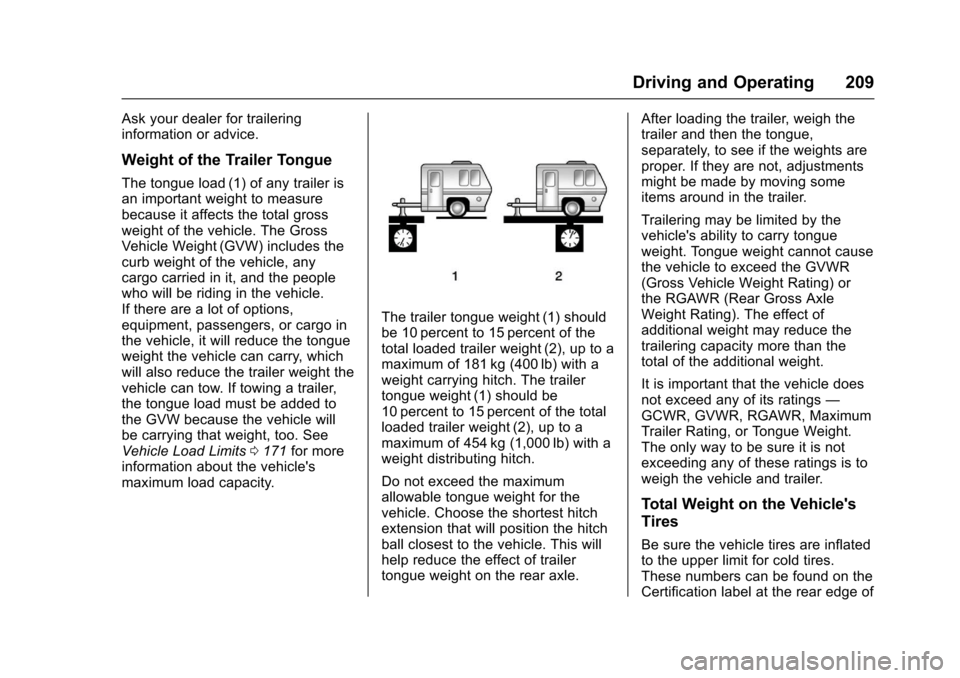
The tongue load (1) of any trailer isan important weight to measurebecause it affects the total grossweight of the vehicle. The GrossVehicle Weight (GVW) includes thecurb weight of the vehicle, anycargo carried in it, and the peoplewho will be riding in the vehicle.If there are a lot of options,equipment, passengers, or cargo inthe vehicle, it will reduce the tongueweight the vehicle can carry, whichwill also reduce the trailer weight thevehicle can tow. If towing a trailer,the tongue load must be added tothe GVW because the vehicle willbe carrying that weight, too. SeeVehicle Load Limits0171for moreinformation about the vehicle'smaximum load capacity.
The trailer tongue weight (1) shouldbe 10 percent to 15 percent of thetotal loaded trailer weight (2), up to amaximum of 181 kg (400 lb) with aweight carrying hitch. The trailertongue weight (1) should be10 percent to 15 percent of the totalloaded trailer weight (2), up to amaximum of 454 kg (1,000 lb) with aweight distributing hitch.
Do not exceed the maximumallowable tongue weight for thevehicle. Choose the shortest hitchextension that will position the hitchball closest to the vehicle. This willhelp reduce the effect of trailertongue weight on the rear axle.
After loading the trailer, weigh thetrailer and then the tongue,separately, to see if the weights areproper. If they are not, adjustmentsmight be made by moving someitems around in the trailer.
Trailering may be limited by thevehicle's ability to carry tongueweight. Tongue weight cannot causethe vehicle to exceed the GVWR(Gross Vehicle Weight Rating) orthe RGAWR (Rear Gross AxleWeight Rating). The effect ofadditional weight may reduce thetrailering capacity more than thetotal of the additional weight.
It is important that the vehicle doesnot exceed any of its ratings—GCWR, GVWR, RGAWR, MaximumTrailer Rating, or Tongue Weight.The only way to be sure it is notexceeding any of these ratings is toweigh the vehicle and trailer.
Total Weight on the Vehicle's
Tires
Be sure the vehicle tires are inflatedto the upper limit for cold tires.These numbers can be found on theCertification label at the rear edge of
Page 231 of 346
Chevrolet Express Owner Manual (GMNA-Localizing-U.S./Canada/Mexico-9967827) - 2017 - crc - 5/2/16
230 Vehicle Care
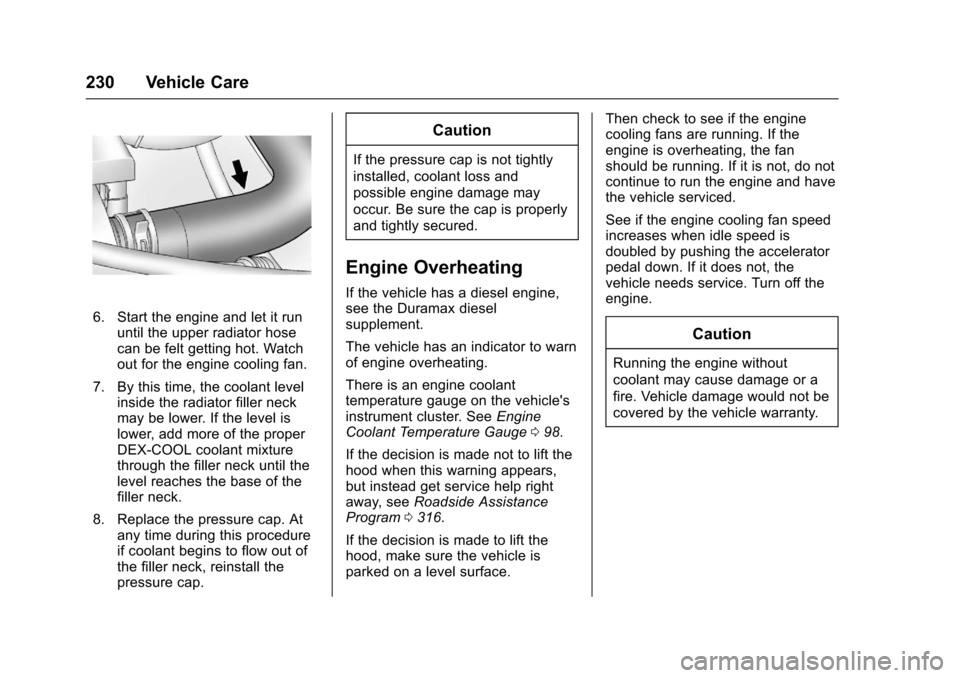
6. Start the engine and let it rununtil the upper radiator hosecan be felt getting hot. Watchout for the engine cooling fan.
7. By this time, the coolant levelinside the radiator filler neckmay be lower. If the level islower, add more of the properDEX-COOL coolant mixturethrough the filler neck until thelevel reaches the base of thefiller neck.
8. Replace the pressure cap. Atany time during this procedureif coolant begins to flow out ofthe filler neck, reinstall thepressure cap.
Caution
If the pressure cap is not tightly
installed, coolant loss and
possible engine damage may
occur. Be sure the cap is properly
and tightly secured.
Engine Overheating
If the vehicle has a diesel engine,see the Duramax dieselsupplement.
The vehicle has an indicator to warnof engine overheating.
There is an engine coolanttemperature gauge on the vehicle'sinstrument cluster. SeeEngineCoolant Temperature Gauge098.
If the decision is made not to lift thehood when this warning appears,but instead get service help rightaway, seeRoadside AssistanceProgram0316.
If the decision is made to lift thehood, make sure the vehicle isparked on a level surface.
Then check to see if the enginecooling fans are running. If theengine is overheating, the fanshould be running. If it is not, do notcontinue to run the engine and havethe vehicle serviced.
See if the engine cooling fan speedincreases when idle speed isdoubled by pushing the acceleratorpedal down. If it does not, thevehicle needs service. Turn off theengine.
Caution
Running the engine without
coolant may cause damage or a
fire. Vehicle damage would not be
covered by the vehicle warranty.
Page 241 of 346
Chevrolet Express Owner Manual (GMNA-Localizing-U.S./Canada/Mexico-9967827) - 2017 - crc - 5/2/16
240 Vehicle Care
Caution (Continued)
the vehicle warranty. Do not allow
the wiper arm to touch the
windshield.
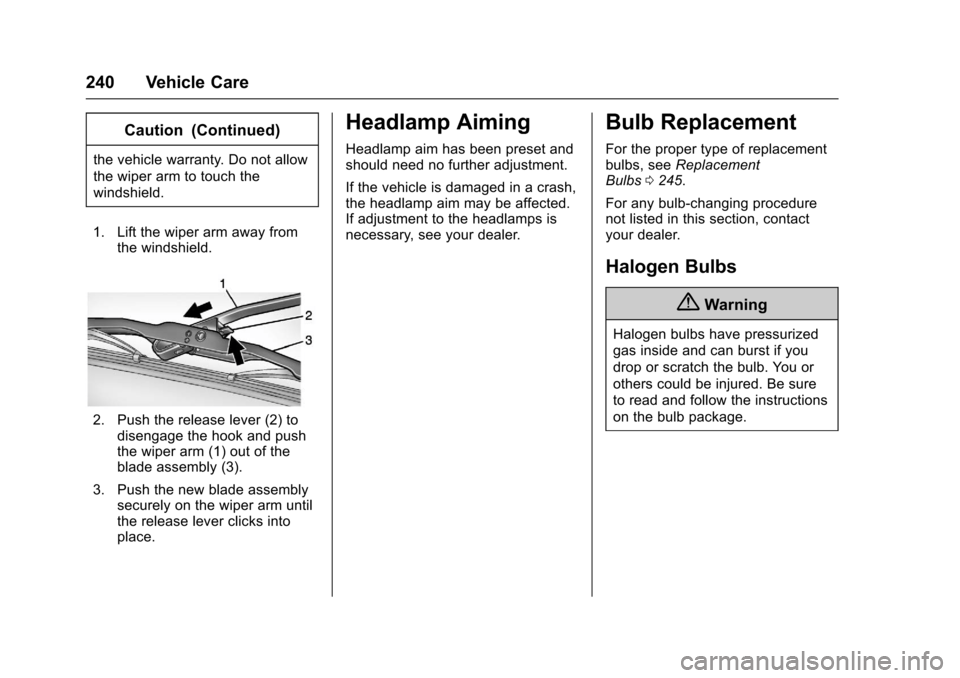
1. Lift the wiper arm away fromthe windshield.
2. Push the release lever (2) todisengage the hook and pushthe wiper arm (1) out of theblade assembly (3).
3. Push the new blade assemblysecurely on the wiper arm untilthe release lever clicks intoplace.
Headlamp Aiming
Headlamp aim has been preset andshould need no further adjustment.
If the vehicle is damaged in a crash,the headlamp aim may be affected.If adjustment to the headlamps isnecessary, see your dealer.
Bulb Replacement
For the proper type of replacementbulbs, seeReplacementBulbs0245.
For any bulb-changing procedurenot listed in this section, contactyour dealer.
Halogen Bulbs
{Warning
Halogen bulbs have pressurized
gas inside and can burst if you
drop or scratch the bulb. You or
others could be injured. Be sure
to read and follow the instructions
on the bulb package.