2017 CHEVROLET EXPRESS CARGO VAN towing
[x] Cancel search: towingPage 205 of 346
Chevrolet Express Owner Manual (GMNA-Localizing-U.S./Canada/Mexico-9967827) - 2017 - crc - 5/6/16
204 Driving and Operating
Passing
More passing distance is neededwhen towing a trailer. Thecombination will not accelerate asquickly and is longer so it isnecessary to go much fartherbeyond the passed vehicle beforereturning to the lane.
Backing Up
Hold the bottom of the steeringwheel with one hand. To move thetrailer to the left, move that hand tothe left. To move the trailer to theright, move your hand to the right.Always back up slowly and,if possible, have someoneguide you.
Making Turns
Caution
Making very sharp turns while
trailering could cause the trailer to
come in contact with the vehicle.
The vehicle could be damaged.
Avoid making very sharp turns
while trailering.
When turning with a trailer, makewider turns than normal. Do this sothe trailer will not strike softshoulders, curbs, road signs, trees,or other objects. Avoid jerky orsudden maneuvers. Signal well inadvance.
If the trailer turn signal bulbs burnout, the arrows on the instrumentcluster will still flash for turns. It isimportant to check occasionally tobe sure the trailer bulbs are stillworking.
Driving on Grades
Reduce speed and shift to a lowergearbeforestarting down a long orsteep downgrade. If thetransmission is not shifted down, thebrakes might get hot and no longerwork well.
Vehicles can tow in D (Drive). Shiftthe transmission to a lower gear ifthe transmission shifts too oftenunder heavy loads and/or hillyconditions.
The Tow/Haul Mode may be used ifthe transmission shifts too often.SeeTo w / H a u l M o d e0187.
When towing at high altitude onsteep uphill grades, consider thefollowing: Engine coolant will boil atalowertemperaturethanatnormalaltitudes. If the engine is turned offimmediately after towing at highaltitude on steep uphill grades, thevehicle may show signs similar toengine overheating. To avoid this,let the engine run while parked,preferably on level ground, with thetransmission in P (Park) for a fewminutes before turning the engineoff. If the overheat warning comeson, seeEngine Overheating0230.
Parking on Hills
{Warning
Parking the vehicle on a hill with
the trailer attached can be
dangerous. If something goes
wrong, the rig could start to move.
People can be injured, and both
the vehicle and the trailer can be
damaged. When possible, always
park the rig on a flat surface.
Page 206 of 346
Chevrolet Express Owner Manual (GMNA-Localizing-U.S./Canada/Mexico-9967827) - 2017 - crc - 5/6/16
Driving and Operating 205
If parking the rig on a hill:
1. Press the brake pedal, but donot shift into P (Park) yet. Turnthe wheels into the curb iffacing downhill or into traffic iffacing uphill.
2. Have someone place chocksunder the trailer wheels.
3. When the wheel chocks are inplace, release the regularbrakes until the chocks absorbthe load.
4. Reapply the brake pedal. Thenapply the parking brake andshift into P (Park).
5. Release the brake pedal.
Leaving After Parking on a Hill
1. Apply and hold the brakepedal.
2. Start the engine.
3. Shift into a gear.
4. Release the parking brake.
5. Let up on the brake pedal.
6. Drive slowly until the trailer isclear of the chocks.
7. Stop and have someone pickup and store the chocks.
Maintenance when Trailer
Towing
The vehicle needs service moreoften when pulling a trailer. SeeMaintenance Schedule0297.Things that are especially importantin trailer operation are automatictransmission fluid, engine oil, axlelubricant, belts, cooling system, andbrake system. It is a good idea toinspect these before and duringthe trip.
Check periodically to see that allhitch nuts and bolts are tight.
Trailer Towing
If the vehicle has a diesel engine,see the Duramax dieselsupplement.
{Warning
The driver can lose control when
pulling a trailer if the correct
equipment is not used or the
vehicle is not driven properly. For
example, if the trailer is too heavy
or the trailer brakes are
inadequate for the load, the
vehicle may not stop as expected.
The driver and passengers could
be seriously injured. The vehicle
may also be damaged; the
resulting repairs would not be
covered by the vehicle warranty.
Pull a trailer only if all the steps in
this section have been followed.
Ask your dealer for advice and
information about towing a trailer
with the vehicle.
Page 207 of 346
Chevrolet Express Owner Manual (GMNA-Localizing-U.S./Canada/Mexico-9967827) - 2017 - crc - 5/6/16
206 Driving and Operating
Caution
Pulling a trailer improperly can
damage the vehicle and result in
costly repairs not covered by the
vehicle warranty. To pull a trailer
correctly, follow the advice in this
section and see your dealer for
important information about
towing a trailer with the vehicle.
To i d e n t i f y t h e t r a i l e r i n g c a p a c i t y o fthe vehicle, read the information in“Weight of the Trailer”following.
Trailering is different than justdriving the vehicle by itself.Trailering means changes inhandling, acceleration, braking,durability, and fuel economy.Successful, safe trailering takescorrect equipment, and it has to beused properly.
The following information has manytime-tested, important trailering tipsand safety rules. Many of these areimportant for your safety and that of
your passengers. So please readthis section carefully before pulling atrailer.
Weight of the Trailer
Safe trailering requires monitoringthe weight, speed, altitude, roadgrades, outside temperature, andhow frequently the vehicle is used topull a trailer are all important. Takeinto consideration any specialequipment on the vehicle, and theamount of tongue weight the vehiclecan carry. See“Weight of the TrailerTo n g u e”later in this section.
Maximum trailer weight is calculatedassuming only the driver is in thetow vehicle and it has all therequired trailering equipment. Theweight of additional optionalequipment, passengers,and cargo inthe tow vehicle must be subtractedfrom the maximum trailer weight.
Use the following chart to determinehow much the vehicle can weigh,based upon the vehicle model andoptions.
Page 210 of 346
Chevrolet Express Owner Manual (GMNA-Localizing-U.S./Canada/Mexico-9967827) - 2017 - crc - 5/6/16
Driving and Operating 209
Ask your dealer for traileringinformation or advice.
Weight of the Trailer Tongue
The tongue load (1) of any trailer isan important weight to measurebecause it affects the total grossweight of the vehicle. The GrossVehicle Weight (GVW) includes thecurb weight of the vehicle, anycargo carried in it, and the peoplewho will be riding in the vehicle.If there are a lot of options,equipment, passengers, or cargo inthe vehicle, it will reduce the tongueweight the vehicle can carry, whichwill also reduce the trailer weight thevehicle can tow. If towing a trailer,the tongue load must be added tothe GVW because the vehicle willbe carrying that weight, too. SeeVehicle Load Limits0171for moreinformation about the vehicle'smaximum load capacity.
The trailer tongue weight (1) shouldbe 10 percent to 15 percent of thetotal loaded trailer weight (2), up to amaximum of 181 kg (400 lb) with aweight carrying hitch. The trailertongue weight (1) should be10 percent to 15 percent of the totalloaded trailer weight (2), up to amaximum of 454 kg (1,000 lb) with aweight distributing hitch.
Do not exceed the maximumallowable tongue weight for thevehicle. Choose the shortest hitchextension that will position the hitchball closest to the vehicle. This willhelp reduce the effect of trailertongue weight on the rear axle.
After loading the trailer, weigh thetrailer and then the tongue,separately, to see if the weights areproper. If they are not, adjustmentsmight be made by moving someitems around in the trailer.
Trailering may be limited by thevehicle's ability to carry tongueweight. Tongue weight cannot causethe vehicle to exceed the GVWR(Gross Vehicle Weight Rating) orthe RGAWR (Rear Gross AxleWeight Rating). The effect ofadditional weight may reduce thetrailering capacity more than thetotal of the additional weight.
It is important that the vehicle doesnot exceed any of its ratings—GCWR, GVWR, RGAWR, MaximumTrailer Rating, or Tongue Weight.The only way to be sure it is notexceeding any of these ratings is toweigh the vehicle and trailer.
Total Weight on the Vehicle's
Tires
Be sure the vehicle tires are inflatedto the upper limit for cold tires.These numbers can be found on theCertification label at the rear edge of
Page 211 of 346
Chevrolet Express Owner Manual (GMNA-Localizing-U.S./Canada/Mexico-9967827) - 2017 - crc - 5/6/16
210 Driving and Operating
the driver door, or seeVehicle LoadLimits0171.Makesurenottogoover the GVW limit for the vehicle,or the GAWR, including the weightof the trailer tongue. If using aweight distributing hitch, make surenot to go over the rear axle limitbefore applying the weightdistribution spring bars.
Towing Equipment
Hitches
The correct hitch equipment helpsmaintain combination control. Manytrailers can be towed with aweight-carrying hitch which simplyfeatures a coupler latched to thehitch ball, or a tow eye latched to apintle hook. Other trailers mayrequire a weight-distributing hitchthat uses spring bars to distributethe trailer tongue weight among thetwo vehicle and trailer axles. See“Weight of the Trailer Tongue”underTr a i l e r To w i n g0205for rating limitswith various hitch types.
Consider using sway controls withany trailer. Ask a traileringprofessional about sway controls orrefer to the trailer manufacturer'srecommendations and instructions.
Weight-Distributing Hitches
and Weight Carrying Hitches
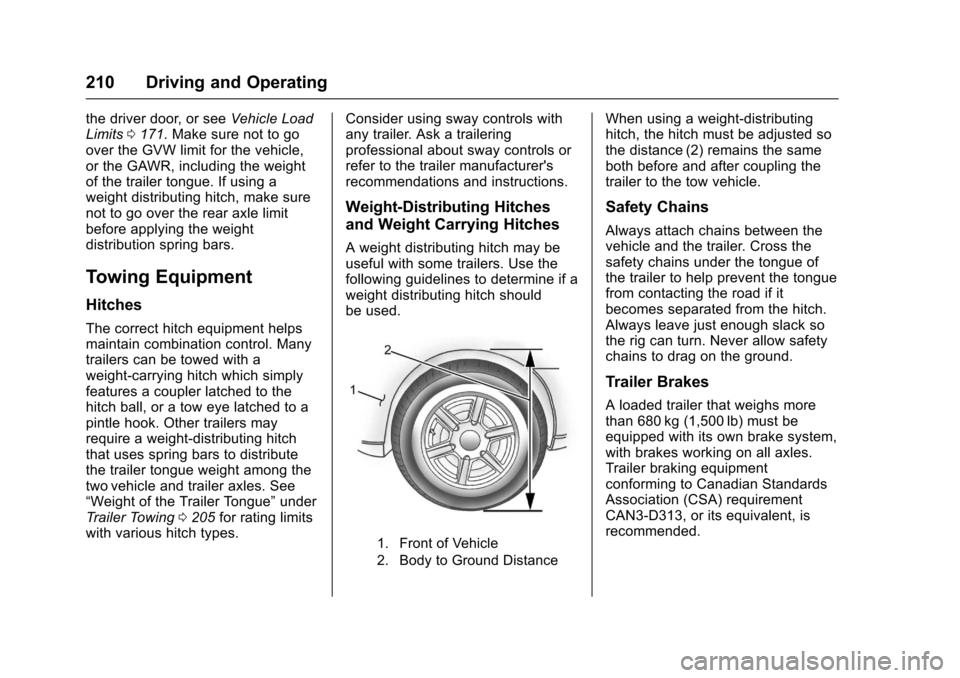
Aweightdistributinghitchmaybeuseful with some trailers. Use thefollowing guidelines to determine if aweight distributing hitch shouldbe used.
1. Front of Vehicle
2. Body to Ground Distance
When using a weight-distributinghitch, the hitch must be adjusted sothe distance (2) remains the sameboth before and after coupling thetrailer to the tow vehicle.
Safety Chains
Always attach chains between thevehicle and the trailer. Cross thesafety chains under the tongue ofthe trailer to help prevent the tonguefrom contacting the road if itbecomes separated from the hitch.Always leave just enough slack sothe rig can turn. Never allow safetychains to drag on the ground.
Trailer Brakes
Aloadedtrailerthatweighsmorethan 680 kg (1,500 lb) must beequipped with its own brake system,with brakes working on all axles.Trailer braking equipmentconforming to Canadian StandardsAssociation (CSA) requirementCAN3-D313, or its equivalent, isrecommended.
Page 216 of 346
Chevrolet Express Owner Manual (GMNA-Localizing-U.S./Canada/Mexico-9967827) - 2017 - crc - 5/2/16
Vehicle Care 215
Tire Chains . . . . . . . . . . . . . . . . . . . 272If a Tire Goes Flat . . . . . . . . . . . . 273Tire Changing . . . . . . . . . . . . . . . . 274Full-Size Spare Tire . . . . . . . . . . 282
Jump Starting
Jump Starting - NorthAmerica . . . . . . . . . . . . . . . . . . . . . 282
Towing the Vehicle
To w i n g t h e V e h i c l e . . . . . . . . . . . 2 8 6Recreational VehicleTo w i n g . . . . . . . . . . . . . . . . . . . . . . 2 8 6
Appearance Care
Exterior Care . . . . . . . . . . . . . . . . . 288Interior Care . . . . . . . . . . . . . . . . . . 292Floor Mats . . . . . . . . . . . . . . . . . . . . 295
General Information
For service and parts needs, visityour dealer. You will receivegenuine GM parts and GM-trainedand supported service people.
Genuine GM parts have one ofthese marks:
California Proposition
65 Warning
WARNING:Most motor vehicles,including this one, as well as manyof its service parts and fluids,contain and/or emit chemicalsknown to the State of California to
cause cancer and birth defects orother reproductive harm. Engineexhaust, many parts and systems,many fluids, and some componentwear by-products contain and/oremit these chemicals.
SeeBattery - North America0236andJump Starting - NorthAmerica0282.
California Perchlorate
Materials Requirements
Certain types of automotiveapplications, such as airbaginitiators, safety belt pretensioners,and lithium batteries contained inRemote Keyless Entry transmitters,may contain perchlorate materials.Special handling may be necessary.For additional information, seewww.dtsc.ca.gov/hazardouswaste/perchlorate.
Page 232 of 346
Chevrolet Express Owner Manual (GMNA-Localizing-U.S./Canada/Mexico-9967827) - 2017 - crc - 5/2/16
Vehicle Care 231
If Steam is Coming from the
Engine Compartment
{Warning
Steam from an overheated engine
can burn you badly, even if you
just open the hood. Stay away
from the engine if you see or hear
steam coming from it. Just turn it
off and get everyone away from
the vehicle until it cools down.
Wait until there is no sign of
steam or coolant before you open
the hood.
If you keep driving when the
engine is overheated, the liquids
in it can catch fire. You or others
could be badly burned. Stop the
engine if it overheats, and get out
of the vehicle until the engine
is cool.
If No Steam is Coming from
the Engine Compartment
If an engine overheat warning isdisplayed but no steam can be seenor heard, the problem may not be
too serious. Sometimes the enginecan get a little too hot when thevehicle:
.Climbs a long hill on a hot day.
.Stops after high-speed driving.
.Idles for long periods in traffic.
.To w s a t r a i l e r . S e e“Driving onGrades”underTr a i l e rTo w i n g0205.
If the overheat warning is displayedwith no sign of steam:
1. Turn the air off.
2. Turn the heater on to thehighest temperature and to thehighest fan speed. Open thewindows as necessary.
3. When it is safe to do so, pull offthe road, shift to P (Park) orN(Neutral) and let theengine idle.
If the engine coolant temperaturegauge is no longer in the overheatzone or an overheat warning nolonger displays, the vehicle can bedriven. Continue to drive the vehicleslowly for about 10 minutes. Keep asafe vehicle distance from the
vehicle in front. If the warning doesnot come back on, continue to drivenormally and have the coolingsystem checked for proper fill andfunction.
If the warning continues, pull over,stop, and park the vehicleright away.
If there is still no sign of steam,push down the accelerator until theengine speed is about twice as fastas normal idle speed for at leastthree minutes while parked. If thewarning is still on, turn off theengine until it cools down.
If the decision is made not to lift thehood, get service help right away.
Engine Fan
The vehicle has a clutched enginecooling fan. When the clutch isengaged, the fan spins faster toprovide more air to cool the engine.In most everyday driving conditions,the fan is spinning slower and theclutch is not fully engaged. Thisimproves fuel economy and reducesfan noise. Under heavy vehicleloading, trailer towing, and/or high
Page 287 of 346
Chevrolet Express Owner Manual (GMNA-Localizing-U.S./Canada/Mexico-9967827) - 2017 - crc - 5/2/16
286 Vehicle Care
Towing the Vehicle
Caution
Incorrectly towing a disabled
vehicle may cause damage. The
damage would not be covered by
the vehicle warranty.
Do not lash or hook to
suspension components. Use the
proper straps around the tires to
secure the vehicle.
Use only a flatbed tow truck fortowing a disabled vehicle. Neveruse a sling type lift or damage willoccur. Use ramps to help reduceapproach angles if necessary.Atowedvehicleshouldhaveitsdrive wheels off the ground.
Consult a professional towingservice if the disabled vehicle mustbe towed.
Recreational Vehicle
Towing
Recreational vehicle towing meanstowing the vehicle behind anothervehicle, such as behind a motorhome. The two most common typesof recreational vehicle towing areknown as dinghy towing and dollytowing. Dinghy towing is towing thevehicle with all four wheels on theground. Dolly towing is towing thevehicle with two wheels on theground and two wheels up on adevice known as a dolly.
Here are some important things toconsider before recreational vehicletowing:
.What is the towing capacity ofthe towing vehicle? Be sure toread the tow vehiclemanufacturer'srecommendations.
.What is the distance that will betraveled? Some vehicles haverestrictions on how far and howlong they can tow.
.Is the proper towing equipmentgoing to be used? See yourdealer or trailering professionalfor additional advice andequipment recommendations.
.Is the vehicle ready to betowed? Just as preparing thevehicle for a long trip, make surethe vehicle is prepared to betowed.
Caution
Use of a shield mounted in front
of the vehicle grille could restrict
airflow and cause damage to the
transmission. The repairs would
not be covered by the vehicle
warranty. If using a shield, only
use one that attaches to the
towing vehicle.