2017 CHEVROLET EXPRESS CARGO VAN seats
[x] Cancel search: seatsPage 55 of 346
Chevrolet Express Owner Manual (GMNA-Localizing-U.S./Canada/Mexico-9967827) - 2017 - crc - 5/2/16
54 Seats and Restraints
safety belt. For more information,see the instruction sheet that comeswith the extender.
Safety System Check
Check that the safety belt reminder,safety belts, buckles, latch plates,and retractors, are all workingproperly. Look for any other loose ordamaged safety belt system partsthat might keep a safety belt systemfrom performing properly. See yourdealer to have it repaired. Torn orfrayed safety belts may not protectyou in a crash. They can rip apartunder impact forces. If a belt is tornor frayed, have it replacedimmediately.
Make sure the safety belt reminderlight is working. SeeSafety BeltReminders099.
Keep safety belts clean and dry.SeeSafety Belt Care054.
Safety Belt Care
Keep belts clean and dry.
{Warning
Do not bleach or dye safety belt
webbing. It may severely weaken
the webbing. In a crash, they
might not be able to provide
adequate protection. Clean and
rinse safety belt webbing only
with mild soap and lukewarm
water. Allow the webbing to dry.
Safety belts should be properlycared for and maintained.
Safety belt hardware should be keptdry and free of dust or debris. Asnecessary exterior hard surfacesand safety belt webbing may belightly cleaned with mild soap andwater. Ensure there is not excessivedust or debris in the mechanism.If dust or debris exists in the systemplease see the dealer. Parts mayneed to be replaced to ensureproper functionality of the system.
Replacing Safety Belt
System Parts after a
Crash
{Warning
Acrashcandamagethesafety
belt system in the vehicle.
Adamagedsafetybeltsystem
may not properly protect the
person using it, resulting in
serious injury or even death in a
crash. To help make sure the
safety belt systems are working
properly after a crash, have them
inspected and any necessary
replacements made as soon as
possible.
After a minor crash, replacement ofsafety belts may not be necessary.But the safety belt assemblies thatwere used during any crash mayhave been stressed or damaged.See your dealer to have the safetybelt assemblies inspected orreplaced.
Page 56 of 346
Chevrolet Express Owner Manual (GMNA-Localizing-U.S./Canada/Mexico-9967827) - 2017 - crc - 5/2/16
Seats and Restraints 55
New parts and repairs may benecessary even if the safety beltsystem was not being used at thetime of the crash.
Have the safety belt pretensionerschecked if the vehicle has been in acrash, or if the airbag readiness lightstays on after you start the vehicleor while you are driving. SeeAirbagReadiness Light099.
Airbag System
The vehicle has the followingairbag:
.Afrontalairbagforthedriver.
The vehicle may have the followingairbags:
.Afrontalairbagforthefrontoutboard passenger.
.Aseat-mountedsideimpactairbag for the driver.
.Aseat-mountedsideimpactairbag for the front outboardpassenger.
Seat-mounted side impactairbags are only available onvehicles equipped with roof-railairbags.
.Aroof-railairbagforthedriveron vans with single row seating.
.Aroof-railairbagforthefrontoutboard passenger on vanswith single row seating.
.Aroof-railairbagforthedriverand the passenger seateddirectly behind the driver onvans with two row seating.
.Aroof-railairbagforthefrontoutboard passenger and thepassenger seated directlybehind the front outboardpassenger on vans with two rowseating.
If the van is equipped with asliding door, the roof-rail airbagfor the front outboard passengeris separate from the roof-railairbag for the passenger seateddirectly behind the front outboardpassenger. If the van isequipped with a 60/40 swing-outdoor, a single roof-rail airbagcovers both seating positions.
.Aroof-railairbagforthedriverand the second and third rowpassengers seated directlybehind the driver on vans withthree or more seating rows.
.Aroof-railairbagforthefrontoutboard passenger and thesecond and third rowpassengers seated directlybehind the front outboardpassenger on vans with three ormore seating rows.
Page 57 of 346
Chevrolet Express Owner Manual (GMNA-Localizing-U.S./Canada/Mexico-9967827) - 2017 - crc - 5/2/16
56 Seats and Restraints
If the van is equipped with asliding door, the roof-rail airbagfor the front outboard passengeris separate from the roof-railairbag for the second and thirdrow passengers seated directlybehind the front outboardpassenger. If the van isequipped with a 60/40 swing-outdoor, a single roof-rail airbagcovers all three seatingpositions.
All vehicle airbags have the wordAIRBAG on the trim or on anattached label near the deploymentopening.
For frontal airbags, the wordAIRBAG is on the center of thesteering wheel for the driver and onthe instrument panel for the frontoutboard passenger.
For seat-mounted side impactairbags, the word AIRBAG is on theside of the seatback closest tothe door.
For roof-rail airbags, the wordAIRBAG is on the ceiling or trim.
Airbags are designed to supplementthe protection provided by safetybelts. Even though today’sairbagsare also designed to help reducethe risk of injury from the force of aninflating airbag, all airbags mustinflate very quickly to do their job.
Here are the most important thingsto know about the airbag system:
{Warning
Yo u c a n b e s e v e r e l y i n j u r e d o r
killed in a crash if you are not
wearing your safety belt, even
with airbags. Airbags are
designed to work with safety
belts, not replace them. Also,
airbags are not designed to inflate
in every crash. In some crashes
safety belts are the only restraint.
SeeWhen Should an Airbag
Inflate?059.
Wearing your safety belt during a
crash helps reduce your chance
of hitting things inside the vehicle
or being ejected from it. Airbags
(Continued)
Warning (Continued)
are“supplemental restraints”to
the safety belts. Everyone in the
vehicle should wear a safety belt
properly, whether or not there is
an airbag for that person.
{Warning
Because airbags inflate with great
force and faster than the blink of
an eye, anyone who is up
against, or very close to any
airbag when it inflates can be
seriously injured or killed. Do not
sit unnecessarily close to any
airbag, as you would be if sitting
on the edge of the seat or leaning
forward. Safety belts help keep
you in position before and during
acrash.Alwayswearasafety
belt, even with airbags. The driver
should sit as far back as possible
while still maintaining control of
the vehicle. The safety belts and
(Continued)
Page 58 of 346
Chevrolet Express Owner Manual (GMNA-Localizing-U.S./Canada/Mexico-9967827) - 2017 - crc - 5/2/16
Seats and Restraints 57
Warning (Continued)
the front outboard passenger
airbags are most effective when
you are sitting well back and
upright in the seat with both feet
on the floor.
Occupants should not lean on or
sleep against the door or side
windows in seating positions with
seat-mounted side impact airbags
and/or roof-rail airbags.
{Warning
Children who are up against,
or very close to, any airbag when
it inflates can be seriously injured
or killed. Always secure children
properly in the vehicle. To read
how, seeOlder Children066or
Infants and Young Children068.
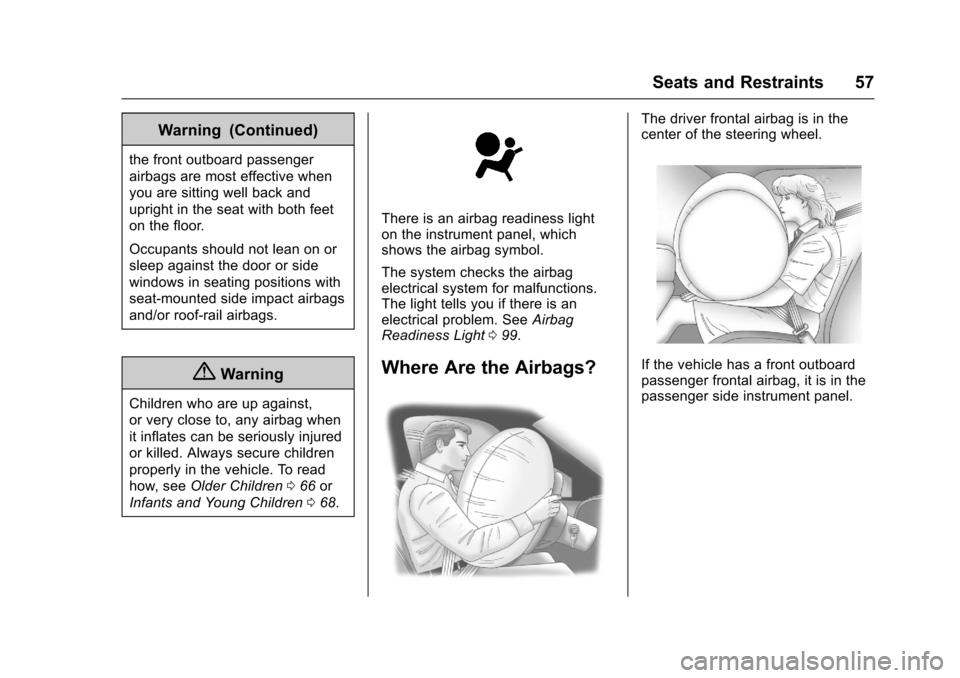
There is an airbag readiness lighton the instrument panel, whichshows the airbag symbol.
The system checks the airbagelectrical system for malfunctions.The light tells you if there is anelectrical problem. SeeAirbagReadiness Light099.
Where Are the Airbags?
The driver frontal airbag is in thecenter of the steering wheel.
If the vehicle has a front outboardpassenger frontal airbag, it is in thepassenger side instrument panel.
Page 59 of 346
Chevrolet Express Owner Manual (GMNA-Localizing-U.S./Canada/Mexico-9967827) - 2017 - crc - 5/2/16
58 Seats and Restraints
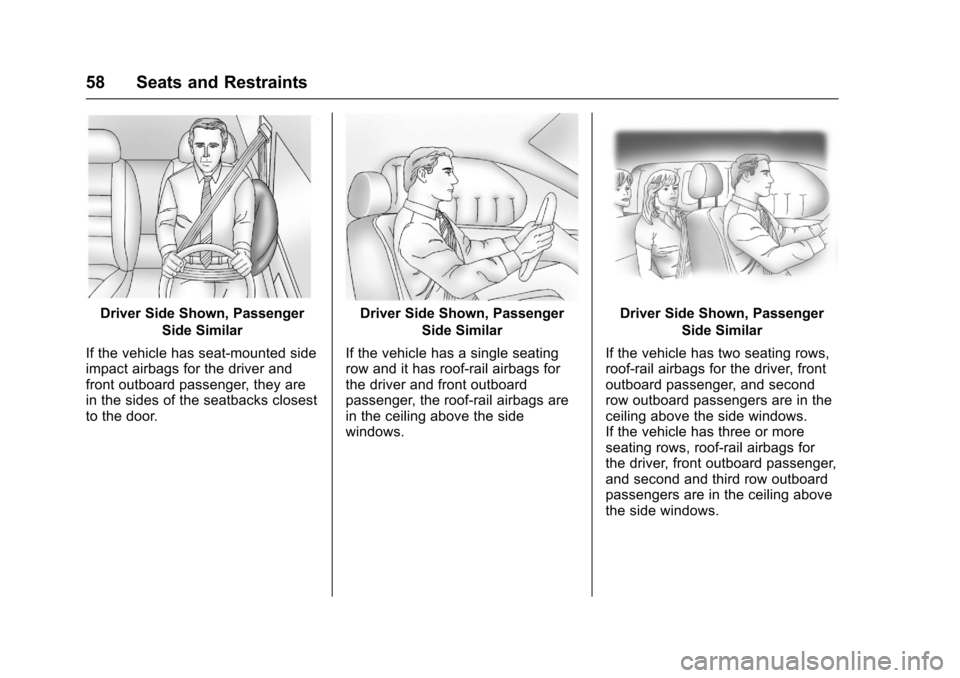
Driver Side Shown, Passenger
Side Similar
If the vehicle has seat-mounted sideimpact airbags for the driver andfront outboard passenger, they arein the sides of the seatbacks closestto the door.
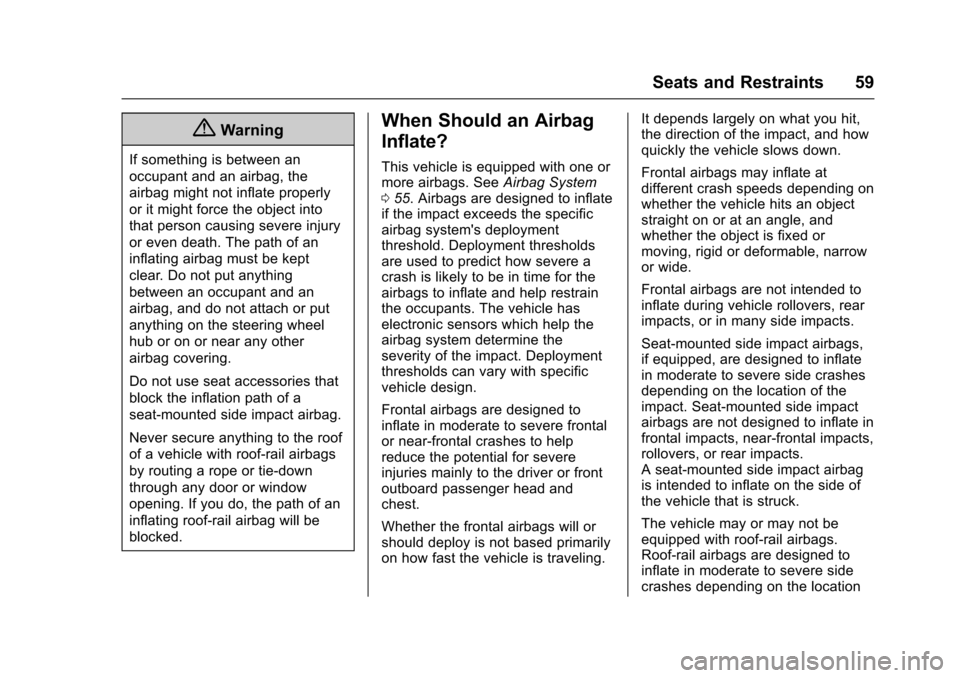
Driver Side Shown, Passenger
Side Similar
If the vehicle has a single seatingrow and it has roof-rail airbags forthe driver and front outboardpassenger, the roof-rail airbags arein the ceiling above the sidewindows.
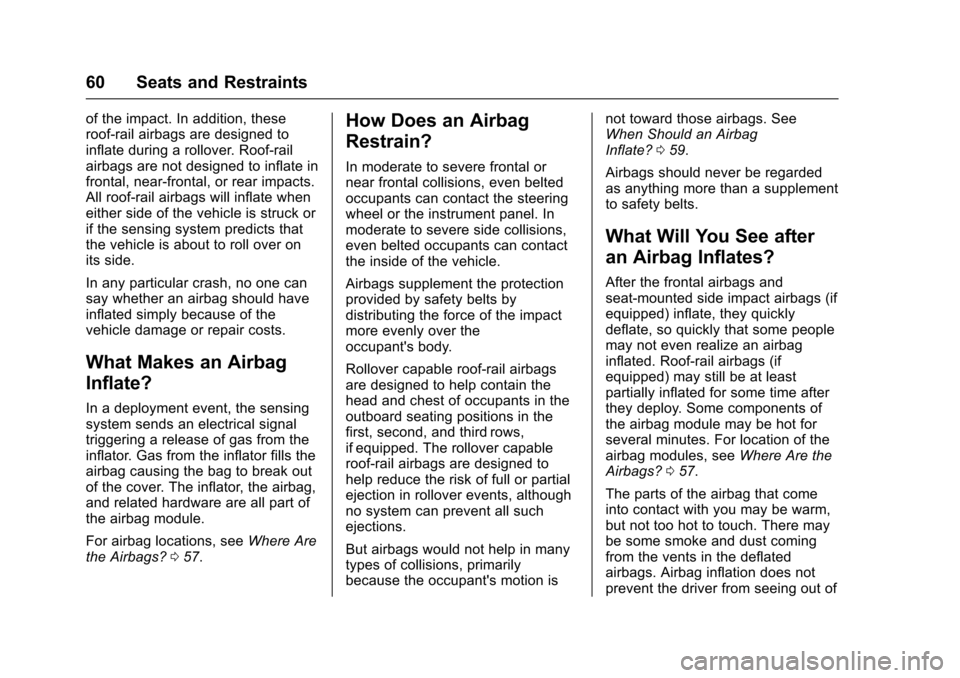
Driver Side Shown, Passenger
Side Similar
If the vehicle has two seating rows,roof-rail airbags for the driver, frontoutboard passenger, and secondrow outboard passengers are in theceiling above the side windows.If the vehicle has three or moreseating rows, roof-rail airbags forthe driver, front outboard passenger,and second and third row outboardpassengers are in the ceiling abovethe side windows.
Page 60 of 346
Chevrolet Express Owner Manual (GMNA-Localizing-U.S./Canada/Mexico-9967827) - 2017 - crc - 5/2/16
Seats and Restraints 59
{Warning
If something is between an
occupant and an airbag, the
airbag might not inflate properly
or it might force the object into
that person causing severe injury
or even death. The path of an
inflating airbag must be kept
clear. Do not put anything
between an occupant and an
airbag, and do not attach or put
anything on the steering wheel
hub or on or near any other
airbag covering.
Do not use seat accessories that
block the inflation path of a
seat-mounted side impact airbag.
Never secure anything to the roof
of a vehicle with roof-rail airbags
by routing a rope or tie⇣down
through any door or window
opening. If you do, the path of an
inflating roof-rail airbag will be
blocked.
When Should an Airbag
Inflate?
This vehicle is equipped with one ormore airbags. SeeAirbag System055.Airbagsaredesignedtoinflateif the impact exceeds the specificairbag system's deploymentthreshold. Deployment thresholdsare used to predict how severe acrash is likely to be in time for theairbags to inflate and help restrainthe occupants. The vehicle haselectronic sensors which help theairbag system determine theseverity of the impact. Deploymentthresholds can vary with specificvehicle design.
Frontal airbags are designed toinflate in moderate to severe frontalor near-frontal crashes to helpreduce the potential for severeinjuries mainly to the driver or frontoutboard passenger head andchest.
Whether the frontal airbags will orshould deploy is not based primarilyon how fast the vehicle is traveling.
It depends largely on what you hit,the direction of the impact, and howquickly the vehicle slows down.
Frontal airbags may inflate atdifferent crash speeds depending onwhether the vehicle hits an objectstraight on or at an angle, andwhether the object is fixed ormoving, rigid or deformable, narrowor wide.
Frontal airbags are not intended toinflate during vehicle rollovers, rearimpacts, or in many side impacts.
Seat-mounted side impact airbags,if equipped, are designed to inflatein moderate to severe side crashesdepending on the location of theimpact. Seat-mounted side impactairbags are not designed to inflate infrontal impacts, near-frontal impacts,rollovers, or rear impacts.Aseat-mountedsideimpactairbagis intended to inflate on the side ofthe vehicle that is struck.
The vehicle may or may not beequipped with roof-rail airbags.Roof-rail airbags are designed toinflate in moderate to severe sidecrashes depending on the location
Page 61 of 346
Chevrolet Express Owner Manual (GMNA-Localizing-U.S./Canada/Mexico-9967827) - 2017 - crc - 5/2/16
60 Seats and Restraints
of the impact. In addition, theseroof-rail airbags are designed toinflate during a rollover. Roof-railairbags are not designed to inflate infrontal, near-frontal, or rear impacts.All roof-rail airbags will inflate wheneither side of the vehicle is struck orif the sensing system predicts thatthe vehicle is about to roll over onits side.
In any particular crash, no one cansay whether an airbag should haveinflated simply because of thevehicle damage or repair costs.
What Makes an Airbag
Inflate?
In a deployment event, the sensingsystem sends an electrical signaltriggering a release of gas from theinflator. Gas from the inflator fills theairbag causing the bag to break outof the cover. The inflator, the airbag,and related hardware are all part ofthe airbag module.
For airbag locations, seeWhere Arethe Airbags?057.
How Does an Airbag
Restrain?
In moderate to severe frontal ornear frontal collisions, even beltedoccupants can contact the steeringwheel or the instrument panel. Inmoderate to severe side collisions,even belted occupants can contactthe inside of the vehicle.
Airbags supplement the protectionprovided by safety belts bydistributing the force of the impactmore evenly over theoccupant's body.
Rollover capable roof-rail airbagsare designed to help contain thehead and chest of occupants in theoutboard seating positions in thefirst, second, and third rows,if equipped. The rollover capableroof-rail airbags are designed tohelp reduce the risk of full or partialejection in rollover events, althoughno system can prevent all suchejections.
But airbags would not help in manytypes of collisions, primarilybecause the occupant's motion is
not toward those airbags. SeeWhen Should an AirbagInflate?059.
Airbags should never be regardedas anything more than a supplementto safety belts.
What Will You See after
an Airbag Inflates?
After the frontal airbags andseat-mounted side impact airbags (ifequipped) inflate, they quicklydeflate, so quickly that some peoplemay not even realize an airbaginflated. Roof-rail airbags (ifequipped) may still be at leastpartially inflated for some time afterthey deploy. Some components ofthe airbag module may be hot forseveral minutes. For location of theairbag modules, seeWhere Are theAirbags?057.
The parts of the airbag that comeinto contact with you may be warm,but not too hot to touch. There maybe some smoke and dust comingfrom the vents in the deflatedairbags. Airbag inflation does notprevent the driver from seeing out of
Page 62 of 346
Chevrolet Express Owner Manual (GMNA-Localizing-U.S./Canada/Mexico-9967827) - 2017 - crc - 5/2/16
Seats and Restraints 61
the windshield or being able to steerthe vehicle, nor does it preventpeople from leaving the vehicle.
{Warning
When an airbag inflates, there
may be dust in the air. This dust
could cause breathing problems
for people with a history of
asthma or other breathing trouble.
To a v o i d t h i s , e v e r y o n e i n t h e
vehicle should get out as soon as
it is safe to do so. If you have
breathing problems but cannot
get out of the vehicle after an
airbag inflates, then get fresh air
by opening a window or a door.
If you experience breathing
problems following an airbag
deployment, you should seek
medical attention.
The vehicle has a feature that mayautomatically unlock the doors(if equipped with power door locks),turn on the interior lamps andhazard warning flashers, and shutoff the fuel system after the airbags
inflate. The feature may alsoactivate, without airbag inflation,after an event that exceeds apredetermined threshold. You canlock the doors, and turn off theinterior lamps and the hazardwarning flashers by using thecontrols for those features.
{Warning
Acrashsevereenoughtoinflate
the airbags may have also
damaged important functions in
the vehicle, such as the fuel
system, brake and steering
systems, etc. Even if the vehicle
appears to be drivable after a
moderate crash, there may be
concealed damage that could
make it difficult to safely operate
the vehicle.
Use caution if you should attempt
to restart the engine after a crash
has occurred.
In many crashes severe enough toinflate the airbag, windshields arebroken by vehicle deformation.
Additional windshield breakage mayalso occur from the front outboardpassenger airbag.
.Airbags are designed to inflateonly once. After an airbaginflates, you will need some newparts for the airbag system.If you do not get them, the airbagsystem will not be there to helpprotect you in another crash.Anew system will include airbagmodules and possibly otherparts. The service manual forthe vehicle covers the need toreplace other parts.
.The vehicle has a crash sensingand diagnostic module whichrecords information after acrash. SeeVehicle DataRecording and Privacy0324andEvent DataRecorders0324.
.Let only qualified technicianswork on the airbag systems.Improper service can mean thatan airbag system will not workproperly. See your dealer forservice.