2017 CHEVROLET EXPRESS CARGO VAN brake light
[x] Cancel search: brake lightPage 224 of 346
Chevrolet Express Owner Manual (GMNA-Localizing-U.S./Canada/Mexico-9967827) - 2017 - crc - 5/2/16
Vehicle Care 223
Caution (Continued)
fluid could come out and fall on
hot engine parts or exhaust
system parts, starting a fire. Too
little fluid could cause the
transmission to overheat. Be sure
to get an accurate reading if
checking the transmission fluid.
Wait at least 30 minutes with theengine off, before checking thetransmission fluid level if the vehiclehas been driven:
.In hot weather, when outsidetemperatures are above 32 °C(90 °F).
.The vehicle is heavily loaded.
.At high speed for quite a while inhot weather.
.In heavy traffic and hot weather.
.While pulling a trailer.
After driving under these conditions,ahotcheckcanbeperformed.Thefluid should be hot, which is 71 °C to93 °C (160 °F to 200 °F).
Acoldfluidlevelcheckcanbeperformed after the vehicle hasbeen sitting for eight hours or morewith the engine off, but this is usedonly as a reference. Let the enginerun at idle for five minutes if theoutside temperature is between 15 °Cto32°C(60°Fto90°F).Shouldthe fluid level be low during this coldcheck, the fluid must be checkedwarm or hot before adding fluid.If the outside temperature is colderthan 15 °C (60 °F) or hotter than 32 °C(90°F),acoldcheckcannotbeperformed.
Awarmfluidlevelcheckcanbeperformed by driving the vehicleunder lightly loaded conditions andoutside temperatures between 10 °Cto 27 °C (50 °F to 80 °F). Thevehicle should be driven for at least24 km (15 mi) before performing awarm check. Checking the fluidwarm or hot will give a moreaccurate reading of the fluid levelthan a cold check.
Because the vehicle is equippedwith a high-efficiency air-to-oilcooler, the transmission fluidtemperature may not reach the
required hot fluid level checkingtemperature under normal lightlyloaded driving vehicle conditions.
Checking the Fluid Level
Prepare the vehicle:
1. Park the vehicle on a levelplace. Keep the enginerunning.
2. With the parking brake applied,place the shift lever in P (Park).
3. With a foot on the brake pedal,move the shift lever througheach gear range, pausing forabout three seconds in eachrange. When M is reached,move the selector from M1through M3. Then, position theshift lever in P (Park).
4. Let the engine run at idle fortwo minutes or more.
Then, without shutting off theengine, use the steps that follow.
Page 235 of 346
Chevrolet Express Owner Manual (GMNA-Localizing-U.S./Canada/Mexico-9967827) - 2017 - crc - 5/2/16
234 Vehicle Care
Caution
Continuing to drive with worn-out
brake pads could result in costly
brake repair.
Some driving conditions or climatescan cause a brake squeal when thebrakes are first applied or lightlyapplied. This does not meansomething is wrong with the brakes.
Properly torqued wheel nuts arenecessary to help prevent brakepulsation. When tires are rotated,inspect brake pads for wear andevenly tighten wheel nuts in theproper sequence to torquespecifications. SeeCapacities andSpecifications0309.
Brake pads should be replaced ascomplete sets.
Brake Pedal Travel
See your dealer if the brake pedaldoes not return to normal height,or if there is a rapid increase inpedal travel. This could be a signthat brake service may be required.
Replacing Brake System Parts
Always replace brake system partswith new, approved replacementparts. If this is not done, the brakesmay not work properly. The brakingperformance expected can changein many other ways if the wrongreplacement brake parts areinstalled or if parts are improperlyinstalled.
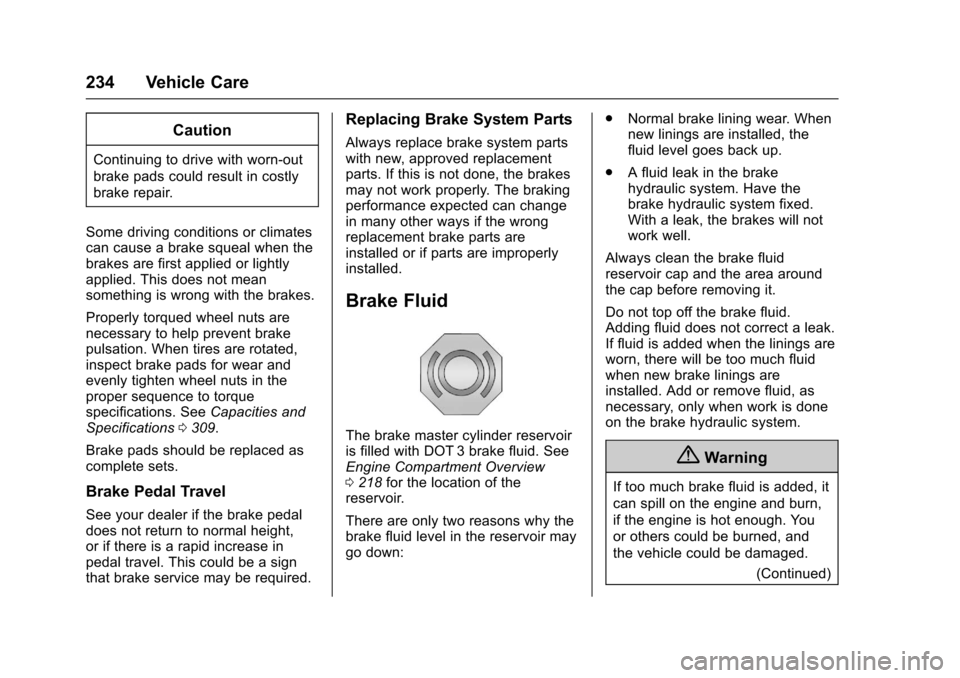
Brake Fluid
The brake master cylinder reservoiris filled with DOT 3 brake fluid. SeeEngine Compartment Overview0218for the location of thereservoir.
There are only two reasons why thebrake fluid level in the reservoir maygo down:
.Normal brake lining wear. Whennew linings are installed, thefluid level goes back up.
.Afluidleakinthebrakehydraulic system. Have thebrake hydraulic system fixed.With a leak, the brakes will notwork well.
Always clean the brake fluidreservoir cap and the area aroundthe cap before removing it.
Do not top off the brake fluid.Adding fluid does not correct a leak.If fluid is added when the linings areworn, there will be too much fluidwhen new brake linings areinstalled. Add or remove fluid, asnecessary, only when work is doneon the brake hydraulic system.
{Warning
If too much brake fluid is added, it
can spill on the engine and burn,
if the engine is hot enough. You
or others could be burned, and
the vehicle could be damaged.
(Continued)
Page 236 of 346
Chevrolet Express Owner Manual (GMNA-Localizing-U.S./Canada/Mexico-9967827) - 2017 - crc - 5/2/16
Vehicle Care 235
Warning (Continued)
Add brake fluid only when work is
done on the brake hydraulic
system.
When the brake fluid falls to a lowlevel, the brake warning light comeson. SeeBrake System WarningLight0104.
Brake fluid absorbs water over time.Replace brake fluid at the specifiedintervals to prevent increasedstopping distance. SeeMaintenanceSchedule0297.
Checking Brake Fluid
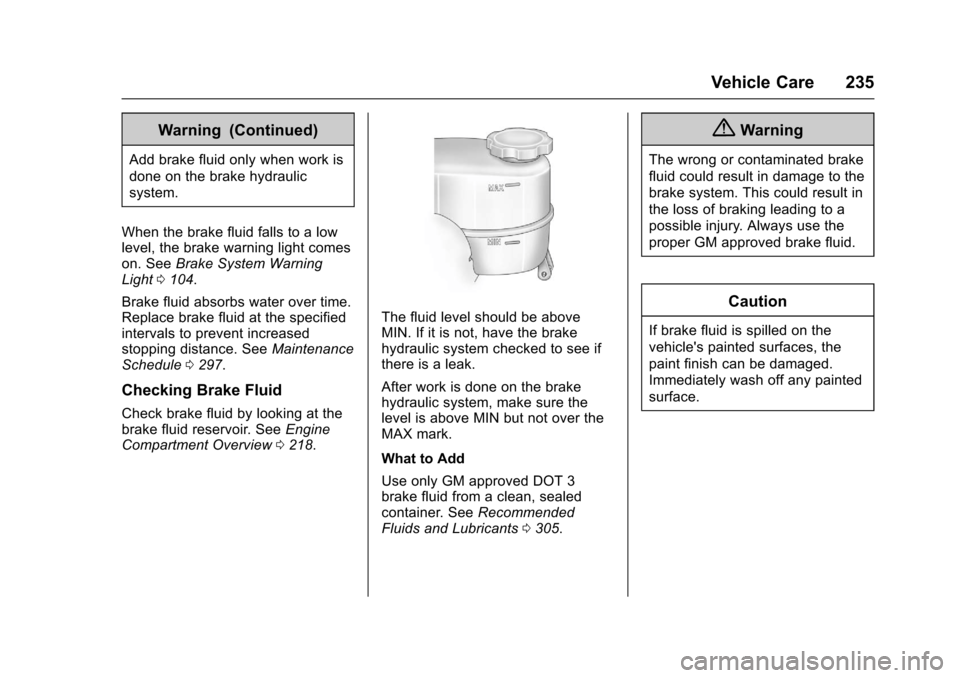
Check brake fluid by looking at thebrake fluid reservoir. SeeEngineCompartment Overview0218.
The fluid level should be aboveMIN. If it is not, have the brakehydraulic system checked to see ifthere is a leak.
After work is done on the brakehydraulic system, make sure thelevel is above MIN but not over theMAX mark.
What to Add
Use only GM approved DOT 3brake fluid from a clean, sealedcontainer. SeeRecommendedFluids and Lubricants0305.
{Warning
The wrong or contaminated brake
fluid could result in damage to the
brake system. This could result in
the loss of braking leading to a
possible injury. Always use the
proper GM approved brake fluid.
Caution
If brake fluid is spilled on the
vehicle's painted surfaces, the
paint finish can be damaged.
Immediately wash off any painted
surface.
Page 265 of 346
Chevrolet Express Owner Manual (GMNA-Localizing-U.S./Canada/Mexico-9967827) - 2017 - crc - 5/2/16
264 Vehicle Care
the sensor matching process isperformed successfully. Seeyour dealer for service.
.Replacement tires or wheels donot match the original equipmenttires or wheels. Tires and wheelsother than those recommendedcould prevent the TPMS fromfunctioning properly. SeeBuyingNew Tires0268.
.Operating electronic devices orbeing near facilities using radiowave frequencies similar to theTPMS could cause the TPMSsensors to malfunction.
If the TPMS is not functioningproperly, it cannot detect or signal alow tire condition. See your dealerfor service if the TPMS malfunctionlight and DIC message come onand stay on.
TPMS Sensor Matching
Process
Each TPMS sensor has a uniqueidentification code. The identificationcode needs to be matched to a newtire/wheel position after rotating thevehicle’stiresorreplacingoneor
more of the TPMS sensors. Also,the TPMS sensor matching processshould be performed after replacingasparetirewitharoadtirecontaining the TPMS sensor. Themalfunction light and the DICmessage should go off at the nextignition cycle. The sensors arematched to the tire/wheel positions,using a TPMS relearn tool, in thefollowing order: driver side front tire,passenger side front tire, passengerside rear tire, and driver side rear.See your dealer for service or topurchase a relearn tool. A TPMSrelearn tool can also be purchased.See Tire Pressure Monitor SensorActivation Tool atwww.gmtoolsandequipment.com orcall 1-800-GM TOOLS(1-800-468-6657).
There are two minutes to match thefirst tire/wheel position, andfive minutes overall to match all fourtire/wheel positions. If it takeslonger, the matching process stopsand must be restarted.
The TPMS sensor matchingprocess is:
1. Set the parking brake.
2. Turn the ignition to ON/RUNwith the engine off.
3. Press the Remote Keyless
Entry (RKE) transmitter'sQ
andKbuttons at the same
time for approximatelyfive seconds. The horn soundstwice to signal the receiver is inrelearn mode and TIRELEARNING ACTIVE messagedisplays on the DIC screen.
If the vehicle does not haveRKE, press the DriverInformation Center (DIC)vehicle information button untilthe PRESSVTO RELEARNTIRE POSITIONS messagedisplays. The horn soundstwice to signal the receiver is inrelearn mode and TIRELEARNING ACTIVE messagedisplays on the DIC screen.
4. Start with the driver sidefront tire.
Page 284 of 346
Chevrolet Express Owner Manual (GMNA-Localizing-U.S./Canada/Mexico-9967827) - 2017 - crc - 5/2/16
Vehicle Care 283
Caution
Ignoring these steps could result
in costly damage to the vehicle
that would not be covered by the
vehicle warranty. Trying to start
the vehicle by pushing or pulling it
will not work, and it could damage
the vehicle.
1. Check the other vehicle.It must have a 12-volt batterywith a negative ground system.
Caution
If the other vehicle does not have
a12-voltsystemwithanegative
ground, both vehicles can be
damaged. Only use a vehicle that
has a 12-volt system with a
negative ground for jump starting.
2. Get the vehicles close enoughso the jumper cables canreach, but be sure the vehiclesare not touching each other.If they are, it could cause a
ground connection you do notwant. You would not be able tostart your vehicle, and the badgrounding could damage theelectrical systems.
To a v o i d t h e p o s s i b i l i t y o f t h evehicles rolling, set the parkingbrake firmly on both vehiclesinvolved in the jump startprocedure. Put an automatictransmission in P (Park) or amanual transmission in Neutralbefore setting the parkingbrake.
Caution
If any accessories are left on or
plugged in during the jump
starting procedure, they could be
damaged. The repairs would not
be covered by the vehicle
warranty. Whenever possible, turn
off or unplug all accessories on
either vehicle when jump starting.
3. Turn off the ignition on bothvehicles. Unplug unnecessaryaccessories plugged into the
cigarette lighter or theaccessory power outlet. Turnoff the radio and all lamps thatare not needed. This will avoidsparks and help save bothbatteries. And it could save theradio!
4. Open the hoods and locate thepositive (+) and negative (✓)terminal locations of the othervehicle.
On your van, use the unpaintedradio antenna bracket as aremote negative (✓)terminal.
{Warning
Using a match near a battery can
cause battery gas to explode.
People have been hurt doing this,
and some have been blinded.
Use a flashlight if you need more
light.
Battery fluid contains acid that
can burn you. Do not get it on
you. If you accidentally get it in
(Continued)
Page 304 of 346
Chevrolet Express Owner Manual (GMNA-Localizing-U.S./Canada/Mexico-9967827) - 2017 - crc - 5/2/16
Service and Maintenance 303
.Trained dealer technicians haveaccess to tools and equipmentto inspect the brakes andrecommend quality partsengineered for the vehicle.
Fluids
Proper fluid levels and approvedfluids protect the vehicle’ssystemsand components. SeeRecommended Fluids andLubricants0305for GM approvedfluids.
.Engine oil and windshieldwasher fluid levels should bechecked at every fuel fill.
.Instrument cluster lights maycome on to indicate that fluidsmay be low and need to befilled.
Hoses
Hoses transport fluids and shouldbe regularly inspected to ensurethat there are no cracks or leaks.With a multi-point inspection, yourdealer can inspect the hoses andadvise if replacement is needed.
Lamps
Properly working headlamps,taillamps, and brake lamps areimportant to see and be seen onthe road.
.Signs that the headlamps needattention include dimming, failureto light, cracking, or damage.The brake lamps need to bechecked periodically to ensurethat they light when braking.
.With a multi-point inspection,your dealer can check the lampsand note any concerns.
Shocks and Struts
Shocks and struts help aid in controlfor a smoother ride.
.Signs of wear may includesteering wheel vibration, bounce/sway while braking, longerstopping distance, or uneventire wear.
.As part of the multi-pointinspection, trained dealertechnicians can visually inspectthe shocks and struts for signs
of leaking, blown seals,or damage, and can advisewhen service is needed.
Tires
Tires need to be properly inflated,rotated, and balanced. Maintainingthe tires can save money and fuel,and can reduce the risk of tirefailure.
.Signs that the tires need to bereplaced include three or morevisible treadwear indicators; cordor fabric showing through therubber; cracks or cuts in thetread or sidewall; or a bulge orsplit in the tire.
.Trained dealer technicians caninspect and recommend the righttires. Your dealer can alsoprovide tire/wheel balancingservices to ensure smoothvehicle operation at all speeds.Yo u r d e a l e r s e l l s a n d s e r v i c e sname brand tires.
Page 337 of 346

Chevrolet Express Owner Manual (GMNA-Localizing-U.S./Canada/Mexico-9967827) - 2017 - crc - 5/2/16
336 Index
IndexA
Accessories and
Modifications . . . . . . . . . . . . . . . . . . 216
Accessory Power . . . . . . . . . . . . . . . 180
Add-On Electrical Equipment . . . 212
Additional Information
OnStar®...................... 331
Additional Maintenance
and Care . . . . . . . . . . . . . . . . . . . . . . 302
Air Cleaner/Filter, Engine . . . . . . . 225
Air Vents . . . . . . . . . . . . . . . . . . . . . . . 163
Airbag System
Check . . . . . . . . . . . . . . . . . . . . . . . . . . 65
How Does an Airbag
Restrain? . . . . . . . . . . . . . . . . . . . . . 60
What Makes an Airbag
Inflate? . . . . . . . . . . . . . . . . . . . . . . . . 60
What Will You See after an
Airbag Inflates? . . . . . . . . . . . . . . . 60
When Should an Airbag
Inflate? . . . . . . . . . . . . . . . . . . . . . . . . 59
Where Are the Airbags? . . . . . . . . 57
Airbags
Adding Equipment to the
Vehicle . . . . . . . . . . . . . . . . . . . . . . . . 65
Light On-Off . . . . . . . . . . . . . . . . . . 100
On-Off Light . . . . . . . . . . . . . . . . . . 100
On-Off Switch . . . . . . . . . . . . . . . . . . 62
Airbags (cont'd)
Readiness Light . . . . . . . . . . . . . . . . 99
Servicing Airbag-Equipped
Vehicles . . . . . . . . . . . . . . . . . . . . . . . 65
System Check . . . . . . . . . . . . . . . . . . 55
All-Season Tires . . . . . . . . . . . . . . . . 253
All-Terrain Tires . . . . . . . . . . . . . . . . . 253
AM-FM Radio . . . . . . . . . . . . . . . . . . . 138
Antenna
Multi-band . . . . . . . . . . . . . . . . . . . . 141
Antilock Brake System (ABS) . . . 188
Warning Light . . . . . . . . . . . . . . . . . 104
Appearance Care
Exterior . . . . . . . . . . . . . . . . . . . . . . . 288
Interior . . . . . . . . . . . . . . . . . . . . . . . . 292
Ashtrays . . . . . . . . . . . . . . . . . . . . . . . . . 94
Assistance Program,
Roadside . . . . . . . . . . . . . . . . . . . . . . 316
Audio
Theft-Deterrent Feature . . . . . . . 133
Audio Players
CD . . . . . . . . . . . . . . . . . . . . . . . . . . . 141
Automatic
Door Locks . . . . . . . . . . . . . . . . . . . . . 30
Headlamp System . . . . . . . . . . . . 127
Transmission . . . . . . . . . . . . . . . . . 183
Transmission Fluid . . . . . . . . . . . 222
Page 338 of 346

Chevrolet Express Owner Manual (GMNA-Localizing-U.S./Canada/Mexico-9967827) - 2017 - crc - 5/2/16
Index 337
Automatic Transmission
Manual Mode . . . . . . . . . . . . . . . . . 186
Shift Lock Control Function
Check . . . . . . . . . . . . . . . . . . . . . . . 238
Auxiliary
Devices . . . . . . . . . . . . . . . . . . . . . . . 146
Avoiding Untrusted Media
Devices . . . . . . . . . . . . . . . . . . . . . . . 141
Axle, Rear . . . . . . . . . . . . . . . . . . . . . . 236
B
Battery
Load Management . . . . . . . . . . . . 130
Power Protection . . . . . . . . . . . . . 131
Voltage and Charging
Messages . . . . . . . . . . . . . . . . . . . .112
Battery - North America . . . . 236, 282
Blade Replacement, Wiper . . . . . 239
Bluetooth
Overview . . . . . . . . . . . . . . . . . . . . . 151
Brake
System Warning Light . . . . . . . . 104
Brakes . . . . . . . . . . . . . . . . . . . . . . . . . . 233
Antilock . . . . . . . . . . . . . . . . . . . . . . . 188
Fluid . . . . . . . . . . . . . . . . . . . . . . . . . . 234
Parking . . . . . . . . . . . . . . . . . . . . . . . 189
System Messages . . . . . . . . . . . . .112
Braking . . . . . . . . . . . . . . . . . . . . . . . . . 166
Break-In, New Vehicle . . . . . . . . . . 175
Bulb Replacement . . . . . . . . . . . . . . 245
Center High-Mounted
Stoplamp (CHMSL) . . . . . . . . . 244
Front Turn Signal,
Sidemarker, and Parking
Lamps . . . . . . . . . . . . . . . . . . . . . . 242
Halogen Bulbs . . . . . . . . . . . . . . . . 240
Headlamp Aiming . . . . . . . . . . . . . 240
Headlamps . . . . . . . . . . . . . . 240, 241
License Plate Lamps . . . . . . . . . 244
Ta i l l a m p s . . . . . . . . . . . . . . . . . . . . . 2 4 3
Buying New Tires . . . . . . . . . . . . . . . 268
C
Calibration . . . . . . . . . . . . . . . . . . . . . . . 90
California
Fuel Requirements . . . . . . . . . . . 199
Perchlorate Materials
Requirements . . . . . . . . . . . . . . . 215
California
Proposition
65 Warning . . . . . . . . . .215, 236, 282
Camera
Rear Vision (RVC) . . . . . . . . . . . . 194
Canadian Vehicle Owners . . . . . . . . 2
Capacities and
Specifications . . . . . . . . . . . . . . . . . 309
Carbon Monoxide
Engine Exhaust . . . . . . . . . . . . . . . 182
Carbon Monoxide (cont'd)
Winter Driving . . . . . . . . . . . . . . . . 169
Cargo
Tie-Downs . . . . . . . . . . . . . . . . . . . . . . 85
Cargo Door Relocking . . . . . . . . . . . 29
Caution, Danger, and Warning . . . . 3
CD Player . . . . . . . . . . . . . . . . . . . . . . 141
Center High-Mounted
Stoplamp (CHMSL) . . . . . . . . . . . 244
Chains, Tire . . . . . . . . . . . . . . . . . . . . 272
Charging System Light . . . . . . . . . 101
Check
Ignition Transmission Lock . . . 239
Malfunction Indicator
Engine Light . . . . . . . . . . . . . . . . 102
Child Restraints
Infants and Young Children . . . . . 68
Lower Anchors and Tethers
for Children . . . . . . . . . . . . . . . . . . . 73
Older Children . . . . . . . . . . . . . . . . . . 66
Securing . . . . . . . . . . . . . . . . . . . . 79, 81
Systems . . . . . . . . . . . . . . . . . . . . . . . . 70
Cigarette Lighter . . . . . . . . . . . . . . . . . 94
Circuit Breakers . . . . . . . . . . . . . . . . 246
Cleaning
Exterior Care . . . . . . . . . . . . . . . . . 288
Interior Care . . . . . . . . . . . . . . . . . . 292
Climate Control Systems . . . . . . . 158