2017 AUDI TT ROADSTER CONVERTI
[x] Cancel search: CONVERTIPage 188 of 314
Safe driving
_& WARNING
Heavy loads will influence the way your vehi
cle handles. To help reduce the risk of a loss
of control leading to serious personal injury:
- Always keep in mind when transporting
heavy objects, that a change in the center of
gravity can also cause changes in vehicle
handling:
- Always distribute the load as evenly as
possible .
- Place heavy objects as far forward in the luggage compartment as possible.
- Never exceed the Gross Axle Weight Rating
or the Gross Vehicle Weight Rating specified
on the safety compliance sticker on the left
door jamb. Exceeding permissible weight
standards can cause the vehicle to slide and hand le differently .
- Please observe information on safe driving
c';> page 181.
_& WARNING
To help prevent poisonous exhaust gas from
being drawn into the vehicle, always keep the
rear lid closed while driving.
- Never transport objects larger than those
fitting completely into the luggage area be cause the rear lid cannot be fully closed .
- If you absolutely must drive with the rear lid open, observe the following notes to reduce
the risk of poisoning:
- Close all windows,
- Close the convertible top,
- Open all air outlets in the instrument pan-
el,
- Switch off the air recirculation,
- Set the fresh air fan to the highest speed .
_& WARNING
'
-
Always make sure that the doors, all win
dows, the convertible top and the rear lid are
securely closed and locked to reduce the risk
of injury when the vehicle is not being used.
- After closing the rear lid, always make sure
that it is properly closed and locked.
186 -
Never leave your vehicle unattended espe
cially with the rear lid left open. A child
could crawl into the vehicle through the lug
gage compartment and close the rear lid be
coming trapped and unable to get out . Be
ing trapped in a vehicle can lead to serious
personal injury.
- Never let children play in or around the vehi
cle.
- Never let passengers ride in the luggage compartment . Vehicle occupants must al
ways be properly restrained in one of the ve hicle 's seating positions.
{1) Tips
- Air circulation helps to reduce window fog
ging . Stale air escapes to the outside
through vents in the trim panel, on the left
side of the luggage compartment. Be sure
to keep these slots free and open.
- The tire pressure must correspond to the
load. The tire pressure is shown on the tire
pressure label. The tire pressure label is lo
cated on the driver's side B-pillar. The tire
pressure label lists the recommended cold
tire inflation pressures for the vehicle at its
maximum capacity weight and the tires that
were on your vehicle at the time it was man ufactured. For recommended tire pressures
for normal load conditions, please see chap
ter
c';> page 257.
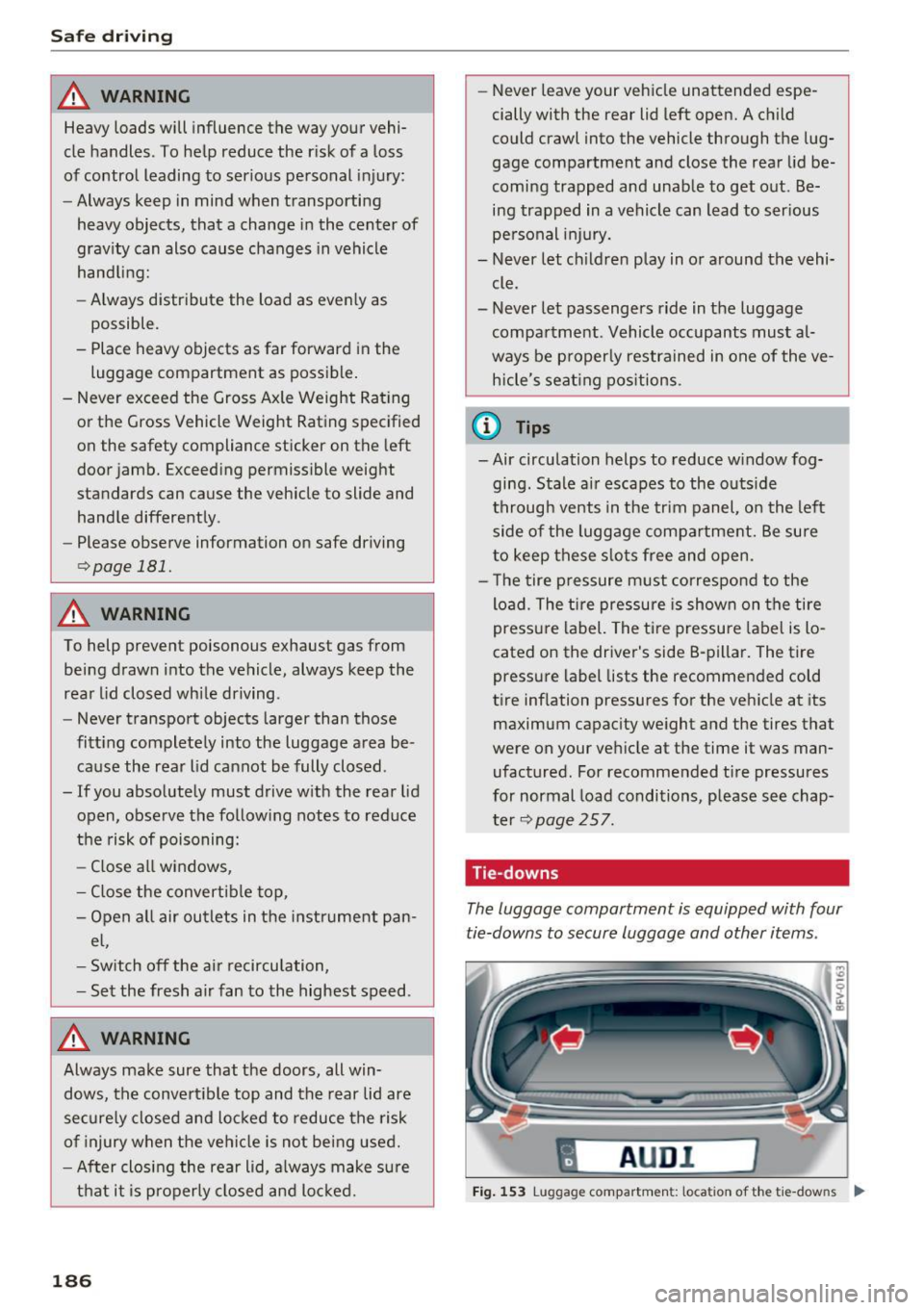
Tie -downs
The luggage compartment is equipped with four
tie-downs to secure luggage and other items .
fl AUD I I
Fig. 153 Lug gage compar tmen t: loca ti on of th e tie-dow ns ....
Page 194 of 314

Safe ty belts
-Never remove a safety be lt while the ve hicle
is mov ing . Do ing so will increase your r isk of
being injured or killed.
- Never wear belts twisted.
- Never wear belts over rigid or breakable ob -
jects in or on your cloth ing, such as eye
glasses, pens, keys, etc., as these may cause
injury.
- Never allow safety be lts to become dam
aged by being caught in door or seat hard
ware.
- Do not wear the shoulder part of the belt
under your arm or otherwise out of position.
- Severa l layers of heavy clothing may inter
fere with cor rect positioning of belts and re
duce the overall effectiveness of t he system.
- Always keep belt buckles free of anything
that may prevent the b uckle from latching
secu rely.
- Never use comfort clips or devices that cre
ate slack in the shoulder belt. However, spe
c ial clips may be requ ired for the prope r use
of some chi ld restraint systems.
- Torn or frayed safety belts can tear and
damaged belt hardware can break in an acc i
dent. Inspect belts regula rly .
If webbing,
bind ings, buckles, or ret rac to rs are dam
aged, have belts repl aced by an auth orized
Audi dealer or quali fied workshop.
- Safety belt s th at have been wo rn a nd loaded
in an accident m ust be rep lace d wi th the
c orrect repl acemen t sa fety be lt by an au
t h o rized Aud i dea le r. Replacement may be
necessary even if damage cannot be clear ly
seen. Anchorages that were loaded m ust al
so be inspected.
- Never remove, modify, disassemble, or try
to repair the safety belts yourself.
- Always keep t he be lts clean . Di rty be lts may
not work properly and can impai r the f unc
tion of the inertia reel¢
table Interior
cleaning on page 268.
192
Safety belts
Fastening safety belts
Seat first -everybody buckle up!
Fig. 159 Be lt buc kle and tongue on the driver 's seat
N
CD
~ ::i: .. a,
To p rovide m axim um pro te ct io n, safety belts
must a lways be positioned co rrectly on the wear
er's body .
.., Ad just the fron t se at prope rly ¢
page 47 , Seats
and storage.
.., Pull the safety belt even ly across the chest and
pe lvis
r::!>fig. 159, ¢ _& .
.., Insert the tongue into the correct buck le of
your seat until you hear it latch securely.
.., Pull on the belt to make sure that it is sec urely
latched in the buckle .
Automatic safety belt ret ractors
Every safety belt is equipped wit h an automatic
belt retractor on the shou lder belt . This feature
locks the belt when the belt is pulled out fast,
during hard brak ing and in an accident. The belt
may also lock when you dr ive up or down a steep
hill or through a sharp curve . During normal driv
i ng t he belt lets you move free ly .
S afety belt pretensioners
The safety belts are equ ipped w ith a belt preten
s ioner that he lps to tighten the safety belt and
remove slack when the pretensioner is activated .
The function of the pretens ioner is monitored by
a war ning light¢
page 14 .
Convertible lock ing retractor
Every safety belt except the one on the driver
seat is equipped with a convertib le lock ing retrac-
tor that
mu st be used when the safety be lt is Ill>-
Page 195 of 314
CD
CD
.... N
" N .... 0 r--. V, co
used to attach a child seat. Be sure to read the
important information about this feature
r::!) page 22 7.
.&_ WARNING
Improperly positioned safety belts can cause
serious injury in an accident
<=>page 193,
Safety belt position.
- Safety belts offer optimum protection only
when the seatback is upright and belts are
properly positioned on the body.
- Never attach the safety belt to the buckle
for another seat. Attaching the belt to the
wrong buckle will reduce safety belt effec
tiveness and can cause serious personal in
JUry.
-A passenger who is not properly restrained
can be seriously injured by the safety belt it
self when it
moves from the stronger parts
of the body into critical areas like the abdo
men.
- Always lock the convertible locking retractor
when you are securing a child seat in the ve
hicle
c> page 228.
(D Tips
For information on safety belt pretensioners,
refer tor::!)
page 194.
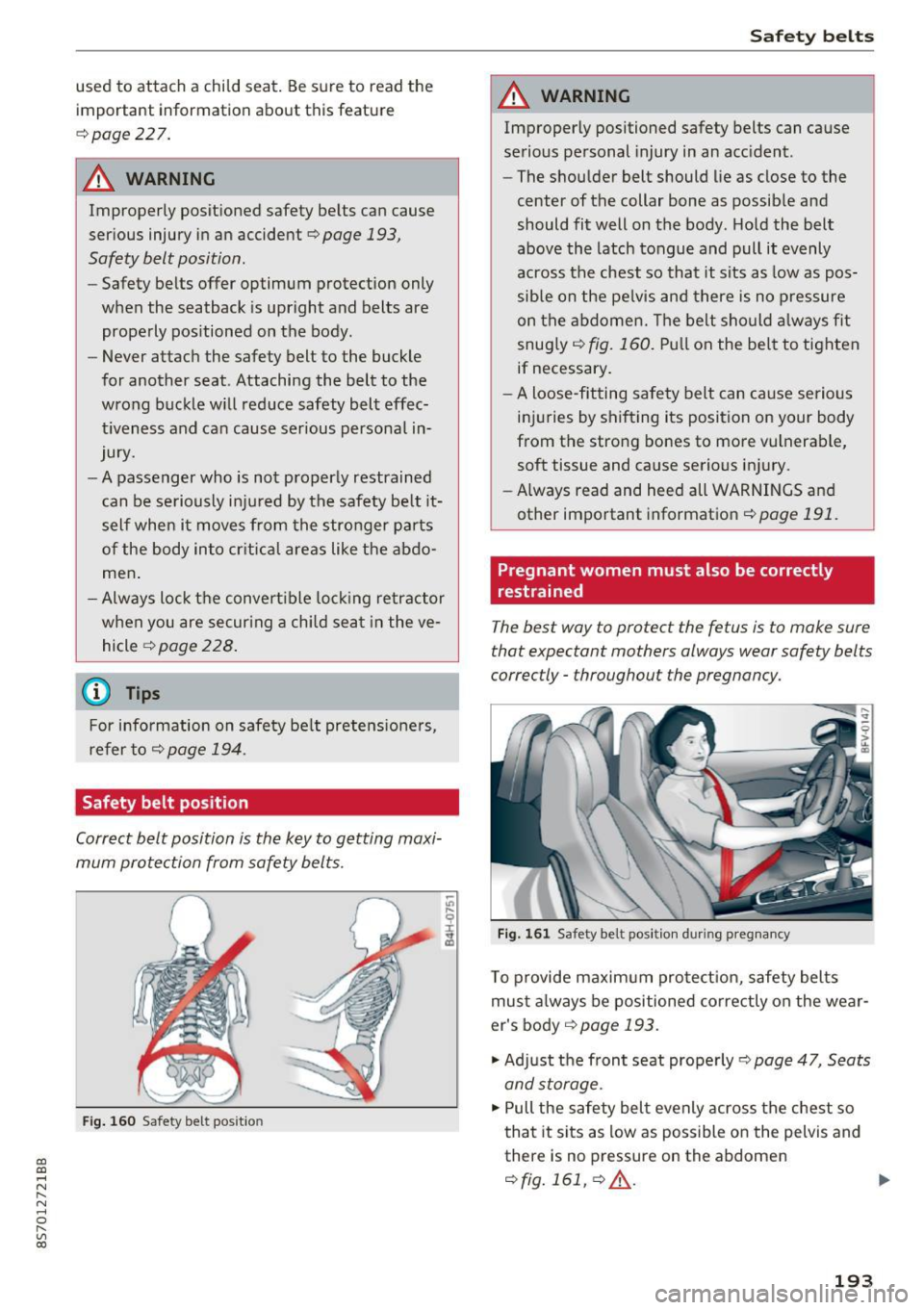
Safety belt position
Correct belt position is the key to getting maxi
mum protection from safety belts.
Fig. 160 Safety belt pos itio n
Safety belts
.&_ WARNING """-iiiiiiiii
Improperly positioned safety belts can cause
serious personal injury in an accident.
- The shoulder belt should lie as close to the
center of the collar bone as possible and
should fit well on the body. Hold the belt
above the latch tongue and pull it evenly
across the chest so that it sits as low as pos
sible on the pelvis and there is no pressure
on the abdomen. The belt should always fit
snugly
c> fig. 160. Pull on the belt to tighten
if necessary.
- A loose-fitting safety belt can cause serious
injuries by shifting its position on your body
from the strong bones to more vulnerable
I
soft tissue and cause serious injury.
- Always read and heed all WARNINGS and
other important information
i=;, page 191.
Pregnant women must also be correctly
restrained
The best way to protect the fetus is to make sure
that expectant mothers always wear safety belts
correctly- throughout the pregnancy.
Fig. 161 Safety belt position during pregnancy
To provide maximum protection, safety belts
must always be positioned correctly on the wear
er's body
<=> page 193.
"'Adjust the front seat properly c> page 47, Seats
and storage.
"' Pull the safety belt evenly across the chest so
that it sits as low as possible on the pelvis and
there is no pressure on the abdomen
c>fig .161 ,r=> .&_ .
193
Page 211 of 314

co
co
.... N
" N .... 0
" "' c:o
met, be sure to check the light regularly to make
certain that the
P A SSENGER AIR BAG OFF '-1;
light stays on continuously whenever the ignition
is on. If the
PAS SENGER AIR BAG OFF '-1; light
does not appear on and does not stay on all the
time, stop as soon as it is safe to do so and
- reactivate the system by turning the ign ition
off for more than 4 seconds and then turning it
on again;
- remove and reinstall the child restraint. Make sure that the child restraint is properly installed and that the safety belt for the front pas
senger seat has been correctly routed through
the child restraint as descr ibed in the child re
straint manufacturer's i nstructions;
- make sure that the convertible locki ng retrac
tor on the safety be lt for the front passenger
seat has bee n activated and that the safety belt
has been pulled tight.
- make sure that no electrical device (such as a
laptop, CD player, electronic games device,
power inverter or seat hea ter for child seats) is
placed or used on the front passenger seat if
the device is connected to the 12•volt socket or
the cigarette lighter socket;
- make sure that no seat heater has been retro
fitted or otherwise added to the front passen
ger seat;
- make sure that nothing can interfere with the
safety belt buckles and that they are not ob
structed;
- make sure that there are no wet objects (such
as a wet towel) and no water or other liquids on
the front passenger seat cush ion.
If the PASSENGER AIR BAG OFF~; light st ill
doe s not come on ...
If the PAS SENGER AIR BA G OFF '-1; light sti ll
does not come on and does not stay on continu
ously (when the ignition is sw itched on),
- take the child restraint off t he front passenger
seat and have the airbag system inspected by
your Audi dealer immed iate ly.
Th e PASSENGER AIR BAG OFF~; light
should NOT come on ...
The PA SSENGER AIR BAG OFF ~ ; light should
NOT come on when the ign ition is on and an
Airb ag sys tem
adult is sitting in a proper seating pos ition on the
front passenger seat. If the
PASSENGER AIR
BAG OFF~;
light comes on and stays on whi le
driv ing, under these c ircumstances, make sure
that:
- the adult on the front passenger seat is proper
ly seated on the center of the seat cushion w ith
his or her back up against the backrest and the backrest is not reclined,
- the adult is not taking we ight off the seat by
holding on to the passenger assist handle
above the front passenger door or support ing
their weight on the armrest,
- the safety belt is being properly worn and that
there is not a lot of slack in the safety belt web
b ing ,
- there are no aftermarket seat covers or cush
ions or other things (such as blankets) on the
front passenger seat that might cause the ca pacitive passenge r detection system to miscal
culate e lectr ica l capaci ta nce.
' Important safety instructions on
monitoring the Advanced Airbag System
A WARNING
--- If the stat us of the Advanced Airbag System
has changed while the vehicle is moving, the
PASSENGER AIR BAG OFF '-1; ON @ light
blin ks for about 5 seconds to cat ch the driv
er 's attent ion . If this happens, a lways stop
as soon as it is sa fe to do so and check the
steps described above .
- If the
PASSENGER AIR BAG OFF~; light
does not go off when an adult who is not
very small is sitting on the front passenger
seat after tak ing the steps described above,
have the airbag system inspected by your
author ized Audi dealer before t ransporting
anyone on the front passenger seat .
A WARNING ....._
An airbag system that is not functioning prop
e rly cannot prov ide supplemental protect io n
i n a fronta l crash.
- If the ai rbag ind icator light
<=:> page 14
comes when the veh icle is being used, have
209
Page 223 of 314
co
co
.... N
" N .... 0
" "' c:o
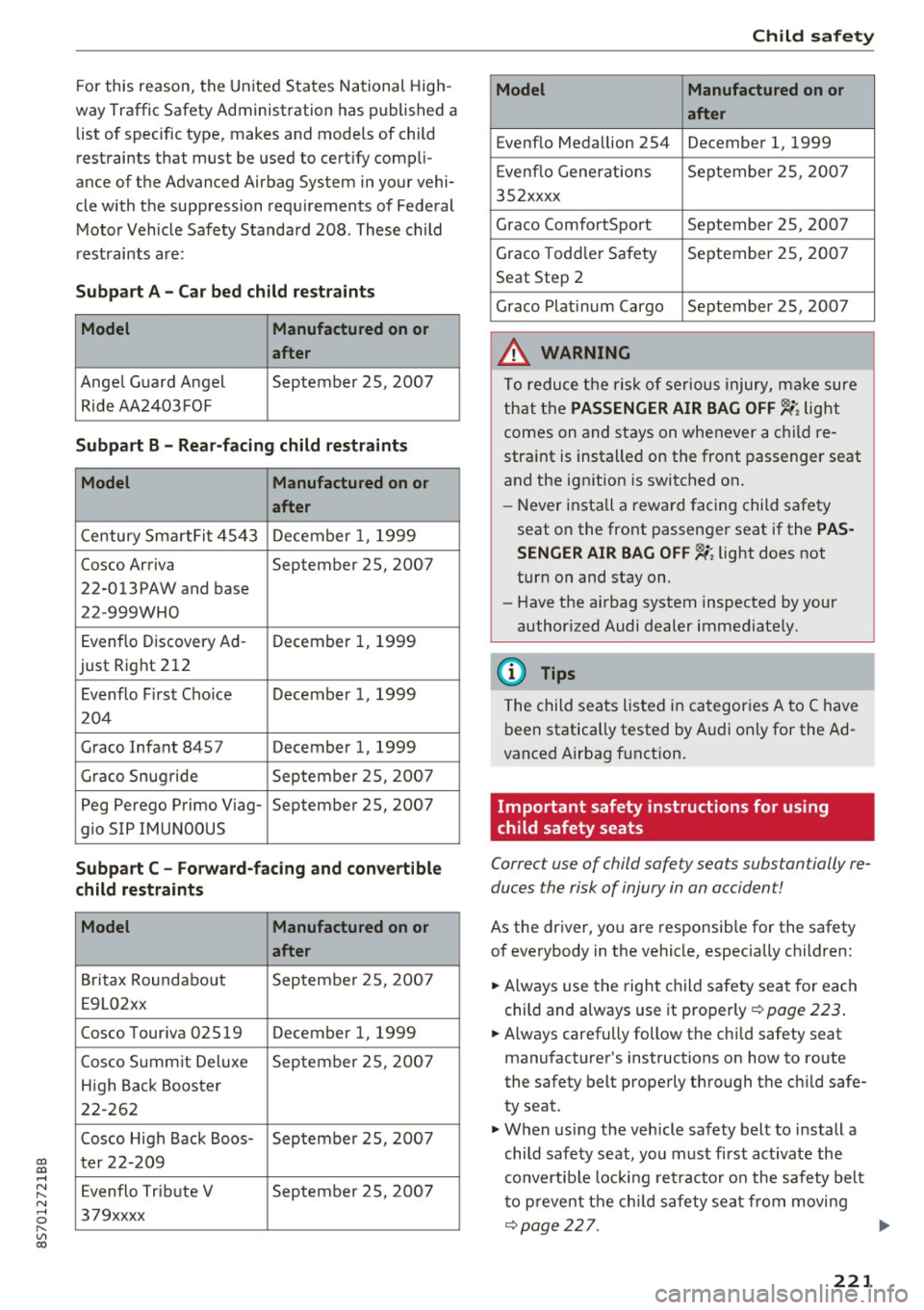
For this reason, the United States National High
way Traffic Safety Administration has published a
list of specific type, makes and models of child
restraints that must be used to certify compli
ance of the Advanced Airbag System in your vehi
cle with the suppression requirements of Federal Motor Vehicle Safety Standard 208. These child
restraints are:
Subpart A - Car bed child restraints
Model Manufactured on or
after
Angel Guard Angel September 25, 2007
Ride AA2403 FOF
Subpart B -Rear-facing child restraints
Model Manufactured on or
after
Century SmartFit 4543 December 1, 1999
Cosco Arriva September 25, 2007
22-013PAW and base
22-999WHO
Evenflo Discovery Ad- December 1, 1999
just Right 212
Evenflo Fir st Cho ice December 1, 1999
204
Graco Infant 8457 December 1, 1999
Graco Snug ride September 25, 2007
Peg Perego Primo Viag- September 25, 2007
gio SIP IMUNOOUS
Subpart C - Forward-facing and convertible
child restraints
Model Manufactured on or
after
Britax Roundabout September 25, 2007
E9L02xx
Cosco Touriva 02519 December 1, 1999
Cosco Summit Deluxe September 25, 2007
High Back Booster
22-262
Cosco High Back Boos- September 2S, 2007
ter 22-209
Evenflo Tribute V September 25, 2007
379xxxx
Child safety
Model Manufactured on or
after
Evenflo Medallion 2S4 December 1, 1999
E venflo Generations September 2S, 2007
352xxxx
Graco ComfortSport September 25, 2007
Graco Todd ler Safety September 25, 2007
Seat Step 2
Graco Plat inum Cargo September 25, 2007
_&. WARNING
To reduce the risk of serious injury, make sure
that the
PASSENGER AIR BAG OFF '1,;; light
comes on and stays on whenever a child re
straint is installed on the front passenger seat
and the ignition is switched on.
- Never install a reward facing child safety
seat on the front passenger seat if the
PAS
SENGER AIR BAG OFF
'1,;; light does not
turn on and stay on.
- Have the airbag system inspected by your
authorized Audi dealer immed iately.
(D Tips
The child seats listed in categories A to C have
been statically tested by Audi only for the Ad
vanced Airbag function.
Important safety instructions for using
child safety seats
Correct use of child safety seats substantially re
duces the risk of injury in an accident!
As the driver, you are responsible for the safety
of everybody in the vehicle, especially children:
.. Always use the right child safety seat for each
child and always use it properly ¢
page 223.
.. Always carefully follow the chi ld safety seat
manufacturer's instructions on how to route
the safety belt properly through the child safe
ty seat.
.. When using the veh icle safety belt to install a
child safety seat, you must first activate the
convertib le loc king retractor on the safety belt
to prevent the chi ld safety seat from moving
¢page 227. ..,.
221
Page 225 of 314
CD
CD
.... N
" N .... 0
" V, co
seat if the device is connected to the 12-
volt socket or the cigarette lighter socket.
- If a seat heater has been retrofitted or
otherwise added to the front passenger
seat, never install any child restraint sys
tem on th is seat.
- Make sure that there are no wet objects
(such as a wet towel) and no water
or oth
er liqu ids on the front passenger seat
cushion.
- Never place objects on the seat (such as a
laptop, CD player, electronic games de
vice, power inverter or seat heater for
child seats). These may influence the elec
tr ica l capacitance measured by the capaci
tive passenge r detection system and can
also fly around in an accident and cause
serio us personal i njury.
- Always buckle the child safe ty seat firmly in
place even if a child is not sitting in it. A
loose child safety seat can fly around during
a sudden stop or in a collision .
-Always read and heed all WARNINGS when"
ever using a child restrained in a veh icle is
being used¢
page 189, Safety belts,
¢page 196, Airbag system
and
¢ page 218, Child safety.
A WARNING
To reduce the risk of serious in jury, make sure
that the PASSENGER AIR BAG OFF~; light
comes on and stays on wheneve r a child re
st raint is ins talled on the front passenger seat
and the ignition is sw itched on.
- Never ins tall a reward facing ch ild safety
seat on the front passenger seat if the PAS
SENGER AIR BAG OFF~; ligh t does not
t u rn on and stay on.
- Have the airbag system inspected by your
authori zed Aud i deale r im mediately.
Ch ild sa fety
Child seats
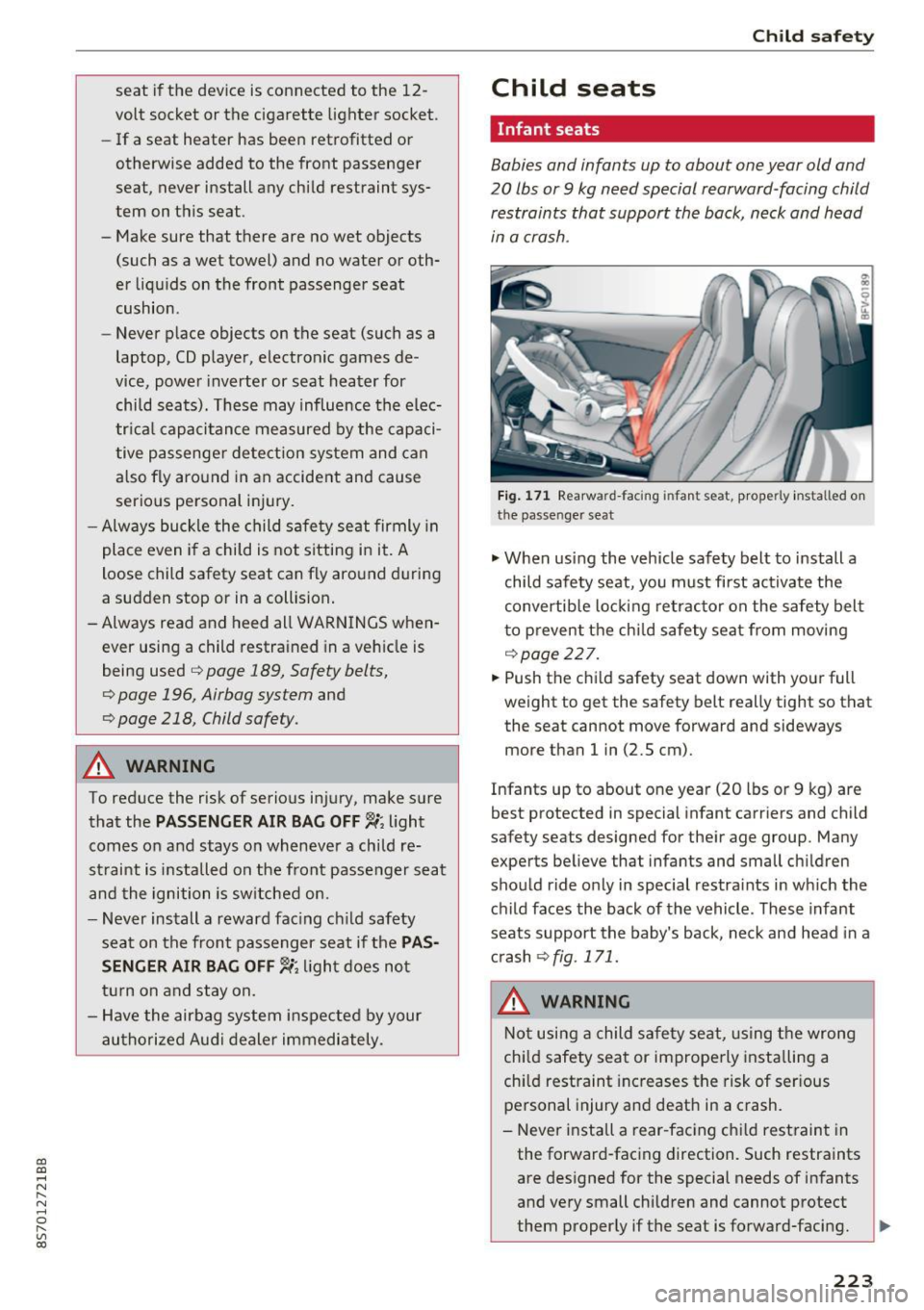
Infant seats
Babies and infants up to about one year old and
20 lbs or
9 kg need special rearward-facing child
restraints that support the back, neck and head
in a crash .
Fig . 17 1 Rearwa rd-facing infant seat, prope rly installed on
the passenger seat
.,. When us ing the vehicle safety belt to install a
child safety seat, yo u must first activate the
convertib le lo ckin g re tractor on the safety belt
to p revent the ch ild safety seat from moving
¢ page 227.
.,. Push the ch ild safety seat down with your full
weight to get the safety belt really tight so that
the seat cannot move forward and sideways
more than 1 in (2.5 cm).
Infants up to about one year (20 lbs or 9 kg) are
best protected in special infant carriers and child
safety seats designed for their age group. Many
experts be lieve that infants and small ch ildren
should ride only in special restraints in wh ich the
child faces the back of the vehicle . These infant
seats support the baby's back, neck and head in a
cr ash
¢fig. 171.
A WARNING
Not using a child sa fe ty seat, using t he wrong
chi ld safety seat or imprope rly inst alling a
chi ld restraint increases the risk of ser ious
personal injury and death in a crash.
- Never install a rear -fac ing ch ild rest raint in
the forward-facing direction. Such restraints
are des igned for the special needs of infants
and very small children and cannot protect
them proper ly if the seat is forward-facing.
223
Page 226 of 314
Child safety
-Never install a rearward facing child safety
seat on the front passenger seat unless the
PASSE NGER AIR BAG OFF,;; light comes
on and stays on. If the
PA SSEN GE R AIR
BAG OFF ,;;
light does not come on and stay
on the inf lating airbag w ill hit the child safe
ty seat or infant ca rr ier with great force and
will smash the chi ld safety seat and chi ld
against the backrest, center armrest, door
or roof. Have the airbag system inspected
immediately by your Audi dealer.
- Never place or use any electrical device
(such as a laptop, CD player, electronic
games device, power inverter or seat heater
for child seats) on the front passenger seat
if the device is connected to the 12-volt
socket or the cigarette lighter socket.
- If a seat heater has been retrof itted or oth
erwise added to the front passenger seat,
never install any ch ild restraint system on
this seat .
- Make sure that there are no wet objects
(such as a wet towel) and no water or other
liquids on the front passenger seat cushion.
- Never place objects on the seat (such as a
laptop, CD player, electronic games dev ice,
power inverter or seat heater for child
seats). T hese may influence the e lectr ica l
capacitance measured by the capaci tive pas
senger detection system and can also fly
around in an accident and ca use serious per
sonal injury.
- Always read and heed all WARN INGS when
ever using a child restrained in a vehicle is
being used
Q page 189, Safety belts,
¢ page 196, Airbag system
and
¢ page 218, Important information.
224
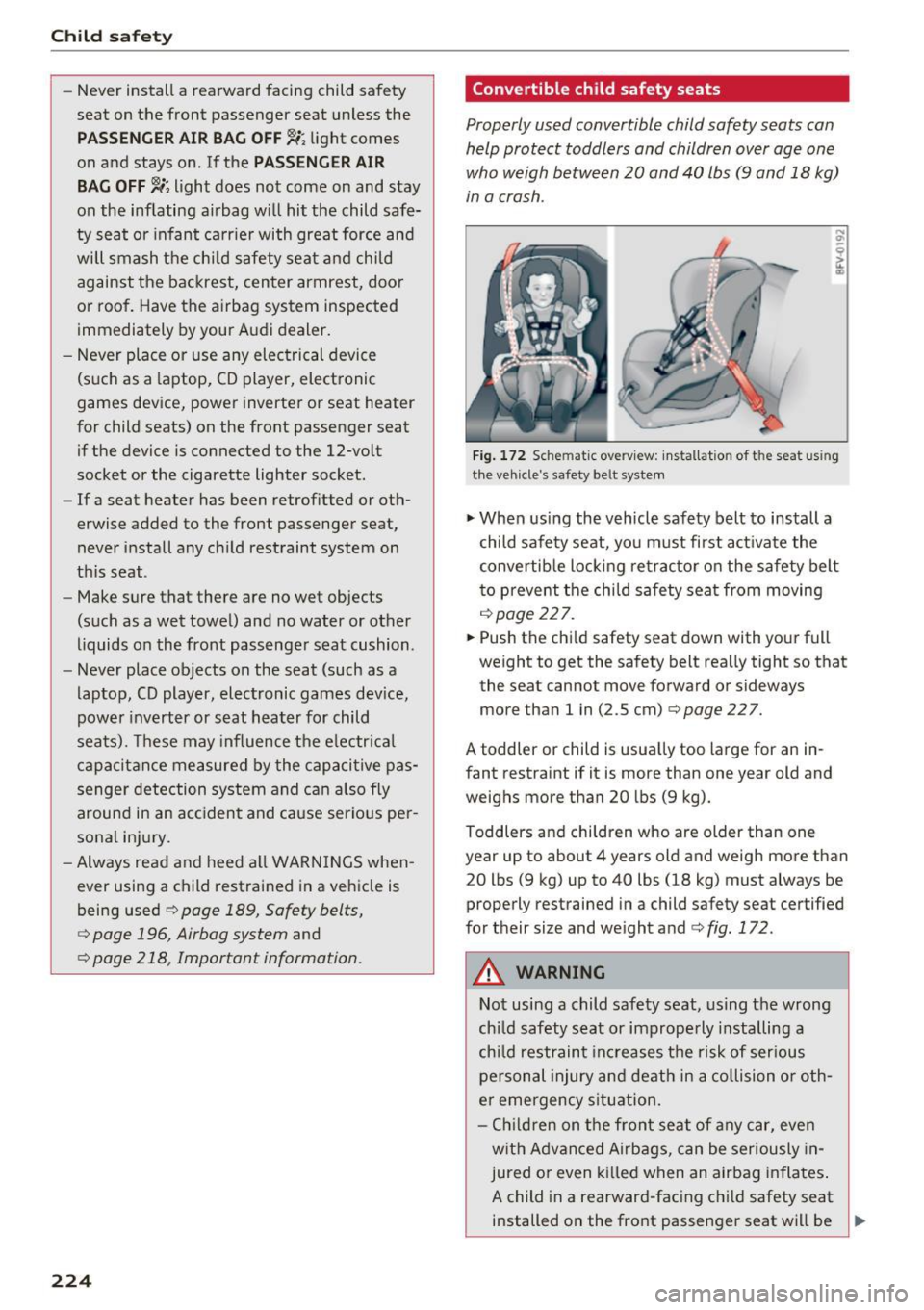
Convertible child safety seats
Properly used convertible child safety seats con
help protect toddlers and children over age one who weigh between 20 and 40 lbs (9 and 18 kg)
in a crash .
.... a,
Fig. 1 72 Sche matic overv iew : installat ion of t he seat using
the vehicle's safety belt system
""When using the vehicle safety belt to install a
child safety seat, yo u must first act ivate the
convertib le locking retractor on the safety belt
t o prevent the chi ld safety seat from moving
¢ page 227.
"" Push the chi ld safety seat down with your full
weight to get the safety belt really tight so that
the seat cannot move forward or sideways
more than 1 in (2.S cm)¢
page 227.
A toddler or child is usua lly too large for an in
fant restraint if it is more than one year old and
weighs more than 20 lbs (9 kg).
Toddlers and children who are older than one
year up to about 4 years old and weigh more than 20 lbs (9 kg) up to 40 lbs (18 kg) must always be
properly restrained in a child safety seat certified
for their size and we ight and ¢
fig. 172 .
A WARNING
Not using a child safety seat, using the wrong
chi ld safety seat or imprope rly installing a
chi ld restrain t inc reases the risk of ser ious
personal injury an d death in a co llision or oth
e r emergency s ituation.
- Ch ild ren on t he front seat of a ny car, eve n
w it h Advanced Airbags, can be seriously in
jured or even kill ed when an airbag inflates .
A child in a rearward-facing ch ild safety seat
installed on the front passenger seat will be .,.
Page 228 of 314
Child safety
The vehicle's safety belts alone will not fit most
childr en until they are at least 4
ft 9 in (57 in/
1.45 m) tall and weigh about 80 lbs (36 kg) .
Booster seats raise these children up so that the
safety belt will pass properly over the s tronger
parts of their bodies and the safety belt can help
protect them in a crash .
"' Do not use the convertible locking retractor
when using the vehicle's safety belt to restrain
a child on a booster seat .
"'The shoulder belt must lie as close to the cen
ter of the child's collar bone as possible and must lie flat and snug on the upper body.
It
must never lie across the throat or neck. The
lap belt must lie across the pelvis and never
across the stomach or abdomen. Make sure the
belt lies flat and snug . Pull on the belt to tight
en if necessary .
Children up to at least 8 years old (over 40 lbs or
18 kg) are best protected in child safety seats de
signed for their age and weight. Experts say that
the skeletal structure, particularly the pelvis, of
these children is not fully developed, and they
must not use the vehicle safety belts without a
suitable child restraint.
It is usually best to put these children in appro
priate booster seats. Be sure the booster seat
meets all applicable safety standards.
Booster seats raise the seating position of the
child and reposition both the lap and shoulder
parts of the safety belt so that they pass across
the child's body in the right places . The routing of
the belt over the child's body is very important
for the child's protection, whether or not a boos
ter seat is used.
Never use the lap belt portion of the vehicle 's
safety belt alone to restrain any child, regardless
of how big the child is. Always remember that
children do not have the pronounced pelvic struc
ture required for the proper function of lap belt
port ion of the vehicle's three point lap and
shoulder belts . The child's safety absolutely re
quires that a lap belt portion of the safety belt be
fastened snugly and as low as possible around the pelvis. Never let the lap belt portion of the
226
safety belt pass over the child's stomach or abdo
men.
In a crash, airbags must inflate w ithin a blink of
an eye and with considerable force. In order to do
its job, the airbag needs room to inflate so that it
will be there to protect the occupant as the occu
pant moves forward into the airbag.
A vehicle occupant who is out of pos it ion and too
close to the airbag gets in the way of an inflating
airbag. When an occupant is too close, he or she
will be struck vio lently and w ill receive serious or
possibly even fatal injury.
In order for the airbag to offer protection, it is
important that all vehicle occupants , especially
any ch ildren, who must be in the front seat be
cause of exceptional circumstances, be properly
restrained and as far away from the airbag as
possible. By keeping room between the child 's
body and the front of the passenger compart
ment, the airbag can inflate completely and pro
vide supplemental protection in certa in frontal
collisions.
,&. WARNING
Not using a booster seat, using the booster
seat improperly, incorrect ly installing a boos
ter seat or using the vehicle safety belt im
proper ly increases the risk of serious personal
injury and death in a collision or other emer
gency situation. To help reduce the risk of se
rious personal injury and/or death:
- The shoulder belt must lie as close to the
center of the child's collar bone as possible
and must lie flat and snug on the upper
body . It must never lie across the throat or
neck . T he lap belt must lie across the pelvis
and never across the stomach or abdomen.
Ma ke sure that the be lt lies flat and snug.
Pull on the belt to tighten if necessary.
- Failure to properly route safety belts over a
child's body will cause severe injuries in an
accident or other emergency situation
<=> page 189.
- The rear side of the chi ld safety seat should
be positioned as close as possible to the
backrest on the veh icle seat.
-