2017 AUDI TT ROADSTER ESP
[x] Cancel search: ESPPage 220 of 314
Child safety
Child safety
Important information
Introduction
The physical principles of what happens when
your vehicle is in a crash apply also to children
¢ page 190, What happens to occupants not
wearing safety belts?.
But unlike adults and
teenagers, their muscles and bones are not fully
developed. In many respects children are at
greater risk of serious injury in crashes than
adults.
Because children's bodies are not fully devel
oped, they require restraint systems especially
designed for their size, weight, and body struc
ture. Many countries and all states of the United
States and provinces of Canada have laws requir
ing the use of approved child restraint systems
for infants and small children .
In a frontal crash at a speed of 20-35 mph (30-56 km/h) the forces acting on a 13 lbs (6 kg)
infant will be more than 20 times the weight of
the child . This means the weight of the child
would suddenly be more than 260 lbs (120 kg).
Under these conditions, only an appropriate child
restraint properly used can reduce the risk of se
rious injury. Child restraints, like adult safety
belts, must be used properly to be effective.
Used improperly, they can increase the risk of se
rious injury in an accident.
If you must install a child restraint on the front
passenger seat in exceptional circumstances, be
sure to read and heed the important information
and warnings ¢
page 197. Infants and other chil
dren who are properly restrained in an appropri
ate child restraint that is for their size and age
can benefit from the protection that supplemen
tal side airbags provide in some kinds of crashes .
For more information please see information
provided by the:
- National Highway Traffic Safety Administration
(NHTSA), currently at: http:/ /www .safe
rcar.gov (for the USA)
- Transport Canada Information Centre, current
ly at: http:/ /www.tc.gc .ca (for Canada)
218
Consult the child safety seat manufacturer's in
structions in order to be sure the seat is right for
your child's size
r:!;> page 221 , Important safety
instructions for using child safety seats.
Please
be sure to read and heed all of the important in
formation and WARNINGS about child safety,
Advanced Airbags, and the installation of child
restraints in this chapter .
There is a lot you need to know about the Ad
vanced Airbags in your vehicle and how they work
when infants and children in child restraints are
on the front passenger seat. Because of the large
amount of important information, we cannot re
peat it all here . We urge you to read the detailed
information in this owner's manual about airbags
and the Advanced Airbag System in your vehicle
and the very important information about trans porting children on the front passenger seat.
Please be sure to heed the WARNINGS -they are
extremely important for your safety and the safe
ty of your passengers, especially infants and
small children .
A WARNING
All vehicle occupants and especially children
must be restrained properly whenever riding
in a vehicle . An unrestrained or improperly re
strained child could be injured by striking the
interior or by being ejected from the vehicle
during a sudden maneuver or impact. An un
restrained or improperly restrained child is al
so at greater risk of injury or death through
contact with an inflating airbag.
A WARNING
Children on the front seat of any car even with
Advanced Airbags can be seriously injured or
even killed when an airbag inflates . A child in
a rearward-facing child safety seat installed
on the front passenger seat will be seriously
injured and can be killed if the front airbag in
flates.
- The inflating airbag will hit the child safety
seat or infant carrier with great force and
will smash the child safety seat and child
against the backrest, center armrest, or
door.
Page 223 of 314
co
co
.... N
" N .... 0
" "' c:o
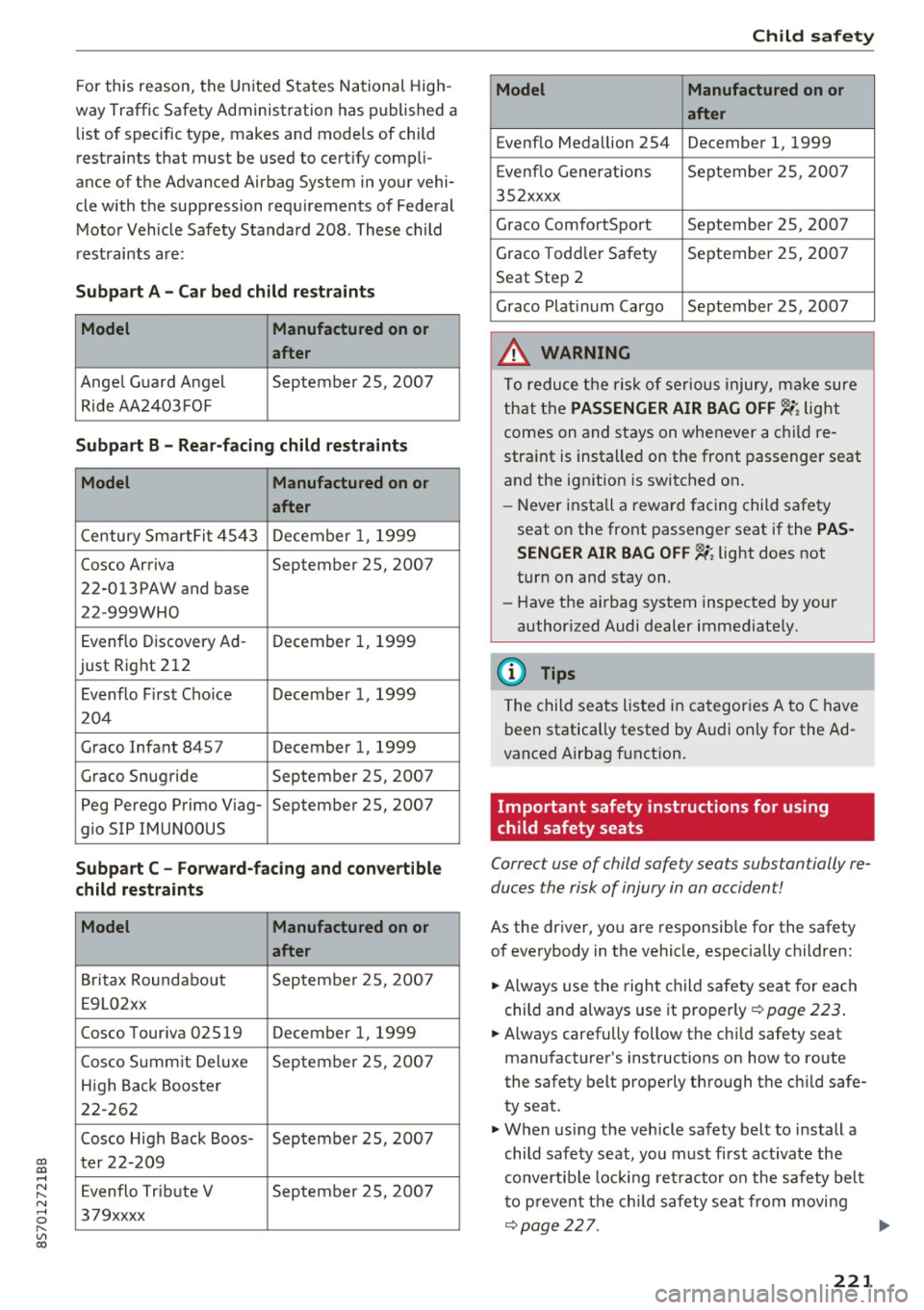
For this reason, the United States National High
way Traffic Safety Administration has published a
list of specific type, makes and models of child
restraints that must be used to certify compli
ance of the Advanced Airbag System in your vehi
cle with the suppression requirements of Federal Motor Vehicle Safety Standard 208. These child
restraints are:
Subpart A - Car bed child restraints
Model Manufactured on or
after
Angel Guard Angel September 25, 2007
Ride AA2403 FOF
Subpart B -Rear-facing child restraints
Model Manufactured on or
after
Century SmartFit 4543 December 1, 1999
Cosco Arriva September 25, 2007
22-013PAW and base
22-999WHO
Evenflo Discovery Ad- December 1, 1999
just Right 212
Evenflo Fir st Cho ice December 1, 1999
204
Graco Infant 8457 December 1, 1999
Graco Snug ride September 25, 2007
Peg Perego Primo Viag- September 25, 2007
gio SIP IMUNOOUS
Subpart C - Forward-facing and convertible
child restraints
Model Manufactured on or
after
Britax Roundabout September 25, 2007
E9L02xx
Cosco Touriva 02519 December 1, 1999
Cosco Summit Deluxe September 25, 2007
High Back Booster
22-262
Cosco High Back Boos- September 2S, 2007
ter 22-209
Evenflo Tribute V September 25, 2007
379xxxx
Child safety
Model Manufactured on or
after
Evenflo Medallion 2S4 December 1, 1999
E venflo Generations September 2S, 2007
352xxxx
Graco ComfortSport September 25, 2007
Graco Todd ler Safety September 25, 2007
Seat Step 2
Graco Plat inum Cargo September 25, 2007
_&. WARNING
To reduce the risk of serious injury, make sure
that the
PASSENGER AIR BAG OFF '1,;; light
comes on and stays on whenever a child re
straint is installed on the front passenger seat
and the ignition is switched on.
- Never install a reward facing child safety
seat on the front passenger seat if the
PAS
SENGER AIR BAG OFF
'1,;; light does not
turn on and stay on.
- Have the airbag system inspected by your
authorized Audi dealer immed iately.
(D Tips
The child seats listed in categories A to C have
been statically tested by Audi only for the Ad
vanced Airbag function.
Important safety instructions for using
child safety seats
Correct use of child safety seats substantially re
duces the risk of injury in an accident!
As the driver, you are responsible for the safety
of everybody in the vehicle, especially children:
.. Always use the right child safety seat for each
child and always use it properly ¢
page 223.
.. Always carefully follow the chi ld safety seat
manufacturer's instructions on how to route
the safety belt properly through the child safe
ty seat.
.. When using the veh icle safety belt to install a
child safety seat, you must first activate the
convertib le loc king retractor on the safety belt
to prevent the chi ld safety seat from moving
¢page 227. ..,.
221
Page 224 of 314
Child safety
"'Push the child safety seat down with your full
weight to get the safety belt really tight so that
the seat cannot move forward and sideways
more than 1 in (2.5 cm).
Always remember: Even though your vehicle is
equipped with an Advanced Airbag system, a
child should always ride in the seat properly re
strained for its age and si ze.
A WARNING
Not using a child safety seat, using the wrong
child safety seat or improperly installing a
child restraint increases the risk of serious
personal injury and death.
-All vehicle occupants and especially children
must be restrained properly whenever riding
in a vehicle. An unrestrained or improperly
restrained child could be injured by striking
the interior or by being ejected from the ve
hicle during a sudden maneuver or impact.
An unrestrained or improperly restrained
child is also at greater risk of injury or death
through contact with an inflating airbag.
- Commercially available child safety seats
are required to comply with U .S. Federal
Motor Vehicle Safety Standard (FMVSS) 213
(in Canada CMVSS 213).
- When buying a child restraint, select one
that fits your child and the vehicle.
- Only use child restraint systems that fully
contact the flat portion of the seat cush
ion. The child restraint must not tip or
lean to either side. Audi does not recom
mend using child safety seats that rest on
legs or tube-like frames. They do not pro
vide adequate contact with the seat.
- Always heed all legal requirements per
taining to the installation and use of child
safety seats and carefully follow the in
structions provided by the manufacturer
of the seat you are using .
- Never let more than one child occupy a child
safety seat .
- Never let babies or older children ride in a
vehicle while sitting on the lap of another
passenger .
222
-Holding a child in your arms is never a sub
stitute for a child restraint system.
- The strongest person could not hold the
child with the forces that exist in an acci
dent. The child will strike the interior of
the vehicle and can also be struck by the passenger.
- The child and the passenger can also in
jure each other in an accident.
- Never install rear-facing child safety seats
or infant carriers on the front passenger
seat . A child will be seriously injured and
can be killed when the passenger airbag in
flates -even with an Advanced Airbag Sys
tem.
- The inflating airbag will hit the child safety
seat or infant carrier with great force and
will smash the child safety seat and child
against the backrest, center armrest, door
or roof.
- If exceptional circumstances require the use
of a forward-facing child restraint on the
front passenger's seat, the child's safety
and well-being require that the following
special precautions be taken:
- Make sure the forward-facing seat has
been designed and certified by its manu
facturer for use on a front seat with a pas
senger front and side airbag.
- Always carefully follow the manufacturer's
instructions provided with the child safety
seat or carrier.
- Always move the front passenger seat into
the rearmost position of the passenger
seat's fore and aft adjustment range, and
as far away from the airbag as possible be
fore installing the child restraint.
- Always make sure that nothing prevents
the front passenger's seat from being
moved to the rearmost position in its fore
and aft adjustment range.
- Always make sure that the backrest is in
the upright position.
- Never place or use any electrical device
(such as a laptop, CD player, electronic
games device, power inverter or seat heat-
er for child seats) on the front passenger ..,.
Page 228 of 314
Child safety
The vehicle's safety belts alone will not fit most
childr en until they are at least 4
ft 9 in (57 in/
1.45 m) tall and weigh about 80 lbs (36 kg) .
Booster seats raise these children up so that the
safety belt will pass properly over the s tronger
parts of their bodies and the safety belt can help
protect them in a crash .
"' Do not use the convertible locking retractor
when using the vehicle's safety belt to restrain
a child on a booster seat .
"'The shoulder belt must lie as close to the cen
ter of the child's collar bone as possible and must lie flat and snug on the upper body.
It
must never lie across the throat or neck. The
lap belt must lie across the pelvis and never
across the stomach or abdomen. Make sure the
belt lies flat and snug . Pull on the belt to tight
en if necessary .
Children up to at least 8 years old (over 40 lbs or
18 kg) are best protected in child safety seats de
signed for their age and weight. Experts say that
the skeletal structure, particularly the pelvis, of
these children is not fully developed, and they
must not use the vehicle safety belts without a
suitable child restraint.
It is usually best to put these children in appro
priate booster seats. Be sure the booster seat
meets all applicable safety standards.
Booster seats raise the seating position of the
child and reposition both the lap and shoulder
parts of the safety belt so that they pass across
the child's body in the right places . The routing of
the belt over the child's body is very important
for the child's protection, whether or not a boos
ter seat is used.
Never use the lap belt portion of the vehicle 's
safety belt alone to restrain any child, regardless
of how big the child is. Always remember that
children do not have the pronounced pelvic struc
ture required for the proper function of lap belt
port ion of the vehicle's three point lap and
shoulder belts . The child's safety absolutely re
quires that a lap belt portion of the safety belt be
fastened snugly and as low as possible around the pelvis. Never let the lap belt portion of the
226
safety belt pass over the child's stomach or abdo
men.
In a crash, airbags must inflate w ithin a blink of
an eye and with considerable force. In order to do
its job, the airbag needs room to inflate so that it
will be there to protect the occupant as the occu
pant moves forward into the airbag.
A vehicle occupant who is out of pos it ion and too
close to the airbag gets in the way of an inflating
airbag. When an occupant is too close, he or she
will be struck vio lently and w ill receive serious or
possibly even fatal injury.
In order for the airbag to offer protection, it is
important that all vehicle occupants , especially
any ch ildren, who must be in the front seat be
cause of exceptional circumstances, be properly
restrained and as far away from the airbag as
possible. By keeping room between the child 's
body and the front of the passenger compart
ment, the airbag can inflate completely and pro
vide supplemental protection in certa in frontal
collisions.
,&. WARNING
Not using a booster seat, using the booster
seat improperly, incorrect ly installing a boos
ter seat or using the vehicle safety belt im
proper ly increases the risk of serious personal
injury and death in a collision or other emer
gency situation. To help reduce the risk of se
rious personal injury and/or death:
- The shoulder belt must lie as close to the
center of the child's collar bone as possible
and must lie flat and snug on the upper
body . It must never lie across the throat or
neck . T he lap belt must lie across the pelvis
and never across the stomach or abdomen.
Ma ke sure that the be lt lies flat and snug.
Pull on the belt to tighten if necessary.
- Failure to properly route safety belts over a
child's body will cause severe injuries in an
accident or other emergency situation
<=> page 189.
- The rear side of the chi ld safety seat should
be positioned as close as possible to the
backrest on the veh icle seat.
-
Page 230 of 314
Child safet y
A WARNING
Always take spec ial precaut ions if you must
install a forward or rearward-fac ing ch ild re
straint on the front passenger's seat in excep
tional situations:
- Whenever a forward or rearwa rd-facing
child restraint is insta lled on the front pas
senger seat, t he
PASSENGER AIR BAG OFF
~; light mus t come on and stay on whenev
e r t he ignition is sw itche d on.
- If the
PASSENGER AIR BAG OFF~; light
does not come on and stay on, perform the
checks described~
page 207, Monitoring
the Advanced Airbag System.
- If the PASSENGER AIR BAG OFF~; light
does not come on and stay on whenever the
ignition is switched on the inflating air bag
will hit the c hild safety seat o r infant carrier
with great force and will smash the child
safety seat and child against the backrest, center armrest, door or roof. Have the air
bag system inspected immediately by your
Audi dealer.
- Improper installation of ch ild restraints can
red uce their effect iveness or even prevent
t h em from p roviding any p rotection .
-An improperly installed c hild rest raint can
interfere w ith the airbag as it deploys and
seriously injure or even kill the child.
- Always carefully follow the manufac turer 's
instructions p rovided w ith the ch ild safety
seat or car rier.
- After checking to ma ke sure that the child
restra int is prope rly installed, ma ke certai n
t h at the child res traint is co rrec tly recog
ni ze d by the c apac it ive passenger detec tion
system in the front passenger sea t and that
the
PASSENGER AIR BAG OFF~. light sig
nals the correct front passenger frontal air
bag status.
A WARNING
Forward-fac ing ch ild rest raints:
- Always make sure the forward-facing seat
has been designed and cert ified by its man
ufact urer for use on a front seat with a pas
senger front and side a irbag .
228
-Never put the fo rwa rd-facing child restraint
up, against o r very near the instrument pan
el.
- Always move the passenge r seat into its
rearmost posit ion in the seat's fo re and aft
ad justment range , as far away from the a ir
bag as poss ible before installing the for
ward-facing chi ld restraint. The back res t
m ust be adjusted to an upr ight position.
- Ma ke sure that the
PASSENGER AIR BAG
OFF ~;
light comes on and stays on all the
time w heneve r the ig nition is switched o n.
A WARNING
R earward-faci ng chi ld restrain ts:
- A child in a rearward-fac ing ch ild safety seat
installed on the fron t passenger seat will be
serious ly injure d and can be killed if t he
front airbag infl ates -even with an Ad
vance d Ai rb ag System.
- The infl ating air bag will h it t he ch ild safety
sea t or i nfan t car rier with great force an d
w ill smash the child safety seat and child
aga inst the backrest, center a rm rest, door
or roof.
- Always be especially carefu l if yo u must in
stall a rea rward facing child safety seat on
the front passenge r seat in exceptiona l cir
cumstances.
- Make sure that the
PASSENGER AIR BAG
OFF ~;
light comes on and stays on all the
time wheneve r the ign it ion is switched on.
- If the
PASSENGER AIR BAG OFF~; light
does not come on and stay on, have the air
bag system inspected by you r Audi dealer.
Activating the convertible locking retractor
Use the convertible locking retractor to secure a
child restraint.
A lways heed the chi ld safety seat manufacturer's
i nst ruct ions when insta lling a child restra int i n
yo ur vehicle. To activate the convertib le locking
r etractor:
.,. Place the chi ld restraint on a seat .
.,. Slowly p ull the belt
all the way out .
Page 233 of 314
co
co
.... N
" N .... 0
" "' c:o
Checking and Filling Fuel
Gasoline grade
The correct gasoline grade is stated on the inside
of the fuel filler door .
The vehicle is equipped with a catalytic converte r
and must only be d riven w it h
unleaded gasoline .
Audi recommends using TOP TIER Detergent Gas
oline. Additiona l information on TOP TIER Deter
gent Gasoline can be found on the offic ial web
site (www .topt iergas.com).
The individ ua l gasoline grades a re differentiated
by
o ctane ratings . This value is given with (R +M)/
2 equating to AKI or in RON.
The fo llow ing headings ma tch the correspon ding
sticker in the fue l filler door .
UNLEADED FUEL ONLY MIN. (R+M)/2 87
Regula r/ MIN. RON
91 Regular
Use reg ular gaso line wi th minim um 87 AK I/
91 RON ~ 0 .
The m aximum engine power is only reache d if
p rem ium gaso line 91 AKI/ 95 R ON is use d .
UNLEADED FUEL ONLY PREMIUM MIN . (R
+M )/2
91 / SUPER MIN. RON 95
Using prem ium gaso line wit h minim um 91 AKI/
9 5 RON is recommende d.
If premium gasoline is not availab le, yo u can also
use reg ular gasoline 87 A KI/ 91 RO N. Howeve r
this does reduce t he engine powe r sli ght ly.
CD Note
- Fill ing the tank just one t ime with lead ed
fuel or o ther meta llic additives will cause
p erm anen t de ter io rat io n to the ca taly tic
c onve rter fu nctio n.
- W hen g asoline wi th an octane ratin g th at is
t oo low is used, high speed s or heavy eng ine
l o ad ca n lea d to eng ine damage.
Checking and Filling
{!) Tips
The vehicle may be filled with fuel t hat has a
higher octane rating than w hat is requ ired by
the eng ine .
Blended gasoline
Use of gasoline containing alcohol or MTBE (methyl tertiary butyl ether)
You may use unleaded gasoline b lended with al
cohol o r MTBE (commonly referre d to as oxygen
a tes) if the blende d m ixt ure meets the fo llow ing
cr it e ria :
Blend of gasoline methanol (wood alcohol or
methyl alcohol)
-Anti-knock index must be 87 AKI or higher.
- Blend must contain no more than
3% metha-
nol.
- Blend must contain more than
2% co-solvents.
Blend of gasoline and ethanol (grain alcohol or
ethyl alcohol )
-Ant i-kno ck ind ex mus t be 87 AKI or hig her.
- Blend must not co nta in mo re than
15% etha-
nol.
Blend of gasoline and MTBE
- Anti-knoc k index must be 87 AKI or h igher .
- Blend mus t contain no t mo re than
15% M TBE .
Seasonally adjusted gasoline
Many gasoline grades are blended to pe rform es
pecially well for w inter or s ummer dr iving . D ur
i ng seasonal cha nge-ove r, we sugges t that yo u
fill up a t busy gas stat ions where the seasonal
adjus tme nt is mo re li ke ly to be m ade in time .
CD Note
- Metha nol fuels which do not meet these re
quireme nts may cause cor rosion and dam
a ge to p last ic and r ubber co mpon ents i n t he
fue l sys te m .
- D o not use f ue ls tha t fa il to mee t the speci
fie d cr iteria in thi s ch ap te r.
231
Page 234 of 314
Checking and Filling
-If you a re unable to determine whether or
not a particular fuel blend meets the speci
fications, ask your service station or its fuel
supplier.
- Do not use fuel for which the contents can
not be identified.
- Fuel system damage and performance prob
lems resulting from the use of fuels differ
ent from those specified are not the respon
sibility of Audi and are not covered under
the New Vehicle or the Emission Control
System Warranties.
- If you experience a loss of fuel economy or
driveability and performance problems due
to the use of one of these fuel blends, we
recommend that you switch to unblended
fuel.
Gasoline additives
A major concern among many auto manufactur
ers is carbon deposit build-up caused by the type
of gasoline you use.
Although gasoline grades differ from one manu
facturer to another, they have certain things in
common. All gasoline grades contain substances
that can cause deposits to collect on vital engine
parts, such as fuel injectors and intake valves. Al
though most gasoline brands include additives to keep engine and fuel systems clean, they are not
equally effective .
Audi recommends using TOP TIER Detergent Gas
oline. For more information on TOP TIER Deter
gent Gasoline, please go to the official website (www .toptiergas .com).
After an extended period of using inadequate
fuels, carbon deposit build-ups can rob your en
gine of peak performance.
(D Note
Damage or malfunction due to poor fuel qual
ity is not covered by the Audi New Vehicle
Limited Warranty.
232
Refueling
' Fuel filler neck
The fuel filler neck is located on the right rear
side panel behind the fuel filler flap .
If the power locking system should fail, you can
still open the flap manually -for detailed instruc
tions see
~ page 234.
You can find the fuel tank capacity of your vehicle in
~ page 291.
The label on the inside of the fuel filler flap tells
you the correct fuel for your vehicle. For more in
formation about fuel specifications, see
~ page 231.
Your vehicle fuel tank has an on board refuelling
vapor recovery system. This feature helps to pre
vent fuel vapors from escaping from the tank and
polluting the environment while you refuel your
vehicle . In order to fill the tank properly while
protecting the environment, please follow this
refueling procedure carefully.
.8, WARNING
Under normal operating conditions, never car
ry additional fuel containers in your car. Gas
canisters and other containers used to trans port fuel can be dangerous. Such containers,
full or empty, may leak and could cause a fire
in a collision. If you must transport fuel to
use for your lawn mower, snow blower, etc .,
be very careful and always observe local and
state laws regarding the use, transportation
and storage of such fuel containers. Make cer
tain the container meets industry standards
(ANSI/ASTM F852 -86).
CI) Note
Never drive your vehicle until the fuel tank is
completely empty. The irregular supply of
fuel can cause misfiring. Gasoline could enter
the exhaust system and damage the catalytic
converter.
Page 237 of 314
co
co
.... N
" N .... 0
" "' c:o
Engine compartment
Working in the engine compartment
Special care is required if you are working in the
engine compartment
F or wo rk in th e en gine c ompar tment su ch as
ch eckin g and fi llin g flu id s, th ere is a risk of in
j u ry , sca lding , acci dent s, a nd b urn s. Fo r this
re aso n, follow all the warnin gs and ge nera l
saf ety pr eca uti ons pr ov ided in the follow in g i n·
form ation . Th e e ng ine c ompartm en t is a d an
ger ous a re a .
¢ ,&. .
A WARNING
- T urn the engine off.
- Switch the ign ition off .
- Set the parking brake .
- Place the selector lever in the P pos it ion.
- Let the engine cool down.
- Never open the hood when there is steam or coolant escaping from the eng ine compart
ment, because there is a risk that you could
be burned . Wait until no steam or coolant is
escaping .
- Keep children away from the engine com
partment .
- Never spill fluids on a hot engine. These flu
ids (such as the freeze protection contained
in the coolant) can catch fire .
- Avoid short circu its in the electrical system,
especially to the battery .
- When working in the engine compartment ,
remember that the radiator fan can sw itch
on even if the ign ition is switched off , which
increases the risk of pe rsonal injury.
- Never open the cap on the coolant expan sion tank when the eng ine is warm . The
cooling system is under pressu re .
- To protect your face, hands, and arms from
hot steam or coolant, cover the cap with a
large cloth when opening.
- Do not remove the engine cover under any
circumstances. This increases the risk of
burns.
- If tests need to be performed w ith the en
gine running, there is additional dange r due
Ch eck ing and Filling
to moving components (such as the ribbed
be lt, alternator and radiator fan) and from
the high voltage ignition system.
- Do not press the acce lerator pedal inadver
tently if a gear is selected when the vehicle
is stationary and the engine is running. Oth
erwise, the vehicle will start to move imme
diate ly and this could result in an accident .
- Pay attent ion to the following warnings list
ed when work on the fuel system or on the
electrical equipment is required.
- Do not smoke .
- Never wor k near open flames .
- Always have a working fi re extingu isher
nearby
- All work on the battery or electrical system
in your veh icle can result in inju ries, chemi
cal burns, acc idents or burns . Because of
this, all work must be performed
onl y by an
authorized Audi dealer or authorized Audi
Service Facility.
- To reduce the risk of electric shock and in
jury, never touch the following components
when the engine is running or is being start·
ed:
- Ign it ion cable
- Other components in the electronic high -
voltage ign ition system
- If you must check or perform work on the
engine wh ile it is running:
- Set the parking brake and place the selec
tor lever in the P (park) position first .
- Always proceed w ith extreme caution so
that clothing, jewelry or long hair do not
become caught in the radiator fan , fan
belt or other moving components or do
not come into contact with hot compo
nents. Tie back long hair before beginning
work and do not wear clothing that can hang down into the engine .
- Lim it your exposure to exhaust and chemi
cals to as short a time as possible
¢ ,&. .
A WARNING '"--
California Proposition 65 Warning:
235