2017 AUDI TT ROADSTER tow
[x] Cancel search: towPage 227 of 314
CD
CD
.... N
" N ...... 0 r--. V, co
seriously injured and can be killed if the
front airbag inflates -even with an Ad
vanced Airbag System.
- The inflating airbag will hit the child safety
seat or infant carrier with great force and
will smash the child safety seat and child
against the backrest, center arm rest, door
or roof.
- Never install a rearward facing child safety
seat on the front passenger seat unless the
PASSENGER AIR BAG OFF~; light comes
on and stays on.
If the PASSENGER AIR
BAG OFF ~;
light does not come on and stay
on have the airbag system inspected imme
diately by your Audi dealer.
- The rear side of the child safety seat should
be positioned as close as possible to the
backrest on the vehicle seat.
- Always read and heed all WARNINGS when
ever using a child restrained in a vehicle is
being used¢
page 189, Safety belts,
¢ page 196, Airbag system and
cc> page 218, Important information.
&_ WARNING
If exceptional circumstances require the use
of a forward-facing child restraint on the
front passenger's seat, the child's safety and
well-being require that the following special precautions be taken:
- Make sure the forward-facing seat has been designed and certified by its manufacturer
for use on a front seat with a passenger
front and side airbag .
-Always follow the manufacturer's instruc
tions provided with the child safety seat or
infant carrier.
- Always move the front passenger seat into
the rearmost position of the passenger seat's fore and aft adjustment range, and as
far away from the airbag as possible before
installing the child restraint.
- Always make sure that nothing prevents the
front passenger's seat from being
moved to
the rearmost position in its fore and aft ad
justment range.
Child safety
- Always make sure the backrest is in an up
right position.
- Never place or use any electrical device
(such as a laptop, CD player, electronic
games device, power inverter or seat heater
for child seats) on the front passenger seat
if the device is connected to the 12-vott
socket or the cigarette lighter socket.
- If a seat heater has been retrofitted or oth
erwise added to the front passenger seat, never install any child restraint system on
this seat.
- Make sure that there are no wet objects
(such as a wet towel) and no water or other
liquids on the front passenger seat cushion.
- Never place objects on the seat (such as a
laptop, CD player, electronic games device,
power inverter or seat heater for child
seats). These may influence the electrical
capacitance measured by the capacitive pas
senger detection system and can also fly
around in an accident and cause serious per
sonal injury.
- Make sure that the
PASSENGER AIR BAG
OFF
IJ,;; light comes on and stays on all the
time whenever the ignition is switched on.
- If the
PASSENGER AIR BAG OFF ,,,; light
does not come on and stay on have the air
bag system inspected by your authorized
Audi dealer .
Booster seats and safety belts
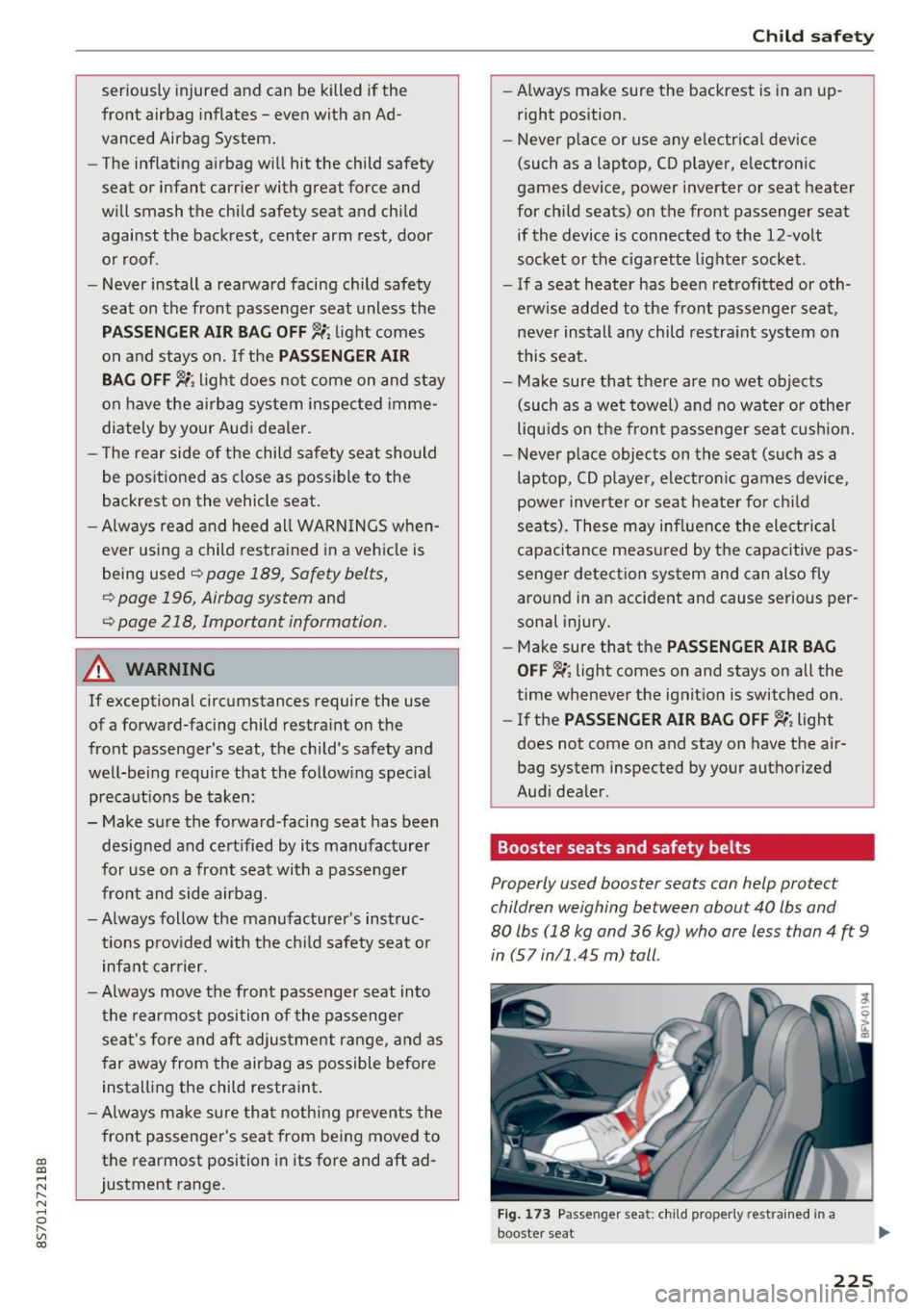
Properly used booster seats can help protect
children weighing between about 40 lbs and
80 lbs (18 kg and 36 kg) who are less than 4 ft
9
in (57 in/1.45 m) tall.
Fig. 173 Passenger seat: chil d properly restrained in a
booster seat
225
Page 231 of 314
co
co
.... N
" N .... 0
" "' c:o
~ Route it around or through the child restraint
belt path
¢ .&_.
~ Push the child safety seat down with your full
weight to get the safety be lt really tight.
~ I nsert the belt tongue into the buckle for that
seating position .
~ Guide the safety belt back into the retractor un
t il the belt lies flat and snug on t he chi ld safety
seat.
~ You should hear a "clicking" no ise as the belt
winds back into the inertia reel. Test the con
vertib le locking retractor by pu lling on the belt .
You should no longer be able to pu ll the belt
out of the retractor. The convertible locking re
tractor is now activated .
~ Make sure that the red release button is facing
away from the child restraint so that it can be
unbuckled qu ickly.
~ Pullon the belt to make sure the safety belt is
properly tig ht and fastened so that the seat
cannot move forward and s ideways more than
1 in (2 .5 cm) .
A WARNING
Using the wrong child restraint or an improp
erly installed child restraint can cause serious
personal injury or death in a crash.
- Always make sure that the safety belt re-
tractor is locked when install ing a child
safety seat. An unlocked safety belt retrac
tor cannot hold the child safety seat in place
dur ing normal driving or in a crash .
- Always buckle the child safety seat firmly in
place even if a child is not sitting in it . A
loose child safety seat can fly around during
a sudden stop or in a crash.
-Always make sure the seat backrest to which the ch ild restraint is installed is in an up
right position. Othe rw ise, the seatback with
the ch ild safety seat attached to it could fly
forward in the event of an accident o r other
emergency sit uation .
- Always read and heed all WARN INGS when
ever using a child res trained in a veh icle is
being used
¢ page 218. Spec ia l precautions
apply when installing a child safety seat on
the front passenger seat ¢
page 19 7, Child
Child safety
restraints on the front seat -some impor
tant things to know.
Deactivating the convertible locking
retractor
The convertible locking retractor for child re
straints will be deactivated automatically when
the belt is wound all the way back into the re
tractor .
~ Press the red button on the safety belt buckle.
The belt tongue will pop out of the buckle.
~ Guide the safety belt all the way back into its
stowed posit ion.
Always let the safety belt retract completely into its stowed posit ion. The safety belt can now be
u sed as an ord inary safety belt without the con
vertible locking retractor for c hild restraints .
If the convertible locking retractor should be ac
t ivated inadvertently, the safety belt must be un
fastened and guided complete ly back into its
stowed pos ition to deactivate th is feature. If the
conve rtible locking retractor is not deactivated,
the safety be lt will g radually become t igh ter and
u ncomfortab le to wear.
A WARNING ,...___ -
Improperly installed child safety seats in
crease the risk of serious personal injury and
death in a co llision.
- Never unfasten the safety belt to deactivate
the convertible locking retractor for child re
stra ints wh ile the vehicle is moving. You
would not be restrained and could be seri
ously injured in an accident .
- Always read and heed all WARNINGS when
ever us ing a child restrained in a vehicle is
be ing used
¢ page 218. Special precautions
apply when instal ling a child safety seat on
the front passenge r seat¢
page 197, Child
restraints on the front seat -some impor
tant things to know.
229
Page 262 of 314
Wheels
NEVER EXCEED XXX KG OR XXX
LBS"on your vehicle's placard
(tire inflation pressure label)
¢ page 256, fig. 190.
2. Determine the combined
weight of the driver and pas
sengers that will be riding in
your vehicle.
3. Subtract the combined weight
of the driver and passengers
from
"XXX" kilograms or "XXX"
pounds shown on the sticker
¢ page 256, fig. 190.
4. The resulting figure equals the
available amount of cargo and
luggage load capacity. For ex
ample, if the "XXX" amount
equals 1400 lbs and there will
be five 150 lbs passengers in
your vehicle, the amount of available cargo and luggage
load capacity is 650 lbs
(1400-750 (5
X 150) = 650 lbs)
5. Determine the combined weight of luggage and cargo
being loaded on the vehicle.
That weight may not safely ex ceed the available cargo and luggage load capacity calculat
ed in Step 4.
6. If your vehicle will be towing a
trailer, load from your trailer
will be transferred to your ve-
260
hicle. Consult this manual to
determine how this reduces
the available cargo and lug
gage load capacity of your vehi
cle.
~check the tire sidewall
(¢ page 246, fig. 188) to deter
mine the designated load rating
for a specific tire.
· Wheel bolts and rims
Wheel bolts
Wheel bolts must be clean and loosen/tighten
easily.
Rims
Rims with a bolted rim ring* or with bolted wheel
covers* consist of multiple pieces. These compo
nents were bolted together using special bolts
and a special procedure. You must not repair or
disassemble them
¢ &..
_8. WARNING
-Wheel bolts that are tightened or repaired in
correctly can become loose and result in loss
of vehicle control, which increases the risk of
an accident. For the correct tightening specifi
cation, see
¢ page 2 78, Finishing.
- Always keep the wheel bolts and the threads in the wheel hub clean and free of
grease .
- Only use wheel bolts that fit the rim.
- Always have damaged rims repaired by an
authorized Audi dealer or authorized Audi
Service Facility . Never repair or disassemble
rims yourself, because this increases the risk
of an accident .
Winter tires
Winter tires significantly improve the vehicle's
handling when driving in winter conditions . Be-
cause of their construction (width, compound, ..,.
Page 286 of 314

Emergency situations
Emergency situations
General
This chapter is intended for trained emergency crews and working personnel who have the nec
essary tools and equipment to perform these
operations.
Starting by pushing or
towing
CD Note
Vehicles with an automatic transmission can
not be started by pushing or towing.
Starting with jumper
cables
If necessary, the engine con be started by con
necting it to the battery of another vehicle .
If the engine should fail to start because of a dis
charged or weak battery, the battery can be con
nected to the battery of
another vehicle, using a
pair of jumper cables to start the engine.
Jumper cables
Use only jumper cables of sufficiently large cross
section
to carry the starter current safely. Refer
to the manufacturer's specifications.
Use only jumper cables with
insulated terminal
clamps which are distinctly marked :
plus(+) cable in most cases colored red
minus(-) cable
in most cases colored black .
A WARNING
Batteries contain electricity, acid, and gas.
Any of these can cause very serious or fatal in
jury. Follow the instructions below for safe hand Ling of your vehicle's battery .
-Always shield your eyes and avoid leaning
over the battery whenever possible.
-A discharged battery can freeze at tempera
tures just below 32 °F (0 °C). Before con
necting a jumper cable, you must thaw the
284
frozen battery completely, otherwise it could explode .
- Do not allow battery acid to contact eyes or
skin. Flush any contacted area with water immediately.
- Improper use of a booster battery to start a
vehicle may cause an explosion.
- Vehicle batteries generate explosive gases.
Keep sparks, flame and lighted cigarettes
away from batteries.
- Do not try to jump start any vehicle with a
low acid level in the battery .
- The voltage of the booster battery must also
have a 12-volt rating. The capacity (Ah) of
the booster battery should not be lower
than that of the discharged battery. Use of
batteries of different voltage or substantial
ly different "Ah" rating may cause an explo
sion and personal injury .
- Never charge a frozen battery. Gas trapped in the ice may cause an explosion .
- Never charge or use a battery that has been
frozen . The battery case may have be weak
ened .
- Use of batteries of different voltage or sub stantially different capacity (Ah) rating may
cause an explosion and injury. The capacity
(Ah) of the booster battery should not be
lower than that of the discharged battery.
- Before you check anything in the engine
compartment, always read and heed all
WARNINGS
~page 235.
CD Note
-Applying a higher voltage booster battery
will cause expensive damage to sensitive
electronic components, such as control
units, relays, radio, etc.
- There must be no electrical contact between
the vehicles as otherwise current could al
ready start to flow as soon as the positive
(+) terminals are connected.
@ Tips
The discharged battery must be properly con-
nected to the vehicle's electrical system. .,..
Page 288 of 314

Emergency situations
(D Note
Improper hook -up of ju mper cables can r uin
the generato r.
- Always con nect P OSITIVE( +) to POS ITI VE
( + ), and NEG ATI VE( -) to NEGATIVE( -)
ground post of t he battery manage r contro l
u nit .
- Check that a ll sc rew p lugs on the battery
cells are sc rewed in firmly . If not, t ighten
plugs p rior to connect ing clamp o n negat ive
b attery t erminal.
- Please note t hat the procedure fo r con nect
i ng a jumper cable as desc rib ed above ap
plies specifica lly to the case of yo ur vehicle
being jum p starte d. When you a re giv ing a
ju mp sta rt to anothe r vehicle, do
not con
n e ct t he neg ative( -) ca b le to the neg ative
(- ) termin al o n t he dis ch arged battery @
¢
fig . 21 1. In ste ad, securely connec t the
negative (-) cab le to either a so lid metal
compo nent that is f irm ly bolted to the e n
gine block o r to the engine bloc k itself. If
the battery that is bei ng cha rged does not
vent to the outside, escap ing battery gas
could ignite an d exp lode!
Towing with a tow truck
General hints
Your Audi requires special handling for towing.
The fo llow ing informa tion is to be used by com
mercial tow truck operators who know how to op
era te the ir equipmen t sa fe ly .
- Never tow your Audi. Towing will cause dam
age to the engine and transmi ssion.
- Never wrap the safety chains or winch cables
around the brake l ines .
- To prevent unnecessary damage, your Audi
must be transported with a flat bed truck.
- To load the vehicle on to the flat bed , use the
towing loop found in the vehicle tools and at
tach to the front or rear anchorage
¢ page 286 and ¢ page 287.
286
A WARNING
A veh icle being towed is not safe for passe n
ge rs . Neve r allow a nyone to ride in a vehicle
be ing towed, fo r any reason .
Front towing loop
Fig. 212 Fron t bumper : cover
Fi g. 2 13 Fron t bumper : install ing the tow ing loop
The threaded opening for the towing loop is lo
cated behind a cover on the rig ht side of the front
bumper .
.. Remove the towing loop f rom the vehicle too l
kit¢
page 272.
.. Press inward on the
upper left side of the cap
to remove i t from the bumper ¢
fig. 212 .
.,. Tighten the towing loop in the threaded o pen
ing until it s tops ¢
fig. 213 and then tig hten it
w it h a wheel w re nch.
.,. After usi ng, p lace the tow ing loop b ack in the
veh icle tool kit.
A WARNING
If t he t ow ing l oop is not tig htened unt il it
stops when installing, the threads may be pu lled out when towing the vehicle and that
could cause an accident .
-
Page 289 of 314
CD
CD
.... N
" N .... 0
" V, co
Rear towing loop
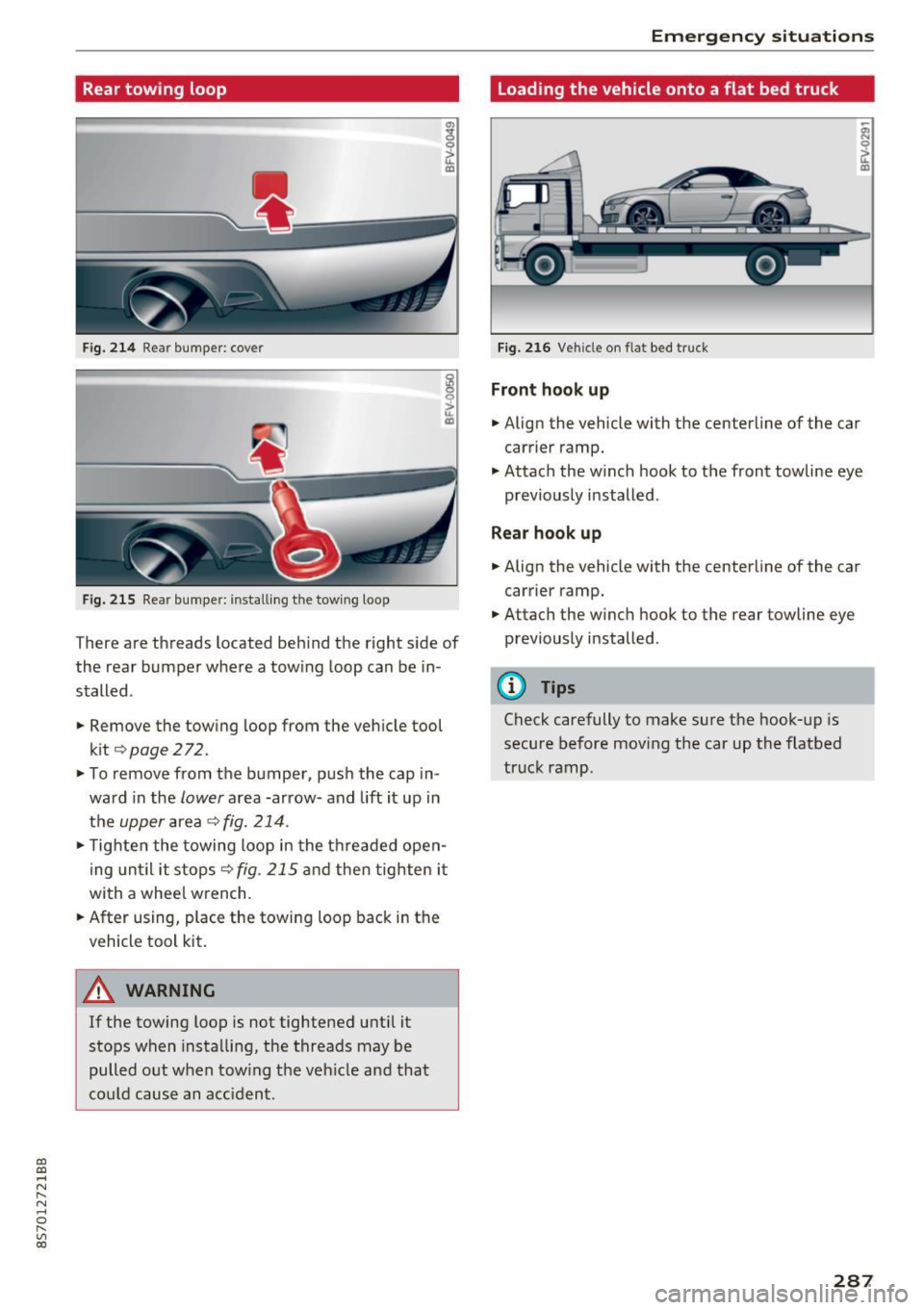
Fig. 214 Rea r bumper: cove r
Fig. 215 Rear bumper: installing the towing loop
There are threads located beh ind the right side of
the rear bumper where a tow ing loop can be in
stalled .
• Remove the tow ing loop from the vehicle tool
kit
¢ page 272.
• To remove from the bumper, push the cap in
ward in the
lower area -arrow- and lift it up in
the
upper area ~ fig. 214 .
"Tighte n the towing loop in the threaded open
ing until it stops
~ fig . 215 and then tighten it
with a whee l wrench.
"A fter using, place the towing loop back in the
vehicle tool kit .
.&_ WARNING
If the towing loop is not tightened until it
stops when installing, the threads may be
pulled o ut when tow ing t he veh icle and that
could cause an acc ident.
-
Emergency situations
Loading the vehicle onto a flat bed truck
Fig. 216 Veh icle on flat bed truck
Front hook up
• Align the vehicle with the centerline of the car
carrier ramp.
" Attach the winch hook to the front towline eye
previously installed .
Rear hook up
.. Align the vehicle with the centerline of the car
carrier ramp.
" Attach the winch hook to the rear towline eye
previously installed .
@ Tips
Check carefully to make sure the hook-up is
secure before moving the car up the flatbed
truck ramp .
287
Page 310 of 314

Index
Symbols 105
Navigation . . . . . . . . . . . . . . . . . . . . . . . . . 144
Traffic . . . . . . . . . . . . . . . . . . . . . . . . . . . . . 149
also refer to Indicator lights . . . . . . . . . . . . . 9
System settings (MMI) . . . . . . . . . . . . . . . . . 175
System update (MMI) .............. ... . 178
System volume 179
T
Tachometer. . . . . . . . . . . . . . . . . . . . . . . . . 8, 23
Technical data . . . . . . . . . . . . . . . . . . . . . . . . 290
Technical modifications . . . . . . . . . . . . . . . . 295
Telephone . . . . . . . . . . . . . . . . . . . . . . . . . . . 114
Connecting . . . . . . . . . . . . . . . . . . . . . . . . . 114
Dialing a number . . . . . . . . . . . . . . . . . . . . 117
Options during a phone call . . . . . . . . . . . 118
Settings . . . . . . . . . . . . . . . . . . . . . . . . . . . 124
Temperature display
Outside temperature . . . . . . . . . . . . . . . . . . 19
Temperature indicator Coolant . . . . . . . . . . . . . . . . . . . . . . . . . . . . . . 8
Text messages . . . . . . . . . . . . . . . . . . . . . . . 119
Tie-downs . . . . . . . . . . . . . . . . . . . . . . . . . . . 186
Tightening specif ication (wheel bolts) . . . . 278
Time . . . . . . . . . . . . . . . . . . . . . . . . . . . . . . . 175
tiptronic (automatic transmission) . . . . . . . . 68
Tire Mobility System (tire repair set) . . . . . . 273
Tires................................ 246
All wheel drive . . . . . . . . . . . . . . . . . . . . . . . 91
Low aspect ratio tires . . . . . . . . . . . . . . . . 261
Repair set . . . . . . . . . . . . . . . . . . . . . . 272, 273
Replacing . . . . . . . . . . . . . . . . . . . . . . . . . . 275
Service life . . . . . . . . . . . . . . . . . . . . . . . . . 254
Tire pressure . . . . . . . . . . . . . . . . . . . . . . . 256
Tire pressure monitoring system . . . 263, 264
Tire pressure table . . . . . . . . . . . . . . . . . . . 257
Tread wear ind icators . . . . . . . . . . . . . . . . 254
un idirectional . . . . . . . . . . . . . . . . . . . . . . . 278
Unidirectional. . . . . . . . . . . . . . . . . . . . . . . 248
Uniform tire quality grading . . . . . . . . . . . 262
Tires and wheels
Glossary of tire and loading terminology . 248
Tires and vehicle load limits . . . . . . . . . . . 258
TMC
refer to Traffic information . . . . . . . . . . . . 149
308
Tone (sound)
refer to Adjusting the sound
179
Tool . . . . . . . . . . . . . . . . . . . . . . . . . . . . . . . . 272
touch
refer to MMI touch 98,99
Towing Tow trucks . . . . . . . . . . . . . . . . . . . . . . . . . 286
TPMS (tire pressure monitoring system) . . . 264
Traffic information . . . . . . . . . . . . . . . . 148, 149
Traffic reports . . . . . . . . . . . . . . . . . . . . . . . . 145
Transmission malfunction (indicator light) . . 70
Transport Canada . . . . . . . . . . . . . . . . . . . . . 187
Treble (sound) . . . . . . . . . . . . . . . . . . . . . . . 179
Trunk lid Trunk escape latch . . . . . . . . . . . . . . . . . . . 272
Turn signals . . . . . . . . . . . . . . . . . . . . . . . . . . 40
u
Unfastening safety belts
Uniform tire quality grading
Unlocking/locking 194
262
By remote control . . . . . . . . . . . . . . . . . . . . 26
With the central locking switch . . . . . . . . . 28
With the convenience key . . . . . . . . . . . . . . 27
Unlocking and locking
On the door lock cylinder . . . . . . . . . . . . . . . 29
Updating stations (rad io) . . . . . . . . . . . . . . . 151
USB stick
refer to Audi music interface . . . . . . . . . . . 162
V
Vanity mirror . . . . . . . . . . . . . . . . . . . . . . . . . . 43
Vehicle Care/cleaning . . . . . . . . . . . . . . . . . . . . . . . 266
Dimensions .. .. .. .. .. .. ........... .. 291
Identification number . . . . . . . . . . . . . . . . 290
Out of service . . . . . . . . . . . . . . . . . . . . . . . 271
Raising ......... ... ............. ... 276
Specificat ions . . . . . . . . . . . . . . . . . . . . . . . 290
Vehicle identification label . . . . . . . . . . . . 290
Vehicle battery . . . . . . . . . . . . . . . . . . . . . . . 243
Charge level . . . . . . . . . . . . . . . . . . . . . . . . . 93
Charging . . . . . . . . . . . . . . . . . . . . . . . . 13, 244
Energy management . . . . . . . . . . . . . . . . . . 93
Indicator light . . . . . . . . . . . . . . . . . . . . . . . 13