2017 AUDI TT ROADSTER ECU
[x] Cancel search: ECUPage 188 of 314
Safe driving
_& WARNING
Heavy loads will influence the way your vehi
cle handles. To help reduce the risk of a loss
of control leading to serious personal injury:
- Always keep in mind when transporting
heavy objects, that a change in the center of
gravity can also cause changes in vehicle
handling:
- Always distribute the load as evenly as
possible .
- Place heavy objects as far forward in the luggage compartment as possible.
- Never exceed the Gross Axle Weight Rating
or the Gross Vehicle Weight Rating specified
on the safety compliance sticker on the left
door jamb. Exceeding permissible weight
standards can cause the vehicle to slide and hand le differently .
- Please observe information on safe driving
c';> page 181.
_& WARNING
To help prevent poisonous exhaust gas from
being drawn into the vehicle, always keep the
rear lid closed while driving.
- Never transport objects larger than those
fitting completely into the luggage area be cause the rear lid cannot be fully closed .
- If you absolutely must drive with the rear lid open, observe the following notes to reduce
the risk of poisoning:
- Close all windows,
- Close the convertible top,
- Open all air outlets in the instrument pan-
el,
- Switch off the air recirculation,
- Set the fresh air fan to the highest speed .
_& WARNING
'
-
Always make sure that the doors, all win
dows, the convertible top and the rear lid are
securely closed and locked to reduce the risk
of injury when the vehicle is not being used.
- After closing the rear lid, always make sure
that it is properly closed and locked.
186 -
Never leave your vehicle unattended espe
cially with the rear lid left open. A child
could crawl into the vehicle through the lug
gage compartment and close the rear lid be
coming trapped and unable to get out . Be
ing trapped in a vehicle can lead to serious
personal injury.
- Never let children play in or around the vehi
cle.
- Never let passengers ride in the luggage compartment . Vehicle occupants must al
ways be properly restrained in one of the ve hicle 's seating positions.
{1) Tips
- Air circulation helps to reduce window fog
ging . Stale air escapes to the outside
through vents in the trim panel, on the left
side of the luggage compartment. Be sure
to keep these slots free and open.
- The tire pressure must correspond to the
load. The tire pressure is shown on the tire
pressure label. The tire pressure label is lo
cated on the driver's side B-pillar. The tire
pressure label lists the recommended cold
tire inflation pressures for the vehicle at its
maximum capacity weight and the tires that
were on your vehicle at the time it was man ufactured. For recommended tire pressures
for normal load conditions, please see chap
ter
c';> page 257.
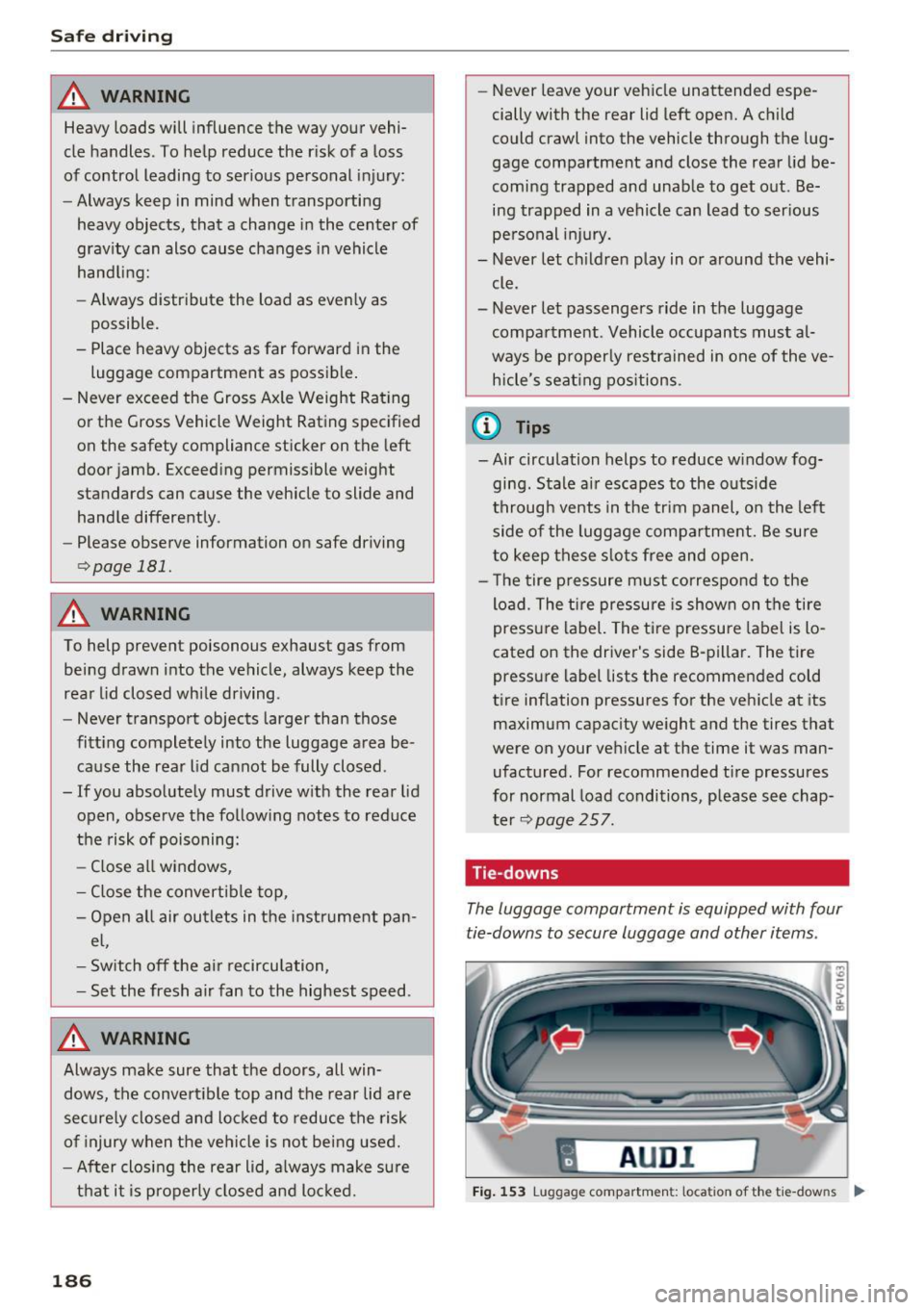
Tie -downs
The luggage compartment is equipped with four
tie-downs to secure luggage and other items .
fl AUD I I
Fig. 153 Lug gage compar tmen t: loca ti on of th e tie-dow ns ....
Page 189 of 314
Use the tie-downs to secure your cargo properly
~page 185, Loading the luggage compartment.
In a coll is ion, the laws of physics mean that even
sma ller i tems that are loose in the vehicle will
become heavy missiles that can cause serious in
jury. Items in the ve hicle possess energy which
vary with vehicle speed and the weight of the
item. Veh icle speed is the most signif icant factor .
F or example, in a frontal collision at a speed o f
30 mph (48 km/h) , the forces acting on a 10 lbs
(4.5 kg) object are about 20 times the norma l
weight of the item. Th is means that the weight
of the item would suddenly be about
200 lbs (90 kg) . You can imagine the injuries that
a 200 lbs (90 kg) item flying freely th rough the
passenger compa rtment cou ld cause in a col li
sion li ke this.
_& WARNING
-
Wea k, damaged o r imp roper straps used to
secure i tems to tie-downs can fail during hard
braking o r in a collision and cause serious per
sonal injury.
- Always use su itab le mounting straps and
properly secure items to the tie-downs in
the luggage compartment to help prevent
items from shifting or f ly ing fo rward as dan
gerous missiles.
- Never attach a child safety seat tether strap
to a tie-down .
Reporting Safety Defects
Applicable to U.S.A.
If you believe that your vehicle
ha s a defect which could cause a
crash or could cause injur y or
death, you should immediatel y in
form the National High way Traffi c
Safet y Admini str ation (NHTSA) in
~ addition to notifying Audi of
....
~ America, Inc . .... 0 r---
"' c:o
Safe d riv ing
If NHTSA re cei ves s imil a r com
pl aint s, it m ay open an in vestiga
tion , and i f it find s that a safet y
defe cts ex ists in a grou p of
v ehicl es, it m ay order a re call and
r e m edy campaign . H ow eve r,
NHTSA cann ot b ecome in vol ved in
ind ivid ual pr oblem s between you,
y our dealer, or Audi of Ameri ca,
In c.
To contact NHTS A, you ma y call
the Vehicle Safety Hotline toll
free at:
T el.: 1 (888) 327-4236 (TTY: 1
( 800) 424 -9153) or 1 (800)
4 24- 9393
or you m ay write to:
Administr ator
NHTSA
1200 Ne w Jerse y Avenue, SE
Wa shington , D.C. 20590
You can als o obtain oth er inf or
mation about motor vehicle safe
t y fro m:
http: //www. saf ercar.gov
Applicable to Canada
If y ou li ve in Canad a and you be
l ie ve that your vehicle has a de
fe ct that could cau se a cra sh, in
jur y or death, you should imm edi-
a tel y inform Transp ort Canada , ..,
187
Page 194 of 314

Safe ty belts
-Never remove a safety be lt while the ve hicle
is mov ing . Do ing so will increase your r isk of
being injured or killed.
- Never wear belts twisted.
- Never wear belts over rigid or breakable ob -
jects in or on your cloth ing, such as eye
glasses, pens, keys, etc., as these may cause
injury.
- Never allow safety be lts to become dam
aged by being caught in door or seat hard
ware.
- Do not wear the shoulder part of the belt
under your arm or otherwise out of position.
- Severa l layers of heavy clothing may inter
fere with cor rect positioning of belts and re
duce the overall effectiveness of t he system.
- Always keep belt buckles free of anything
that may prevent the b uckle from latching
secu rely.
- Never use comfort clips or devices that cre
ate slack in the shoulder belt. However, spe
c ial clips may be requ ired for the prope r use
of some chi ld restraint systems.
- Torn or frayed safety belts can tear and
damaged belt hardware can break in an acc i
dent. Inspect belts regula rly .
If webbing,
bind ings, buckles, or ret rac to rs are dam
aged, have belts repl aced by an auth orized
Audi dealer or quali fied workshop.
- Safety belt s th at have been wo rn a nd loaded
in an accident m ust be rep lace d wi th the
c orrect repl acemen t sa fety be lt by an au
t h o rized Aud i dea le r. Replacement may be
necessary even if damage cannot be clear ly
seen. Anchorages that were loaded m ust al
so be inspected.
- Never remove, modify, disassemble, or try
to repair the safety belts yourself.
- Always keep t he be lts clean . Di rty be lts may
not work properly and can impai r the f unc
tion of the inertia reel¢
table Interior
cleaning on page 268.
192
Safety belts
Fastening safety belts
Seat first -everybody buckle up!
Fig. 159 Be lt buc kle and tongue on the driver 's seat
N
CD
~ ::i: .. a,
To p rovide m axim um pro te ct io n, safety belts
must a lways be positioned co rrectly on the wear
er's body .
.., Ad just the fron t se at prope rly ¢
page 47 , Seats
and storage.
.., Pull the safety belt even ly across the chest and
pe lvis
r::!>fig. 159, ¢ _& .
.., Insert the tongue into the correct buck le of
your seat until you hear it latch securely.
.., Pull on the belt to make sure that it is sec urely
latched in the buckle .
Automatic safety belt ret ractors
Every safety belt is equipped wit h an automatic
belt retractor on the shou lder belt . This feature
locks the belt when the belt is pulled out fast,
during hard brak ing and in an accident. The belt
may also lock when you dr ive up or down a steep
hill or through a sharp curve . During normal driv
i ng t he belt lets you move free ly .
S afety belt pretensioners
The safety belts are equ ipped w ith a belt preten
s ioner that he lps to tighten the safety belt and
remove slack when the pretensioner is activated .
The function of the pretens ioner is monitored by
a war ning light¢
page 14 .
Convertible lock ing retractor
Every safety belt except the one on the driver
seat is equipped with a convertib le lock ing retrac-
tor that
mu st be used when the safety be lt is Ill>-
Page 195 of 314
CD
CD
.... N
" N .... 0 r--. V, co
used to attach a child seat. Be sure to read the
important information about this feature
r::!) page 22 7.
.&_ WARNING
Improperly positioned safety belts can cause
serious injury in an accident
<=>page 193,
Safety belt position.
- Safety belts offer optimum protection only
when the seatback is upright and belts are
properly positioned on the body.
- Never attach the safety belt to the buckle
for another seat. Attaching the belt to the
wrong buckle will reduce safety belt effec
tiveness and can cause serious personal in
JUry.
-A passenger who is not properly restrained
can be seriously injured by the safety belt it
self when it
moves from the stronger parts
of the body into critical areas like the abdo
men.
- Always lock the convertible locking retractor
when you are securing a child seat in the ve
hicle
c> page 228.
(D Tips
For information on safety belt pretensioners,
refer tor::!)
page 194.
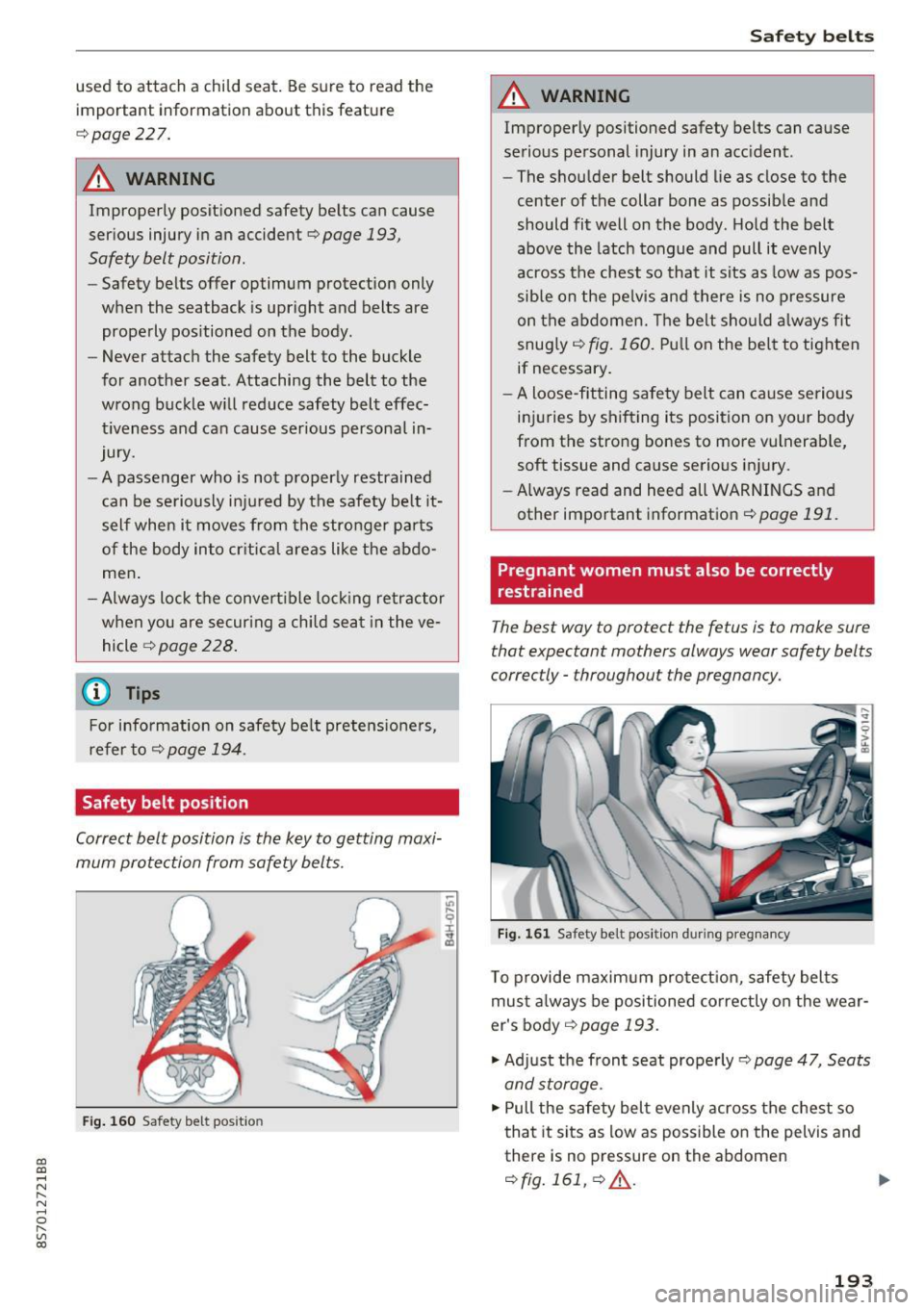
Safety belt position
Correct belt position is the key to getting maxi
mum protection from safety belts.
Fig. 160 Safety belt pos itio n
Safety belts
.&_ WARNING """-iiiiiiiii
Improperly positioned safety belts can cause
serious personal injury in an accident.
- The shoulder belt should lie as close to the
center of the collar bone as possible and
should fit well on the body. Hold the belt
above the latch tongue and pull it evenly
across the chest so that it sits as low as pos
sible on the pelvis and there is no pressure
on the abdomen. The belt should always fit
snugly
c> fig. 160. Pull on the belt to tighten
if necessary.
- A loose-fitting safety belt can cause serious
injuries by shifting its position on your body
from the strong bones to more vulnerable
I
soft tissue and cause serious injury.
- Always read and heed all WARNINGS and
other important information
i=;, page 191.
Pregnant women must also be correctly
restrained
The best way to protect the fetus is to make sure
that expectant mothers always wear safety belts
correctly- throughout the pregnancy.
Fig. 161 Safety belt position during pregnancy
To provide maximum protection, safety belts
must always be positioned correctly on the wear
er's body
<=> page 193.
"'Adjust the front seat properly c> page 47, Seats
and storage.
"' Pull the safety belt evenly across the chest so
that it sits as low as possible on the pelvis and
there is no pressure on the abdomen
c>fig .161 ,r=> .&_ .
193
Page 196 of 314
Safe ty belts
• Insert the tongue into the correct buckle of
your seat until you hear it latch secure ly
r:!> page 192, fig. 159 .
•Pullon the belt to make sure that it is securely
latched in the buckle.
A WARNING
Improperly positioned safety belts can cause
ser ious personal injury in an c1ccident.
- Expectant mothers must always wear the
lap portion of the safety belt as low as pos
sible across the pelvis and below the round ing of the abdomen .
- Always read and heed all WARNINGS and
othe r important information
c:> .&. in Fasten
ing safety belts on page 193.
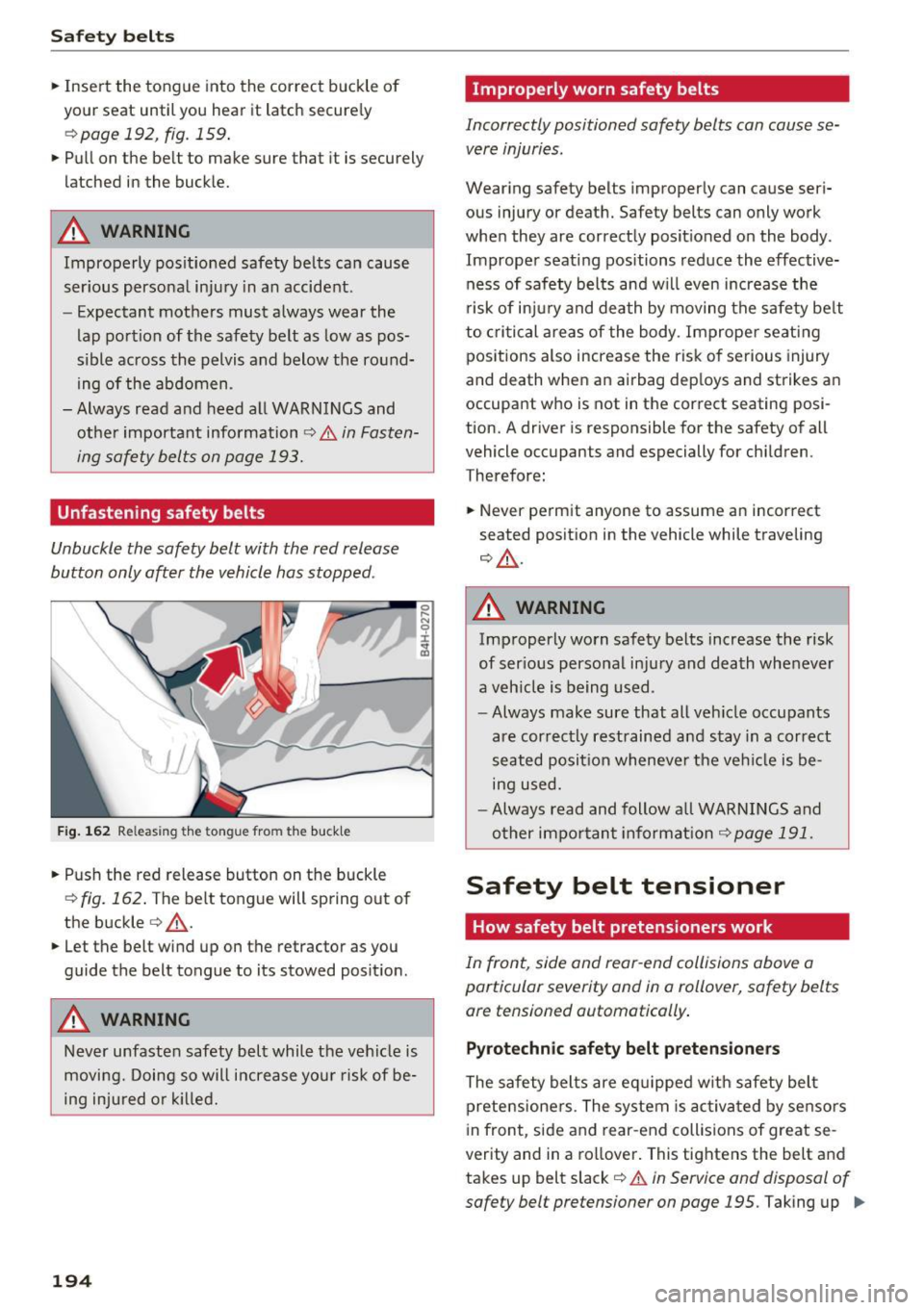
Unfastening safety belts
Unbuckle the safety belt with the red release
button only after the vehicle has stopped.
F ig . 162 Releasi ng the tongue fro m the buckle
• Push the red release button on the buckle
r:!> fig. 162 . The belt tongue will spring out of
the buckle
c:> _& .
• Let the belt wind up on the retractor as you
guide the belt tongue to its stowed posit ion .
A WARNING
Never unfasten safety belt while the vehicle is
moving. Doing so will increase your risk of be
ing injured o r kil led.
194
Improperly worn safety belts
Incorrectly positioned safety belts can cause se
vere injuries.
Wearing safety belts improperly can cause seri
ous injury or death. Safety belts can only work
when they are correctly posit ioned on the body .
Improper seating positions reduce the effective ness of safety bel ts and w ill even increase the
risk of inju ry and death by moving the safety be lt
to criti cal areas of the body . Imprope r seating
positions also increase the risk of serious injury
and death when an airbag dep loys and strikes an
occupant who is not in the correct seating posi
tion. A driver is responsible for the safety of all
vehicle occupants and especially for children.
Therefore:
• Never pe rm it anyone to assume an incor rect
seated position in the vehicle while traveling
<=> _& .
A WARNING
Improperly worn safety belts increase the risk
of ser ious perso nal injury and death whenever
a veh icle is being used .
- Always make sure that all veh icle occupants
are correctly restrained and stay in a correct
seated posit ion wheneve r the ve hicle is be
ing used.
- Always read and follow a ll WARNINGS and
other impo rtant informat ion
r:!> page 191.
Safety belt tensioner
How safety belt pretensioners work
In front, side and rear -end collisions above a
particular severity and in a rollover, safety belts ore tensioned automatically.
Pyrotechnic safety belt pretensioners
The safety belts are eq uipped w ith safety belt
prete nsione rs. The system is ac tiva ted by sensors
i n front, side and rear-end collisions of great se
verity and in a rollover . This tightens the belt and
takes up belt slack¢.&.
in Service and disposal of
safety belt pretensioner on page 195.
Taking up IJ,-
Page 229 of 314
co
co
.... N
" N .... 0
" "' c:o
-Children on the front seat of any car, even
with Advanced Airbags, can be seriously in
jured or even killed when an airbag inflates.
- Never let a child stand or kneel on the seat .
- Never let a child ride in the cargo area of
your vehicle.
-Always remember that a child leaning for ward, sitting sideways or out of position in any way during an accident can be struck by
a deploying airbag. This will result in serious
personal injury or death.
- If you must install a booster seat on the
front passenger seat because of exceptional
c ircumstances the
PA SSENGER AIR BAG
OFF ~;
light must come on and stay on,
whenever the ignition is switched on.
- If the
PAS SENG ER AIR BAG OFF~; light
does not come on and stay on, perform the
checks described ¢
page 207, Monitoring
the Advanced Airbag System.
- If the PASSE NGE R AIR BAG OFF~; light
does not come on and stay on wheneve r the
ignition is switched on the infla ting airbag
will hit the child safety sea t or i nfant c arr ier
with great force and will smash the child safety seat and child against the backrest,
center armrest, door or roof . Have the air
bag system inspected immediately by your
Audi dealer.
- Always read and heed all WARNINGS when
ever using a child restrained in a veh icle is
being used¢
page 189, Safety belts,
¢ page 196, Airbag system
and
¢page 218, Important information .
Securing child seats
Securing a child safety seat using a safety
belt
Safety belts for the front passenger con be
locked with the convertible locking retractor to
properly secure child safety seats .
The safety belt emergency locking retractor for
the front passenger's seat safety belt have a con
vertible locking retractor for chi ld restraints . The
safety belt must be locked so that belt webbing
cannot unreel. The retractor can be activated to
Ch ild safety
lock the safety belt and prevent the safe ty be lt
webbing from loosening up during norma l driv
ing. A chi ld safety seat can only be properly in
stalled when the safety belt is locked so that the child and ch ild safety seat will stay in p lace.
Always remember : Even though your vehicle is
equipped with an Advanced Airbag system, a
child should always r ide in the seat properly re
strained for its age and s ize.
A WARNING .,.__
Improperly installed ch ild safety seats in
crease the risk of serious personal injury and
death in a co llision .
-
-Always make sure that the safety belt re
tractor is locked when installing a child
safety seat. An un locked safety be lt retrac
tor cannot hold the ch ild safety seat in place
du ring normal driving or in a c rash.
- Always buckle the child safety seat fi rm ly in
p lace even if a ch ild is not sitt ing in it. A
loose chi ld safety seat can fly around during
a sudden stop or in a co llision.
- If the backrest is not securely latched, the
child and the ch ild restraint will be thrown
forward together with the backrest and will strike parts of the vehicle interior. The child
can be seriously injured or killed.
- The inflating airbag will hit the ch ild safety
seat or infant carrier with great force and
will smash the child safety seat and child aga inst the backrest, center armrest, door
or roof.
- Forward-facing child safety seats or infant
carriers installed on the front passenger's
seat may interfere w ith the deployment of
the airbag and cause serious in ju ry to the
child.
- Always read and heed all WARNINGS when
eve r us ing a child restrained in a vehicle is
be ing used
¢ page 218. Special p recautions
apply when ins ta lli ng a child safety seat on
the front passenge r seat¢
page 197, Child
restraints on the front seat -some impor -
tant things to know . ..,
227
Page 230 of 314
Child safet y
A WARNING
Always take spec ial precaut ions if you must
install a forward or rearward-fac ing ch ild re
straint on the front passenger's seat in excep
tional situations:
- Whenever a forward or rearwa rd-facing
child restraint is insta lled on the front pas
senger seat, t he
PASSENGER AIR BAG OFF
~; light mus t come on and stay on whenev
e r t he ignition is sw itche d on.
- If the
PASSENGER AIR BAG OFF~; light
does not come on and stay on, perform the
checks described~
page 207, Monitoring
the Advanced Airbag System.
- If the PASSENGER AIR BAG OFF~; light
does not come on and stay on whenever the
ignition is switched on the inflating air bag
will hit the c hild safety seat o r infant carrier
with great force and will smash the child
safety seat and child against the backrest, center armrest, door or roof. Have the air
bag system inspected immediately by your
Audi dealer.
- Improper installation of ch ild restraints can
red uce their effect iveness or even prevent
t h em from p roviding any p rotection .
-An improperly installed c hild rest raint can
interfere w ith the airbag as it deploys and
seriously injure or even kill the child.
- Always carefully follow the manufac turer 's
instructions p rovided w ith the ch ild safety
seat or car rier.
- After checking to ma ke sure that the child
restra int is prope rly installed, ma ke certai n
t h at the child res traint is co rrec tly recog
ni ze d by the c apac it ive passenger detec tion
system in the front passenger sea t and that
the
PASSENGER AIR BAG OFF~. light sig
nals the correct front passenger frontal air
bag status.
A WARNING
Forward-fac ing ch ild rest raints:
- Always make sure the forward-facing seat
has been designed and cert ified by its man
ufact urer for use on a front seat with a pas
senger front and side a irbag .
228
-Never put the fo rwa rd-facing child restraint
up, against o r very near the instrument pan
el.
- Always move the passenge r seat into its
rearmost posit ion in the seat's fo re and aft
ad justment range , as far away from the a ir
bag as poss ible before installing the for
ward-facing chi ld restraint. The back res t
m ust be adjusted to an upr ight position.
- Ma ke sure that the
PASSENGER AIR BAG
OFF ~;
light comes on and stays on all the
time w heneve r the ig nition is switched o n.
A WARNING
R earward-faci ng chi ld restrain ts:
- A child in a rearward-fac ing ch ild safety seat
installed on the fron t passenger seat will be
serious ly injure d and can be killed if t he
front airbag infl ates -even with an Ad
vance d Ai rb ag System.
- The infl ating air bag will h it t he ch ild safety
sea t or i nfan t car rier with great force an d
w ill smash the child safety seat and child
aga inst the backrest, center a rm rest, door
or roof.
- Always be especially carefu l if yo u must in
stall a rea rward facing child safety seat on
the front passenge r seat in exceptiona l cir
cumstances.
- Make sure that the
PASSENGER AIR BAG
OFF ~;
light comes on and stays on all the
time wheneve r the ign it ion is switched on.
- If the
PASSENGER AIR BAG OFF~; light
does not come on and stay on, have the air
bag system inspected by you r Audi dealer.
Activating the convertible locking retractor
Use the convertible locking retractor to secure a
child restraint.
A lways heed the chi ld safety seat manufacturer's
i nst ruct ions when insta lling a child restra int i n
yo ur vehicle. To activate the convertib le locking
r etractor:
.,. Place the chi ld restraint on a seat .
.,. Slowly p ull the belt
all the way out .
Page 238 of 314

Checking and Filling
-Engine exhaust, some of its constituents,
and certain vehicle components contain or
emit chemicals known to the State of Cali
fornia to cause cancer and birth defects and reproduct ive harm . In addition, certain flu
ids contained in veh icles and certain prod
ucts of compo nent wear con tain or emit
c hemicals known to the State of Califo rnia
to cause cance r and birth defects or other
reproductive harm .
- Battery posts, termina ls and re lated acces
sories contain lead and lead compounds, chemicals known to the State of California
to cause cancer and reproductive harms .
Wash hands after handling .
(D Note
When fil lin g flu ids, be sure not to mix the flu
ids up . Otherwise severe ma lfunctions and en
gine damage w ill occur .
@ For the sake of the environment
You shou ld regularly chec k the ground under
your vehicle in order to detect leaks qu ickly. If
there are visible spots from oil or other fluids,
bring your vehicle to an authorized Aud i deal
er or author ized Audi Se rvice Facility to be
checked.
Opening/closing the hood
The hood is released from inside the vehicle.
F ig . 17 9 Sect io n from the driv er' s s ide footwell: relea se
l ever
236
~ 0 0
ct Q)
F ig. 1 80 Unlocked hood : lev er
Make su re the wiper a rms are not raised up from
the windshie ld. Otherw ise the paint could be
dam aged .
Opening the engine compartment lid
"With the driver's door open, pull the lever be -
low the instrument pane l in the direction of the
arrow
9 fig . 179 .
" Raise the hood slightly 9 ,& .
"Press the lever 9 fig. 180 in the direct ion of the
arrow . This releases the hooks .
" Open the hood.
Closing the engine compartment lid
" Push the hood down u ntil yo u over ride the
for ce of the s truts .
" Let the hood fa ll lightly into the latch .
Do not
press it in.
~ ,& .
&_ WARNING
-Never open the hood when there is steam o r
coo lant escaping from the engine compart
ment, because there is a risk that yo u could
be burned. Wait unt il no steam or coolant is
escaping.
- For safety reasons, the hood must always be
closed securely while dr iving . Because of
this, always chec k the hood after closing i t
to make sure it is latched correctly . T he
hood is lat ched if the front corners canno t
be lifted .
- If you notice that the hood is not latched
while you are d riving, s top imme diate ly and
close it, because d riving when the hood is
no t latched increases the r isk o f an accident .