2017 AUDI S3 SEDAN battery
[x] Cancel search: batteryPage 327 of 400
a, a, ..... N
" N ..... 0 N > 00
- the temperature of the engine coolant r ises due
to the heat bui ld-up from the engine in the en
gine compartment , or
- the engine compartment heats up because the
vehicle is parked in intense su nlight .
_& WARNING
- To reduce the risk of personal injury never
touch the radiator fan .
- The auxiliary elect ric fan is temperature
contro lled and can switch on suddenly even
w hen the eng ine is not running.
- The auxiliary radiator fan switches on auto matically when the engine coo lant reaches a
certain temperature and will cont inue to run
until the coolant temperat ure drops.
Brake fluid
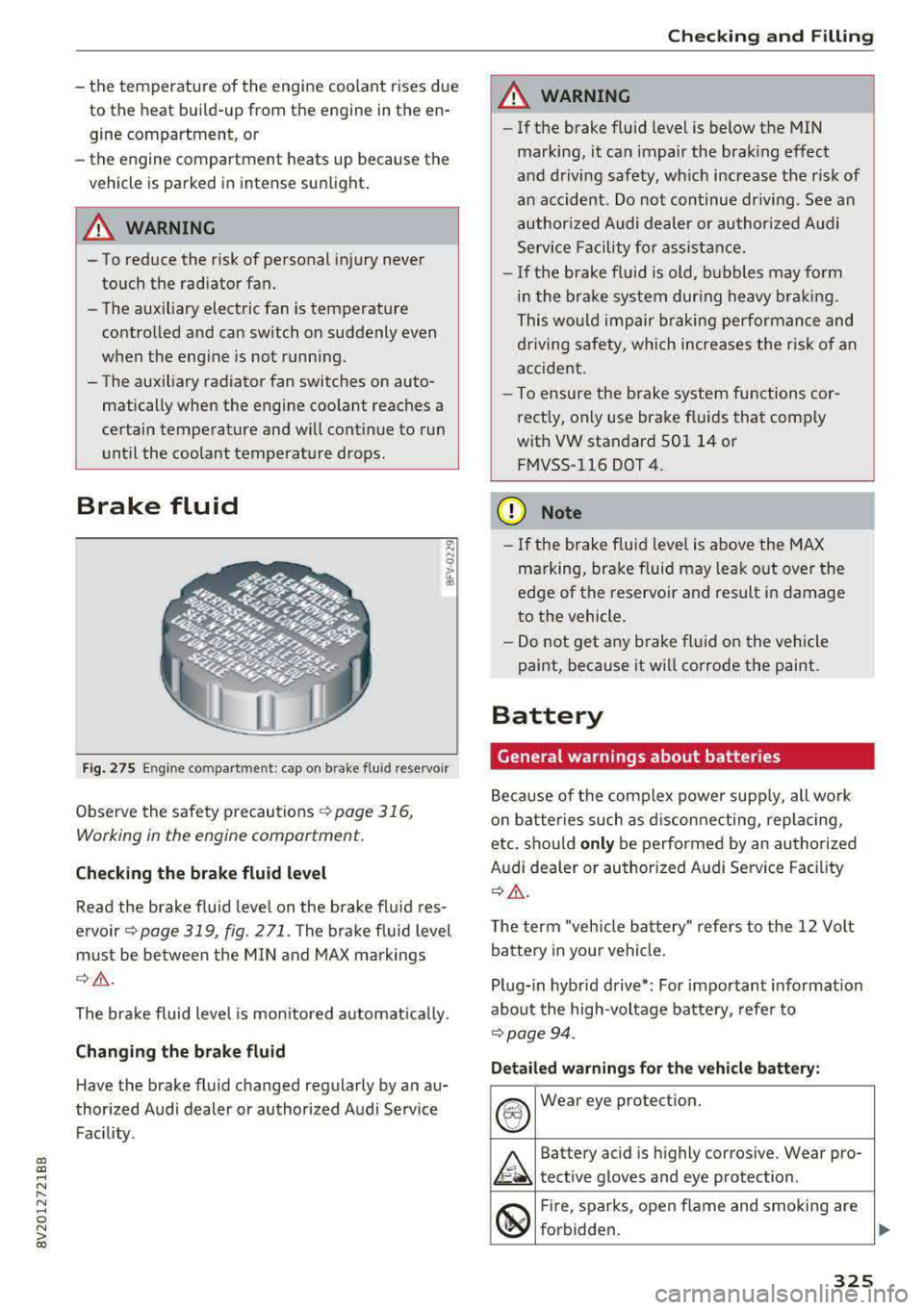
Fi g. 27 5 Engine co mpartment: cap on b rake f lu id reservoir
Observe the safety p recau tions ¢ page 316,
Working in the engine compartment .
Checking the brake fluid level
Read the brake f lu id leve l on the brake fl uid res
e rvo ir
Q page 319 , fig. 271. The bra ke fluid level
must be be tween the M IN and MAX m ark ings
¢ _& .
The brake fluid level is mon itored a utomat ica lly .
Changing the brake fluid H ave the brake fluid changed regularly by an au
thor ized Audi dealer or authorized Audi Service
Facility .
-
Checking and Filling
A WARNING
=
-If the brake fluid level is below the MIN
marking, it can impair the brak ing effect
and d riving safety, wh ich increase the risk of
a n accident . Do no t continue dr iving . See a n
a uthor ized Audi dealer or author ized A udi
Serv ice F acility for a ssistance.
- I f the b rake fl uid is old, b ubbles may form
i n t he bra ke sys tem dur ing heavy bra king.
This wo uld impair braking per formance an d
d riving safety, which increases the r is k of an
accident.
- T o ensu re the brake system fu nctions cor
rectly, only use brake fluids that comp ly
with VW standard 501 14 or F M VSS -116 DOT 4.
(D Note
- If the brake flu id leve l is above the MAX
marking, bra ke f luid may leak o ut over the
edge of the reservo ir and result in damage
to the vehicle.
- Do not get any b rake fl uid on the vehicle
paint, because it wi ll corrode the paint.
Battery
General warnings about batteries
B ecause of the complex power supp ly, all work
o n batter ies such as d iscon necti ng, replac ing,
etc. should only be performed by an authori ze d
Audi dealer or au thor ized A udi Service Fac ility
Q _& .
The term "veh icle batte ry" refe rs to the 1 2 Vol t
battery in your vehicle .
P lug- in hybr id driv e*: For important informat ion
abou t the high-vol tage batte ry, refe r to
Qpage 94.
Detail ed warnings fo r the vehicle battery :
®
Wear eye protect ion.
A
Battery acid is h ighly corros ive. Wear pro-
tect ive gloves and eye protection.
@
F ir e, sparks, open flame and smoking are
forbidden .
325
Page 328 of 400

Checking and Filling
A
A highly explosive mixture of gases can
form when charging batteries.
®
Keep children away from battery acid and
batteries.
A WARNING
All wo rk on the battery or electrical system in
your vehicle can result in injuries, chemical burns, accidents o r burns. Because of this, a ll
work m ust be performed
only by an author
ized Aud i dea ler or a uthorized Audi Service
Facility.
A WARNING
California Proposition 65 Warning:
- Battery posts, termina ls and re lated acces
sories contain lead and lead compounds,
chemicals known to the State of California
to cause cancer and reproduct ive p roblems.
Wash hands after handling.
(D Note
Protect the vehicle battery against freezing if
the vehicle will be parked for long periods of
time so that it is not destroyed by "freezing"
¢ page 326, Charging the vehicle battery.
Charging the vehicle battery
F ig. 276 Eng ine compartment: connectors for a charger
and jump start cables
Observe the safety precautions c:;;, page 316,
Working in the engin e compartment.
Plug-in hybrid drive*: ¢ page 104.
Req uirement: on ly use chargers with a maximum
charg ing current of 30 amps /14 .8 Volts .
The ve
hicle battery cables rema in connected.
326
The battery is located in the engine compart
ment. The ground point
0 is always located on
the ve hicle body.
.. Read the wa rnings¢ A in General warnings
about batteries on page 326
and ¢ _& .
.. Switch off the ignition and all electrica l equip-
ment .
.. Open the hood ¢page 318.
.. Fold the battery cover upward.
.. Clamp the charger terminal clamps as instruct
ed on the
battery terminal (+ ) and only on t he
bod y ground point (· ).
.,. Insert the power cable fo r th e cha rging dev ice
into the socket and switch t he device on .
.. At the end of the cha rging p rocess, switch the
charger off and pull the power cable out of the
socket.
.. Remove the charger terminal clamps.
.. Fold the cover back on the battery correctly.
.. Close the hood¢ page 318.
A WARNING
-A high ly explosive m ixture of gases can form
when charg ing batte ries. Only cha rge the
veh icle ba ttery in well-ven tila ted a reas.
- A dra ined vehicle battery can free ze at tem
pe ratures arou nd
32 QF (0 QC). A frozen or
thawed vehicle bat tery must no t be cha rged
and must no t be used anymo re. The b attery
housing can crack and battery ac id can leak
out if ice forms, which increases the risk of
an explosion and chemical burns. Contact an
authorized Audi dealer or authorized A udi
Serv ice Facility fo r more info rmation.
- Do not connect or disconnect the charging
cable wh ile charging because this increases
the risk of an explos ion.
@ Tips
- Only charge the vehicle battery t hrough the
connect ions in the engine compartment.
- Read all of the manufacturer's instructions
for the c harger before charging the vehicle
battery.
Page 334 of 400

Wheel s
Maximum (permissible)
inflation pressure
means the max imum cold infla
tion pressure to which a t ire may
be inflated . Also called "maxi
mum inflation pressure."
Normal occupant weight
means 150 lbs. (68 k ilograms)
times the number of occupants seated in the vehicle up to the to
tal seating capacity of your vehi
cle .
Occupant distribution
means distribution of occupants
in a vehicle.
Outer d iameter
means the overall diamete r of an
inflated new tire.
Overall width
means the linear distance be
tween the exteriors of the side
walls of an inflated tire , including
elevations due to labeling, deco rations, or protective bands or
ribs .
Ply
means a layer of rubber-coated
para llel cords.
332
Production options we ight
means the combined weight of
those installed regular product ion
options weighing over 5 lbs . (2 .3
kg) in excess of those standard
items which they replace, not pre
viously considered in curb weight or accessory weight , including
heavy duty brakes, ride levelers,
roof rack, heavy duty battery, and
special trim.
Radial ply ti re
means a pneumatic tire in which
the ply cords that extend to the beads are la id at substantially 90
degrees to the centerline of the
tread.
Recommended inflation
pressure
see ¢ page 331 , Cold tire infla
tion pressure.
Reinforced tire
means a tire designed to operate
at higher loads and at higher in
flation pressures than the corre
sponding standard tire . Rein
forced tires may be identified as
"XL", "xl", "EXTRA LOAD", or "RF"
on the sidewall. ...
Page 354 of 400

Care and cleaning
(D Tips
-Insects are easier to remove from paint that
has been fresh ly waxed.
- Regular waxing can prevent rust spots from
forming.
Placing your vehicle out
of service
If you wou ld like to take your vehicle out of serv
ice for a longer t ime, contact an authorized Audi
dealer or authorized Aud i Serv ice Facility . They
w ill advise you of impo rtant measures, such as
corros ion protection, se rvice and storage proce
dures. A lso follow the information about the
ve
h icle battery ¢ page 325.
352
Page 367 of 400

a, co ..... N
" N ..... 0 N > 00
Fuse assignment -interior
Fig. 301 Vehicle interior: fuse assignment
No. Equipment
Fl Ad
Blue engine components
F2 Seat adjustment
F3 Power top hyd
raulic pump
F4 Infotainment control panel, Infotainment
components
FS Gateway
F6 Selector lever (automat ic transmission)
F7 Climate/heating control, auxiliary heating,
rear window defogger relay
Electromechan ica l parking brake sw itch,
F8 light switch,
rain/light sensor, inte rior
lighting, anti-theft alarm system, diagnos -
tic connector, communication box
F9 Steering column sw itch module
Fl0 Infotainment system display
Fll Dr iver's side safety belt tens ioner
F12 Infotainment components
F13 Suspension
control control module, diag-
nostic connector
F14 Heating/air conditioning system blower
FlS Electronic steering column lock
No .
Fl6
F 17
Fl8
F 19
F20
F21
F2 3
F24
F 2S
F26
F 27
F28
F2 9
F 31
F32
F33
F34
F 3S
F36
F3 7
F38
F39
F 40
F41
F42
F43
F44
F47
F4 8
Fuses and bulbs
Equipment
Infotainment components
Instrument cluster
Rearview camera
Convenience access cont rol module
Engine components
Steering column, steering wheel heating
switch module
Right vehicle electrical system control
module
Panorama glass roof/power top control
module, power top latch
Driver's s ide front/rear power w indows
Seat heating
Sound-amplifier
Convertible top control module
Interior lights
Left vehicle electrical system control mod-
ule
Rearview camera, radar sensor control
module
A irbag
Button i llumination, interior sound, re-
versing light switch, temperature sensor,
coil for neck heating relay and socket relay
Fu nct ion lighting, headl ight range control,
a ir quality sensor, automatic dimming
rearview mirror
R ight headlight
l eft headlight
High-voltage battery
Passenger's s ide front/rear power win -
dows
Sockets Passenger's side safety belt tensioner
Cen tral locking components, windshield
washer system
Interior lights
Al l wheel drive
Rear w indow wiper
Outer sound actuator
365
Page 368 of 400

Fuses and bulbs
No . Equipment
F49 Starter, clutch sensor, high-voltage bat-
tery, power electronics
FS3 Rear window defogger
The power seats* are protected via
circuit break
ers
that automatically switch on after a few sec
onds after the overload has been reduced.
Fuse assignment - engine compartment
F ig . 302 Engine co mpa rtment: fuse assignmen t
No. Equipment
Fl E
lectronic Stabilization Control (ESC)
F2 Electronic Stabilization Control ( ESC)
F3 Engine control module
Engine components, eng ine cooling, aux-
F4 ilia
ry heater coil relay (1+2), secondary
air injection pump relay
FS Engine components, tank system
F6 Brake light sensor
F7 Engine components, water pumps
FB Heat oxygen sensor
F9 Engine components, exhaust door, glow
time control module
FlO Fue l injectors, fuel control module
366
No . Equipment
Fll Auxiliary heater heating element 2
, en-
gine components
F l2 Auxiliary heater heating element 3
Fl3 Automatic transmission
F lS Horn
F l6 Ignition coils, CNG cut-off valve, power
and control electronics
Fl7 Elec
tronic Stabilization Control (ESC), en -
gine contro l module
Fl8 Terminal 30 (voltage
reference), battery
monitoring
F19 Windshield wipers
F20 Anti-theft alarm system
F 22 Terminal SO diagnosis, engine control
module
F2 3 Starter
F 24 Auxiliary heater heating element 1, brake
booster
F31 Vacuum pump, water pump
F33 Brake booster
F34 Brake booster
F35 A/C function relay
F37 Parking heater
Bulbs
Replacing light bulbs
For your safety, we recommend that you have
your authorized Audi dealer replace any bulbs for you.
It is becoming increasingly more and more diffi
cu lt to replace vehicle light bulbs since in many
cases, other parts of the car must first be re
moved before you are able to get to the bulb.
This applies especially to the light bulbs in the
front of your car which you can only reach
through the engine compartment.
Sheet meta l and bulb holders can have sharp
edges that can cause serious cuts, parts must be
correctly taken apa rt and then properly put back
together to help prevent breakage of parts and
..,.
Page 370 of 400

Emergency situations
Emergency situations
General
Thi s chapter is intended for trained eme rgency
crews and working per sonnel who have the nec
essary tool s and equipment to perform these
ope rations.
Starting by pushing or
towing
(D Note
Vehicles wi th an au tomat ic tra nsmission can
not be starte d by pushi ng or towi ng.
Starting with jumper
cables
If necessary, the engine con be started by con
necting it to the battery of another vehicle .
Plug -In hybrid drive* : The con nection poin ts for
the jump start cables vary ¢
page 104.
If t he engine sho uld fa il to s tart because of a dis
c har ged o r we ak battery, the batt ery c an be con
nected to the ba ttery of
another vehicle, using a
pair of jumper cable s to start the engine .
Jumper cables
Use only jumper cables of suffi cien tly large cross
se ction
to car ry the s tarter cur rent safely. Refer
t o the man ufact urer 's spe cifica tions.
Use o nly jumper cables with
insulated te rm inal
clamps whi ch a re distin ct ly ma rked :
positive (+ ) cable , in most cases colored red
negative(-) cable ,
in most cases colo red black.
A WARNING
Plug-in hybr id d rive*: you must not give a
jump start with your vehicle. This could cause sign ifica nt damage to the electrical system in
your vehicle
¢ pag e 104.
368
A WARNING ,_ -
Batteries conta in e lectr ic ity, acid, and gas.
A ny of these ca n cause very ser ious or fatal in
ju ry . Follow the ins truct io ns be low for safe
h andling of you r ve hicle's bat tery.
- Always sh ie ld your eyes and avo id leaning
over the battery w henever p ossible .
- A dead battery can freeze at temperatures
around 32 °F (0 °C) .
If the vehicle batte ry is
fro zen, yo u m ust t haw i t befo re connect ing
t he jump s tart cables. If y ou do no t, t his in
creases the r isk of an explos io n and chemi
c a l bur ns. A fter jump st art in g the vehicle,
drive to an aut ho riz e d Au di dea ler o r auth o r
ized Au di Service Faci lity immediately to
have the vehicle batte ry c hecked.
- Do not allow battery ac id to contact eyes or
skin. Fl ush any contacte d area with water
immed iate ly.
- Improper use of a booste r batte ry to sta rt a
veh icle may cause an exp losion.
- Veh icle batteries gene rate exp losive gases.
K eep s parks, flame an d lig hte d ciga rettes
away from batter ies .
- Do not t ry to jump start any vehicle with a
low acid level in the batte ry .
- The vo ltage of the booster batte ry must a lso
have a 12-volt rat ing. The capacity (Ah) of
the booster battery should not be lower
than that of the discharged battery. Use of
batter ies of diffe re nt voltage or substantial
ly diffe rent
"A h" rating may cause an exp lo
sion and perso na l inju ry .
- Never cha rge a frozen battery. Gas trapped
in the ice may cause an ex plosion .
- Never cha rge o r use a battery that has been
frozen . The battery case may have be w eak
e ned.
- Use of batter ies of different voltage or sub
s tan tially d if f eren t capacity (Ah) ra t ing may
cause an exp losion and injury. T he capac ity
(Ah) of the booste r ba ttery sho uld not be
l o wer th an that of the dis ch arged battery .
- B efore you c heck anyth ing in the eng ine
co mpart me nt, alw ays re ad and h eed all
W AR NING S
¢page 316.
Page 371 of 400

a, a, ..... N
" N ..... 0 N > 00
(D Note
-Applying a higher voltage booster battery
will cause expensive damage to sensitive electronic components, such as control
units, relays, radio, etc.
- There must be no electrical contact between the vehicles as otherwise current could al
ready start to flow as soon as the positive
(+) terminals are connected .
@ Tips
The discharged battery must be properly con
nected to the vehicle's electrical system.
When jump starting or charging the battery,
never connect the negative ground cable to
the battery negative post because the battery
manager system must be able to detect the
battery's state of charge. Always connect the
negative ground cable to the negative ground
post of the battery manager control unit.
Using jump start cables
Connect the jump start cables in the exact order
described below.
Fig. 303 Engine compartment: connectors for jump start
cables and a charger
Fig . 304 Ju mp starting t he battery wit h another vehicle:
@ -dra in ed battery, @-starter batte ry
Emergency situations
Plug-in hybrid drive*: The connection points for
the jump start cables
vary ¢ page 104.
The battery is located to the left in the engine
compartment. The procedure for connecting
jump start cables that is described next is de
signed to help jump start your vehicle.
Vehicle with drained battery:
.. Read the following carefully 9 page 368
.. Set the parking brake and place the se lector
lever in the P position .
.. Turn the ignition and electrical equipment off
in both vehicles .
Connecting positive terminal(+) to positive
terminal (+)
.. To reach the battery terminals, flip the battery
cover cap to the side¢ fig. 303 .
l. Clamp the end of the red jump start cab le to
the terminal
(D c> fig. 304 on the dead bat
tery @¢ 0 in Starting with jumper cables
on page 369 .
2. Clamp the other end of the red jump start ca
ble to the terminal @on the charging bat
te ry @ .
Connecting negative terminal(-) to negative
terminal (-)
3. Clamp the black end of the jump start cab le
preferably at the ground point, or on the
negative terminal @ on the charging battery
®·
4. Clamp the other end of the black jump start
cable
only to the ground point @ on your
vehicle @c>(D.
5. Route the jump start cables so they cannot
get caught in the moving parts in the engine
compartment.
Starting the engine
6. Start the engine in the vehicle giving the
charge and let it run at idle .
7. Now start the engine in the vehicle with the
dead battery and wait two to three m inutes
until it "runs smoothly" .
8.
If the engine does not start, stop the start ing
procedure after 10 seconds and then repeat
it after approx imately 30 seconds.
Ill>
369