2017 AUDI Q5 wing
[x] Cancel search: wingPage 185 of 296

a,
a,
..... N
" ('I ..... 0 0
0:
co
LATCH lower anchorage so that the connectors
lock into place
¢ fig. 180 .
.. Pull on the connector attachments to make
sure they are p roperly attached to the LATCH
lower anchorage .
.. Pull straps tight following the child restraint
manufacturer's instructions .
Relea sing
.. Loosen the tension on the straps following the
c hild restra int manufac turer 's ins tructions .
.. Depress the spring catches to release the an
chorage hooks from the lower anchorages .
Remember: Use tether straps to he lp keep the
child rest raint firmly in place .
A WARNING
Improper use of the LATCH system can in
crease the risk of serious pe rsonal injury and
death in an acc ident.
- These anchors were developed only for child safety seats using the "LA TCH" system .
- Never attach other child safety seats, belts
or othe r objects to these anchors .
- Always make sure that you hear a click when
latch ing the seat in place. If you do not hear
a click the seat is not secure and could fly
forward and h it the interior of t he vehicle,
o r be ejected from the vehicle.
A WARNING
Improper installatio n of child rest rai nts will
increase the r is k of injury in an a cc ident.
- Always follow the child restra int system
man ufacturer's inst ru ct ions for proper in
sta llation of the child res tra int system and
pro per use of tether straps as well as the
lower anchorages or safety be lts in your
ve
hicle.
- Always read and heed the important infor
mation and WARNINGS about child safety
and the insta llation of chi ld restraint sys
tems
¢ page 168, Child safety. Ch
ild
sa fety
Tether anchors and tether straps
F ig. 181 Tet her anch ors : attachmen t hook loca tion s be
hin d the rear seatbacks
T he tether anchors for the rea r seating pos itions
are located on the backside of the rear seatbacks
¢ fig . 181 .
A tether is a straight o r V-shaped strap that a t
t a ches the top p art of a ch ild rest raint to spe cial
anchorage points in the ve hicle .
T he purpose of the tether is to reduce the for
ward movement of t he ch ild restrain t in a crash,
in order to help reduce the risk of head inju ry
that co uld be caused by striking the vehicle inte
rior.
Forward facing child restra in ts manufac tured af
ter September 1, 1999, are requ ired by U.S . fed
er al reg ulations to comply with new child head
movement performance req uirements. These
new performance requ irements mak e a t ether
necessary on most new chi ld safety seats.
A WARNING
-
Improper installation of child restra ints w ill
i ncrease the risk of injury and death in a
crash .
- Always follow the instructions prov ided by
the ma nufact urer of the ch ild restraint you
i n tend to install in your Audi .
- Improper use of chi ld restraint anchors ( in
cluding tether anchors) can lead to injury in
a co llision . The anchors are designed to
withstand only those loads imposed by cor
rectly fi tted ch ild rest rain ts.
- Neve r mo unt two child restraint systems o n
one LA TC H lowe r anchor point.
~
183
Page 186 of 296
Child safety
-Never attach two child restraint systems to
one tether strap or tether anchorage.
- Never attach a tether strap to a tie-down
hook in the luggage compartment.
- Never use chil d restraint tether anchorages
to secure safety belts or other kinds of occu
pant restraints.
- Never secure or attach any luggage or other
items to the LATCH lower anchorages or to
the tether anchors.
- If a tether or other strap is used to attach a
child restraint to the front passenger seat,
make sure that it is not so tight, that it
causes the we ight-sens ing mat to measure
more weight than is actually on the seat.
- The heav ier we ight registered can make the
Advanced Airbag System work as though an
adul t were on the seat and deploy the Ad
vanced Airbag when it must be suppressed ca using se rious or even fatal inju ry to the
child.
- If you must install a rearward fac ing ch ild
safety seat on the front passenger seat be
ca use of exceptiona l circumsta nces and the
PAS SENGER AIR BAG OFF light does not
come on and stay on, immediate ly install
the rear-fac ing chi ld safety seat in a rear
seat ing pos ition and have the airbag system
inspected by your Audi dealer.
Installing the upper tether strap on the
anchorage
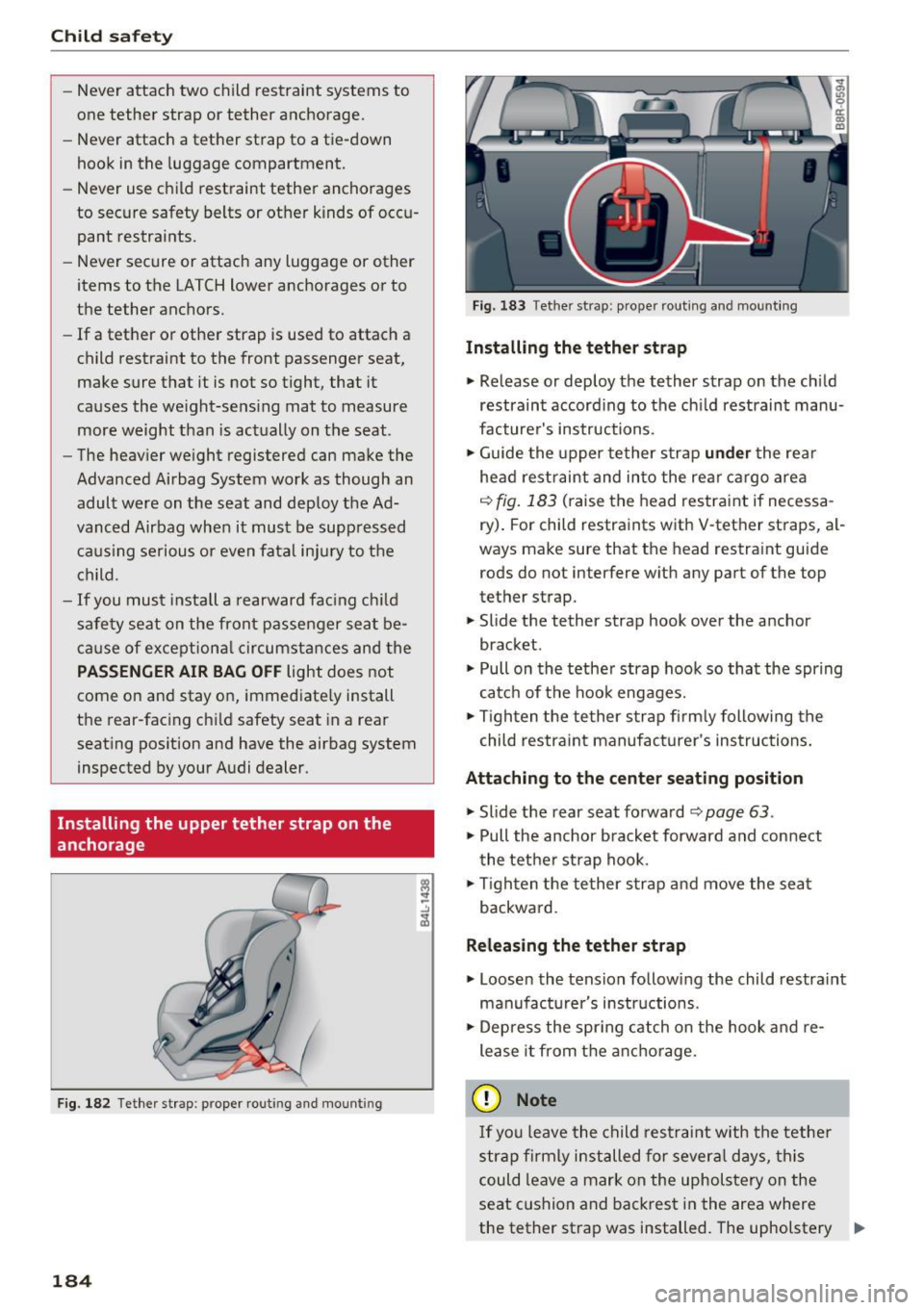
F ig. 18 2 Tether strap : proper routing and mount ing
184
Fig. 1 83 Tether strap: proper routing and mount ing
Installing the tether st rap
~ Release or deploy the tether strap on the ch ild
restraint accord ing to the ch ild restraint manu
facture r's instructions.
~ Guide the upper tether s trap under the rea r
head rest raint and in to the rear cargo area
~ fig. 183 (raise the head restraint if necessa
ry). For child restraints with V -tet her straps, al
ways make sure that the head restra int guide
rods do not interfere with any pa rt of the top
tether strap.
~ Slide the tether strap hook over the anchor
bracket .
~ Pull on the tether strap hook so that the spring
ca tch of the hook engages.
~ Tighten the tether stra p firm ly following the
child restra int manufacturer's instruc tions .
Attaching to the cente r seating position
~ Slide the rear seat forward ~ page 63 .
~ Pull the anchor bracket forward and con nect
the tethe r strap hook.
~ Tigh ten the te ther strap a nd move the seat
backward.
Releasing the tether strap
~ Loosen the tension following the child restra int
manufac turer's instr uctions .
~ Depress the spr ing catch on the hook and re
lease it from t he a nch o rage.
(D Note
If yo u leave the child restraint w ith the tethe r
strap firmly installed for severa l d ays, this
could leave a mark on the upholstery on the
seat cushion and backrest in the area where
the tether strap was installed. The upholstery
IJ>
Page 190 of 296

Inte llig ent Techn olo gy
Hill descent assist
The hill descent assist makes it possible to drive
down an incline at a constant speed .
~~,·~ ('l)ofF ___ P..1 --- fl~ IIL..~
---
Fig. 186 Top of the center conso le: hill descent assist but
ton
Fig. 187 Display: hill descent assist
.. Press the~ button in the center console
¢ fig . 186 or on the shift gate . The button will
illuminate .
" Press the button again to switch it off. The di-
ode in the button will go out .
H ill descent ass ist brakes all four wheels auto
matically in order to limit speed when driving ei
ther forwa rd o r reverse on hills with a grade up to
approx imately 50%.
When the hill descent assist is on, the current
driving speed, when your vehicle entered the in
cline is maintained.
It is only possible to switch
on the assist when driving slower than 37 mph
(60 km/h). The assist works between app roxi
mately 2 and 19 mph (4 and 30 km/h) . The driver
can increase or decrease the vehicle speed within
these limits by depressing the accelerator or
brake pedal In addition, vehicle steerability is in
creased due to the braking distribution when
driving in reverse .
18 8
There must be however sufficient ground adhe
sion . The hill descent assist can
no t do its job if
the incline is icy or if the incl ine ground is loose
¢ &.
The system does not work at speeds between 19
and 37 mph (30 and 60 km/h). The system is
then in the ready-mode. The diode in the button
will come on . The system automatically sw itched
off when you drive faster than 37 mph (60 km/ h) . The diode will go out in this case .
Active control at a specific speed up to approxi
mately 19 mph (30 km/h) will appear in the in
strument cluster display
c:> fig. 187 . Two dashes
" •• " w ill appear in the ready mode .
Hill descent assist is automatically activated un
der the following conditions:
- the diode in the button ill uminates,
- veh icle speed is below approximately 19 mph
(30 km/h)
- the incl ine is 10%.
& WARNING
- Always adapt your speed to the weather,
road and traffic cond itions. Do not let the
increased safety provided tempt you into
taking risks.
-
-The hill descent assist system cannot over
come the laws of phys ics. Your driving style
must always be adapted to the current road
and traffic conditions.
- The hill descent assist may not be ab le to
hold your vehicle at a constant speed under
all cond itions wh ile driving on an incline (for
example if ground under the vehicle is
loose).
Notice about data
recorded by the Event
Data Recorder and
vehicle control modules
E ven t Data R eco rde r
This vehicle is equipped with an Event Data Re
corder ( EDR). The main purpose of an EDR is to
record, in certain crash or near crash-like .,,_
Page 196 of 296

Driving and th e en vironm ent
Driving and the
environment
Breaking in
New engine
The engine needs to be run-in during the first
1,000 miles (1,500 km).
For the first 600 miles (1 ,000 kilometer s):
.,. Do not use full throttle .
.,. Do not drive at engine speeds that are more
than 2/3 of the max imum permitted RPM .
From 600 to 1,000 miles (1 ,000 to 1 ,500
kilometers ):
.,. Speeds ca n gradually be increased to the maxi
mum perm iss ib le road or eng ine speed .
During and after break-in pe riod
.,. Do not rev the engine up to high speeds when it
is cold. This applies whether the transmission is
in N (Neutral) or in gear .
After the break- in period
.,. Do not exceed maximum engine speed under
any circumstances.
.,. Upshift into the next higher gear
before reach
ing t he red area at the end of the tachometer
sca le
¢page 8.
During the first few hours of driving, the eng ine's
internal friction is higher than later whe n all the
mov ing parts have been broken in. How well this
break- in process is done depends to a considera
b le exte nt on the way the vehicle is d rive n during
the firs t 1,000 miles (1,500 kilometers).
{[) Note
Extremely high eng ine speeds a re au tomati
cally reduced . However, these rpm lim its are
progr ammed for an e ng ine well run -in, not a
new engine.
@ For the sake of the environment
Do not dr ive with u nne cessarily high eng ine
spee ds -upshi fting ea rly saves fuel, reduces
noise and protec ts the enviro nment .
194
· New tires
If your veh icle is runni ng on new tires, d rive very
c ar efu lly fo r the fi rs t 350 miles (500 kilometers)
a fter fi tting.
_& WARNING
New tires tend to be slippe ry and must a lso
be "broken-in". Be sure to remember this dur
ing the first 350 m iles (500 kilometers) .
Brake gent ly. Avoid following closely behind
other ve hicles or ot her situations that might
require sudden, hard braking.
Catalytic converter
App lies to : vehicles wi th gaso line e ngi ne
-
It is very important that your emission control
system (catalytic converter) is functioning prop
erly to ensure that your vehicle is running in an
environmen tally sound manner .
.,. Always use lead-free gasoline¢ page 209,
Gasoline .
.,. Never r un the tank down all the w ay to emp ty.
.,. Never put too much mo to r o il in yo ur engi ne
¢ page 221, Adding engine oil 9::r..
.,. Never try to push- or tow-start your vehicle .
The cata lyt ic converter is an efficie nt "clea n-up"
device b uilt into the exhaus t sys tem o f the ve hi
cle . Th e catalytic converter b urns many of the
po llutants in the exhaust gas before they are re
l eased into the atmosphere.
The exclusive use of un le ad ed fuel is critically im
portan t fo r the life o f the cataly tic converte r and
proper functio ning of the engine .
A WARNING
The temperature o f the exhaust system is
h igh, both when driv ing and after stopp ing
the eng ine.
-
- Never touch the exhaust tail pipes once they
have become hot. This could resu lt in burns.
- Do not park or operate the vehicle in a reas
where the hot exhaust system may come in
contact with dry grass, b rush, fuel sp ill or
other mate rial which can cause a fire.
Page 200 of 296

Offroad dri ving
Offroad driving
Driving under difficult
conditions and off-road
General information
The operation of the Electronic Stabilization Con
trol (ESC) is expanded for operation away from
paved roads. In situations where slip or a differ
ential locking function is required, the offroad mode can be activated
<=> page 186. Your Audi al
so has permanent all-wheel drive in addition .
However, your Audi is not a pure offroad vehicle.
It was not built for driving under extreme condi
tions, e.g. for trips that are in the nature of an
expedition .
Drive only on roads and offroad sections which
match the design of your vehicle and your abili
ties as a driver. Never take risks!
Befo re driving offroad
-Check the eng ine oil level, tire pressure, coo l
ant level, and the fluid leve l in the windshield
washer reservoir.
- Stow luggage items and other objects in the
lu ggage compartment, and secure them
against sliding around.
After driving offroad
-After trips offroad, remove any twigs and other
foreign objects from the grill, the underbody
and the wheels. Pay specia l attention to foreign
objects (stones) which have become lodged in
the tire tread.
- Clean the body and the vehicle underside, and
inspect the vehicle for possible damage.
- Clean dirty windows, headlamp lenses, rear
lights, and license plates.
- Perform a brake check (particularly after travel
ling through water) .
A WARNING
- Drive especially attentive ly and plan ahead
in difficult road conditions and when off
road. Excessive speed or incorrect maneu
vers can cause in juries and damage to the
vehicle.
198
- Always adapt your speed and driving style to
road, offroad, traffic, and weather condi
tions. Drive especially slowly offroad when
your view is restricted.
- Please be aware that in offroad mode, par
ticularly on a smooth and slippery road, the
wheels may have an increased tendency to
spin and the vehicle may break away - dan
ger of skidding!
- Stability is limited in the offroad mode.
® For the sake of the environment
Avoid damage to the environment and re
spect nature.
(D Tips
Only drive where it is permitted and stay on
marked roads and paths.
Explanation of some technical terms
The following data refer to ideal conditions. De pending on vehicle load and ground conditions
and the env ironment, the numbers may vary. It is
the driver's responsibility to decide whether ave
hicle can overcome a specific s ituation
<=> .&. .
Gradient angle
The number of meters in alt itude gained over a
distance of 109.4 yards or 100 meters (grade)
are given as a percentage or degrees . Informa
tion about the gradient the vehicle can cl imb un
der its own power (depends in part on the road
surface and eng ine power). Maximum permitted
grade: 31
°
Ground clearance
The distance between the road surface and the lowest point of the vehicle underbody. Ground
clearance 7.9 in (200 mm)
.&, WARNING
Exceeding the stated maximum figures can
result in severe injuries or vehicle damage.
- All the information was gathered on level,
firm and non-slippery road surfaces, and un-
-
der dry weather conditions. ..,
Page 201 of 296

CD
CD
.... N ,-... N ..... 0 0 C<'. 00
-Ideal conditions do not prevail offroad . Nev
er utilize the maximum readings to their
fullest, always leave a safety reserve.
Driving tips
On poor rood and offrood, there is always only
one motto: Plan ahead and drive slowly!
Please observe the following when driving away
from paved roads:
~ Drive only on roads and offroad sections wh ich
match the design of your veh icle and your abili
ties as a driver. Never take risks!
~ Drive slowly and plan ahead!
~ Take into consideration the ground clearance
of your veh icle.
~ Activate the off road mode q page 186 as need
ed .
~ Use the hill descent assist q page 188 when
driv ing down steep sections on h ills.
Unpaved road s and offroad
Drive s low ly on unfamiliar roads and unknown
offroad sections, and look out for unexpected ob
stacles (e .g . potholes, rocks, tree stumps, etc .).
T o prevent the vehicle from bottoming and avoid
damage to the underbody, you should drive
stra ight across severe bumps in the ground with
only one side of the vehicle so that only two of
your wheels cross the bumps .
Drive briskly through sandy or marshy offroad
sections and do not stop, if at all possible.
Driving through water
Note the following to avoid vehicle damage when
driving through water, for example on flooded
roads:
- Th e wate r must not be any higher than the bot-
tom of the vehicle body.
- Do not drive faster than walking speed.
Driving on a slope
If you ever find yourself not able to climb a slope,
do not try to turn around, drive back down in
re
verse.
Othe rw ise, you run the risk of tipping over.
Offroad driving
If the vehicle threatens to tip over when driving
across a slope, you must immediately steer
downhill in the direction of the slope.
Do not park your vehi cle on steep slopes or
grades .
T o reduce the risk of tipping over, drive on slopes
i n the direction of the downward slope (fall line) -
not crosswise .
& WARNING ~ -
After driving thro ugh water, mud, slush, etc.,
the brakes may be slow to take effect beca use
of wet brake rotors and pads. Dry the brakes
f ir st by braking carefu lly to restore the full
braking effect.
(D Note
-Vehicle components such as the engine,
transmission, suspension or electrical sys
tem can be severely damaged by driving
through water .
- Always switch off the Start-Stop-System*
when driving through water
Q page 90.
(D Tips
-Check the depth of the water before driving
through it.
- Do not stop the vehicle, drive in reverse or
switch the engine off when driving through
water.
- Keep in mind that oncoming vehicles may
create waves that raise the water level and
make it too deep for your vehicle to drive
through safely.
-Avoid dr iv ing through salt water because it
can cause corros ion.
199
Page 202 of 296

Trailer towing
Trailer towing
Driving with a trailer
General information
Your Audi was designed primarily for passenger
transportation.
If you plan to tow a trailer, please remember that
the additional load will affect durability, economy and performance.
Trailer towing not on ly places more stress on the
ve hicle, it also ca lls for more concentration from
the dr iver.
F or this reason, always follow the operating and
driving instructions provided and use common
sense.
Technical requirements
Trailer hitch
Use a weight-carrying hitch conforming to the
gross tra iler weight. The hitch must be suitab le
for your veh icle and tra iler and must be mounted
securely on the vehicle's chassis at a technically
sound
locat ion . Use on ly a trailer hitch with a re
movable ba ll mount . Always che ck with the t rail
er hitch man ufac tur er to make s ure t hat you are
using the co rrect hi tc h.
Do not use a bumper hitch.
The hitch must be installed in such a way that it
does not interfere with the impact -absorbing
bumper system. No mod ificat ions should be
made to the vehicle exhaust and b rake systems .
Fr om t ime to t ime, che ck that all hitch mo unti ng
bol ts rem ain securely f aste ned.
W hen you are not tow ing a tra iler, remove the
tra ile r hitc h ba ll mount . This prevents the hit ch
from caus ing damage s hou ld your veh icle be
s truck from be hind ¢
,&..
Trailer brakes
If you r trailer is equipped with a brak ing system,
check to be su re that it conforms to all regula
tions .
200
The t rai ler hydraulic bra ke system must not be
directly connected to the vehicle's hydraulic
bra ke system ¢&. .
Safety chains
Always use s afety chains be tween you r vehi cle
and t he tra ile r.
Trailer lights
Traile r lights must meet all regula tions . B e s ure
to check w ith your author ized Audi dealer for cor
r ec t wir ing, swi tches, an d relays.
Mirrors
If you are unable to see t he traffic behind you us
i ng t he regular outs ide mirrors, then yo u
must in
stall ex tended mirro rs . It is impo rtant that you
al ways have clear vision to the rear.
.&_ WARNING
- If a tra ile r has e lectr ical brake s ple ase no te
t h at these b ra kes are not activated by the
factory -fit ted contro l unit -risk of accident!
- After removing the traile r h itch, d o no t
s t o re it in your vehicle. In case of sud den
braking, the hitch co uld fly forwar d and in
jure you or yo ur passenge rs.
- Never install a "we igh t distribu tin g" or
"loa d eq ualizing" trailer hitch on your veh i
cle . The vehicle was not designed fo r these
kinds o f trailer hitches. The hitch attach
ment can fail, ca us ing the tra ile r to tear
loose from the vehicle .
- The Gross Vehicle Weight Rating for your
veh icle, found on the safety compliance la
be l on the driver's s ide B-pillar, must never
be exceeded under any circ umstances . Ex
ceed ing the Gross Vehicle We ight Rat ing of
your veh icle is likely to damage yo ur vehicle,
a nd such d amage will no t be covered by
your Limi ted New Vehicle W arra nty . Exceed
ing the Gross Ve hicl e We ight Rating will al
so change the pe rformance and han dling
characte ristics o f yo ur vehicle, which could
cause a crash result ing in se rious injury or
death.
Page 203 of 296
CD
CD
.... N ,-... N ..... 0 0 C<'. 00
Operating instructions
6" r-2
~·~
1/2"
1·1/2"
ill
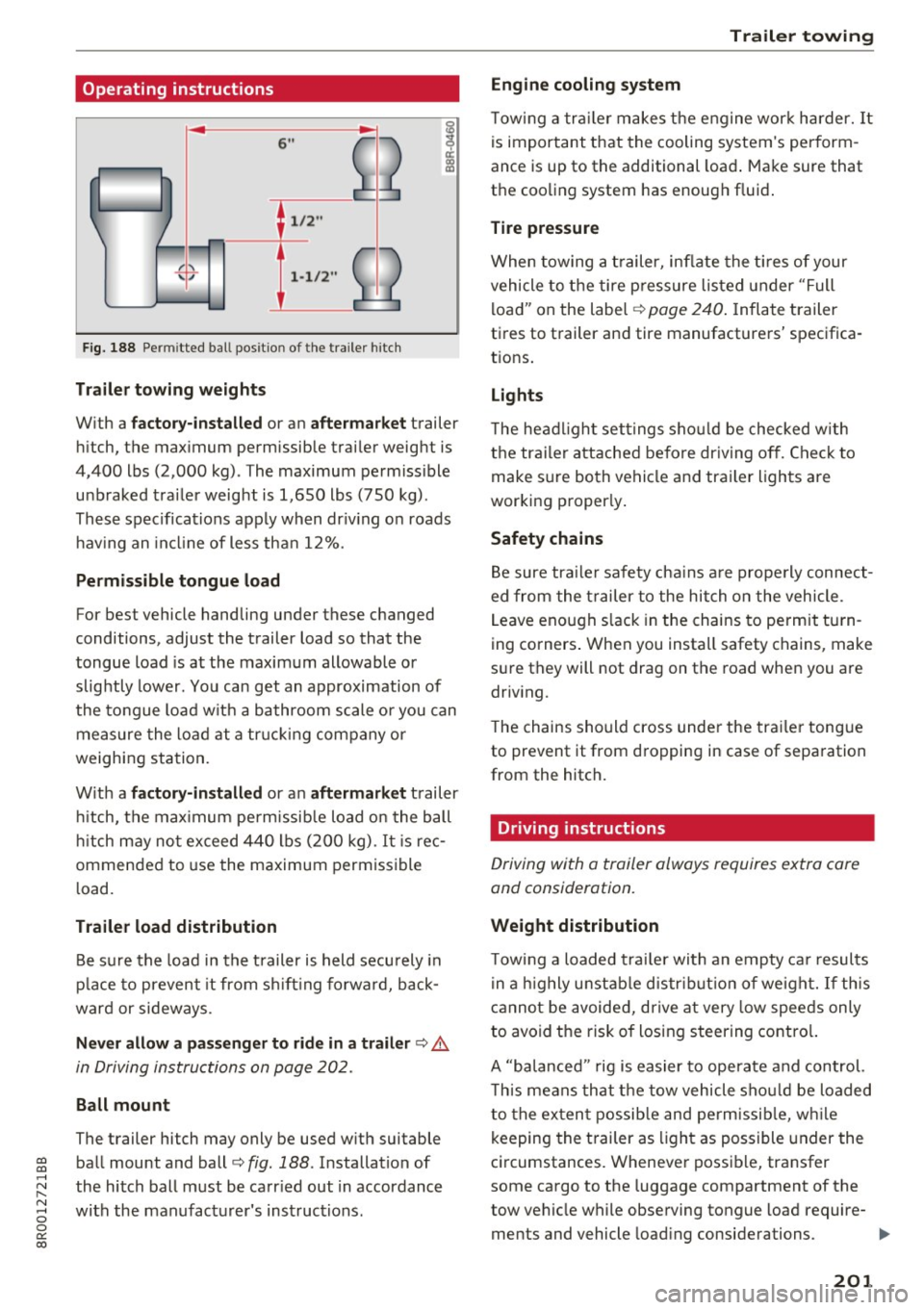
Fig. 188 Permi tted ba ll pos it io n of the trailer h itch
Trailer towing weights
With a
factory-installed or an aftermarket trailer
hitch, the maximum permissible trailer weight is
4,400 lbs (2,000 kg) . The maximum permissible
unbraked trailer weight is 1,650 lbs (750 kg).
These specifications apply when driving on roads having an incline of less than 12%.
Permissible tongue load
For best vehicle handling under these changed
conditions, adjust the trailer load so that the
tongue load is at the maximum allowable or
slightly lower. You can get an approximation of
the tongue load with a bathroom scale or you can
measure the load at a trucking company or
weighing station.
With a
factory-installed or an aftermarket trailer
hitch, the maximum permissible load on the ball
hitch may not exceed 440 lbs (200 kg) .
It is rec
ommended to use the maximum permissible
load.
Trailer load distribution Be sure the load in the trailer is held securely in
place to prevent it from shifting forward, back
ward or sideways.
Never allow a passenger to ride in a trailer ¢.&.
in Driving instructions on page 202.
Ball mount
The trailer hitch may only be used with suitable ball mount and ball¢
fig. 188 . Installation of
the hitch ball must be carried out in accordance
with the manufacturer's instructions .
Trailer towing
Engine cooling system
Towing a trailer makes the engine work harder. It
is important that the cooling system's perform
ance is up to the additional load. Make sure that
the cooling system has enough fluid.
Tire pressure
When towing a trailer, inflate the tires of your
vehicle to the tire pressure listed under "Full
load" on the label¢
page 240. Inflate trailer
tires to trailer and tire manufacturers' specifica
tions.
Lights
The headlight settings should be checked with
the trailer attached before driving off. Check to
make sure both vehicle and trailer lights are
working properly.
Safety chains
Be sure trailer safety chains are properly connect
ed from the trailer to the hitch on the vehicle .
Leave enough slack in the chains to permit turn
ing corners. When you install safety chains, make
sure they will not drag on the road when you are
driving.
The chains should cross under the trailer tongue
to prevent it from dropping in case of separation
from the hitch.
· Driving instructions
Driving with a trailer always requires extra care
and consideration.
Weight distribution
Towing a loaded trailer with an empty car results
in a highly unstable distribution of weight. If this
cannot be avoided, drive at very low speeds only
to avoid the risk of losing steering control.
A "balanced " rig is easier to operate and control.
This means that the tow vehicle should be loaded
to the extent possible and permissible, while
keeping the trailer as light as possible under the
circumstances. Whenever possible, transfer
some cargo to the luggage compartment of the
tow vehicle while observing tongue load require-
ments and vehicle loading considerations. .,.
201