2017 AUDI Q5 lights
[x] Cancel search: lightsPage 203 of 296
CD
CD
.... N ,-... N ..... 0 0 C<'. 00
Operating instructions
6" r-2
~·~
1/2"
1·1/2"
ill
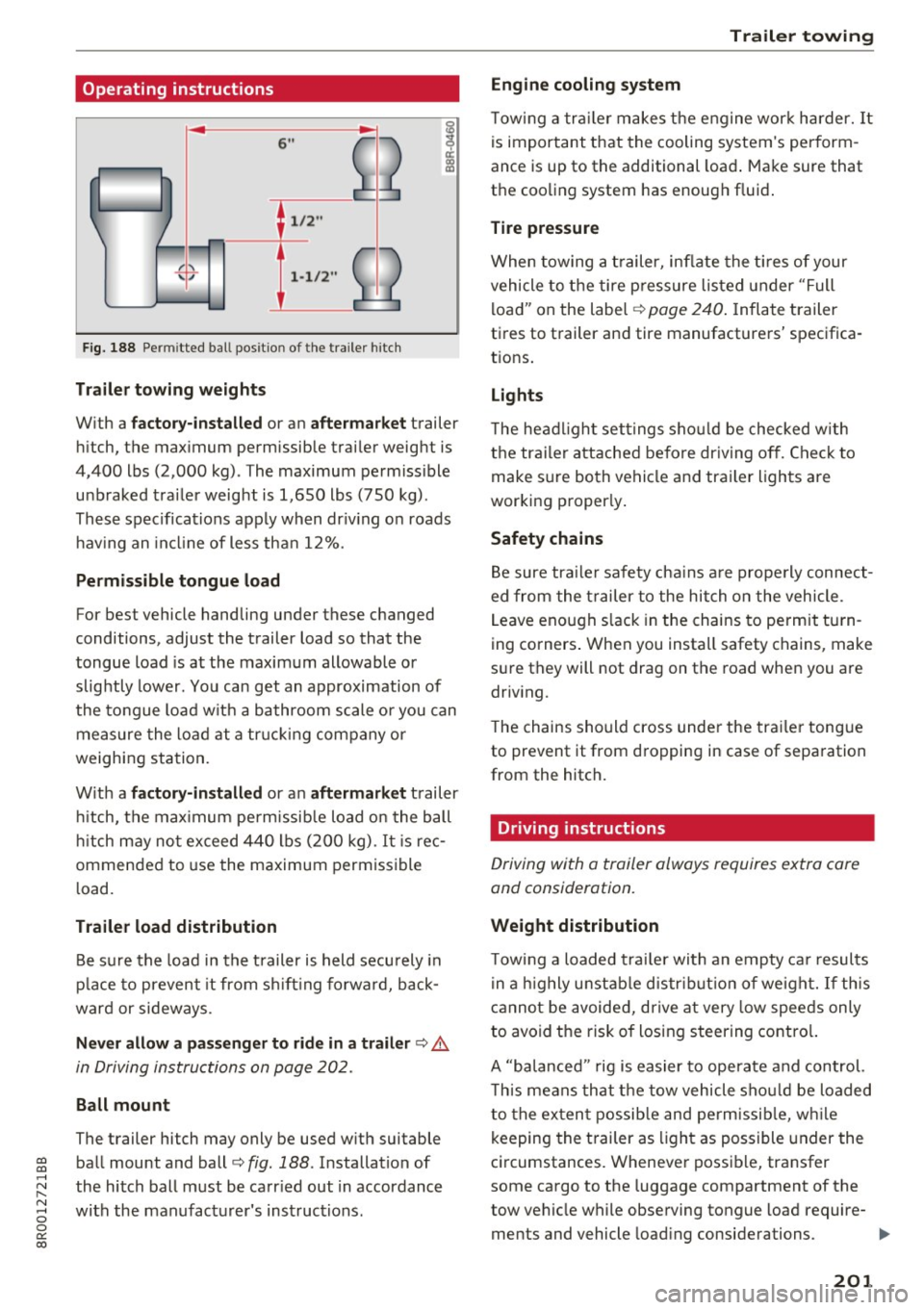
Fig. 188 Permi tted ba ll pos it io n of the trailer h itch
Trailer towing weights
With a
factory-installed or an aftermarket trailer
hitch, the maximum permissible trailer weight is
4,400 lbs (2,000 kg) . The maximum permissible
unbraked trailer weight is 1,650 lbs (750 kg).
These specifications apply when driving on roads having an incline of less than 12%.
Permissible tongue load
For best vehicle handling under these changed
conditions, adjust the trailer load so that the
tongue load is at the maximum allowable or
slightly lower. You can get an approximation of
the tongue load with a bathroom scale or you can
measure the load at a trucking company or
weighing station.
With a
factory-installed or an aftermarket trailer
hitch, the maximum permissible load on the ball
hitch may not exceed 440 lbs (200 kg) .
It is rec
ommended to use the maximum permissible
load.
Trailer load distribution Be sure the load in the trailer is held securely in
place to prevent it from shifting forward, back
ward or sideways.
Never allow a passenger to ride in a trailer ¢.&.
in Driving instructions on page 202.
Ball mount
The trailer hitch may only be used with suitable ball mount and ball¢
fig. 188 . Installation of
the hitch ball must be carried out in accordance
with the manufacturer's instructions .
Trailer towing
Engine cooling system
Towing a trailer makes the engine work harder. It
is important that the cooling system's perform
ance is up to the additional load. Make sure that
the cooling system has enough fluid.
Tire pressure
When towing a trailer, inflate the tires of your
vehicle to the tire pressure listed under "Full
load" on the label¢
page 240. Inflate trailer
tires to trailer and tire manufacturers' specifica
tions.
Lights
The headlight settings should be checked with
the trailer attached before driving off. Check to
make sure both vehicle and trailer lights are
working properly.
Safety chains
Be sure trailer safety chains are properly connect
ed from the trailer to the hitch on the vehicle .
Leave enough slack in the chains to permit turn
ing corners. When you install safety chains, make
sure they will not drag on the road when you are
driving.
The chains should cross under the trailer tongue
to prevent it from dropping in case of separation
from the hitch.
· Driving instructions
Driving with a trailer always requires extra care
and consideration.
Weight distribution
Towing a loaded trailer with an empty car results
in a highly unstable distribution of weight. If this
cannot be avoided, drive at very low speeds only
to avoid the risk of losing steering control.
A "balanced " rig is easier to operate and control.
This means that the tow vehicle should be loaded
to the extent possible and permissible, while
keeping the trailer as light as possible under the
circumstances. Whenever possible, transfer
some cargo to the luggage compartment of the
tow vehicle while observing tongue load require-
ments and vehicle loading considerations. .,.
201
Page 207 of 296

CD
CD
.... N ,-... N ..... 0 0 C<'. 00
wash operator to reduce the risk of accidents.
- To reduce the risk of cuts, protect yourself
from sharp metal components when wash
ing the underbody or the inside of the wheel
housings .
- After washing the vehicle, the brak ing effect
may be delayed due to mo isture on the
brake rotors or ice in the w inter . This in
creases the risk of an acc ident. The brakes
must be d ried fi rst w ith a few careful b rake
applications.
(D Note
- If you wash t he vehicle in an automatic car
wash, yo u m ust fold the exte rior m irrors in
to reduce the risk of damage. Power fo ld ing
exter ior mir ro rs* m ust only be folded in and
out using t he power folding fu nction .
- To reduce the risk of damage to the rims
a nd ti res, compare the width between the
whee ls on your vehi cle w it h the dis tance be
tween the guide rai ls in the car wash.
- To reduce t he risk of damage, compare the
height and width o f yo ur vehicle wi th the
Ca re and cleaning
height and w idth of the inside of the car
was h.
- T o red uce the risk of pa int damage, do not
was h the vehicle in d irect sun light .
- T o red uce the risk of d am age to the s urf ace,
do not use insect removing sponges, k itche n
sponges or similar items .
- Mat te finish painted veh icle components:
- To reduce the risk of damage to the sur-
face, do not use polishing agents or hard
wax .
- Never use protective wax. It can destroy
the matte finish effect .
- Do not place any stickers or magnetic
signs on vehicle parts painted with matte
finish paint . The paint cou ld be damaged
when the stickers or magne ts are re
moved .
@ For the sake of the environment
Only wash t he vehicle in facilities s pec ially de
s igned for that pu rpose . This will reduce the
r isk of dirty wate r contaminated with oil from
ente ring the sewe r sys tem.
Cleaning and care information
When clea ning and caring for individua l vehicle
components, refer to the following tables. The
i nformation contained there is simply recom
mendations. For quest ions or for components t
h at are not listed, cons ult an autho rized Aud i
de aler or au thori zed Audi Se rvice Fac ility. Also
f o llow the information fo und in ~ .&. -
Exterior cleaning
Component Situation Solution
Windshield wiper
Deposits ~ page 55, Cleaning windshield wiper blades
blades
Headlights /
Deposits Soft spo nge with a m ild soap solution3>
Tail lights
Sensors /
Deposits Sensors: soft cloth wit h solvent-free cleaning solut ion
camera lens es Camera le nses: soft cloth w ith a lcohol -free cleaning solu-
tion
Snow/ice Hand br
ush/solvent-free de-icing spray
Wheels Road salt Water
Brake dust Acid-free special cleaning so
lution
E xhaust tail pipes Road salt Water, clean ing so lution su itab le for stainless stee l, if nee-
essary
205
Page 209 of 296

CD
CD
.... N ,-... N .... 0 0 c:<: 00
Care and cleaning
Component Situation Solution
T ex til es
Deposits adhering to Vacuum cleaner
art ifici al leat her, the surface
A lcan tara Water-based deposits Absorbent
cloth and mild soap solutiona>
such as coffee, tea,
b lood, etc.
Oil -based deposits Apply a m ild soap solution
a), blot away the dissolved o il or
such as oil, make-up, dye, treat afterward with water, if necessary
etc.
Special deposits such Special stain
remover, blot with absorbent material, treat
as ink, nail polish, la- afterward with mild soap solution, if necessary
a)
tex paint, shoe pol-
ish, etc.
Natu ral le ath er Fresh stains Cotton cloth with a mild soap solution a>
Water-based deposits Fresh stains: absorbent cloth
such as coffee, tea, Dried stains : stain
remover suitable fo r leather
b lood , etc.
Oi l-based deposits Fresh stains: absorbent cloth and stain
remover suitable
such as oil, make-up, for leather
etc. Dried stains : grease dissolving spray
Special deposits such Spot remove r suitab le for leather
as ink, nai l polish, la-
tex paint, shoe pol-
ish, etc.
Care Regularly apply condit ion ing c ream that protects from
lig ht and penet rates into the material. Use specia lly-co l-
ored conditioning cream, if necessary .
Carbon part s Deposits clean the same way as plast ic parts
a) Mi ld soap solution: maximum two tablespoons of neutral soap in 1 q uart (1 liter) of water
.8, WARNING
The windshield may not be trea ted with wa
ter-repelling windshield coating agents. Un
favorable cond itions such as wetness, dark
ness, or low sun can result in increased glare.
Wiper blade chatter is also possible.
@ Note
- Headlight s/tail li ght s
-Never clean headlights or tail lights with a
dry cloth or sponge.
- Do not use any cleaning product that con
tains alcohol, because they could cause
cracks to form.
- Whe els
-
- Never use a ny pa int polish or other abra
sive materials .
- Damage to the protect ive layer on the
rims such as sto ne ch ips or scratches must
be repaired immediately .
-Sen sor s/camera l enses
- Neve r use warm or hot water to remove
snow or ice from the camera lens . This
could cause the lens to crack .
- Neve r use ab rasive cleaning materials or
a lcohol to clean the camera lens . This
could cause scratches and cracks .
-Door window s
-Remove snow and ice on windows and ex-
terior mirrors w ith a plast ic scraper . To
207
Page 222 of 296

Check ing and F illing
Audi oil quality standard
Gas olin e
VW 502 00 or
engi ne vw 50400
Di esel vw 50 7 00
eng in e
Au di r ecomm ends
~ castroL //gJB,'flt@t Frti:rr.:;-...1"JDl'1Al.
Au di r ecommend s Longlif e high perf ormance
engi ne oil from A udi Genuine Part s
Using the proper engine oil is important for the
functionality and service life of the eng ine. Your
engine was factory-filled with a high-quality oil
which can usually be used throughout the entire
year.
{tD Note
Your Limited New Vehicle Warranty does not
cover damage or malfunctions due to failure
to follow recommended maintenance and use
requirements as set forth in the Audi Owner's
Manual and Warranty
& Maintenance booklet.
- Use only a high quality eng ine oil that ex-
pressly complies wi th the Audi oil quality
standard specified for your vehicle's engine.
Using any other oil can cause serious engine
damage.
- Do not mix any lub ricants or other additives
i nto the engine oil. Doing so can cause en
g ine damage.
@ Tips
If you need to add oil and there is none availa
ble tha t meets the Audi o il quality standard
your eng ine requi res, you may add a tota l of
no more than 0 .5 quart/li ter of a h igh-quality
"synthetic"oil that meets the fo llowing speci
fications.
- Vehicles with gasoline eng ine: ACEA A3 or
API SM with a viscosity grade of SAE OW-30,
SAE 5W-30 or SAE 5W-40.
- Vehicles w it h diese l engine: ACEA C3 o r
API CF with a viscosity grade of SAE OW-30
or SAE 5W-30.
- For more information about engine oi l that
has been approved for your ve hicle, please
contact either your authorized Audi dea ler
220
or Audi Customer Relations at
1 (800) 822-2834 or visit our web site at
www.aud iusa .com or www .a udicanada .ca.
Engine oil consumption
The engine in your vehicle depends on an ade
quate amount of oil to lubricate and cool all of
its moving parts.
In order to provide effective lub rication and cool
ing of internal engine components, all internal
combust ion engines consume a certa in amount
of oil. Oil consumption var ies from engine to en
gine and may change significantly over the life of
the engine . Typically, engines w ith a specified
break-in period (see
c::;,page 194) consume more
o il dur ing the break-in per iod than they consume
after o il consumption has stabi lized .
Under normal cond itions, the rate of oil con
sumption depends on t he quality and viscos ity of
the oil, the RPM (revolutions per m inute) at
wh ich the engine is operated, the ambient tem
perature and road condit ions. Furthe r facto rs a re
t h e amount of o il d ilution from water condensa
tion or fue l residue and the oxidation level of the
oi l. As any engine is subject to wear as mileage
builds up, the oil consumption may increase over
time unt il replacement of worn components may
become necessary.
With a ll these variab les coming into p lay, no
standard rate of oi l consumption can be estab
li shed or spec ified . There is no alternative to reg
ular and frequent checking of the oi l level, see
Note .
If the yellow engine oil level warning symbo l in
the instrument cluster
Ill lights up, you should
check the o il level as soon as possible
<=:> page 221 . Top off the o il at your earliest con
venience
c::;, page 221 .
&. WARNING
Before you check anything in the engine com
partment, always read and heed all WARN
I NGS
<=:> .&. in Wor king in the engine compart-
ment on page 217. ..,
Page 227 of 296

CD
CD
.... N ,-... N ..... 0 0 C<'. 00
& WARNING
-Brake fluid is poisonous. It must be stored
only in the closed original container out of
the reach of children!
- Brake failure can resu lt from old or inappro
priate brake fluid. Observe these precau
t ions:
- Use only brake flu id that meets SAE speci
fication
J 1 703 and confo rms to Fede ral
Motor Vehicle Standard 116. Always check
with your author ized Audi dealer to make
sure you are using the correct brake fluid.
The correct type of brake fluid is a lso indi
cated on the brake flu id reservoir.
- The brake fluid must be new. Heavy use o f
the brakes can cause a vapor lock if the
brake fl uid is left in the system too long.
This can serious ly affect the efficiency of
the brakes as well as your safety. This
could result in an acc ident.
Brake fluid w ill damage the pa int of yo ur vehi
cle.
@) For the sake of the environment
Because of the prob lem of proper disposal of
brake flu id as we ll as the special tools re
qui red and the necessary expertise, we rec
ommend that you have the brake fluid
changed by your author ized Audi dealer.
Battery
General information
Under normal operating conditions, the battery
in your Audi does not need any maintenance.
W ith
high outside temperatures or long da ily
drives we recommend that you have the electro lyte level checked by an authorized Audi dea ler or
qua lified workshop. The e lectrolyte level should
a lso be checked each t ime the batte ry is charged
¢ page 22 7.
H ave the battery checked when you take your ve
hi cle in for serv ice. You a re well advised to re
p lace a batte ry that is o lde r than 5 years .
Check ing and Filling
Hybrid dr ive *: you can find important in format ion
about the high voltage battery under
¢ page 100.
Disconnecting the battery te rminals
Some vehi cle functions (power window regula
tors, for examp le) are lost if the batte ry te rm i
nals a re disconnected . These functions have to be
re learned after the battery terminals a re con
nected again. To prevent this, the battery should
only be disconnected from the vehicle electrical
system when absolutely necessary for repa irs.
Vehicles not dr iven for long p eriod s
If you do not drive your vehicle over a period of
severa l days or weeks, electrical compone nts are
gradually cut back or switched off. This reduces
energy consumpt ion and maintains starting ca
pability over a longer per iod
¢ page 192.
T ake into consideratio n that when you unlock
your vehicle, some convenience functions, suc h
as the inter ior lights or the power seat adjust
ment, may not be ava ilab le. The conve nience
funct ions will be available again when you turn
on the ignition and sta rt the eng ine.
Winter operation
D uring the winter months, battery capacity tends
to decrease as temperatures drop. This is be
cause more power is also consumed while start
i ng, and the headlights, rear w indow defogger,
etc., are used more ofte n.
Avo id unnecessary power consumption, pa rtic u
larly in city traff ic or when traveling only short
distances . Let your author ized Audi dealer check
the capacity of the veh icle batte ry before winter
sets in
¢ page 22 7. A we ll charged batte ry will
not only p reve nt start ing prob lems when the
wea the r is co ld, but will also last longer.
Working on the battery
Be especially careful when working on or near
the battery.
T he battery is loca ted in t he luggage compart
ment unde r the floo r. B efo re yo u check any thing .,..
225
Page 250 of 296

Wheels
check your tires as soon as possible, and inflate
them to the proper pressure. Driving on a signifi
cantly under-inflated tire causes the tire to overheat and can lead to tire failure. Under-inflation
also reduces fuel efficiency and tire tread life,
and may affect the vehicle's handling and stop
ping ability.
Please note that the TPMS is not a substitute for
proper tire maintenance, and it is the driver's re
sponsibility to maintain correct tire pressure,
even if under-inflation has not reached the level
to trigger illumination of the TPMS low tire pres
sure telltale.
Your vehicle has also been equipped with a TPMS malfunction indicator to indicate when the sys
tem is not operating properly. The TPMS mal
function indicator is combined with the low tire pressure telltale. When the system detects a
malfunction, the telltale will flash for approxi
mately one minute and then remain continuously
illuminated. This sequence will continue upon
subsequent vehicle start-ups as long as the mal
function exists .
When the malfunction indicator is illuminated,
the system may not be able to detect or signal low tire pressure as intended . TPMS malfunctions
may occur for a variety of reasons, including the
installation of replacement or alternate tires or
wheels on the vehicle that prevent the TPMS from functioning properly . Always check the
TPMS malfunction telltale after replacing one or
more tires or wheels on your vehicle to ensure
that the replacement or alternate tires and
wheels allow the TPMS to continue to function
properly.
248
· If the Tire Pressure Monitoring System
indicator appears
Applies to: vehicles with Tire Pressure Monitoring System
The tire pressure indicator in the instrument
cluster informs you if the tire pressure is too low
or if there is a system malfunction.
Fig. 206 Instrument cl uster: i ndic ator ligh t with message
Using the ABS sensors, the tire pressure monitor
ing system compares the tire tread circumfer
ence and vibration characteristics of the individu
al tires . If the pressure changes in one or more
tires , this is indicated in the instrument cluster
display with an indicator light
IE and a message
c>fig. 206. If only one tire is affected, the loca
tion of that tire will be indicated.
The tire pressures must be stored in the Infotain
ment system again each time the pressures
change (switching between partial and full load
pressure) or after changing or replacing a tire on
your vehicle
c> page 249. The tire pressure moni
toring system only monitors the tire pressure you have stored. Refer to the tire pressure label for
the recommended tire pressure for your vehicle
c> page 240, fig . 205.
Tire tread circumference and vibration character
istics can change and cause a tire pressure warn
ing if:
- the tire pressure in one or more tires is too low.
- the tire has structural damage.
- the tire was replaced or the tire pressure was
changed and it was not stored
c> page 249 .
-the collapsible spare* tire is installed.
Indicator lights
IE Loss of pressure in at least one tire c> &.
Check the tires and replace or repair if necessary . .,.
Page 265 of 296

a,
a,
..... N r-N ..... 0 0
0:
co
Right cockpit fuse assignment
Fig. 223 Right side of the cockpit: fuse panel wit h plastic
clip
Fuse panel @ (black)
No . Equipment
5 Steering column switch module
7 Terminal 15 diagnostic connector
8 Gateway (Databus diagnostic interface)
9 Auxil iary heater
Fuse panel @ (brown)
No. Equipment
1 CD /DVD player
2 Wi-Fi
3 MMI/Radio
4 Instrument cluster
5
Gateway (instrument cluster control mod-
ule)
6 Ignition lock
7 Light dial
8 Climate control system blower
9 Steering column lock
1 0 Climate control system
Fuses and bulbs
No . Equipment
11 Diagnostic data
link connector, terminal
30
12 Steering column switch module
Right luggage compartment fuse
assignment
Fig. 224 Right luggage compartment: fuse panel with
pla stic dip
Fuse panel @ (black)
No. Equipment
1 Luggage compartment lid control module
2 Trailer control module
3 Traile r control module
4 Tra iler control module
5 Electromechanical parking brake
6 Electronic damping control
7 Electromechanical parking brake
8 Tail lights
9 quattro Sport
10 Tail lights
11 Central locking system
12 Termina l 30
263
Page 266 of 296

Fuses a nd bul bs
Fu se pa nel© (bro wn)
No. Equipment
1 Luggage compartment lid control module
2 12 V socket, cigarette lighter
3
DCDC converter path 1 or high vo ltage bat-
tery blower (hybrid drive)
4 DCDC converter path 2, DSP amp lifier, ra-
dio
7 Electromechanical
parking brake
9
Right front door (window regu lator, cen-
tral locking, mirror, switch, lighting)
11 Rear right
door (window regulator, switch,
lighting)
12 Cell phone preparation
F
use panel © (black )
No. Equipment
1 Rig ht
front seat heating/venti lation
2 Automatic dimming rearview mirror
3 Instrument
panel terminal 30
4 MMI
5 Radio
6 Rearview camera
7 Rear window defogger
8 Rear Seat Entertainment
11 AdBlue heating
12 Ad Blue supply or h
igh vo ltage battery (hy-
brid drive)
Bulbs
Replacing light bulbs
For your safety, we recommend that you have
your authorized Audi dealer replace burned out bulbs for you.
It is becoming increasingly more and more diffi
cult to replace vehicle light bulbs since in many
cases, other parts of the car must first be re
moved before you are able to get to the bu lb.
This applies espec ially to the light bulbs in the
front of your ca r wh ich you can only reach
through the eng ine compartment.
2 6 4
Sheet meta l and bu lb holders can have sharp
edges that can cause serious cuts, and parts
must be correctly taken apart and then properly
put back together to help prevent breakage of
parts and long term damage from water that can
enter housings that have not been properly re
sealed.
For your safety, we recommend that you have
your authorized Audi dealer replace any bulbs for
you, since your dealer has the proper tools, the correct bulbs and the expertise.
Ga s d ischar ge lam ps (Xeno n light s)*:
Due to the high e lectrica l voltage, have the bulbs
rep laced by a qualified technician. Headlights
with Xenon light can be identified by the h igh
voltage sticker.
A WARNING
-
Contact with high-voltage components of the
electr ical system and improper replacement
of gas discharge (Xenon) headlight bulbs can
cause ser ious persona l injury and death .
- Xenon bulbs are pressur ized and can ex
plode when being changed .
- Changing Xenon lamps requires the special
tra ining, instruct ions and equ ipment .
- Only an authorized Audi dealer or other
qualified workshop should change the bulbs
in gas discharge lamps .
A WARNING
There are parts with sharp edges on the open
ings and on the bulb ho lders that can cause
serious cuts.
- If you are uncertain about what to do, have
the wor k performed by an authorized Audi
dea ler or other qual ified workshop. Ser ious
personal injury may resu lt from improperly
performed work .
(D Tips
-If you must replace the light bulbs you rself,
always remember that the eng ine compart
ment of any vehicle is a hazardous area to
work in. Always read and heed all WARN
INGS
¢page 217 ¢ &.