2017 AUDI A3 SEDAN flat tire
[x] Cancel search: flat tirePage 347 of 400

CXl CXl .... N ,.__
N .... 0 N > 00
label, you should determine the proper tire infla
tion pressure for those tires).
As an added safety feature, your veh icle has been
eq uipped w ith a t ire pressu re monitoring system
(TPMS) that illuminates a low tire press ure te ll
tale when one or more of your tires is significant l y under- inflated. Accordingly, when the low tire
pressure tellta le illuminates, you should stop and
check your tires as soon as possible, and inflate
them to the proper pressure . Driving on a s ignifi
cantly under- inflated tire causes the tire to ove r
h eat and can lead to t ire failure. Unde r-inflation
a lso reduces fuel efficiency and tire tread life,
and may affec t the vehicle's handling and stop
p ing ability .
P lease note that the TPMS is not a substitute for
p roper tire maintenance, and i t is the d rive r's re
sponsib ility to ma inta in cor rec t tire p ressure,
even if under-inflation has not reached the leve l
to trigger illumination of the TPMS low tire pres
sure tellta le .
Your veh icle has also been eq uipped w ith a TPM S
mal funct ion indicator to indicate when the sys
tem is not operating properly . The TPMS ma l
function indicator is combined with the low tire
pressure tellta le. When the system detects a
malfunct ion, the telltale will flash for approxi
mately one minute and then remain cont inuously
i l lum inated . This sequence will continue upon
subseq uent ve hicle start-ups as long as the ma l
function ex ists .
When the malfunct ion indicator is illuminated,
the system may not be ab le to detect or signal
low t ire press ure as intended. TPM S malf unctions
may occur for a var iety of reasons, including the
i nstalla tion of replacement o r alte rnate t ires o r
wheels o n the vehicle that prevent the TPM S
from func tioning properly. Always chec k the
TPMS malfunction telltale afte r rep lacing one or
more tires or whee ls on your ve hicle to ensure
that the replacement or alternate tires and
wheels allow the TPMS to cont inue to function
properly.
Wh eel s
If the tire pressure indicator appears
App lies to : vehicles wi th Tire Pressure Monito rin g Syste m in
dicator
The tire pressure indicator in the instrument
cluster informs you if the tire pressure is too low
or if there is a system malfunction.
U sing the ABS sensors, the tire pressure monitor
ing system compares the tire tread c ircumfer
ence and vibration characterist ics of the ind ividu
al tires. If the pressure changes in one or more
t ires, th is is indicated in the instrument cluster
display with an
[I] indicator light and a message .
If only one tire is affected, the location of that
t ir e will be indicated.
The tire pressures must be stored in the menu display again each t ime the p ressures change
(swi tching between partial and full load pres
s ur e) o r after changing or replacing a ti re o n your
vehicle
Q page 346. T he tire p ressure mo nitor
ing system on ly monitors the t ire pressure you
have stored. Refer to the tire pressure label for
the recommended tire pressure for yo ur vehicle
c:> page 336, fig. 281.
T ire tread c ircumference and vibra tion characte r
istics can change and ca use a tire press ure wa rn
ing if:
- t he t ire pressure in one or more ti res is too low.
- the t ire has str uctural damage.
- t he t ire was replaced or the t ire pressure was
changed and it was not stored
c:> page 346.
- one side of the vehicle is more heavi ly loaded
than the othe r.
- the wheels on one axle are more heavily loaded
than the othe rs (for example, when towing a
t ra ile r or when driving up and down hi lls).
- snow chains are installed .
- the spare tire* is installed.
- only one tire was replaced on eac h axle.
Indicator lights
[I] -Loss of pressu re in at least one tire c:> ,&. .
Check the tires and replace or re pair if necessary .
Check/correct the pressures of all fou r tires . Then
store the tire pressures in the menu
Q page 346 .
m (T ire Pressure Mon itor ing Sys tem) Tir e
pre ssure: System malfunction!.
If m appears 1JJ,,
345
Page 348 of 400

Wheels
after switching the ignition on or while driving
and the
[tlJ indicator light in the instrument clus
ter blinks for approximately one minute and then
stays on, there is system malfunction. Check/cor rect the pressures on all four tires and store the
pressures
Q page 346 . If the indicator light does
turn off or turns on again after a short period of
time, drive to an authorized Audi dealer or au
thorized Audi Service Facility immediately to have
the malfunction corrected.
A WARNING
- If the tire pressure indicator appears in the
instrument cluster display, reduce your
speed immediately and avoid any hard
steering or braking maneuvers. Stop as soon
as possible and check the tires and their
pressures.
- The driver is responsible for maintaining the correct tire pressures. You must check the
tire pressures regularly.
- Under certain conditions (such as a sporty
driving style, winter conditions or unpaved
roads), the pressure monitor indicator may
be delayed.
- Do not use run-flat tires on your vehicle. Us
ing them when not permitted can lead to
vehicle damage or accidents.
@ Tips
- The tire pressure monitoring system can al
so stop working when there is an ESC/ABS
malfunction.
- Using snow chains may result in a system
malfunction.
- The tire pressure monitoring system in your
Audi was calibrated with "Audi Original
Tires"
¢ page 335. Using these tires is rec
ommended .
- The tire pressure monitoring system can on
ly monitor the tire pressure of the driving
tires. Check the tire pressure of the spare
wheel in the luggage compartment so that
if necessary it is ready for use.
346
· Storing tire pressures
Applies to: vehicles with Tire P ressure Monitoring System in
dicator
A change in tire pressure or a change in tires
must be stored in the system.
Before storing the tire pressures, make sure the
tire pressures of all four tires meet the specified
values and are adapted to the load¢
page 335.
.,. Select in the Infotainment system: IMENU ! but
ton
> Vehicle > Service & checks > Tire pres
sure monitoring
> Store tire pressure > Yes,
store now.
(D Tips
Do not store the tire pressures if snow chains
are installed.
Page 355 of 400
a, a, ..... N
" N ..... 0 N > 00
Emergency assistance
Trunk escape latch
Applies to: vehicles with trunk escape latch (Sedan and Cab
rio let)
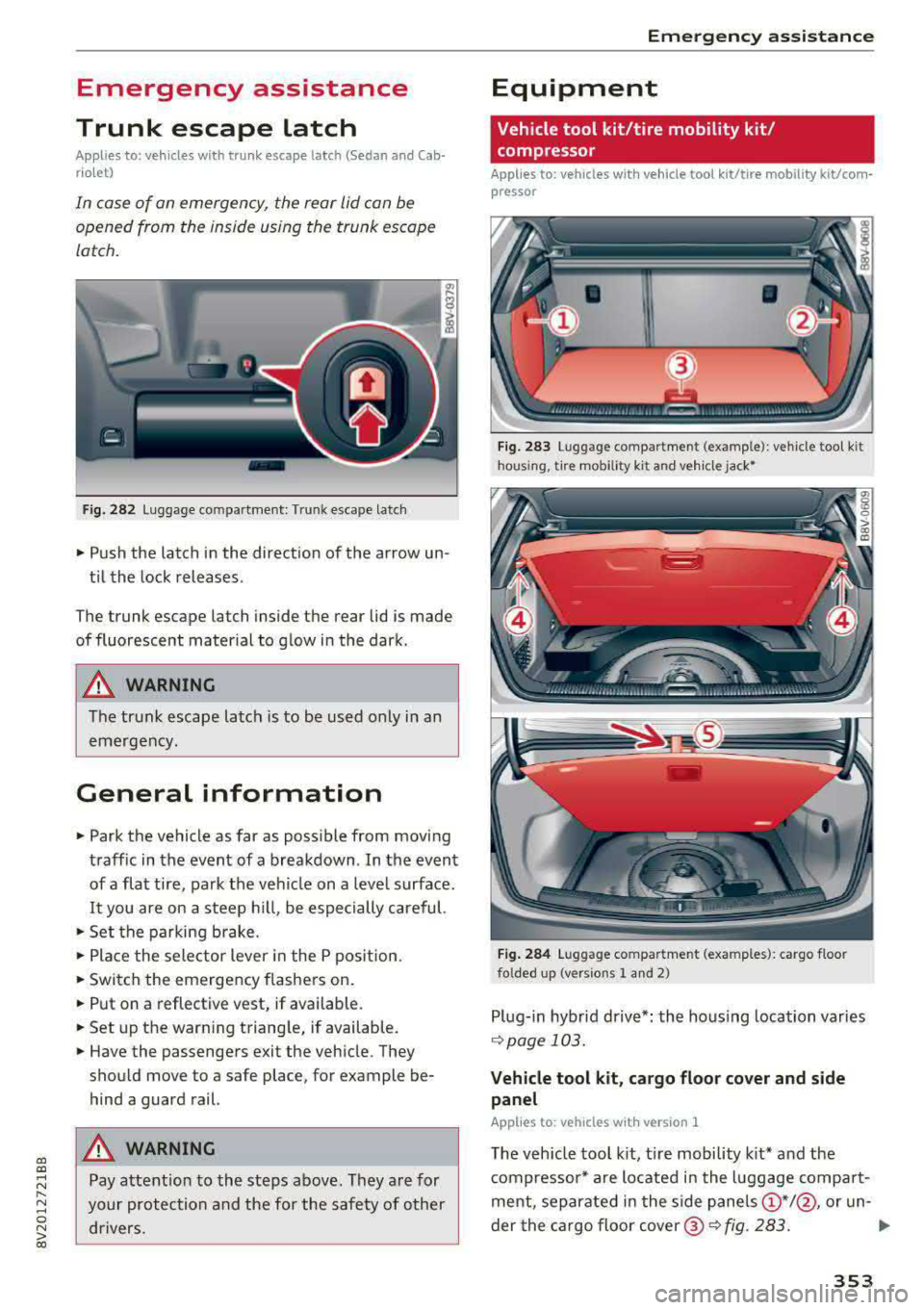
In case of an emergency, the rear lid can be
opened from th e inside using th e trunk escape
latch.
Fig. 282 Luggage co m partment: T runk escape latch
• Push the latch in the direction of the arrow un
t il the lock releases .
T he trunk escape latch inside the rear lid is made
of fluorescent mater ial to g low in the dark .
A WARNING
The trunk escape latch is to be used only in an
emergency .
General information
• Park the vehicle as far as possible from moving
traff ic in the event of a breakdown . In the event
of a flat tire, park the vehicle on a leve l surface .
It you are on a steep h ill, be especially careful.
• Set the parking b rake .
• Place the sele ctor lever in the P pos ition.
• Switch the emergency flashers on .
• Put on a reflective vest, if available.
•Setup th e warn ing triang le, if available.
• Have the passengers exit the vehicle . They
shou ld move to a safe place, for example be
hind a guard rail.
A WARNING
Pay attent ion to the steps above . They a re for
your protection and the for the safety of other drivers.
Em ergen cy a ssis tanc e
Equipment
' Vehicle tool kit/tire mobility kit /
compressor
Applies to: vehicles with vehicle tool kit/tire mobility kit/com
pressor
Fi g. 283 Lugg age compartme nt (ex ample): ve hicle too l kit
h o u sin g, tire mobili ty k it and vehicle
jac k*
F ig . 284 Luggage compar tmen t (exa mples ): cargo floor
fo lded up (ve rs ion s 1 and 2)
Plug- in hybr id drive*: the housing location var ies
~ page 103.
Vehicle t ool k it , ca rgo floor cover and s ide
panel
Applies to: vehicles with version 1
The vehicle tool k it, t ire mobility k it * an d the
compressor* are located in the l uggage compart
ment, separate d in the side
panels @*/@ , or un-
der the cargo floor
cover @~ fig. 283. ..,.
353
Page 357 of 400
a, co ..... N
" N ..... 0 N > 00
-If tire sealant gets in your eyes or on your
sk in, thoroughly rinse the affected area im
med iately with clean water.
- Do not inhale the fumes.
- If you swallow any of the ti re sealant, thor-
oughly rinse your mouth immediately and
drink a lot of water. Do not induce vomiting .
Seek medical attention immediately.
- Change your clothes immediate ly if they get
t ire sealant on them.
- If an allergic reaction occurs, seek immedi
ate medical attention.
- Keep the tire sea lant away from children .
- In vehicles with a ti re pressure monitoring
system *, using tire sealant can results in an
incorrect display or a system malfunction .
Drive carefully to the nearest authorized
Audi dealer or authorized Audi Service Facili
ty.
{!) Tips
- If sealant leaks, allow it to dry in place. Yo u
can then pee l it off like a sticker.
- Note the expiration date on the sealant bot
tle . Replace the tire sea lant at an author
ized Audi dealer or authorized Audi Service
Fac ility.
- Radio reception can be interrupted when operating the compressor*.
- Obey all laws .
Repairing tires
App lies to: ve hicles w ith tire mobility ki t
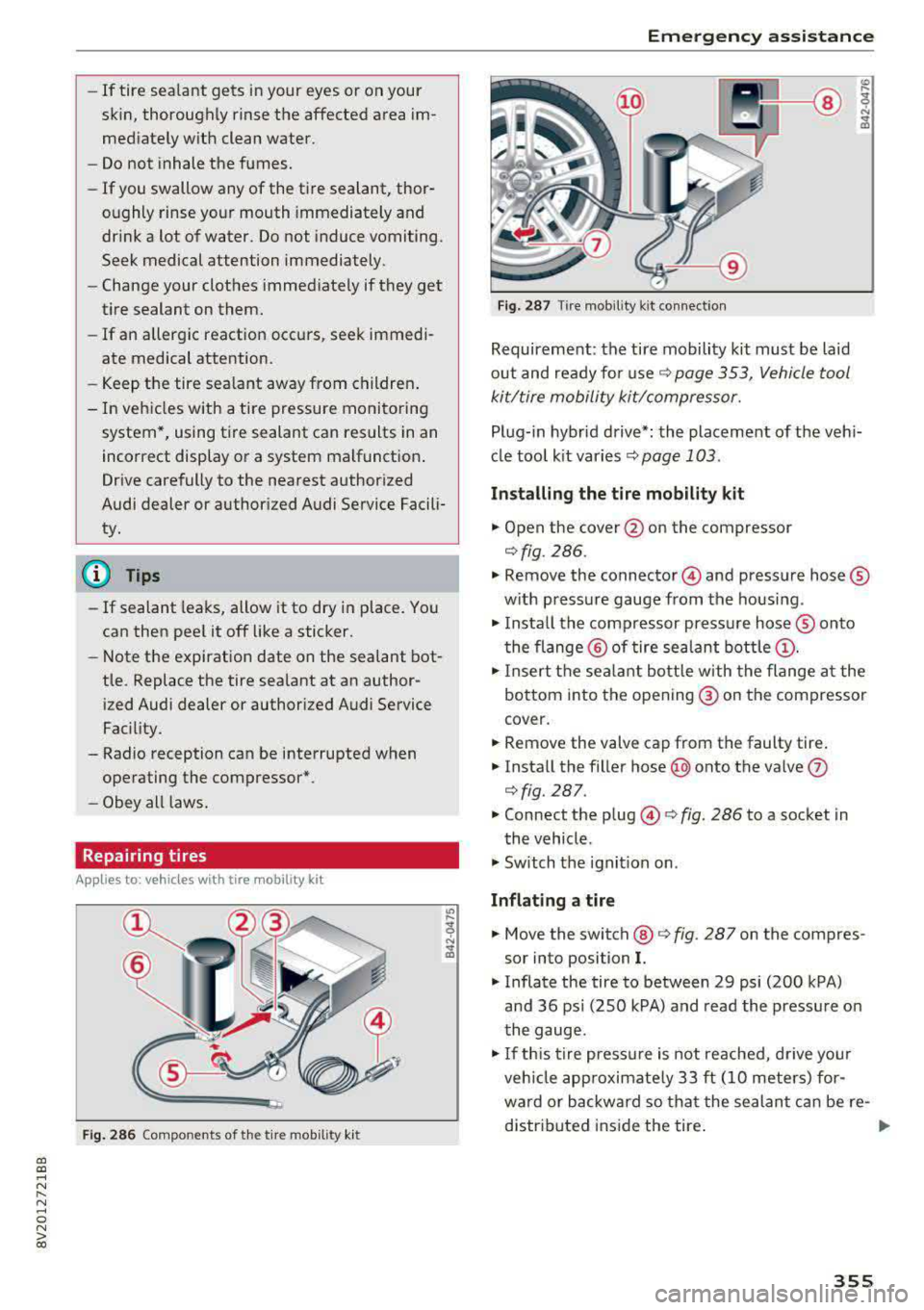
Fig. 286 Components of the t ire mobility kit
Em ergen cy a ssis tanc e
Fig. 287 Tire mobil ity k it connection
Requirement: the tire mobility kit must be laid
out and ready fo r
use ¢ page 353, Vehicle tool
ki t/tire mobility kit/compressor.
Pl ug- in hybrid drive*: the placement of the veh i
cl e tool k it varies
¢ page 103 .
Installing the tire mobility k it
.,. Open the cover @ on the compressor
¢fig. 286.
.,. Remove the connector © and pressure hose ®
w ith pressure gauge from the housing .
.,. Install the compressor pressu re hose ® onto
t he flange @ of tire sea lant
bottle @.
.,. Insert the sea lant bott le with the flange a t the
bo ttom into the opening ® on the compressor
cover .
.,. Remove the valve cap from the faulty tire .
.,. Install the filler hose @onto the valve (J)
¢fig. 287.
.,. Connect the plug ©¢ fig. 286 to a socket in
the vehicle.
.,. Switch the ignit ion on .
Inflating a tire
.,. Move the switch @¢ fig. 287 on the compres
sor into position
I.
.,. Inflate the tire to between 29 psi (200 kPA)
and 36 ps i (250 kPA) and read the pressure on
the gauge .
.,. I f th is ti re press ure is not reached, d rive yo ur
veh icle app roximate ly 33
ft (10 meters) for
ward or backwa rd so tha t the sealant can be re
distr ibuted ins ide the tire .
355
Page 358 of 400
Emergency assistance
A WARNING
-Read and follow the manufacturer's safety
precautions on the compressor and in the
instructions on the bottle of sealant .
- If a t ire pressure of 29 ps i (200 kPA) cannot
reached after inflating for 6 minutes, then
the tire is too severely damaged. Do not
continue driving.
- If the t ire cannot be repaired with the tire
sealant, see an authorized Audi dealer or au
thorized Aud i Serv ice Facility fo r ass istance.
@ Tips
Do not operate the compressor for more than
six m inutes continuously, or it can overheat.
Once the compressor has cooled, you can con
tinue to use it.
Completing
App lies to: vehicles with tire mobility kit
.,. Affix the sticker that says "max. SO mph (max .
80 km/h)" that is provided with the tire mobili
ty kit within the driver's field of vision .
.,. Stop the vehicle after driving for about 10 mi
nutes and check the tire pressure.
.,. If the tire pressure is lower than 19 ps i (130
kPA), then the tire is too severely damaged. Do
not cont inue driving. See an authorized Audi
dealer or authorized Audi Service Fac il ity for as
s istance.
.,. If the tire pressure is at least 19 psi (130 kPA),
adjust the tire pressure to the spec ified value
<:!'v page 336, Tire pressure . Store the tire pres
sures
¢ page 346, Storing tire pressures. Drive
to the nearest authorized Aud i dea le r or au
thorized Audi Service Facility to have the tire re placed.
A WARNING
If the tire pressure is less than 19 psi
(130 kPA) afte r 10 minutes of driving, then
the tire is too severely damaged. Do not con
tinue driving. See an authorized Audi dealer
or authorized Audi Service Facility for assis
tance.
356
A WARNING
-
Pay attention to the following after repairing
the tire:
- Do not drive faster than SO mph (80 km/h).
- Avoid hard acceleration, braking sharply,
and fast cornering.
- The vehicle may become more difficult to
control.
- If the tire is too severe ly damaged, see an
authorized Audi dealer or authorized Audi
Serv ice Facility for assistance.
@ For the sake of the environment
You can give the used tire sealant bottle to an
a uthorized Audi dea ler or authorized Audi
Service Facility for disposal.
(D Tips
Remember to obtain a new bott le of sealant
from an authorized Audi dealer or authorized
Audi Service Facility after repairing a tire .
Replacing wheels
Before changing a wheel
Observe the following precautions for your own
and your passenger's safety when changing a
wheel.
.,. After you experience a t ire failure, pull the car
well away from moving traffic and try to reach
level ground before you stop¢.&_ .
.,. All passengers should leave the car and move
to a safe location (for instance, behind the
guardrail)¢ .&_.
.,. Engage the parking brake to prevent your vehi
cle from rolling
unintentiona lly¢ ,&.
.,. Move selector lever to position P ¢ ,& .
.,. If you are towing a trai ler, unhitch the trailer
from your vehicle.
.,. Ta ke the jack ¢ page 353 and the spare tire
<:!'v page 362 out of the luggage compartment . ..,.
Page 359 of 400

a, a, ..... N
" N ..... 0 N > 00
_& WARNING
You or your passengers could be injured while
changing a wheel if you do not follow these
safety precautions:
- If you have a flat tire, move a safe distance
off the road. Turn off the engine, turn the emergency flashers on and use other warn
ing devices to alert other motorists.
- Make sure that passengers wait in a safe
place away from the vehicle and well away
from the road and traffic.
- To help prevent the vehicle from moving
suddenly and possibly slipping off the jack,
always fully set the parking brake and block
the wheel diagonally opposite the wheel be
ing changed. When one front wheel is lifted
off the ground, placing the Automatic
Transmission in P (Park) will
not prevent the
vehicle from moving.
- Before you change a wheel, be sure the
ground is level and firm. If necessary, use a
sturdy board under the jack.
- Always store the vehicle tool kit, the jack
and the replaced tire in the luggage com
partment
c:> page 253.
Changing a wheel
When you change a wheel, follow the sequence
described below step-by-step and in exactly that
order.
1. Remove the decorative wheel cover*. For
more details see also
c:> page 357, Decora-
tive wheel covers
or c:> page 358, Wheels
with wheel bolt caps.
2. Loosen the wheel bolts c:> page 358.
3 . Locate the proper mounting point for the
jack and align the jack below that point
c:> page359.
4. Raise the car with the jack c:> page 359.
5. Remove the wheel with the flat tire and then
install
the spare c:> page 360.
6. Tighten all wheel bolts lightly.
7. Lower the vehicle with the jack .
8 . Use the wheel bolt wrench and firmly tighten
all wheel bolts
c:> page 358 .
9. Replace the decorative wheel cover* .
Emergency assistance
_& WARNING
-Always read and follow all WARNINGS and in-
formation
c:> .&. in Raising the vehicle on
page 359
and c:> page 361.
After changing a wheel
A wheel change is not complete without the do
ing the following.
.. Always store the vehicle tool kit, the jack* and
the replaced tire in the lugg age compartment
c:> page 253.
.. Check the tire pressure on the spare wheel im
mediately after mounting it .
.. As soon as possible, have the tightening tor
ques
on all wheel bolts checked with a torque
wrench. The correct tightening torque is
90 ft lb (120 Nm).
.. Have the flat tire replaced as soon as possible.
@ Tips
-If you notice that the wheel bolts are cor
roded and difficult to turn while changing a
tire, they should be replaced before you
check the tightening torque.
- Drive at reduced speed until you have the tightening torques checked.
- After changing a wheel, the tire pressure in
all four tires must be checked/corrected and
the tire pressure monitoring indicator must
be stored in the MMI
c:>page 346.
Decorative wheel covers
Applies to : vehicles wit h decorative w heel covers
The decorative wheel covers must be removed
first to access the wheel bolts.
Fig. 288 Changing a wheel: Removing the wheel cover
357
Page 361 of 400

car to keep your balance and take care not
to slip .
Raising the vehicle
The vehicle must be li~ed with the jack first be
fore the wheel con be removed .
Fig. 291 S ill pane ls: mark ings (example)
F ig. 292 S ill: position ing the ve hicle jack
"Engage the parkin g brak e to prevent your vehi
cle from roll ing unintentionally .
"Move the se lector le ver to p osition P .
"Find the markin g (imprint) on the s ill that is
nearest the whee l tha t will be changed
r::> fig. 291 . Behind the marking, there is a lift
ing point on the sill for the vehicle jack.
"Vehicles with a sill: Note the position of the sill
when positioning the vehicle jack¢
fig. 292.
"Place the vehicle jack (vehicle tool kit) on a firm
surface. Use a flat, stable support if necessary.
On a slippery surface such as tile, you should
use a non-slip pad (such as a rubber mat) ¢
,&.
"Turn the ve hi cle jack located under the lifting
po int on the s ill to ra ise the jack until its
arm @
r::> fig. 292 is located under the des ignated plas-
gi tic mount r::> ,& , ¢0).
~ "Align the jack so that its arm @¢ fig. 292 en-
8 gages in the designated lift ing point in the door
~ sill and the movable base ® lies flat on the
Em ergen cy a ssis tanc e
ground. The base ® must be vertical unde r the
lifting point @.
"Wind the jack up further until the f lat tire
comes off the
ground ¢,& .
Position the vehicle jack only unde r the designat
ed lifting points on the sill¢
fig. 291. T here is ex
actly
one location for each wheel. The jack must
not be positioned at any other
location¢ ,&.¢0) .
An un sta b le surf ace under the jack can cause the
vehicle to slip off the jack . Always provide a firm
base for the jack on the ground. If necessary
place a sturdy board or similar support under the
jack. On
ha rd , s lippery surfa ces (such as tiles)
use a rubber mat or similar to prevent the jack
from
slipp ing ¢,&. .
.&, WARNING
-
-You o r you r passengers could be inj ured
while changing a wheel if you do not fo llow
these sa fety precautions :
- Position the vehicle jack only at the desig
nated lifting points and align the jack.
Otherwise, the vehicle jack could slip and
cause an injury if it does not have suffi
c ient hold on the vehicle .
-A soft or unstable surface under the jack may cause the veh icle to slip off the jack.
Always provide a firm base for the jack on
the g ro u nd. If necessary, use a sturdy
board unde r the jack.
- On hard, slippe ry su rface (s uch as t iles)
u se a r ubber mat or simi lar to prevent the
j ac k from slipping.
- Only raise yo ur vehicle with the veh icle
j ac k prov ided by the factory.
If you use a
vehicle jack for another veh icle, your vehi
cle can s lide and cause injury.
- Changes in load can affe ct the height of
the vehicle.
- Never star t the eng ine when the vehicle is
raised, which could cause an accident.
- Suppor t the vehicle se cur ely with appro
priate stands if work is to be performed
underneath the vehicle; otherwise, there
i s a potential risk for injury.
.,.
359
Page 363 of 400

CXl CXl .... N ,.__
N .... 0 N > 00
-When mountin g tires w ith unidirectional
tread design
ma ke sure the t read pattern is
p oin ted the r ight way ¢
page 36 1.
-The wheel bolts should be clean and easy to
turn. C heck for d irt a nd cor rosion on the
ma ting surfaces o f both the wheel an d the
hub. Remove all dirt from t hese surfaces be
fo re remo unt ing the wheel.
Tires with unidirectional tread design
Tires with unidirectional tread design must be
mounted with their tread pattern pointed in the
right direction.
Using a spare t ire with a tread pattern
intended for use in a specific direction
W hen using a spa re t ire with a tread patte rn in
tended fo r use in a specific direction, please note
the following:
-The direct ion of rotat ion is ma rked by an a rrow
on the side of the tire .
-If the spare tire has to be installed in the incor
rect d irection, use the spare tire only tempora
ri ly s ince the tire w ill not be ab le to achieve its
opt imum p erformance c harac ter istics wi th re
gard to aquaplaning, noise and wea r.
-We recommend t hat you pay particular atten
t io n t o this fac t during we t weat her and that
yo u adju st yo ur speed to match road condi
ti ons.
-Rep lace the flat t ire with a new one and have it
insta lled on yo ur ve hicl e as soon as possibl e to
r es to re th e hand li n g adva ntages of a unid irec
tional t ire.
Notes on changing tires
Please read the info rmation I:!> page 3 35 if you
are go ing to use a spare tire which is different
from the tires on your veh icle.
Af te r yo u c hange a tire:
-Check the tire pressure on the spare immedi
ately after in stallation .
-Have the wheel bolt tightening torque
checked with a torque wrench as soon as pos -
Emergency assistance
sible by your authorized Audi dealer or a
qualified service station.
-With steel and alloy wheel rims, the wheel bolts are correctly tightened at a torque of
90 ft lb (120 Nm).
-If you notice that the wheel bolts are corroded
and difficult to turn while changing a tire ,
they should be replaced before you check the
tightening torque.
-Replace the flat tire with a new one and have
it installed on your vehicle as soon as possi ·
ble. Remount the wheel cover .
Until then , dr ive with extra care and at reduced
speeds.
_& WARNING
-I f you are going to equip yo ur vehicle with
tires or r ims which differ from those w hich
were factory installed, the n be sure to read
th e information
¢ pag e 335.
-Always make sure the damaged wheel or
e ven a flat tire a nd the jack and tool kit are
p rop erly secur ed in t he lu ggag e compart
m en t an d are not l oose in th e p asseng er
compa rtme nt.
-In an accide nt or sudde n man euv er th ey
could fly forward, injuri ng a nyo ne in the ve
hicl e.
-Always s tor e damag ed w heel, jack and t ools
securely i n the lu ggage compa rtm ent. Ot h
erwise, in an accid ent or sud den m aneuve r
t he y c ould fl y forwar d, ca using injury to pas
sen gers in the ve hicle.
-
361