2017 AUDI A3 SEDAN ABS
[x] Cancel search: ABSPage 261 of 400
injury and death in automobile accidents.
For your protection and that of your passen
gers, always correctly wear safety belts
when the vehicle is moving .
- Failure to pay attention to the warn ing light
that come on, could lead to personal injury.
Why use safety belts?
Frontal collisions and the law of physics
Frontal crashes create very strong forces for peo
ple riding in vehicles .
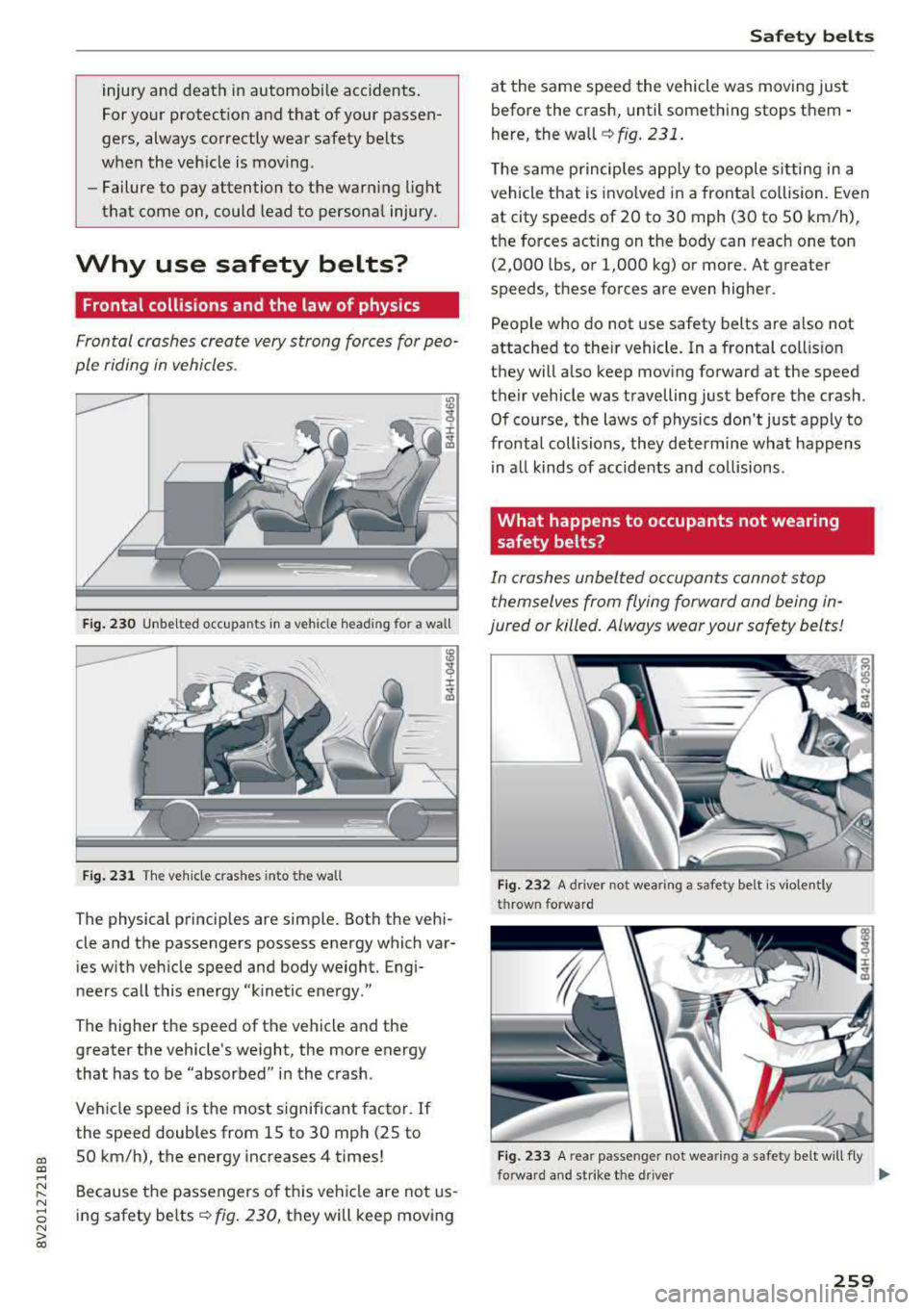
Fig . 230 Unbe lted occupants in a veh icle head ing fo r a wall
Fig . 23 1 The ve hicle c rashes into the wa ll
The physical principles are simple . Both the vehi
cle and the passengers possess energy which var
ies with vehicle speed and body we ight. Engi
neers call this energy "k inetic energy ."
The higher the speed of the vehicle and the
greater the vehicle's weight, the more energy
that has to be "absorbed" in the crash.
Vehicle speed is the most significant facto r. If
the speed doubles from 15 to 30 mph (25 to
a, 50 km/h), the energy increases 4 times! a, .....
~ Because the passengers of t his veh icle are not us-
"' 8 ing safety belts ~ fig. 230, they will keep mov ing N > 00
Safet y bel ts
at the same speed the vehicle was moving just
before the crash, until something stops them -
here, the wall
~ fig. 231 .
The same p rinciples apply to people s itting in a
vehicle that is invo lved in a fronta l co llision. Even
at city speeds of 20 to 30 mph (30 to SO km/h),
the forces acting on the body can reach one ton (2,000 lbs, or 1,000 kg) or more. At greater
speeds, these forces are even higher.
People who do not use safety belts are a lso not
attached to the ir vehicle . In a frontal coll is ion
they will also keep mov ing forward at the speed
their vehicle was travelling just before the crash .
Of course, the laws of physics don't just apply to
frontal collisions , they determine wha t happens
in a ll kinds of accidents and co llisions .
What happens to occupants not wearing
safety belts?
In crashes unbelted oc cupants cannot stop
themselves from flying forward and being in
jured or killed. Always wear your safety belts!
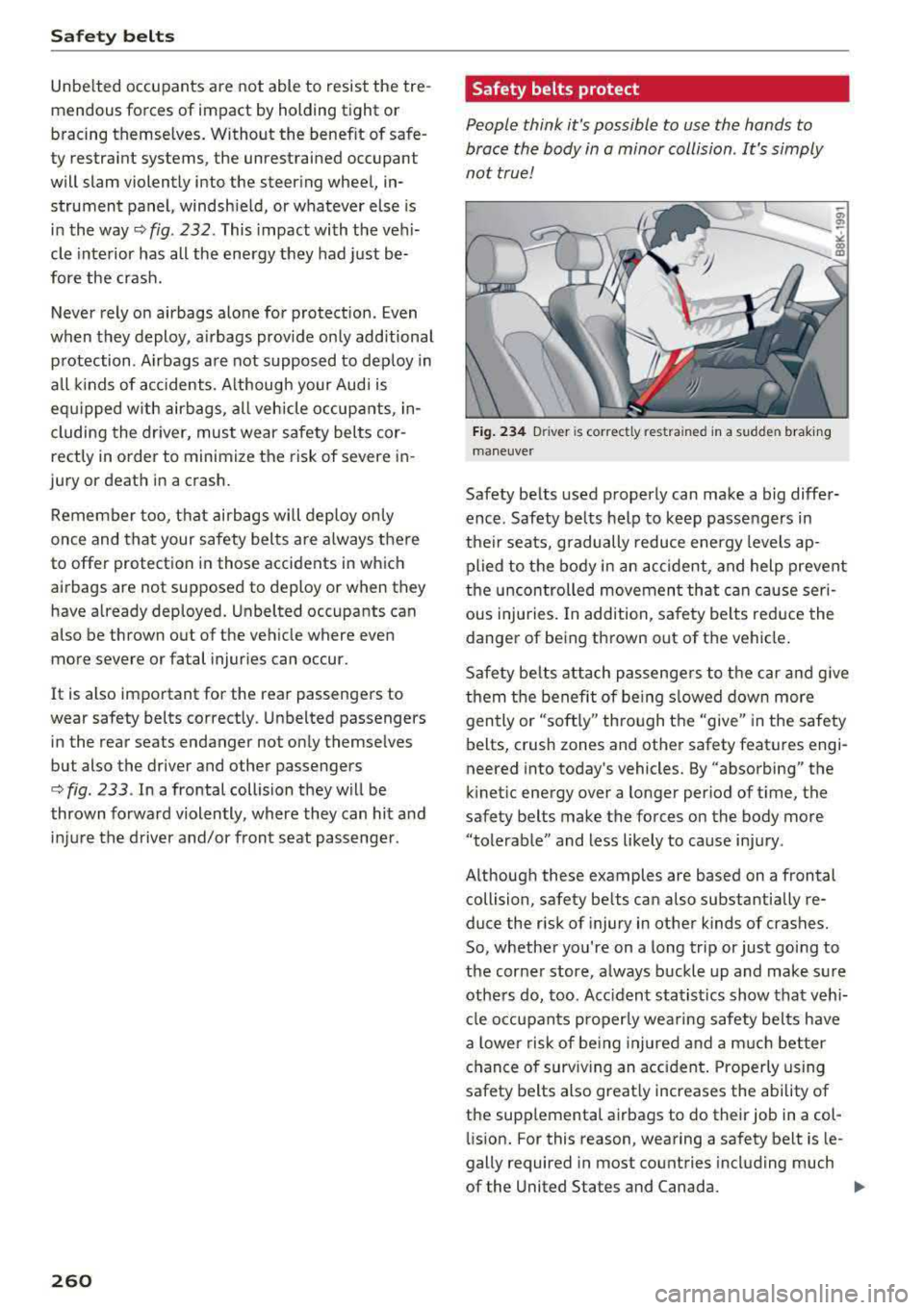
Fi g. 232 A driver not wear ing a safe ty belt is violen tly
throw n forward
F ig. 233 A re ar passe nge r not we aring a safety be lt w ill fly
forward and strike t he driver
Ill-
259
Page 262 of 400
Safe ty belts
Unbelted occupants are not able to resist the tre
mendous fo rces of impact by holding tight or
bracing themselves. Without the benefit of safe
ty restra int systems, the unrestrained occupant
will slam violently into the steering whee l, in
strument panel, windsh ield, or whatever else is
i n the way
¢ fig . 232. This impact with t he ve hi
cle interior has all the ene rgy they had just be
fore the crash.
Never rely on airbags alone for protection . Even
when they deploy, airbags provide only add itional
protection . Airbags are not supposed to dep loy in
all kinds of accidents. A lthough your Audi is
eq uipped w ith airbags, all veh icle occupants, in
cluding the dr iver, must wear safety belts cor
rectly in order to minimize the risk of severe in
jury or death in a crash.
Remember too, that ai rbags will deploy on ly
once and that your safety belts are a lways there
to offer protection in those accidents in which
airbags are not supposed to deploy or when they
have a lready deployed. Unbelted occupants can
also be thrown out of the ve hicle where eve n
more severe or fatal injuries can occur.
It is also important for the rear passengers to
wear safety belts correctly . U nbelted passengers
in the rear seats endanger not only themselves
but also the driver and other passengers
¢ fig . 233 . In a frontal collision they will be
thrown fo rward violently, where they can hit a nd
inj ure the driver and/or front seat passenge r.
260
Safety belts protect
People think it 's possible to use the hands to
brace the body in a minor collision . It's simply
not true!
Fi g. 234 D river is corre ctly res trained in a sudde n brak ing
maneuver
Safety belts used properly can make a big differ
ence . Safety belts help to keep passengers in
thei r seats, gradually reduce energy levels ap
plied to the body in an accident, and help prevent
the u ncon trolled movemen t that can cause ser i
ous injuries. In add ition, sa fe ty belts reduce the
danger of being thrown out of the vehicle .
Safety be lts attach passenge rs to the car a nd g ive
them the benefit of be ing s lowed down more
gently or "soft ly" th rough the "give" in the safety
belts, crush zones and other safety features engi
neered into today's vehicles. By "absorbing" the
k inet ic energy over a longer per iod of t ime, the
safety belts make the forces on the body more
"tole rab le" and less likely to cause injury .
Although these examples are based on a frontal collision, safety be lts can also substantially re
duce the r isk of injury in other kinds of crashes.
So, whether you're on a long trip or just going to
the cor ner store, a lways buckle up and make s ure
others do, too . Acc ident sta tist ics show that veh i
cle occupants properly wea ring safety bel ts have
a lowe r risk of be ing injured and a m uch better
c h ance of surviv ing an accident . Properly us ing
safety belts also great ly increases the ability of
the supp lemental airbags to do their job in a col
li sion. For this reason, wearing a safety belt is
le
gally required in most countries including much
of the United States and Canada.
liJI,
Page 274 of 400
Airbag system
-Therefore, always wear your safety belts and
make sure that everybody in your vehicle is
properly restrained.
- Always hold the steering wheel with both
hands on the outside of the steering wheel
rim at the 9:00 o 'clock and 3 :00 o'clock po
sitions to help reduce the risk of personal in
jury if the driver's airbag inflates .
- Never hold the steering wheel at the 12
o'clock position or with your hands any
where inside the steering wheel or on the steering wheel hub. Holding the steering
wheel the wrong way increases the risk of
severe injury to the arms, hands, and head if
the driver airbag deploys.
A WARNING
Objects between you and the airbag will in
crease the risk of injury in a crash by interfer
ing with the way the airbag unfolds and/or by
being pushed into you as the airbag inflates.
- Always make sure nothing is in the front air-
-
bag deployment zone that could be struck
by the airbag when it inflates.
- Objects in the zone of a deploying airbag
can become projectiles when the airbag de
ploys and cause serious personal injury.
- Never hold things in your hands or on your lap when the vehicle is in use .
- Never place accessories or other objects
(such as cup holders, telephone brackets,
note pads, navigation systems, or things
that are large, heavy, or bulky) on the doors;
never attach then to the doors or the wind
shield; never place them over or near or at
tach them to the area marked
,.AIRBAG" on
the steering wheel, instrument panel or the
seat backrests; never place them between
these areas and you or any other person in
the vehicle.
- Never attach objects to the windshield
above the passenger front airbag, such as
accessory GPS navigation units or music players. Such objects could cause serious in
jury in a collision, especially when the air bags inflate .
272
-Never recline the front passenger seat to
transport objects. Items can also move into
the deployment area of the side airbags or
the front airbag during breaking or in a sud
den maneuver . Objects near the airbags can
fly dangerously through the passenger com
partment and cause injury, particularly
when the seat is reclined and the airbags in
flate.
A WARNING
A person on the front passenger seat, espe
cially infants and small children, will receive
serious injuries and can even be killed by be ing too close to the airbag when it inflates .
- Although the Advanced Airbag System in
-
your vehicle is designed to turn off the front
passenger airbag if an infant or a small child
is on the front passenger seat, nobody can
absolutely guarantee that deployment un
der these special conditions is impossible in
all conceivable situations that may happen
during the useful life of your vehicle.
-The Advanced Airbag System can deploy in
accordance with the .,low
risk" option for 3-
and 6-year-old children under the U.S . Fed
eral Standard if a child with electrical capac
itance greater than the combined capaci
tance of a typical one-year old infant re
strained in one of the forward facing or rear
facing child safety seats with which your ve
hicle was certified is on the front passenger
seat and the other conditions for airbag de
ployment are met.
- Accident statistics have shown that children
are generally safer in the rear seat area than
in the front seating position.
- For their own safety, all children, especially
12 years and younger, should always ride in
the back properly restrained for their age and size.
Advanced front airbag system
Your vehicle is equipped with a front Advanced
Airbag System in compliance with United States
Federal Motor Vehicle Safety Standard 208, as
well as Canada Motor Vehicle Safety Standard
..,.
Page 276 of 400
Airbag syste m
seat. Please be sure to read the important infor
mation in the sections that follow and be sure to
heed all of the WARNINGS.
A WARNING
To reduce the risk of injury when an airbag in
flates, always wear safety belts properly.
- If you are unrestrained, leaning forward, sit ting s ideways or out of position in any way,
your risk of injury is much h igher.
- You will also receive serious injuries and could even be killed if you are up aga inst the
airbag or too close to it when it inflates -
even with an Advanced Airbag
c::> page 267 .
A WARNING
A child in a rearward-facing chi ld safety seat
installed on the front passenge r seat w ill be
ser iously injured and can be killed i f the front
airbag inflates
-even w ith an Advanced Ai rbag
System.
-Although the Advanced A irbag System in
yo ur vehicle is designed to tu rn off the front
airbag when a rearwa rd -facing child re
straint has been insta lled on the front pas
senger seat, nobody can absolutely guaran
tee that deployment is impossible in all con
ceivable s ituations that may happen during
the useful life of your vehicle .
- The inflating a irbag w ill hit the child safety
seat or infant carrier with great force and
will smash the chi ld safety seat and child
against the backrest, center armrest , door,
o r roof .
- Always install rearward -facing ch ild re
straints on the rear seat .
- If you must install a rearward fac ing ch ild
safety seat on the front passenger seat be
cause of exceptiona l circumstances and the
PASSENGER AIR BAG OFF light does not
come on and s tay on, immed iate ly install
the rear-fac ing ch ild safety seat in a rear
seating position and have the airbag system
inspected by your Audi dealer.
274
A WARNING ,_
If, in exceptional circumstances, you must in
stall a forward-facing child restraint on the
front passenger's seat:
- Always make sure the forward-facing seat
has been des igned and certified by its man
ufacturer for use on a front seat with a pas
senger front and side airbag.
- Never put the forwa rd-facing child restraint
up against or very nea r the instrument pan
el.
- Always move the front passenge r seat to
the highest posit ion in the up and down ad
justmen t range and move it back to the
rearmost posit io n in the seat's fo re and aft
adjustment range, as far away from the a ir
bag as poss ible, before install ing the for
ward-facing chi ld restraint.
- Always make sure that the safety be lt upper
anchorage is behind the chi ld rest raint and
not next to o r in front of the c hild restraint
so that the safety be lt will be p roper ly posi
tioned.
- Always make sure that there is noth ing on
the front passenger seat that will cause the
capacitive passenger detection system in
the seat to signal to the Airbag System that
the seat is occup ied by a person when it is
no t, or to signal that it is occupied by some
one who is heavier than the person ac tually
si tting on the sea t. T he presence of addi
tional objects could cause the passenger
front airbag to be turned on when it should
be
off, or could cause the airbag to work in a
way that is d ifferent from the way it wou ld
have worked without the object on the seat.
- Make sure that the
PASSENGER AIR BAG
OFF
li ght comes on and stays on all the time
whenever the ign it ion is switched on.
Advanced Airbag System components
T he front passenger seat in your veh icle has a lot
of ve ry important parts of the Advanced A irbag
System i n it. These parts incl ude the capacitive
passenger detection system, wir ing , b rackets,
and more. The control uni t moni tors the system
on the front passenge r seat when t he ignit ion is
..,.
Page 285 of 400

a, a, ..... N
" N ..... 0 N > 00
action is entered in your Audi Warranty &
Maintenance booklet under
AIRBAG RE
PLACEMENT RECORD.
- Applies to plug-in hybrid* vehicles: In the
event of a co llision where the a irbags de
ploy, the electrical connection to the high
voltage battery is automatically disconnect
ed. This prevents a short c ircuit.
@) For the sake of the environment
Undep loyed airbag modules and pretension
ers might be classified as Perch lorate Materi
al - special handling may apply, see
www.dtsc.ca.gov/hazardouswaste/perchlo
rate. When the veh icle or parts of the re
straint system incl uding airbag modules and
safety belts with pre tensioners are scrapped,
all applicable laws and regulations must be
observed. Your authorized Audi dealer is fa
miliar with these requirements and we recom
mend that you have your dealer perform this
service for you.
Other things that can affect Advanced
Airbag performance
Changing the vehicle's suspension system can
change the way that the Advanced Airbag Sys tem
performs in a crash. For examp le, using tire-r im
combinations not approved by Audi, lowering the
vehicle, changing the stiffness of the suspension, including the springs , suspension struts, shock
absorbers etc. can change the forces that are
measured by the airbag sensors and sent to the
electronic control unit . Some suspens ion changes
can, for example, increase the force levels meas
ured by the sensors and make the airbag system
deploy in crashes in wh ich it would not dep loy if
t he changes had no t been made. Other kinds of
changes may reduce the force levels meas ured by
the sensors and prevent the airbag from deploy ing when it should.
.&_ WARNING
Changing the vehicle 's s uspension incl uding
use of unapproved tire-rim combinations can
change Advanced A irbag performance and in-
Airb ag sys tem
crease the risk of serious personal injury in a
crash.
- Never install suspension components that
do not have the same performance charac
ter istics as the components originally instal
led on your vehicle.
- Never use tire-rim combinations that have
not been approved by Audi.
Knee airbags
Description of knee airbags
Applies to: vehicles wit h knee airbags
The knee airbag system con provide supplemen
tal protection to properly restrained front seat
occupants.
F ig . 24 S Driver 's knee airbag
The driver knee airbag is in the instrument panel
underneath the steering
whee l¢ fig. 245, the
airbag for the passenger is at about the same
height in the instrument pane l underneath the
glove compartment.
The knee airbag offers additiona l protection to
t h e driver's and passenger's knees and upper and
lower thigh areas a nd supplements the p rotec
t io n prov ided by the safety belts .
If the front airbags deploy, the knee airbags also
deploy in frontal collis ions when the deployment
threshold stored in the control un it is met
¢ page 2 77, More important things to know
about front airbags .
In addition to their normal safety function, safe
ty belts help keep the dr iver or front passenger in
pos it ion in a frontal collision so t hat the airbags
can p rovide supplemental protection .
..,.
283
Page 304 of 400
Child safety
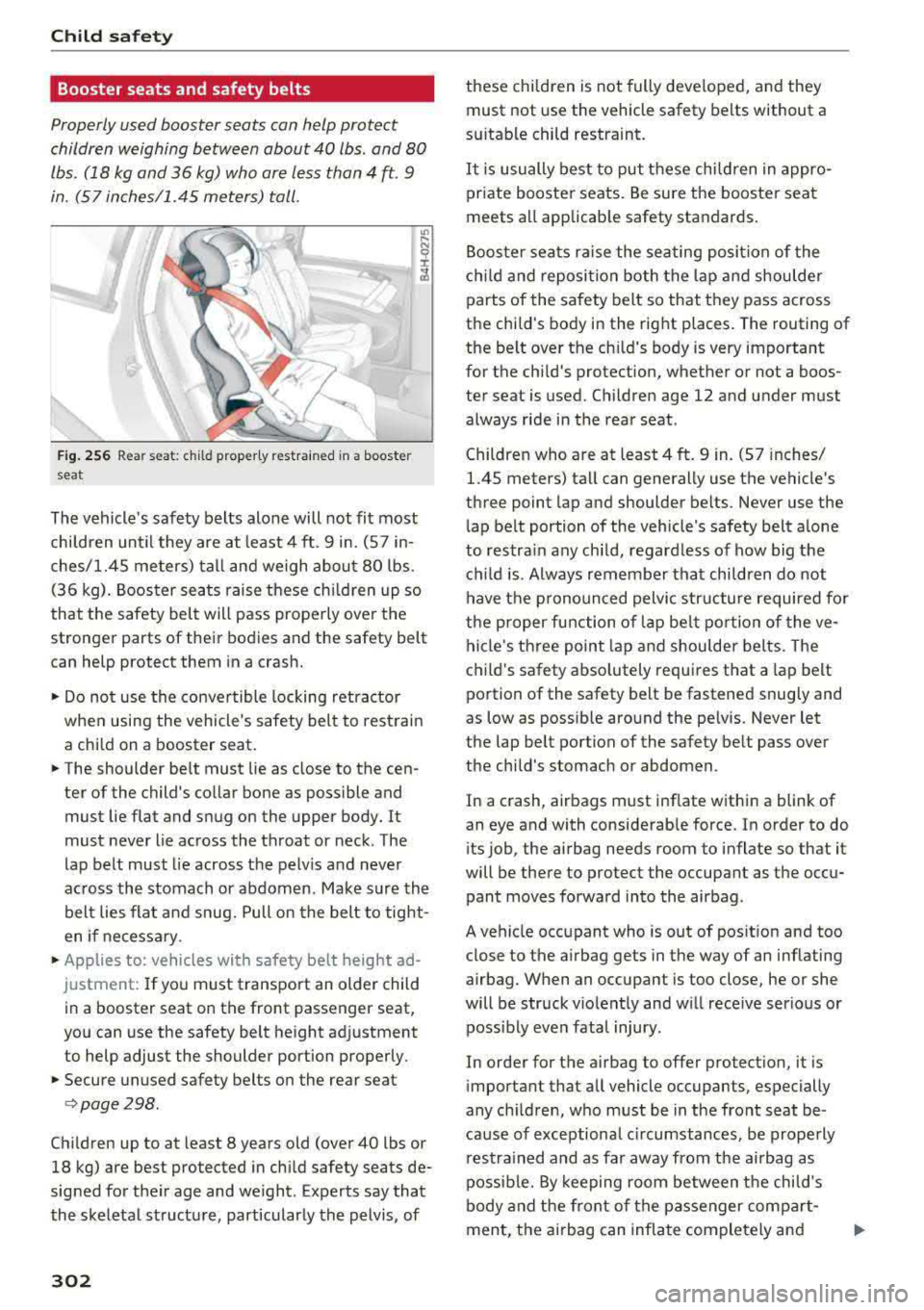
Booster seats and safety belts
Properly used booster seats can help protect
children weighing between about 40 lbs . and 80
lbs. (18 kg and 36 kg) who are less than 4
ft. 9
in. (57 inches/1.45 meters) tall .
Fig. 256 Rear seat: child properly restrained in a booster
seat
The vehicle's safety belts alone will not fit most
children until they are at least 4
ft. 9 in. (57 in
ches/1.45 meters) tall and weigh about 80 lbs.
(36 kg). Booster seats raise these children up so
that the safety belt will pass properly
over the
stronger parts of their bodies and the safety belt
can help protect them in a crash.
• Do not use the convertible locking retractor
when using the vehicle's safety belt to restrain
a child on a booster seat.
• The shoulder belt must lie as close to the cen
ter of the child's collar bone as possible and
must lie flat and snug on the upper body. It
must never lie across the throat or neck. The
lap belt must lie across the pelvis and never
across the stomach or abdomen . Make sure the
belt lies flat and snug. Pull on the belt to tight
en if necessary .
• Applies to: vehicles with safety be lt height ad
justment: If you must transport an older child
in a booster seat on the front passenger seat,
you can use the safety belt height adjustment
to help adjust the shoulder portion properly.
• Secure unused safety belts on the rear seat
qpage298 .
Children up to at least 8 years old (over 40 lbs or
18 kg) are best protected in child safety seats de
signed for their age and weight. Experts say that
the skeletal structure, particularly the pelvis, of
302
these children is not fully developed, and they
must not use the vehicle safety belts without a
suitable child restraint.
It is usually best to put these children in appro
priate booster seats. Be sure the booster seat
meets all applicable safety standards.
Booster seats raise the seating position of the
child and reposition both the lap and shoulder
parts of the safety belt so that they pass across
the child 's body in the right places. The routing of
the belt over the child's body is very important
for the child's protection, whether or not a boos
ter seat is used. Children age 12 and under must
always ride in the rear seat .
Children who are at least 4 ft. 9 in. (57 inches/
1.45 meters) tall can generally use the vehicle's
three point lap and shoulder belts. Never use the
lap belt portion of the vehicle's safety belt alone
to restrain any child, regardless of how big the
child is. Always remember that children do not
have the pronounced pelvic structure required for
the proper function of lap belt portion of the
ve
hicle's three point lap and shoulder belts. The
child's safety absolutely requires that a lap belt
portion of the safety belt be fastened snugly and
as low as possible around the pelvis. Never let
the lap belt portion of the safety belt pass
over
the child's stomach or abdomen.
In a crash, airbags must inflate within a blink of
an eye and with considerable force. In order to do its job , the airbag needs room to inflate so that it
will be there to protect the occupant as the occu pant moves forward into the airbag.
A vehicle occupant who is out of position and too
close to the airbag gets in the way of an inflating
airbag. When an occupant is too close, he or she
will be struck violently and will receive serious or
possibly even fatal injury.
In order for the airbag to offer protection, it is
important that all vehicle occupants, especially
any children, who must be in the front seat be
cause of exceptional circumstances, be properly
restrained and as far away from the airbag as
possible. By keeping room between the child's
body and the front of the passenger compart-
ment, the airbag can inflate completely and
..,.
Page 337 of 400
a, a, ..... N
" N ..... 0 N > 00
fo r t he numb er of seating p osi
t io ns . R efe r to th e ta bl e
¢ ta ble
o n pag e 33 8 for th e number of
p eople th at co rrespo nd to th e ve
hi cle n orm al l oa d.
New tires or wheels
Aud i recommends having all work on tires or
wheels performed by an authorized Audi dealer
or author ized Audi Se rvice Facility . These fac ili
ties have the proper know ledge and are equipped
with the required too ls and replacement parts.
• New tires do not yet have the optimum grip
ping properties. Drive caref ully and at moder
ate speeds for the first 350 mi les (500 km)
with new tires.
• Only use tires w it h the same design, size (roll
i ng c ircumference) and as close to the same
tread patter n as poss ible on all four wheels .
• Do not replace t ires individua lly. At least re
pla ce both t ires on the same axle at the same
t ime .
• Audi recommends that you use Aud i Original
Tires . If you wou ld like to use different tires,
please note that the tires may perform differ
ently even if they are the same
si ze ¢ ,& .
• If you would like to equip your veh icle w ith a
tire/rim comb inat ion that is different from
what was installed at the factory, consult w ith
an aut horized Aud i dea ler o r authorized Audi
Se rvice Facility befo re making a
purchase ¢,& .
The spare tire* is different from the regular tires
insta lled on the veh icle
-for example, if w inter
tires or w ide tires a re ins talled
-so only use the
spa re ti re* tempo rar ily in case of emergen cy and
d rive caref ully wh ile i t is in use . It should be re
p laced w it h a regular t ire as soon as possib le.
Applies to: vehicles with all wheel drive: all four
wheels must be eq uipped w ith tires that are the
same brand and have the same construc tion and
tread pattern so that the drive system is not
damaged by different wheel speeds. For this rea
son , in case of eme rgency, only use a spare tire*
Wheels
that is the same circ umfe rence as the regular
tires.
A WARNING
--On ly use t ire/rim comb inations and suitab le
wheel bo lts that have been approved by
Aud i. Otherwise, damage to the vehicle and
a n accident could res ult.
-For technical reasons, it is not possible to
use t ires from other ve hicles
-in some cas
es, yo u cannot even use tires from the same
veh icle model.
-Make sure that the tires you select have
e nough clearance to the veh icle. Rep lace
ment tires should not be chosen s imply
based on the nomina l size, because ti res
wit h a differe nt constru ction can diffe r
g reatly even if they are the same size . If
there is no t enough clearance, the tires or
the vehicle can be damage d and this can re
duce dr iving safety and increase the risk of
an accident.
-On ly use t ires that are more than s ix years
old when absolutely necessa ry and drive
carefully when doing so.
- Do not use run -flat tires on your vehicle . Us
ing them when not perm itted can lead to
veh icle damage or accidents.
- If you install wheel covers on the vehicle, make sure they allow enough air circulation
to cool the brake system. If they do not, t his
could increase the risk of an acc ident.
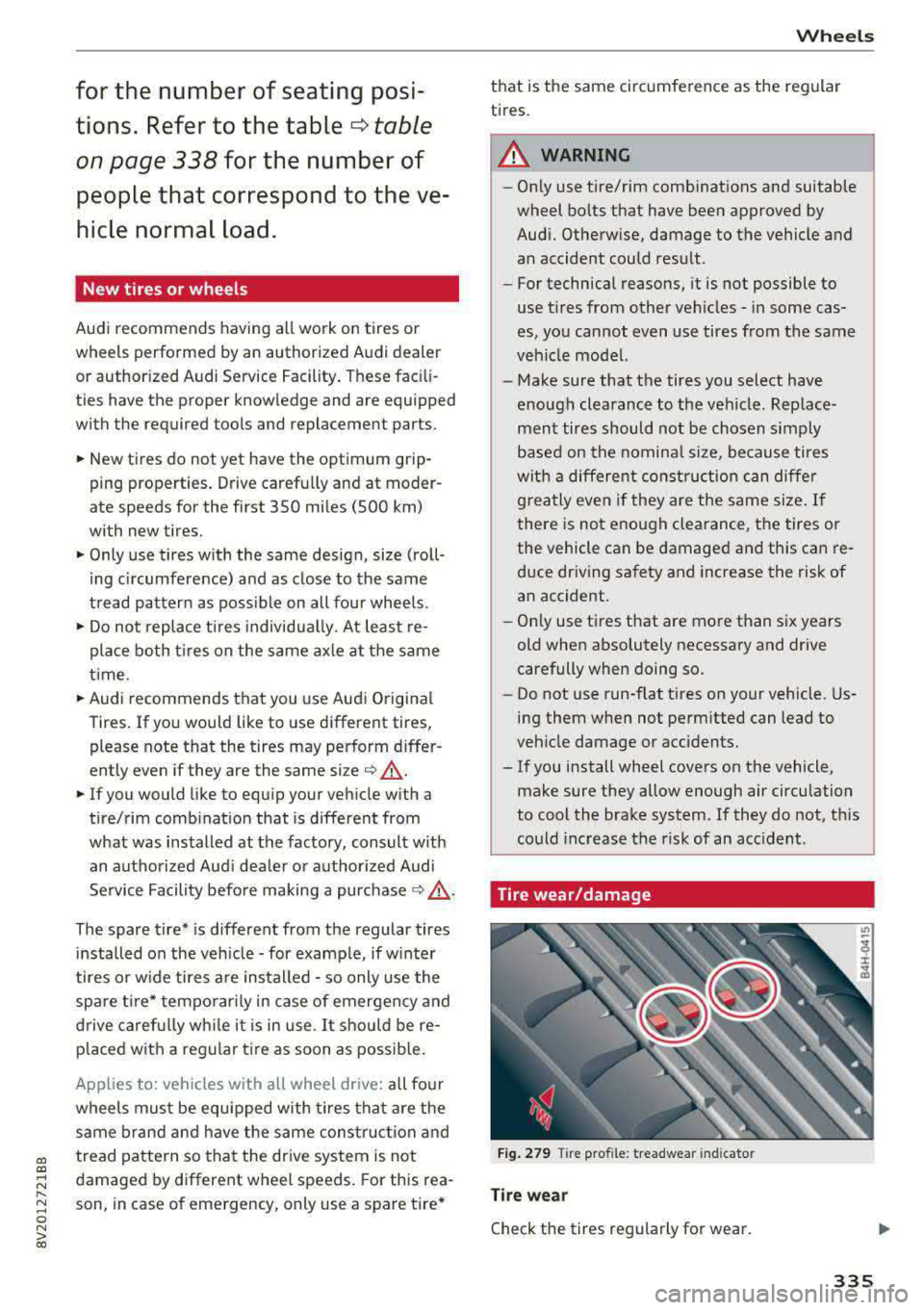
Tire wear/damage
F ig . 279 Tire pro file: treadwear indicato r
Tire we ar
Check the tires regu larly for wear.
335
Page 347 of 400

CXl CXl .... N ,.__
N .... 0 N > 00
label, you should determine the proper tire infla
tion pressure for those tires).
As an added safety feature, your veh icle has been
eq uipped w ith a t ire pressu re monitoring system
(TPMS) that illuminates a low tire press ure te ll
tale when one or more of your tires is significant l y under- inflated. Accordingly, when the low tire
pressure tellta le illuminates, you should stop and
check your tires as soon as possible, and inflate
them to the proper pressure . Driving on a s ignifi
cantly under- inflated tire causes the tire to ove r
h eat and can lead to t ire failure. Unde r-inflation
a lso reduces fuel efficiency and tire tread life,
and may affec t the vehicle's handling and stop
p ing ability .
P lease note that the TPMS is not a substitute for
p roper tire maintenance, and i t is the d rive r's re
sponsib ility to ma inta in cor rec t tire p ressure,
even if under-inflation has not reached the leve l
to trigger illumination of the TPMS low tire pres
sure tellta le .
Your veh icle has also been eq uipped w ith a TPM S
mal funct ion indicator to indicate when the sys
tem is not operating properly . The TPMS ma l
function indicator is combined with the low tire
pressure tellta le. When the system detects a
malfunct ion, the telltale will flash for approxi
mately one minute and then remain cont inuously
i l lum inated . This sequence will continue upon
subseq uent ve hicle start-ups as long as the ma l
function ex ists .
When the malfunct ion indicator is illuminated,
the system may not be ab le to detect or signal
low t ire press ure as intended. TPM S malf unctions
may occur for a var iety of reasons, including the
i nstalla tion of replacement o r alte rnate t ires o r
wheels o n the vehicle that prevent the TPM S
from func tioning properly. Always chec k the
TPMS malfunction telltale afte r rep lacing one or
more tires or whee ls on your ve hicle to ensure
that the replacement or alternate tires and
wheels allow the TPMS to cont inue to function
properly.
Wh eel s
If the tire pressure indicator appears
App lies to : vehicles wi th Tire Pressure Monito rin g Syste m in
dicator
The tire pressure indicator in the instrument
cluster informs you if the tire pressure is too low
or if there is a system malfunction.
U sing the ABS sensors, the tire pressure monitor
ing system compares the tire tread c ircumfer
ence and vibration characterist ics of the ind ividu
al tires. If the pressure changes in one or more
t ires, th is is indicated in the instrument cluster
display with an
[I] indicator light and a message .
If only one tire is affected, the location of that
t ir e will be indicated.
The tire pressures must be stored in the menu display again each t ime the p ressures change
(swi tching between partial and full load pres
s ur e) o r after changing or replacing a ti re o n your
vehicle
Q page 346. T he tire p ressure mo nitor
ing system on ly monitors the t ire pressure you
have stored. Refer to the tire pressure label for
the recommended tire pressure for yo ur vehicle
c:> page 336, fig. 281.
T ire tread c ircumference and vibra tion characte r
istics can change and ca use a tire press ure wa rn
ing if:
- t he t ire pressure in one or more ti res is too low.
- the t ire has str uctural damage.
- t he t ire was replaced or the t ire pressure was
changed and it was not stored
c:> page 346.
- one side of the vehicle is more heavi ly loaded
than the othe r.
- the wheels on one axle are more heavily loaded
than the othe rs (for example, when towing a
t ra ile r or when driving up and down hi lls).
- snow chains are installed .
- the spare tire* is installed.
- only one tire was replaced on eac h axle.
Indicator lights
[I] -Loss of pressu re in at least one tire c:> ,&. .
Check the tires and replace or re pair if necessary .
Check/correct the pressures of all fou r tires . Then
store the tire pressures in the menu
Q page 346 .
m (T ire Pressure Mon itor ing Sys tem) Tir e
pre ssure: System malfunction!.
If m appears 1JJ,,
345