Page 427 of 620
PRIUS v_OM_OM47B12U_(U)
4277-3. Do-it-yourself maintenance
7
Maintenance and care
With the engine at operating temperature and turned off, check the oil
level on the dipstick.
■Checking the engine oil
Park the vehicle on level ground. After warming up the engine
and turning off the hybrid system, wait more than 5 minutes for
the oil to drain back into the bottom of the engine.
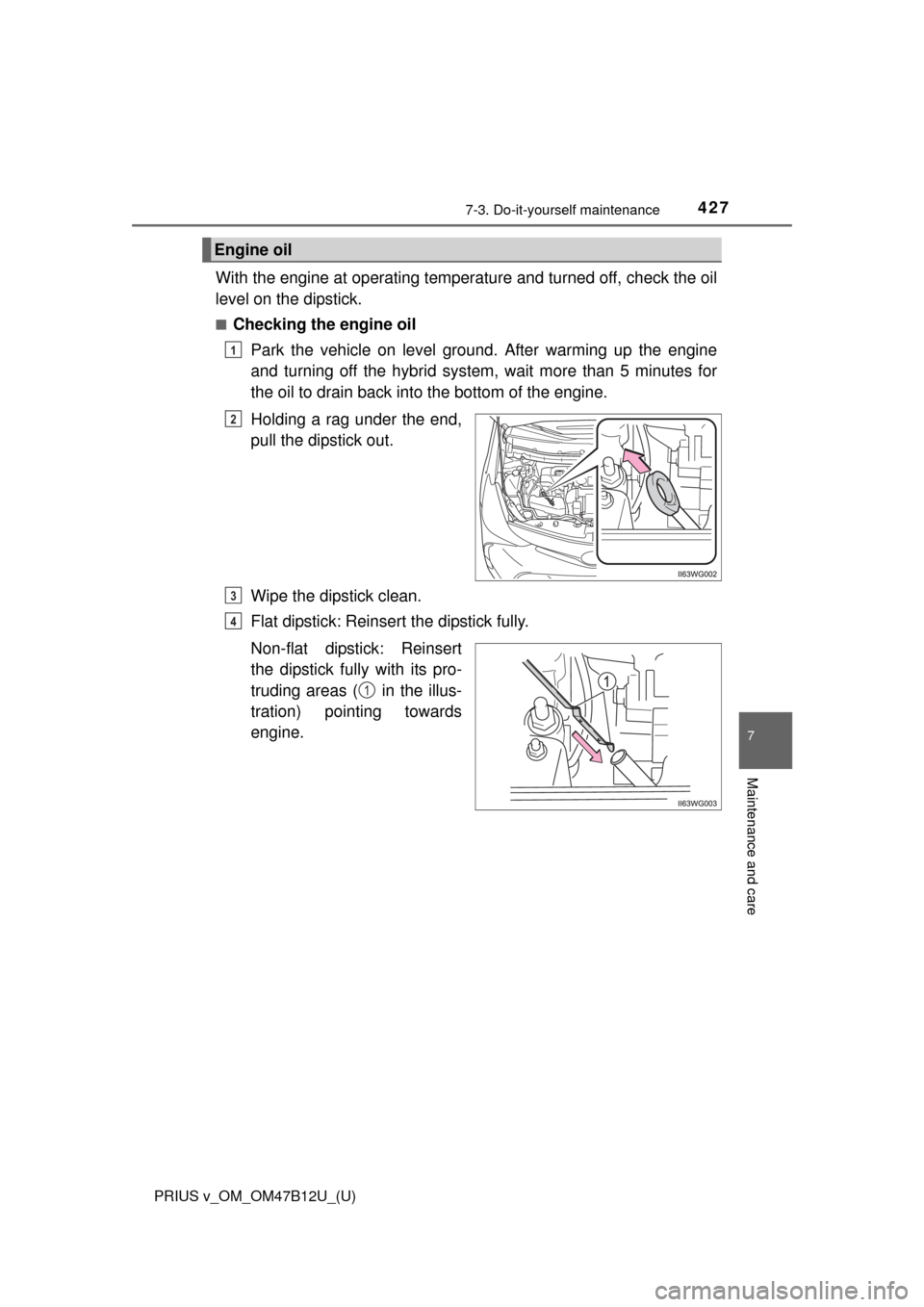
Holding a rag under the end,
pull the dipstick out.
Wipe the dipstick clean.
Flat dipstick: Reinsert the dipstick fully.
Non-flat dipstick: Reinsert
the dipstick fully with its pro-
truding areas ( in the illus-
tration) pointing towards
engine.
Engine oil
1
2
3
4
1
Page 448 of 620

448
PRIUS v_OM_OM47B12U_(U)
7-3. Do-it-yourself maintenance
■Situations in which the tire pressure warning system may not operate
properly
●In the following cases, the tire pressure warning system may not operate
properly.
• If non-genuine Toyota wheels are used.
• When a replacement tire is used, the system may not operate correctly
due to the structure of the replacement tire.
• A tire has been replaced with a tire that is not of the specified size.
• Tire chains etc. are equipped.
• An auxiliary-supported run-flat tire is equipped.
• If a window tint that affects the radio wave signals is installed.
• If there is a lot of snow or ice on the vehicle, particularly around the
wheels or wheel housings.
• If the tire inflation pressure is extremely higher than the specified level.
• If wheel without the tire pressure warning valve and transmitter is used.
• If the ID code on the tire pressure warning valves and transmitters is not
registered in the tire pressure warning computer.
●Performance may be affected in the following situations.
• Near a TV tower, electric power plant, gas station, radio station, large dis-
play, airport or other facility that generates strong radio waves or electri-
cal noise
• When carrying a portable radio, cellular phone, cordless phone or other
wireless communication device
●When the vehicle is parked, the time taken for the warning to start or go off
could be extended.
●When tire inflation pressure declines rapidly for example when a tire has
burst, the warning may not function.
Page 481 of 620
481
PRIUS v_OM_OM47B12U_(U)
8When trouble arises
8-1. Essential information
Emergency flashers .......... 482
If your vehicle has to
be stopped in an
emergency ...................... 483
8-2. Steps to take in an
emergency
If your vehicle needs to
be towed ......................... 484
If you think something is
wrong .............................. 489
If a warning light turns on
or a warning buzzer
sounds ............................ 490
If a warning message is
displayed......................... 503
If you have a flat tire.......... 521
If the hybrid system will
not start ........................... 534
If the electronic key does
not operate properly........ 536
If the 12-volt battery is
discharged ...................... 538
If your vehicle overheats ... 543
If the vehicle becomes
stuck ............................... 548
Page 484 of 620
484
PRIUS v_OM_OM47B12U_(U)
8-2. Steps to take in an emergency
If your vehicle needs to be towed
In the following situations, it is not possible to be towed by another
vehicle using cables or chains, as the front wheels may be locked due
to the parking lock. Contact your Toyota dealer or commercial towing
service.
●There is a malfunction in the shift control system. (P. 492, 505)
●There is a malfunction in the immobilizer system. (P. 82)
●There is a malfunction in the smart key system. (P. 536)
●The 12-volt battery is discharged. (P. 538)
The following may indicate a problem with your hybrid transmission.
Contact your Toyota dealer or commercial towing service before tow-
ing.
●The hybrid system warning light turns on or the hybrid system
warning message is displayed on the multi-information display and
the vehicle does not move.
●The vehicle makes an abnormal sound.
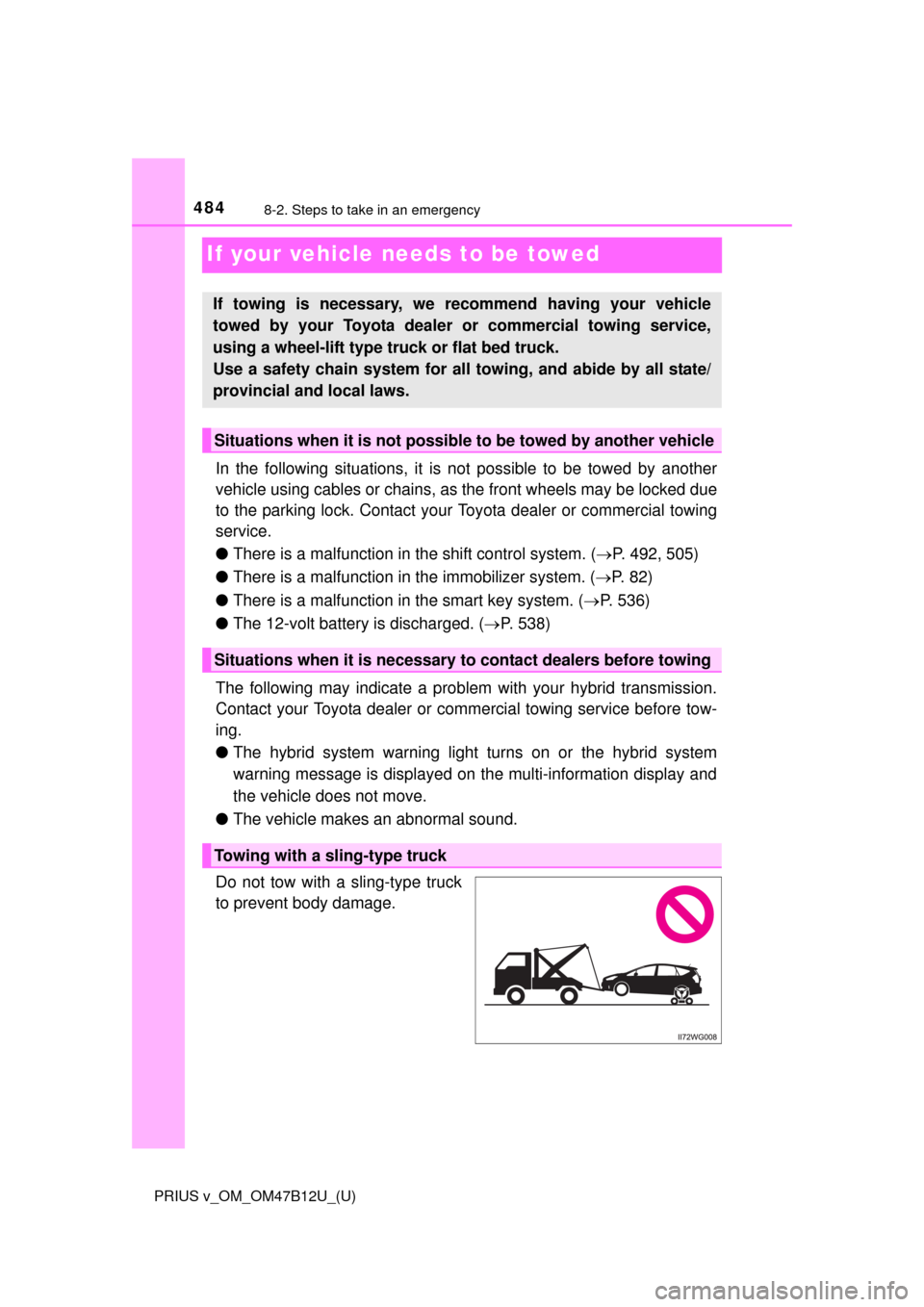
Do not tow with a sling-type truck
to prevent body damage.
If towing is necessary, we recommend having your vehicle
towed by your Toyota dealer or commercial towing service,
using a wheel-lift type truck or flat bed truck.
Use a safety chain system for all towing, and abide by all state/
provincial and local laws.
Situations when it is not possible to be towed by another vehicle
Situations when it is necessary to contact dealers before towing
Towing with a sling-type truck
Page 485 of 620
4858-2. Steps to take in an emergency
PRIUS v_OM_OM47B12U_(U)
8
When trouble arises
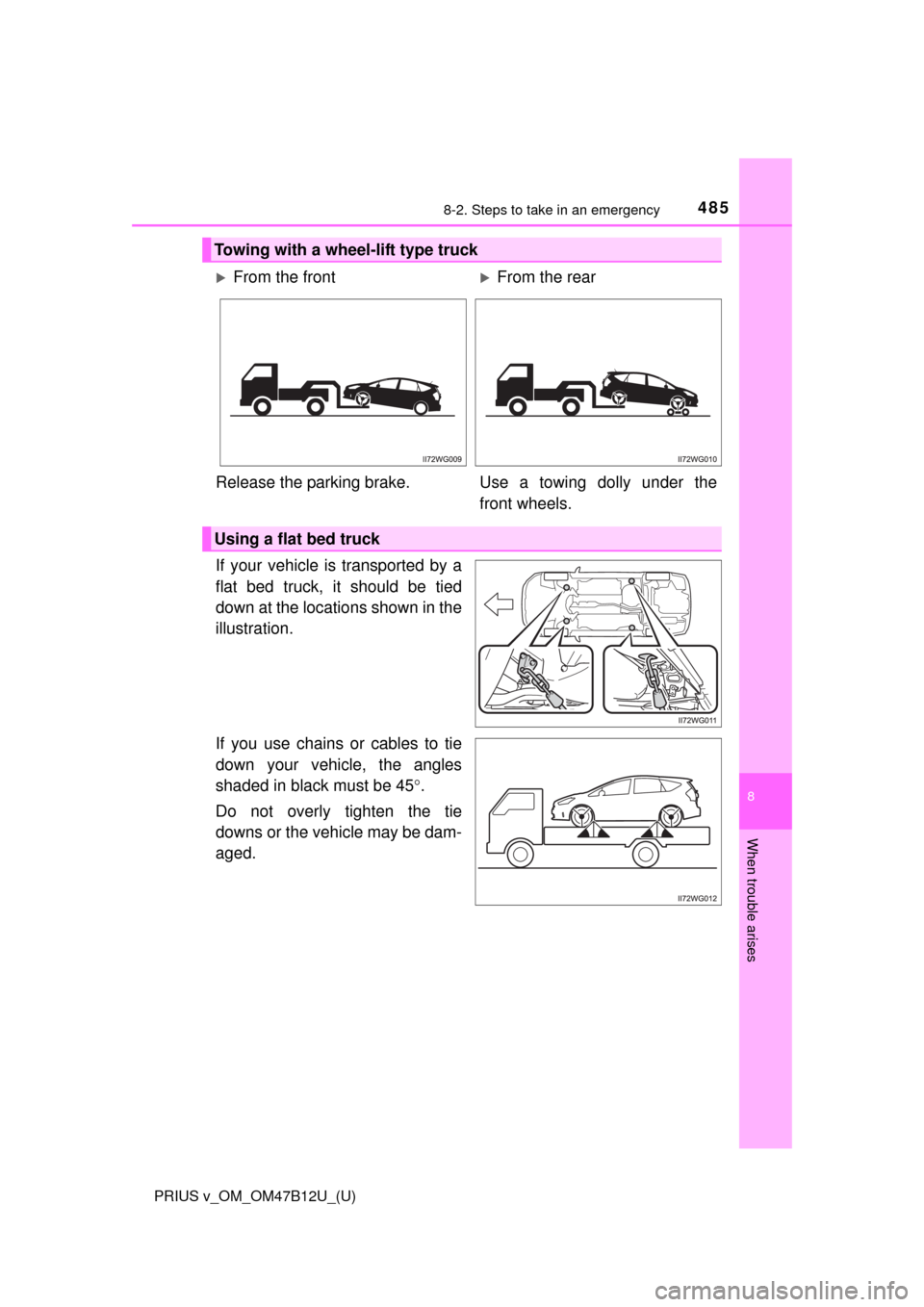
If your vehicle is transported by a
flat bed truck, it should be tied
down at the locations shown in the
illustration.
If you use chains or cables to tie
down your vehicle, the angles
shaded in black must be 45.
Do not overly tighten the tie
downs or the vehicle may be dam-
aged.
Towing with a wheel-lift type truck
From the front From the rear
Release the parking brake. Use a towing dolly under the
front wheels.
Using a flat bed truck
Page 486 of 620
4868-2. Steps to take in an emergency
PRIUS v_OM_OM47B12U_(U)
If a tow truck is not available in an emergency, your vehicle may be
temporarily towed using cables or chains secured to the emergency
towing eyelets. This should only be attempted on hard surfaced roads
for short distances at under 3 mph (5 km/h).
A driver must be in the vehicle to steer and operate the brakes. The
vehicle’s wheels, drive train, axles, steering and brakes must be in
good condition.
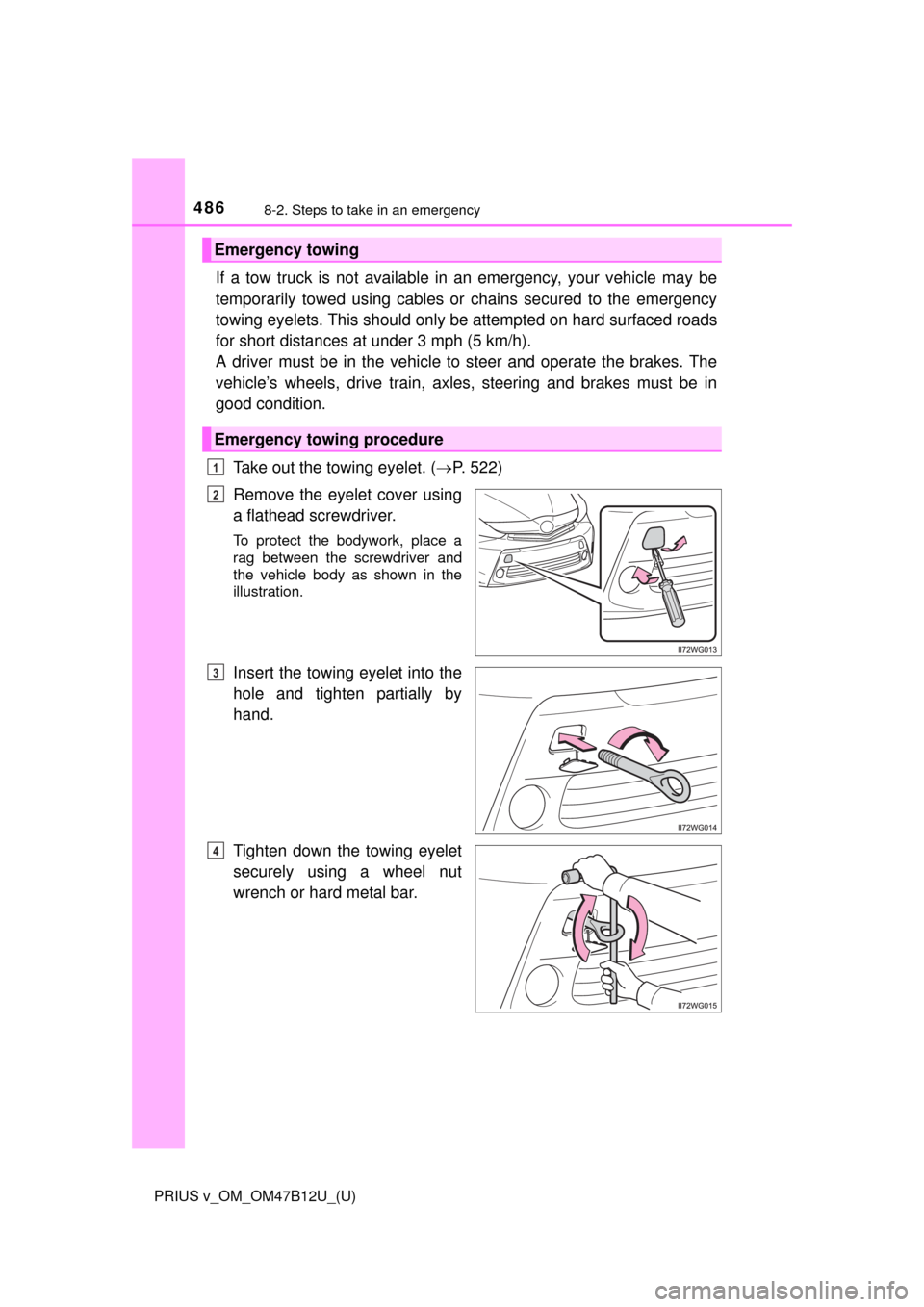
Take out the towing eyelet. (P. 522)
Remove the eyelet cover using
a flathead screwdriver.
To protect the bodywork, place a
rag between the screwdriver and
the vehicle body as shown in the
illustration.
Insert the towing eyelet into the
hole and tighten partially by
hand.
Tighten down the towing eyelet
securely using a wheel nut
wrench or hard metal bar.
Emergency towing
Emergency towing procedure
1
2
3
4
Page 487 of 620
4878-2. Steps to take in an emergency
PRIUS v_OM_OM47B12U_(U)
8
When trouble arises
Securely attach cables or chains to the towing eyelet.
Take care not to damage the vehicle body.
Enter the vehicle being towed and start the hybrid system.
If the hybrid system does not start, turn the power switch to ON mode.
Shift the shift position to N and release the parking brake.
■While towing
If the hybrid system is off, the power assist for the brakes and steering will not
function, making steering and braking more difficult.
■Wheel nut wrench
Wheel nut wrench is installed in luggage compartment. (P. 522)
WARNING
Observe the following precautions.
Failure to do so may result in death or serious injury.
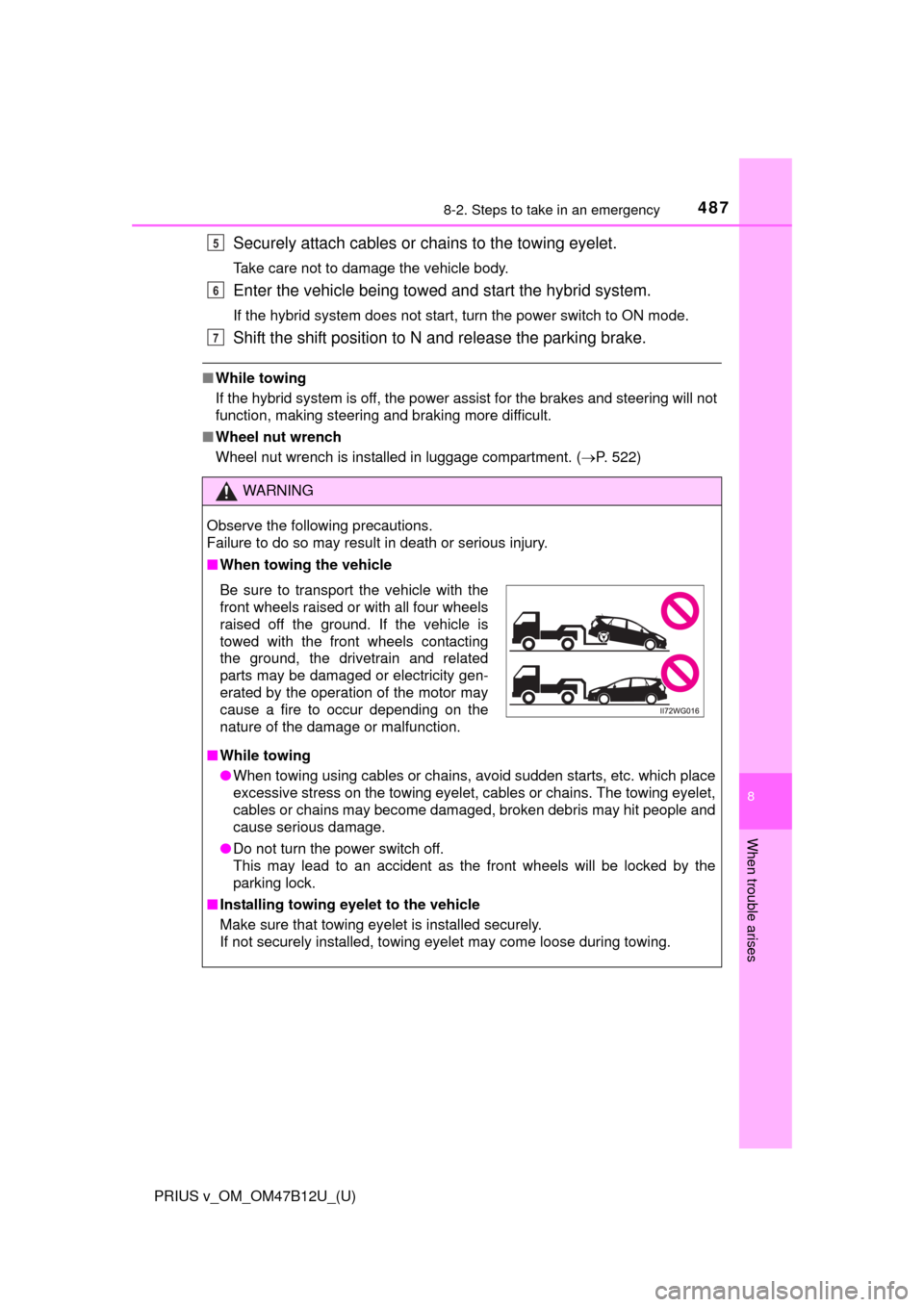
■When towing the vehicle
■While towing
●When towing using cables or chains, avoid sudden starts, etc. which place
excessive stress on the towing eyelet, cables or chains. The towing eyelet,
cables or chains may become damaged, broken debris may hit people and
cause serious damage.
●Do not turn the power switch off.
This may lead to an accident as the front wheels will be locked by the
parking lock.
■Installing towing eyelet to the vehicle
Make sure that towing eyelet is installed securely.
If not securely installed, towing eyelet may come loose during towing.
5
6
7
Be sure to transport the vehicle with the
front wheels raised or with all four wheels
raised off the ground. If the vehicle is
towed with the front wheels contacting
the ground, the drivetrain and related
parts may be damaged or electricity gen-
erated by the operation of the motor may
cause a fire to occur depending on the
nature of the damage or malfunction.
Page 488 of 620
4888-2. Steps to take in an emergency
PRIUS v_OM_OM47B12U_(U)
NOTICE
■To prevent damage to the vehicle when towing using a wheel-lift type
truck
When raising the vehicle, ensure adequate ground clearance for towing at
the opposite end of the raised vehicle. Without adequate clearance, the
vehicle could be damaged while being towed.
■To prevent damage to the vehicle when towing with a sling-type truck
Do not tow with a sling-type truck, either from the front or rear.
■To prevent damage to the vehicle during emergency towing
Do not secure cables or chains to the suspension components.