Page 218 of 620
218
PRIUS v_OM_OM47B12U_(U)
4-5. Using the driving support systems
Pulling the lever toward you
cancels the cruise control.
The speed setting is also canceled
when the brakes are applied.
Pushing the lever up resumes
the cruise control and returns
vehicle speed to the set speed.
Resuming is available when the
vehicle speed is more than approx-
imately 25 mph (40 km/h).
This mode employs a radar sensor to detect the presence of vehicles
up to approximately 400 ft. (120 m) ahead, determines the current
vehicle-to-vehicle following distance, and operates to maintain a suit-
able following distance from the vehicle ahead.
Note that vehicle-to-vehicle distance will close in when traveling on long
downhill slopes.
Canceling and resuming the speed control
1
2
Driving in vehicle-to-vehicle distance control mode
Page 359 of 620
PRIUS v_OM_OM47B12U_(U)
3595-11. Using the voice command system
5
Audio system
■Microphone
P. 324
■When using the microphone
●It is unnecessary to speak directly into the microphone when giving a com-
mand.
●When “Voice Prompt Interrupt” set to on, it is not necessary to wait for the
confirmation beep before speaking a command. (P. 284)
●Voice commands may not be recognized if:
• Spoken too quickly.
• Spoken at a low or high volume.
• The windows are open.
• Passengers are talking while voice commands are spoken.
• The air conditioning speed is set high.
• The air conditioning vents are turned towards the microphone.
●In the following conditions, the system may not recognize the command
properly and using voice commands may not be possible:
• The command is incorrect or unclear. Note that certain words, accents or
speech patterns may be difficult for the system to recognize.
• There is excessive background noise, such as wind noise.
• The ability to dial a contact using voice commands may take some time
after the power switch is in ACCESSORY or ON mode, especially when
the phone has many contacts.
Page 378 of 620
378
PRIUS v_OM_OM47B12U_(U)
6-3. Using the storage features
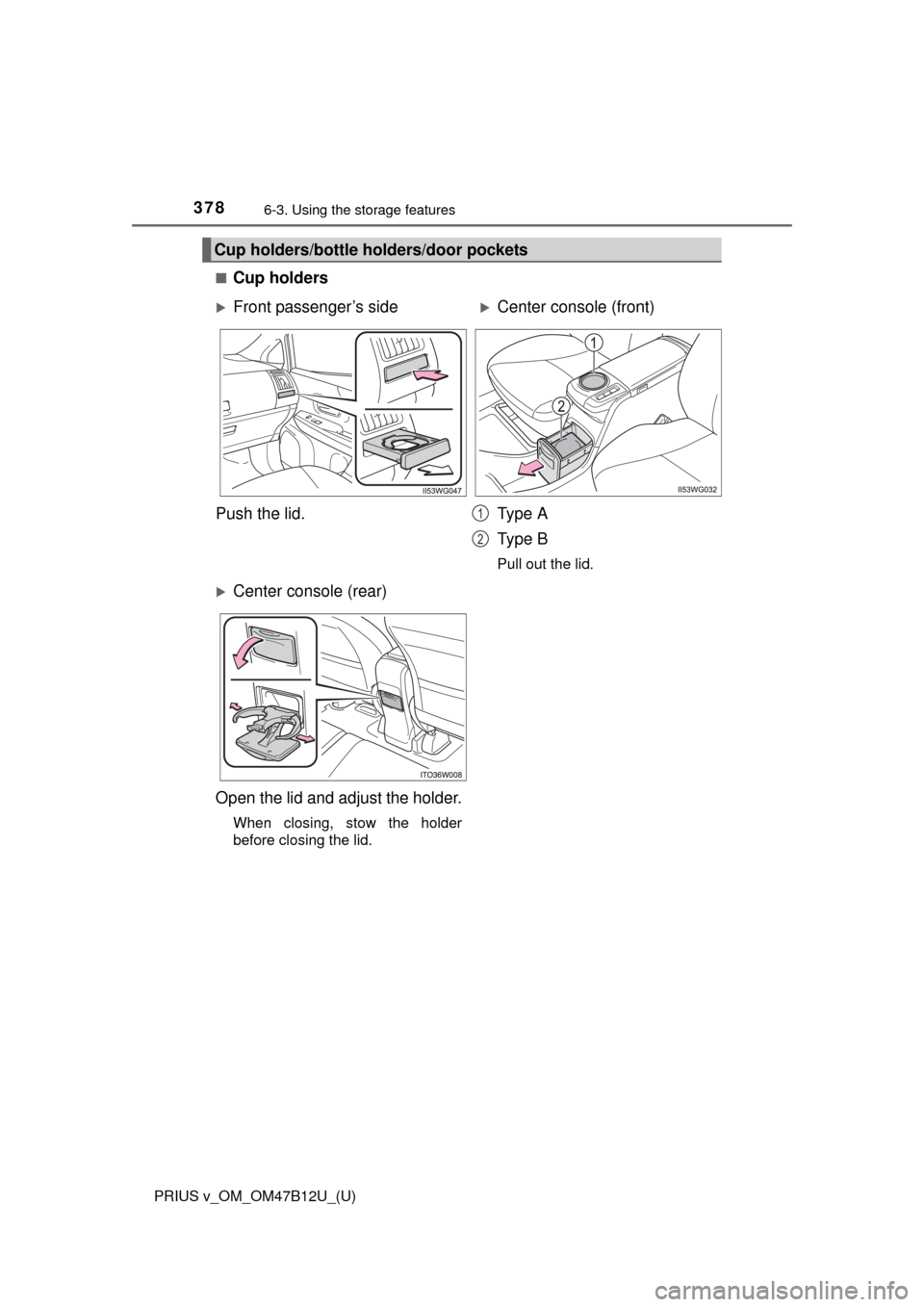
■Cup holders
Cup holders/bottle holders/door pockets
Front passenger’s sideCenter console (front)
Push the lid. Type A
Type B
Pull out the lid.
Center console (rear)
Open the lid and adjust the holder.
When closing, stow the holder
before closing the lid.
1
2
Page 379 of 620
PRIUS v_OM_OM47B12U_(U)
3796-3. Using the storage features
6
Interior features
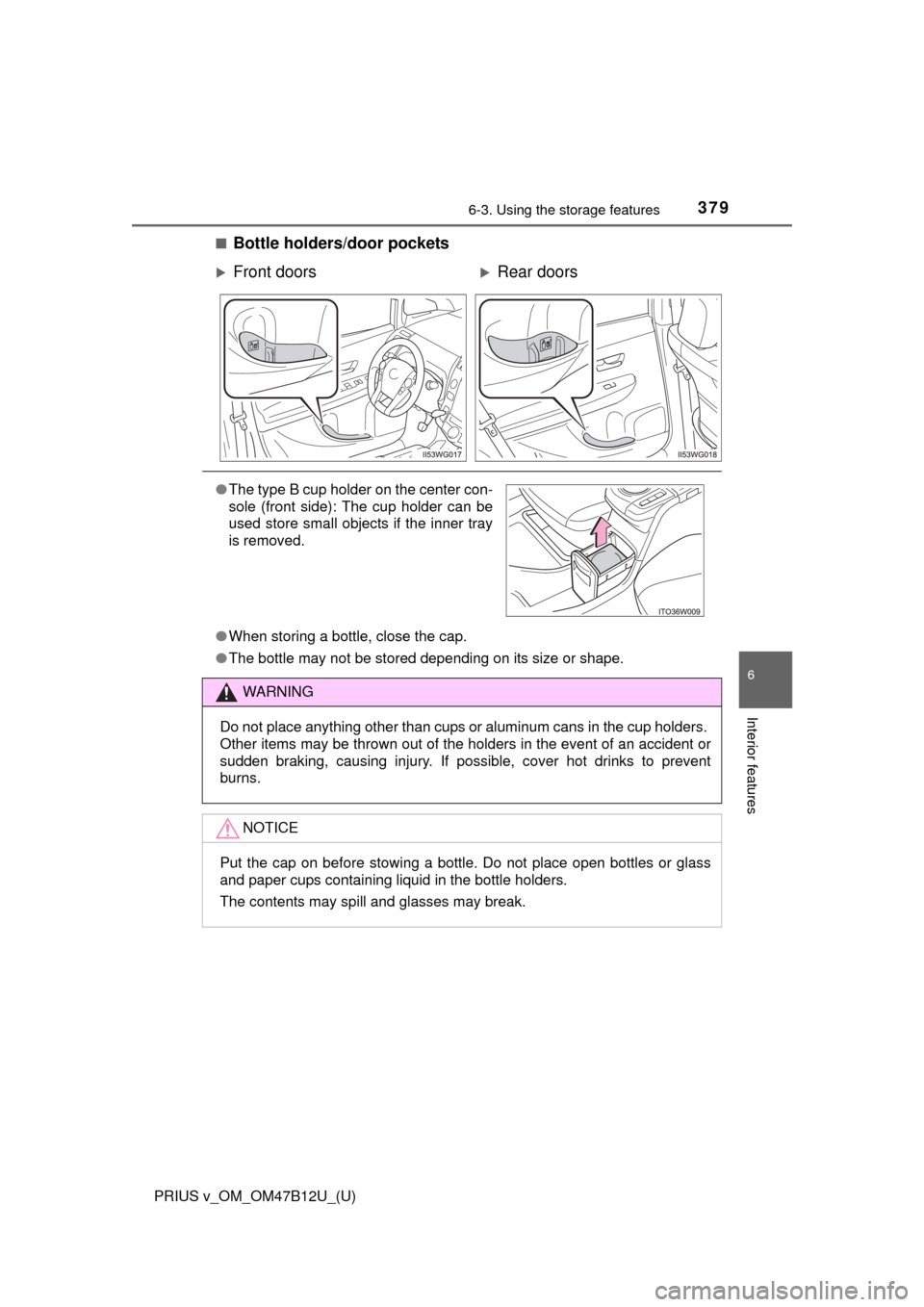
■Bottle holders/door pockets
●When storing a bottle, close the cap.
●The bottle may not be stored depending on its size or shape.
Front doorsRear doors
●The type B cup holder on the center con-
sole (front side): The cup holder can be
used store small objects if the inner tray
is removed.
WARNING
Do not place anything other than cups or aluminum cans in the cup holders.
Other items may be thrown out of the holders in the event of an accident or
sudden braking, causing injury. If possible, cover hot drinks to prevent
burns.
NOTICE
Put the cap on before stowing a bottle. Do not place open bottles or glass
and paper cups containing liquid in the bottle holders.
The contents may spill and glasses may break.
Page 382 of 620
382
PRIUS v_OM_OM47B12U_(U)
6-3. Using the storage features
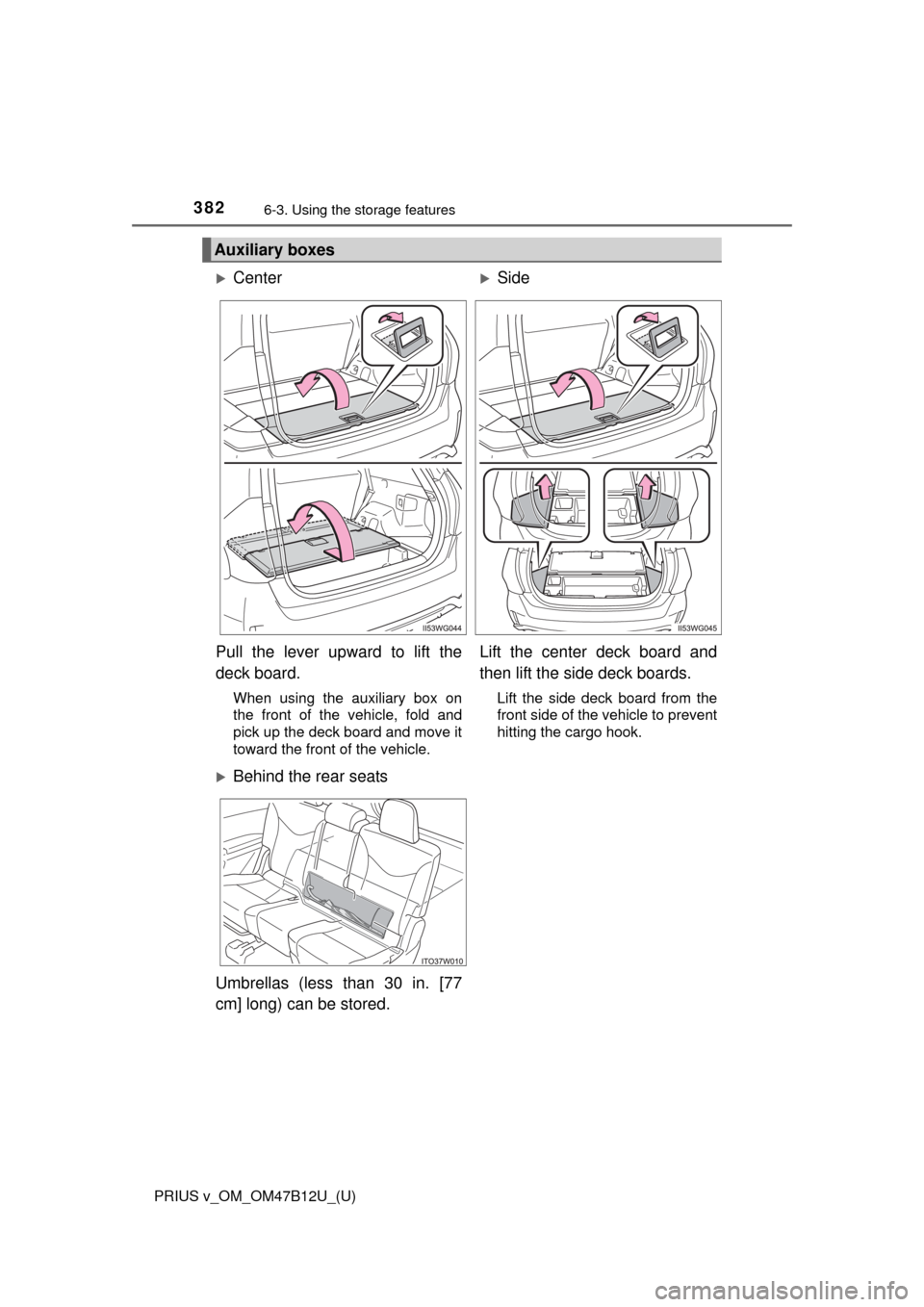
Auxiliary boxes
Center Side
Pull the lever upward to lift the
deck board.
When using the auxiliary box on
the front of the vehicle, fold and
pick up the deck board and move it
toward the front of the vehicle.
Lift the center deck board and
then lift the side deck boards.
Lift the side deck board from the
front side of the vehicle to prevent
hitting the cargo hook.
Behind the rear seats
Umbrellas (less than 30 in. [77
cm] long) can be stored.
Page 384 of 620
384
PRIUS v_OM_OM47B12U_(U)
6-3. Using the storage features
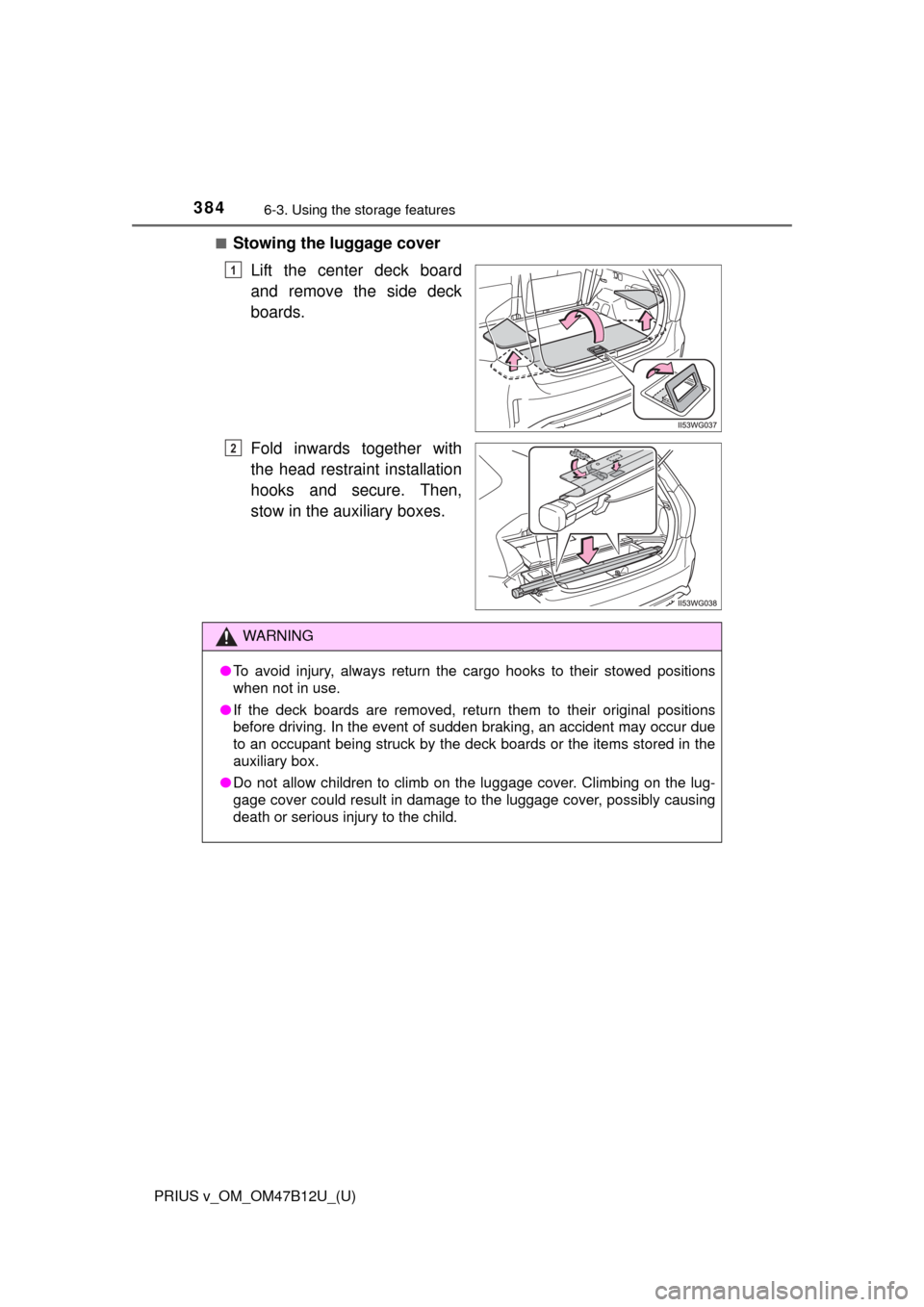
■Stowing the luggage cover
Lift the center deck board
and remove the side deck
boards.
Fold inwards together with
the head restraint installation
hooks and secure. Then,
stow in the auxiliary boxes.
1
2
WARNING
●To avoid injury, always return the cargo hooks to their stowed positions
when not in use.
●If the deck boards are removed, return them to their original positions
before driving. In the event of sudden braking, an accident may occur due
to an occupant being struck by the deck boards or the items stored in the
auxiliary box.
●Do not allow children to climb on the luggage cover. Climbing on the lug-
gage cover could result in damage to the luggage cover, possibly causing
death or serious injury to the child.
Page 402 of 620
402
PRIUS v_OM_OM47B12U_(U)
6-4. Using the other interior features
■Enhanced Roadside Assistance
Enhanced Roadside Assistance adds GPS data to the already
included warranty-based Toyota roadside service.
Subscribers can press the “SOS” button to reach a Safety Connect
response-center agent, who can help with a wide range of needs,
such as: towing, flat tire, fuel delivery, etc. For a description of the
Roadside Assistance services and their limitations, please see the
Safety Connect Terms and Conditions, which are available at
To y o t a . c o m .
Important! Read this information before using Safety Connect.
■Exposure to radio frequency signals
The Safety Connect system installed in your vehicle is a low-power
radio transmitter and receiver. It receives and also sends out radio
frequency (RF) signals.
In August 1996, the Federal Communications Commission (FCC)
adopted RF exposure guidelines with safety levels for mobile wire-
less phones. Those guidelines are consistent with the safety stan-
dards previously set by the following U.S. and international
standards bodies.
●ANSI (American National Standards Institute) C95.1 [1992]
●NCRP (National Council on Radiation Protection and Measure-
ment) Report 86 [1986]
●ICNIRP (International Commission on Non-Ionizing Radiation
Protection) [1996]
Those standards were based on comprehensive and periodic eval-
uations of the relevant scientific literature. Over 120 scientists, engi-
neers, and physicians from universities, and government health
agencies and industries reviewed the available body of research to
develop the ANSI Standard (C95.1).
The design of Safety Connect complies with the FCC guidelines in
addition to those standards.
Safety information for Safety Connect
Page 419 of 620

419
PRIUS v_OM_OM47B12U_(U)
7-3. Do-it-yourself maintenance
7
Maintenance and care
Do-it-yourself ser vice precautions
If you perform maintenance by yourself, be sure to follow the
correct procedure as given in these sections.
ItemsParts and tools
12-volt battery
condition
(P. 439)•Grease
• Conventional wrench (for terminal clamp bolts)
Brake fluid level
(P. 434)
• FMVSS No.116 DOT 3 or SAE J1703 brake fluid
• Rag or paper towel
• Funnel (used only for adding brake fluid)
Engine/power
control unit cool-
ant level
(P. 431)
• “Toyota Super Long Life Coolant” or a similar high
quality ethylene glycol-based non-silicate, non-
amine, non-nitrite and non-borate coolant with long-
life hybrid organic acid technology
For the U.S.A.:
“Toyota Super Long Life Coolant” is pre-mixed with
50% coolant and 50% deionized water.
For Canada:
“Toyota Super Long Life Coolant” is pre-mixed with
55% coolant and 45% deionized water.
• Funnel (used only for adding coolant)
Engine oil level
(P. 427)
• “Toyota Genuine Motor Oil” or equivalent
• Rag or paper towel
• Funnel (used only for adding engine oil)
Fuses (P. 463)• Fuse with same amperage rating as original
Light bulbs
(P. 466)
• Bulb with same number and wattage rating as origi-
nal
• Phillips-head screwdriver• Flathead screwdriver
• Wrench
Radiator and con-
denser (P. 433)
Tire inflation
pressure
(P. 452)
• Tire pressure gauge• Compressed air source