2016 TOYOTA COROLLA Speed
[x] Cancel search: SpeedPage 457 of 620

4577-3. Do-it-yourself maintenance
7
Maintenance and care
COROLLA_TMMMS_TMMC_U (OM12J84U)
uRegistering ID codes
The tire pressure warning valve and transmitter is equipped with a
unique ID code. When replacing a tire pressure warning valve and
transmitter, it is necessary to register the ID code. Have the ID code
registered by your Toyota dealer.
nWhen to replace your vehicle’s tires
Tires should be replaced if:
lThe treadwear indicators are showing on a tire.
lYou have tire damage such as cuts, splits, cracks deep enough to
expose the fabric, and bulges indicating internal damage
lA tire goes flat repeatedly or cannot be properly repaired due to the size
or location of a cut or other damage
If you are not sure, consult with your Toyota dealer.
nReplacing tires and wheels (vehicles with a tire pressure warning
system)
If the ID code of the tire pressure warning valve and transmitter is not reg-
istered, the tire pressure warning system will not work properly. After driv-
ing for about 20 minutes, the tire pressure warning light blinks for 1
minute and stays on to indicate a system malfunction.
nTire life
Any tire over 6 years old must be checked by a qualified technician even
if it has seldom or never been used or damage is not obvious.
nRoutine tire inflation pressure checks (vehicles with a tire pressure
warning system)
The tire pressure warning system does not replace routine tire inflation
pressure checks. Make sure to check tire inflation pressure as part of
your routine of daily vehicle checks.
nLow profile tires (17-inch tires)
Generally, low profile tires will wear mo re rapidly and tire grip perfor-
mance will be reduced on snowy and /or icy roads when compared to
standard tires. Be sure to use snow tires or tire chains on snowy and/or
icy roads and drive carefully at a speed appropriate for road and weather
conditions.
Page 458 of 620
4587-3. Do-it-yourself maintenance
COROLLA_TMMMS_TMMC_U (OM12J84U)n
Maximum load of tire
Check that the maximum load of the re
placement tire is greater than 1/2
of the Gross Axle Weight Ratings (GAWR) of either the front axle or the
rear axle, whichever is greater.
nTire types
lSummer tires
Summer tires are high-speed performance tires best suited to highway
driving under dry conditions. Since summer tires do not have the same
traction performance as snow tires, summer tires are inadequate for
driving on snow-covered or icy ro ads. For driving on snow-covered
roads or icy roads, the use of snow tires is recommended. When install-
ing snow tires, be sure to replace all four tires.
lAll season tires
All season tires are designed to provide better traction in snow and to
be adequate for driving in most winter conditions as well as for use
year-round. All season tires, however, do not have adequate traction
performance compared with snow tires in heavy or loose snow. Also, all
season tires fall short in acceleration and handling performance com-
pared with summer tires in highway driving.
lSnow tires
For driving on snow-covered roads or icy roads, we recommend using
snow tires. If you need snow tires, select tires of the same size, con-
struction and load capacity as the or iginally installed tires. Since your
vehicle has radial tires as original equipment, make sure your snow
tires also have radial construction. Do not install studded tires without
first checking local regulations fo r possible restrictions. Snow tires
should be installed on all wheels. ( P. 221)
nInitializing the tire pressure warn ing system (vehicles with a tire
pressure warning system)
Initialize the system with the tire infl ation pressure adjusted to the speci-
fied level.
nIf the tread on snow tires wears down below 0.16 in. (4 mm)
The effectiveness of the tire s as snow tires is lost.
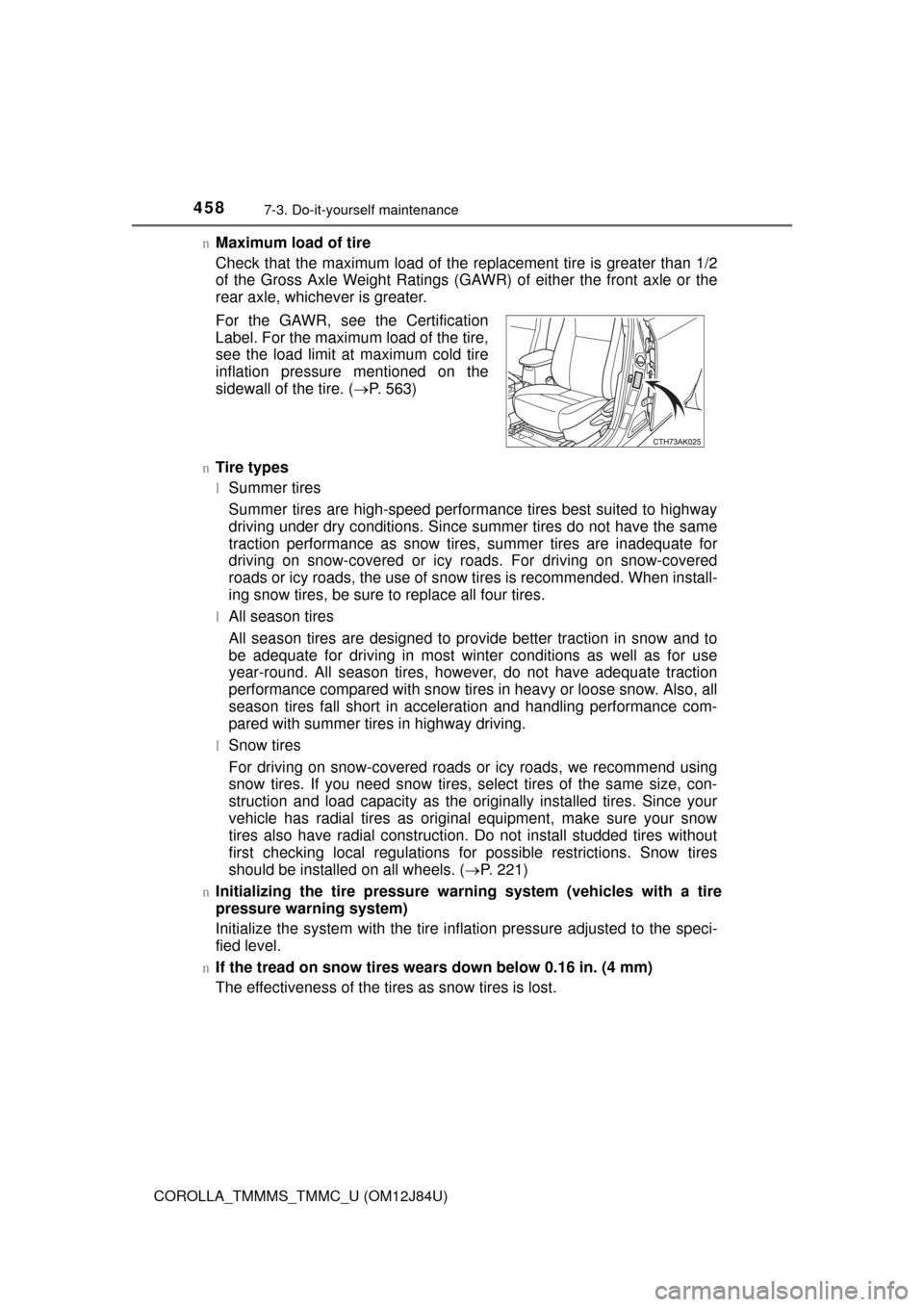
For the GAWR, see the Certification
Label. For the maximum load of the tire,
see the load limit at maximum cold tire
inflation pressure mentioned on the
sidewall of the tire. (
P. 563)
Page 489 of 620
4898-1. Essential information
8
When trouble arises
COROLLA_TMMMS_TMMC_U (OM12J84U)
Steadily step on the brake pedal with both feet and firmly depress it.
Do not pump the brake pedal repeatedly as this will increase the effort
required to slow the vehicle.
Shift the shift lever to N.
If the shift lever is shifted to N
After slowing down, stop the vehicle in a safe place by the road.
Stop the engine.
If the shift lever cannot be shifted to N
Keep depressing the brake pedal with both feet to reduce vehicle
speed as much as possible.
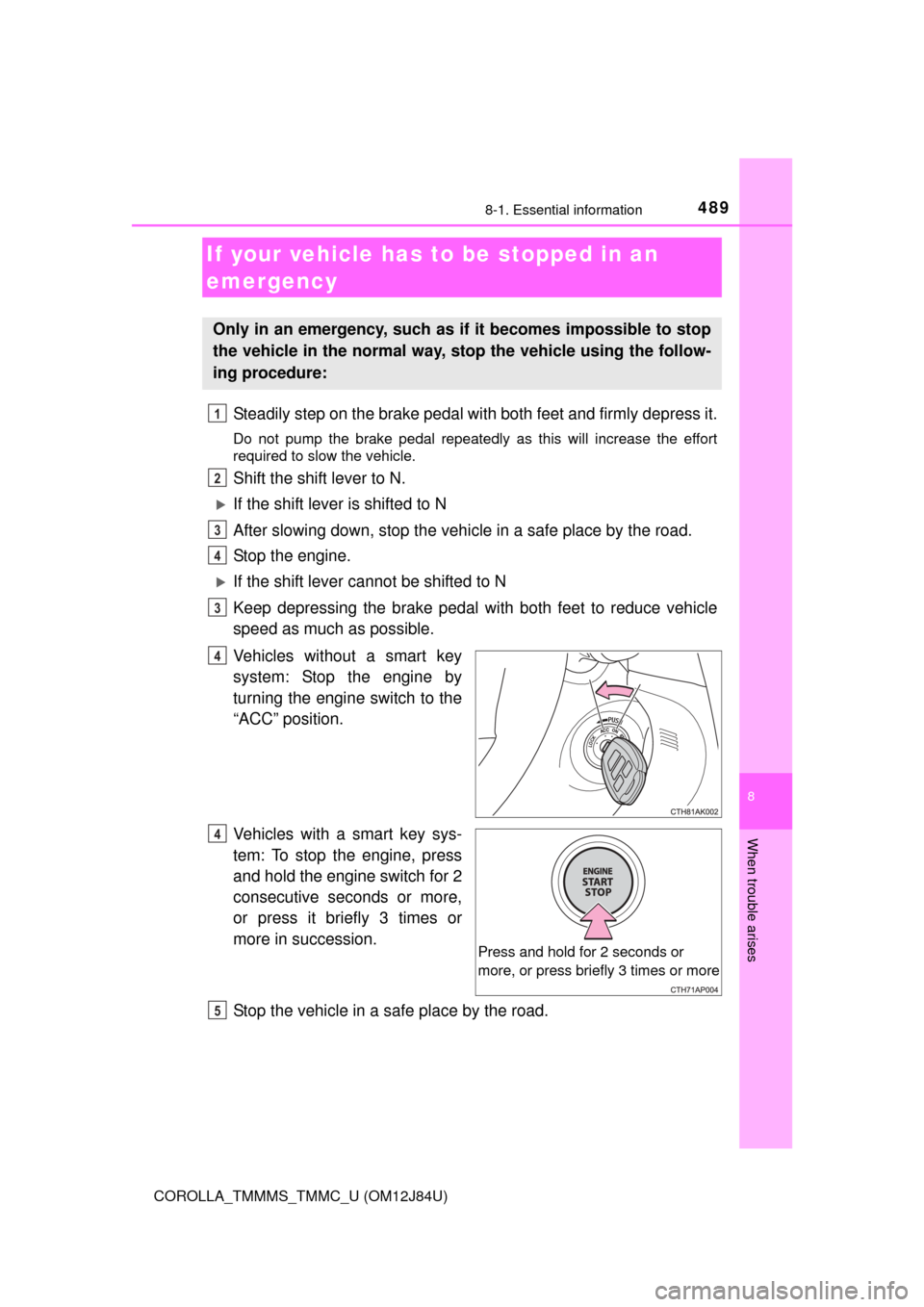
Vehicles without a smart key
system: Stop the engine by
turning the engine switch to the
“ACC” position.
Vehicles with a smart key sys-
tem: To stop the engine, press
and hold the engine switch for 2
consecutive seconds or more,
or press it briefly 3 times or
more in succession.
Stop the vehicle in a safe place by the road.
If your vehicle has to be stopped in an
emergency
Only in an emergency, such as if it becomes impossible to stop
the vehicle in the normal way, st op the vehicle using the follow-
ing procedure:
1
2
3
4
3
4
Press and hold for 2 seconds or
more, or press briefly 3 times or more
4
5
Page 502 of 620

5028-2. Steps to take in an emergency
COROLLA_TMMMS_TMMC_U (OM12J84U)
*5: Driver’s seat belt buzzer:Vehicles without a smart key system: The driver’s seat belt buzzer sounds
to alert the driver that his or her seat belt is not fastened. Once the engine
switch is turned to the “ON” position, the buzzer sounds for 6 seconds. If
the vehicle reaches a speed of 12 mph (20 km/h), the buzzer sounds once.
If the seat belt is still unfastened after 30 seconds, the buzzer will sound
intermittently for 10 seconds. Then, if the seat belt is still unfastened, the
buzzer will sound in a different tone for 20 more seconds.
Vehicles with a smart key system: The driver’s seat belt buzzer sounds to
alert the driver that his or her seat belt is not fastened. Once the engine
switch is turned to IGNITION ON mode, the buzzer sounds for 6 seconds.
If the vehicle reaches a speed of 12 mph (20 km/h), the buzzer sounds
once. If the seat belt is still unfastened after 30 seconds, the buzzer will
sound intermittently for 10 seconds. Then, if the seat belt is still unfas-
tened, the buzzer will sound in a different tone for 20 more seconds.
Front passenger’s seat belt buzzer:
The front passenger’s seat belt buzzer sounds to alert the front passenger
that his or her seat belt is not fastened. The buzzer sounds once if the\
vehicle reaches a speed of 12 mph (20 km/h). If the seat belt is still unfas-
tened after 30 seconds, the buzzer will sound intermittently for 10 seconds.
Then, if the seat belt is still unfastened, the buzzer will sound in a different
tone for 20 more seconds.
*6: If equipped
*7: Refer to the separate “Scheduled Maintenance Guide” or “Owner’s Manual
Supplement” for the maintenance interval applicable to your vehicle.
Page 510 of 620
5108-2. Steps to take in an emergency
COROLLA_TMMMS_TMMC_U (OM12J84U)
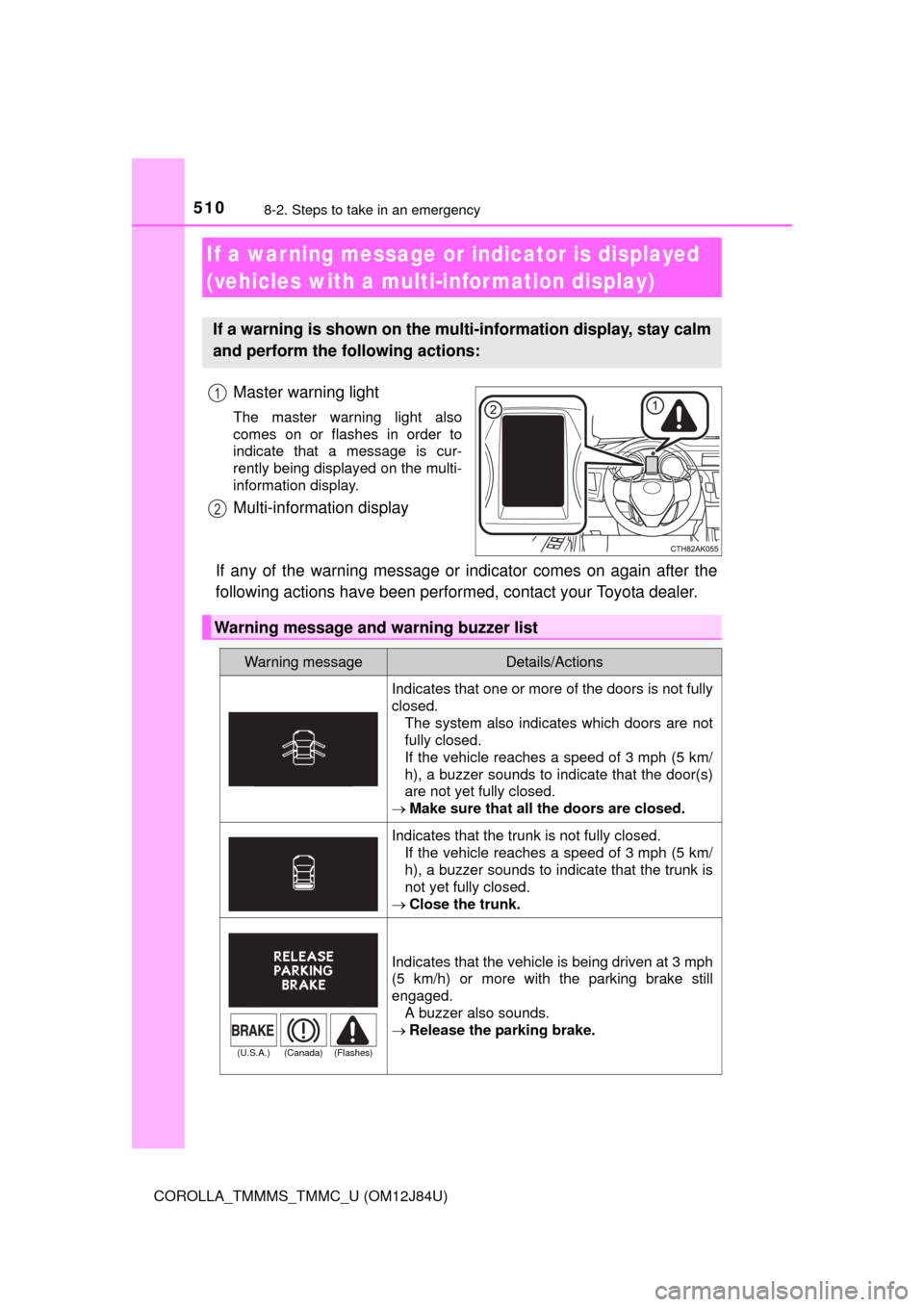
Master warning light
The master warning light also
comes on or flashes in order to
indicate that a message is cur-
rently being displayed on the multi-
information display.
Multi-information display
If any of the warning message or indicator comes on again after the
following actions have been performed, contact your Toyota dealer.
If a war ning message or indicator is displayed
(vehicles with a multi-infor mation display)
If a warning is shown on the multi-information display, stay calm
and perform the following actions:
1
2
Warning message and warning buzzer list
Warning messageDetails/Actions
Indicates that one or more of the doors is not fully
closed. The system also indicates which doors are not
fully closed.
If the vehicle reaches a speed of 3 mph (5 km/
h), a buzzer sounds to indicate that the door(s)
are not yet fully closed.
Make sure that all the doors are closed.
Indicates that the trunk is not fully closed.
If the vehicle reaches a speed of 3 mph (5 km/
h), a buzzer sounds to indicate that the trunk is
not yet fully closed.
Close the trunk.
Indicates that the vehicle is being driven at 3 mph
(5 km/h) or more with the parking brake still
engaged.
A buzzer also sounds.
Release the parking brake.
(U.S.A.) (Canada) (Flashes)
Page 519 of 620
5198-2. Steps to take in an emergency
8
When trouble arises
COROLLA_TMMMS_TMMC_U (OM12J84U)
nWarning buzzer
P. 506
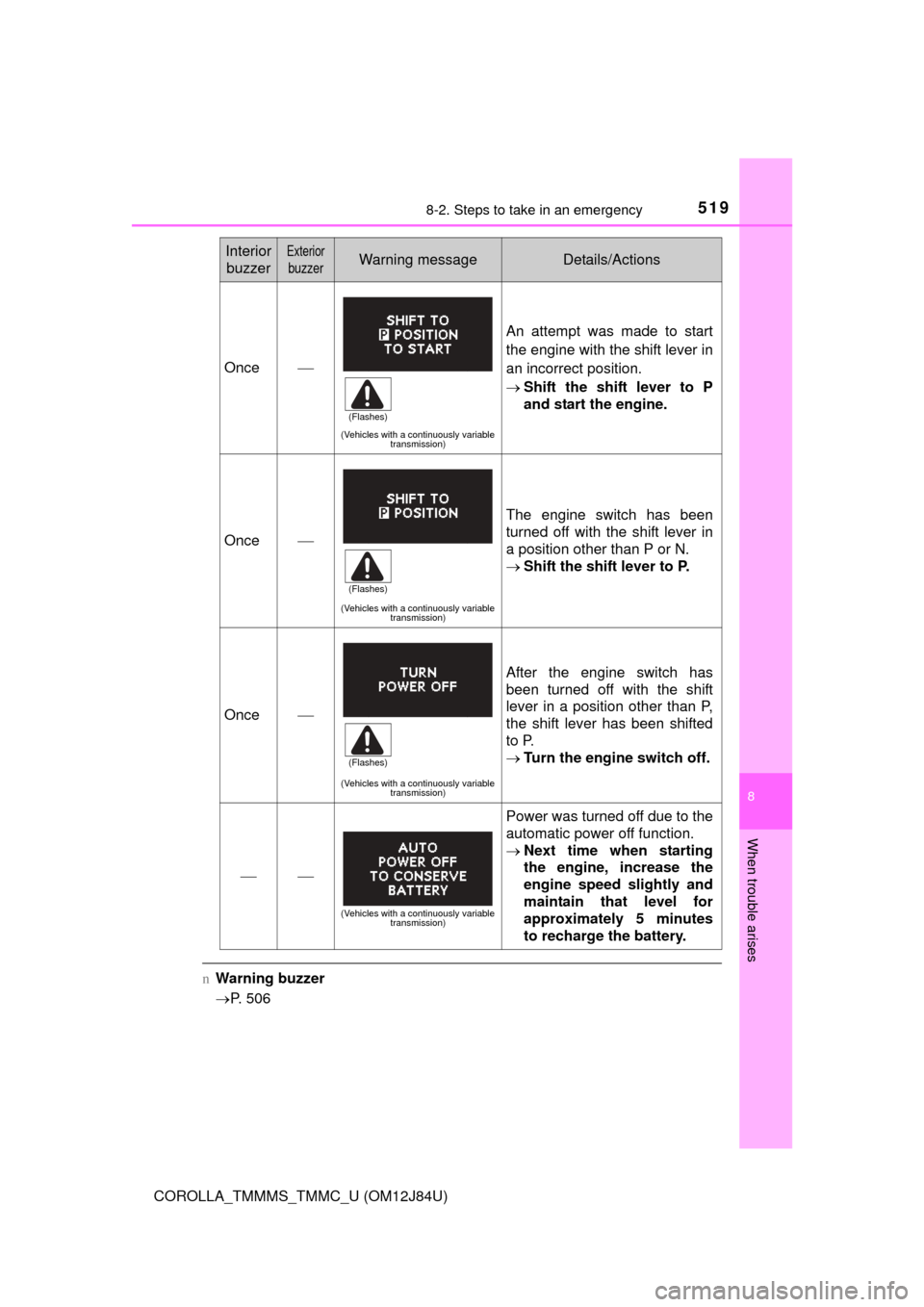
Once
(Vehicles with a continuously variable
transmission)
An attempt was made to start
the engine with the shift lever in
an incorrect position.
Shift the shift lever to P
and start the engine.
Once
(Vehicles with a continuously variable
transmission)
The engine switch has been
turned off with the shift lever in
a position other than P or N.
Shift the shift lever to P.
Once
(Vehicles with a continuously variable
transmission)
After the engine switch has
been turned off with the shift
lever in a position other than P,
the shift lever has been shifted
to P.
Turn the engine switch off.
(Vehicles with a continuously variable
transmission)
Power was turned off due to the
automatic power off function.
Next time when starting
the engine, increase the
engine speed slightly and
maintain that level for
approximately 5 minutes
to recharge the battery.
Interior
buzzerExterior
buzzerWarning messageDetails/Actions
(Flashes)
(Flashes)
(Flashes)
Page 530 of 620

5308-2. Steps to take in an emergency
COROLLA_TMMMS_TMMC_U (OM12J84U)
CAUTION
nWhen using the compact spare tire
lRemember that the compact spare tire provided is specifically
designed for use with your vehicle. Do not use your compact spare tire
on another vehicle.
lDo not use more than one compact spare tires simultaneously.
lReplace the compact spare tire with a standard tire as soon as possi-
ble.
lAvoid sudden acceleration, abrupt steering, sudden braking and shift-
ing operations that cause sudden engine braking.
nWhen the compact spare tire is attached
The vehicle speed may not be correctly detected, and the following sys-
tems may not operate correctly:
nSpeed limit when using the compact spare tire
Do not drive at speeds in excess of 50 mph (80 km/h) when a compact
spare tire is installed on the vehicle.
The compact spare tire is not designed for driving at high speeds. Fail-
ure to observe this precaution may lead to an accident causing death or
serious injury.
nAfter using the tools and jack
Before driving, make sure all the tools and jack are securely in place in
their storage location to reduce the po ssibility of personal injury during a
collision or sudden braking.
• ABS & Brake assist
• VSC
•TRAC
• Cruise control (if equipped) • EPS
• Rear view monitor system (if
equipped)
• Navigation system (if equipped)
Page 540 of 620

5408-2. Steps to take in an emergency
COROLLA_TMMMS_TMMC_U (OM12J84U)
Start the engine of the second vehicle. Increase the engine speed
slightly and maintain at that level for approximately 5 minutes to
recharge the batter y of your vehicle.
Vehicles with a smart key system: Open and close any of the doors
of your vehicle with the engine switch off.
Vehicles without a smart key system:
Maintain the engine speed of the second vehicle and turn the
engine switch to the “ON” position, then start the vehicle's engine.
Vehicles with a smart key system:
Maintain the engine speed of the second vehicle and turn the
engine switch to IGNITION ON mode, then start the vehicle's
engine.
Once the vehicle’s engine has started, remove the jumper cables in
the exact reverse order from which they were connected.
Once the engine starts, have the vehicle inspected at your Toyota
dealer as soon as possible.4
5
6
7