2016 SUBARU WRX 11-2
[x] Cancel search: 11-2Page 427 of 594
Starting and operating/Vehicle Dynamics Control system
If the brake system warning light and ABS
warning light illuminate simultaneously,
take the following steps.
1. Stop the vehicle in the nearest safe,
flat location.
2. Apply the parking brake and turn off
the engine.
3. Restart the engine.
4. Release the parking brake.
Even if both warning lights turn off:
The EBD system may be malfunctioning.
Drive carefully to the nearest SUBARU
dealer and have the system inspected.
If both warning lights illuminate again
and remain illuminated after restarting
the engine:
1. Turn off the engine again.
2. Apply the parking brake.
3. Check the brake fluid level. For details
about checking the brake fluid level, refer
to “ Checking the fluid level ” F 11-25.
. If the brake fluid level is not below the
“ MIN ” mark, the EBD system may be
malfunctioning. Drive carefully to the
nearest SUBARU dealer and have the
system inspected.
. If the brake fluid level is below the
“ MIN ” mark, DO NOT drive the vehicle.
Instead, have the vehicle towed to the nearest SUBARU dealer for repair.
WARNING. Driving with the brake system
warning light illuminated is dan-
gerous. This indicates your brake
system may not be working
properly. If the light remains
illuminated, have the brakes in-
spected by a SUBARU dealer
immediately.
. If at all in doubt about whether
the brakes are operating prop-
erly, do not drive the vehicle.
Have your vehicle towed to the
nearest SUBARU dealer for re-
pair. Vehicle Dynamics Control
system WARNINGAlways use the utmost care in
driving – overconfidence because
you are driving a vehicle with the
Vehicle Dynamics Control system
could easily lead to a serious acci-
dent.
CAUTION. Even if your vehicle is equipped
with Vehicle Dynamics Control
system, winter tires should be
used when driving on snow-cov-
ered or icy roads; in addition,
vehicle speed should be reduced
considerably. Simply having a
Vehicle Dynamics Control sys-
tem does not guarantee that the
vehicle will be able to avoid
accidents in any situation.
. Activation of the Vehicle Dy-
namics Control system is an
indication that the road being
travelled on has a slippery sur-
face; since having Vehicle Dy-7-38
Page 490 of 594

Maintenance schedule ....................................... 11-3
Maintenance precautions ................................... 11-3Before checking or servicing in the engine
compartment .................................................... 11-4
When checking or servicing in the engine
compartment .................................................... 11-5
When checking or servicing in the engine
compartment while the engine is running .......... 11-5
Maintenance tips ................................................ 11-6Removing and reinstalling clips .......................... 11-6
Engine hood ....................................................... 11-9
Engine compartment overview ........................ 11-11STI................................................................... 11-11
Except STI ....................................................... 11-12
Engine oil .......................................................... 11-13Engine oil consumption .................................... 11-13
Checking the oil level ....................................... 11-13
Changing the oil and oil filter ............................ 11-15
Recommended grade and viscosity .................. 11-16
Synthetic oil ..................................................... 11-16
Cooling system ................................................ 11-17Cooling fan, hose and connections ................... 11-17
Engine coolant ................................................. 11-18
Air cleaner element .......................................... 11-19
Replacing the air cleaner element ..................... 11-19
Spark plugs ...................................................... 11-21
Recommended spark plugs .............................. 11-21
Drive belts ........................................................ 11-22
Manual transmission oil .................................. 11-23
Recommended grade and viscosity .................. 11-23 Continuously variable transmission fluid ...... 11-23
Front differential gear oil (CVT models) and
rear differential gear oil ................................ 11-23Recommended grade and viscosity .................. 11-23
Power steering fluid (STI) ............................... 11-24Checking the fluid level .................................... 11-24
Recommended fluid ......................................... 11-24
Brake fluid ........................................................ 11-25Checking the fluid level .................................... 11-25
Recommended brake fluid ............................... 11-25
Clutch fluid (MT models) ................................. 11-26Checking the fluid level .................................... 11-26
Recommended clutch fluid ............................... 11-26
Brake booster .................................................. 11-27
Brake pedal ...................................................... 11-27Checking the brake pedal free play .................. 11-27
Checking the brake pedal reserve distance ....... 1 1-28
Clutch pedal (MT models) ............................... 11-28Checking the clutch function ............................ 11-28
Checking the clutch pedal free play .................. 11-28
Hill start assist system .................................... 11-29
Replacement of brake pad and lining ............ 11-29Breaking-in of new brake pads (models with
electronic parking brake system) .................... 11-29
Breaking-in of new brake pads and linings
(models without electronic parking brake
system) ......................................................... 11-30
Parking brake stroke (models without
electronic parking brake system) ................ 11-30Maintenance and service
11
Page 500 of 594

Engine compartment overview & STI 1) Power steering fluid reservoir
(page 11-24)
2) Brake fluid reservoir/Clutch fluid reservoir
(page 11-25)
3) Fuse box (page 11-42)
4) Battery (page 11-41)
5) Windshield washer tank (page 11-38)
6) Engine oil filler cap (page 11-13)
7) Engine coolant reservoir (page 11-18)
8) Engine oil level gauge (page 11-13)
9) Coolant filler tank cap (page 11-18)
10) Air cleaner case (page 11-19)Maintenance and service/Engine compartment overview
– CONTINUED –11-11
Page 501 of 594

Maintenance and service/Engine compartment overview
& Except STI 1) Brake fluid reservoir/Clutch fluid reservoir
(MT models) (page 11-25)
2) Fuse box (page 11-42)
3) Battery (page 11-41)
4) Windshield washer tank (page 11-38)
5) Engine oil filler cap (page 11-13)
6) Engine coolant reservoir (page 11-18)
7) Radiator cap (page 11-18)
8) Engine oil filter (page 11-15)
9) Engine oil level gauge (page 11-13)
10) Air cleaner case (page 11-19)
11-12
Page 509 of 594
Maintenance and service/Air cleaner element
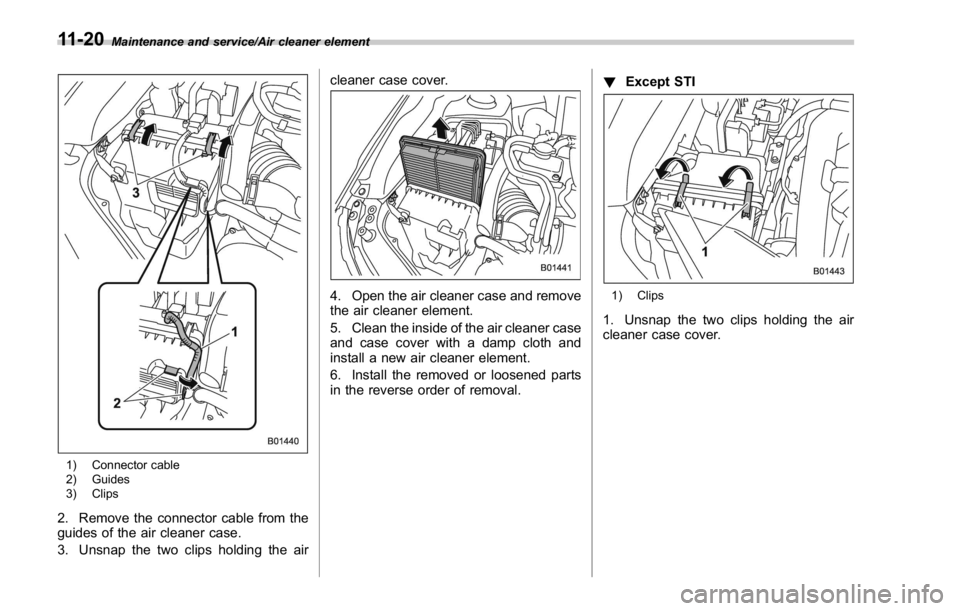
1) Connector cable
2) Guides
3) Clips
2. Remove the connector cable from the
guides of the air cleaner case.
3. Unsnap the two clips holding the air cleaner case cover.
4. Open the air cleaner case and remove
the air cleaner element.
5. Clean the inside of the air cleaner case
and case cover with a damp cloth and
install a new air cleaner element.
6. Install the removed or loosened parts
in the reverse order of removal. ! Except STI
1) Clips
1. Unsnap the two clips holding the air
cleaner case cover.11-20
Page 510 of 594

1) Air cleaner case
2) Air cleaner case cover
2. Open the air cleaner case and pull the
cover rearward while lifting it up.
3. Remove the air cleaner element. 4. Clean the inside of the air cleaner case
and case cover with a damp cloth and
install a new air cleaner element.
5. To install the air cleaner case cover,
insert the projections on the air cleaner
case cover into the slits on the air cleaner
case. The illustration above shows an
example in which the projections are not
fitted into the slits correctly.
6. Install in the reverse order of removal. Spark plugs It may be difficult to replace the spark
plugs. It is recommended that you have
the spark plugs replaced by your
SUBARU dealer.
The spark plugs should be replaced
according to the maintenance schedule
in the “ Warranty and Maintenance Book-
let ” .
& Recommended spark plugs For the recommended spark plugs, refer
to “ Electrical system ” F 12-8.Maintenance and service/Spark plugs
11-21
Page 511 of 594

Maintenance and service/Drive belts
Drive belts NOTE For models except STI, it is unneces-
sary to check the deflection of the drive
belt periodically because this engine is
equipped with an automatic belt ten-
sion adjuster. However, replacement of
the belt should be done according to
the maintenance schedule in the “ War-
ranty and Maintenance Booklet ” . Con-
sult your SUBARU dealer for replace-
ment.
If the drive belt is loose, cracked or
worn, contact your SUBARU dealer. STI
1) Power steering oil pump pulley
2) Front side belt
3) Alternator pulley
4) Air conditioner compressor pulley
5) Rear side belt
6) Crank pulley
A) 22 lbf (98 N, 10 kgf)
CAUTION
The front side belt, which runs in
conjunction with the following com-
ponents, must be used within the
specified deflection.
. Power steering oil pump pulley
. Alternator pulley
. Crank pulley
Check the deflection of the front side belt and if there is any loosen-
ess, cracks, wear or unusual noise
on the front side belt, contact your
SUBARU dealer.
Continuing to use the vehicle with
the belt outside of the specification
may cause the engine to malfunc-
tion and the above components to
malfunction.
To check the deflection of the front side
belt, place a straightedge (ruler) across
two adjacent pulleys (alternator pulley and
crank pulley) and apply a force of 22 lbf
(98 N, 10 kgf) midway between the pulleys
by using a spring scale. The belt deflec-
tion should be the amount specified. If the
front side belt is loose, cracked or worn,
contact your SUBARU dealer. in (mm)
Deflection
New belt
Used belt
A 0.28 – 0.35
(7.0 – 9.0) 0.35 – 0.43
(9.0 – 11.0)
The rear side belt is a stretch-type belt,
therefore the deflection does not need to
be checked. If there are cracks or wear
confirmed on the belts and a squeaking
noise is heard from them, contact your
SUBARU dealer.11-22
Page 512 of 594

Manual transmission oil It is not necessary to check the transmis-
sion oil level. Check that there are no
cracks, damage or leakage. However, the
oil inspection should be performed ac-
cording to the maintenance schedule in
the “ Warranty and Maintenance Booklet ” .
Consult your SUBARU dealer for details.
& Recommended grade and
viscosity Each oil manufacturer has its own base
oils and additives. Never use different
brands together. For details, refer to
“ Manual transmission, f ront differential
and rear differential gear oil ” F 12-6.Continuously variable trans-
mission fluid It is not necessary to check the transmis-
sion fluid level. Check that there are no
cracks, damage or leakage. However, the
fluid inspection should be performed
according to the maintenance schedule
in the “ Warranty and Maintenance Book-
let ” . Consult your SUBARU dealer for
details. Front differential gear oil
(CVT models) and rear differ-
ential gear oil It is not necessary to check the gear oil
level. Check that there are no cracks,
damage or leakage. However, the oil
inspection should be performed according
to the maintenance schedule in the
“ Warranty and Maintenance Booklet ” .
Consult your SUBARU dealer for details.
& Recommended grade and
viscosity Each oil manufacturer has its own base
oils and additives. Never use different
brands together. For details, refer to
“ Manual transmission, front differential
and rear differential gear oil ” F 12-6.
CAUTION
Using a differential gear oil other
than the specified oil may cause a
decline in vehicle performance.Maintenance and service/Manual transmission oil
11-23