2016 SUBARU WRX ESP
[x] Cancel search: ESPPage 520 of 594

Tires and wheels & Types of tires You should be familiar with type of tires
present on your vehicle.
! All season tires
All season tires are designed to provide
an adequate measure of traction, handling
and braking performance in year-round
driving including snowy and icy road
conditions. However all season tires do
not offer as much traction performance as
winter (snow) tires in heavy or loose snow
or on icy roads.
All season tires are identified by “ ALL
SEASON ” and/or “ M+S ” (Mud & Snow) on
the tire sidewall.
! Summer tires
Summer tires are high-speed capability
tires best suited for highway driving under
dry conditions.
Summer tires are inadequate for driving
on slippery roads such as on snow-
covered or icy roads.
If you drive your vehicle on snow-covered
or icy roads, we strongly recommend the
use of winter (snow) tires.
When installing winter tires, be sure to
replace all four tires. ! Winter (snow) tires
Winter tires are best suited for driving on
snow-covered and icy roads. However
winter tires do not perform as well as
summer tires and all season tires on roads
other than snow-covered and icy roads.
& Tire pressure monitoring
system (TPMS) (if equipped) The tire pressure monitoring system pro-
vides the driver with a warning message
by sending a signal from a sensor that is
installed in each wheel when tire pressure
is severely low. The tire pressure monitor-
ing system will activate only when the
vehicle is driven. Also, this system may
not react immediately to a sudden drop in
tire pressure (for example, a blow-out
caused by running over a sharp object).
If you adjust the tire pressures in a warm
garage and will then drive the vehicle in
cold outside air, the resulting drop in tire
pressures may cause the low tire pressure
warning light to illuminate. To avoid this
problem when adjusting the tire pressures
in a warm garage, inflate the tires to
pressures higher than those shown on the
tire placard. Specifically, inflate them by an
extra 1 psi (6.9 kPa, 0.07 kgf/cm 2
) for
every difference of 10 8 F (5.6 8 C) between
the temperature in the garage and the temperature outside. By way of example,
the following table shows the required tire
pressures that correspond to various out-
side temperatures when the temperature
in the garage is 60 8 F (15.6 8 C).
Example:
Tire size: 245/40R18 97W
Standard tire pressures:
Front: 33 psi (230 kPa, 2.3 kgf/cm 2
)
Rear: 32 psi (220 kPa, 2.2 kgf/cm 2
)
Garage temperature: 60 8 F (15.6 8 C)Outside
temperature Adjusted pressure
[psi (kPa, kgf/cm 2
)]
Front Rear
30 8 F( − 1 8 C) 36 (250, 2.5) 35 (240, 2.4)
10 8 F( − 12 8 C) 38 (260, 2.6) 37 (255, 2.55)
− 10 8 F( − 23 8 C) 40 (275, 2.75) 39 (270, 2.7)
If the low tire pressure warning light
illuminates when you drive the vehicle in
cold outside air after adjusting the tire
pressures in a warm garage, re-adjust the
tire pressures using the method described
above. Then, increase the vehicle speed
to at least 20 mph (32 km/h) and check to
see that the low tire pressure warning light
turns off a few minutes later. If the low tire
pressure warning light does not turn off,
the tire pressure monitoring system may
not be functioning normally. In this event, Maintenance and service/Tires and wheels
– CONTINUED –11-31
Page 523 of 594
Maintenance and service/Tires and wheels
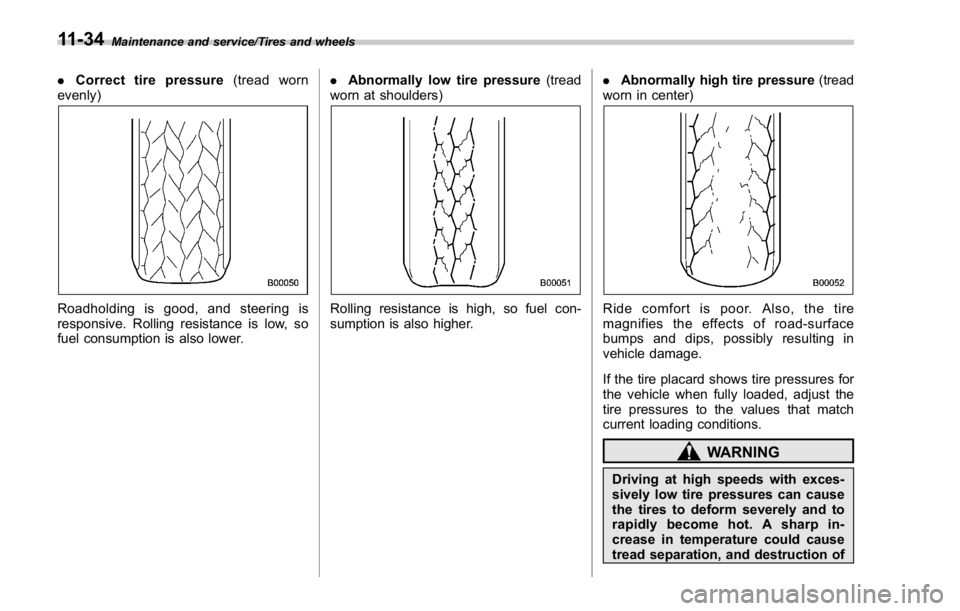
. Correct tire pressure (tread worn
evenly)
Roadholding is good, and steering is
responsive. Rolling resistance is low, so
fuel consumption is also lower. . Abnormally low tire pressure (tread
worn at shoulders)
Rolling resistance is high, so fuel con-
sumption is also higher. . Abnormally high tire pressure (tread
worn in center)
Ride comfort is poor. Also, the tire
magnifies the effects of road-surface
bumps and dips, possibly resulting in
vehicle damage.
If the tire placard shows tire pressures for
the vehicle when fully loaded, adjust the
tire pressures to the values that match
current loading conditions.
WARNING
Driving at high speeds with exces-
sively low tire pressures can cause
the tires to deform severely and to
rapidly become hot. A sharp in-
crease in temperature could cause
tread separation, and destruction of11-34
Page 532 of 594

1) Spare fuses
The other one (main fuse box) is housed
in the engine compartment. Also, the
spare fuses are stored in the fuse box
cover.
The fuse puller is stored in the main fuse box in the engine compartment.
1) Good
2) Blown
If any lights, accessories or other electrical
controls do not operate, inspect the
corresponding fuse. If a fuse has blown,
replace it.
1. Turn the ignition switch to the “ LOCK ” /
“ OFF ” position and turn off all electrical
accessories.
2. Remove the cover.
3. Determine which fuse may be blown.
Look at the back side of each fuse box
cover and refer to “ Fuses and circuits ”
F 12-10. 4. Pull out the fuse with the fuse puller.
5. Inspect the fuse. If it has blown,
replace it with a spare fuse of the same
rating.
6. If the same fuse blows again, this
indicates that its system has a problem.
Contact your SUBARU dealer for repairs. Maintenance and service/Fuses
11-43
Page 558 of 594

Wattage Bulb No.
1) High beam headlight 12V-60W HB3
2) Low beam headlight (models without LED headlights) 12V-55W H11
3) Parking light (models without LED headlights) 12V-5W W5W
4) Map light
12V-8W –
5) Dome light 12V-8W –
6) License plate light 12V-5W W5W
7)
Trunk light 12V-5W W5W
8)
Rear side marker light 12V-5W W5W
9)
Backup light 12V-16W W16W
10)
Rear turn signal light 12V-21W WY21W
11 )
Vanity mirror light 12V-2W –
12)
Front side marker light (if equipped) 12V-5W W5W
13)
Front fog light (models without steering responsive fog
lights system) 12V-19W H16
Front fog light (models with steering responsive fog
lights system) 12V-55W H11
14)
Front turn signal light 12V-21W WY21W
A)
Low beam headlight (models with LED headlights) ––
B)
Parking light (models with LED headlights) ––
C)
Side turn signal light (if equipped) ––
D)
High-mounted stop light ––
E)
Stop light/Tail light – – WARNINGBulbs may become very hot while
illuminated. Before replacing bulbs,
turn off the lights and wait until the
bulbs cool down. Otherwise, there is
a risk of sustaining a burn injury.
CAUTIONReplace any bulb only with a new
bulb of the specified wattage. Using
a bulb of different wattage could
result in a fire. Specifications/Bulb chart
12-17
Page 565 of 594

Consumer information and Reporting safety defects/Tire information
.
Extra load tire
A tire designed to operate at higher
loads and higher inflation pressure
than the corresponding standard
tire. .
Groove
The space between two adjacent
tread ribs. .
Innerliner
The layer(s) forming the inside sur-
face of a tubeless tire that contains
the inflating medium within the tire. .
Innerliner separation
The parting of the innerliner from
cord material in the carcass. .
Intended outboard sidewall (1)
The sidewall that contains a
whitewall, bears white lettering
or bears manufacturer, brand,
and/or model name molding that
is higher or deeper than the
same molding on the other side-
wall of the tire, or (2)
The outward facing sidewall
of an asymmetrical tire that has
a particular side that must al-
ways face outward when mount- ing on a vehicle. .
Light truck (LT) tire
A tire designated by its manufac-
turer as primarily intended for use
on lightweight trucks or multipur-
pose passenger vehicles. .
Load rating
The maximum load that a tire is
rated to carry for a given inflation
pressure. .
Maximum inflation pressure
The maximum cold inflation pres-
sure to which a tire may be inflated. .
Maximum load rating
The load rating for a tire at the
maximum permissible inflation
pressure for that tire. .
Maximum loaded vehicle weight
The sum of: (a)
Curb weight (b)
Accessory weight (c)
Vehicle capacity weight (d)
Production options weight .
Maximum permissible inflation
pressure
The maximum cold inflation pres-
sure to which a tire may be inflated. .
Measuring rim
The rim on which a tire is fitted for
physical dimension requirements. .
Normal occupant weight
150 lbs (68 kg) times the number of
occupants specified in the second
column of Table 1 that is appended
to the end of this section. .
Occupant distribution
Distribution of occupants in a vehi-
cle as specified in the third column
of Table 1 that is appended to the
end of this section. .
Open splice
Any parting at any junction of tread,
sidewall, or innerliner that extends
to cord material. .
Outer diameter
The overall diameter of an inflated
new tire. .
Overall width
The linear distance between the
exteriors of the sidewalls of an
inflated tire, including elevations
due to labeling, decorations, or
protective bands or ribs.13-6
Page 566 of 594

.
Passenger car tire
A tire intended for use on passen-
ger cars, multipurpose passenger
vehicles, and trucks, that have a
gross vehicle weight rating (GVWR)
of 10,000 lbs (4,535 kg) or less. .
Ply
A layer of rubber-coated parallel
cords. .
Ply separation
A parting of rubber compound
between adjacent plies. .
Pneumatic tire
A mechanical device made of rub-
ber, chemicals, fabric and steel or
other materials, that, when
mounted on an automotive wheel,
provides the traction and contains
the gas or fluid that sustains the
load. .
Production options weight
The combined weight of those
installed regular production options
weighing over 5.1 lbs (2.3 kg) in
excess of those standard items
which they replace, not previously
considered in curb weight or acces- sory weight, including heavy duty
brakes, ride levelers, roof rack,
heavy duty battery, and special
trim. .
Radial ply tire
A pneumatic tire in which the ply
cords that extend to the beads are
laid at substantially 90 degrees to
the centerline of the tread. .
Recommended inflation pres-
sure
The cold inflation pressure recom-
mended by a vehicle manufacturer. .
Reinforced tire
A tire designed to operate at higher
loads and at higher inflation pres-
sures than the corresponding stan-
dard tire. .
Rim
A metal support for a tire or a tire
and tube assembly upon which the
tire beads are seated. .
Rim diameter
Nominal diameter of the bead seat.
.
Rim size designation
Rim diameter and width. .
Rim type designation
The industry of manufacturer ’ s des-
ignation for a rim by style or code. .
Rim width
Nominal distance between rim
flanges. .
Section width
The linear distance between the
exteriors of the sidewalls of an
inflated tire, excluding elevations
due to labeling, decoration, or
protective bands. .
Sidewall
That portion of a tire between the
tread and bead. .
Sidewall separation
The parting of the rubber com-
pound from the cord material in
the sidewall. .
Test rim
The rim on which a tire is fitted for
testing, and it may be any rim listed
as appropriate for use with that tire. .
Tread
That portion of a tire that comes
into contact with the road.Consumer information and Reporting safety defects/Tire information
– CONTINUED –13-7
Page 574 of 594
form to Federal Safety Require-
ments in addition to these grades.
& Treadwear
The treadwear grade is a compara-
tive rating based on the wear rate of
the tire when tested under con-
trolled conditions on a specified
government test course.
For example, a tire graded 150
would wear one and one-half (1-
1/2) times as well on the govern-
ment course as a tire graded 100.
The relative performance of tires
depends upon the actual conditions
of their use, however, and may
depart significantly from the norm
due to variations in driving habits,
service practices and differences in
road characteristics and climate.
& Traction AA, A, B, C
The traction grades, from highest to
lowest, are AA, A, B and C. Those
grades represent the tire ’ s ability to
stop on wet pavement as measured
under controlled conditions on spe- cified government test surfaces of
asphalt and concrete. A tire marked
C may have poor traction perfor-
mance. WARNING
The traction grade assigned to
this tire is based on straight-
ahead braking traction tests,
and does not include accel-
eration, cornering, hydroplan-
ing, or peak traction charac-
teristics.
& Temperature A, B, C
The temperature grades are A (the
highest), B, and C, representing the
tire ’ s resistance to the generation of
heat and its ability to dissipate heat
when tested under controlled con-
ditions on a specified indoor labora-
tory test wheel. Sustained high
temperature can cause the material
of the tire to degenerate and reduce
tire life, and excessive temperature
can lead to sudden tire failure. The grade C corresponds to a level of
performance which all passenger
car tires must meet under the
Federal Motor Vehicle Safety Stan-
dards No. 109. Grades B and A
represent higher levels of perfor-
mance on the laboratory test wheel
than the minimum required by law.
WARNING
The temperature grade for this
tire is established for a tire
that is properly inflated and
not overloaded. Excessive
speed, underinflation, or ex-
cessive loading, either sepa-
rately or in combination, can
cause heat buildup and possi-
ble tire failure.Consumer information and Reporting safety defects/Uniform tire quality grading standards
13-15
Page 581 of 594

14-6 Index
Bulb wattage ....................................................... 12-16
Control switch ........................................................ 3-94
Flasher ................................................................. 3-96
Indicator light ......................................................... 3-35
HID headlights .......................................................... 11-44
High beam indicator light ............................................ 3-35
High/low beam change (dimmer) .................................. 3-96
Hill Holder ................................................................. 7-46
Indicator light ................................................. 3-24, 7-48
Switch .................................................................. 7-47
Hill start assist .................................................. 7-49, 11-29
OFF indicator light .................................................. 3-24
To activate/deactivate ............................................. 7-51
Warning light ......................................................... 3-24
HomeLink ®
.............................................................. 3-105
Hook
Coat ..................................................................... 6-11
Towing and tie-down ............................................... 9-12
Horn ........................................................................ 3-114
Hose and connections ............................................... 11-17
I
Ignition switch .............................................................. 3-4
Light ....................................................................... 3-6
Illumination brightness control ...................................... 3-98
Immobilizer. ................................................................. 2-3
Indicator light (security indicator light) ....................... 3-33
Indicator light
BSD/RCTA OFF. .................................................... 3-37
BSD/RCTA warning ................................................ 3-37
Cruise control ........................................................ 3-35 Cruise control set ................................................... 3-35
Front fog light ......................................................... 3-35
Headlight ............................................................... 3-35
High beam ............................................................. 3-35
Hill Holder ............................................................. 3-24
Hill start assist OFF ................................................ 3-24
Immobilizer ............................................................ 3-33
REV. ..................................................................... 3-37
Security ................................................................. 3-33
Select lever/Gear position ........................................ 3-34
Shift-up ................................................................. 3-34
SI-DRIVE .............................................................. 3-34
Steering responsive fog lights OFF ... ........................ 3-37
Traction control OFF ............................................... 3-27
Turn signal ............................................................ 3-35
Vehicle Dynamics Control OFF ................................. 3-27
Vehicle Dynamics Control operation .......................... 3-26
Inside mirror ............................................................ 3-103
Interior lights ............................................................... 6-2
Internal trunk lid release handle .................................... 2-37
J
Jack-up point .............................................................. 9-4
Jump starting .............................................................. 9-9
K
Key............................................................................ 2-3
Number .................................................................. 2-3
Reminder chime ...................................................... 3-5
Replacement. .......................................................... 2-4
Keyless access entry function ...................................... 2-13