Page 13 of 398

11
308_en_Chap00c_eco-conduite_ed02-2015
Limit the causes of excess consumption
Spread loads throughout the vehicle; place the heaviest items in the
bottom of the boot, as close as possible to the rear seats.
Limit the loads carried in the vehicle and reduce wind resistance (roof
bars, roof rack, bicycle carrier, trailer...).
use a r
oof box in preference.
Remove roof bars and roof racks after use.
At the end of winter, remove snow tyres and refit your summer tyres.
Observe the recommendations on
maintenance
Check the tyre pressures regularly, when cold, referring to the label in
the door aperture, driver's side.
Carry out this check in particular:
-
be
fore a long journey,
-
at e
ach change of season,
-
af
ter a long period out of use.
Don't forget the spare wheel and the tyres on any trailer or caravan.
Have your vehicle serviced regularly (engine oil, oil filter, air filter,
passenger compartment filter...) and observe the schedule of
operations recommended in the manufacturer's service schedule.
With a BlueHDi Diesel engine, if the SCR system is faulty your vehicle
becomes polluting; go to a P
eu
ge
Ot d
ealer or a qualified workshop
without delay to have the emissions of nitrous oxides brought back to
the legal level.
When refuelling, do not continue after the third cut-off of the nozzle to
avoid any over flow.
At the wheel of your new vehicle, it is only after the first 1 800 miles
(3
0
00 kilometres) that you will see the fuel consumption settle down to
a consistent average.
.
eco-driving
Page 14 of 398
12
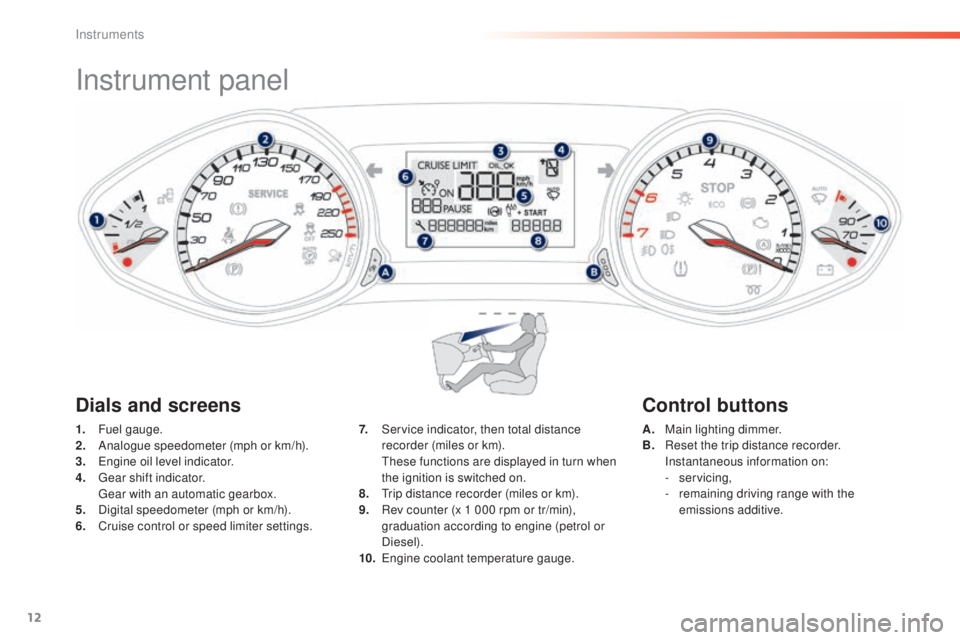
Instrument panel
1. Fuel gauge.
2. An alogue speedometer (mph or km/h).
3.
eng
ine oil level indicator.
4.
gear
shift indicator.
gear
with an automatic gearbox.
5.
Di
gital speedometer (mph or km/h).
6.
Cr
uise control or speed limiter settings. A. Ma
in lighting dimmer.
B. Re set the trip distance recorder.
In
stantaneous information on:
-
ser
vicing,
-
rem
aining driving range with the
emissions additive.
7. Se
rvice indicator, then total distance
recorder (miles or km).
the
se functions are displayed in turn when
the ignition is switched on.
8.
tri
p distance recorder (miles or km).
9.
Re
v counter (x 1 000 rpm or tr/min),
graduation according to engine (petrol or
Diesel).
10.
engi
ne coolant temperature gauge.
Dials and screens Control buttons
Instruments
Page 21 of 398

19
308_en_Chap01_instruments-de-bord_ed02-2015
Warning / indicator lampStateCause Action / Observations
Service on temporarily. A minor fault has occurred for which
there is no specific warning lamp. Identify the fault by means of the associated
message, such as:
-
lo
w engine oil level,
-
lo
w screenwash/headlamp wash fluid level,
-
di
scharged remote control battery,
-
lo
w tyre pressures,
-
sa
turation of the particle filter (FAP) on Diesel
vehicles.
For more information on checking the particle filter,
refer to the corresponding section.
For any other faults, contact a P
eu
ge
Ot d
ealer or a
qualified workshop.
fixed. A major fault has occurred for which
there is no specific warning lamp. Identify the fault by reading the message and contact
a P
eu
ge
Ot d
ealer or a qualified workshop.
fixed, associated with
flashing and then fixed
display of the service
spanner.
the ser
vicing interval has been
exceeded. Only on BlueHDi Diesel versions.
Your vehicle must be serviced as soon as possible.
1
Instruments
Page 30 of 398

28
Coolant temperature gauge
With the engine running, when the needle is:
- in zone A, the temperature is correct,
-
in z
one B, the temperature is too high;
the maximum temperature and the
central STOP warning lamps come on,
accompanied by an audible signal and a
warning message in the screen.
You MUST stop as soon as it is safe to do so.
Wait a few minutes before switching off
the
eng
ine.
Contact a P
eu
ge
Ot d
ealer or a qualified
workshop. After driving for a few minutes, the temperature
and pressure in the cooling system increase.
to to
p up the level:
F
wa
it for the engine to cool,
F
un
screw the cap slightly to allow the
pressure to drop,
F
wh
en the pressure has dropped, remove
the cap,
F
to
p up the level to the "MA X" mark.
Be aware of the risk of burns when
topping up the cooling system. Do not
fill above the maximum level (indicated
on the header tank).
gauges and indicators
Service indicator
System which informs the driver when the
next service is due, in accordance with the
manufacturer's servicing schedule.
More than 1 800 miles (3 000 km)
remain before the next service is due
When the ignition is switched on, no service
information appears in the screen.
the p
oint at which the next service is due is
calculated from the last indicator zero reset,
depending on the distance travelled and the
time elapsed since the last service.
For BlueHDi Diesel versions, the degree of
deterioration of the engine oil is also taken into
account (depending on the country of sale).
Instruments
Page 33 of 398

31
308_en_Chap01_instruments-de-bord_ed02-2015
Engine oil level indicator
On versions fitted with an electric oil gauge,
information on the oil level is displayed in the
instrument panel for a few seconds when the
ignition is switched on, at the same time as the
service information.
the l
evel read will only be correct if
the vehicle is on level ground and the
engine has been off for more than
30
m
inutes.
Oil level correct
this is indicated by a message in the
in strument panel.
Oil level incorrect
this is indicated by a message in the
in strument panel.
If the low oil level is confirmed by a check using
the dipstick, the level must be topped up to
avoid damage to the engine.
Oil level indicator fault
this is indicated by a message in the
i nstrument panel. Contact a Peu geOt d ealer
or a qualified workshop.
Dipstick
there are 2 marks on the
di pstick:
-
A = m
ax; never exceed this
level,
-
B = m
in; top up the level via
the oil filler, using the grade
of oil suited to your engine.
Refer to the petrol or Diesel engine
section to locate the dipstick and the oil
filler cap on your engine.
1
Instruments
Page 231 of 398

229
308_en_Chap07_info-pratiques_ed02-2015
Checking levels
take care when working under the bonnet, as certain areas of the engine may be extremely hot (risk of burns) and the cooling fan could start at
a ny time (even with the ignition off).
Engine oil level
the check is carried out either when
t he ignition is switched on using the
oil level indicator in the instrument
panel for vehicles so equipped, or
using the dipstick.Checking using the dipstick
F Locate the dipstick in the engine
c ompartment of your vehicle.
For more information on the petrol or Diesel
engine, refer to the corresponding section.
F
t
ak
e the dipstick by its coloured grip and
remove it completely.
F
Wi
pe the end of the dipstick using a clean
non-fluffy cloth.
F
Re
fit the dipstick and push fully down, then
pull it out again to make the visual check:
the correct level is between the marks A
and B .
Check all of these levels regularly, in line with the manufacturer's service schedule.
top t
hem up if necessary, unless other wise indicated.
If a level drops significantly, have the corresponding system checked by a P
eu
ge
Ot d
ealer or a qualified workshop.
A = MA X
to en
sure that the reading is correct, your
vehicle must be parked on a level sur face
with the engine having been off for more than
30
m
inutes.
It is normal to top up the oil level between
two services (or oil changes). P
eu
ge
Ot
r
ecommends that you check the level, and top
up if necessary, every 3 000 miles (5 000 kms). B = MIN
If you find that the level is above the A mark or
below the B mark, do not star t the engine .
-
If t
he level is above the MAX mark (risk
of damage to the engine), contact a
P
eu
ge
Ot d
ealer or a qualified workshop.
-
If t
he level is below the MIN mark, you
must top up the engine oil.
7
Practical information
Page 232 of 398

230
308_en_Chap07_info-pratiques_ed02-2015
Oil grade
Before topping-up the oil or changing the oil,
check that the oil is the correct grade for your
engine and conforms to the manufacturer's
recommendations.
Topping-up the engine oil level
F Locate the oil filler cap in the engine
compartment of your vehicle.
For more information on the petrol or Diesel
engine, refer to the corresponding section.
F
u
ns
crew the oil filler cap to reveal the filler
aperture.
F
Ad
d oil in small quantities, avoiding any
spills on engine components (risk of fire).
F
Wa
it a few minutes before checking the
level again using the dipstick.
F
Ad
d more oil if necessary.
F
Af
ter checking the level, carefully refit the
oil filler cap and the dipstick in its tube. After topping-up the oil, the check when
switching on the ignition with the oil
level indicator in the instrument panel
is not valid during the 30 minutes after
topping up.
Engine oil change
Refer to the manufacturer's service schedule
for details of the interval for this operation.
In order to maintain the reliability of the engine
and emission control system, never use
additives in the engine oil.
Practical information
Page 234 of 398
232
308_en_Chap07_info-pratiques_ed02-2015
Avoid prolonged contact of used oil or
fluids with the skin.
Most of these fluids are harmful to
health or indeed very corrosive.
Do not discard used oil or fluids into
sewers or onto the ground.
tak
e used oil to a P
eu
ge
Ot d
ealer or
a qualified workshop (France) or to an
authorised waste disposal site.
Used products
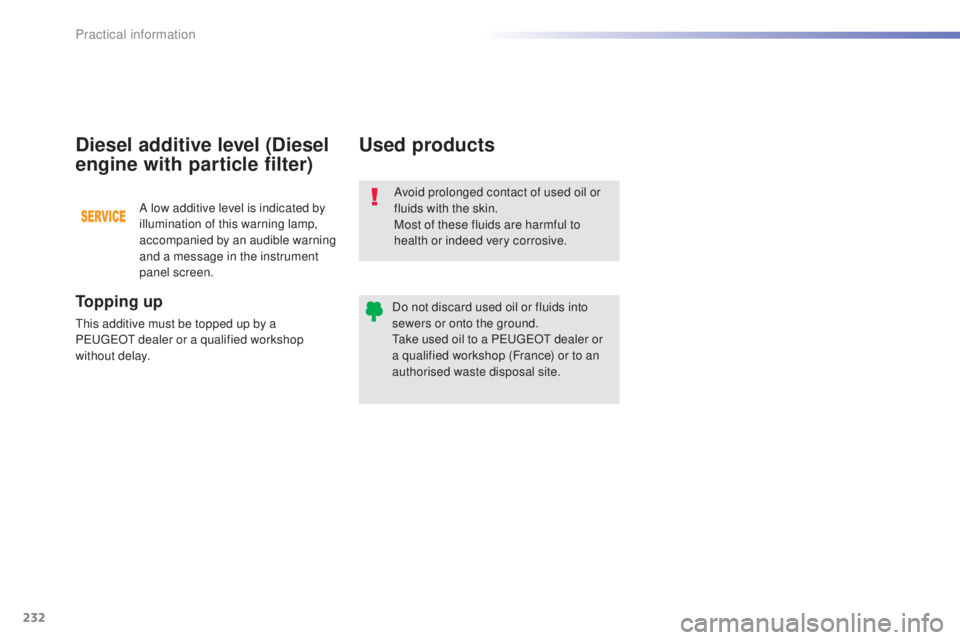
To p p i n g u p
this additive must be topped up by a
Peu geOt d ealer or a qualified workshop
without delay.
Diesel additive level (Diesel
engine with particle filter)
A low additive level is indicated by
illumination of this warning lamp,
accompanied by an audible warning
and a message in the instrument
panel screen.
Practical information