2016 Peugeot 308 lock
[x] Cancel search: lockPage 90 of 398
88
308_en_Chap03_ergonomie-et-confort_ed02-2015
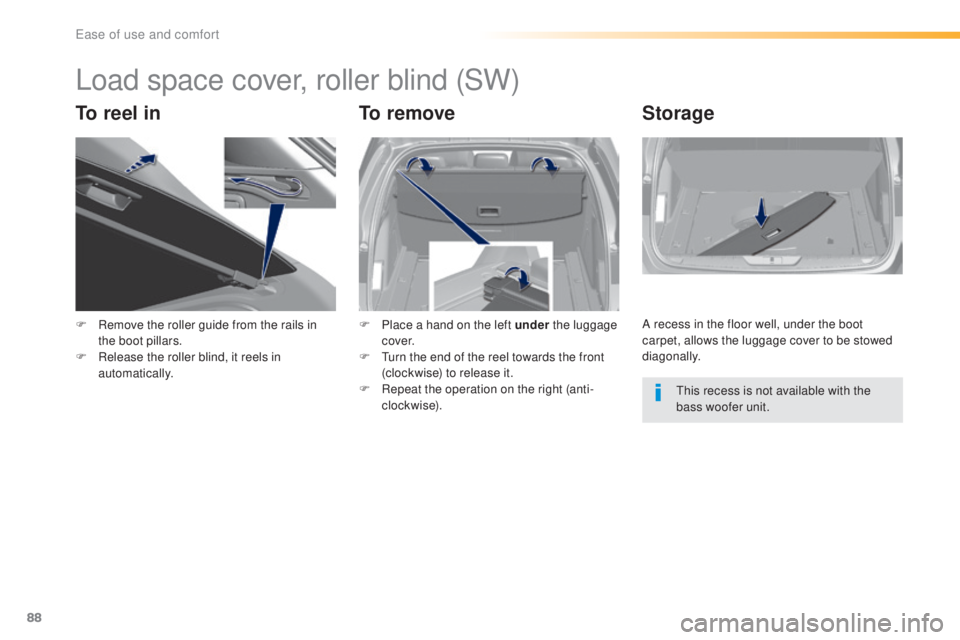
Load space cover, roller blind (SW)
To reel inTo removeStorage
F Remove the roller guide from the rails in
t
he boot pillars.
F
Re
lease the roller blind, it reels in
automatically. F Pl
ace a hand on the left under
the luggage
c ove r.
F
t
ur
n the end of the reel towards the front
(clockwise) to release it.
F
Re
peat the operation on the right (anti-
clockwise). A recess in the floor well, under the boot
carpet, allows the luggage cover to be stowed
diagonally.
thi
s recess is not available with the
bass woofer unit.
ease of use and comfort
Page 91 of 398
89
308_en_Chap03_ergonomie-et-confort_ed02-2015
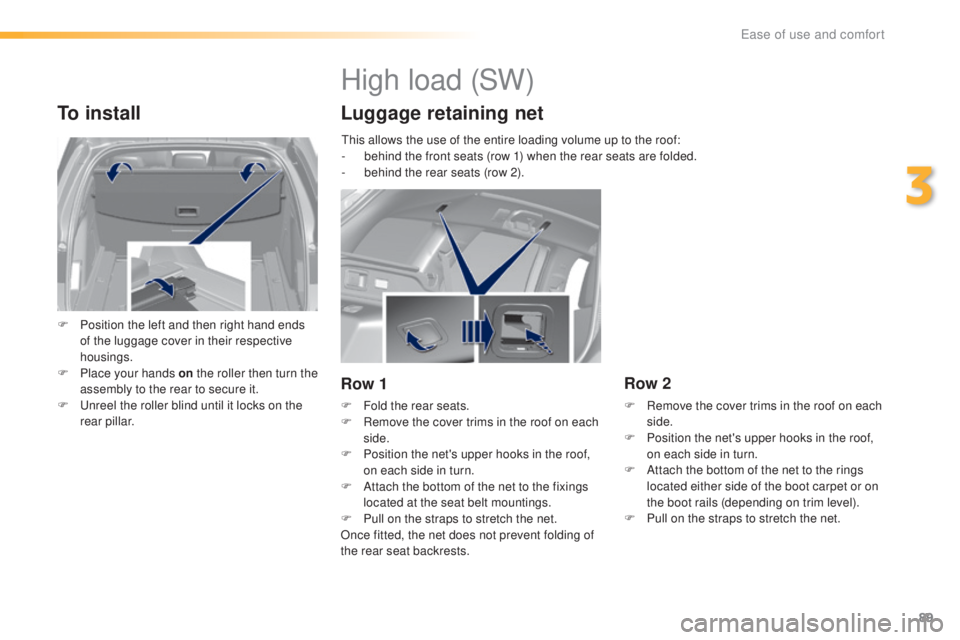
To install
F Position the left and then right hand ends
of the luggage cover in their respective
housings.
F
Pl
ace your hands on the roller then turn the
assembly to the rear to secure it.
F
u
nr
eel the roller blind until it locks on the
rear pillar.
High load (SW)
Luggage retaining net
Row 1
F Fold the rear seats.
F Re move the cover trims in the roof on each
side.
F
Po
sition the net's upper hooks in the roof,
on each side in turn.
F
At
tach the bottom of the net to the fixings
located at the seat belt mountings.
F
Pu
ll on the straps to stretch the net.
Once fitted, the net does not prevent folding of
the rear seat backrests.
Row 2
F Remove the cover trims in the roof on each
si de.
F
Po
sition the net's upper hooks in the roof,
on each side in turn.
F
At
tach the bottom of the net to the rings
located either side of the boot carpet or on
the boot rails (depending on trim level).
F
Pu
ll on the straps to stretch the net.
thi
s allows the use of the entire loading volume up to the roof:
-
be
hind the front seats (row 1) when the rear seats are folded.
-
be
hind the rear seats (row 2).
3
ease of use and comfort
Page 106 of 398
104
308_en_Chap03_ergonomie-et-confort_ed02-2015
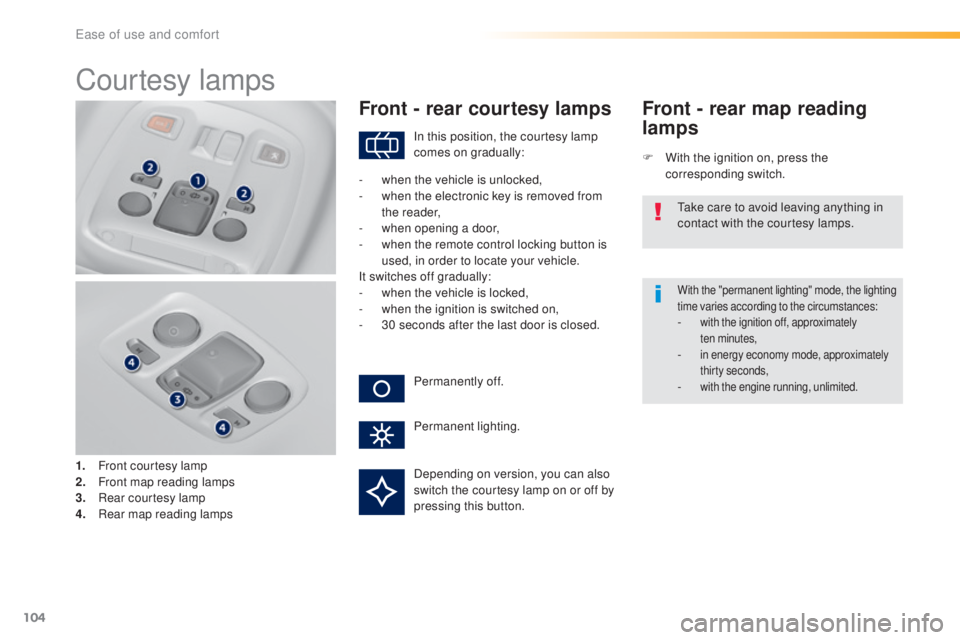
Courtesy lamps
1. Front courtesy lamp
2. Fr ont map reading lamps
3.
Re
ar courtesy lamp
4.
Re
ar map reading lamps
Front - rear courtesy lamps
F With the ignition on, press the
corresponding switch.
Front - rear map reading
lamps
With the "permanent lighting" mode, the lighting
time varies according to the circumstances:
- with the ignition off, approximately
ten m inutes,
- in energy economy mode, approximately
thirty seconds,
- with the engine running, unlimited.
In this position, the courtesy lamp
comes on gradually:
Permanently off.
Permanent lighting.
-
wh
en the vehicle is unlocked,
-
wh
en the electronic key is removed from
the reader,
-
when
opening a door,
-
wh
en the remote control locking button is
used, in order to locate your vehicle.
It switches off gradually:
-
wh
en the vehicle is locked,
-
wh
en the ignition is switched on,
-
30 s
econds after the last door is closed.
tak
e care to avoid leaving anything in
contact with the courtesy lamps.
Depending on version, you can also
switch the courtesy lamp on or off by
pressing this button.
ease of use and comfort
Page 108 of 398
106
308_en_Chap04_eclairage-et-visibilite_ed02-2015
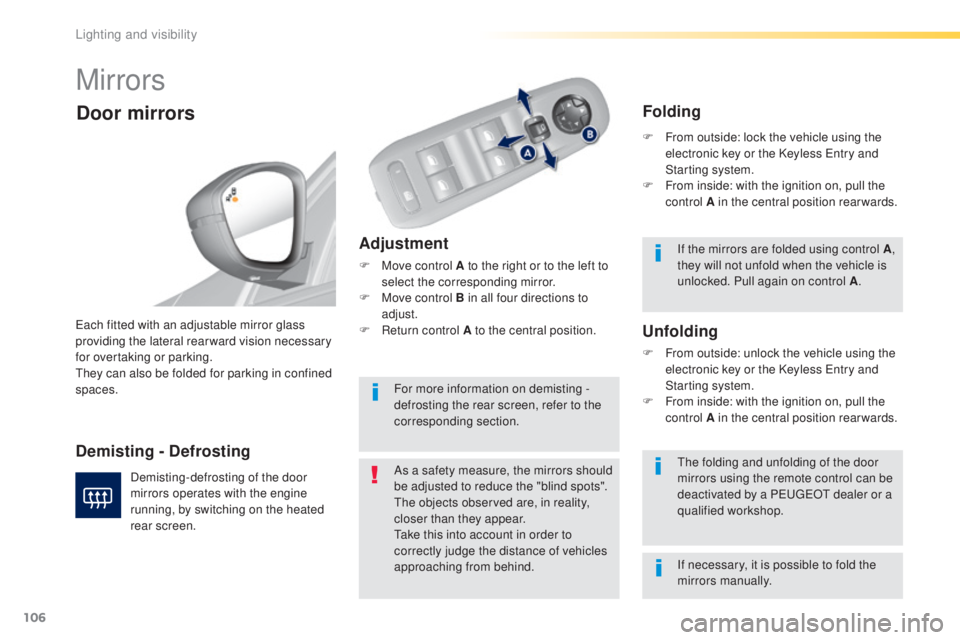
Mirrors
Adjustment
F Move control A to the right or to the left to
select the corresponding mirror.
F
Mov
e control B in all four directions to
adjust.
F
Re
turn control A to the central position.
eac
h fitted with an adjustable mirror glass
providing the lateral rear ward vision necessary
for overtaking or parking.
the
y can also be folded for parking in confined
spaces.
Demisting - Defrosting
Door mirrors
Demisting-defrosting of the door
mirrors operates with the engine
running, by switching on the heated
rear screen. As a safety measure, the mirrors should
be adjusted to reduce the "blind spots".
the o
bjects observed are, in reality,
closer than they appear.
tak
e this into account in order to
correctly judge the distance of vehicles
approaching from behind.the f olding and unfolding of the door
mirrors using the remote control can be
deactivated by a P
eu
ge
Ot d
ealer or a
qualified workshop.
Unfolding
F From outside: unlock the vehicle using the
e lectronic key or the Keyless ent ry and
Starting system.
F
Fr
om inside: with the ignition on, pull the
control A in the central position rearwards.
Folding
F From outside: lock the vehicle using the
e lectronic key or the Keyless ent ry and
Starting system.
F
Fr
om inside: with the ignition on, pull the
control A in the central position rearwards.
If the mirrors are folded using control A ,
they will not unfold when the vehicle is
unlocked. Pull again on control A .
For more information on demisting -
defrosting the rear screen, refer to the
corresponding section.
If necessary, it is possible to fold the
mirrors manually.
Lighting and visibility
Page 115 of 398
113
308_en_Chap04_eclairage-et-visibilite_ed02-2015
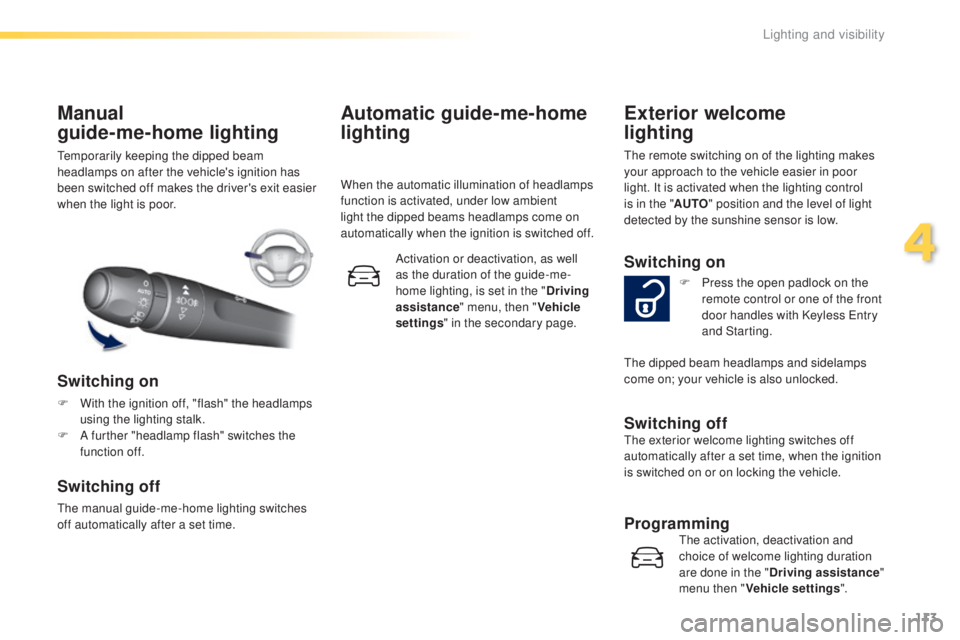
temporarily keeping the dipped beam
h eadlamps on after the vehicle's ignition has
been switched off makes the driver's exit easier
when the light is poor.
Manual
guide-me-home lighting
Switching on
F With the ignition off, "flash" the headlamps
us ing the lighting stalk.
F
A fu
rther "headlamp flash" switches the
function off.
Switching off
the manual guide-me-home lighting switches
o ff automatically after a set time.
Automatic guide-me-home
lighting
When the automatic illumination of headlamps
function is activated, under low ambient
light the dipped beams headlamps come on
automatically when the ignition is switched off.
Activation or deactivation, as well
as the duration of the guide-me-
home lighting, is set in the " Driving
assistance " menu, then " Vehicle
settings " in the secondary page.
Exterior welcome
lighting
the remote switching on of the lighting makes
y our approach to the vehicle easier in poor
light. It is activated when the lighting control
is in the " AUTO" position and the level of light
detected by the sunshine sensor is low.
Switching on
F Press the open padlock on the
r emote control or one of the front
door handles with Keyless
ent
ry
and Starting.
Switching offthe exterior welcome lighting switches off
a utomatically after a set time, when the ignition
is switched on or on locking the vehicle.
Programmingthe activation, deactivation and
c hoice of welcome lighting duration
are done in the " Driving assistance "
menu then " Vehicle settings ".
the
dipped beam headlamps and sidelamps
come on; your vehicle is also unlocked.
4
Lighting and visibility
Page 116 of 398

114
308_en_Chap04_eclairage-et-visibilite_ed02-2015
to make your approach to the vehicle easier,
t hese illuminate:
-
th
e zones facing the driver’s and
passenger’s doors,
-
th
e zones for ward of the door mirrors and
rear ward of the front doors.
Door mirror
spotlamps
Switching on
the spotlamps come on:
- wh en you unlock the vehicle,
-
wh
en you switch off the ignition,
-
wh
en you open a door,
-
wh
en you use the remote control to locate
the vehicle.
Switching off
they are timed to go off automatically.
Manual adjustment of
halogen headlamps Automatic adjustment of
"full-LED" headlamps
to avoid causing a nuisance to other road
u sers, the beams of the halogen headlamps
should be adjusted according to the load in the
vehicle.
0
Dr
iver or driver + front passenger.
-
Dr
iver + front passenger + rear
passengers.
1
5 p
eople.
-
5 pe
ople + a load in the boot.
2
Dr
iver + a load in the boot.
If a fault occurs, this warning lamp
is displayed in the instrument panel,
accompanied by an audible signal and a
message in the instrument panel screen.
In order to avoid causing a nuisance to other
road users, this system corrects the height of
the "full L
eD"
headlamps beam automatically,
according to the load in the vehicle.
the s
ystem then places your headlamps in the
lowest position.
the i
nitial setting is position "0" .
If a fault occurs, do not touch the "full
L
eD" l
ight sources. Contact a P
eu
ge
Ot
de
aler or a qualified workshop.
Headlamp beam height adjustment
Lighting and visibility
Page 122 of 398

120
308_en_Chap05_securite_ed02-2015
electronic Stability Control (eSC) incorporating
the following systems:
-
an
ti-lock braking system (ABS) and the
electronic brake force distribution (
eBF
D),
-
emer
gency braking assistance (
eBA)
,
-
wh
eel anti-slip regulation (ASR) or traction
control,
-
dy
namic stability control (DSC).
electronic stability control (eSC )
Definitions
Anti-lock braking system (ABS)
and electronic brake force
distribution (EBFD)
this system improves the stability and
m anoeuvrability of your vehicle when braking
and contributes towards improved control in
corners, in particular on poor or slippery road
surfaces.
the A
BS prevents wheel lock in the event of
emergency braking.
the e
lectronic brake force distribution system
manages the braking pressure wheel by wheel.
Emergency braking assistance
(EBA)
In an emergency, this system enables you to
reach the optimum braking pressure more
quickly and therefore reduce the stopping
distance.
It is triggered according to the speed at which
the brake pedal is pressed.
thi
s is felt by a
reduction in the resistance of the pedal and an
increase in the effectiveness of the braking.
Anti-slip regulation (ASR)
the ASR system (also known as tra ction
Control) optimises traction in order to limit
wheel slip by acting on the brakes of the driving
wheels and on the engine. It also improves
the directional stability of the vehicle on
acceleration.
Dynamic stability control (DSC)
If there is a difference between the path
followed by the vehicle and that required by
the driver, the DSC monitors each wheel and
automatically acts on the brake of one or more
wheels and on the engine to return the vehicle
to the required path, within the limits of the laws
of physics.
Horn
F Press the central part of the steering
w heel.
Safety
Page 123 of 398

121
308_en_Chap05_securite_ed02-2015
Operation
Anti-lock braking system (ABS)
and electronic brake force
distribution (EBFD)
In emergency braking, press
very firmly without releasing the
pressure. When changing wheels (tyres and rims),
make sure that these are approved for
your vehicle.
Normal operation of the ABS may make
itself felt by slight vibrations of the brake
pedal.
When this warning lamp comes on,
accompanied by an audible signal
and a message, it indicates that there
is a fault with the ABS, which could
cause loss of control of the vehicle
when braking.
When this warning lamp comes on,
coupled with the STOP
warning
lamp, accompanied by an audible
signal and a message, it indicates
Intelligent traction control
system
the use of snow tyres is strongly recommended
o n sur faces offering low levels of adhesion.
that there is a fault with the electronic brake
force distribution (
eBF
D), which could cause
loss of control of the vehicle when braking.
You must stop as soon as it is safe to do so.
In both cases, contact a P
eu
ge
Ot d
ealer or a
qualified workshop.
Depending on version, your vehicle has a
system to help driving on snow: intelligent
traction control
.
thi
s system detects situations of difficult
sur face adhesion that could make it difficult to
move off or make progress on deep fresh snow
or compacted snow.
In these situations, the intelligent traction
control limits the amount of wheel slip to
provide the best traction and trajectory control
for your vehicle.
5
Safety