2016 Peugeot 308 charging
[x] Cancel search: chargingPage 25 of 398

23
308_en_Chap01_instruments-de-bord_ed02-2015
Warning / indicator lampStateCause Action / Observations
Battery charge *fixed.
the
battery charging circuit has a
fault (dirty or loose terminals, slack or
cut alternator belt, ...).
the w
arning lamp should go off when the engine is
started.
If it does not go off, contact a P
eu
ge
Ot d
ealer or a
qualified workshop.
*
D
epending on the country of sale. Seat belt(s)
not fastened
/
un
fastened fixed
or flashing
accompanied by an
audible signal. A seat belt has not been fastened or
has been unfastened.
Pull the strap then insert the tongue in the buckle.
Airbags on temporarily.
thi
s lamp comes on for a few
seconds when you turn on the
ignition, then goes off.
thi
s lamp should go off when the engine is started.
If it does not go off, contact a P
eu
ge
Ot d
ealer or a
qualified workshop.
fixed. One of the airbag or seat belt
pretensioner systems has a fault. Have it checked by a P
eu
ge
Ot d
ealer or a qualified
workshop.
1
Instruments
Page 75 of 398

73
308_en_Chap03_ergonomie-et-confort_ed02-2015
electric driver's seat
Forwards-backwardsSeat backrest angleSeat cushion height and
angle
to avoid discharging the battery, carry out
t hese adjustments with the engine running.
F Push the control for wards or rear wards to
sl ide the seat. F
til t the control for wards or rear wards to
adjust the angle of the seat backrest. F
tip t he rear of the control upwards or
downwards to obtain the desired height.
F
t
ip t
he front of the control upwards or
downwards to obtain the desired angle.
Before moving the seat backwards, ensure that there is nothing that might prevent the full
travel of the seat, so as to avoid the risk of of jamming the seat caused by the presence of
objects on the floor behind the seat or rear passengers. If the seat jams, stop the movement
immediately.
3
ease of use and comfort
Page 85 of 398
83
308_en_Chap03_ergonomie-et-confort_ed02-2015
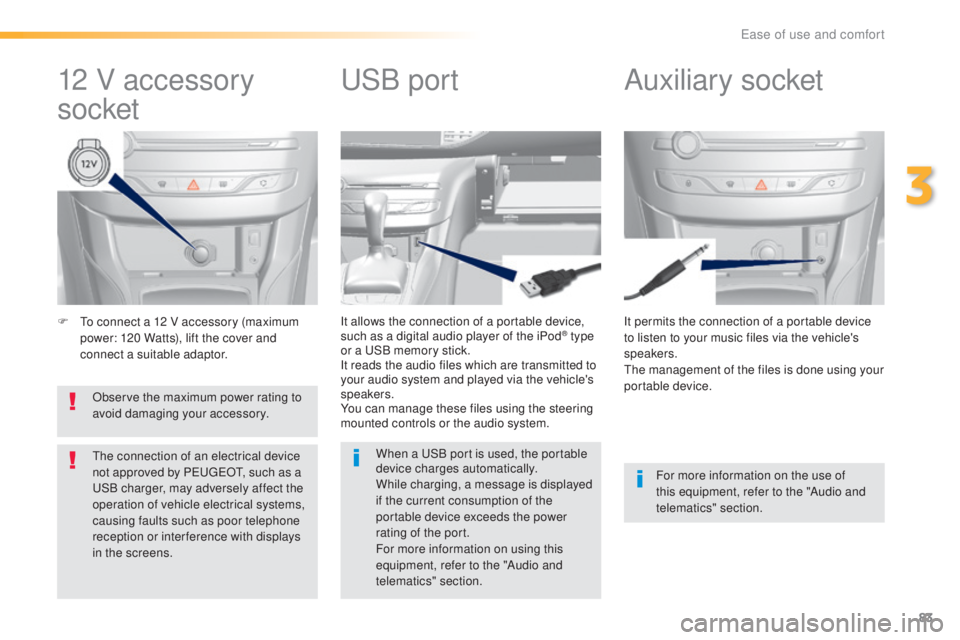
F to connect a 12 V accessory (maximum
p ower: 120 Watts), lift the cover and
connect a suitable adaptor. It permits the connection of a portable device
to listen to your music files via the vehicle's
speakers.
the m
anagement of the files is done using your
portable device.
It allows the connection of a portable device,
such as a digital audio player of the iPod® type
or a uSB m
emory stick.
It reads the audio files which are transmitted to
your audio system and played via the vehicle's
speakers.
You can manage these files using the steering
mounted controls or the audio system.
12 V accessory
socket Auxiliary socketuSB po
rt
For more information on the use of
this equipment, refer to the "Audio and
telematics" section.
When a
uSB p
ort is used, the portable
device charges automatically.
While charging, a message is displayed
if the current consumption of the
portable device exceeds the power
rating of the port.
For more information on using this
equipment, refer to the "Audio and
telematics" section.
Observe the maximum power rating to
avoid damaging your accessory.
the c
onnection of an electrical device
not approved by Peu
geOt, su
ch as a uSB c
harger, may adversely affect the
operation of vehicle electrical systems,
causing faults such as poor telephone
reception or inter ference with displays
in the screens.
3
ease of use and comfort
Page 113 of 398
111
308_en_Chap04_eclairage-et-visibilite_ed02-2015
In good or rainy weather, both day
and night, the front foglamps and the
rear foglamps are prohibited. In these
situations, the power of their beams
may dazzle other drivers.
they
should
only be used in fog or snow.
In these weather conditions, it is your
responsibility to switch on the foglamps
and dipped headlamps manually as the
sunshine sensor may detect sufficient
light.
Do not forget to switch off the front
foglamps and the rear foglamps when
they are no longer needed.Lighting left on audible signal
An audible signal when a front door
is opened warns the driver that the
vehicle's exterior lighting is on, with the
ignition off and in manual lighting mode.
In this case, switching off the lighting
stops the audible signal.
With the ignition off, if the dipped
headlamps remain on, the vehicle goes
into "
eCO
" mode to avoid discharging
the battery.
the l
ighting goes off when you switch
off the ignition, but you can always
switch it on again using the lighting
control stalk.
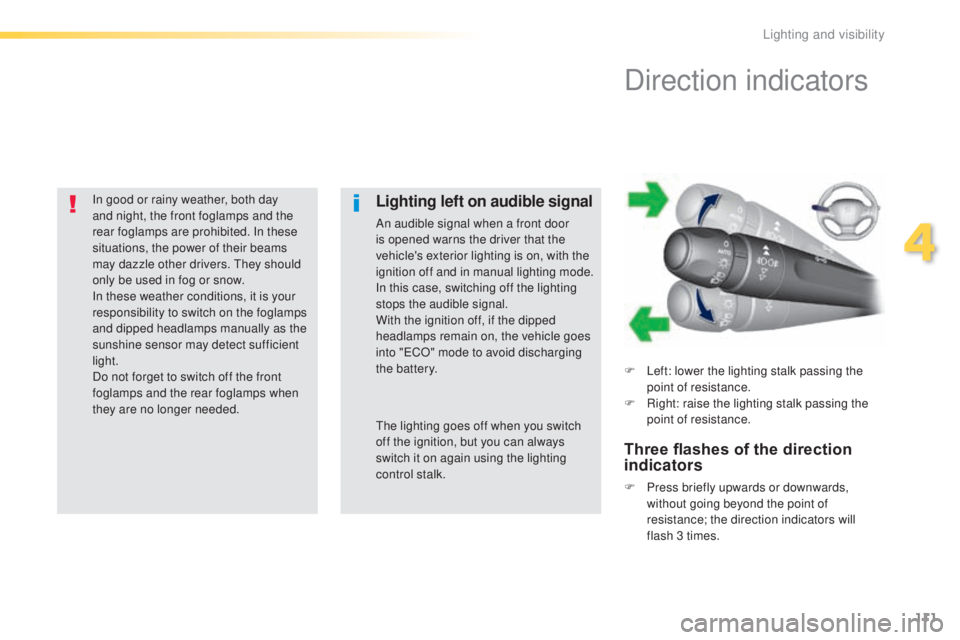
Direction indicators
F Left: lower the lighting stalk passing the
p oint of resistance.
F
Ri
ght: raise the lighting stalk passing the
point of resistance.
Three flashes of the direction
indicators
F Press briefly upwards or downwards,
w ithout going beyond the point of
resistance; the direction indicators will
flash 3 times.
4
Lighting and visibility
Page 131 of 398
129
308_en_Chap05_securite_ed02-2015
Sit in a normal upright position.
Wear a correctly adjusted seat belt.
Do not leave anything between the
occupants and the airbags (a child, pet,
object...), nor fix or attach anything close to
the inflation trajectory of the airbags; this
could cause injuries during their deployment.
Never modify the original definition of your
vehicle, particularly in the area directly
around the airbags.
After an accident or if the vehicle has been
stolen or broken into, have the airbag
systems checked.
All work on the airbag system must be
carried out by a P
eu
ge
Ot d
ealer or a
qualified workshop.
eve
n if all of the precautions mentioned
are observed, a risk of injury or of minor
burns to the head, chest or arms when an
airbag is deployed cannot be ruled out.
the
b
ag inflates almost instantly (within a few
milliseconds) then deflates within the same
time discharging the hot gas via openings
provided for this purpose.Lateral airbags
use only approved covers on the seats,
c ompatible with the deployment the lateral
airbags. For information on the range of seat
covers suitable for your vehicle, you can
contact a P
eu
ge
Ot d
ealer.
Refer to the "Accessories" section.
Do not fix or attach anything to the seat
backs (clothing...).
thi
s could cause injury
to the chest or arms if the lateral airbag is
deployed.
Do not sit with the upper part of the body any
nearer to the door than necessary.
Front airbags
Do not drive holding the steering wheel by its
spokes or resting your hands on the centre
part of the wheel.
Passengers must not place their feet on the
dashboard.
Do not smoke as deployment of the airbags
can cause burns or the risk of injury from a
cigarette or pipe.
Never remove or pierce the steering wheel or
hit it violently.
Do not fit or attach anything to the steering
wheel or dashboard, this could cause
injuries with deployment of the airbags.
For the airbags to be fully effective, observe the following safety rules:
Curtain airbags
Do not fix or attach anything to the roof. this
could cause injury to the head if the curtain
airbag is deployed.
If fitted on your vehicle, do not remove the
grab handles installed on the roof, they play
a part in securing the curtain airbags.
5
Safety
Page 174 of 398
172
308_en_Chap06_conduite_ed02-2015
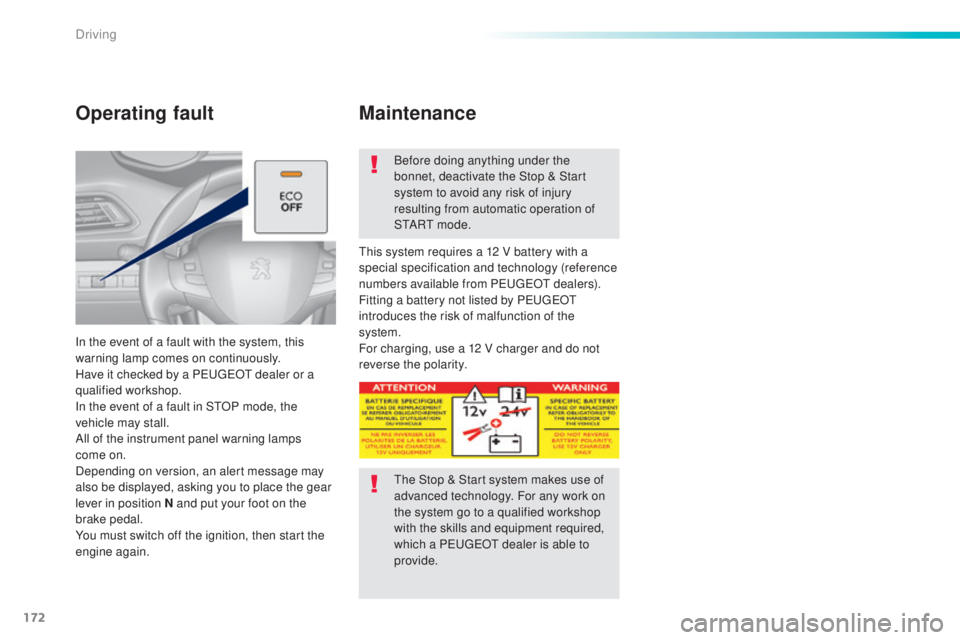
Operating fault
In the event of a fault with the system, this
warning lamp comes on continuously.
Have it checked by a P
eu
ge
Ot d
ealer or a
qualified workshop.
In the event of a fault in S
tOP m
ode, the
vehicle may stall.
All of the instrument panel warning lamps
come on.
Depending on version, an alert message may
also be displayed, asking you to place the gear
lever in position N and put your foot on the
brake pedal.
You must switch off the ignition, then start the
engine again. Before doing anything under the
bonnet, deactivate the Stop & Start
system to avoid any risk of injury
resulting from automatic operation of
S
tA
R
t m o
d e .
thi
s system requires a 12 V battery with a
special specification and technology (reference
numbers available from P
eug
e
Ot de
alers).
Fitting a battery not listed by P
eu
ge
Ot
i
ntroduces the risk of malfunction of the
system.
For charging, use a 12 V charger and do not
reverse the polarity.
Maintenance
the Stop & Start system makes use of
a dvanced technology. For any work on
the system go to a qualified workshop
with the skills and equipment required,
which a P
eu
ge
Ot d
ealer is able to
provide.
Driving
Page 274 of 398
272
308_en_Chap08_en-cas-de-panne_ed02-2015
12 V battery
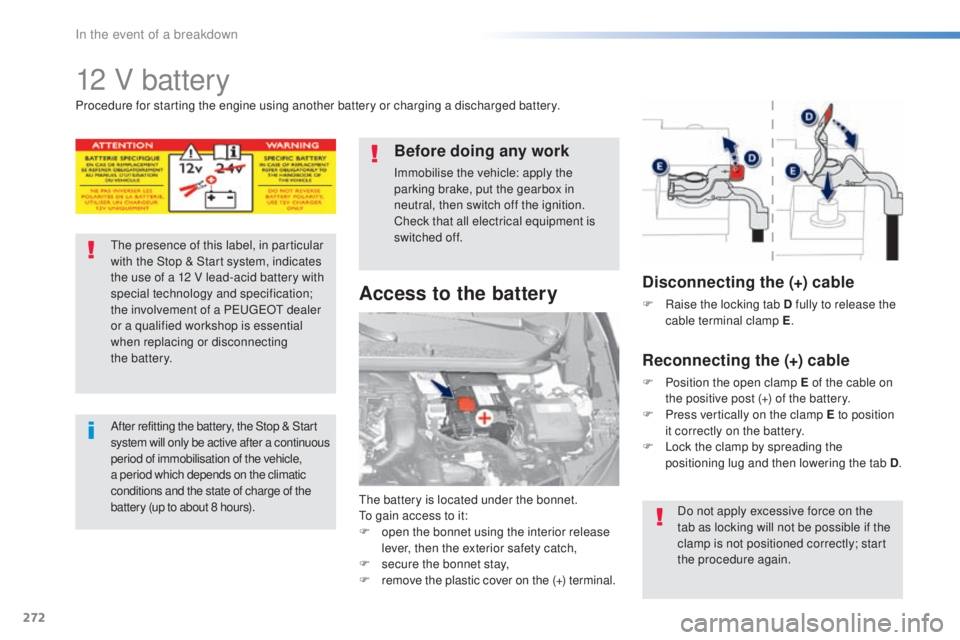
the battery is located under the bonnet.to ga
in access to it:
F
op
en the bonnet using the interior release
lever, then the exterior safety catch,
F
se
cure the bonnet stay,
F
re
move the plastic cover on the (+)
t
erminal.
Access to the battery
Procedure for starting the engine using another battery or charging a discharged battery.
the
presence of this label, in particular
with the Stop & Start system, indicates
the use of a 12 V lead-acid battery with
special technology and specification;
the involvement of a P
eu
ge
Ot d
ealer
or a qualified workshop is essential
when replacing or disconnecting
the
b
attery.
After refitting the battery, the Stop & Start
sy stem will only be active after a continuous
period of immobilisation of the vehicle,
a period which depends on the climatic
conditions and the state of charge of the
battery (up to about 8 hours).
Before doing any work
Immobilise the vehicle: apply the
parking brake, put the gearbox in
neutral, then switch off the ignition.
Check that all electrical equipment is
switched off.
Disconnecting the (+) cable
F Raise the locking tab D fully to release the
c able terminal clamp E .
Reconnecting the (+) cable
F Position the open clamp E of the cable on
t
he positive post (+) of the battery.
F
Pr
ess vertically on the clamp E to position
it correctly on the battery.
F
Lo
ck the clamp by spreading the
positioning lug and then lowering the tab D .
Do not apply excessive force on the
tab as locking will not be possible if the
clamp is not positioned correctly; start
the procedure again.
In the event of a breakdown
Page 276 of 398
274
308_en_Chap08_en-cas-de-panne_ed02-2015
the batteries contain harmful substances
s uch as sulphuric acid and lead. the y
must be disposed of in accordance
with regulations and must not, in any
circumstances, be discarded with household
waste.
tak
e used remote control batteries and
vehicle batteries to a special collection point.
It is advisable to disconnect the battery
if the vehicle is to be left unused for
more than one month. Protect your eyes and face before
handling the battery.
All operations on the battery must be
carried out in a well ventilated area and
away from naked flames and sources
of sparks, so as to avoid the risk of
explosion or fire.
Do not try to charge a frozen battery;
the battery must first be thawed out to
avoid the risk of explosion. If the battery
has been frozen, before charging have
it checked by a Peu
geOt d ealer or a
qualified workshop who will check that
the internal components have not been
damaged and the casing is not cracked,
which could cause a leak of toxic and
corrosive acid.
Do not reverse the polarity and use only
a 12 V charger.
Do not disconnect the terminals while
the engine is running.
Do not charge the batteries without
disconnecting the terminals first.
Wash your hands afterwards.
With Stop & Start, the battery does not
have to be disconnected for charging.
F
Di
sconnect the battery from the vehicle.
F
Fo
llow the instructions for use provided by
the manufacturer of the charger.
F Co
nnect the battery starting with the
negative terminal (-).
F
Ch
eck that the terminals and connectors
are clean. If they are covered with sulphate
(whitish or greenish deposit), remove them
and clean them.
Charging the battery using
a battery charger
Do not push the vehicle to start the
engine if your vehicle has an automatic
gearbox.
In the event of a breakdown