2016 Peugeot 308 check engine
[x] Cancel search: check enginePage 210 of 398
208
308_en_Chap06_conduite_ed02-2015
the system is deactivated by pressing the
c ontrol.
the s
ystem is deactivated automatically:
-
on s
witching off the ignition,
-
if t
he engine stalls,
-
if n
o manoeuvre is started within 5 minutes
of selection of the type of manoeuvre,
-
af
ter a prolonged stop of the vehicle during
a manoeuvre,
-
if t
he road wheel anti-slip regulation (ASR)
is triggered,
-
if t
he speed of the vehicle exceeds the
stated limit,
-
wh
en the driver interrupts movement of the
steering wheel,
-
af
ter 4 manoeuvre cycles,
-
on
opening the driver's door,
-
if o
ne of the front wheels encounters an
obstacle.
the o
peration indicator lamp goes off in the
instrument panel and a message is displayed
accompanied by an audible signal.
the d
river should then take back control of the
vehicle's steering.
Deactivation
If the system is deactivated during a
manoeuvre, the drive should reactivate it to
repeat the measurement.
the s
ystem is switched off automatically:
-
wh
en towing a trailer,
-
if t
he driver's door is opened,
-
if t
he speed of the vehicle is above 42 mph
(70 km/h).
to sw
itch the system of for a prolonged period,
contact a P
eu
ge
Ot d
ealer or a qualified
workshop.
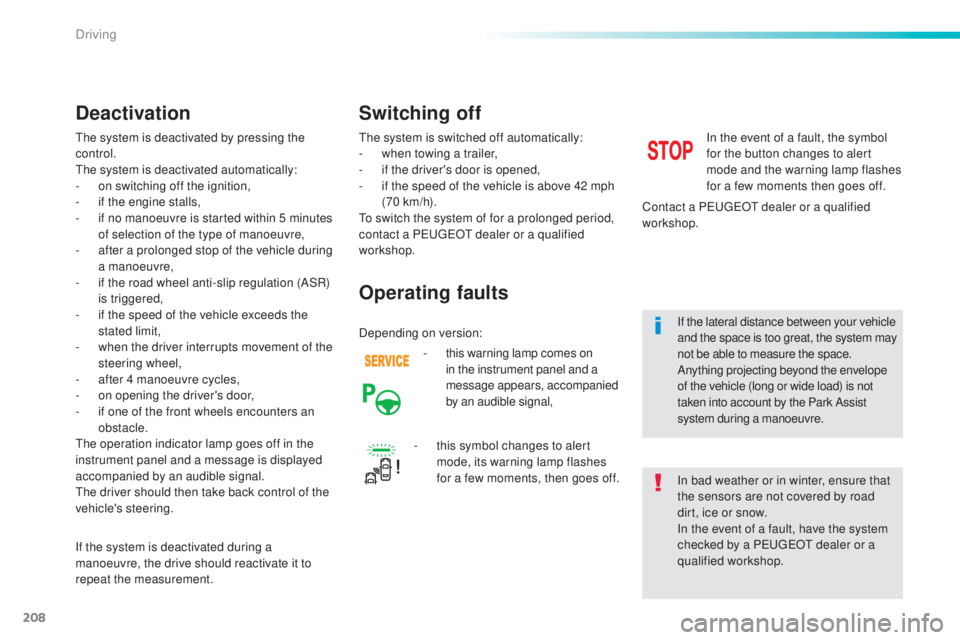
-
th
is warning lamp comes on
in the instrument panel and a
message appears, accompanied
by an audible signal,
Operating faults
In the event of a fault, the symbol
for the button changes to alert
mode and the warning lamp flashes
for a few moments then goes off.
Contact a P
eu
ge
Ot d
ealer or a qualified
workshop.
Switching off
In bad weather or in winter, ensure that
the sensors are not covered by road
dirt, ice or snow.
In the event of a fault, have the system
checked by a P
eu
ge
Ot d
ealer or a
qualified workshop.
-
th
is symbol changes to alert
mode, its warning lamp flashes
for a few moments, then goes off. If the lateral distance between your vehicle
and the space is too great, the system may
not be able to measure the space.
Anything projecting beyond the envelope
of the vehicle (long or wide load) is not
taken into account by the Park Assist
system during a manoeuvre.
Depending on version:
Driving
Page 216 of 398
214
308_en_Chap07_info-pratiques_ed02-2015
Low fuel level
When the low fuel level in the tank is
reached, this warning lamp comes on
in the instrument panel, accompanied
by an audible warning and a message.
Fuel supply cut-off
Your vehicle is equipped with a safety device
which cuts off the fuel supply in the event of a
collision. When it first comes on, less than 10 litres of
fuel remain in the tank.
You must refuel as soon as possible to avoid
running out.If you have put in the wrong fuel for
your vehicle, you must have have
the tank drained and refilled with
the correct fuel before you star t the
engine.
Your vehicle is fitted with a catalytic converter,
a device which helps to reduce the level of
harmful emissions in the exhaust gases.
For petrol engines, you must use unleaded
fuel only.
the f
iller neck is narrower, admitting petrol
nozzles only. It is still possible to use a fuel can to fill
the tank but this must be done slowly.
In order to ensure a good flow of fuel,
do not place the nozzle of the fuel can
in direct contact with the flap of the
misfuel prevention device.
Diesel misfuel prevention
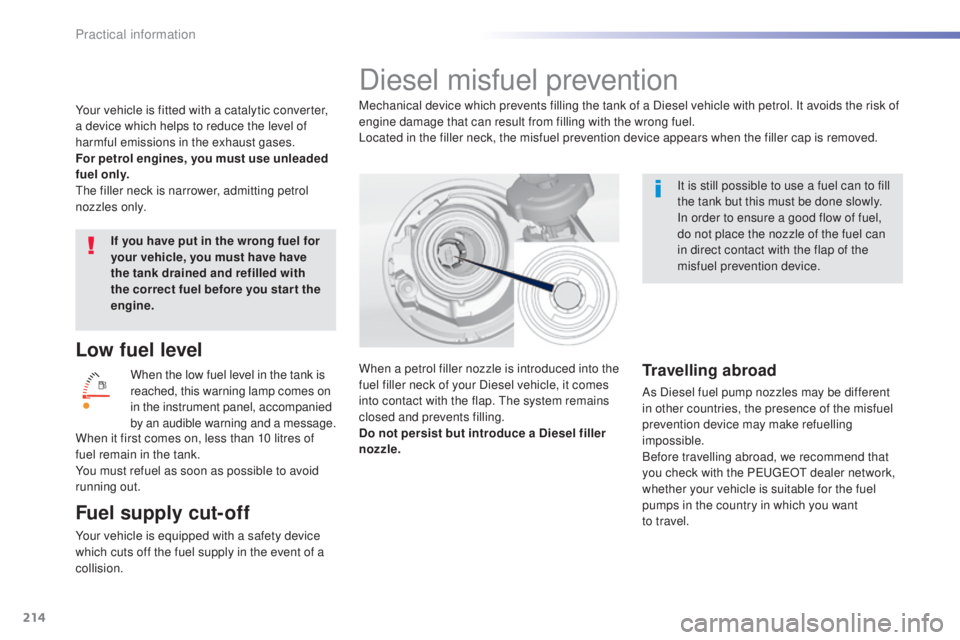
Mechanical device which prevents filling the tank of a Diesel vehicle with petrol. It avoids the risk of
engine damage that can result from filling with the wrong fuel.
Located in the filler neck, the misfuel prevention device appears when the filler cap is removed.
When a petrol filler nozzle is introduced into the
fuel filler neck of your Diesel vehicle, it comes
into contact with the flap.
the s
ystem remains
closed and prevents filling.
Do not persist but introduce a Diesel filler
nozzle.
Travelling abroad
As Diesel fuel pump nozzles may be different
in other countries, the presence of the misfuel
prevention device may make refuelling
impossible.
Before travelling abroad, we recommend that
you check with the P
eu
ge
Ot d
ealer network,
whether your vehicle is suitable for the fuel
pumps in the country in which you want
to
t
ravel.
Practical information
Page 228 of 398
226
308_en_Chap07_info-pratiques_ed02-2015
Bonnet
Before doing anything under the
bonnet, switch off the Stop & Start
system to avoid any risk of injury
resulting from an automatic change to
S
tA
R
t m o
d e .
Opening Closing
F take the stay out of its support slot.
F Cl ip the stay back into its housing.
F
Lo
wer the bonnet and release it at the end
of its travel.
F
Pu
ll on the bonnet to check that it has
latched correctly.
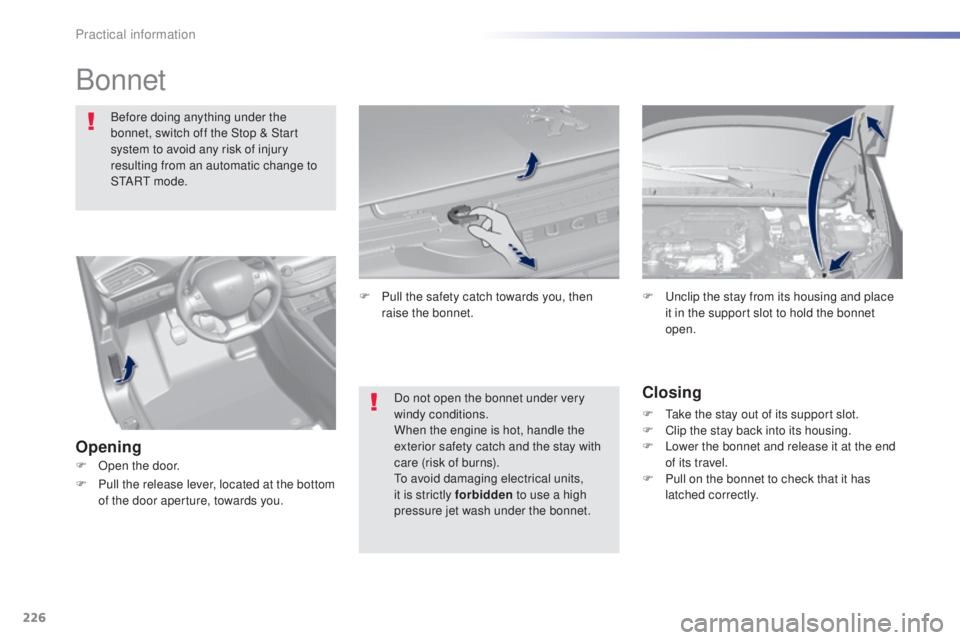
F
u
nc
lip the stay from its housing and place
it in the support slot to hold the bonnet
open.
Do not open the bonnet under very
windy conditions.
When the engine is hot, handle the
exterior safety catch and the stay with
care (risk of burns).
to a
void damaging electrical units,
it is strictly forbidden to use a high
pressure jet wash under the bonnet.
F
Pu
ll the safety catch towards you, then
raise the bonnet.
F
Op
en the door.
F
Pu
ll the release lever, located at the bottom
of the door aperture, towards you.
Practical information
Page 231 of 398

229
308_en_Chap07_info-pratiques_ed02-2015
Checking levels
take care when working under the bonnet, as certain areas of the engine may be extremely hot (risk of burns) and the cooling fan could start at
a ny time (even with the ignition off).
Engine oil level
the check is carried out either when
t he ignition is switched on using the
oil level indicator in the instrument
panel for vehicles so equipped, or
using the dipstick.Checking using the dipstick
F Locate the dipstick in the engine
c ompartment of your vehicle.
For more information on the petrol or Diesel
engine, refer to the corresponding section.
F
t
ak
e the dipstick by its coloured grip and
remove it completely.
F
Wi
pe the end of the dipstick using a clean
non-fluffy cloth.
F
Re
fit the dipstick and push fully down, then
pull it out again to make the visual check:
the correct level is between the marks A
and B .
Check all of these levels regularly, in line with the manufacturer's service schedule.
top t
hem up if necessary, unless other wise indicated.
If a level drops significantly, have the corresponding system checked by a P
eu
ge
Ot d
ealer or a qualified workshop.
A = MA X
to en
sure that the reading is correct, your
vehicle must be parked on a level sur face
with the engine having been off for more than
30
m
inutes.
It is normal to top up the oil level between
two services (or oil changes). P
eu
ge
Ot
r
ecommends that you check the level, and top
up if necessary, every 3 000 miles (5 000 kms). B = MIN
If you find that the level is above the A mark or
below the B mark, do not star t the engine .
-
If t
he level is above the MAX mark (risk
of damage to the engine), contact a
P
eu
ge
Ot d
ealer or a qualified workshop.
-
If t
he level is below the MIN mark, you
must top up the engine oil.
7
Practical information
Page 232 of 398

230
308_en_Chap07_info-pratiques_ed02-2015
Oil grade
Before topping-up the oil or changing the oil,
check that the oil is the correct grade for your
engine and conforms to the manufacturer's
recommendations.
Topping-up the engine oil level
F Locate the oil filler cap in the engine
compartment of your vehicle.
For more information on the petrol or Diesel
engine, refer to the corresponding section.
F
u
ns
crew the oil filler cap to reveal the filler
aperture.
F
Ad
d oil in small quantities, avoiding any
spills on engine components (risk of fire).
F
Wa
it a few minutes before checking the
level again using the dipstick.
F
Ad
d more oil if necessary.
F
Af
ter checking the level, carefully refit the
oil filler cap and the dipstick in its tube. After topping-up the oil, the check when
switching on the ignition with the oil
level indicator in the instrument panel
is not valid during the 30 minutes after
topping up.
Engine oil change
Refer to the manufacturer's service schedule
for details of the interval for this operation.
In order to maintain the reliability of the engine
and emission control system, never use
additives in the engine oil.
Practical information
Page 233 of 398

231
308_en_Chap07_info-pratiques_ed02-2015
the brake fluid level must be
b etween the marking " A" (MA X
located on the remote reservoir) and
the marking " B" (MIN located on the
main reservoir). If it is not, check the
brake pad wear.
Brake fluid level
Changing the fluid
Refer to the personalised service schedule for
your vehicle for details of the interval for this
operation.
Fluid specification
the brake fluid must conform to the
ma nufacturer's recommendations.
Coolant level
the coolant level should be close
t o the "MA X" mark but should never
exceed it.
In addition, as the cooling system is pressurised,
wait at least one hour after switching off the
engine before carrying out any work.
to av
oid any risk of scalding, unscrew the cap
by two turns to allow the pressure to drop. When
the pressure has dropped, remove the cap and
top up the level.
Changing the coolant
the coolant does not have to be replaced at routine services.
Fluid specification
the coolant must conform to the
ma nufacturer's recommendations.
The cooling fan may star t after switching
off the engine: take care with ar ticles and
clothing that might be caught by the fan
blades. When the engine is warm, the temperature of
the coolant is regulated by the fan.
Fluid specification
For optimum cleaning and to avoid freezing,
this fluid must not be topped up with or
replaced with plain water.
Screenwash and headlamp
wash fluid
In the case of vehicles fitted with
headlamp washers, the low fluid level
is indicated by an audible signal and
a message in the instrument panel
screen.
top u
p the reservoir when you next
stop the vehicle.
In wintry conditions, the use of an ethyl alcohol
or methanol base fluid is recommended.
7
Practical information
Page 235 of 398

233
308_en_Chap07_info-pratiques_ed02-2015
Checks
12 V battery
the battery does not require any maintenance.
H owever, check that the terminals are clean
and correctly tightened, particularly in summer
and winter.Refer to the manufacturer's
service schedule for details of the
replacement intervals for these
components.
Air filter and passenger compartment filter
Replace the oil filter each time the
engine oil is changed.
Refer to the manufacturer's
service schedule for details of
the replacement interval for this
component.Oil filterthe presence of this label, in particular with
t he Stop & Start system, indicates the use of
a specific 12 V lead-acid battery with special
technology and specification.
the
involvement
of a P
eu
ge
Ot d
ealer or a qualified workshop
is essential when replacing or disconnecting
the battery.
Particle filter (Diesel)
the start of saturation of the particle
f ilter is indicated by the temporary
illumination of this warning lamp
accompanied by a message in the
multifunction screen.
As soon as the traffic conditions permit,
regenerate the filter by driving at a
speed of at least 40 mph (60 km/h) until
the warning lamp goes off.
If the warning lamp stays on, this
indicates a low additive level.
For more information on checking
levels, refer to the corresponding
section.
On a new vehicle, the first particle
filter regeneration operations may be
accompanied by a "burning" smell,
which is per fectly normal.
Following prolonged operation of the
vehicle at very low speed or at idle,
you may, in exceptional circumstances,
notice the emission of water vapour at
the exhaust on acceleration.
thi
s does
not affect the behaviour of the vehicle
or the environment.
unl
ess otherwise indicated, check these components in accordance with the manufacturer's
service schedule and according to your engine.
Other wise, have them checked by a Peu
geOt d
ealer or a qualified workshop.
When carrying out work on the battery, refer
to the "12 V battery" section for details of the
precautions to be taken before disconnecting
the battery and following its reconnection. Depending on the environment (e.g. dusty
atmosphere) and the use of the vehicle (e.g.
city driving), replace them twice as often if
necessary
.
A clogged passenger compartment filter may
have an adverse effect on the per formance
of the air conditioning system and generate
undesirable odours.
7
Practical information
Page 240 of 398
238
308_en_Chap07_info-pratiques_ed02-2015
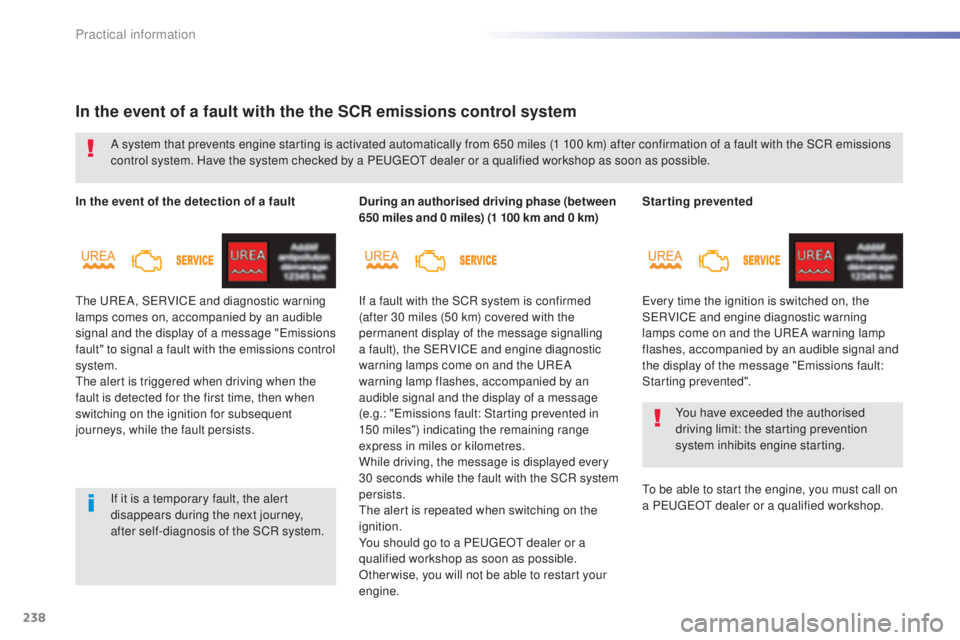
Starting prevented
eve
ry time the ignition is switched on, the
S
eRV
IC
e and
engine diagnostic warning
lamps come on and the
uReA wa
rning lamp
flashes, accompanied by an audible signal and
the display of the message "
emi
ssions fault:
Starting prevented".
You have exceeded the authorised
driving limit: the starting prevention
system inhibits engine starting.
to be a
ble to start the engine, you must call on
a P
eu
ge
Ot d
ealer or a qualified workshop.
In the event of a fault with the the SCR emissions control system
A system that prevents engine starting is activated automatically from 650 miles (1 100 km) after confirmation of a fault with the SCR emissions
co ntrol system. Have the system checked by a Peu geOt d ealer or a qualified workshop as soon as possible.
If it is a temporary fault, the alert
disappears during the next journey,
after self-diagnosis of the SCR system.
In the event of the detection of a fault
the uReA, SeRV
IC
e a
nd diagnostic warning
lamps comes on, accompanied by an audible
signal and the display of a message "
emi
ssions
fault" to signal a fault with the emissions control
system.
the a
lert is triggered when driving when the
fault is detected for the first time, then when
switching on the ignition for subsequent
journeys, while the fault persists. During an authorised driving phase (between
650 miles and 0 miles) (1 100 km and 0 km)
If a fault with the SCR system is confirmed
(after 30 miles (50 km) covered with the
permanent display of the message signalling
a fault), the S
eRV
IC
e a
nd engine diagnostic
warning lamps come on and the
uReA
war
ning lamp flashes, accompanied by an
audible signal and the display of a message
(e.g.: "
emi
ssions fault: Starting prevented in
150
m
iles") indicating the remaining range
express in miles or kilometres.
While driving, the message is displayed every
30 seconds while the fault with the SCR system
persists.
the a
lert is repeated when switching on the
ignition.
You should go to a P
eu
ge
Ot d
ealer or a
qualified workshop as soon as possible.
Other wise, you will not be able to restart your
engine.
Practical information