2016 Peugeot 308 check engine
[x] Cancel search: check enginePage 243 of 398

241
308_en_Chap07_info-pratiques_ed02-2015
Never dispose of AdBlue® additive
bottles in the household waste. Place
them in a special container provided
this purpose or take them to your dealer.
F
Af
ter emptying the bottle, wipe away any
spillage around the tank filler using a damp
cloth. If any additive is split or splashed, wash
immediately with cold water or wipe with
a damp cloth.
If the additive has crystallised, clean it
off using a sponge and hot water.
F
Re
fit the blue cap to the tank and turn it a
6
th of a turn clockwise, to its stop.
F Re fit the black cap and turn it a quarter of
a turn clockwise without pressing.
ens
ure
that the indicator on the cap lines up with
the indicator on the support.
F
De
pending on equipment, return the spare
wheel and/or the storage box to the bottom
of the boot.
F
Re
fit the boot carpet and close the tailgate. Important: when topping
-up after
running out of additive , signalled
by the message "
top u
p emissions
additive: Starting prevented", you
must wait for about 5 minutes before
switching on the ignition, without
opening the driver's door, unlocking
the vehicle, introducing the key
into the ignition switch, or placing
the key of the "Keyless Entr y and
Star ting" system inside the vehicle .
Switch on the ignition, then wait for
10
se
conds before starting the engine.
F
Ob
tain a bottle of AdBlue
®. After first
checking the use-by date, read carefully
the instructions on use on the label before
pouring the contents of the bottle into your
vehicle's AdBlue
® tank.
Freezing of the AdBlue
® additive
the
AdBlue
® additive freezes at
temperatures below around -11°C.
the S
CR system includes a heater
for the AdBlue
® tank, allowing you to
continue driving in very cold conditions.
7
Practical information
Page 251 of 398
249
308_en_Chap08_en-cas-de-panne_ed02-2015
Checking tyre pressures /
inflating accessories
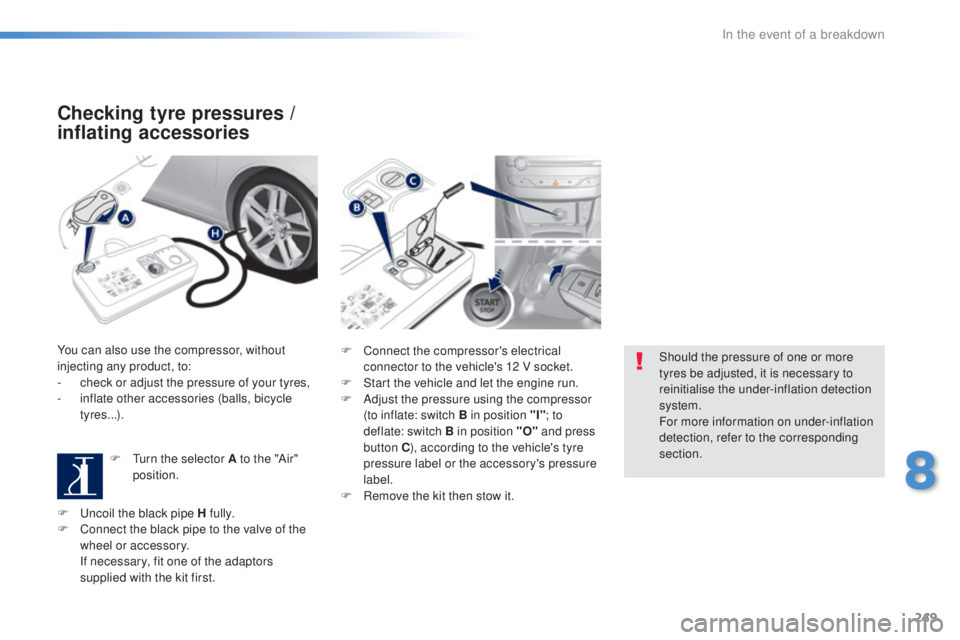
You can also use the compressor, without
injecting any product, to:
-
ch
eck or adjust the pressure of your tyres,
-
in
flate other accessories (balls, bicycle
tyres...).
F
t
ur
n the selector A to the "Air"
position. F Con
nect the compressor's electrical
connector to the vehicle's 12 V socket.
F
St
art the vehicle and let the engine run.
F
Ad
just the pressure using the compressor
(to inflate: switch B in position "I" ; to
deflate: switch B in position "O" and press
button C ), according to the vehicle's tyre
pressure label or the accessory's pressure
label.
F
Re
move the kit then stow it.Should the pressure of one or more
tyres be adjusted, it is necessary to
reinitialise the under-inflation detection
system.
For more information on under-inflation
detection, refer to the corresponding
section.
F
u
nc
oil the black pipe H fully.
F
Co
nnect the black pipe to the valve of the
wheel or accessory.
If n
ecessary, fit one of the adaptors
supplied with the kit first.
8
In the event of a breakdown
Page 274 of 398
272
308_en_Chap08_en-cas-de-panne_ed02-2015
12 V battery
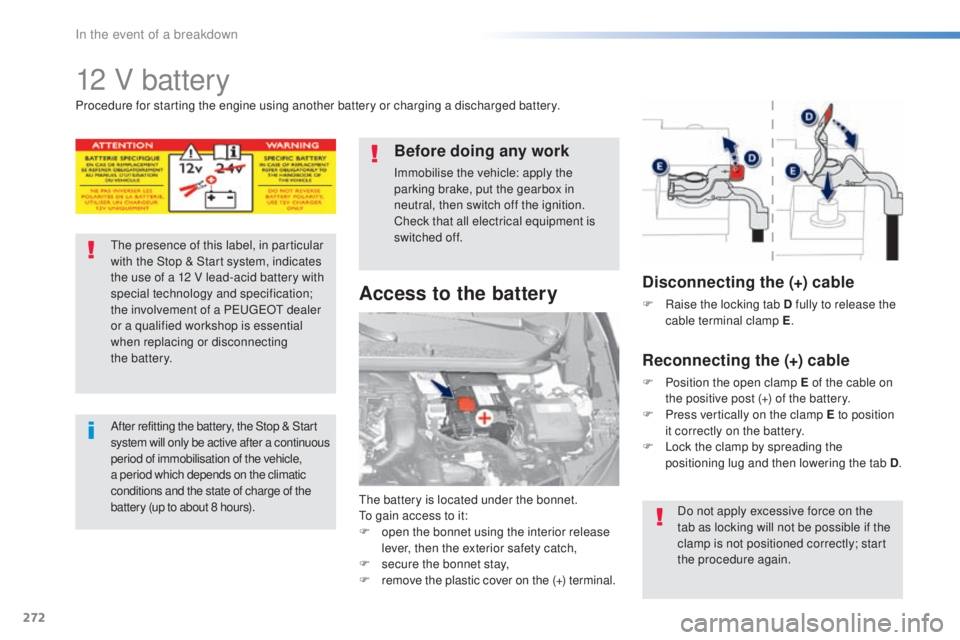
the battery is located under the bonnet.to ga
in access to it:
F
op
en the bonnet using the interior release
lever, then the exterior safety catch,
F
se
cure the bonnet stay,
F
re
move the plastic cover on the (+)
t
erminal.
Access to the battery
Procedure for starting the engine using another battery or charging a discharged battery.
the
presence of this label, in particular
with the Stop & Start system, indicates
the use of a 12 V lead-acid battery with
special technology and specification;
the involvement of a P
eu
ge
Ot d
ealer
or a qualified workshop is essential
when replacing or disconnecting
the
b
attery.
After refitting the battery, the Stop & Start
sy stem will only be active after a continuous
period of immobilisation of the vehicle,
a period which depends on the climatic
conditions and the state of charge of the
battery (up to about 8 hours).
Before doing any work
Immobilise the vehicle: apply the
parking brake, put the gearbox in
neutral, then switch off the ignition.
Check that all electrical equipment is
switched off.
Disconnecting the (+) cable
F Raise the locking tab D fully to release the
c able terminal clamp E .
Reconnecting the (+) cable
F Position the open clamp E of the cable on
t
he positive post (+) of the battery.
F
Pr
ess vertically on the clamp E to position
it correctly on the battery.
F
Lo
ck the clamp by spreading the
positioning lug and then lowering the tab D .
Do not apply excessive force on the
tab as locking will not be possible if the
clamp is not positioned correctly; start
the procedure again.
In the event of a breakdown
Page 275 of 398

273
308_en_Chap08_en-cas-de-panne_ed02-2015
Starting using another battery
First check that the slave battery has a
nominal voltage of 12 V and a capacity
at least equal to that of the discharged
battery.
Do not try to start the engine by
connecting a battery charger.
Do not disconnect the (+) terminal when
the engine is running.
F
Re
move the plastic cover from
the
(
+)
t
erminal, if your vehicle has one.
F
Co
nnect the red cable to the positive
terminal (+) of the flat battery A , then to the
positive terminal (+) of the slave battery B.
F
Co
nnect one end of the green or black
cable to the negative terminal (-) of the
slave battery B (or earth point on the other
vehicle).
F
Co
nnect the other end of the green or black
cable to the earth point C on the broken
down vehicle (or on the engine mounting).
F
St
art the engine of the vehicle with the
good battery and leave it running for a
few
m
inutes. F
Op
erate the starter on the broken down
vehicle and let the engine run
If t
he engine does not start straight
away, switch off the ignition and wait a
few
m
oments before trying again.
F
Wa
it until the engine returns to idle then
disconnect the jump lead cables in the
reverse order.
F
Re
fit the plastic cover to the (+) terminal, if
your vehicle has one.
When your vehicle's battery is discharged, the
engine can be started using a slave battery
(external or on another vehicle) and jump lead
cables.Before disconnecting the battery
Wait 2 minutes after switching off the ignition
before disconnecting the battery.
Close the windows and the doors before
disconnecting the battery.
Following reconnection of the
battery
Following reconnection of the battery, switch on
the ignition and wait 1 minute before starting to
permit initialisation of the electronic systems.
However, if problems remain following this
operation, contact a P
eu
ge
Ot d
ealer or a
qualified workshop.
Referring to the corresponding section, you
must yourself reinitialise (depending on
version):
-
th
e remote control key,
-
th
e electric blind(s),
-
... S
ome functions are not available if the
battery is not sufficiently charged.
8
In the event of a breakdown
Page 276 of 398
274
308_en_Chap08_en-cas-de-panne_ed02-2015
the batteries contain harmful substances
s uch as sulphuric acid and lead. the y
must be disposed of in accordance
with regulations and must not, in any
circumstances, be discarded with household
waste.
tak
e used remote control batteries and
vehicle batteries to a special collection point.
It is advisable to disconnect the battery
if the vehicle is to be left unused for
more than one month. Protect your eyes and face before
handling the battery.
All operations on the battery must be
carried out in a well ventilated area and
away from naked flames and sources
of sparks, so as to avoid the risk of
explosion or fire.
Do not try to charge a frozen battery;
the battery must first be thawed out to
avoid the risk of explosion. If the battery
has been frozen, before charging have
it checked by a Peu
geOt d ealer or a
qualified workshop who will check that
the internal components have not been
damaged and the casing is not cracked,
which could cause a leak of toxic and
corrosive acid.
Do not reverse the polarity and use only
a 12 V charger.
Do not disconnect the terminals while
the engine is running.
Do not charge the batteries without
disconnecting the terminals first.
Wash your hands afterwards.
With Stop & Start, the battery does not
have to be disconnected for charging.
F
Di
sconnect the battery from the vehicle.
F
Fo
llow the instructions for use provided by
the manufacturer of the charger.
F Co
nnect the battery starting with the
negative terminal (-).
F
Ch
eck that the terminals and connectors
are clean. If they are covered with sulphate
(whitish or greenish deposit), remove them
and clean them.
Charging the battery using
a battery charger
Do not push the vehicle to start the
engine if your vehicle has an automatic
gearbox.
In the event of a breakdown
Page 362 of 398
360
308_en_Chap10c_SMegplus_ed02-2015
QUESTIONANSWER SOLUTION
the
re is a difference in
sound quality between the
different audio sources. For optimum sound quality, the audio settings for Volume, Bass,
tre
ble,
equ
alizer and Loudness can be adapted to the different
sound sources, which may result in audible differences when
changing source. Check that the audio settings for (Volume, Bass,
tre
ble,
equ
alizer, Loudness) are adapted to the
sources listened to. It is advisable to set the
Audio functions (Bass,
tre
ble, Fr-Re balance,
Le-Ri balance) to the middle position, select the
"Linear", musical ambience and set the loudness
correction to the "Active" position in CD mode or
to the "Inactive" position in radio mode.
With the engine off, the
system switches off after a
few minutes of use. When the engine is switched off, the system's operating time
depends on the state of charge of the battery.
the s
witch-off is normal: the system switches to economy mode and
switches off to prevent discharging of the vehicle's battery. Start the vehicle's engine to increase the battery
charge.
Audio and telematics
Page 381 of 398
379
308_en_Chap10d_RD45_ed02-2015
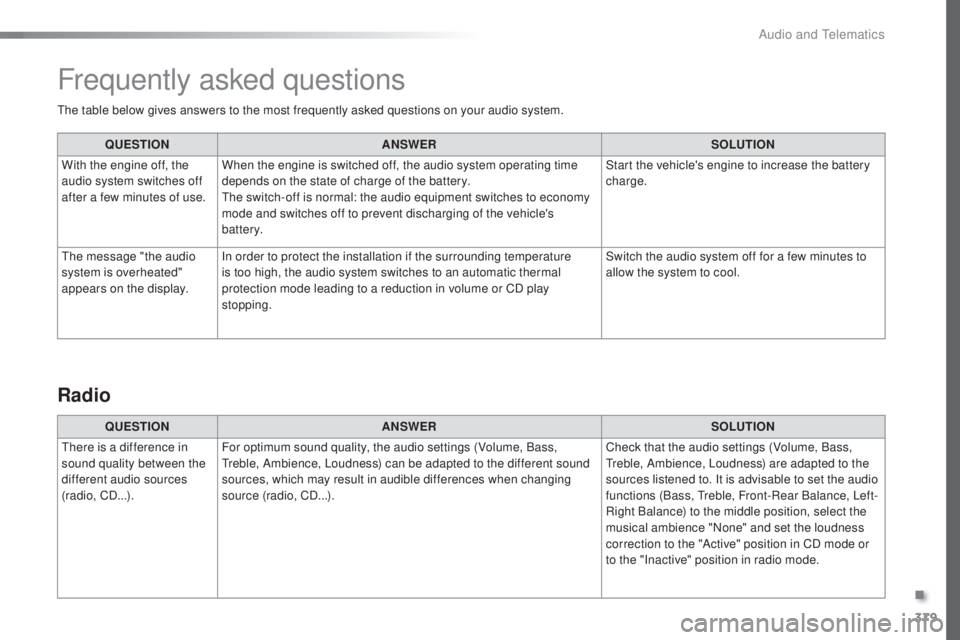
the table below gives answers to the most frequently asked questions on your audio system.Q UESTION ANSWER SOLUTION
With the engine off, the
audio system switches off
after a few minutes of use. When the engine is switched off, the audio system operating time
depends on the state of charge of the battery.
the s
witch-off is normal: the audio equipment switches to economy
mode and switches off to prevent discharging of the vehicle's
battery. Start the vehicle's engine to increase the battery
charge.
the m
essage "the audio
system is overheated"
appears on the display. In order to protect the installation if the surrounding temperature
is too high, the audio system switches to an automatic thermal
protection mode leading to a reduction in volume or CD play
stopping. Switch the audio system off for a few minutes to
allow the system to cool.
Frequently asked questions
QUESTION
ANSWER SOLUTION
the
re is a difference in
sound quality between the
different audio sources
(radio, CD...). For optimum sound quality, the audio settings (Volume, Bass,
tre
ble, Ambience, Loudness) can be adapted to the different sound
sources, which may result in audible differences when changing
source (radio, CD...). Check that the audio settings (Volume, Bass,
tre
ble, Ambience, Loudness) are adapted to the
sources listened to. It is advisable to set the audio
functions (Bass,
tre
ble, Front-Rear Balance, Left-
Right Balance) to the middle position, select the
musical ambience "None" and set the loudness
correction to the "Active" position in CD mode or
to the "Inactive" position in radio mode.
Radio
.
Audio and telematics
Page 385 of 398

383
308_en_Chap11_index-alpha_ed02-2015
ABS ...............................................................12 0
Accessories .............................. ....................220
Accessory position
....................................... 15
2
Additive, AdBlue
.............................. 26
, 235-241
Additive, Diesel
...............................
......232, 233
Adjusting headlamps
.................................... 11
4
Adjusting head restraints
....................................................... 75
Ad
justing seats
.......................................... 7
2, 73
Adjusting the air distribution
....................................... 93
, 95, 98
Adjusting the air flow
.......................... 9
2, 94, 98
Adjusting the date
..................................... 4
4 - 47
Adjusting the height and reach of the steering wheel
.................................... 71
Adj
usting the lumbar
support
.......................................................... 7
2
Adjusting the temperature
.............................. 96
Ad
justing the time
............................... 4
4, 45, 47
Advice on driving
..............................
....146, 147
Affaire version
............................................... 29
4
Airbags
...............
..................................... 23, 126
Airbags, curtain
..................................... 128
, 129
Airbags, front ......................................... 126, 129
Airbags, lateral
...................................... 12
8, 129
Air conditioning
............................ 1
0, 92, 94, 96
Air conditioning, digital
................................... 96
A
ir conditioning, manual
........................... 9
2, 94
Air intake
...............
........................................ 10 0
Air vents
..............................
............................90
Alarm
............................................................... 65
A
nti-lock braking system
(A BS)
...............
........................................... 120
Anti-pinch
................................................ 6
9, 103
Anti-theft
..............................
.............51, 63, 154
Armrest, front
............................................ 8
0, 82
Armrest, rear
................................................... 85
ASR ............................................................... 12
0
Assistance call
...............................
.......11 9 , 2 9 6 Assistance, emergency braking ...................
120
A
udible warning ............................................12
0
Audio streaming (Bluetooth)
................. 318
, 373
Auxiliary
.......................................... 8
3, 316, 371
A
B
C
Battery ....................................219, 233, 272-274
Battery, charging ............................... ............2 74
Battery, remote control
...................... 53
, 62, 63
Bicycle carrier
............................................... 2
24
Blanking screen (snow shield)
.............. 217
, 218
Blind, panoramic roof
.................................... 10
3
Blind spot sensors
.................................. 1
6, 195
BlueHDi
...............................
....................26, 235
Bluetooth (hands-free)
.......................... 3 5
0 , 374
Bluetooth (telephone)
............................ 3
5 0 , 374
Bonnet
...............
............................................ 226
Boot
........
................................................... 58, 59
Boot lamp
........................................................ 87
B
rake discs
.................................................... 234
B
rake lamps
...............................
...........261, 263
Brakes
............................................... 2
1, 24, 234
Braking, automatic on risk of collision
................
.........................22, 19 0, 193
Braking, dynamic emergency
....................... 15
9
Bulbs (changing)
................................... 2
56-265Cable, audio
..........................................
3
16 , 371
Capacity, fuel tank
........................................ 2
13
Cap, fuel filler
................................................ 2
13
CD
..............................
...........................
316 , 371
CD, MP3
................................................ 3 1
7, 3 7 2
Central locking
............................. 4
9, 54, 56, 57
Changing a bulb
.................................... 2
56-265
Changing a fuse
.................................... 2
6 6 -271
Changing a wheel
...............................
..
250-255
Changing a wiper blade
........................ 1
18, 222
Changing the remote control battery .........................................53, 62
Checking the engine oil level
.................. 3
1, 2 29
Checking the levels
............................... 2
29-232
Checking tyre pressures (using the kit) .............................................. 24 4
Checks ................................. 2
27, 228, 233, 234
Checks, routine .................................... 23
3, 234
Child lock
....................................................... 14
5
Children
.................................. 12
5, 127, 13 0 -14 5
Children (safety)
............................................ 14
5
Child seats
............................. 13 0
-132, 13 6, 141
Child seats, conventional
.............................. 13
6
Child seats, ISOFIX
...................................... 141
C
losing the boot
...............................
.........58, 59
Closing the doors
......................... 4
9, 54, 56, 57
Collision risk alert
......................................... 19
0
Compressor, tyre inflation
............................ 24
4
Configuration, vehicle
..................................... 42
C
onnection, Bluetooth
..........................3
5 0 , 374
Container, AdBlue
......................................... 23
9
Control, electric windows
................................ 69
C
ontrol, emergency boot release
...................60
C
ontrol, emergency door
................................61
C
ontrol, heated seats
......................................75
C
ontrol stalk, lighting
....................................108
C
ontrol stalk, wipers
.....................................11
5
Courtesy lamps
............................................. 10
4
Cover, load space
..................................... 87, 8
8
.
Alphabetical index