2016 Peugeot 308 CD player
[x] Cancel search: CD playerPage 320 of 398
318
308_en_Chap10c_SMegplus_ed02-2015
Bluetooth® audio streaming
Streaming allows audio files on your telephone
to be played through the vehicle's speakers.
Connect the telephone: see the "Telephone"
section, then " Bluetooth".
Choose the " Audio" or "All" profile.
If play does not start automatically, it may be
necessary to start the audio playback from the
telephone.
Control is from the peripheral device or by
using the audio system buttons.
Once connected in streaming mode,
the telephone is considered to be a
media source.
It is recommended that you activate
"Repeat " on the Bluetooth peripheral.
Connecting Apple® players
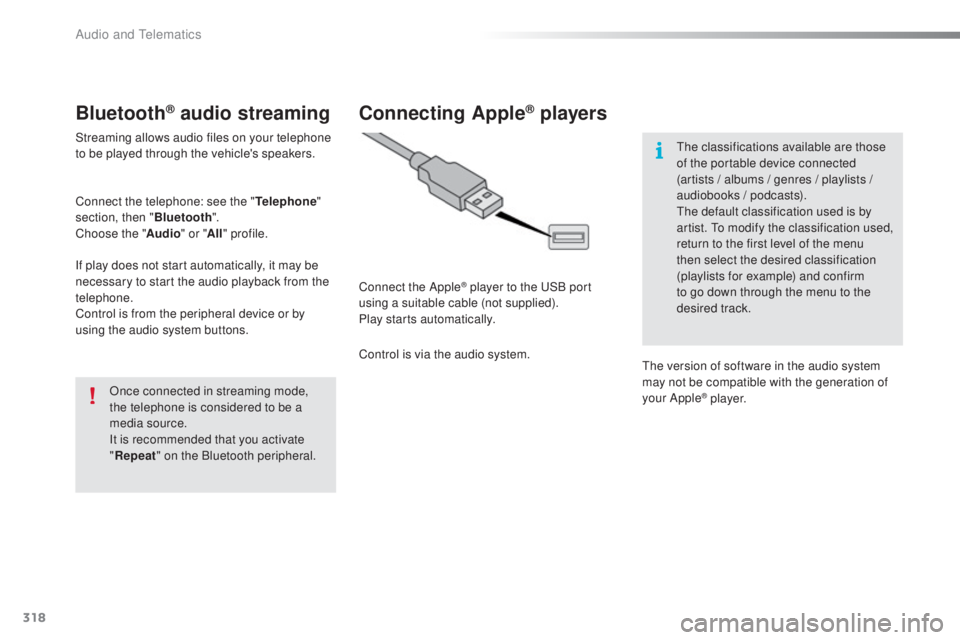
Connect the Apple® player to the uSB p ort
using a suitable cable (not supplied).
Play starts automatically.
Control is via the audio system.
the c
lassifications available are those
of the portable device connected
(artists / albums / genres / playlists /
audiobooks / podcasts).
the d
efault classification used is by
artist.
to mo
dify the classification used,
return to the first level of the menu
then select the desired classification
(playlists for example) and confirm
to go down through the menu to the
desired track.
the v
ersion of software in the audio system
may not be compatible with the generation of
your Apple
® p l aye r.
Audio and telematics
Page 359 of 398
357
308_en_Chap10c_SMegplus_ed02-2015
Media
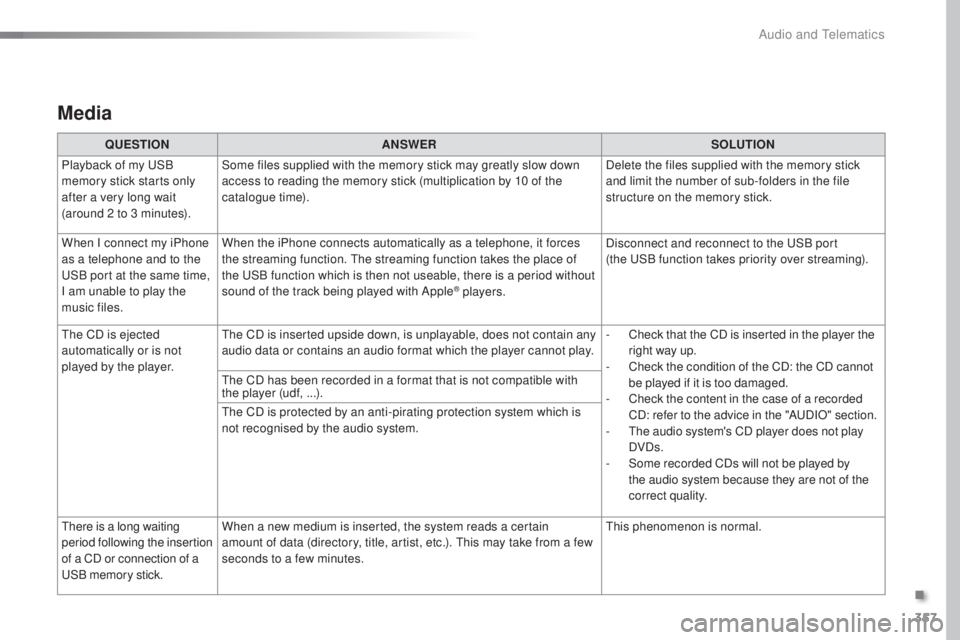
QUESTIONANSWER SOLUTION
Playback of my
uSB
m
emory stick starts only
after a very long wait
(around 2 to 3 minutes). Some files supplied with the memory stick may greatly slow down
access to reading the memory stick (multiplication by 10 of the
catalogue time).
Delete the files supplied with the memory stick
and limit the number of sub-folders in the file
structure on the memory stick.
When I connect my iPhone
as a telephone and to the
uSB p
ort at the same time,
I am unable to play the
music files. When the iPhone connects automatically as a telephone, it forces
the streaming function.
the s
treaming function takes the place of
the
uSB f
unction which is then not useable, there is a period without
sound of the track being played with Apple
® players. Disconnect and reconnect to the
uSB p
ort
(the
uSB f
unction takes priority over streaming).
the C
D is ejected
automatically or is not
played by the player.
the C
D is inserted upside down, is unplayable, does not contain any
audio data or contains an audio format which the player cannot play. -
Ch
eck that the CD is inserted in the player the
right way up.
-
Ch
eck the condition of the CD: the CD cannot
be played if it is too damaged.
-
Ch
eck the content in the case of a recorded
CD: refer to the advice in the "A
uDI
O" section.
-
t
he a
udio system's CD player does not play
DVDs.
-
So
me recorded CDs will not be played by
the audio system because they are not of the
correct quality.
the C
D has been recorded in a format that is not compatible with
the player (udf, ...).
the C
D is protected by an anti-pirating protection system which is
not recognised by the audio system.
there
is a long waiting
period following the insertion
of a CD or connection of a
uSB
memory stick. When a new medium is inserted, the system reads a certain
amount of data (directory, title, artist, etc.).
thi
s may take from a few
seconds to a few minutes.
thi
s phenomenon is normal.
.
Audio and telematics
Page 360 of 398
358
308_en_Chap10c_SMegplus_ed02-2015
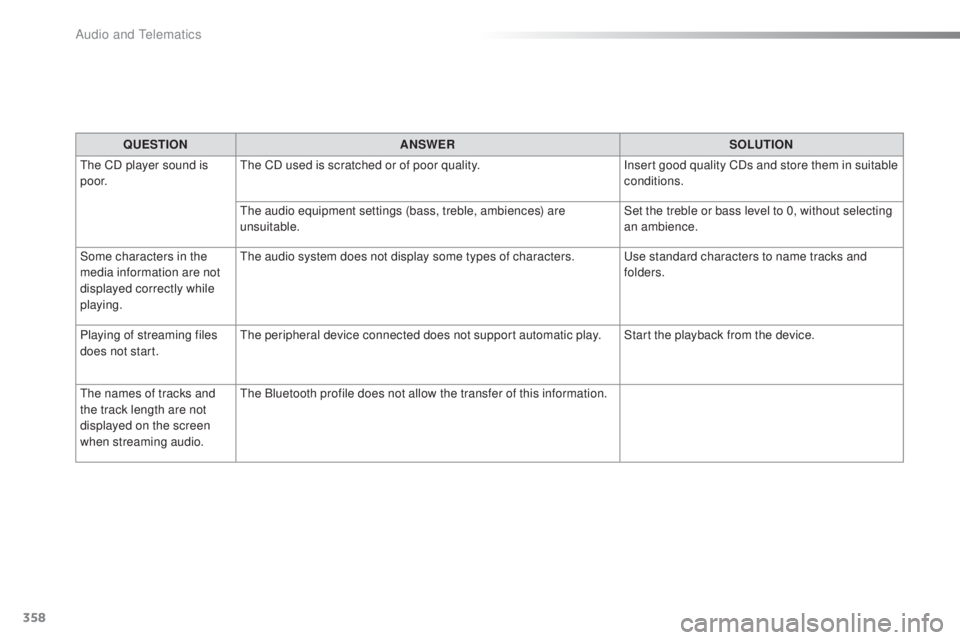
QUESTIONANSWER SOLUTION
the C
D player sound is
p o o r.
the C
D used is scratched or of poor quality. Insert good quality CDs and store them in suitable
conditions.
the a
udio equipment settings (bass, treble, ambiences) are
unsuitable. Set the treble or bass level to 0, without selecting
an ambience.
Some characters in the
media information are not
displayed correctly while
playing.
the a
udio system does not display some types of characters.
us
e standard characters to name tracks and
folders.
Playing of streaming files
does not start.
the p
eripheral device connected does not support automatic play. Start the playback from the device.
the n
ames of tracks and
the track length are not
displayed on the screen
when streaming audio.
the B
luetooth profile does not allow the transfer of this information.
Audio and telematics
Page 372 of 398
370
308_en_Chap10d_RD45_ed02-2015
Media
USB player
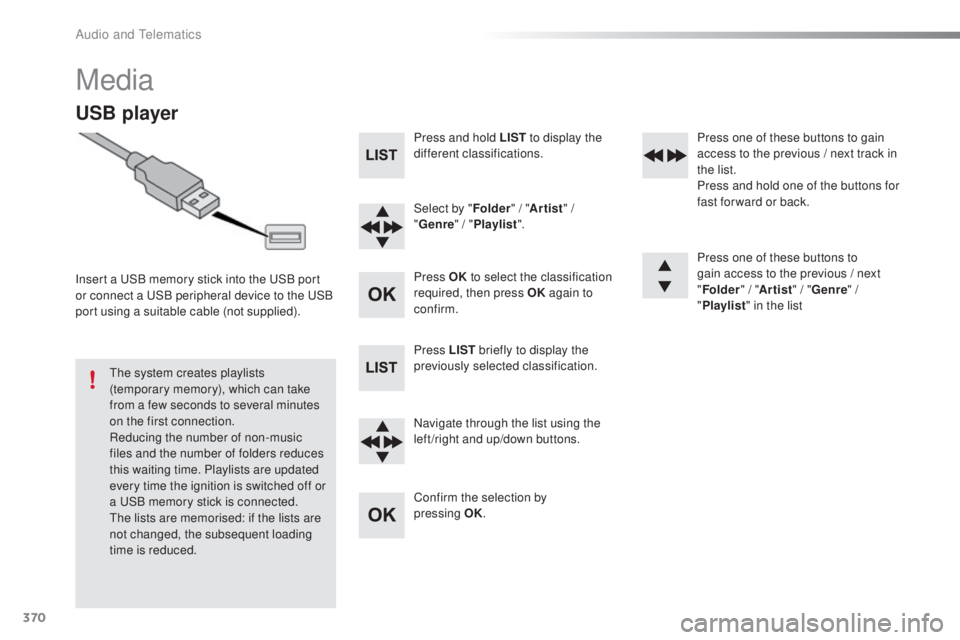
Insert a uSB memory stick into the uSB p ort
or connect a uSB p eripheral device to the uSB
p
ort using a suitable cable (not supplied).
the s
ystem creates playlists
(temporary memory), which can take
from a few seconds to several minutes
on the first connection.
Reducing the number of non-music
files and the number of folders reduces
this waiting time. Playlists are updated
every time the ignition is switched off or
a
uSB m
emory stick is connected.
the l
ists are memorised: if the lists are
not changed, the subsequent loading
time is reduced. Press and hold LIST
to display the
different classifications.
Select by " Folder" / "Artist " /
" Genre " / "Playlist ".
Press OK to select the classification
required, then press OK again to
confirm.
Press LIST briefly to display the
previously selected classification.
Navigate through the list using the
left /right and up/down buttons.
Confirm the selection by
pressing
OK
.Press one of these buttons to gain
access to the previous / next track in
the list.
Press and hold one of the buttons for
fast for ward or back.
Press one of these buttons to
gain access to the previous / next
"
Folder " / "Artist " / "Genre " /
" Playlist " in the list
Audio and telematics
Page 373 of 398
371
308_en_Chap10d_RD45_ed02-2015
Auxiliary socket (AUX)
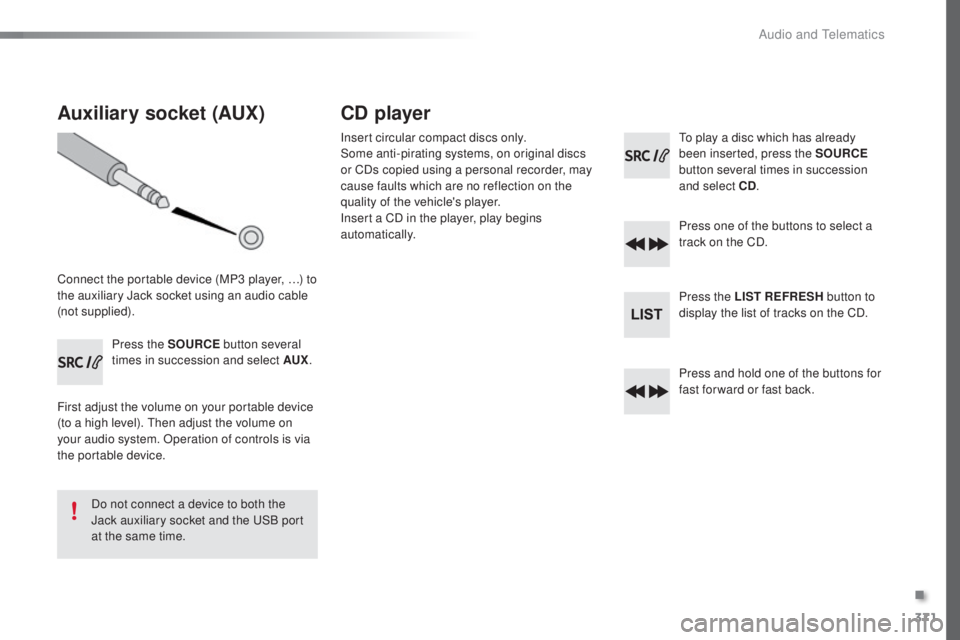
Connect the portable device (MP3 player, …) to
the auxiliary Jack socket using an audio cable
(not supplied).Press the SOURCE button several
times in succession and select AUX .
First adjust the volume on your portable device
(to a high level).
the
n adjust the volume on
your audio system. Operation of controls is via
the portable device.
Do not connect a device to both the
Jack auxiliary socket and the
uSB p
ort
at the same time.
CD player
Insert circular compact discs only.
Some anti-pirating systems, on original discs
or CDs copied using a personal recorder, may
cause faults which are no reflection on the
quality of the vehicle's player.
Insert a CD in the player, play begins
automatically.to pl ay a disc which has already
been inserted, press the SOURCE
button several times in succession
and select CD .
Press one of the buttons to select a
track on the CD.
Press the LIST REFRESH button to
display the list of tracks on the CD.
Press and hold one of the buttons for
fast for ward or fast back.
.
Audio and telematics
Page 374 of 398
372
308_en_Chap10d_RD45_ed02-2015
the audio system will only play files with
t he extension ".mp3" with a sampling rate of
22.05
K
Hz or 44.1 KHz. No other type of file
(.wma, .mp4, .m3u...) can be played.
It is advisable to restrict file names to
20
c
haracters without using special characters
(e.g. " ? ; ù) to avoid any playing or displaying
problems.
In order to be able to play a recorded CDR
or CDRW, when recording, the ISO 9660
level
1
.
2 o
r Joliet file format is recommended.
If the disc is recorded in another format, it may
not be played correctly.
It is recommended that the same recording
format is always used for an individual disc,
with as low a speed as possible (4x maximum)
for optimum sound quality.
In the particular case of a multi-session CD, the
Joliet format is recommended.
Information and advice
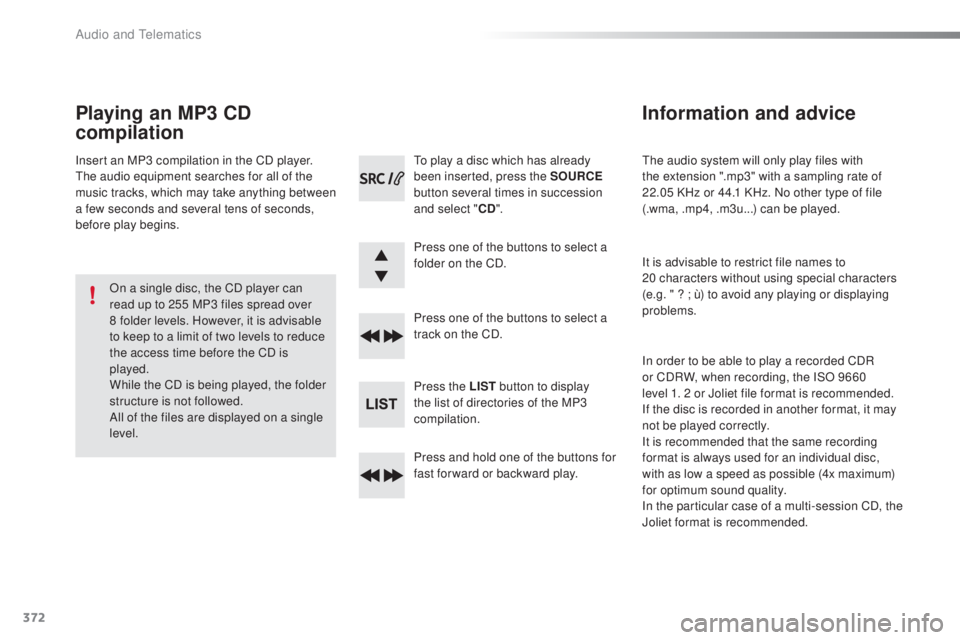
to play a disc which has already
b een inserted, press the SOURCE
button several times in succession
and select " CD".
Press one of the buttons to select a
folder on the CD.
Press one of the buttons to select a
track on the CD.
Press the LIST button to display
the list of directories of the MP3
compilation.
Press and hold one of the buttons for
fast for ward or backward play.
Playing an MP3 CD
compilation
Insert an MP3 compilation in the CD player.the a udio equipment searches for all of the
music tracks, which may take anything between
a few seconds and several tens of seconds,
before play begins.
On a single disc, the CD player can
read up to 255 MP3 files spread over
8 folder levels. However, it is advisable
to keep to a limit of two levels to reduce
the access time before the CD is
played.
While the CD is being played, the folder
structure is not followed.
All of the files are displayed on a single
level.
Audio and telematics
Page 375 of 398
373
308_en_Chap10d_RD45_ed02-2015
use only uSB memory sticks formatted FAt32
( File Allocation table ).
It is recommended that you use
genuine Apple
® uSB cables for correct
ope
ration.
*
In c
ertain cases, play of the audio files must
be initiated from the keypad.
** If the telephone supports the function.
Bluetooth® audio streaming
Streaming allows music files on the telephone
to be played via the audio system.
Connect the telephone: see the " Telephone"
section.
Select in the " Bluetooth: Telephone - Audio "
menu the telephone to be connected.
the a
udio system connects to a newly paired
telephone automatically.
Control of tracks to be played is via the buttons
on the audio system control panel and the
steering mounted controls**.
the c
ontextual
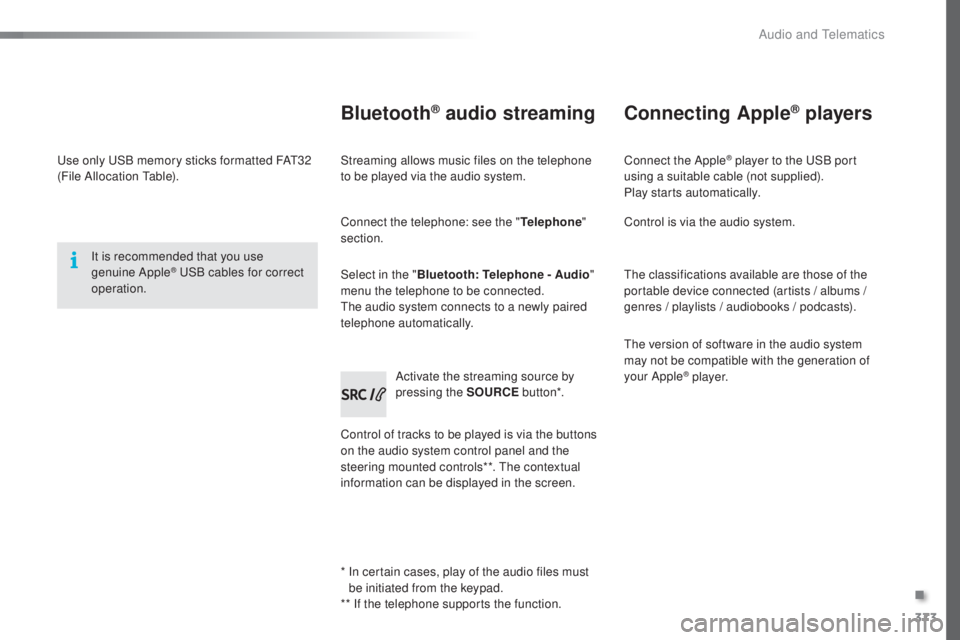
information can be displayed in the screen. Activate the streaming source by
pressing the SOURCE
but to n*.
Connecting Apple® players
Connect the Apple® player to the uSB port
using a suitable cable (not supplied).
Play starts automatically.
Control is via the audio system.
the c
lassifications available are those of the
portable device connected (artists / albums /
genres / playlists / audiobooks / podcasts).
the v
ersion of software in the audio system
may not be compatible with the generation of
your Apple
® p l aye r.
.
Audio and telematics
Page 383 of 398
381
308_en_Chap10d_RD45_ed02-2015
Media
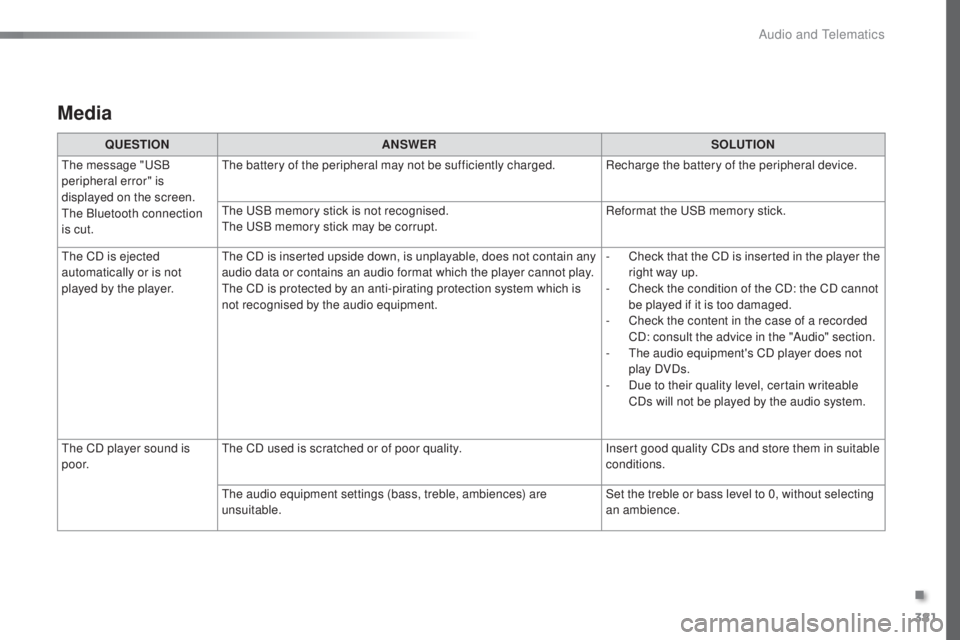
QUESTIONANSWER SOLUTION
the m
essage "
uSB
p
eripheral error" is
displayed on the screen.
the B
luetooth connection
is cut.
the b
attery of the peripheral may not be sufficiently charged. Recharge the battery of the peripheral device.
the uSB m
emory stick is not recognised.
the uSB m
emory stick may be corrupt. Reformat the
uSB m
emory stick.
the C
D is ejected
automatically or is not
played by the player.
the C
D is inserted upside down, is unplayable, does not contain any
audio data or contains an audio format which the player cannot play.
the C
D is protected by an anti-pirating protection system which is
not recognised by the audio equipment. -
Ch
eck that the CD is inserted in the player the
right way up.
-
Ch
eck the condition of the CD: the CD cannot
be played if it is too damaged.
-
Ch
eck the content in the case of a recorded
CD: consult the advice in the "Audio" section.
-
t
he a
udio equipment's CD player does not
play DVDs.
-
Du
e to their quality level, certain writeable
CDs will not be played by the audio system.
the C
D player sound is
p o o r.
the C
D used is scratched or of poor quality. Insert good quality CDs and store them in suitable
conditions.
the a
udio equipment settings (bass, treble, ambiences) are
unsuitable. Set the treble or bass level to 0, without selecting
an ambience.
.
Audio and telematics