2016 PEUGEOT 108 tow
[x] Cancel search: towPage 137 of 268
135
108_en_Chap06_securite_ed01-2016
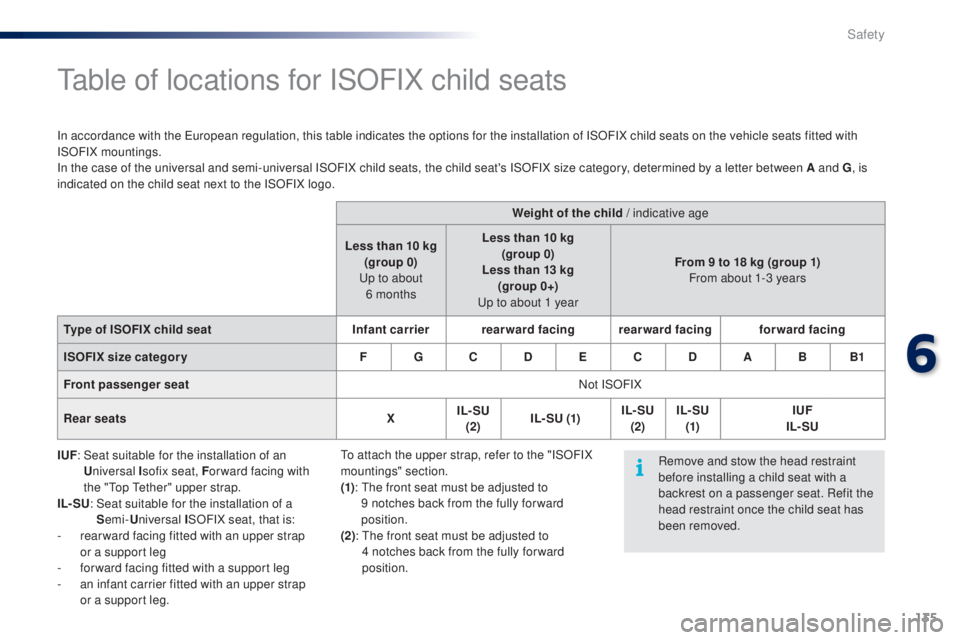
table of locations for ISOFIX child seats
In accordance with the european regulation, this table indicates the options for the installation of ISOFIX child seats on the vehicle seats fitted with
ISOFIX mountings.
In the case of the universal and semi-universal ISOFIX child seats, the child seat's ISOFIX size category, determined by a letter between A and
g
, i
s
indicated on the child seat next to the ISOFIX logo.
I
u
F:
S
eat suitable for the installation of an
un
iversal I sofix seat, F or ward facing with
the "
to
p t
e
ther" upper strap.
IL- S
u:
S
eat suitable for the installation of a
S emi-
un
iversal ISOFIX seat, that is:
-
r
ear ward facing fitted with an upper strap
or a support leg
-
f
or ward facing fitted with a support leg
-
a
n infant carrier fitted with an upper strap
or a support leg. Weight of the child / indicative age
Less than 10 kg (group 0)
up t
o about
6
monthsLess than 10 kg
(group 0)
Less than 13 kg (group 0+)
up t
o about 1 yearFrom 9 to 18 kg (group 1)
From about 1-3 years
ty
pe of IS
oF
IX child seat Infant carrierrearward facing rearward facing forward facing
IS
oF
IX size categor y F
gC DeC DABB1
F
ront passenger seat Not ISOFIX
Rear seats XIL- S
u
(2
)I L- S
u (
1)IL- S
u
(2
)IL- S
u
(
1)I
u
F
IL- S
u
R
emove and stow the head restraint
before installing a child seat with a
backrest on a passenger seat. Refit the
head restraint once the child seat has
been removed.
to a
ttach the upper strap, refer to the "ISOFIX
mountings" section.
(1) :
t
h
e front seat must be adjusted to
9
notches back from the fully for ward
position.
(2):
t
h
e front seat must be adjusted to
4
notches back from the fully for ward
position.
6
Safety
Page 138 of 268
136
108_en_Chap06_securite_ed01-2016
the incorrect installation of a child seat in a
vehicle compromises the child's protection in
the event of an accident.
Check that there is no seat belt or seat belt
buckle under the child seat as this could
destabilise it.
Remember to fasten the seat belts or the
child seat harnesses keeping the slack in
relation to the child's body to a minimum,
even for short journeys.
For the installation of a child seat using a
seat belt, ensure that this is well tensioned
on the child seat and that it is holding the
child seat firmly against the seat of your
vehicle. If your front passenger seat is
adjustable, move it forward if necessary.
At the rear seats, always leave sufficient
space between the front seat and:
-
a r
ear ward facing child seat,
-
t
he feet of a child seated in a for ward
facing child seat.
For this, move the front seat for ward and if
necessary straighten its backrest.
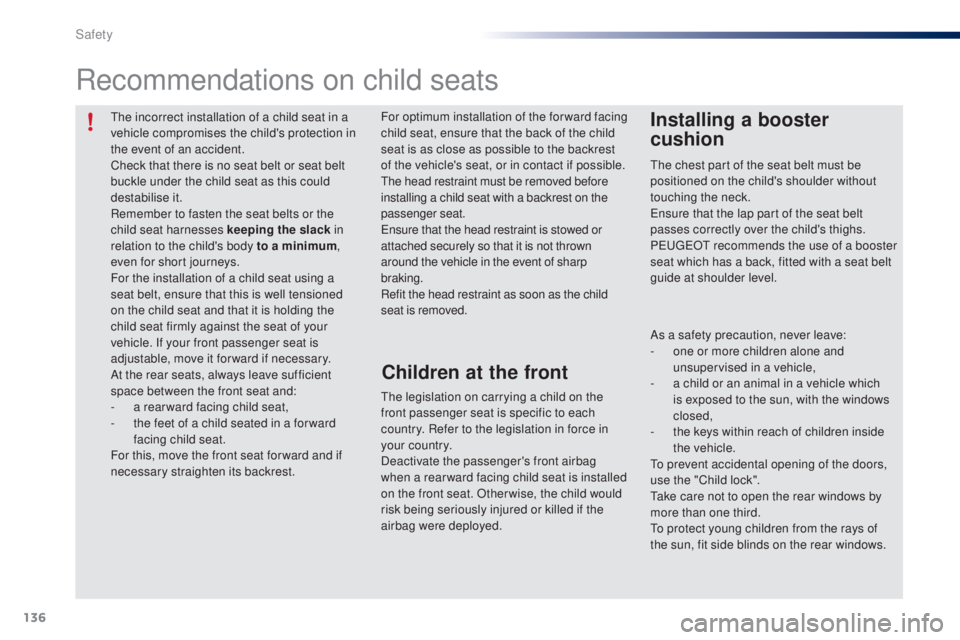
Recommendations on child seats
the chest part of the seat belt must be
positioned on the child's shoulder without
touching the neck.
en
sure that the lap part of the seat belt
passes correctly over the child's thighs.
P
e
uge
Ot
recommends the use of a booster
seat which has a back, fitted with a seat belt
guide at shoulder level.
As a safety precaution, never leave:
-
o
ne or more children alone and
unsupervised in a vehicle,
-
a c
hild or an animal in a vehicle which
is exposed to the sun, with the windows
closed,
-
t
he keys within reach of children inside
the vehicle.
to p
revent accidental opening of the doors,
use the "Child lock".
ta
ke care not to open the rear windows by
more than one third.
to p
rotect young children from the rays of
the sun, fit side blinds on the rear windows.
th
e legislation on carrying a child on the
front passenger seat is specific to each
country. Refer to the legislation in force in
your country.
Deactivate the passenger's front airbag
when a rear ward facing child seat is installed
on the front seat. Otherwise, the child would
risk being seriously injured or killed if the
airbag were deployed. For optimum installation of the forward facing
child seat, ensure that the back of the child
seat is as close as possible to the backrest
of the vehicle's seat, or in contact if possible.
th
e head restraint must be removed before
installing a child seat with a backrest on the
passenger seat.
en
sure that the head restraint is stowed or
attached securely so that it is not thrown
around the vehicle in the event of sharp
braking.
Refit the head restraint as soon as the child
seat is removed.
Installing a booster
cushion
Children at the front
Safety
Page 146 of 268
144
108_en_Chap07_info-pratiques_ed01-2016
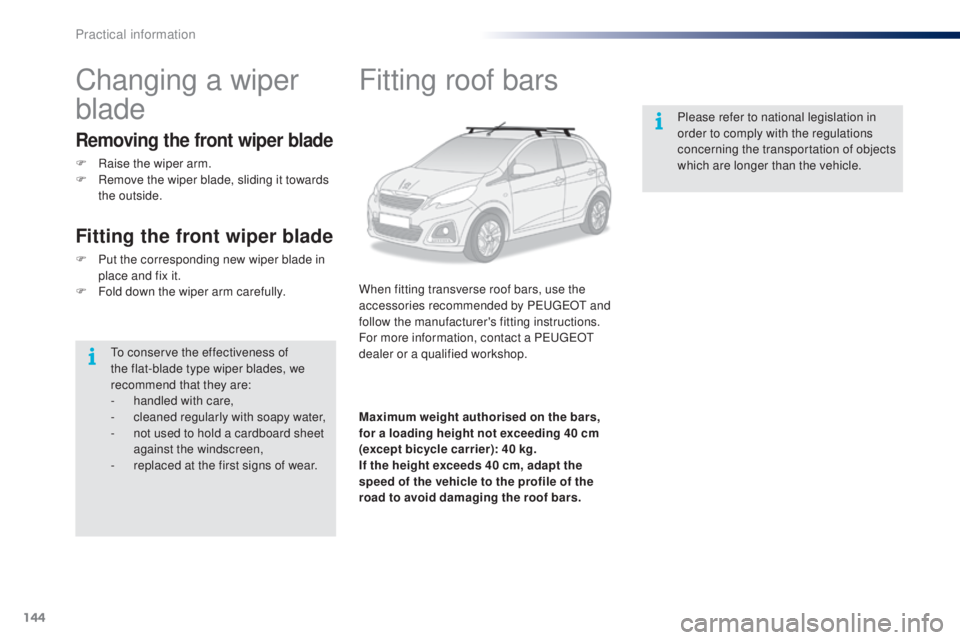
Fitting roof bars
When fitting transverse roof bars, use the
accessories recommended by PeugeOt and
follow the manufacturer's fitting instructions.
For more information, contact a P
e
uge
Ot
dealer or a qualified workshop. Please refer to national legislation in
order to comply with the regulations
concerning the transportation of objects
which are longer than the vehicle.
Maximum weight authorised on the bars,
for a loading height not exceeding 40 cm
(except bicycle carrier): 40 kg.
If the height exceeds 40 cm, adapt the
speed of the vehicle to the profile of the
road to avoid damaging the roof bars.
Changing a wiper
blade
Removing the front wiper blade
F Raise the wiper arm.
F R emove the wiper blade, sliding it towards
the outside.
Fitting the front wiper blade
F Put the corresponding new wiper blade in place and fix it.
F
F
old down the wiper arm carefully.
to c
onserve the effectiveness of
the flat-blade type wiper blades, we
recommend that they are:
-
han
dled with care,
-
c
leaned regularly with soapy water,
-
n
ot used to hold a cardboard sheet
against the windscreen,
-
r
eplaced at the first signs of wear.
Practical information
Page 148 of 268

146
108_en_Chap07_info-pratiques_ed01-2016
Bonnet
Do not open the bonnet when there is a
very strong wind.
When the engine is hot, handle the
exterior safety catch and the stay with
care (risk of burns).
F
P
ush the exterior safety catch to the left
and raise the bonnet. F u
n
clip the bonnet stay from its housing.
F
F
ix the stay in the notch to hold the bonnet
open.
opening
F Pull towards you the interior release lever, located in the lower dashboard.
th
e cooling fan may star t after
switching off the engine: take care
with articles and clothing that might
be caught by the fan blades.
Closing
F take the stay out of the support notch.
F C lip the stay in its housing.
F
L
ower the bonnet and release it near the
end of its travel.
F
P
ull on the bonnet to check that it is fully
latched.
Because of the presence of electrical
equipment under the bonnet, it is
recommended that exposure to water
(rain, washing, ...) be limited.
Practical information
Page 154 of 268
152
108_en_Chap07_info-pratiques_ed01-2016
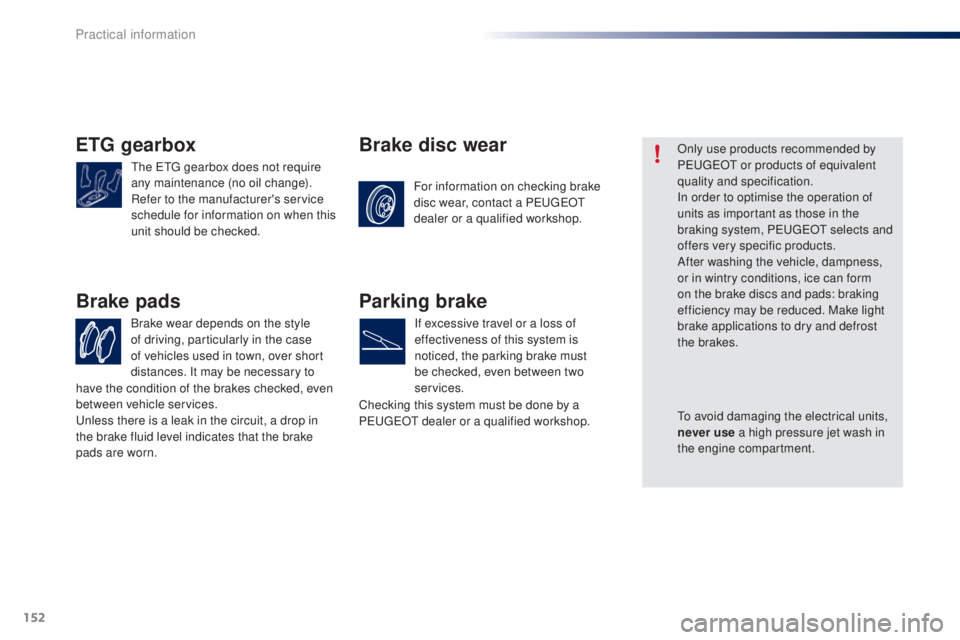
etg gearbox
the etg gearbox does not require
any maintenance (no oil change).
Refer to the manufacturer's service
schedule for information on when this
unit should be checked.
Brake wear depends on the style
of driving, particularly in the case
of vehicles used in town, over short
distances. It may be necessary to
Brake pads
For information on checking brake
disc wear, contact a Pe ugeOt
dealer or a qualified workshop.
Brake disc wearOnly use products recommended by
Pe ugeOt or products of equivalent
quality and specification.
In order to optimise the operation of
units as important as those in the
braking system, P
e
uge
Ot
selects and
offers very specific products.
After washing the vehicle, dampness,
or in wintry conditions, ice can form
on the brake discs and pads: braking
efficiency may be reduced. Make light
brake applications to dry and defrost
the brakes.
Parking brake
If excessive travel or a loss of
effectiveness of this system is
noticed, the parking brake must
be checked, even between two
services.
Checking this system must be done by a
P
e
uge
Ot
dealer or a qualified workshop.
have the condition of the brakes checked, even
between vehicle services.
un
less there is a leak in the circuit, a drop in
the brake fluid level indicates that the brake
pads are worn.
to a
void damaging the electrical units,
never use a high pressure jet wash in
the engine compartment.
Practical information
Page 156 of 268
154
108_en_Chap08_en-cas-pannes_ed01-2016
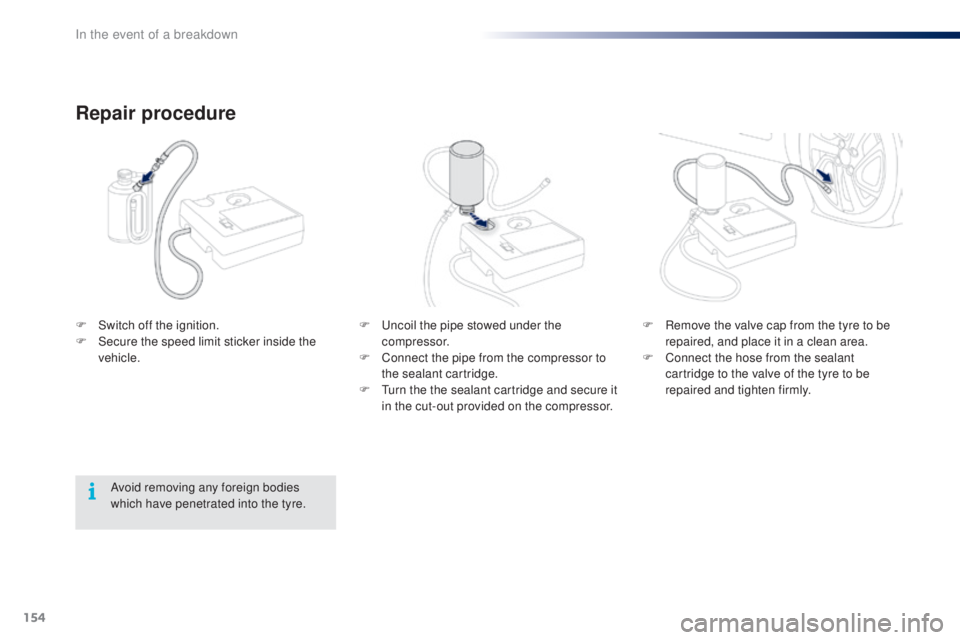
F uncoil the pipe stowed under the compressor.
F
C
onnect the pipe from the compressor to
the sealant cartridge.
F
t
u
rn the the sealant cartridge and secure it
in the cut-out provided on the compressor.
Repair procedure
Avoid removing any foreign bodies
which have penetrated into the tyre. F
R
emove the valve cap from the tyre to be
repaired, and place it in a clean area.
F
C
onnect the hose from the sealant
cartridge to the valve of the tyre to be
repaired and tighten firmly.
F
S
witch off the ignition.
F
S
ecure the speed limit sticker inside the
vehicle.
In the event of a breakdown
Page 157 of 268

155
108_en_Chap08_en-cas-pannes_ed01-2016
F Check that the compressor switch is at the "o" position.
F
u
n
coil fully the electric cable, stowed under
the compressor.
F
C
onnect compressor's plug to the vehicle's
12 V socket.
F
S
witch on the ignition.
ta
ke care, the sealant product is
harmful if swallowed and causes
irritation to the eyes.
Keep this product out of the reach of
children.
th
e use-by date is marked on the
cartridge.
After use, do not discard the
cartridge by the roadside, take it to a
P
e
uge
Ot
dealer or an authorised
waste disposal site.
Don't forget to obtain a new sealant
cartridge, available from a P
e
uge
Ot
dealer or a qualified workshop. If after around 5 to 7 minutes the
pressure is not attained, this indicates
that the tyre is not repairable; contact
a P
e
uge
Ot
dealer or a qualified
workshop for assistance.
F S tart the compressor by placing the switch
at the " I" position and leave it running until
the tyre pressure reaches 2.0 bar.
t
h
e sealant product is injected into the tyre
under pressure; do not disconnect the pipe
from the valve during this operation (risk of
splashing and stains).
8
In the event of a breakdown
Page 158 of 268
156
108_en_Chap08_en-cas-pannes_ed01-2016
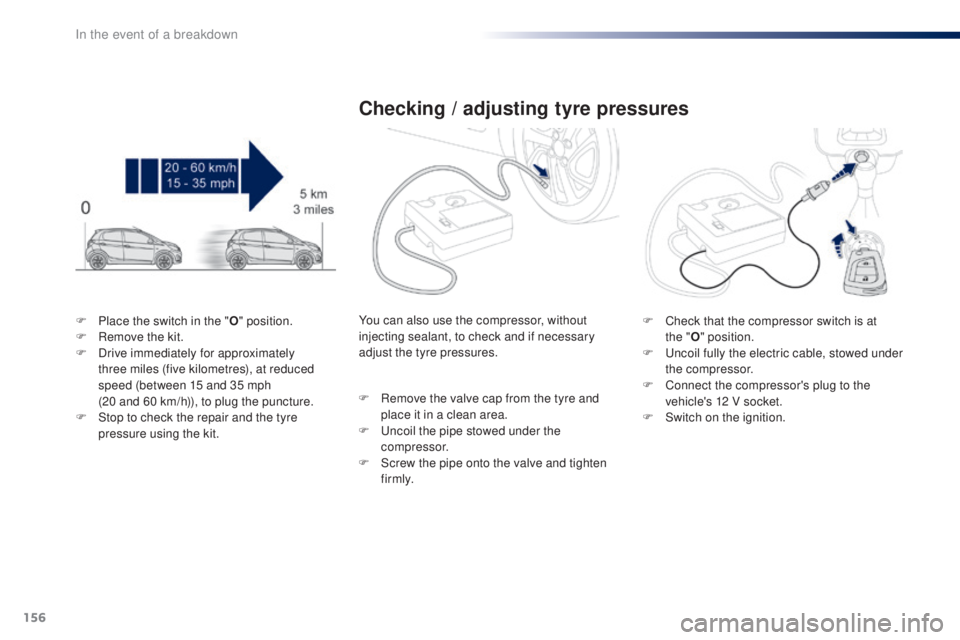
F Place the switch in the "o" position.
F R emove the kit.
F
D
rive immediately for approximately
three
miles (five kilometres), at reduced
speed (between 15 and 35 mph
(20 and 60
km/h)), to plug the puncture.
F
S
top to check the repair and the tyre
pressure using the kit.
Checking / adjusting tyre pressures
F Check that the compressor switch is at the "o" position.
F
u
n
coil fully the electric cable, stowed under
the compressor.
F
C
onnect the compressor's plug to the
vehicle's 12 V socket.
F
S
witch on the ignition.
You can also use the compressor, without
injecting sealant, to check and if necessary
adjust the tyre pressures.
F
R
emove the valve cap from the tyre and
place it in a clean area.
F
u
n
coil the pipe stowed under the
compressor.
F
S
crew the pipe onto the valve and tighten
f i r m l y.
In the event of a breakdown