2016 MITSUBISHI OUTLANDER III ECO mode
[x] Cancel search: ECO modePage 122 of 464
Theft-alarm system 5-46 Features and controls
5
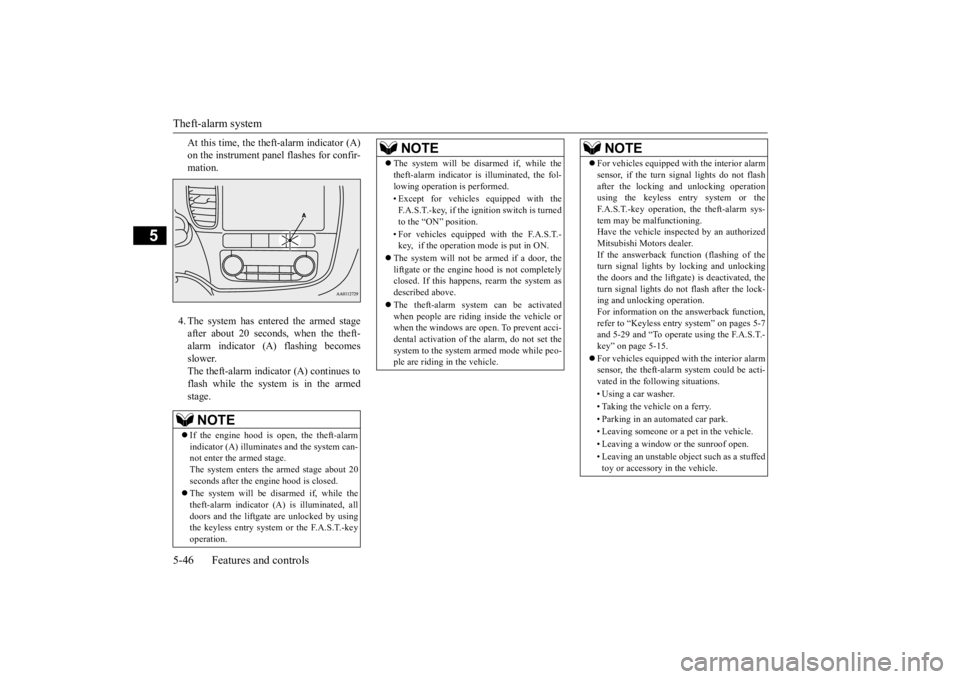
At this time, the theft-alarm indicator (A) on the instrument pane
l flashes for confir-
mation. 4. The system has entered the armed stage after about 20 seconds, when the theft-alarm indicator (A) flashing becomes slower. The theft-alarm indicator (A) continues toflash while the system is in the armed stage.NOTE
If the engine hood is open, the theft-alarm indicator (A) illuminates and the system can- not enter the armed stage. The system enters the armed stage about 20seconds after the engine hood is closed. The system will be disarmed if, while the theft-alarm indicator (A) is illuminated, all doors and the liftgate are unlocked by using the keyless entry system or the F.A.S.T.-keyoperation.
The system will be disarmed if, while the theft-alarm indicator is illuminated, the fol-lowing operation is performed. • Except for vehicles equipped with the F.A.S.T.-key, if the ignition switch is turnedto the “ON” position. • For vehicles equippe
d with the F.A.S.T.-
key, if the operation mode is put in ON.
The system will not be armed if a door, the liftgate or the engine
hood is not completely
closed. If this happens, rearm the system as described above. The theft-alarm system can be activated when people are riding inside the vehicle orwhen the windows are open. To prevent acci- dental activati
on of the alarm, do not set the
system to the system armed mode while peo-ple are riding in the vehicle.NOTE
For vehicles equipped wi
th the interior alarm
sensor, if the turn signal lights do not flashafter the locking a
nd unlocking operation
using the keyless entry system or the F.A.S.T.-key operation, the theft-alarm sys- tem may be ma
lfunctioning.
Have the vehicle inspected by an authorized Mitsubishi Motors dealer. If the answerback function (flashing of theturn signal lights by locking and unlocking the doors and the liftgate) is deactivated, the turn signal lights do not flash after the lock-ing and unlocking operation. For information on the answerback function, refer to “Keyless entry system” on pages 5-7and 5-29 and “To operate using the F.A.S.T.- key” on page 5-15. For vehicles equipped wi
th the interior alarm
sensor, the theft-alarm
system could be acti-
vated in the following situations. • Using a car washer. • Taking the vehicle on a ferry. • Parking in an automated car park.• Leaving someone or a pet in the vehicle. • Leaving a window or the sunroof open. • Leaving an unstable objec
t such as a stuffed
toy or accessory in the vehicle.NOTE
BK0223400US.book 46 ページ 2015年2月13日 金曜日 午後12時15分
Page 124 of 464
Theft-alarm system 5-48 Features and controls
5
be deactivated when parking in automated car parks or leaving pets in the vehicle. 1. Except for vehicles
equipped with the
F.A.S.T.-key, remove the key from the ignition switch. For vehicles equipped with the F.A.S.T.-key, put the operation mode in OFF. 2. Raise and hold the wiper and washer switch to the “MIST” position for about 3seconds. The buzzer will sound once and the function will
be deactivated.
To activate the function again, raise and hold the wiper and washer switch to the “MIST” position for about 3 seconds. The buzzer will sound
twice and the function
will be activated.
N00510501172
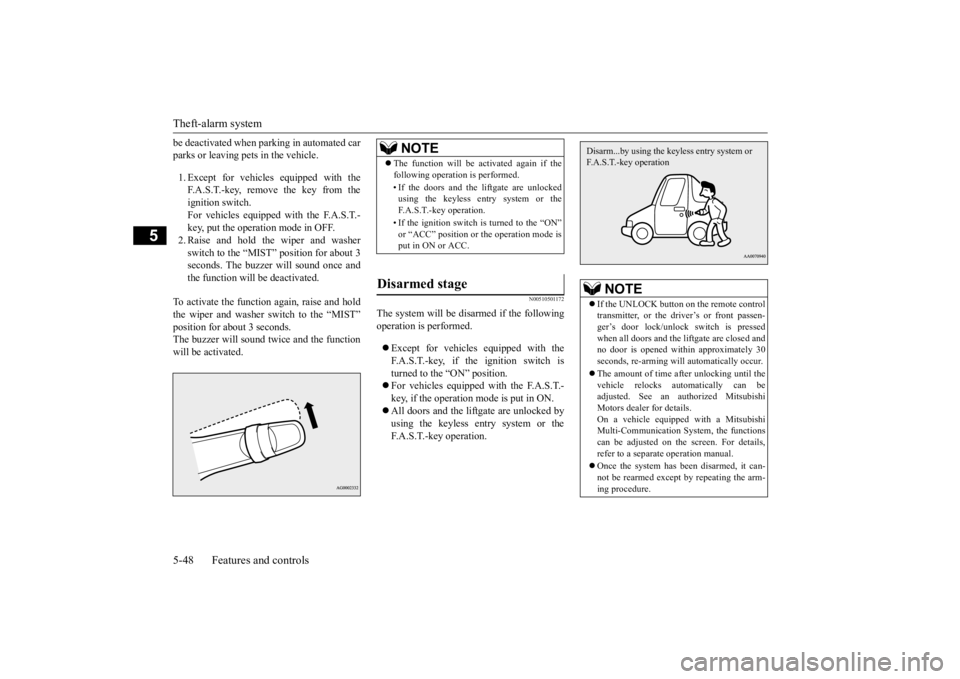
The system will be disarmed if the followingoperation is performed. Except for vehicles equipped with the F.A.S.T.-key, if the ignition switch is turned to the “ON” position. For vehicles equipped with the F.A.S.T.- key, if the operation mode is put in ON. All doors and the lift
gate are unlocked by
using the keyless entry system or the F.A.S.T.-key operation.NOTE
The function will be activated again if the following operation is performed. • If the doors and the liftgate are unlocked using the keyless entry system or the F.A.S.T.-key operation. • If the ignition switch is turned to the “ON” or “ACC” position or
the operation mode is
put in ON or ACC.
Disarmed stage
NOTE
If the UNLOCK button on the remote control transmitter, or the driver’s or front passen-ger’s door lock/unlock switch is pressed when all doors and the li
ftgate are closed and
no door is opened with
in approximately 30
seconds, re-arming will
automatically occur.
The amount of time after unlocking until the vehicle relocks automatically can be adjusted. See an authorized Mitsubishi Motors dealer for details.On a vehicle equippe
d with a Mitsubishi
Multi-Communication System, the functions can be adjusted on the screen. For details,refer to a separa
te operation manual.
Once the system has been disarmed, it can- not be rearmed except
by repeating the arm-
ing procedure.Disarm...by using the keyless entry system or F.A.S.T.-key operation
BK0223400US.book 48 ページ 2015年2月13日 金曜日 午後12時15分
Page 126 of 464
Power window control 5-50 Features and controls
5
N00548701137
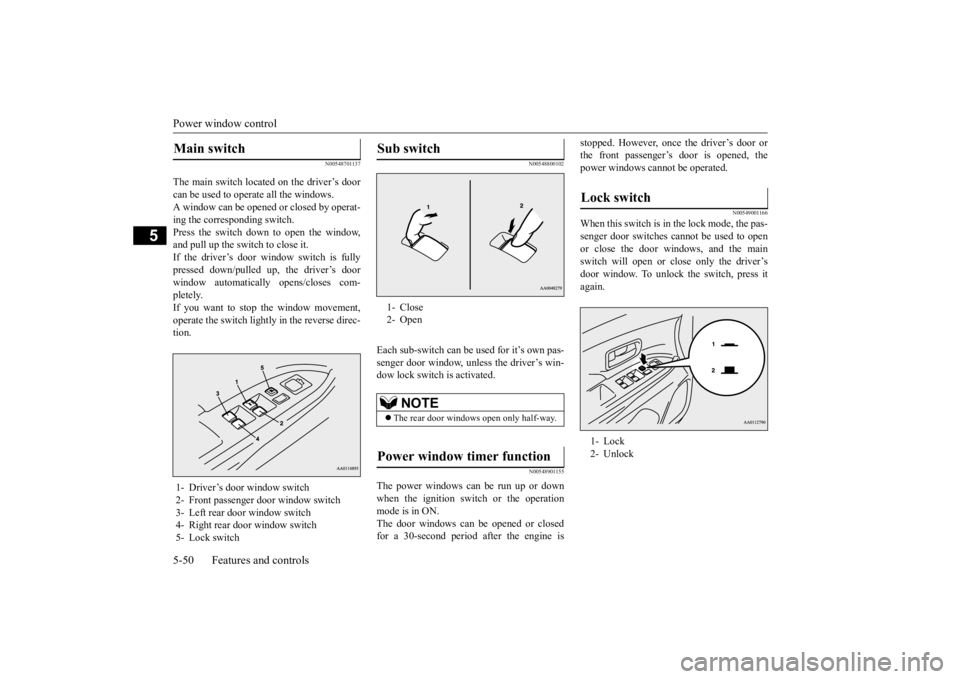
The main switch located on the driver’s door can be used to operate all the windows.A window can be opened or closed by operat- ing the corresponding switch. Press the switch down to open the window,and pull up the switch to close it. If the driver’s door window switch is fully pressed down/pulled up, the driver’s door window automatically opens/closes com- pletely.If you want to stop the window movement, operate the switch lightly in the reverse direc- tion.
N00548800102
Each sub-switch can be used for it’s own pas-senger door window, unless the driver’s win-dow lock switch is activated.
N00548901155
The power windows can be run up or downwhen the ignition switch or the operationmode is in ON. The door windows can be opened or closed for a 30-second period after the engine is
stopped. However, once the driver’s door or the front passenger’s door is opened, thepower windows cannot be operated.
N00549001166
When this switch is in the lock mode, the pas-senger door switches cannot be used to open or close the door windows, and the main switch will open or
close only the driver’s
door window. To unlock the switch, press it again.
Main switch 1- Driver’s door window switch2- Front passenger door window switch 3- Left rear door window switch 4- Right rear door window switch5- Lock switch
Sub switch 1- Close2- Open
NOTE
The rear door windows open only half-way.
Power window timer function
Lock switch 1- Lock 2- Unlock
BK0223400US.book 50 ページ 2015年2月13日 金曜日 午後12時15分
Page 127 of 464
Sunroof (if so equipped)
Features and controls 5-51
5
N00528801129
If a hand or head is trapped, for safety the door window is automati
cally lowered a little.
After the obstruction is removed, pull up the switch again to close the door window.
N00551400014
Wind buffeting can be described as the per-ception of pressure on the ears or a boomingor rumbling sound. Your vehicle may exhibit wind buffeting when driving with one or both rear door windows down or partially opened.This is a normal occurrence that can be mini- mized. If the buffeting
occurs with the rear
door windows open, open the front door win- dows as well as the rear door windows to minimize the condition.
N00511001682
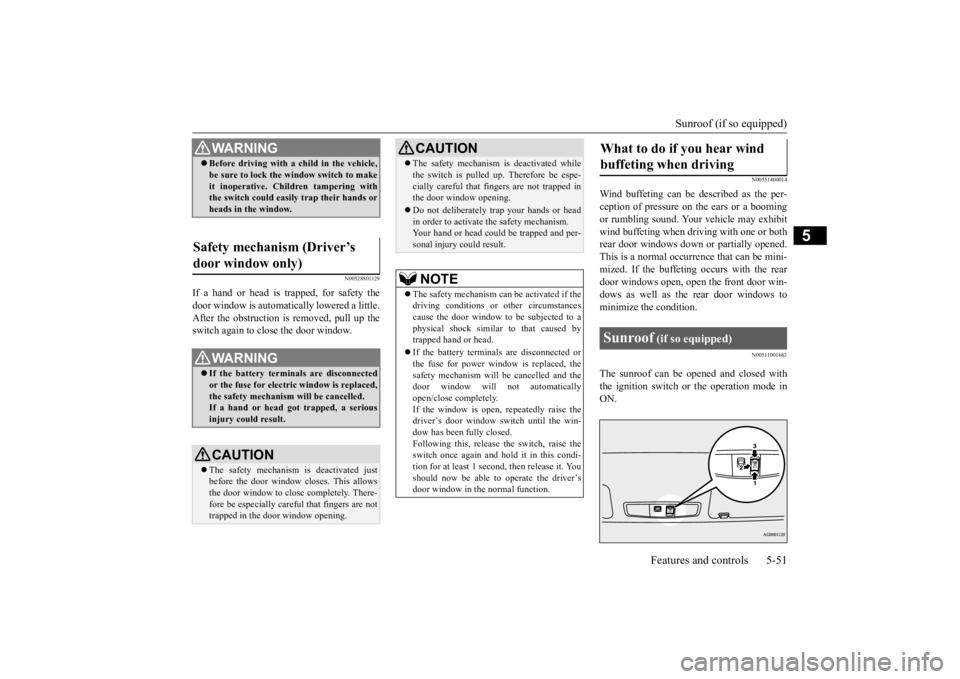
The sunroof can be ope
ned and closed with
the ignition switch or the operation mode in ON.
WA R N I N G Before driving with a child in the vehicle, be sure to lock the window switch to makeit inoperative. Children tampering withthe switch could easily trap their hands or heads in the window.
Safety mechanism (Driver’s door window only)
WA R N I N G If the battery terminals are disconnected or the fuse for electric window is replaced, the safety mechanism will be cancelled.If a hand or head got
trapped, a serious
injury could result.CAUTION The safety mechanism is deactivated just before the door window closes. This allows the door window to close completely. There-fore be especially care
ful that fingers are not
trapped in the door window opening.
The safety mechanism is deactivated while the switch is pulled up.
Therefore be espe-
cially careful that fi
ngers are not trapped in
the door window opening. Do not deliberately trap your hands or head in order to activate the safety mechanism. Your hand or head coul
d be trapped and per-
sonal injury could result.NOTE
The safety mechanism can be activated if the driving conditions or
other circumstances
cause the door window to be subjected to a physical shock similar to that caused by trapped hand or head. If the battery terminals are disconnected or the fuse for power window is replaced, thesafety mechanism will
be cancelled and the
door window will not automatically open/close completely.If the window is open,
repeatedly raise the
driver’s door window switch until the win- dow has been fully closed.Following this, release the switch, raise theswitch once again and hold it in this condi- tion for at least 1 second, then release it. You should now be able to operate the driver’sdoor window in the normal function.CAUTION
What to do if you hear wind buffeting when driving Sunroof
(if so equipped)
BK0223400US.book 51 ページ 2015年2月13日 金曜日 午後12時15分
Page 128 of 464
Sunroof (if so equipped) 5-52 Features and controls
5
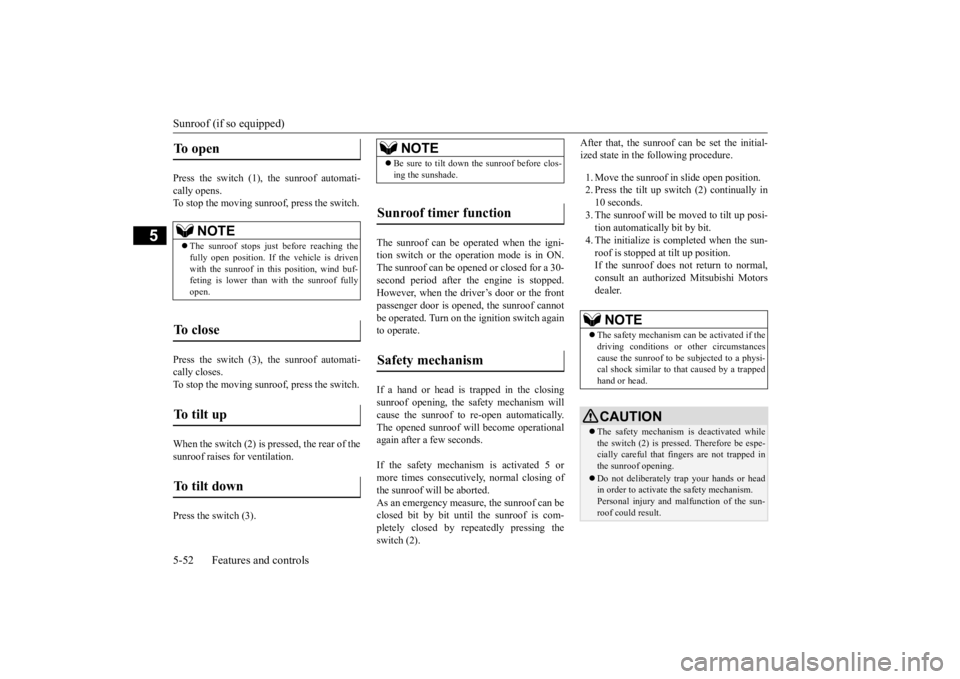
Press the switch (1), the sunroof automati- cally opens. To stop the moving sunroof, press the switch. Press the switch (3), the sunroof automati- cally closes. To stop the moving sunroof, press the switch. When the switch (2) is pressed, the rear of the sunroof raises for ventilation. Press the switch (3).
The sunroof can be operated when the igni- tion switch or the operation mode is in ON.The sunroof can be opened or closed for a 30- second period after th
e engine is stopped.
However, when the driver’s door or the frontpassenger door is opene
d, the sunroof cannot
be operated. Turn on the ignition switch again to operate. If a hand or head is trapped in the closing sunroof opening, the safety mechanism willcause the sunroof to re-open automatically. The opened sunroof will
become operational
again after a few seconds. If the safety mechanism is activated 5 or more times consecutively, normal closing ofthe sunroof will be aborted. As an emergency measure, the sunroof can be closed bit by bit until the sunroof is com-pletely closed by re
peatedly pressing the
switch (2).
After that, the sunroof can be set the initial- ized state in the following procedure. 1. Move the sunroof
in slide open position.
2. Press the tilt up switch (2) continually in 10 seconds. 3. The sunroof will be moved to tilt up posi-tion automatically bit by bit. 4. The initialize is completed when the sun- roof is stopped at tilt up position.If the sunroof does not return to normal, consult an authorized Mitsubishi Motors dealer.
To open
NOTE
The sunroof stops just before reaching the fully open position. If
the vehicle is driven
with the sunroof in this position, wind buf- feting is lower than with the sunroof fullyopen.
To close
To t i l t u p
To t i l t d o w n
NOTE
Be sure to tilt down the sunroof before clos- ing the sunshade.
Sunroof timer function
Safety mechanism
NOTE
The safety mechanism can be activated if the driving conditions or other circumstances cause the sunroof to be
subjected to a physi-
cal shock similar to th
at caused by a trapped
hand or head.CAUTION The safety mechanism is deactivated while the switch (2) is pressed. Therefore be espe- cially careful that fi
ngers are not trapped in
the sunroof opening. Do not deliberately trap your hands or head in order to activate the safety mechanism.Personal injury and malfunction of the sun- roof could result.
BK0223400US.book 52 ページ 2015年2月13日 金曜日 午後12時15分
Page 134 of 464
Outside rearview mirrors 5-58 Features and controls
5
N00549101167
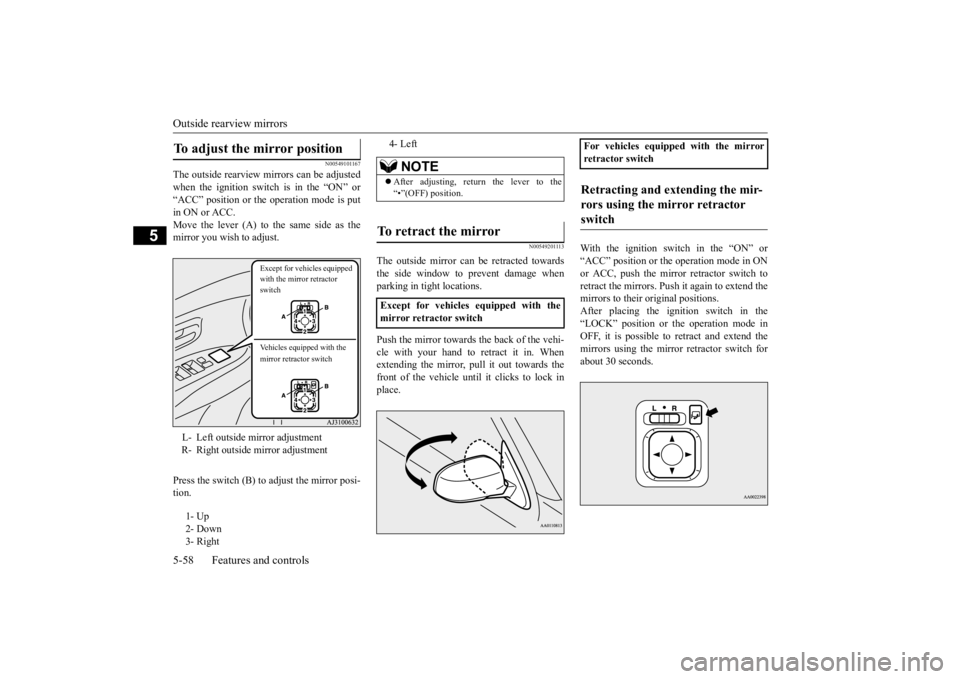
The outside rearview mirrors can be adjusted when the ignition switch is in the “ON” or “ACC” position or the operation mode is putin ON or ACC. Move the lever (A) to the same side as the mirror you wish to adjust. Press the switch (B) to adjust the mirror posi- tion.
N00549201113
The outside mirror can
be retracted towards
the side window to prevent damage when parking in tight locations. Push the mirror towards the back of the vehi- cle with your hand to retract it in. When extending the mirror, pull it out towards thefront of the vehicle until it clicks to lock in place.
With the ignition switch in the “ON” or “ACC” position or the
operation mode in ON
or ACC, push the mirror retractor switch to retract the mirrors. Push it again to extend the mirrors to their original positions.After placing the ignition switch in the “LOCK” position or the operation mode in OFF, it is possible to
retract and extend the
mirrors using the mirror retractor switch for about 30 seconds.
To adjust the mirror position L- Left outside mirror adjustment R- Right outside mirror adjustment 1- Up 2- Down 3- Right
Except for vehicles equipped with the mirror retractor switch Vehicles equipped with the mirror retractor switch
4- Left
NOTE
After adjusting, return the lever to the “•”(OFF) position.
To retract the mirror Except for vehicles equipped with the mirror retractor switch
For vehicles equipped with the mirror retractor switchRetracting and extending the mir- rors using the mirror retractor switch
BK0223400US.book 58 ページ 2015年2月13日 金曜日 午後12時15分
Page 139 of 464

Starting the engine
Features and controls 5-63
5
This model is equipped with an electronically controlled fuel injection system. This is a sys-tem that automatically controls fuel injection. There is usually no need to depress the accel- erator pedal when starting the engine.The starter should not be run for more than 15 seconds at a time. To prevent battery drai
n, wait a few seconds
between attempts to restart the engine. 1. Make sure all occupants are properly seated with seat belts fastened.
2. Insert the ignition key. 3. Press and hold the brake pedal down withyour right foot. 4. Make sure the selector
lever is in the “P”
(PARK) position.5. Turn the ignition switch to the “ON” posi- tion and make certain that all warning lights are functioning properly beforestarting the engine. 6. Turn the ignition switch to the “START” position without pre
ssing the accelerator
pedal. Release the
ignition switch when
the engine starts.
After several attempts
, you may experience
that the engine still does not start. 1. Make sure that all electric devices, such as lights, air conditi
oning blower and rear
window defogger, are turned off.
2. While depressing the brake pedal, press the accelerator peda
l halfway and hold it
there, then crank the engine. Release the accelerator pedal, immediately after the engine starts.3. If the engine still wi
ll not start, the engine
could be flooded with too much gasoline. While depressing the brake pedal, pushthe accelerator pedal all the way down and hold it there, then crank the engine for 5 to 6 seconds. Return the ignition switch to the “OFF” or “LOCK” position and release the accelerator pedal. Wait a fewseconds, and then crank the engine again for 5 to 6 seconds while depressing the brake pedal, but do
not push the accelera-
tor pedal. Release the ignition key if the engine starts. If the e
ngine fails to start,
repeat these procedures
. If the engine still
will not start, contact your local Mitsubi- shi Motors dealer or a repair facility of your choice for assistance.
When the ambient temperature is -22 °F (-30 °C) or lower, it may not be possible to startfrom a standstill even with the selector lever
WA R N I N G Never run the engine in
a closed or poorly
ventilated area any lo
nger than is needed
to move your vehicle out of the area. Car-bon monoxide gas, whic
h is odorless and
extremely poisonous, could build up and cause serious injury or death.CAUTION Do not push-start the vehicle.Do not run the engine at high rpms or drive at high speeds until th
e engine has had a
chance to warm up. Release the ignition sw
itch as soon as the
engine starts. Otherwise, the starter motor will be damaged
Starting the engine
NOTE
Minor noises may be he
ard on engine start-
up. These will disappear
as the engine warms
up.
When the engine is hard to start
Startability of automatic transaxle vehicle and CVT vehicle with ambient temperature of -22 °F (-30 °C) or lower
BK0223400US.book 63 ページ 2015年2月13日 金曜日 午後12時15分
Page 140 of 464

Automatic transaxle (if so equipped) 5-64 Features and controls
5
in the “D” (DRIVE) or “R” (REVERSE) position.This occurs because the transaxle has not warmed up sufficiently; it does not indicate a problem. If this occurs
, place the selector
lever in the “P” (PARK) position and let the engine idle for at least 10 minutes. The transaxle will wa
rm up, and you will be
able to start normally. Do not leave the vehicle during warm-up operation. The MIVEC engine automatically switches its intake-valve contro
l between a low-speed
mode and a high-speed mode in accordance with driving conditions for maximum engineperformance.
N00513200216
Automatic transaxle will automaticallychange its gear depending on road and driv-ing conditions. This
helps achieve smooth
driving and excellent fuel efficiency. Also you can manually shift up and shiftdown the transaxle. Refer to “Sports mode” on page 5-68. The transaxle prevents unnecessary upshifts even when the accelerator pedal is releasedand ensures smooth driving. According to the conditions, the transaxle will automatically shift to a lower gear to achieve stronger engine
braking. This may
help reduce your need to use the servicebrake.
N00513801408
As an additional safe
ty precaution, models
equipped with an automatic transaxle have a shift-lock device that
holds the selector lever
in the “P” (PARK) position. To move theselector lever from the “P” (PARK) position to another position, follow the steps below. 1. Press and hold the brake pedal down. 2. Move the selector
lever to the desired
position.
The transaxle has 6 forward gears and 1 reverse gear.
Using the MIVEC engine
NOTE
To protect the engine, the high-speed mode may not be selected wh
ile the engine coolant
temperature is low. In such a case, the engine revolutions do not rise to over 5,000 rpmeven if the accelerator pedal is depressed.
Automatic transaxle
(if so
equipped)DRIVING UPHILL
DRIVING DOWNHILL
NOTE
During the break-in pe
riod or immediately
after reconnecting the
battery, your vehicle
may not shift smoothly. This does not indi-cate a problem in the transaxle. Shifting will become smoother once the transaxle has been shifted several
times by the electronic
control system.
Selector lever operation
NOTE
The selector lever ca
nnot be moved from “P”
(PARK) to another pos
ition if the operation
mode is put in OFF or
ACC, or if the brake
pedal is not pressed and held down.
BK0223400US.book 64 ページ 2015年2月13日 金曜日 午後12時15分