2016 MERCEDES-BENZ G-Class service
[x] Cancel search: servicePage 293 of 302

If standard unleaded gasoline is unavailable
and you have to refuel with unleaded gasoline
of a lower grade, observe the following pre-
cautions:
ROnly fill the fuel tank to half full with regular unleaded gasoline and fill the rest with pre-
mium-grade unleaded gasoline as soon as
possible.
RDo not drive at the maximum speed.
RAvoid sudden acceleration and engine
speeds over 3,000 rpm.
You will usually find information about the fuel
grade on the pump. If you cannot find the label
on the pump, ask the staff for assistance.
iFor further information, consult a qualified
specialist workshop or visit
http://www.mbusa.com (USA only).
iE10 fuel contains up to 10% bioethanol.
Your vehicle is E10-compatible. You can
refuel your vehicle using E10 fuel.
As a temporary measure, if the recommended
fuel is not available, you may also use regular
unleaded gasoline with an octane rating of
87 AKI/91 RON. This may reduce engine per-
formance and increase fuel consumption. Avoid
driving at full throttle and sudden acceleration.
Never refuel using fuel with a lower AKI.
Information on refueling (
Ypage 127).
AMG vehicles
!Only refuel using super-grade unleaded gas-
oline with at least 98 RON/88 MON that con-
forms to European standard EN 228 or an
equivalent specification.
You could otherwise impair engine output or
damage the engine.
!Premium-grade unleaded gasoline with an
octane rating of 95 RON/85 MON may be
used as a temporary measure if the recom-
mended fuel is not available. This may reduce
engine performance and increase fuel con-
sumption. Do not drive at full throttle.
!Regular unleaded gasoline with an octane
rating of 91 RON/82.5 MON may also be
used as an emergency measure if the recom-
mended fuel is not available.
Doing so results in noticeably higher fuel con- sumption, and the engine power output is
noticeably reduced. Avoid driving at full throt-
tle. If only regular unleaded gasoline with an
octane ra
ting of 91 RON/82.5 MON or lower
is available, you must have the vehicle adap-
ted to this fuel at a qualified specialist work-
shop.
Additives
!Operating the engine with fuel additives
added later can lead to engine failure. Do not
mix fuel additives with fuel. This does not
include additives for the removal and preven- tion of residue buildup. gasoline must only be
mixed with additives recommended by
Mercedes-Benz. Comply with the instructions
for use on the product label. More information
about recommended additives can be
obtained from any authorized Mercedes-Benz
Center.
Mercedes-Benz recommends that you use bran-
ded fuels that have additives.
The quality of the fuel available in some coun-
tries may not be sufficient. Residue could build
up in the fuel injection system as a result. In
such cases, and in consultation with an author-
ized Mercedes-Benz Center, the gasoline may
be mixed with the cleaning additive recommen-
ded by Mercedes-Benz. You must observe the
notes and mixing ratios specified on the con-
tainer.
Fuel consumption information
HEnvironmental note
CO
2(carbon dioxide) is the gas which scien-
tists believe to be principally responsible for
global warming (the greenhouse effect). Your
vehicle's CO
2emissions are directly related to
fuel consumption and therefore depend on:
Refficient use of the fuel by the engine
Rdriving style
Rother non-technical factors, such as envi-
ronmental influences, road conditions or
traffic flow
You can minimize your vehicle's CO
2emis-
sions by driving carefully and having it serv-
iced regularly.
Service products and filling capacities291
Technical data
Z
Page 294 of 302
The vehicle will use more fuel than usual in the
following situations:
Rat very low outside temperatures
Rin city traffic
Ron short journeys
Rin mountainous terrain
Rwhen towing a trailer
Engine oil
General notes
!Never use engine oil or an oil filter of a spec-
ification other than is necessary to fulfill the
prescribed service intervals. Do not change
the engine oil or oil filter in order to achieve
longer replacement intervals than those pre-
scribed. You could otherwise cause engine
damage or damage to the exhaust gas after-
treatment.
Follow the instructions in the service interval display regarding the oil change. Otherwise,
you may damage the engine and the exhaust
gas aftertreatment.
When handling engine oil, observe the important
safety notes on service products (
Ypage 289).
The engine oils are matched to the performance
of Mercedes-Benz engines and service intervals.
For this reason, only use engine oils and oil fil-
ters that are approved for vehicles with a service
system.
For a list of approved engine oils and oil filters,
consult an authorized Mercedes-Benz Center or
go to the Internet site
http://bevo.mercedes-benz.com (USA only).
The table shows which engine oils have been
approved for your vehicle.
ModelMB-Freigabe or MB
Approval
G 550229.3 / 229.5
G 63 AMG229.5
iThe MB-Freigabe or MB Approval is stated
on the oil containers.
Filling capacities
The following values refer to an oil change
including the oil filter.
Vehicle modelCapacity including oil filter
G 5502.4 US gal (9.0 l)
G 63 AMG2.25 US gal (8.5 l)
Additives
!Do not use any additives in the engine oil.
This could damage the engine.
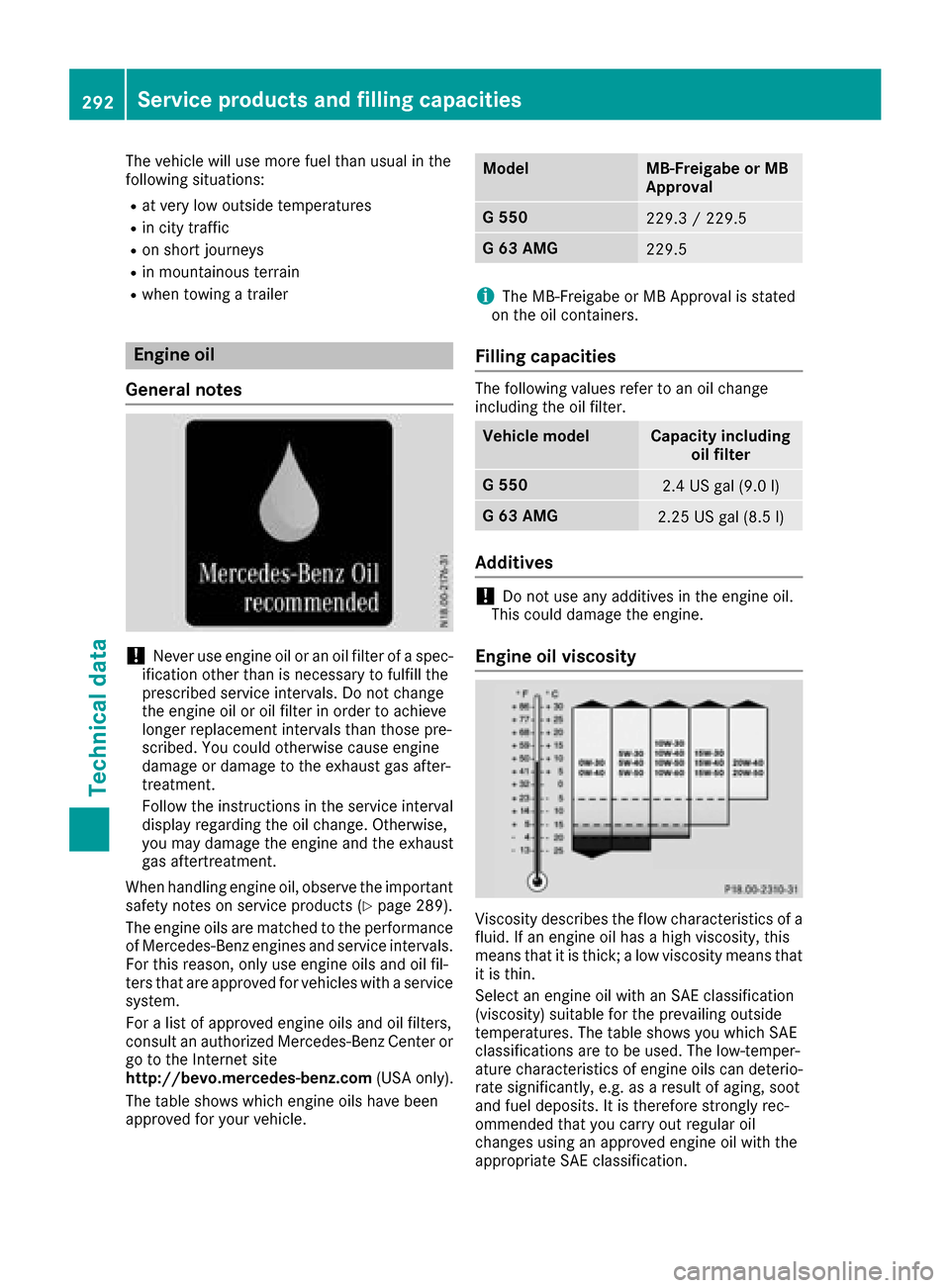
Engine oil viscosity
Viscosity describes the flow characteristics of a
fluid. If an engine oil has a high viscosity, this
means that it is thick; a low viscosity means that it is thin.
Select an engine oil with an SAE classification
(viscosity) suitable for the prevailing outside
temperatures. The table shows you which SAE
classifications are to be used. The low-temper-
ature characteristics of engine oils can deterio-
rate significantly, e.g. as a result of aging, soot
and fuel deposits. It is therefore strongly rec-
ommended that you carry out regular oil
changes using an approved engine oil with the
appropriate SAE classification.
292Service products and filling capacities
Technical data
Page 295 of 302

Climate control system refrigerant
Important safety notes
The climate control system of your vehicle is fil-
led with refrigerant R‑ 134a.
The instruction label regarding the refrigerant
type used can be found on the radiator cross
member.
!Only the refrigerant R ‑134a and the PAG oil
approved by Mercedes-Benz may be used.
The approved PAG oil may not be mixed with
any other PAG oil that is not approved for
R-134a refrigerant. Otherwise, the climate
control system may be damaged.
Service work, such as topping up refrigerant or
replacing components, may only be carried out
by a qualified specialist workshop. All applicable
regulations must be adhered to, SAE standard
J639 included.
Always have work on the climate control system
carried out at a qualified specialist workshop.
Refrigerant instruction label
Example :refrigeran tinstruction label
:
Warning symbol
;Refrigerant filling capacity
=Applicable standards
?PAG oil part number
AType of refrigerant
Warning symbol :advises you about:
Rpossible dangers
Rhaving service work carried out at a qualified
specialist workshop
Filling capacities
Missing values were not available at time of
going to print.
AMG vehiclesCapacity
Refrigerant
PAG oil
All other modelsCapacity
Refrigerant
PAG oil
Brake fluid
GWARNING
The brake fluid constantly absorbs moisture
from the air. This lowers the boiling point of
the brake fluid. If the boiling point of the brake
fluid is too low, vapor pockets may form in the
brake system when the brakes are applied
hard. This would impair braking efficiency.
There is a risk of an accident.
You should have the brake fluid renewed at
the specified intervals.
When handling brake fluid, observe the impor-
tant safety notes on service products
(
Ypage 289).
The brake fluid change intervals can be found in
the Maintenance Booklet.
Only use brake fluid approved by Mercedes-
Benz according to MB-Freigabe or MB Approval
331.0.
Information about approved brake fluid can be
obtained at any qualified specialist workshop or on the Internet at
http://bevo.mercedes-benz.com.
iHave the brake fluid regularly replaced at a
qualified specialist workshop and the replace-
ment confirmed in the Maintenance Booklet.
Service products and filling capacities293
Technical data
Z
Page 296 of 302

Coolant
Important safety notes
GWARNING
If antifreeze comes into contact with hot com- ponents in the engine compartment, it may
ignite. There is a risk of fire and injury.
Let the engine cool down before you add anti-
freeze. Make sure that antifreeze is not spilled
next to the filler neck. Thoroughly clean the
antifreeze from components before starting
the engine.
!Only add coolant that has been premixed
with the desired antifreeze protection. You
could otherwise damage the engine.
Further information on coolants can be found
in the Mercedes-Benz Specifications for Ser-
vice Products, MB BeVo 310.1, e.g. on the
Internet at http://bevo.mercedes-benz.com.
Or contact a qualified specialist workshop.
!Always use a suitable coolant mixture, even
in countries where high temperatures prevail.
Otherwise, the engine cooling system is not
sufficiently protected from corrosion and
overheating.
iHave the coolant regularly replaced at a
qualified specialist workshop and the replace-
ment confirmed in the Maintenance Booklet.
Comply with the important safety precautions
for service products when handling coolant
(
Ypage 289).
The coolant is a mixture of water and anti-
freeze/corrosion inhibitor. It performs the fol-
lowin g t
asks:
Rcorrosion protection
Rantifreeze protection
Rraising the boiling point
If the coolant has antifreeze protection down to -35 ‡(-37 †), the boiling point of the coolant in
the pressurized system is approximately 266 ‡ (130 †). The antifreeze/corrosion inhibitor concentra-
tion in the engine cooling system should:
Rbe at least 50%. This will protect the engine
cooling system against freezing down to
approximately -35 ‡ (-37 †).
Rnot exceed 55% (antifreeze protection down
to -49
‡[-45 †]) .Otherwise ,hea twill no tbe
dissipated as effectively.
Mercedes-Ben zrecommends an antifreeze/
corrosion inhibitor in accordance wit hMB Spec -
ification sfo rServic eProducts 310.1.
iWhe nth evehicle is first delivered, it is filled
wit h a coolan tmixture that ensures adequat e
antifreez ean dcorrosion protection .
iThe coolantis checke dwit hever ymainte-
nanc einterval at aqualifie dspecialis twork-
shop.
The engin ecoolin gsyste mis filled wit hcoolan t
at th efactory whic hcontain santifreeze/corro-
sio ninhibitor that ensures protection down to
approximately -35 ‡(-37 †) .
Yo ur vehicle has a ran ge of alum
inum compo-
nents. Aluminum components in the engine
make itnecessary to use antifreeze/corrosion
inh ibit or that has been specific allyformulated to
protect the aluminum parts. Failure to use such
anticorrosion/antifreeze coolant willresult in a
significantly shortened service life.
The coolant must beused throughout the year in
order to maintain the necessary corrosion pro-
tection and to provide protection from over-
heating. Inthe Maintenance Booklet, you can
find information on the intervals for renewal.
The renewal interval is determined bythe cool-
ant type and the engine co oling system design.
The renewal interval in the Maintenance Booklet
is only valid if the coolant is renewed or added to
wit h Mercedes-Benz approved products. There-
fore, only use MB 326.0 antifreeze/corrosion
inh ibit or or another Mercedes-Benz approved
product of the same specification.
In formation on other products with the same
specifications that are approved byMercedes-
Benz can beobtained at an authorized
Mercedes-Benz Center or on the Internet at
ht tp://bevo.mercedes-benz.com .
If the coolant level is too low, MB 325.0 anti-
freeze/corrosion inh ibitor should beadded.
Have the engine co oling system c
hecked for
possible leaks.
294Service products and filling capacities
Technical data
Page 298 of 302

G 550
Vehicle length187.6 in
(4764 mm)
Vehicle width including
exterior mirrors80.9 in
(2056 mm)
Vehicle height76.9 in
(1954 mm)
Vehicle height (sports sus-
pension)75.9 in
(1928 mm)
Wheelbase112.2 in
(2850 mm)
Minimum ground clear-
ance7.6 in
(193 mm)
Turning radius44.6 ft
(13.60 m)
Gross vehicle weight rat-
ing (GVWR)7054.8 lb
(3200 kg)
Gross axle weight rating
(GAWR), front3196.7 lb
(1450 kg)
Gross axle weight rating
(GAWR), rear4188.8 lb
(1900 kg)
G 63 AMG
Vehicle length187.8 in
(4769 mm)
Vehicle width including
exterior mirrors80.9 in
(2056 mm)
Vehicle height76.3 in
(1938 mm)
Wheelbase112.2 in
(2850 mm)
Minimum ground clear-
ance7.7 in
(196 mm)
Turning radius44.6 ft
(13.60 m)
Gross vehicle weight rat-
ing (GVWR)7054.8 lb
(3200 kg)
Gross axle weight rating
(GAWR), front3417.1 lb
(1550 kg)
Gross axle weight rating
(GAWR), rear4122.6 lb
(1870 kg)
iGVWR is the maximum permissible gross
weight of the vehicle. Gross vehicle weight
(GVW) is the vehicle weight including fuel,
service products, spare wheel, accessories
installed, load and, if applicable, trailer draw-
bar load. The GVW must never exceed the
GVWR.
iThe GAWR is the maximum permissible axle
weight.
Vehicle data for off-road driving
Fording depth
!
The depth of water must not exceed the
value specified in the table. Note that the
possible fording depth is less in flowing water.
The table shows fording depth :when loaded
and ready to drive.
Fording depth24 in (60 cm)
For more information about off-road fording, see
(Ypage 135).
Approach/departure angle
GWARNING
If you drive on a steep incline at an angle or
turn when driving on an incline, the vehicle
could slip sideways, tip and rollover. There is a risk of an accident.
Always drive on a steep incline in the line of
fall (straight up or down) and do not turn the
vehicle.
296Vehicle data for off-road driving
Technical data