Page 419 of 688

NOTE:
•Even if the power steering assistance is no longer
operational, it is still possible to steer the vehicle.
Under these conditions there will be a substantial
increase in steering effort, especially at low speeds and
during parking maneuvers.
•If the condition persists, see your authorized dealer for
service.
TRAILER TOWING
In this section you will find safety tips and information
on limits to the type of towing you can reasonably do
with your vehicle. Before towing a trailer, carefully
review this information to tow your load as efficiently
and safely as possible.
To maintain the New Vehicle Limited Warranty coverage,
follow the requirements and recommendations in this
manual concerning vehicles used for trailer towing.
Common Towing Definitions
The following trailer towing related definitions will assist
you in understanding the following information:
Gross Vehicle Weight Rating (GVWR)
The GVWR is the total allowable weight of your vehicle.
This includes driver, passengers, cargo and tongue
weight. The total load must be limited so that you do not
exceed the GVWR. Refer to “Vehicle Loading/Vehicle
Certification Label” in “Starting And Operating” for
further information.
Gross Trailer Weight (GTW)
The GTW is the weight of the trailer plus the weight of all
cargo, consumables and equipment (permanent or tem-
porary) loaded in or on the trailer in its�loaded and
ready for operation�condition.
7
STARTING AND OPERATING 417
Page 421 of 688

Trailer Sway Control — Mechanical
The trailer sway control is a telescoping link that can be
installed between the hitch receiver and the trailer tongue
that typically provides adjustable friction associated with
the telescoping motion to dampen any unwanted trailer
swaying motions while traveling.
Weight-Carrying Hitch
A weight-carrying hitch supports the trailer tongue
weight, just as if it were luggage located at a hitch ball or
some other connecting point of the vehicle. These kinds
of hitches are the most popular on the market today and
they are commonly used to tow small and medium sized
trailers.
Weight-Distributing Hitch
A weight-distributing system works by applying lever-
age through spring (load) bars. They are typically used
for heavier loads to distribute trailer tongue weight to thetow vehicle’s front axle and the trailer axle(s). When used
in accordance with the manufacturer’s directions, it pro-
vides for a more level ride, offering more consistent
steering and brake control thereby enhancing towing
safety. The addition of a friction/hydraulic sway control
also dampens sway caused by traffic and crosswinds and
contributes positively to tow vehicle and trailer stability.
Trailer sway control and a weight distributing (load
equalizing) hitch are recommended for heavier Tongue
Weights (TW) and may be required depending on vehicle
and trailer configuration/loading to comply with Gross
Axle Weight Rating (GAWR) requirements.
WARNING!
•An improperly adjusted Weight Distributing Hitch
system may reduce handling, stability, braking
performance, and could result in a collision.
(Continued)
7
STARTING AND OPERATING 419
Page 425 of 688

NOTE:Remember that everything put into or on the
trailer adds to the load on your vehicle. Also, additional
factory-installed options or dealer-installed options must
be considered as part of the total load on your vehicle.
Refer to the “Tire And Loading Information” placard for
the maximum combined weight of occupants and cargo
for your vehicle.
Towing Requirements
To promote proper break-in of your new vehicle drive-
train components, the following guidelines are recom-
mended:
WARNING!
Improper towing can lead to a collision. Follow these
guidelines to make your trailer towing as safe as
possible:
(Continued)
WARNING!(Continued)
•Make certain that the load is secured in the trailer
and that it will not shift during travel. When
trailering cargo that is not fully secured, dynamic
load shifts can occur that may be difficult for the
driver to control. You could lose control of your
vehicle and have a collision.
•When hauling cargo, or towing a trailer, do not
overload your vehicle or trailer. Overloading can
cause a loss of control, poor performance, or dam-
age to brakes, axle, engine, transmission, steering,
suspension, chassis structure, or tires.
•Safety chains must always be used between your
vehicle and trailer. Always connect the chains to
the frame or hook retainers of the vehicle hitch.
Cross the chains under the trailer tongue and allow
enough slack for turning corners.
(Continued)
7
STARTING AND OPERATING 423
Page 472 of 688
WARNING!(Continued)
•Before replacing a fuse, make sure that the ignition
is off and that all the other services are switched off
and/or disengaged.
•If the replaced fuse blows again, contact an autho-
rized dealer.
•If a general protection fuse for safety systems (air
bag system, braking system), power unit systems
(engine system, gearbox system) or steering system
blows, contact an authorized dealer.
General Information
The fuses protect electrical systems against excessive
current.
When a device does not work you must check the
electrical circuit inside the fuse for a break/melt.Also please be aware that when using power outlets for
extended periods of time with the engine off may result
in vehicle battery discharge.
Blade Fuses
1 — Electrical Circuit
2 — Blade Fuse With Good Electrical Circuit
3 — Blade Fuse With Bad Electrical Circuit 470 IN CASE OF EMERGENCY
Page 476 of 688
CavityMaxi Fuse Cartridge Fuse Micro Fuse Description
F01 70 Amp Tan – – Module Body Computer
F02 70 Amp Tan – – Module Body Computer,
Rear Distribution Units
F03 – 20 Amp Blue – Controller Power Supply Body
Computer
F04 – 30 Amp Pink – Brake Control Electronics Module
F05 70 Amp Tan – – Electric Power-Assisted Steering
F06 20 Amp Yellow – – Engine Cooling fan
F07 40 Amp Orange –
1.4 Without A/C
50 Amp Red – 1.4
With A/C And All
2.4 Models– – Engine Cooling fan
F08 – 30 Amp Pink – Automatic Transmission, GSM
F09 – – 5 Amp Tan Control Module Engine
F10 – – 15 Amp Blue Horn
474 IN CASE OF EMERGENCY
Page 478 of 688
CavityMaxi Fuse Cartridge Fuse Micro Fuse Description
F21 – – 15 Amp Blue Fuel Pump
F22 – – 20 Amp Yellow Power Control Module Engine
F23 – – 30 Amp Green Heated Windshield – If Equipped
F24 – – 15 Amp Blue Electronic Unit Supply Automatic
Transmission
F30 – –
20 Amp Yellow
(Customer Installed)12V Rear Cargo Outlet Constant Bat-
tery Powered
F83 – 40 Amp Green – Air Conditioning Fan
F84 – – 30 Amp Green Power Supply All Wheel Drive
F87 – – 5 Amp Tan Shift Lever Automatic Transmission
F88 – – 7.5 Amp Brown Heated Outside Mirrors
F89 – – 30 Amp Green Heated Rear Window
F90 – – 5 Amp Tan IBS Sensor (Battery State Of Charge)
Body Computer Fuse Center
The controller is located at the left side of the steering
column at the bottom of the instrument panel.For the fuse replacement see your authorized dealer.
476 IN CASE OF EMERGENCY
Page 511 of 688

5. Insert a small screwdriver or similar tool down into
the shift lever override access hole (at the right front
corner of the shift lever assembly), and push and hold
the override release lever down.6. Move the shift lever to the NEUTRAL position.
7. The vehicle may then be started in NEUTRAL.
8. Reinstall the shift lever bezel.
IGNITION KEY REMOVAL OVERRIDE
This vehicle is equipped with a Key Ignition Park Inter-
lock which requires the transmission to be in PARK
before the ignition switch can be turned to the STOP/
OFF (key removal) position. To remove the key manually,
proceed as follows:
1. Make sure the vehicle is in a safe location and set the
Electric Park Brake.
2. Unlock the steering column, and pull the tilt/
telescoping control handle down.
3.
Pull the steering wheel outward until it is in the end of the
travel position, then lock the steering column in position
and push the control handle up until fully engaged.Shift Lever Override Location
1 — Shift Lever Opening
8
IN CASE OF EMERGENCY 509
Page 512 of 688
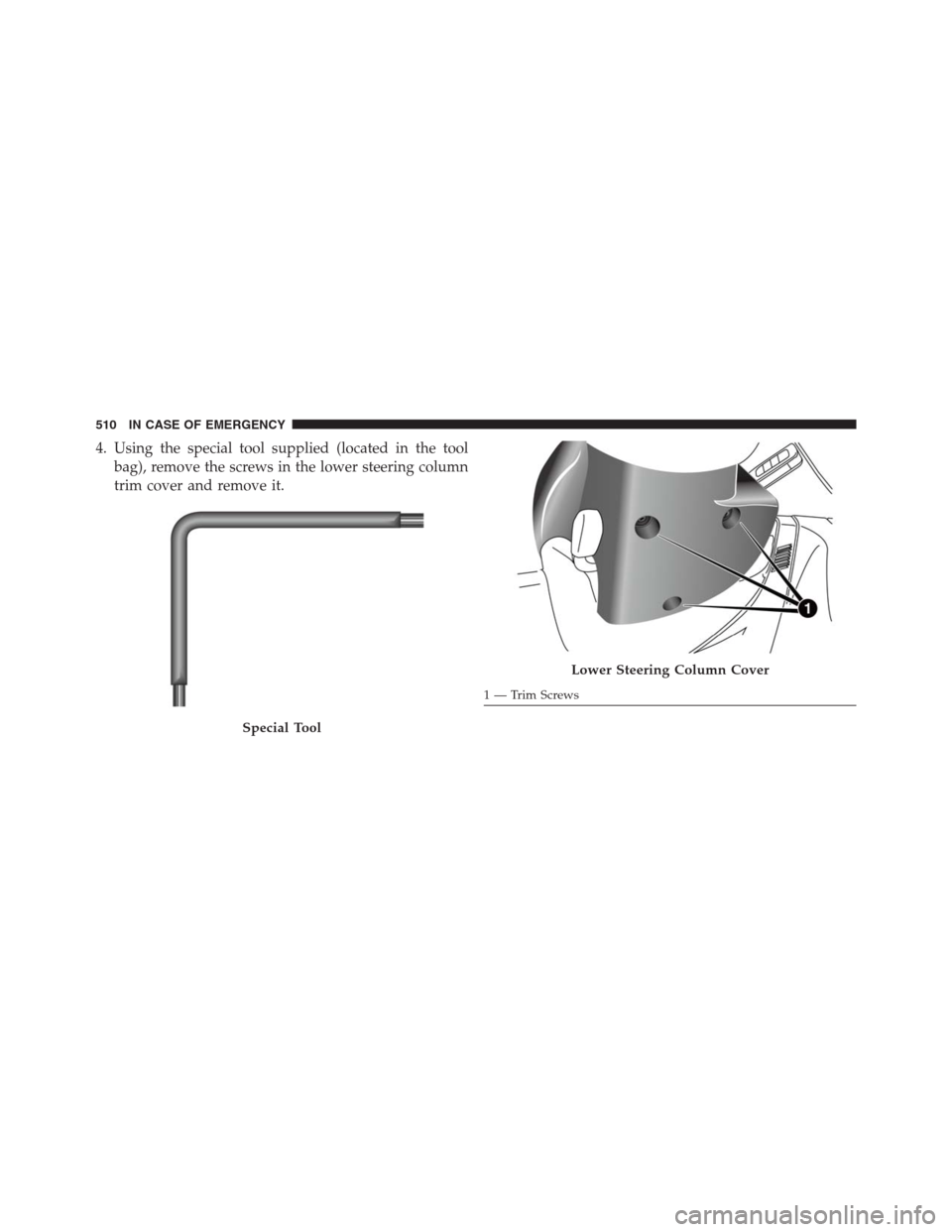
4. Using the special tool supplied (located in the tool
bag), remove the screws in the lower steering column
trim cover and remove it.
Special Tool
Lower Steering Column Cover
1 — Trim Screws 510 IN CASE OF EMERGENCY